
MALAGA, SPAIN: ROAD-TRIP
Dates: 29.03.2022 – 09.04.2022
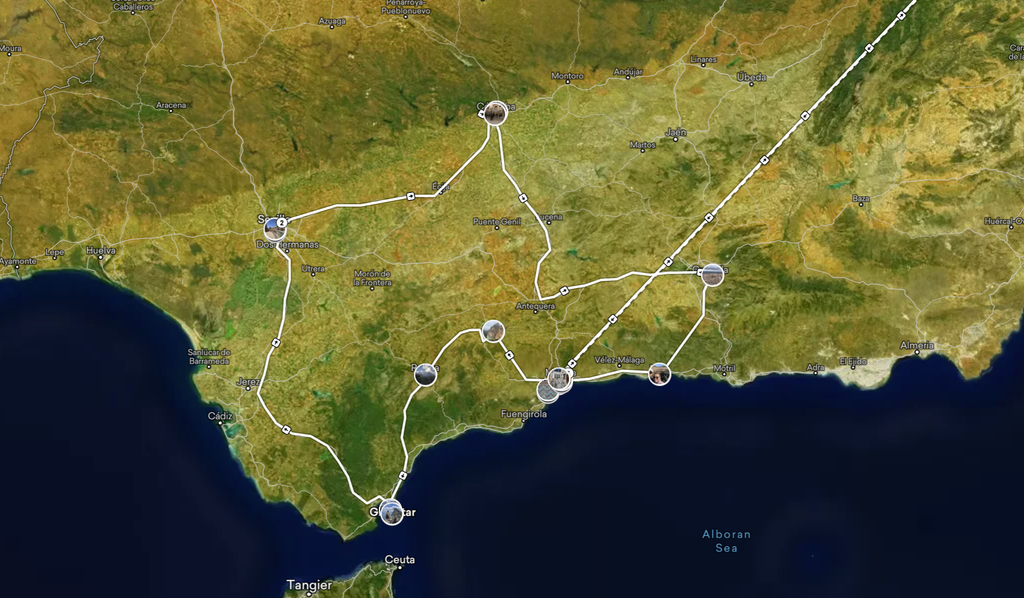
RIX – AGP
29.03.2022: Over the last two years we’ve already got used to unstable travel conditions, and this trip is no exception. Just over a week before departure, Madara finally gave in and caught Covid.
Luckily, everything went smoothly and she only had mild symptoms. We isolated in separate rooms so I wouldn’t catch it too, because I no longer had enough time to recover – at least not legally, according to the epidemiological rules.
Of course, “isolating” while living in the same apartment is a rather relative concept. The day before departure, Madara has no idea what kind of weather she should pack for. The forecast isn’t great and, as usual, we’re travelling with hand luggage only to keep things mobile and flight costs low.
The trip is also reasonably long – ten days – so the packing process gets slightly stressful and ends with us sleeping barely four hours. The flight is early – 06:45 – but at least we’ll have the whole day at the destination. We’re off for almost two weeks around Andalusia in southern Spain!
Starting and finishing point – Málaga, one of the southernmost major cities in Europe.
MÁLAGA: PLAZA SAN PABLO
29.03.2022: After the early flight, by lunchtime we’re already running slightly low on power.
Breakfast in Málaga Old Town turns out surprisingly profitable – the waiter gives us €45 change from a €50 note for an €18 bill. We leave him €2 as a tip for the excellent service and continue on our way. ☺️ To avoid walking around with our bags for too long, I ask whether we can check in earlier. Yes, we can.
Our apartment is less than a 15-minute walk from the Old Town. We head towards Plaza San Pablo, which is right next to where we’re staying. The apartment is located on one of those narrow, colourful streets that feel very Spanish. The place itself is minimal, but everything we need is there. From the window we can see the tower of San Pablo Church. So far, so good.
The tower visible from our room is the highest point of the church and reaches around 50 metres. The church has been standing here since the 17th century, although it has been significantly rebuilt several times.



MÁLAGA: LA MANQUITA
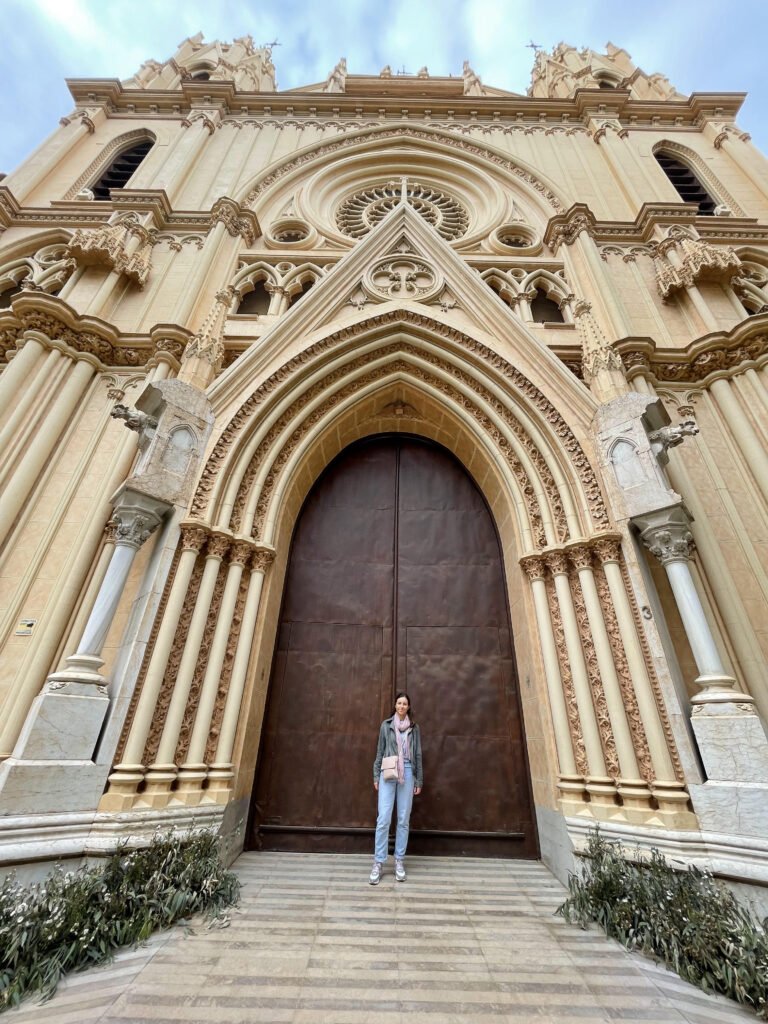
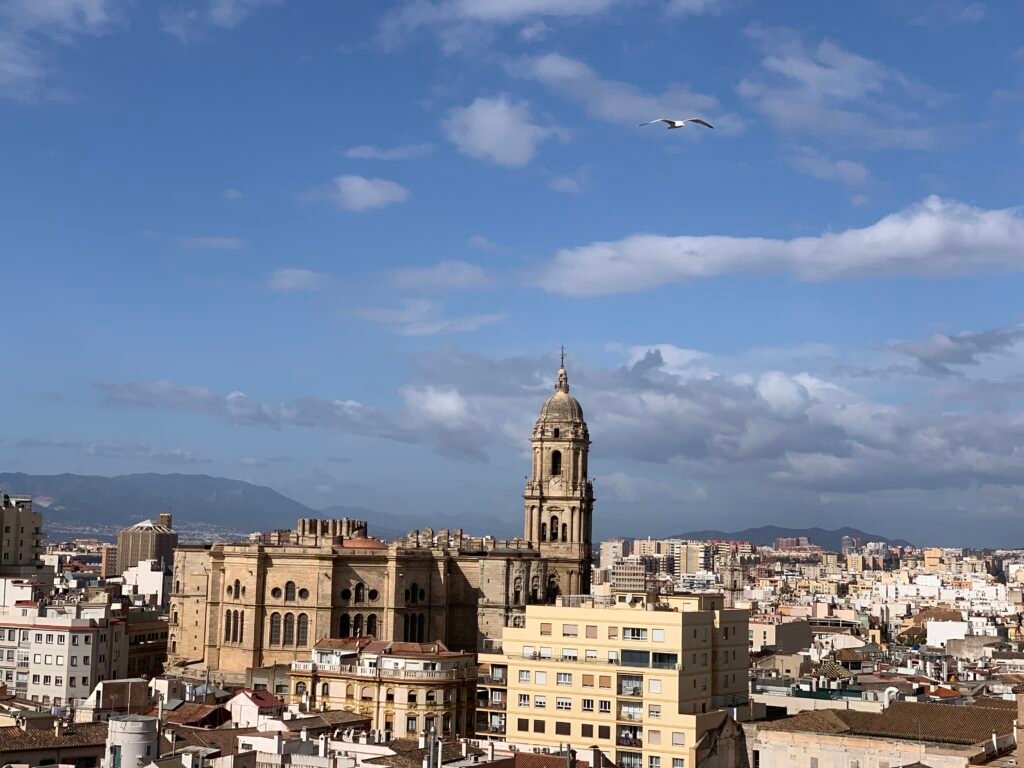
29.03.2022: After a very necessary power nap, we head back out. While resting, I put together a rough plan for where we’ll go today. The main stop is Málaga Cathedral – Catedral de la Encarnación de Málaga. For €10 per person, we can enter the cathedral itself and climb around 200 steps up to the roof of Andalusia’s second-highest cathedral. Like many historic churches of this scale, Málaga Cathedral is absolutely massive. Construction began in 1528 and technically still hasn’t been completed. That’s also where its nickname La Manquita – “The One-Armed Lady” – comes from. One of the planned towers was never built.
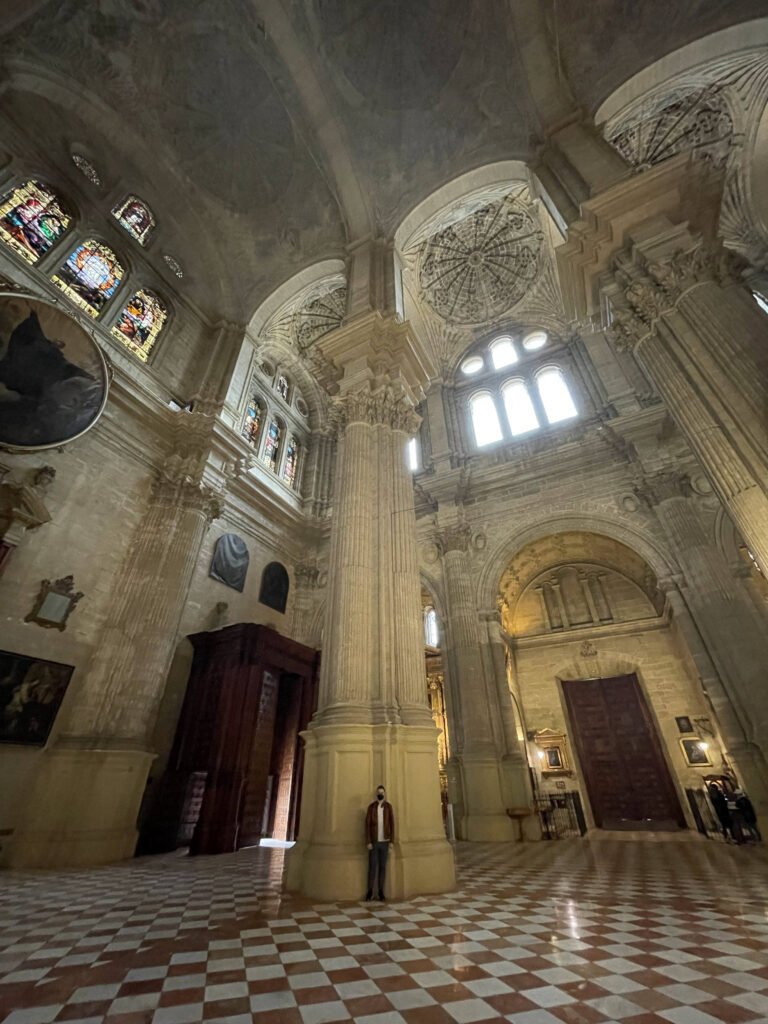
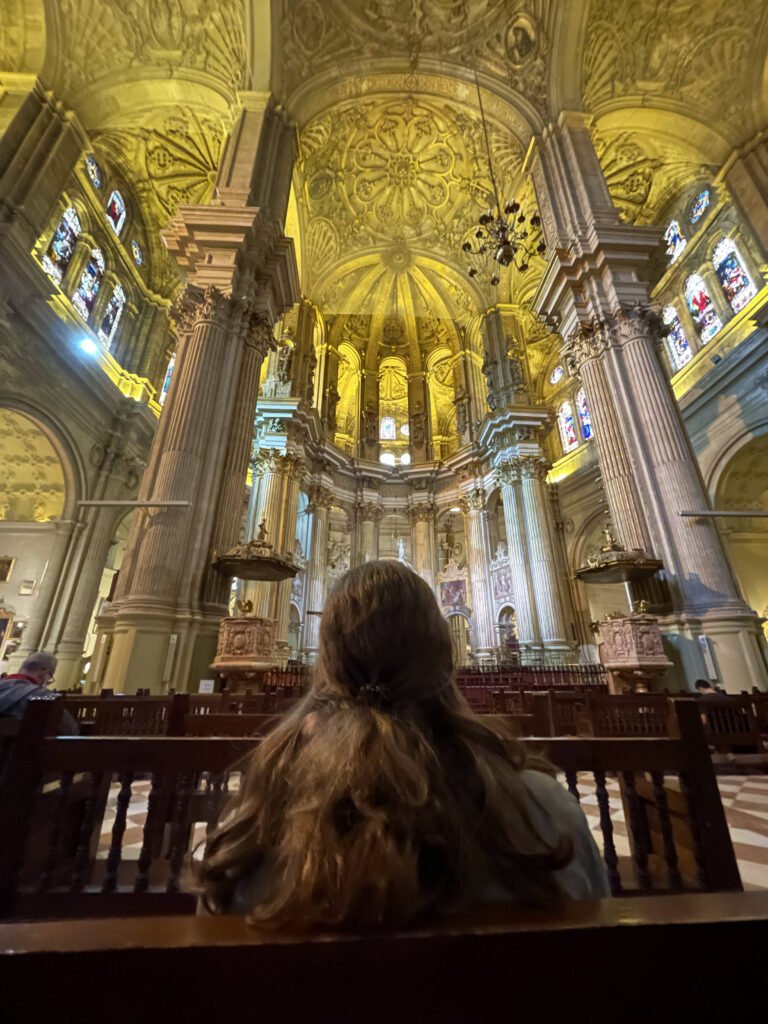
There have been several attempts to complete the original design, but opposition from locals and the municipality has stopped it. Like many giant Andalusian cathedrals, the building is a complete mix of styles. The interior is Renaissance, the exterior Baroque and the altar Gothic.
Columns at least two metres in diameter and probably 30 metres high. Irrational, impractical, inefficient – and absolutely magnificent. At the Roman Theatre – El Teatro Romano – we’re greeted by at least four male cats. There may well be a few more hiding somewhere. The theatre itself somehow doesn’t make as much of an impression as expected. Maybe tiredness and hunger are starting to take over, so right now the main priority is solving the stomach problem. Still, it’s worth mentioning that this is Málaga’s oldest monument, dating back to the 1st century BC. For a late lunch or early dinner, we end up at Lounge Bar Plaza on a nicely developed promenade out on the peninsula. On one side is the famous Malagueta Beach, on the other the tourist part of the harbour. Madara sticks with a safe choice – Margherita pizza. I go for seafood paella. Both happy.
Earlier in the day, we walk along the main street – Calle Marqués de Larios. There are decorative arches above the street that will probably be illuminated for Easter. Not today though, despite us hoping they might turn them on after dark. By the way, Calle Larios is considered one of the most elegant streets in Spain and, unsurprisingly, commercial rent here is also among the most expensive in the country.




MÁLAGA: ALCAZABA
30.03.2022: Today we’re heading straight to the main target of the day – Alcazaba.
Okay, not quite straight. We make a small detour through Mercado de Atarazanas.
Paradise for olive lovers. Big ones, small ones, green, black, stuffed, empty – whatever you want.
We limit ourselves to freshly squeezed juices. Mango and orange for me, plain orange for Madara. €2.50 each.
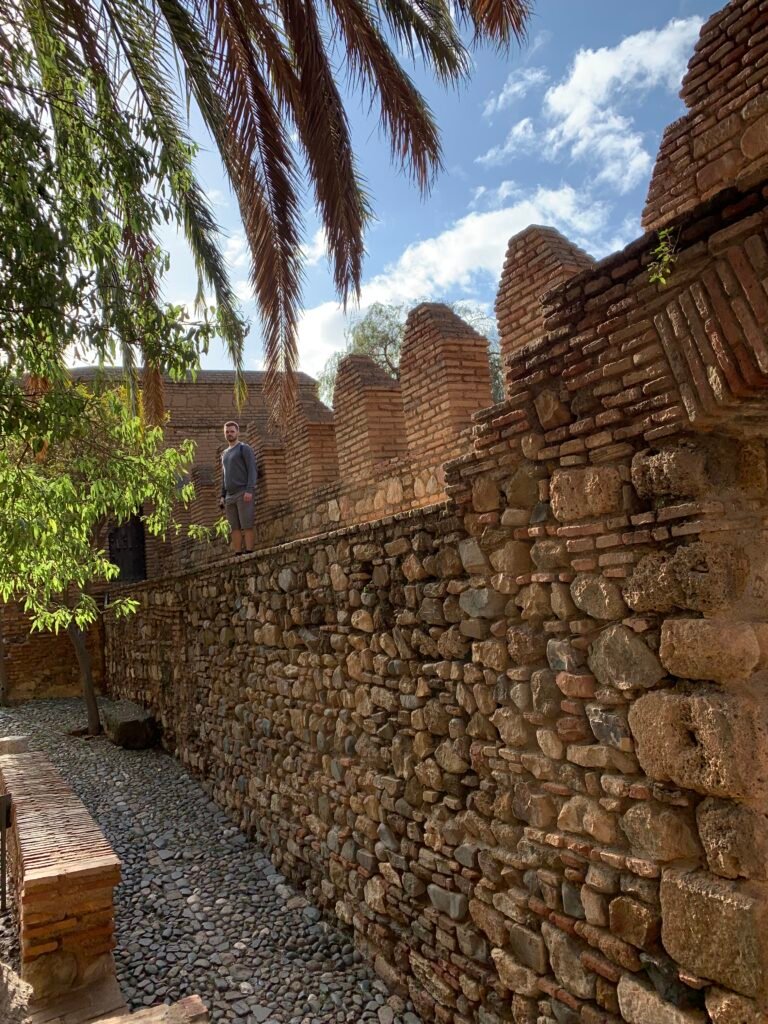
We successfully find tickets for Alcazaba – literally meaning “citadel” – and head inside.
This is one of Málaga’s two fortresses. It’s the lower of the two, but still offers great panoramic views over Málaga harbour and the Old Town. Alcazaba is considered the best-preserved Moorish fortress in Spain with double defensive walls – an outer and inner citadel. One thing I find particularly interesting is the rainwater drainage. You can clearly see how water runs from the very top through small grooves built into the paving without flooding the narrow labyrinth-like passages. And this was built almost a thousand years ago! The citadel dates from 1057–1063.
After around 1.5 hours of walking, we need a little break before heading to the second fortress.
We stop for coffee next to the Roman Theatre at a restaurant with a pretty great name – El Pimpi.
The coffee is strong, good and very reasonably priced considering the location – €1.80. While resting, I do a bit of historical Googling and discover that materials from the Roman Theatre were reused in the construction of Alcazaba. It’s also believed the fortress was built on top of the foundations of an earlier Roman structure.




MÁLAGA: GIBRALFARO
30.03.2022: To reach the second fortress – Gibralfaro – we need to climb up a proper 130-metre hill. The trail is well maintained and easy enough, but it still takes around 30 minutes. The higher we go, the wider the panorama gets, until eventually we can see right into Málaga’s famous bullring – La Malagueta. I have a feeling a large percentage of Málaga postcards are photographed from somewhere along this path.
Once at the top, we realise that the fortress itself isn’t quite as interesting as Alcazaba. But as mentioned before – it’s higher, so you can see further. Logical. The 14th-century fortress was originally built as a military structure and, interestingly, stayed in military use until 1925. At its peak, it was considered one of the hardest fortresses to conquer on the Iberian Peninsula.
It has two defensive wall lines and eight towers. The walls zigzag down the hillside and connect to Alcazaba below. Once we make it to the top, we settle into a little bar surrounded by the fortress walls. La Terrazita.
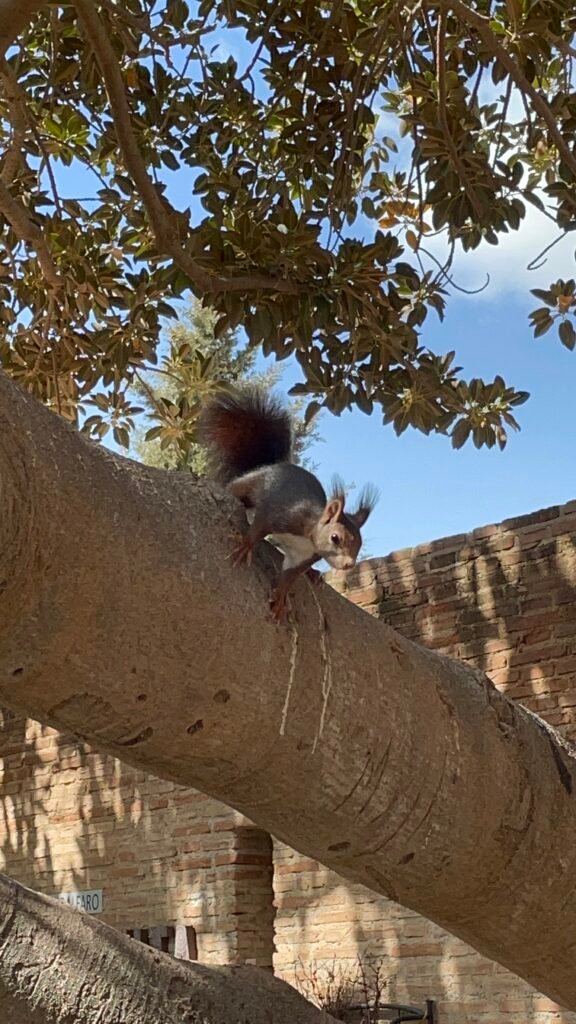
For €10 we get a 0.5L Málaga beer, a very generous glass of wine and a bottle of water. For such a touristy location, that’s excellent. They definitely don’t hold back on the wine. The guy in front of me gets his glass filled almost to the very top. The waitress realises there’s still a tiny splash left in the bottle and pours that in too. The poor guy has to drink directly from the glass while it’s still sitting on the bar because otherwise there’s no way he can carry it. As we’re preparing to leave, a little squirrel friend appears. Instant celebrity. Everyone starts taking photos. The animal has absolutely no fear of people. Clearly not its first day on the job.
MÁLAGA: PLAYA DE SAN ANDRÉS
30.03.2022: Almost five hours spent wandering through fortresses. Now we need to figure out who we are and what we’re doing. At 19:00 we have to collect our rental car from the train station. That leaves us almost four hours. We can’t decide whether to go home and rest or keep wandering through the streets. We choose walking. Eventually we end up at Playa de San Andrés.
On the way there, tiredness starts to kick in and we collapse onto the black sand. I even manage to fall asleep for a few minutes. Finally got my power nap.
While I’m snoring, my ears and hair slowly fill with black beach sand. For a city that supposedly gets around 16 million tourists per year – presumably pre-Covid numbers – and around 300 sunny days annually, the beaches feel strangely dark and gloomy. Maybe we’re just spoiled by Latvia’s soft, flour-like sand. Before heading to Avis, we refuel ourselves at Taco Bell with quesadillas. Then it’s finally time to collect our little horse – a Fiat 500 Hybrid.
CAMINITO DEL REY
31.03.2022: The drive from Málaga takes around an hour, but since the whole logistics of where, when and how isn’t completely clear, we leave early. The trail is very popular, so you need to book a specific entry time in advance. Our start is scheduled for 10:00. We leave a little before eight because we also need to take into account the tiny-car factor and the serpentines.
The little Fiat handles everything surprisingly well. We manage to park right next to the entrance because we’re among the first groups going in today. On the way back later, the roadside is packed with cars. Arriving later would probably turn parking into a separate stress-inducing problem. The trail was originally built in 1905 so workers could move between the Chorro Falls dam and the Gaitanejo hydroelectric facility and transport materials.
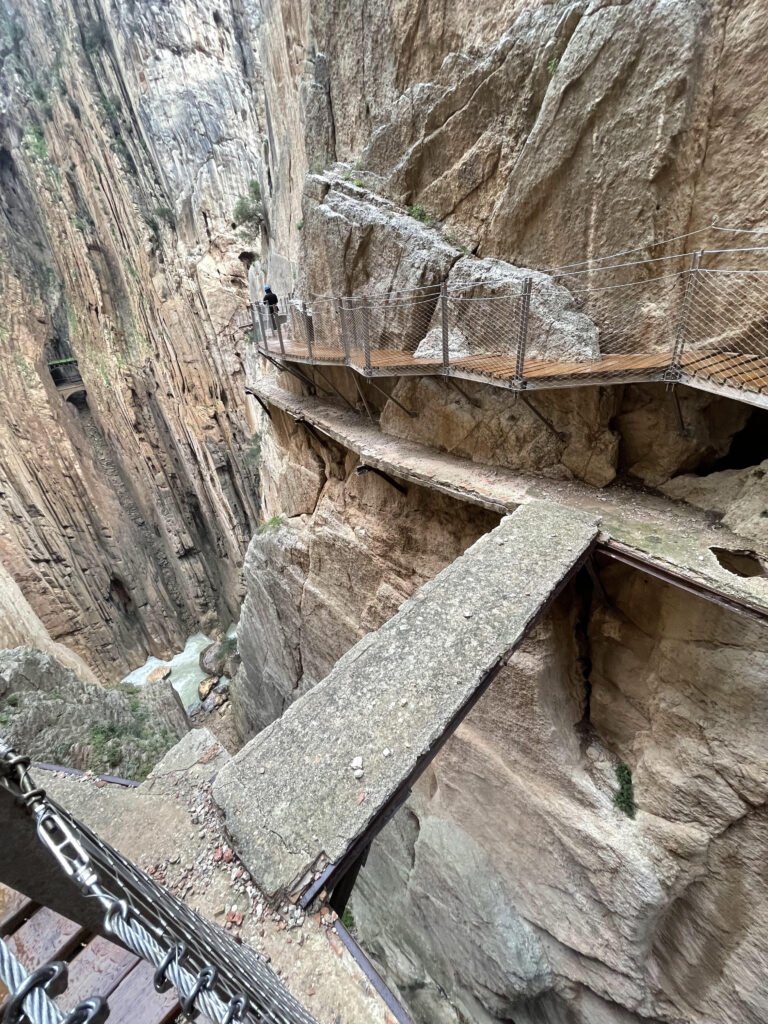
Caminito del Rey translates as “The King’s Little Path”, named after King Alfonso. It used to be considered one of the most dangerous trails in the world. Between 1999 and 2000 alone, five people died here. The route was then closed until 2015. During that time, it was extensively rebuilt to make it safe for visitors. Since reopening, around 300,000 people a year come to walk it. The hike starts with a tunnel through the rock. From there, it’s around 1.5 km along a gravel path to the official entrance where helmets are handed out.
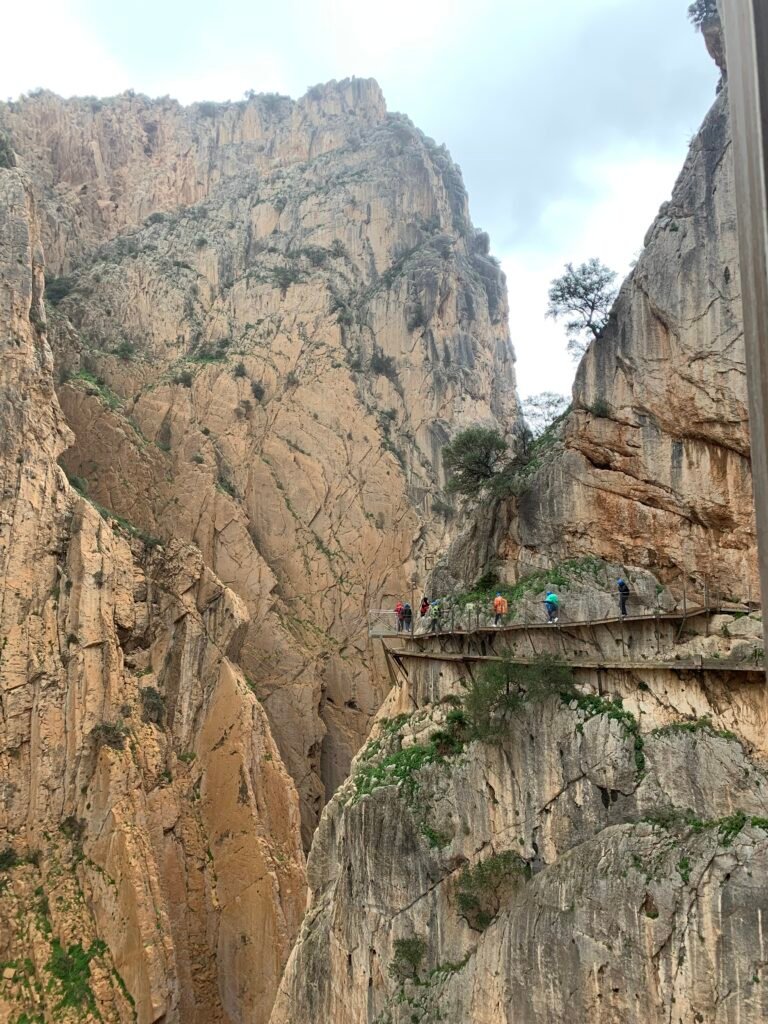
We arrive early and are allowed in around 40 minutes before our actual ticket time. The trail runs along wooden walkways attached directly to the cliffs between two enormous rock walls. Jaw-dropping. The cliffs rise massively above us, while the drop below is equally impressive.
The walkways are around 100 metres above the Guadalhorce River. Every now and then you can still see the remains of the old path that gave Caminito del Rey its reputation as one of the world’s most dangerous hikes. Looking at it, you really don’t need to ask why. There are plenty of people, but it never feels crowded. Probably because everyone spreads out along the roughly 5 km route looking for the perfect photo spot. And there are more photo spots than you could possibly count. Across the gorge, there’s even a tunnel carved into the opposite cliff where trains still run. We manage to see one passing through. The route is one-way. At the finish, a bus takes us back to the starting point for €3.10. A morning full of impressions! Next stop – Ronda.





RONDA
31.03.2022: On the way to Ronda, the rain starts coming down quite heavily. Good thing that cloud didn’t arrive while we were on Caminito del Rey. That would have been miserable.
After around an hour of driving, we reach Ronda. It’s a relatively small town with around 35,000 residents.
After several attempts at squeezing through miniature streets looking for parking, we finally give up and leave the car quite a distance from our accommodation. At least there’s actually a space.
At the apartment, we’re greeted by a Spanish gentleman who also speaks good English. He lets us into our three-storey accommodation – Casa Duende del Tajo – which costs €60 for the night.
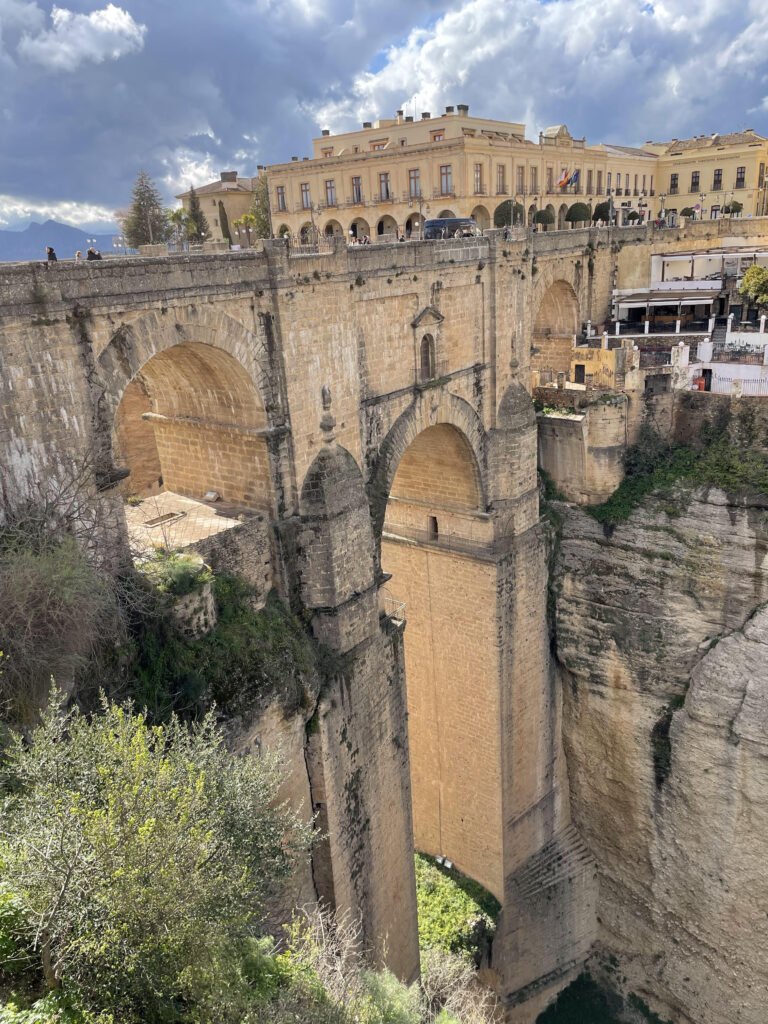
Worth mentioning: the third floor is a terrace overlooking Ronda’s main attraction – Puente Nuevo.
If you ever stay in Ronda, I definitely recommend this place just for the terrace alone. We have a short drink on the terrace and then head out. The main attraction is, of course, Puente Nuevo, connecting the two halves of the city across the Guadalevín River in the 120-metre-deep El Tajo gorge. This is the newest of three bridges serving the same purpose. The 66-metre-long bridge has a pretty eventful history. The first version was built in 1735 as a single-span bridge, but poor and rushed construction caused it to collapse in 1741, killing 50 people. The second version was completed in 1793 with three spans and has been doing its job successfully ever since. Most likely it’ll continue doing so for another few hundred years.
We walk along the small streets and Paseo de los Ingleses on the northern side of town. The strong wind quickly encourages us to change direction. Quick selfies, a few photos and back the other way. The weather is surprisingly cold for Andalusia, even if it is still the end of March.
After crossing the bridge and walking slightly outside the centre, the old city walls remind me a little of Levoča in Slovakia, where we visited three years ago. The walls are huge, impressive and extremely old, yet somehow mostly ignored by tourists. There’s almost nobody here. Most visitors take their pretty bridge photos and leave. That might also explain why accommodation with such a great view can still be found for such a pleasant price.
We also walk to Plaza de Toros de Ronda, which turns out to be the oldest bullring in Spain.
Built in 1785. Our inner cheapskate wins again though, so we skip going inside because of the entrance fee. For dinner, we head to Puerta Grande, which Google Maps research tells us is one of the highest-rated restaurants in town. Definitely doesn’t disappoint. As soon as your wine glass starts getting low, someone appears to refill it. As soon as a plate is empty, it disappears and a clean one arrives. We share a mixed seafood paella. Excellent! Three different types of prawns and rice with several completely unidentified but very tasty ingredients. Perfect amount for two people. The whole thing costs us €50. Considering the location and amount of food, that feels completely reasonable.




GIBRALTAR NATIONAL PARK
01.04.2022: Next, our route takes us to a British Overseas Territory at the southern tip of Spain – Gibraltar. We’re staying on the Spanish side because it’s significantly cheaper. No problem at all.
We leave the car by the hotel and around 20 minutes later we’ve walked across the border.
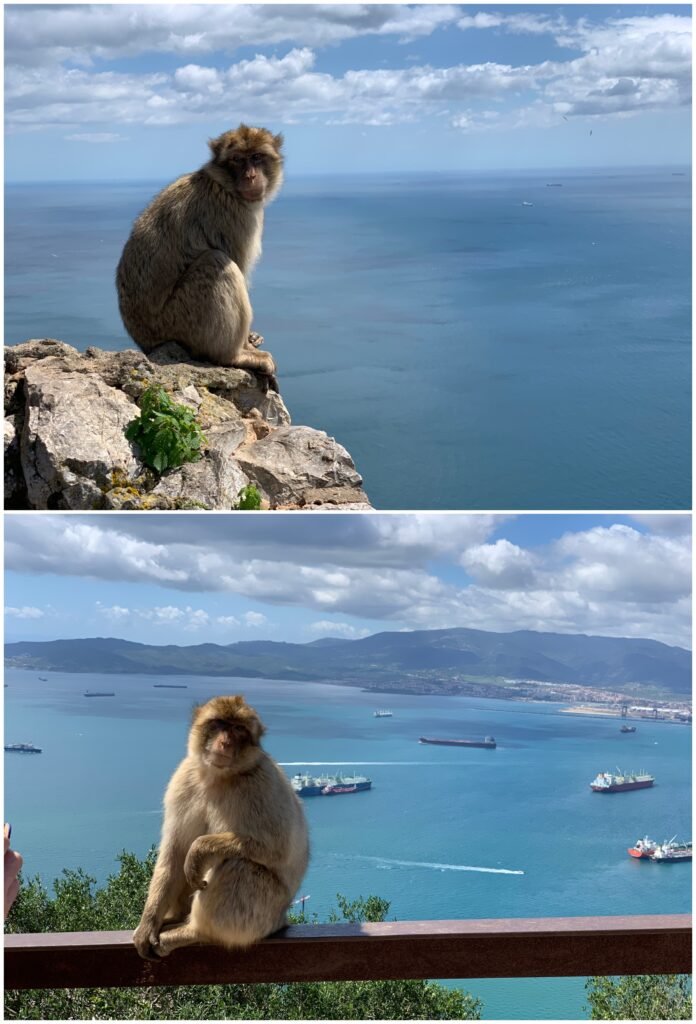
Interestingly, the border is basically right next to the airport runway. The main mission today is the Big Rock – Gibraltar Nature Reserve. Tickets are quite expensive, but there’s absolutely no question about going up. We need to find the monkeys – Barbary macaques! 🐒 Entry plus the cable car costs €84 for both of us. You can save a little money by hiking up, but that takes extra time that we don’t really have and energy that we’d prefer to save.
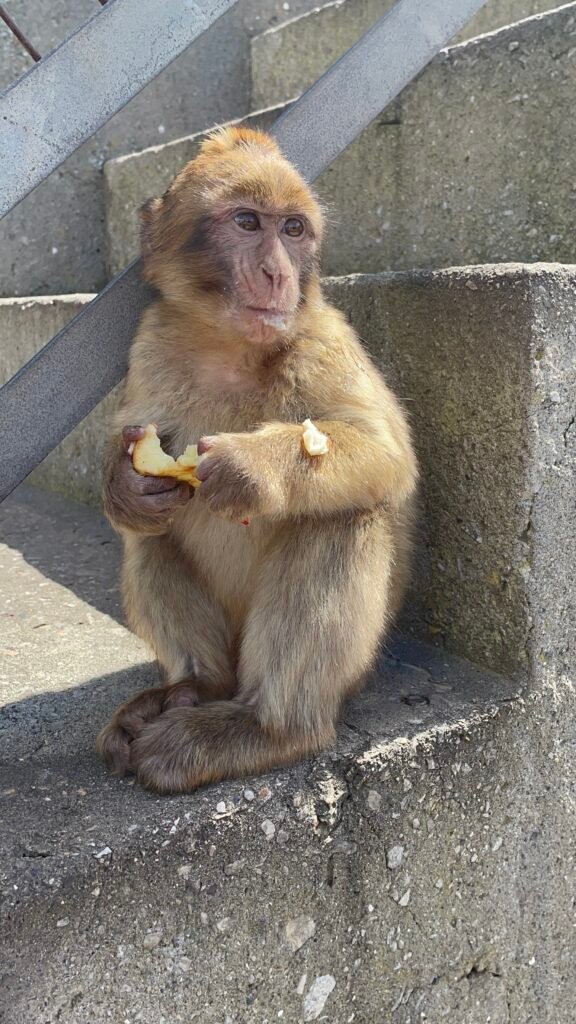
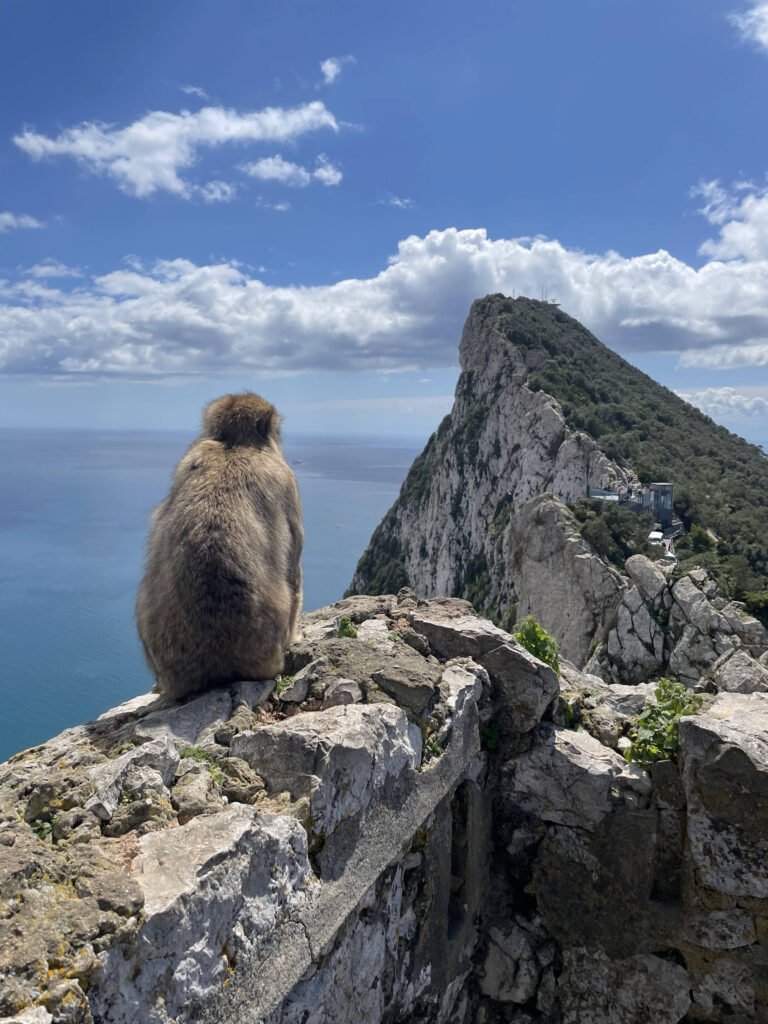
A few minutes later, we’re standing on top of the 426-metre-high Rock of Gibraltar. The wind is pretty strong in places, but overall it’s warm. It only takes a few minutes before we meet our first monkey friends. Big ones, small ones. Most are very sociable and relaxed. The smarter ones immediately show particular interest in tourists carrying bags. One jumps onto my shoulders.
I’m happily taking selfies while a girl runs up behind me and warns that the furry criminal is already opening my backpack. Turns out the couple who warned me are Latvian too!
There’s a saying that the British will remain in Gibraltar as long as the macaques remain here. The story goes that during the Great Siege of Gibraltar between 1779 and 1783, the monkeys started screaming and going crazy, warning of approaching Spanish and French troops. So when the local macaque population later came under threat, Churchill supposedly ordered more to be brought in from Morocco to increase their numbers. Interestingly, during wartime the monkeys were also taken very seriously. If one was injured, it could be taken to the Royal Gibraltar Hospital, where it reportedly received almost the same standard of care as soldiers. Eventually we realise that if we want to see anything besides monkeys, we need to keep moving. The next stop is the Skywalk.
In reality, it’s a slightly dirty glass platform that doesn’t add much to the already excellent views.
The most memorable thing there is a stupid British tourist feeding gummy sweets to the monkeys. Slowly continuing along and occasionally meeting another furry local, we reach O’Hara’s Battery with its enormous artillery gun. Tourists can also visit a small section of the wartime tunnels carved inside the Rock, where large numbers of soldiers once lived for extended periods. Apparently there are around 50 km of tunnels inside the Rock. Impressive. From the gun platform, we can also see Africa, only around 20 km away. We’re lucky today. The weather is clear and visibility is good.
At the next attraction – St. Michael’s Cave – we discover there’s also a café and toilets. Perfect.
Time to empty ourselves and refuel before continuing. Since Gibraltar isn’t in the EU and there’s Wi-Fi here, we briefly reconnect with the outside world as well. I’d seen photos of St. Michael’s Cave, but in real life I didn’t expect the stalactites to be this impressive. There’s also subtle background music and the cave formations are occasionally illuminated in different colours.
Very impressive. Every seven minutes there’s also a light show inside the largest chamber.
The chamber now contains seating for around 400 people and is used for small performances.
Originally, it was prepared during World War II as an emergency hospital. It was never actually used as one.
Next, we continue towards Windsor Suspension Bridge, which crosses a gorge and leads further towards Apes’ Den. Here we meet one of Gibraltar’s oldest female macaques – apparently around 26 years old. We chat with a park employee who tells us a little about the animals. Apparently this old lady is basically the boss of the local group. There are around 300 macaques on Gibraltar, divided into 11 groups. Eventually we realise there isn’t much time left before the final cable car down. Time to increase the pace. We make it successfully and on time. Right next to the cable car, one monkey manages to rob me. Very professionally. He pulls an empty snack wrapper straight out of my pocket so smoothly that I barely notice. Eventually we negotiate a deal:
one nut in exchange for the wrapper. Nature saved.





GIBRALTAR
01.04.2022: Filled with macaque inspiration, we take almost the final cable car back down.
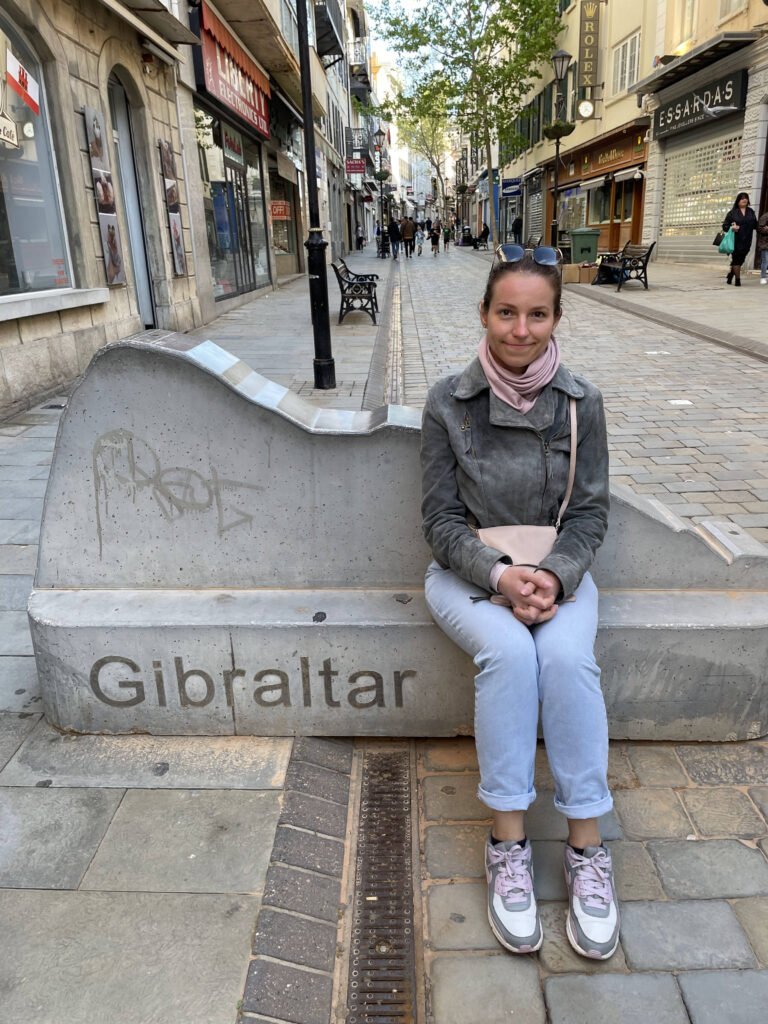
Six hours disappear ridiculously quickly. To properly explore the whole Rock, you really need to go up first thing in the morning. Or even hike up earlier. We leave with a slight feeling that we didn’t get enough. Which only confirms how impressive the place is. In this tiny territory, which the British Empire took control of in 1704, it’s immediately obvious who is British – or Gibraltarian – and who is Spanish. We walk along the main nightlife and shopping street, appropriately called Main Street. Ahead of us are two slightly round British ladies in shorts and flip-flops. Walking towards them is a Spanish woman wearing boots and a winter coat. It’s around 17–18°C outside.
Gibraltar itself is only 6.8 km², yet around 35,000 people somehow manage to live here. That makes it one of the most densely populated territories in the world. In reality, it could probably rank even higher, because at least two-thirds of the territory is taken up by the Rock, where the macaques live rather than the British. On the streets there are funny red cylindrical Royal Mail post boxes. They remind me of an episode of Mr Bean. We consider continuing the tradition we started in the Vatican and sending Grandma another postcard. Unfortunately, we’re too late.
The post office is already closed. We’ll try from another Spanish city instead.
There are also plenty of the classic red telephone boxes we’ve seen so many times on TV.
Naturally, Madara gets a mini photoshoot in one. You can also spot the locals – Gibraltarians – pretty easily. Looks British, dresses Spanish, pays in British money. On the walk back to the hotel, we hope to catch a plane landing on Gibraltar’s interesting runway, which doubles as a road whenever the flight schedule allows it. No luck this time.
In any case, after just one day here we leave with very interesting feelings – in a good way. The atmosphere is completely different from neighbouring Spain. Definitely somewhere I’d like to return to. Have a beer in a British pub and give another nut to a macaque. Sending that thought into the universe!



SEVILLE: SETAS DE SEVILLA
02.04.2022: It’s around a two-hour drive from La Línea on the Gibraltar border to Seville, one of Spain’s largest cities. First, we check into our relatively central hotel – Hesperia Sevilla.
Supposedly a four-star hotel for €110 per night. Since our original booking had to be replaced at the last moment, it was basically the cheapest reasonable option available. Still, the value-for-money feeling is pretty disappointing. A completely ordinary room without even a kettle.
Originally, we had booked a nice Airbnb apartment, but the owner cancelled two days before arrival. Our first stop is Plaza de España.
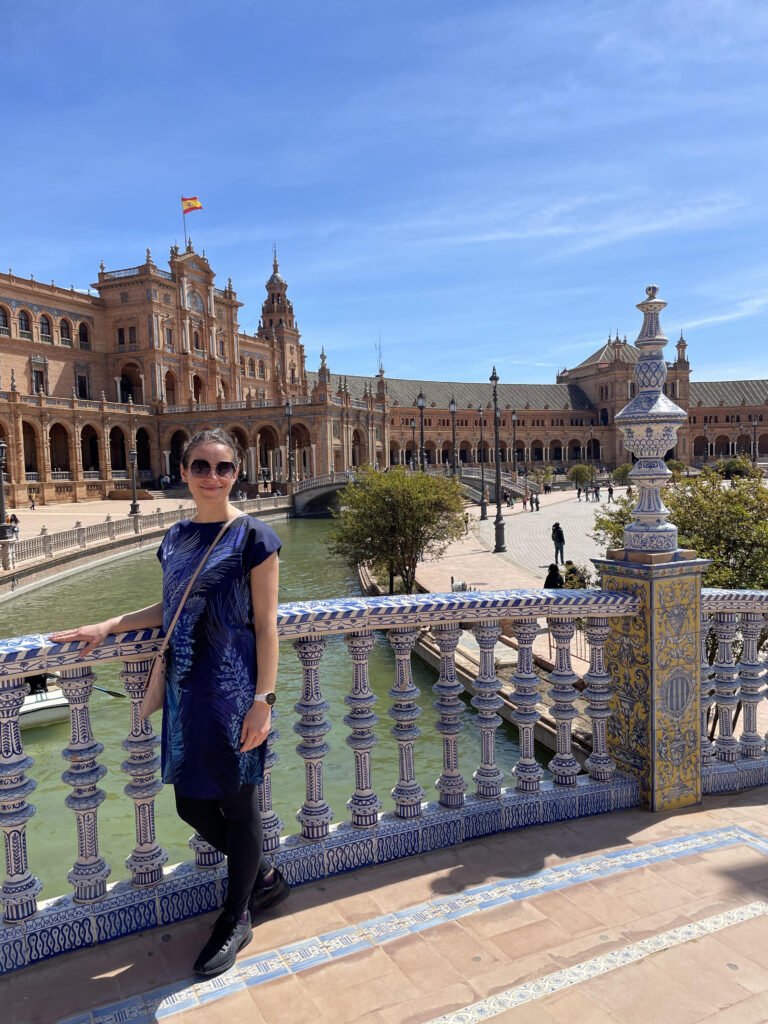
A huge semicircular square where each of Spain’s major cities has its own decorated section with a coat of arms and characteristic mosaic. Smaller cities only get the coat of arms. In the middle of the square is a Venice-style canal where you can rent little boats. Today is already day five of the trip. We’re pretty active walkers, so a certain amount of tiredness has started building up from all the kilometres and impressions. The plan today is supposedly to take things a little easier.
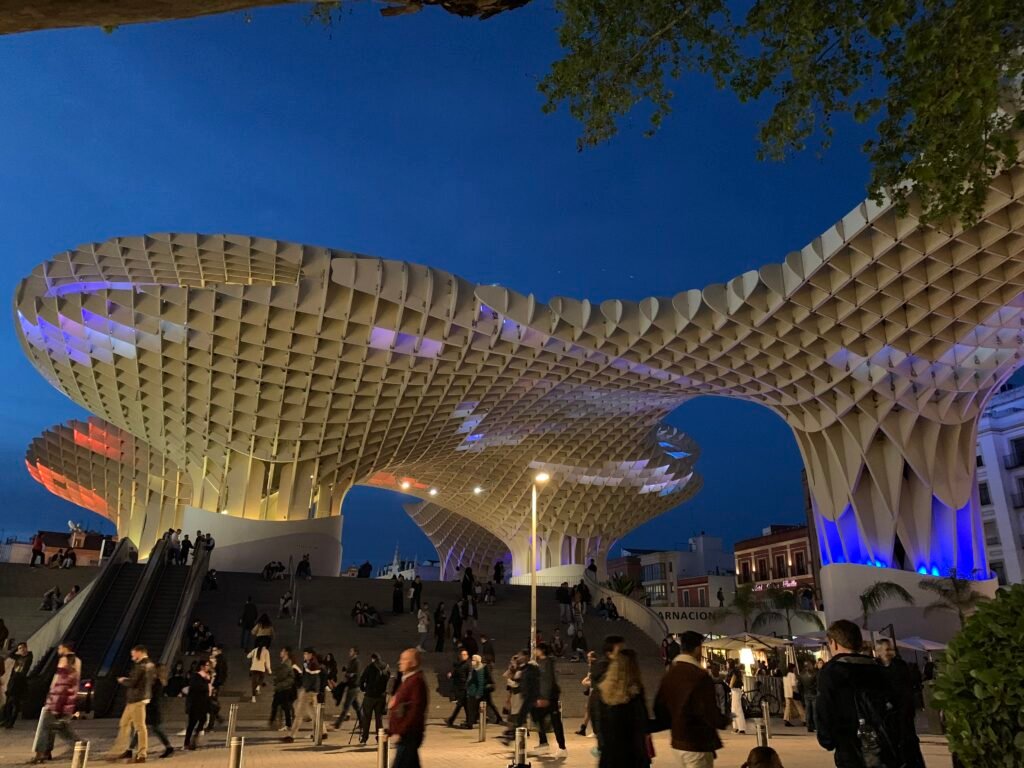
As usual, that doesn’t really happen. The main ticketed attraction today is Setas de Sevilla. For €10 we can go up what is supposedly the largest wooden structure in the world. The design is inspired by six mushrooms growing together. Construction ended up costing almost twice the original budget – around €100 million – so local residents apparently protested quite a lot about wasting so much money on something without much practical value. Still, this was basically the only building I knew in Seville before coming here. So saying it has absolutely no value would be unfair. After walking around the upper platform and watching a 15-minute film about Seville, we sit on the steps beneath the mushrooms with the locals. I manage to open a bottle of water in the most unsuccessful way possible. Turns out it’s actually lemonade.
It sprays all over the front of my trousers so badly that it looks like I didn’t make it to the toilet in time. On the way home, we accidentally run into a religious procession. It’s an annual event in Seville two weeks before Easter, marking the beginning of the Holy Week period. The streets are packed along both sides. In the middle, a large figure of Jesus is slowly carried through the city accompanied by brass instruments and drums. Ordinary people then join behind. Completely unplanned and unexpected. But visually and acoustically, very impressive.



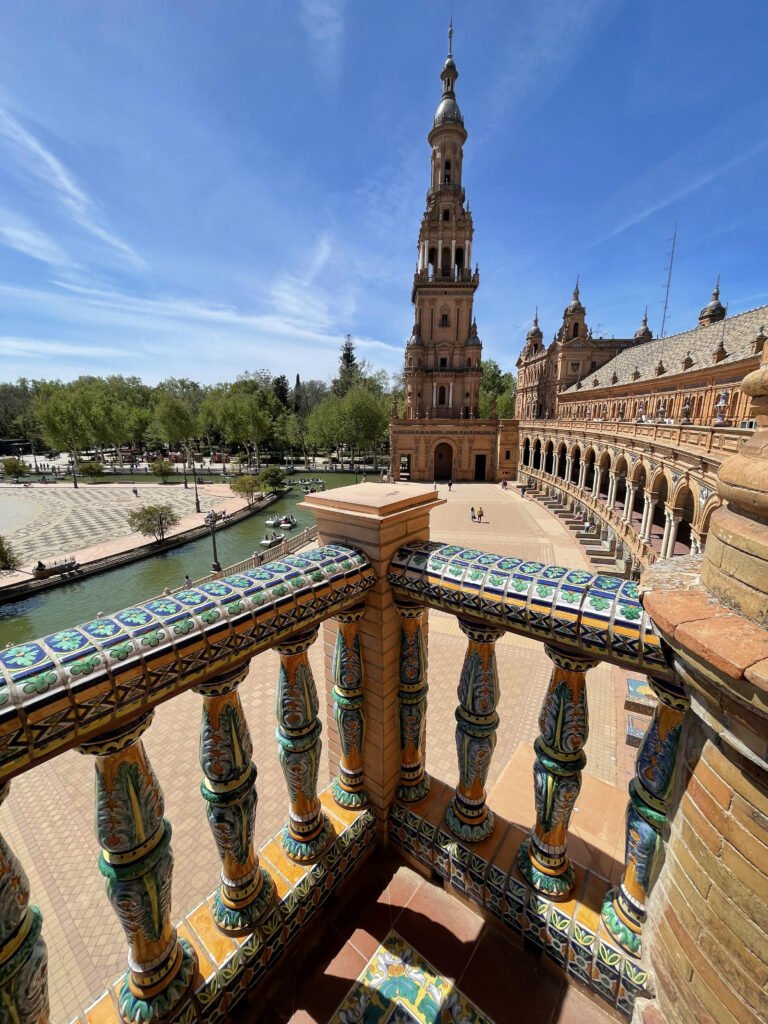


SEVILLE: ROYAL ALCÁZAR
03.04.2022: Out of three possible palaces – Royal Alcázar, Palacio de Pilatos and Palacio de las Dueñas – we choose the biggest and most expensive one. Royal Alcázar, next to Seville Cathedral.
Entry is €13.50 per person. Not great, not terrible. Apparently members of the Spanish royal family still stay here when visiting Seville. The palace has that familiar Arabic influence we’ve already seen in several places, but here it’s extremely ornate. Traditional blue-and-white tiles everywhere. And I mean everywhere. The courtyard gardens could easily be botanical gardens in their own right. We take a break with refreshing drinks in the garden café surrounded by peacocks casually wandering around. In total, we spend almost three hours here. Time goes surprisingly quickly. Later, we return to the little bar we found yesterday near the wooden mushrooms. Despite the touristy location, drinks are very reasonably priced. We order a bottle of wine for €8.50 but they bring us a Rioja that apparently costs €13.50. Arguing in Spanish doesn’t sound appealing. And it’s not like my 15-word vocabulary would allow much of an argument anyway. So we accept our fate.
The pleasant surprise comes when the bill still shows the cheaper bottle. Never mind that all these wines probably cost €2–4 in a supermarket. You still somehow feel like a winner.
Interestingly, the waitress even remembers Madara from yesterday. Slowly heading back towards the hotel, we stop at a tapas bar called Casa Manolo. Sitting by the window with a view of the pedestrian street, we snack on tapas and watch people slowly drift through their Sunday evening.
Although, to be fair, I’m starting to think Spaniards drift slowly regardless of the day or time.


CÓRDOBA: MOSQUE–CATHEDRAL
04.04.2022: Leaving Seville, the first problem to solve is fuel for the little car. 🚗 Without overthinking it, we pull into the first petrol station we see on the motorway. At Shell, I put in 25 litres and the tank is full. There was still a little fuel left, so I assume the Fiat holds around 30 litres. Pretty economical considering all the motorways and serpentines we’ve driven so far.
From Seville to Córdoba is around 140 km, almost all motorway. Cruise control on and wait until we arrive. At our accommodation, which is named after Los Angeles – the city we were supposed to visit before Covid cancelled our California trip – we wait for someone to show us the parking.
While waiting, we get a little local theatre performance.
The situation is this: a tiny courtyard with a fountain in the middle. By Latvian standards, maybe enough space for three cars. We’re already occupying one spot. A guy drives around us and takes another. Then a large pickup with a trailer enters. Then a Renault SUV. Then a delivery van starts reversing in. The van driver is unhappy because yet another car tries to enter at the same time.
Important detail: nobody has left the courtyard during this entire process. Eventually our hotel representative arrives and shows us our garage. Naturally, it’s diagonally on the opposite side of the courtyard from where we are. All the Spaniards shout something at each other and within a few minutes somehow create a narrow tunnel between the cars so we can reach the gate. The garage entrance itself is maybe 10 cm wider than our Fiat 500 with the mirrors folded in. What do people with normal-sized cars do here? Our room is simple and small – absolute minimum requirements. We don’t need much, but a kettle and fridge would be useful.
Interestingly, the bathroom is bigger than the actual room. Put something flat across the bidet and we could almost turn it into a dining table. We’re tired again today, so before going out I take a short nap. Good decision. The Old Town streets are genuinely tiny. Even though Córdoba has around 350,000 residents, the centre feels almost rural and authentic. Not polished specifically for tourists. Sheets and underwear hanging from windows, old ladies carrying random bags around. Completely different feeling after Seville.
Probably partly because the main tourist season is only just starting. And there’s still Covid.
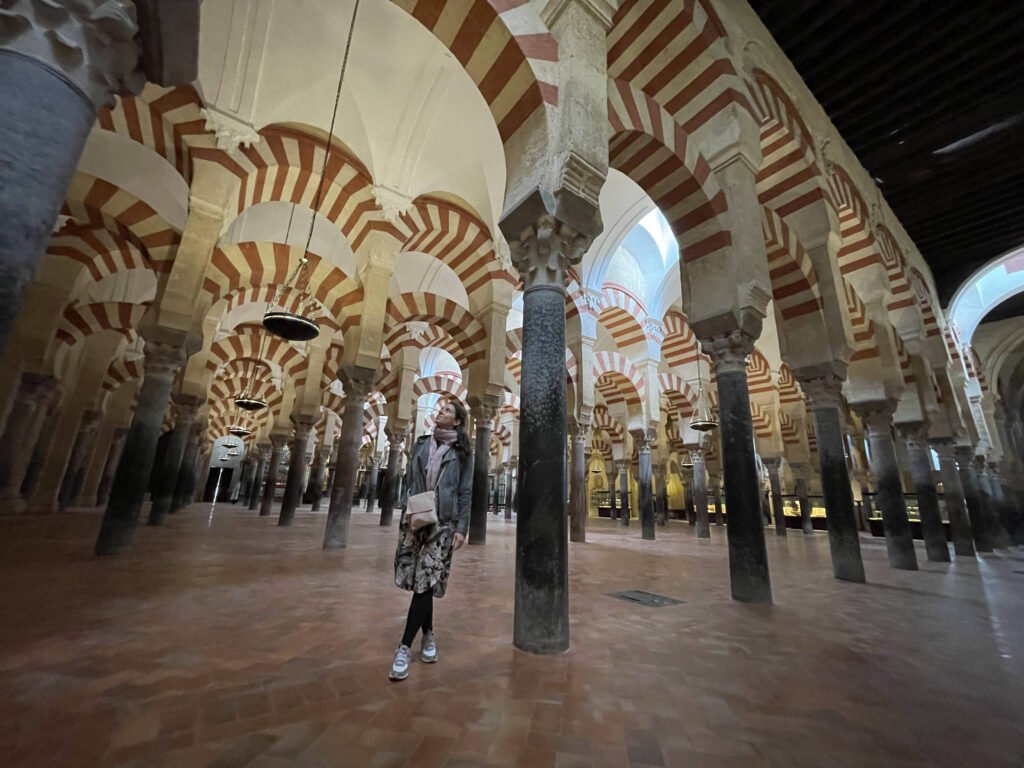
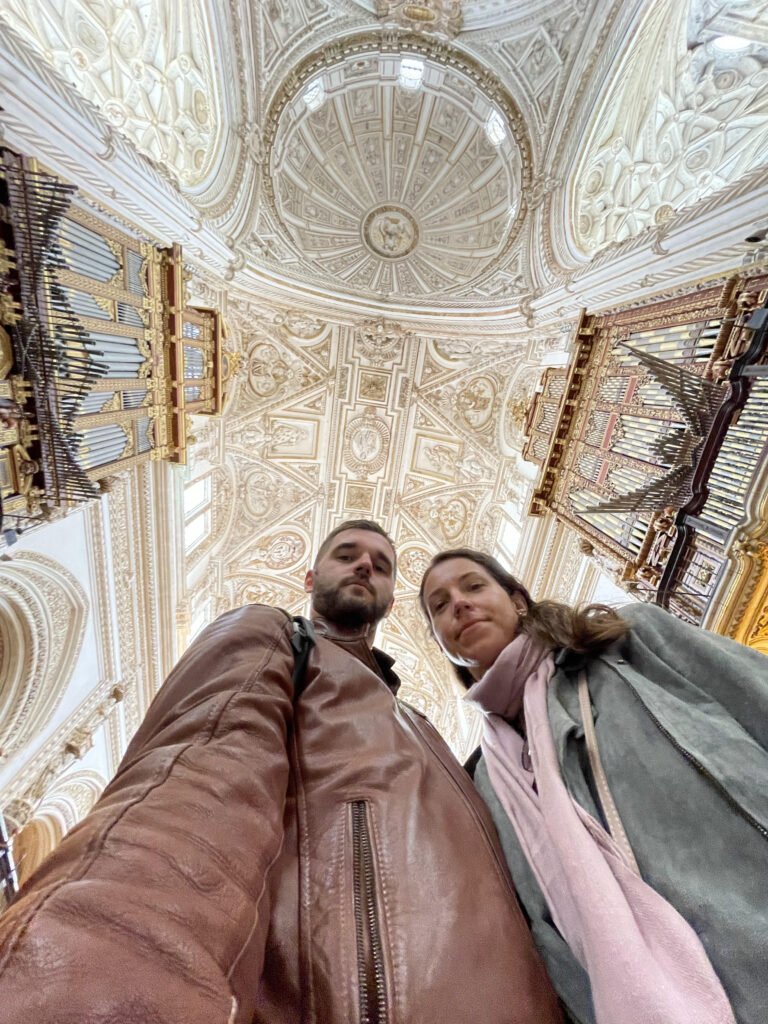
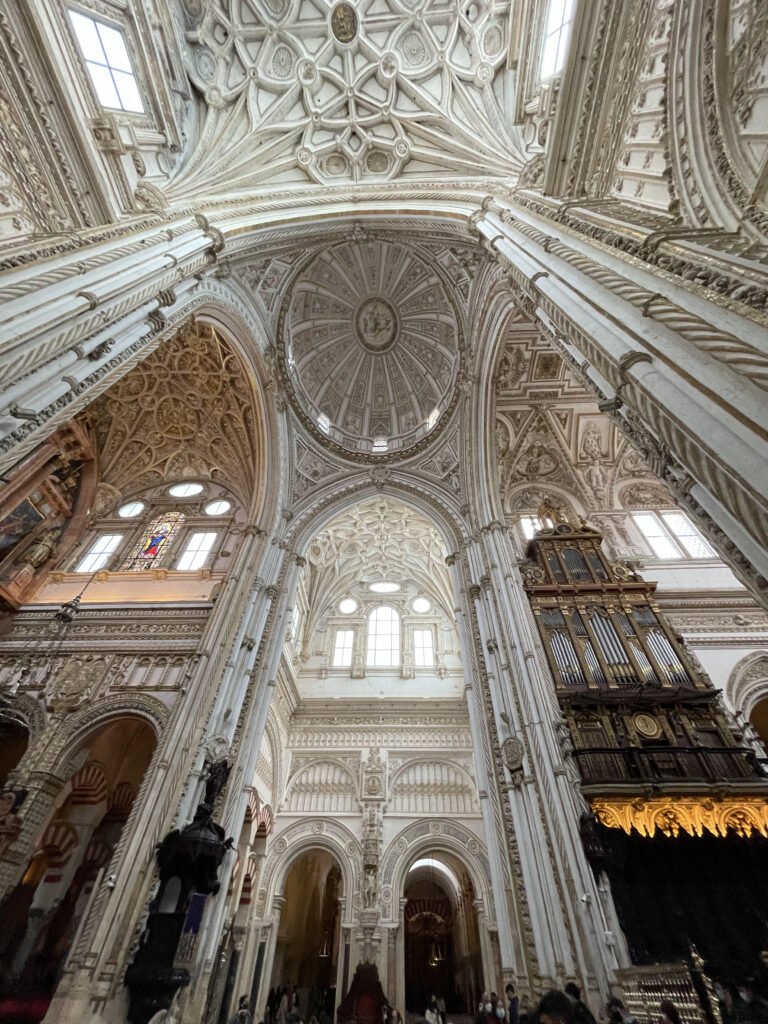
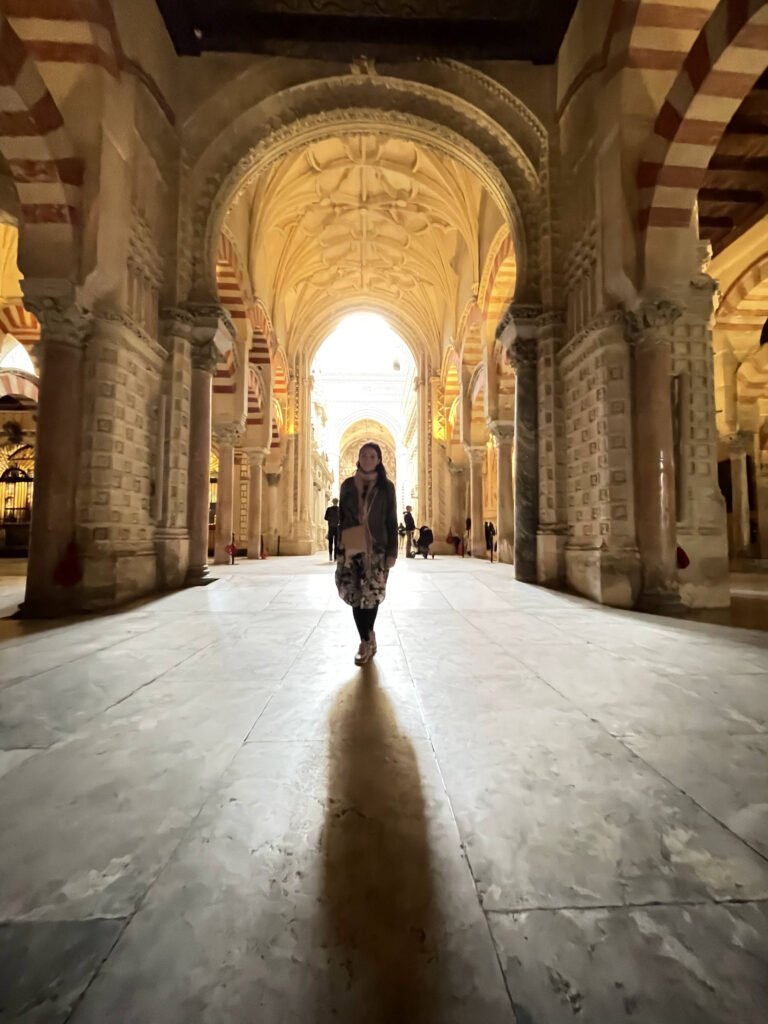
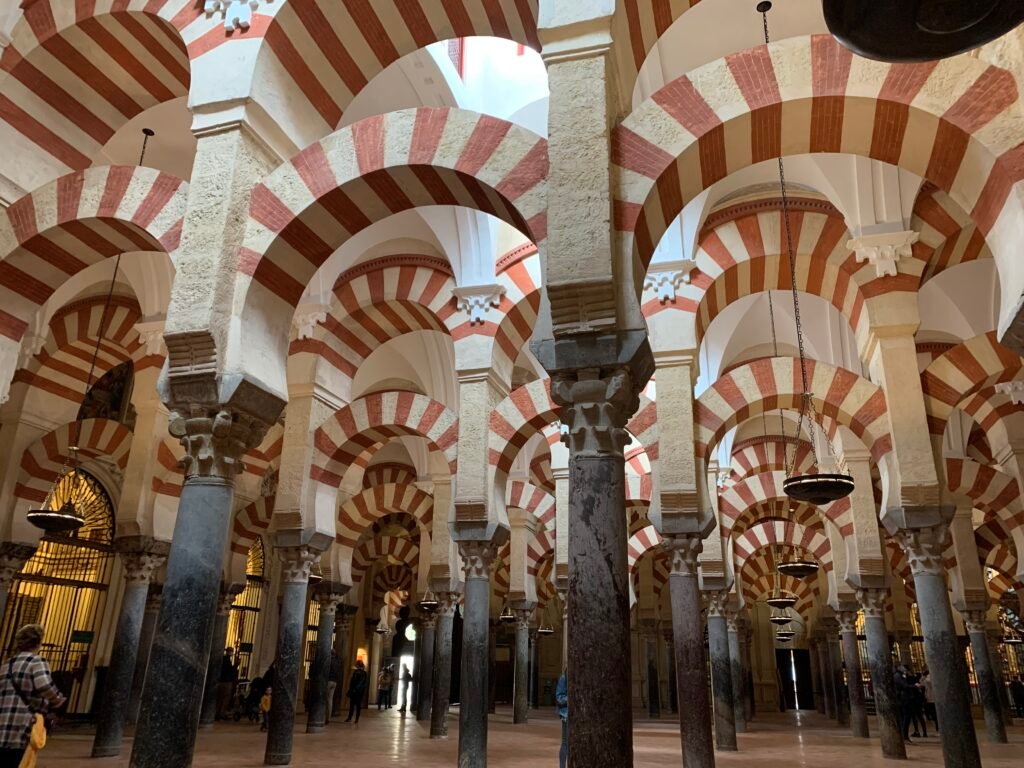
The main attraction today is the Mosque–Cathedral of Córdoba. Inside, you can genuinely get lost in the forest of columns. There are 856 arches. Every direction you look is filled with red-and-white striped arches. It’s visually strange. The building is historically and geometrically very special and obviously one of the city’s major attractions. But for some reason, it doesn’t leave a particularly strong impression on me this time. After all the walking, we’re hungry. But everything is closed until 19:30. So we wait.
Once the Spaniards wake up from their siesta, we go hunting for dinner. We end up at Taberna El Abanico. Madara gets chicken salad. I get croquettes filled with chicken and mashed potato.
Not bad. We originally came here for the daily menu where €11 supposedly gets you three courses. In very clear Spanish, we’re informed that it only applies until 14:00. Basically, until siesta.
So croquettes it is.




CÓRDOBA: PALACIO DE VIANA
05.04.2022: This morning I have to do a little work. At least bringing the small laptop turns out to be useful. It’s not easy to force myself into work mode, but eventually I manage to finish what needs to be done so we can head out with a clear conscience. Going outside is more difficult though. It rains all morning and the forecast doesn’t promise anything much better for the next few hours. Our room feels like a bunker with a tiny firing slit looking into the courtyard.
We definitely don’t want to sit here all day. Raincoats on.
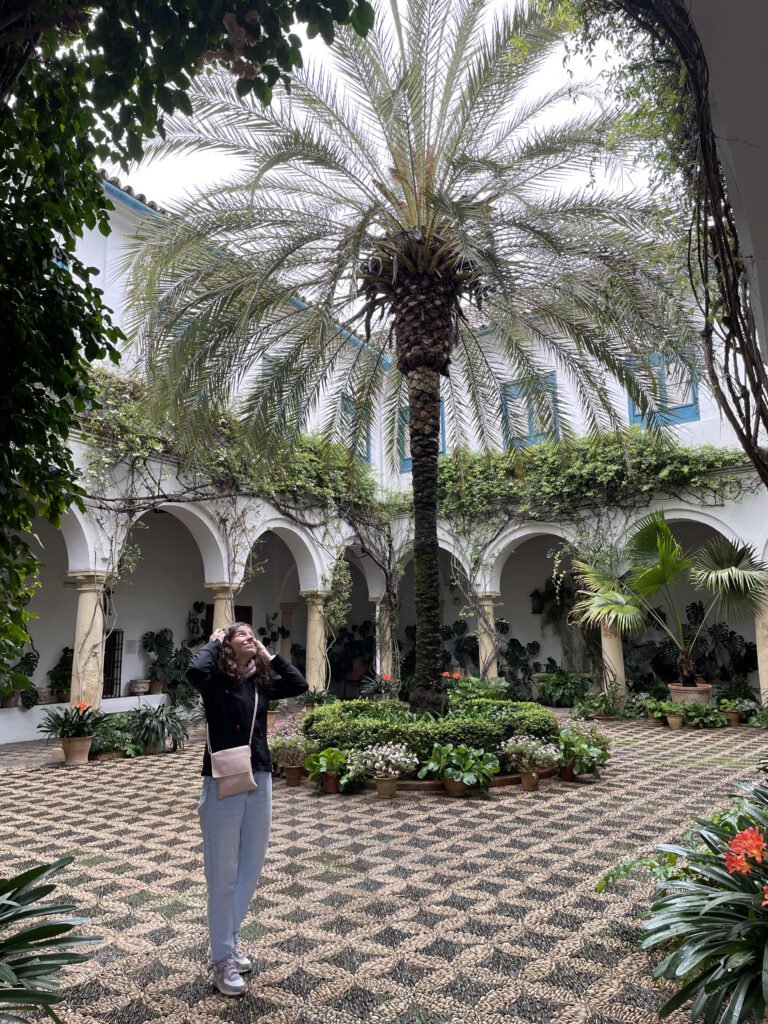
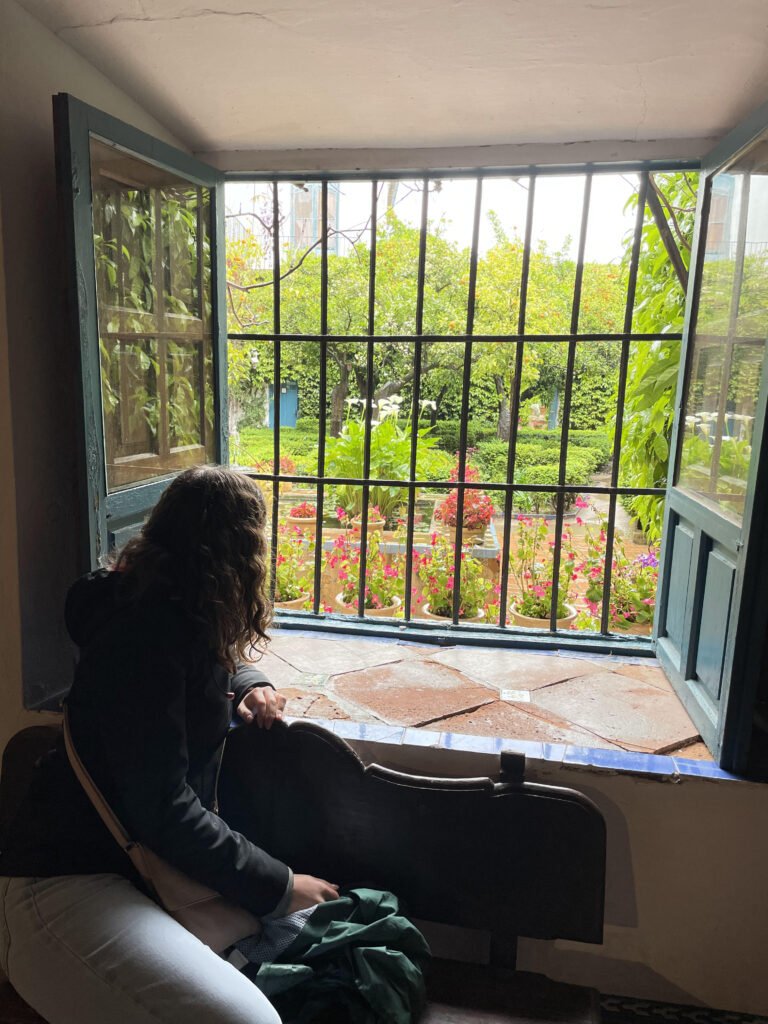
Today’s main attraction is Palacio de Viana. Maybe it’s because of the rain, but across all 12 courtyards there are probably only six to eight visitors. Each courtyard has its own story and is carefully maintained so Madara can take photos at every single one. Not as simple as it sounds.
At every stop, the mask and raincoat need to come off so the photos look like the weather is fantastic. Entry is €6 per person.
While walking through the gardens, I Google what to do in Córdoba when it rains. Everything points towards Mercado de la Victoria. A modern covered market built inside a park, offering food from different countries and cultures. The atmosphere is relaxed and interesting.
One person eats Mexican food with Spanish wine. Another drinks beer with Italian spaghetti.
We choose something that looks like a stew with prawns and what visually appears to be worms on top. While waiting for beer, a familiar little friend walks along the bar. A cockroach! Or, in the local language – cucaracha. 🪳 Probably not the best sign in a food establishment. For some reason, it doesn’t bother us too much. It’s still raining outside. Everything is closed because the Spaniards are sleeping. We decide to adapt. Home for a nap.
I take the assignment very seriously and sleep for almost two hours. When I wake up, naturally I’m hungry again. We decide to make another loop through town and souvenir shops, ending back at Mercado de la Victoria. Despite the cucarachas, the atmosphere is good and the food options are interesting. There are TVs everywhere in the market and football is playing on all of them. Live Champions League – Manchester City against Atlético Madrid. No question about which team we need to support if we want to fit in here. Eventually Madara gives in and buys fried sprats. Actually pretty tasty.



GRANADA
06.04.2022: Today we have a fairly long drive to Granada – 185 km. But around 90% of it is motorway, so it takes less than two hours. We approach the city with mixed feelings because Madara Googled that Granada’s main attraction – the Alhambra – wants €38 per person for entry.
Psychologically, after paying for so many attractions already, we’re not really feeling that. At the same time, if we skip it, the obvious question is: why are we even going to Granada? Probably 99 out of 100 tourists come here specifically for the Alhambra. And as we later discover, it’s also one of Spain’s most visited tourist attractions, with around two million visitors per year. Our hotel is quite far from the centre, so to save time we use public transport. On the way, I find that tickets should actually cost only €14 per person. Hope returns.
We’ll go to the palace and see what happens. The moment we step off the bus in the centre, Granada immediately feels more like a major city. Even though it has only around 240,000 residents compared with Córdoba’s 350,000. Then again, in Córdoba we mostly stayed inside the Old Town. We basically head straight towards the Alhambra. After around 30 minutes of walking, we reach the palace. Before discovering the truth about the tickets, we stop for coffee. No croissant for us. Apparently croissants are only for breakfast time.
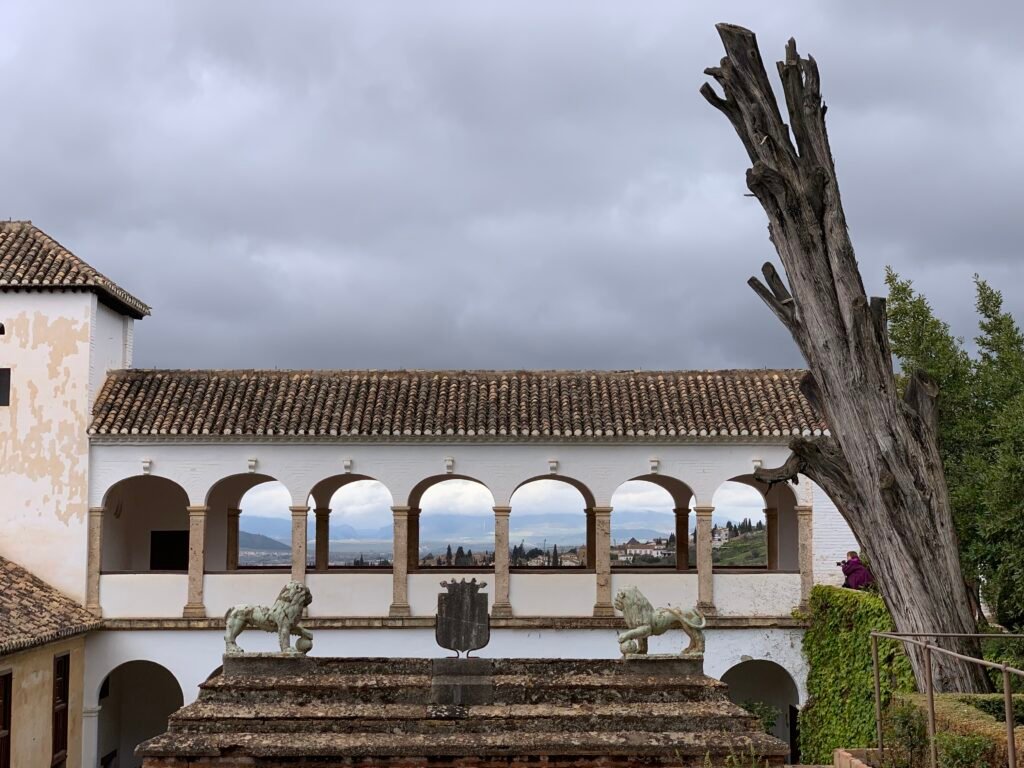
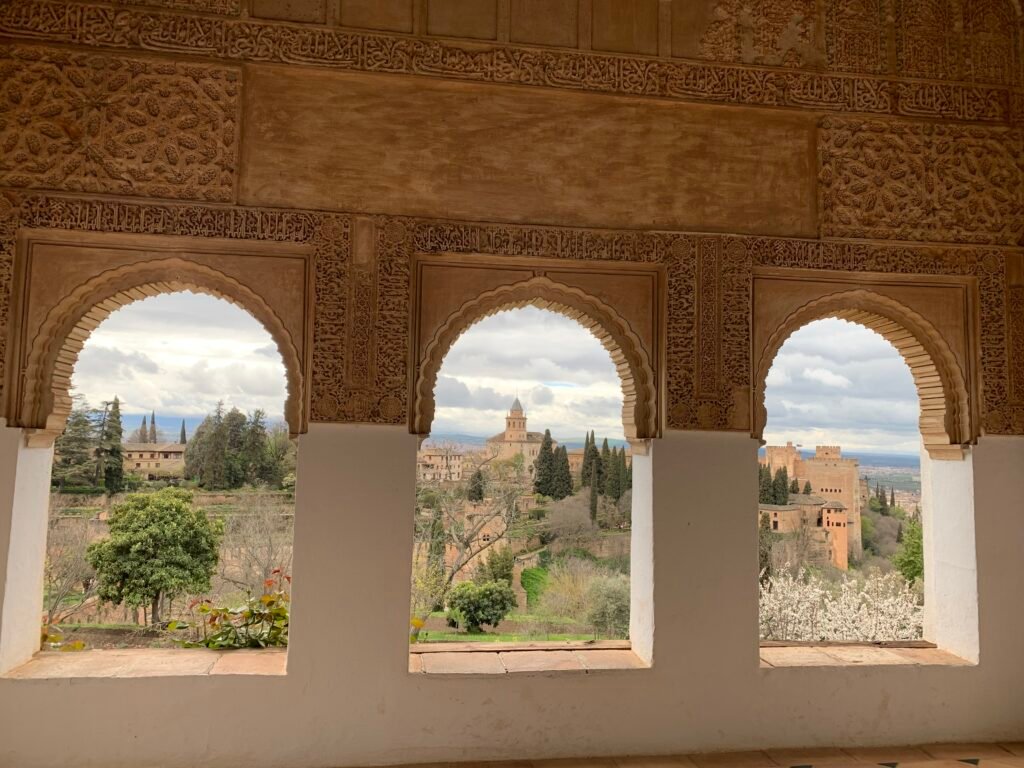
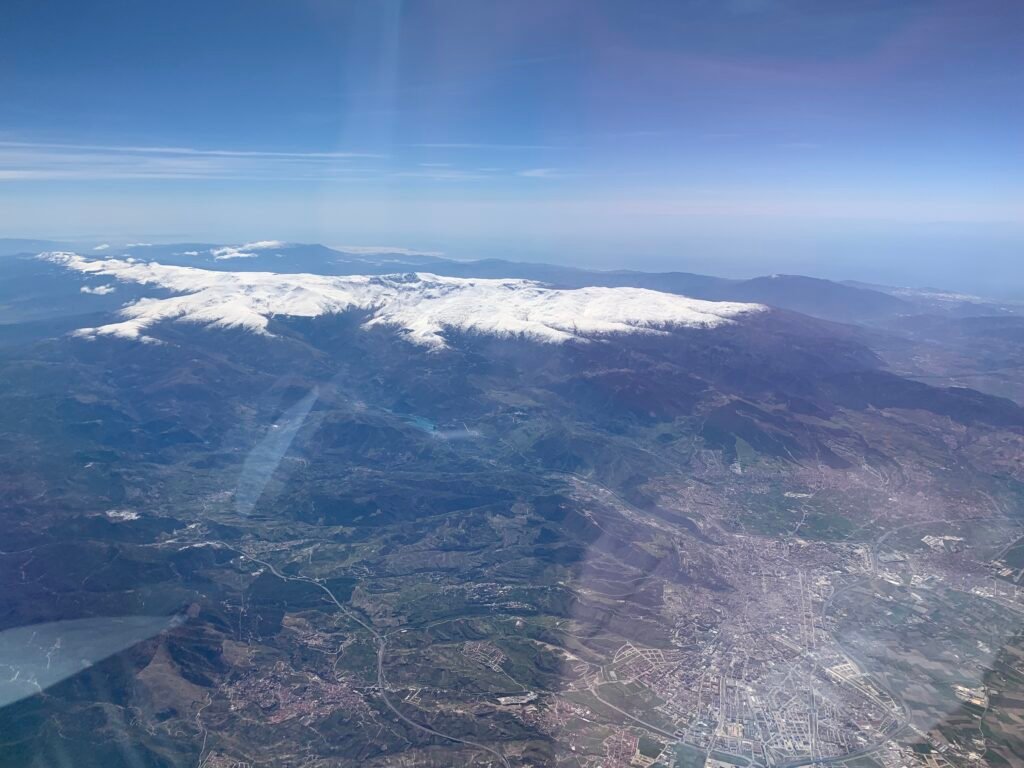
The good news: we can enter for the €14 tickets I found. They include access to the three main areas without a guide – Generalife, Alcazaba and the Nasrid Palaces. Only the Nasrid Palaces have a specific entry time, which is around two hours after we enter the complex. The palace sits on top of a hill, giving impressive views over Granada and the nearby snow-covered peaks of the Sierra Nevada. It’s cloudy today and you can see the mountain range physically stopping clouds that are trying to move away.
Of all the palaces we’ve visited, this one has the strongest Arabic character. If this had been the first palace of the trip, our jaws would probably be on the ground. By now, though, we’ve become slightly numb after so many impression-heavy days. So there are fewer screams of excitement. Still, absolutely impressive.
As in previous cities, Mum keeps supplying us with concentrated information from geography books, where all the important facts are conveniently summarised. Afterwards, we’re hungry.
The search for food is very short and we enter almost the first place we see. For €14.50 per person there’s a three-course menu. First course – paella for both. Second course – fried seafood for Madara, chicken with potatoes for me. Dessert is apparently sold out. Honestly, after the first two courses there wouldn’t have been space anyway. Tea and coffee become dessert.
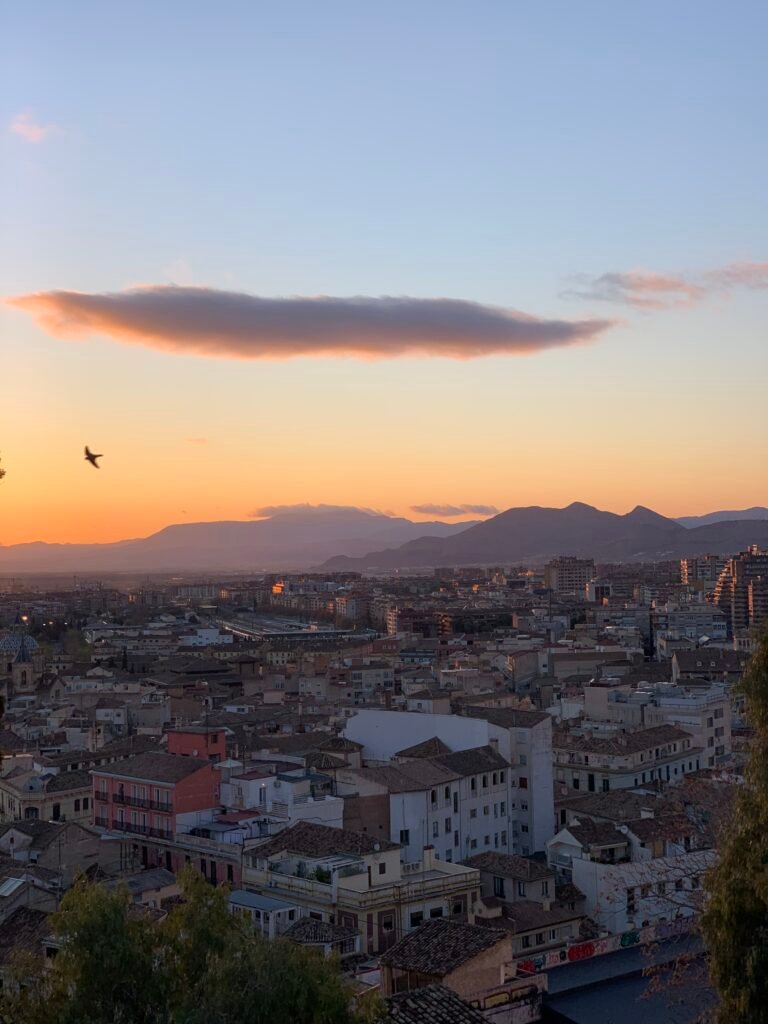
We also wander through the small Arabic-style shops and buy Mum a pair of yellow leather slippers. Funny pointed shoes decorated with camels. Later, we walk up to the supposedly authentic Albaicín district, located on a small hill with more nice views over Granada.
It’s one of the few places where you can properly see Granada Cathedral. The cathedral itself is enormous, but the surrounding buildings are packed so tightly around it that when you stand right next to it, you can barely see anything.




NERJA
07.04.2022: Originally, today was supposed to be a hike in the nearby Sierra Nevada mountains.
But something inside me is saying we probably shouldn’t. As an alternative, we decide to take a small detour on the way back to Málaga and stop in the Mediterranean resort town of Nerja for breakfast and a short walk. Turns out listening to that feeling was a very good decision. Once we reach the motorway, we can see our intended hiking area. Covered in deep snow. We’re neither physically nor mentally prepared for that. Before reaching Nerja, we stop at Acueducto del Águila. A still-functioning aqueduct built in the 19th century to supply water. We take some photos and selfies from the opposite bridge and move on. Apparently there’s also a trail down into the valley to see it from below. We decide not to bother.
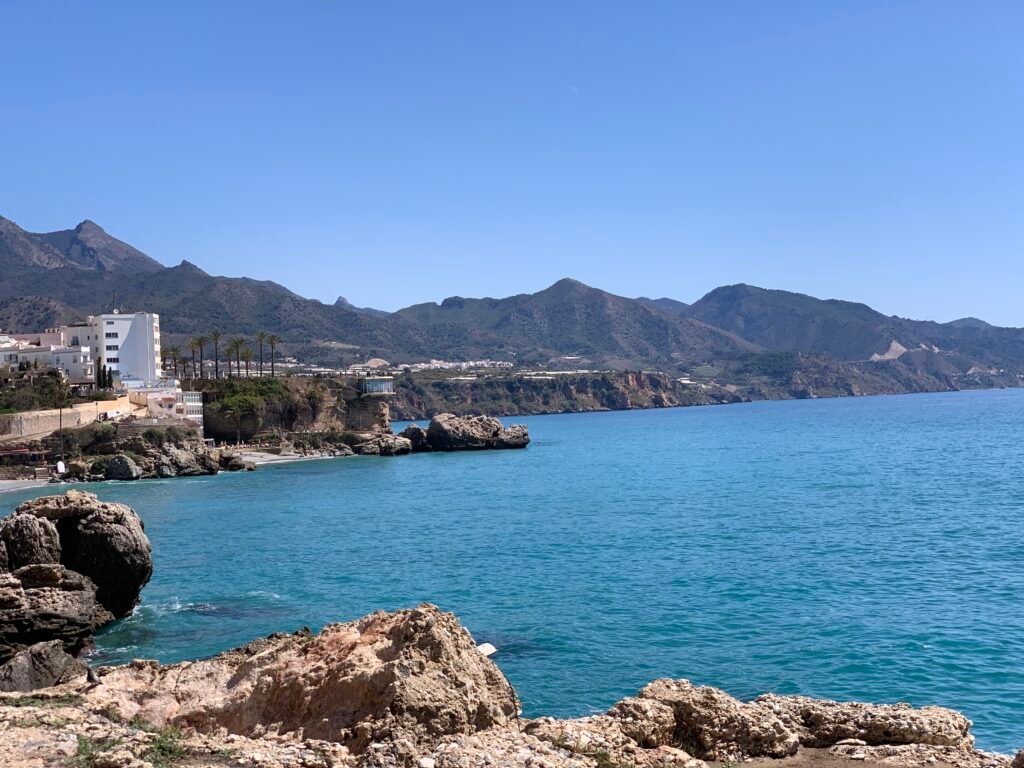
To avoid circling endlessly through tiny streets looking for parking, we go straight to a large paid car park. Conveniently, it’s also very close to Nerja’s main photo spot – Balcón de Europa. Today is pleasantly warm and sunny, so the coastal photos finally look properly Mediterranean. We sit down for breakfast at a nearby hotel. Prices are reasonable and we can see the Mediterranean while eating. Madara chooses an English breakfast. I choose continental. The English option comes with eggs, sausages and bacon. Mine gets a croissant and baguette. In the end, we swap plates. The location is good, the sun is shining and we settle in for a while longer.
Madara orders a mimosa for the photos. Orange juice and sparkling wine in a fancy glass. We wander around the streets. Everyone is actively preparing for the real tourist season. Not that the streets are exactly empty right now. We also walk to nearby Playa La Torrecilla. People are already sunbathing first thing in the morning. The beach has that typical Mediterranean mix of sand and stones. If Liepāja had water this clear, like here or in Nice, there probably wouldn’t be a better beach destination anywhere in the world. Those stones just aren’t nice.


MÁLAGA: PLAYA DE LA MALAGUETA
07.04.2022: We successfully settle into the final apartment of the trip. Once again proving that hotels really aren’t competitive accommodation for our style of travel. Maybe if you want to spend the whole day by a pool drinking cocktails. Here, for less money than the hotel cost us, we get a full three-room apartment. Today is basically plage day. Beach day.
After a short rest, we head to Málaga’s main beach – Playa de la Malagueta. It doesn’t look quite as beautiful as it probably should because we saw on the news that a storm last week caused quite a lot of damage along the coast. That doesn’t stop hundreds of people from catching some sun. The Spaniards themselves are still walking around in coats. After about an hour in the first proper sunny day of the trip, we’re already turning pink. Time to move on before we have to replace our skin. I want to buy some souvenir socks with Spanish patterns. Mission successfully completed for €5. The streets feel noticeably more alive today.
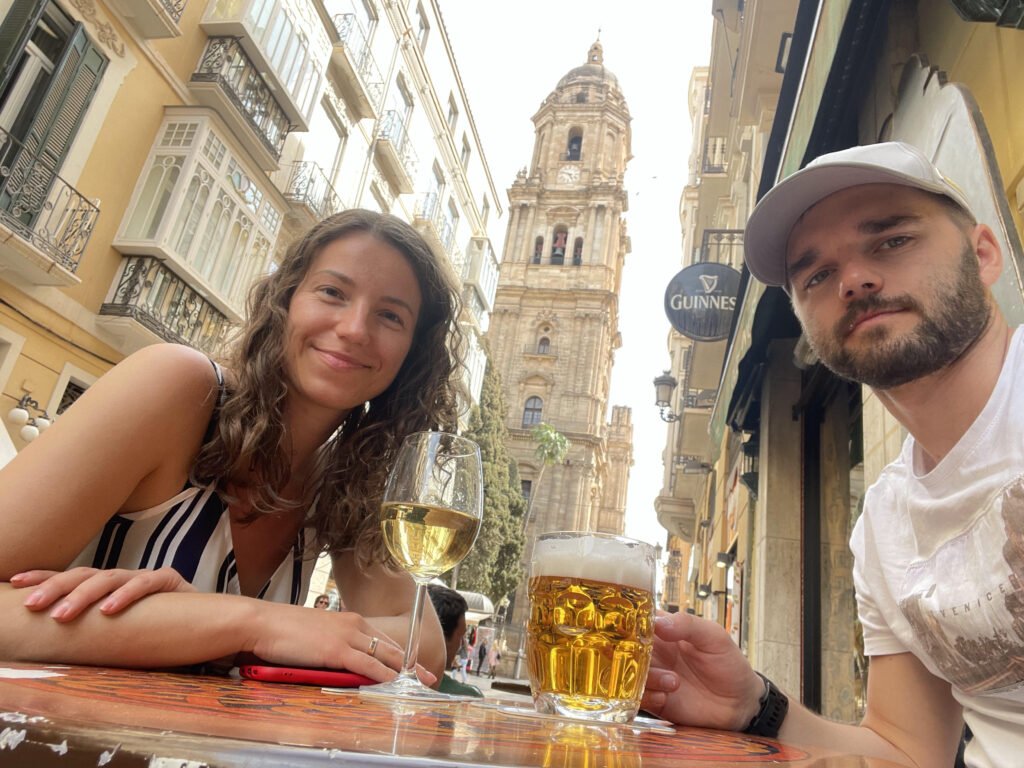
Apparently a few extra degrees and some sunshine really do make a big difference. After a short walk, we settle into a bar with a view of the cathedral. A proper tick-box drinking stop on Calle Molina Lario. We’re sitting at one end of the street and at the other end you can clearly see the “complete arm” of the One-Armed Lady – Málaga Cathedral’s finished tower. In the evening, we wander fairly aimlessly through the Old Town, stopping occasionally at different bars to refuel.
Basically, whenever you need the toilet, you go into a bar. “Una cerveza. Grande, por favor!”
Then eventually: “La cuenta, por favor!” “Pagar efectivo!” These phrases I’ve perfected. After tonight’s walk, we conclude that all roads in Málaga lead to the cathedral. At least inside the Old Town. No matter which way we turn, somehow we end up back there.


MÁLAGA: PASEO DE LAS CURAS
08.04.2022: Since today is one of the very rare days when the weather is genuinely good, the first and most important mission – at least according to Madara – is sunbathing. So that’s what we do first thing in the morning at the closest beach to our apartment – Playa de la Misericordia. It’s a little after 10 in the morning and Madara is the only volunteer sunbather. Apparently it’s still too cold for the Spaniards. Others gradually start appearing an hour or so later. Madara’s goosebumps while absorbing vitamin D from the sun might explain why. Meanwhile, I dig a hole in the stony beach to keep warm. Somehow, my back still catches a pretty good amount of sun.
Later it turns rather red. After the roasting procedure, we head home to reorganise for the second half of the day. Another important operation today: return the rental Fiat. Before that, we need to add a little fuel because one bar has disappeared from the gauge. I have to say, the little car has been excellent. After around 1,000 km, we’ve used only 55 litres of fuel. With fuel prices over the last few months, that’s a very pleasant bonus. Returning the car turns out ridiculously simple.
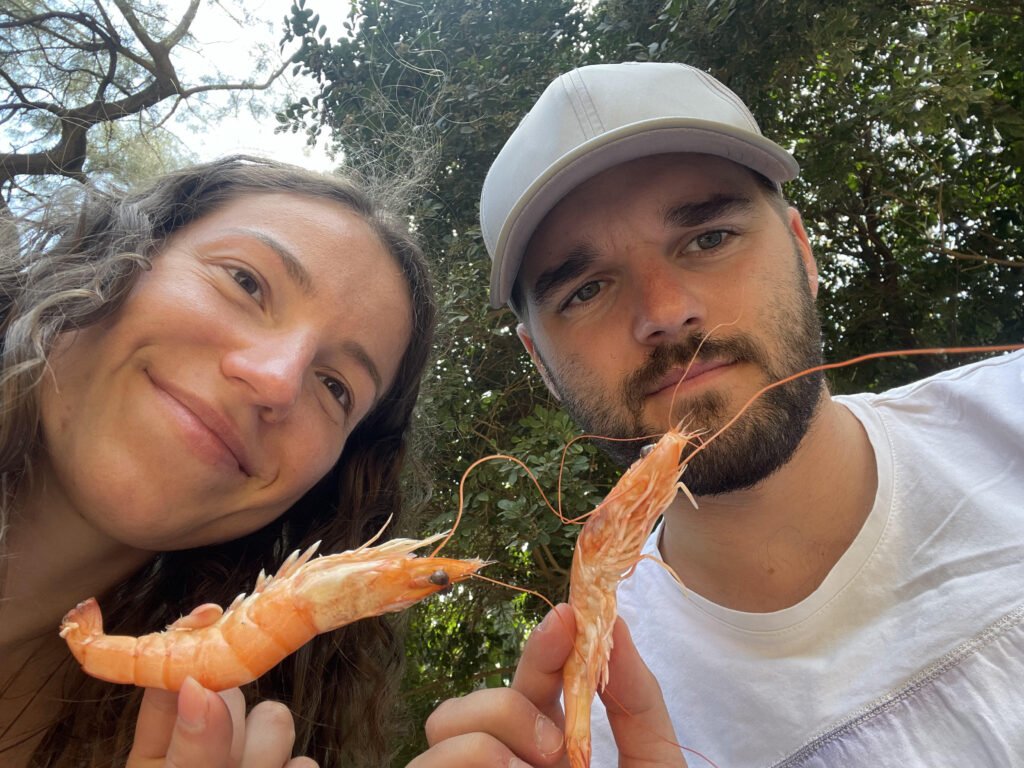
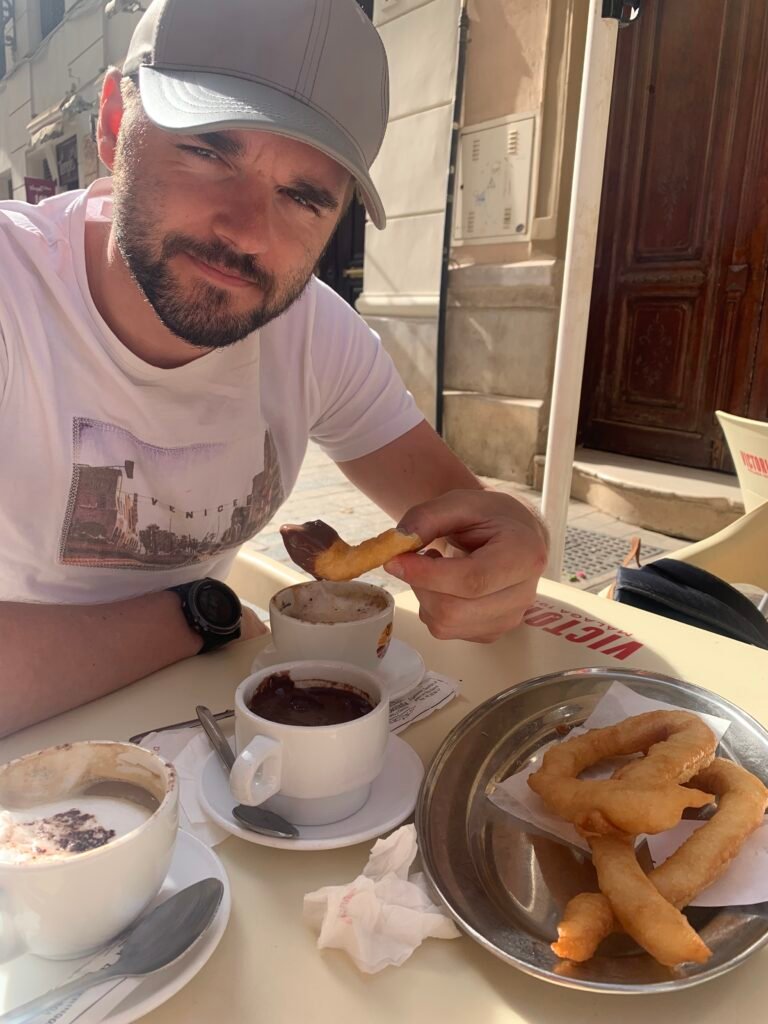
We park it in the same car park where we collected it, take the keys to the Avis employee and he doesn’t even go outside to inspect the vehicle. He just asks: “No damage? Full tank?” Everything okay. Thank you. Easiest rental return we’ve ever had. We’re slightly hungry, so we refuel ourselves at the supermarket inside the station. We buy the prawns we couldn’t get yesterday, a small bottle of wine and a beer. Then we head to Paseo de las Curas, where we eat everything together with the local parrots. Nearby, under the shade of a palm tree, one Spaniard apparently hasn’t made it home and is having his siesta right there on a bench. There’s still one Spanish delicacy we need to try today – churros. Basically a sausage-shaped object cooked in oil. We choose a place in the Old Town where everyone seems to eat nothing but churros – La Malagueña Churrería. Together with cappuccino, we get four churros and a cup of melted chocolate for dipping. Taste-wise, they’re actually not bad. But I don’t think I ever need to eat them again. You can’t escape the feeling that you’re basically eating a solidified lump of oil.
The local ladies at the neighbouring table clearly disagree. Between loud conversations, the two of them casually finish six or eight each.

AGP – RIX
09.04.2022: Today we finish the trip. Bus M135 gets us from home to the airport in around 20 minutes. And for €1.70 per person instead of the €4 we paid when arriving. The airport is big and, as Google likes to say, “as busy as it gets”. There really are a lot of people. Still, the Spaniards handle the large tourist crowds pretty quickly and efficiently. There isn’t much motivation to walk through Duty Free because there’s a 99% chance we won’t buy anything anyway. The flight is 4.5 hours, so strategically we should eat something proper. The only option that isn’t directly bread or baguette is pizza. Pizza it is.
Overall, Spain treated us very well and was extremely welcoming. We would have preferred much better weather, but judging by the Spaniards hiding under coats and jackets, they weren’t particularly happy about it either. And being angry at nature is fairly pointless. In 11 days, we cover around 950 km around Andalusia. Including Gibraltar – or “Džibītis”, as we started calling it – we visit six cities. Looking at the map, the route makes a pretty comprehensive loop. Still, it’s obvious we’ve only seen the tip of the iceberg. If I had to highlight one place, Gibraltar immediately comes to mind. Technically, it isn’t even Spain. But it really stuck with me.
Not only because of the macaques. The whole combination – the Big Rock, half-naked Brits standing next to winter-dressed Spaniards, red telephone boxes and post boxes, and of course the monkeys sitting on the edges of dramatic cliffs. I’m glad the final two days finally gave us proper Spanish sunshine. At least we can finish the trip on a positive and sunny note.
Total trip costs:
Transportation expenses (flights, car rental, fuel, etc.): ~715 EUR
Living expenses (accommodation, meals, etc.): ~1,000 EUR
Entertainment (admission fees, souvenirs, etc.): ~550 EUR
Total costs: ~2,250 EUR
Cost per person per day: 93 EUR