8-DAY ROAD TRIP IN SLOVENIA
Dates: 08.05.2025 – 15.05.2025
RIX-LJU
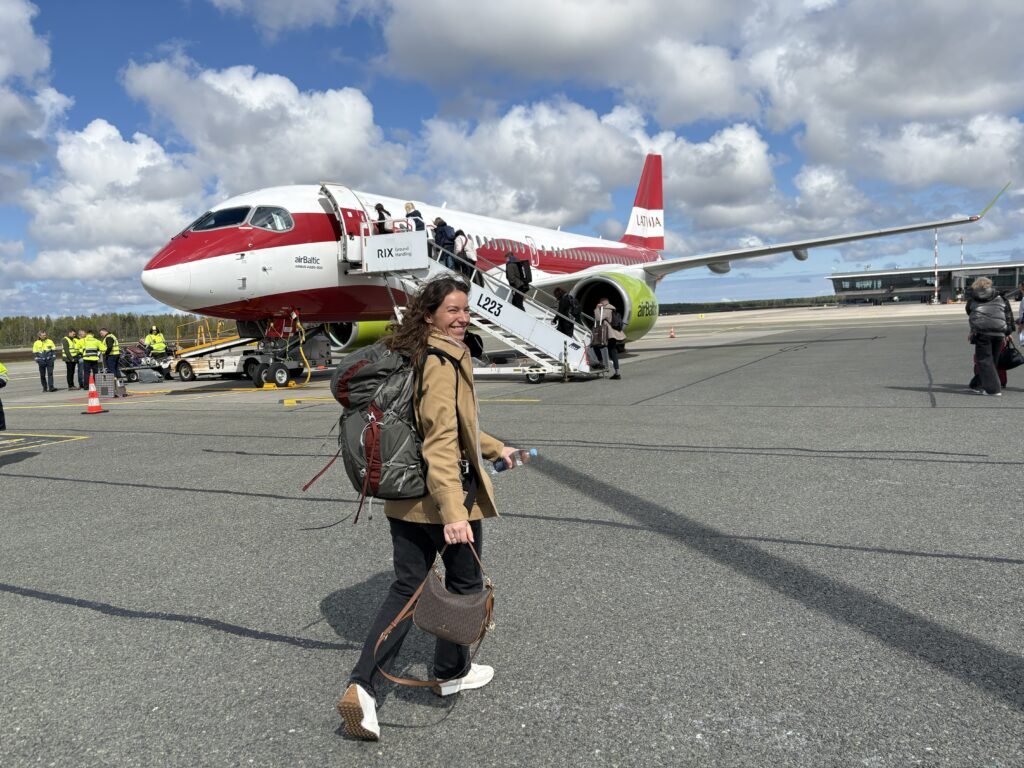
08.05.2025: After a long and rather stubborn battle with Latvia’s national airline AirBaltic — all in an attempt to exchange loyalty points for actual plane tickets — and a fair share of mostly
one-sided frustration, we finally succeeded. Using airBaltic points, we managed to book flights for the two of us to Slovenia’s capital and back. The price: 30,000 points.
Of course, this doesn’t quite mean flying “for free” — airport taxes still apply — but it does work out to roughly a 70% discount, which feels like a small victory in itself. And so, here we are at the airport, waiting to board and heading off to a new country for us: Slovenia. Its capital, Ljubljana, turns out to be one of the greenest cities in Europe. The city centre is almost entirely closed to car traffic, and in 2016 it was named European Green Capital.
Completely unrelated, but somehow fitting: Ljubljana’s symbol is a green dragon.
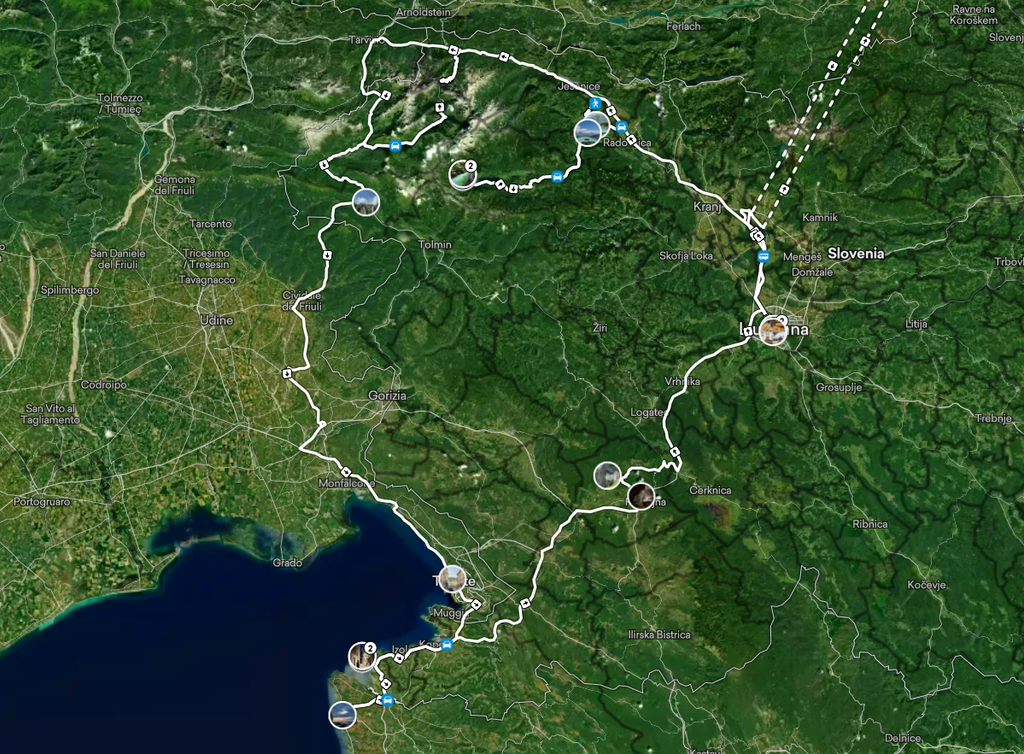
The plan once we land is to explore western Slovenia by car — with a small intentional detour into Italy, and just a brief step across the border into Croatia as well.
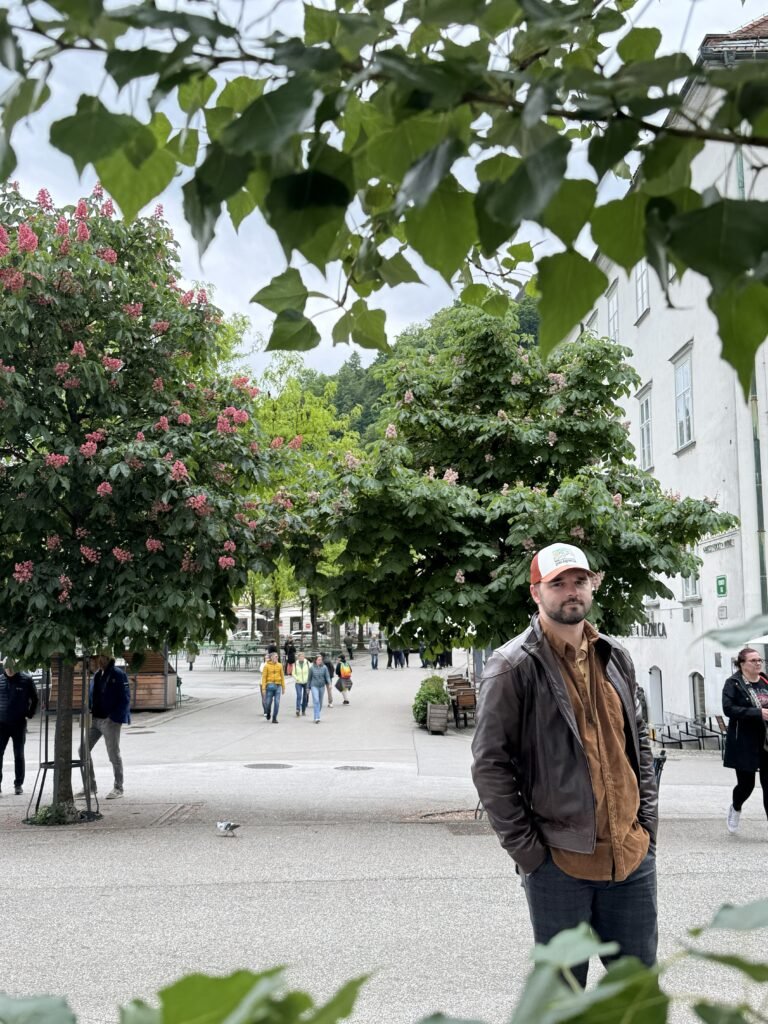
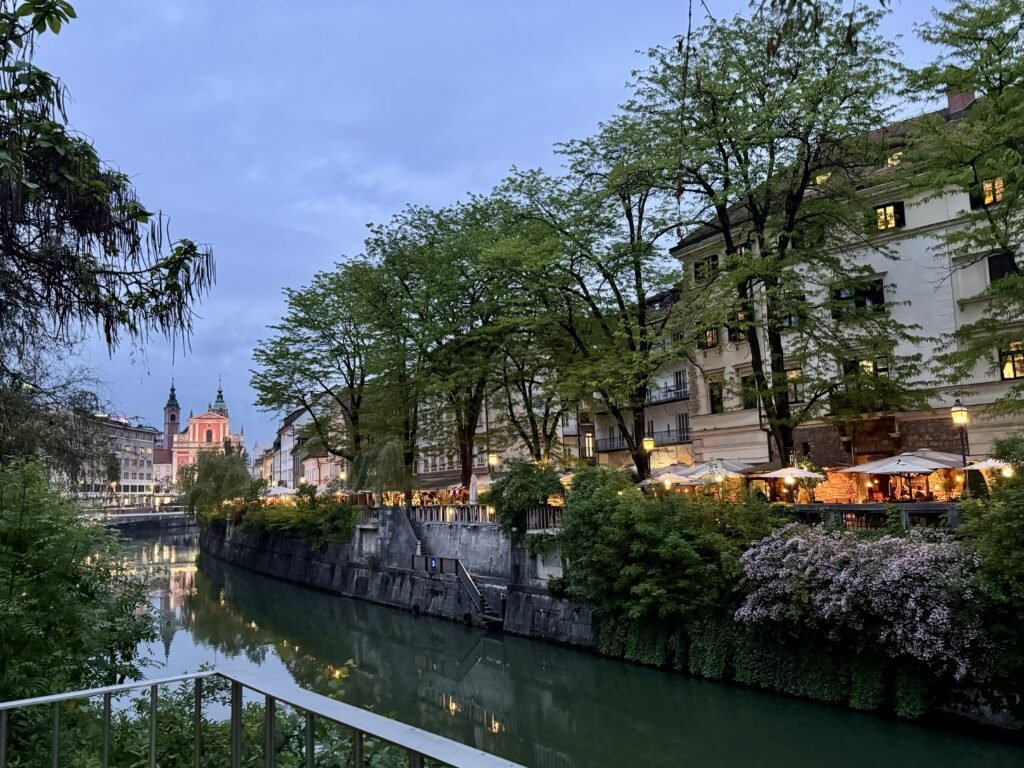
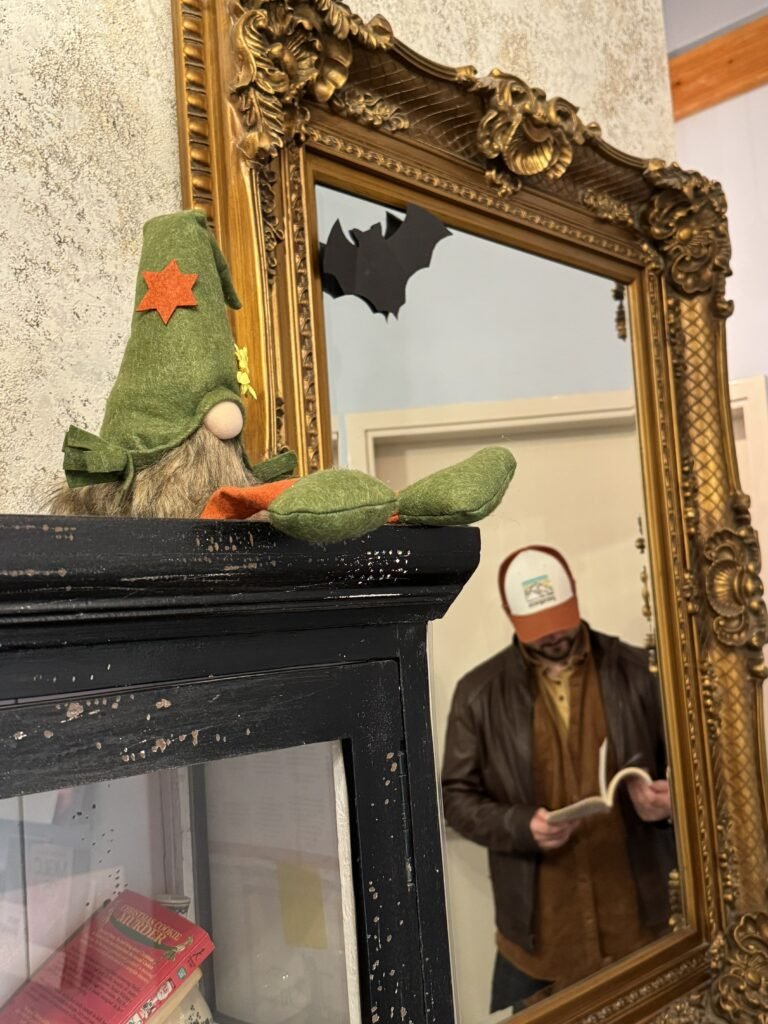
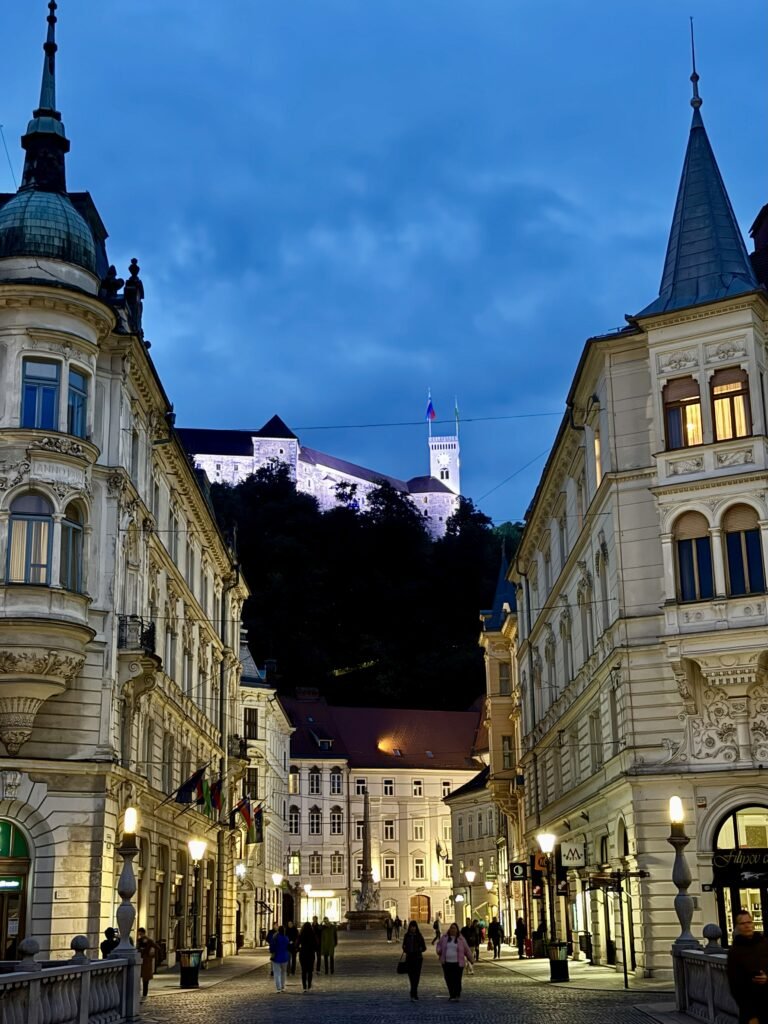
LJUBLJANA
09.05.2025: I had read beforehand that the bus from the airport to the city doesn’t run very frequently. In the off-season, it goes once an hour, departing on the exact hour, like 13:00, 14:00 etc. Since it was already 13:06, I briefly started considering car-sharing options. While I was registering in the app, some time passed anyway — and in the end, we stuck with the bus, which, arrived earlier than scheduled.
The ticket costs just €3.30 per person, and after about 40 minutes we’re already at our accommodation. With any other transport option, it definitely wouldn’t have been this cheap.
We settle in and grab lunch at the local bar on the ground floor — Bolognese and Margherita pizzas. Madara also takes down a dark beer and even admits it’s actually quite good.
Before heading out into the streets of Ljubljana, we still have a couple of work-related things to take care of — and then it’s time to start racking up steps.
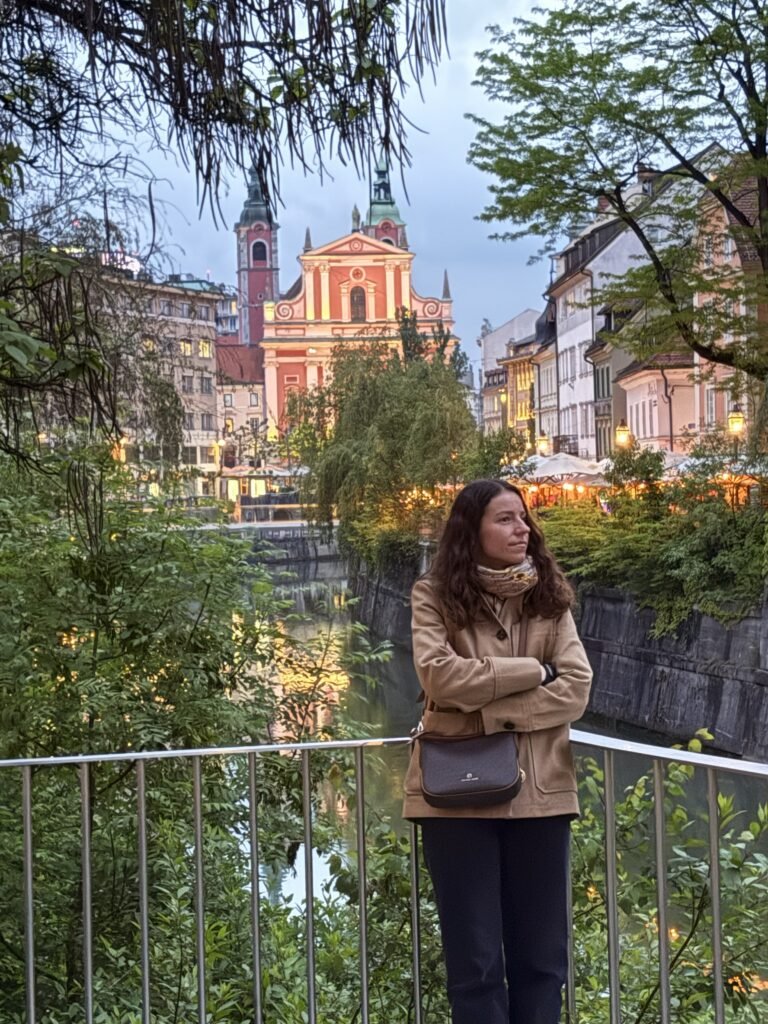
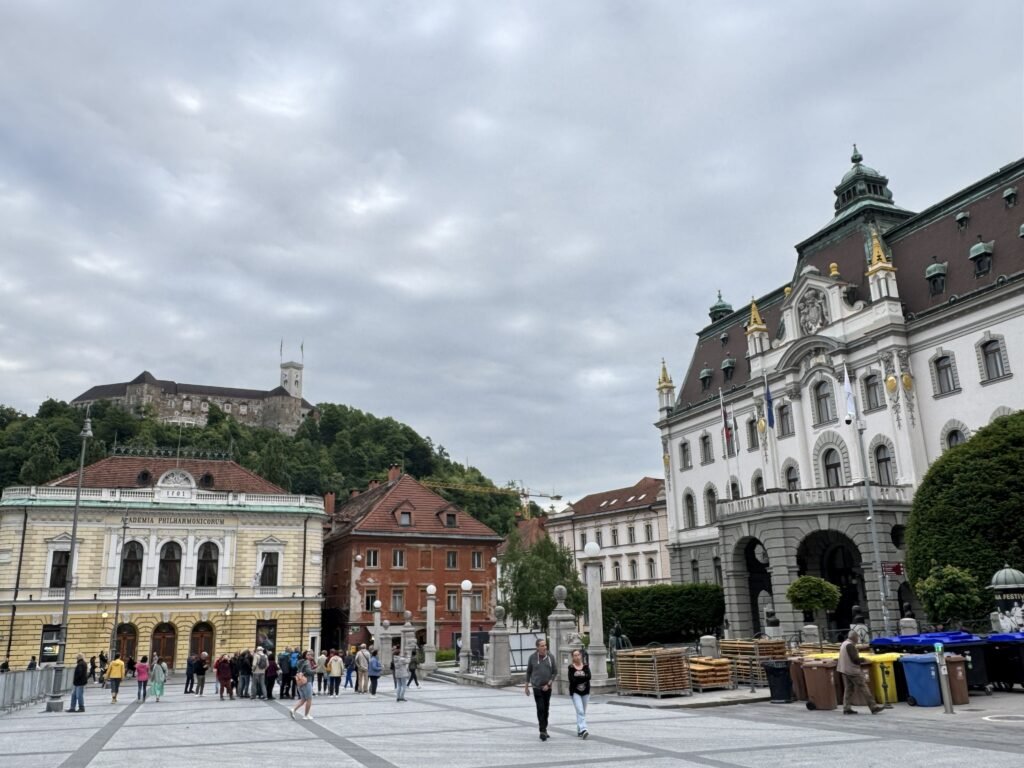
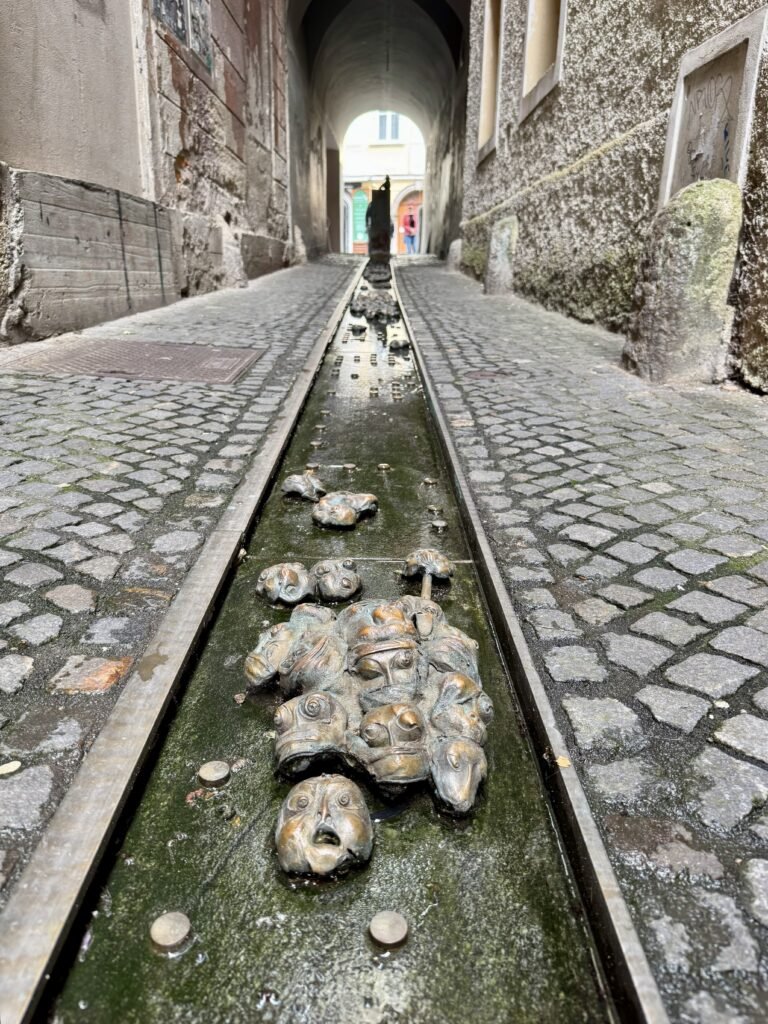
More or less by chance, the first landmark we stumble upon is the Dragon Bridge (Zmajski most) over the Ljubljanica River. The bridge is one of the city’s symbols — built in 1901, it was among the first reinforced concrete bridges in Europe. The green dragons sitting on its corners have long since become part of the city’s folklore, with smaller dragon figures “holding” lanterns along the
railings.
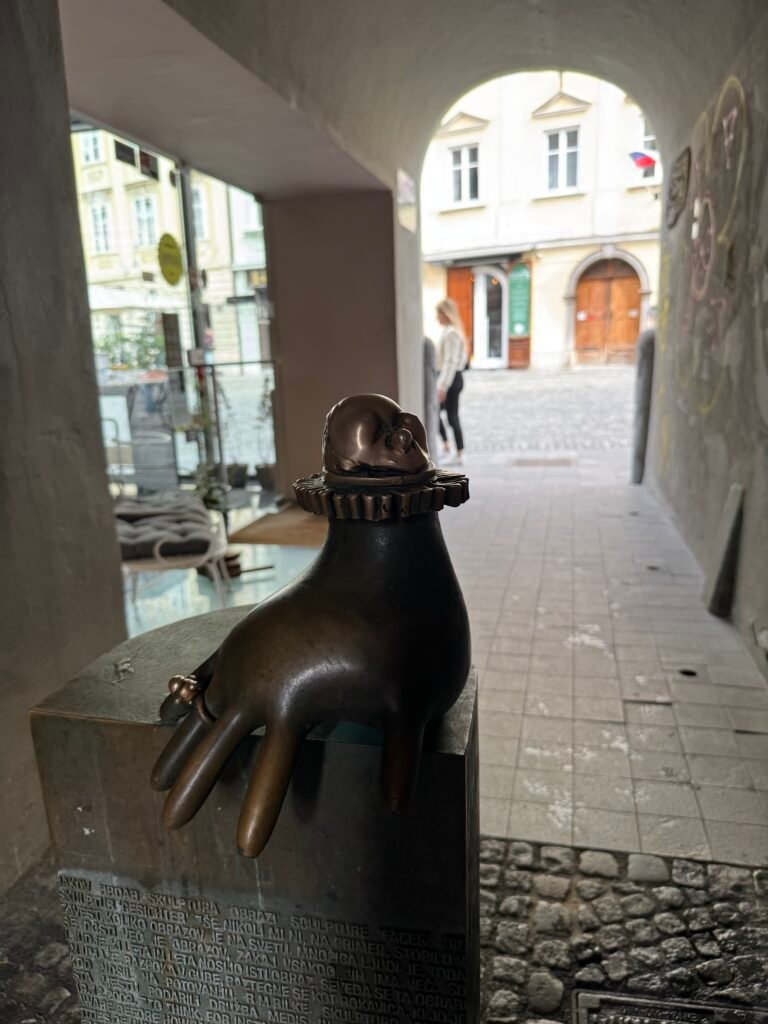
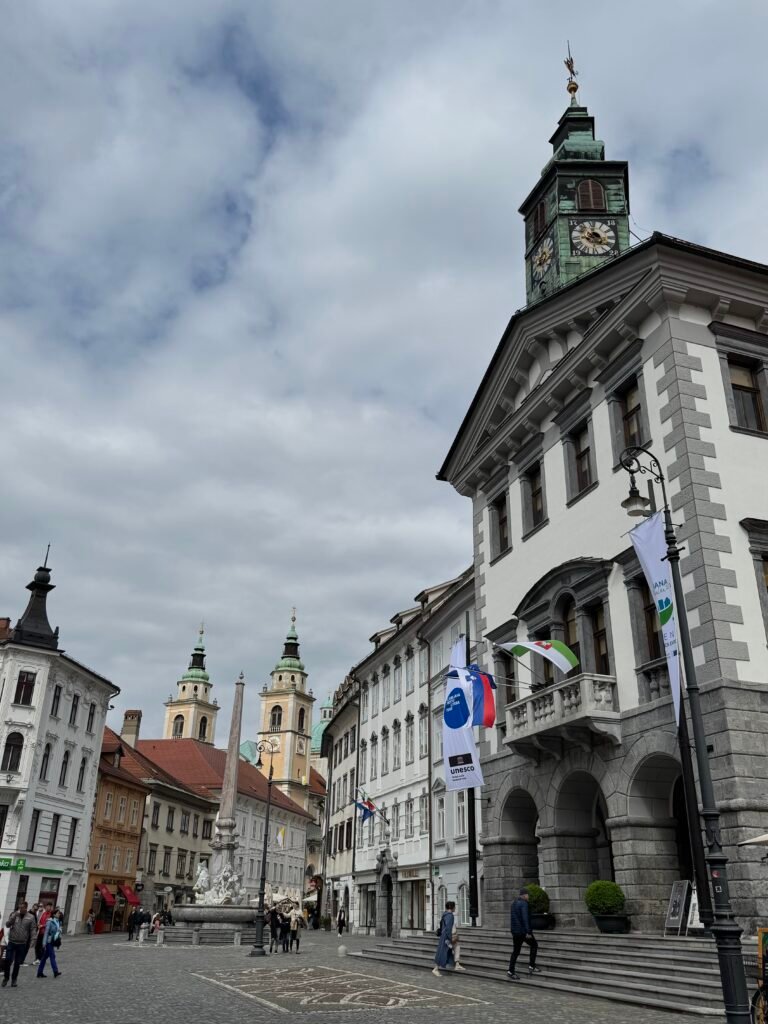
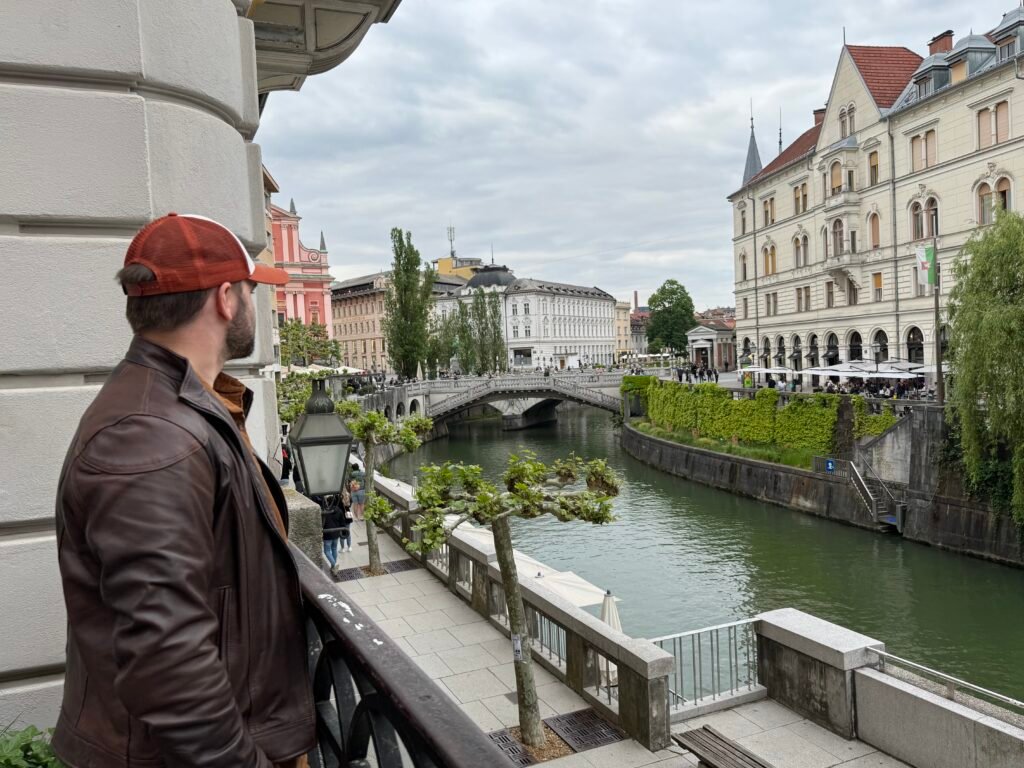
We slowly follow the canal towards the Old Town. There’s no real plan for today — we go wherever our noses point us, choosing whichever streets look the most interesting.
We stop at a small bar by the canal and watch a duck battling against the surprisingly strong river current. Madara had read up on Ljubljana’s famous rolled cinnamon buns, so we set out to find them. In the end, they’re nothing extraordinary — €4.20 per piece feels a bit excessive — but at least we can say we’ve ticked off this local Slovenian treat.
We settle in for a longer stay at Sax Pub, which, according to Google Maps reviews, is one of the highest-rated beer bars in the city. It offers a wide selection of local Slovenian beers. We’re sitting next to an artsy guy with a violin by his side. He smokes nonstop, drinks beer paired with some kind of small shot — pure bohemian energy.
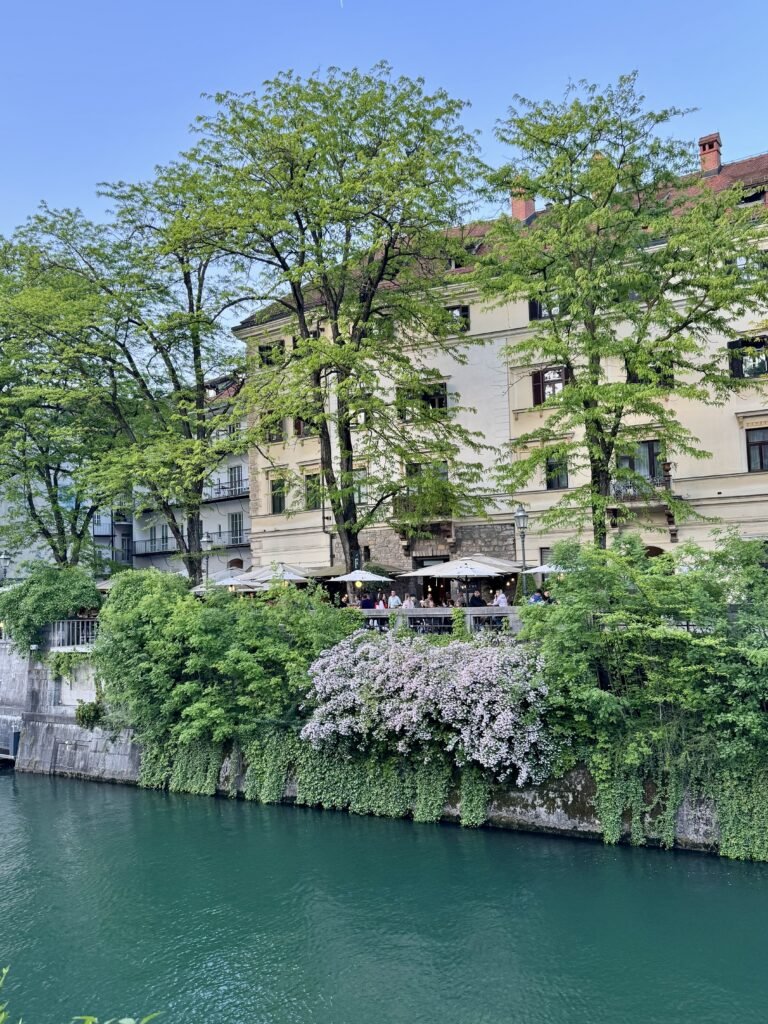
With the day’s furthest point reached, we slowly head back toward our accommodation along the same canal path. By early evening, the streets have become noticeably livelier — the city is starting to come alive.
LJUBLJANSKI GRAD
09.05.2025: Breakfast at the hotel — fairly average, but it does the job. We’re staying at Sobe Janez (Janez Rooms), located on Celovška cesta 55, in the Šiška district — a residential area just outside Ljubljana’s historic centre. It’s a practical and quiet part of the city, well connected by public transport, and close enough to walk or take a short ride into the Old Town.
We start the day with a walk through Tivoli Park. It’s the largest park in Ljubljana, though we only skim along its edge. The park features plenty of open-air exhibitions, children’s playgrounds, and relaxed green spaces.
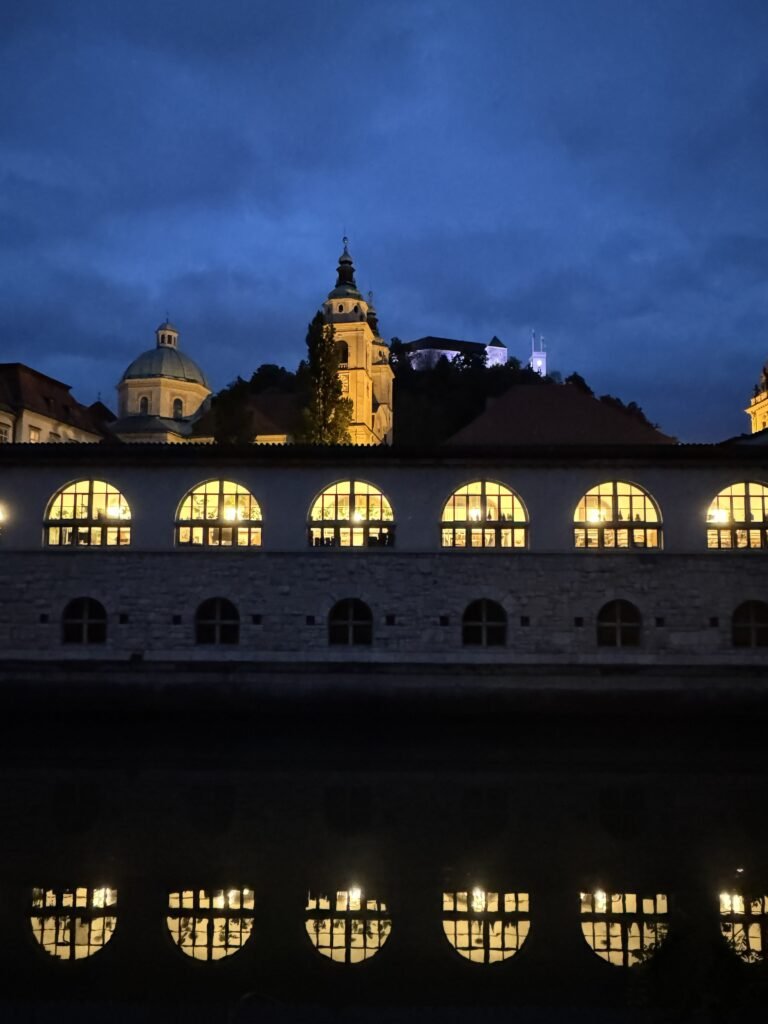
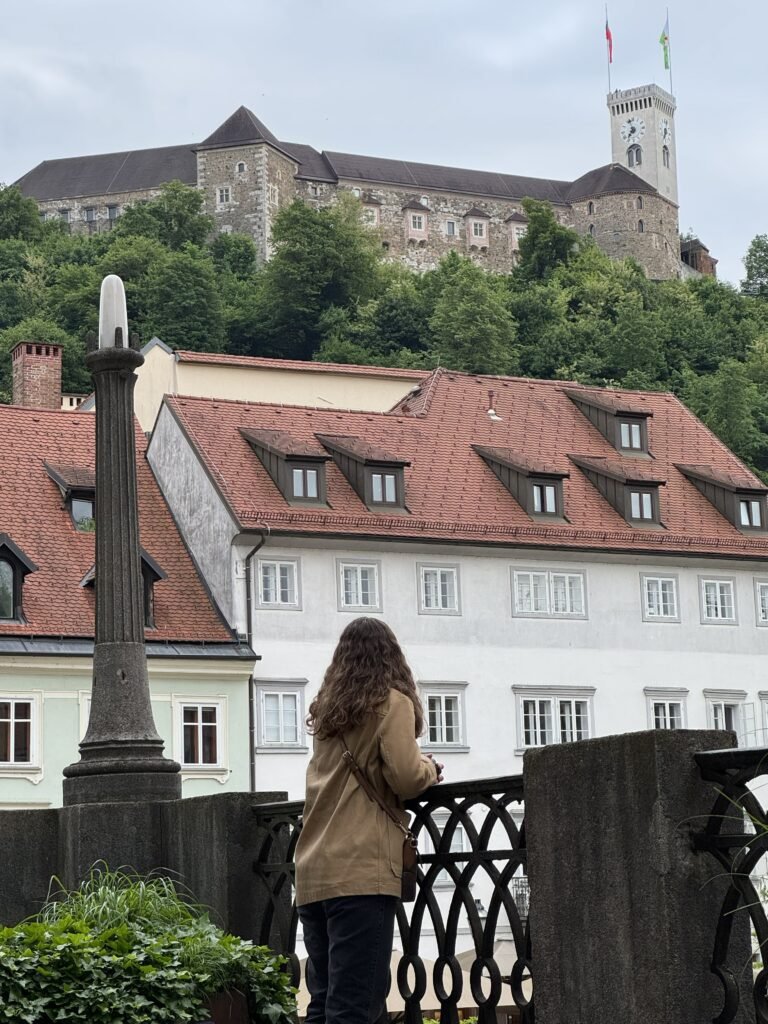
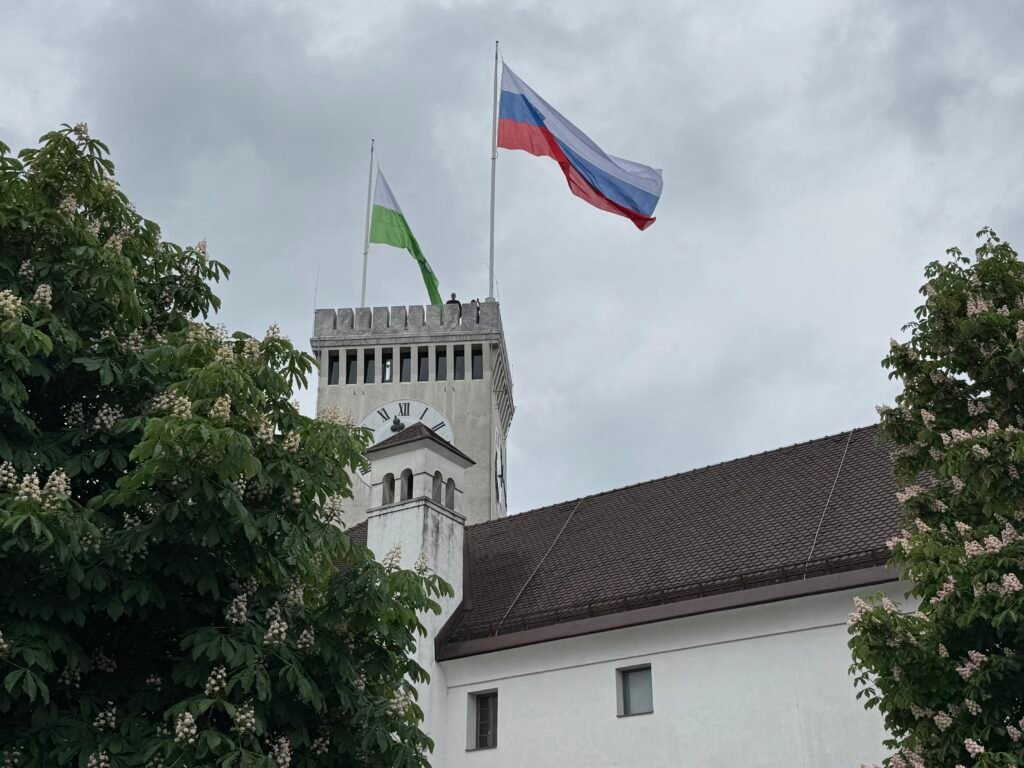
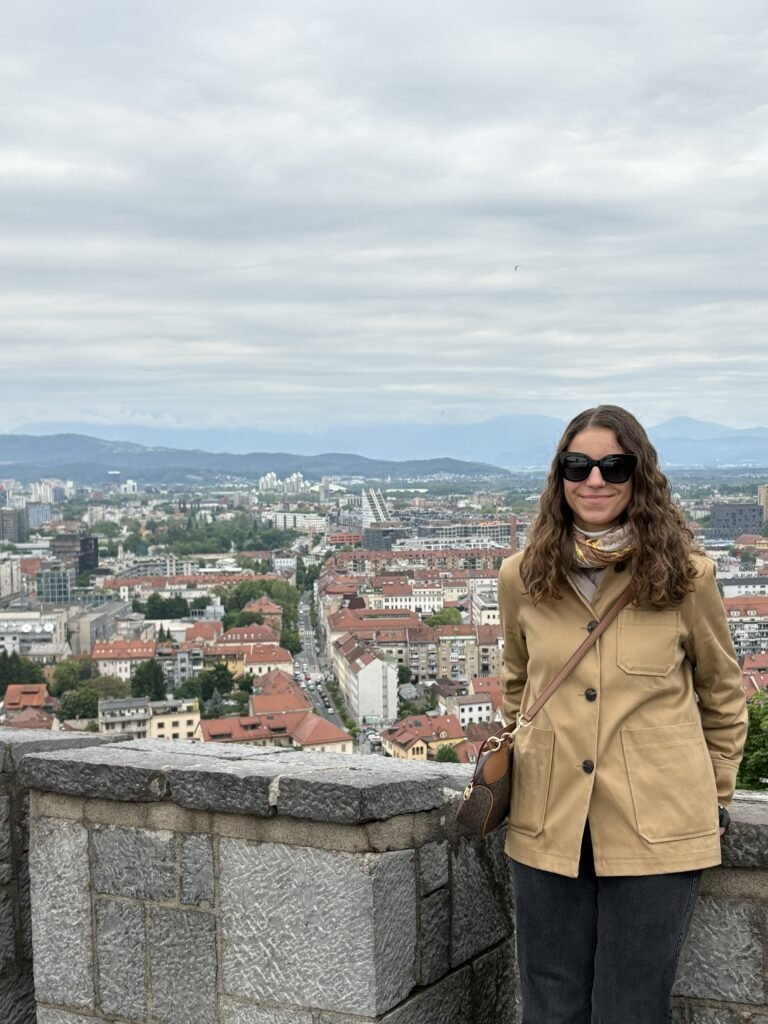
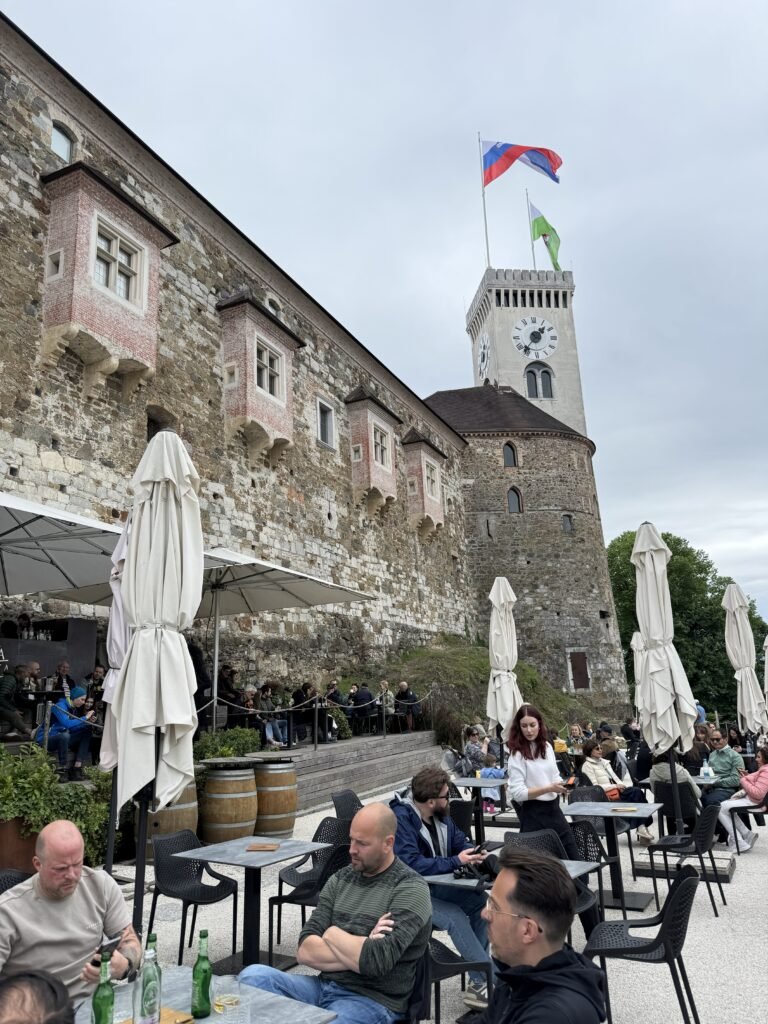
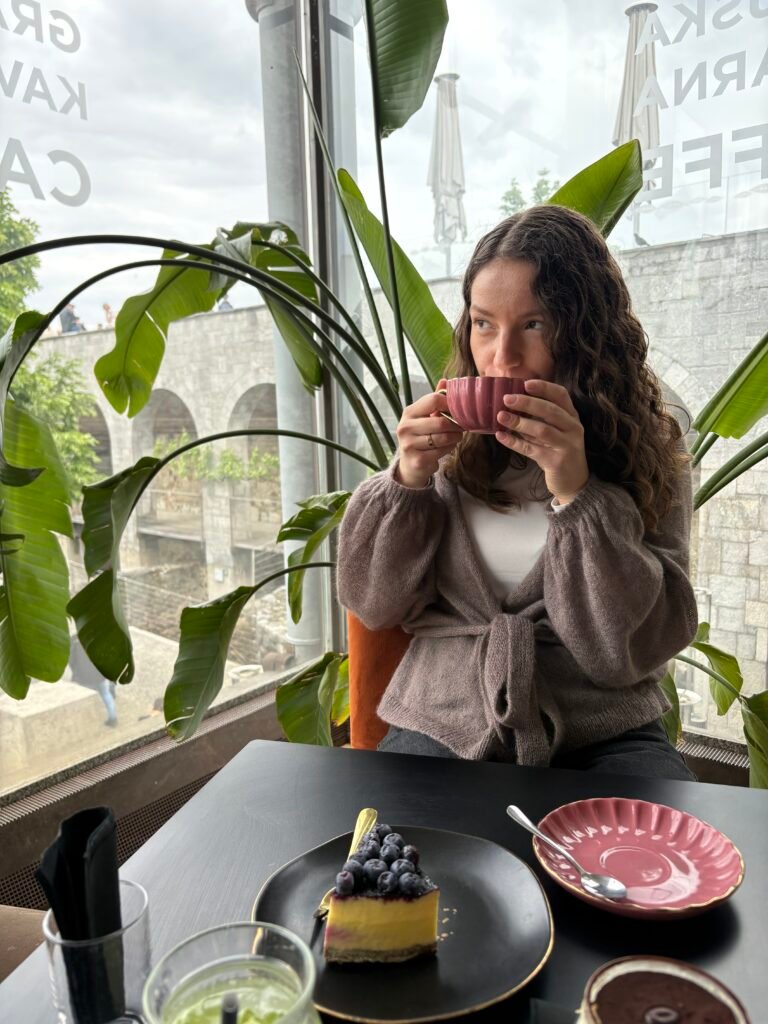
Next, we head up to the capital’s castle, perched on top of a hill. For €3.30, we take the funicular to the top, which already offers a great view over the Old Town. Today, there seems to be some sort of banquet taking place in the castle courtyard — judging by appearances, for high-ranking military personnel. Various elderly gentlemen decorated with patches and medals slowly make their way in, while we casually sip coffee just off to the side.
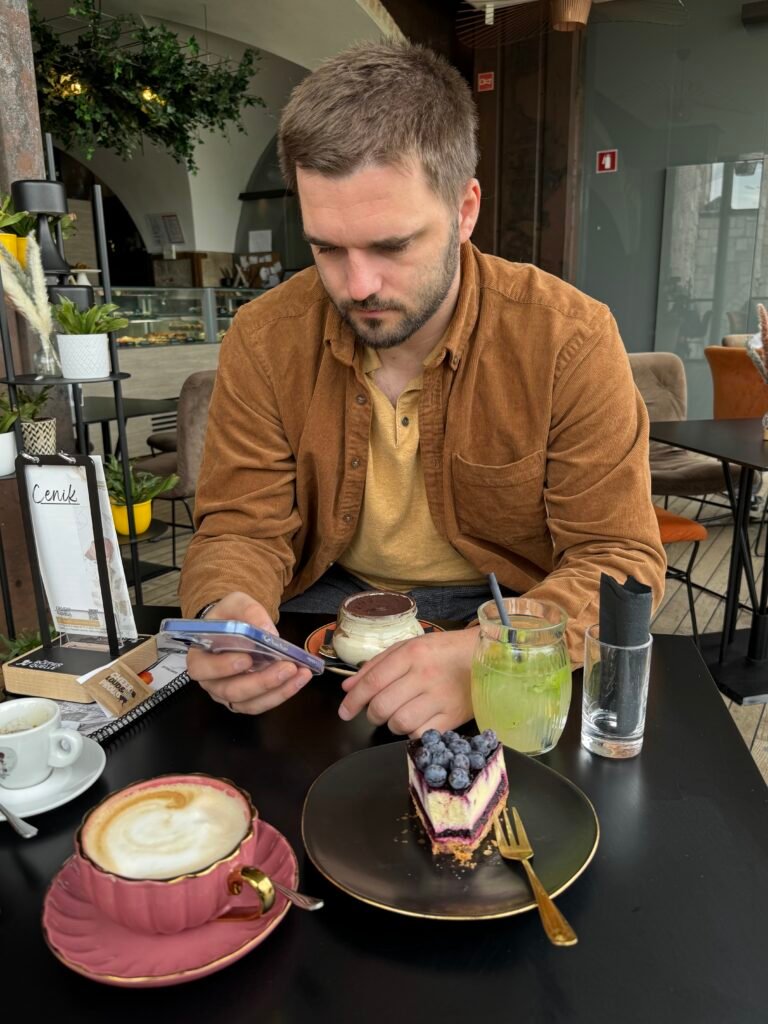
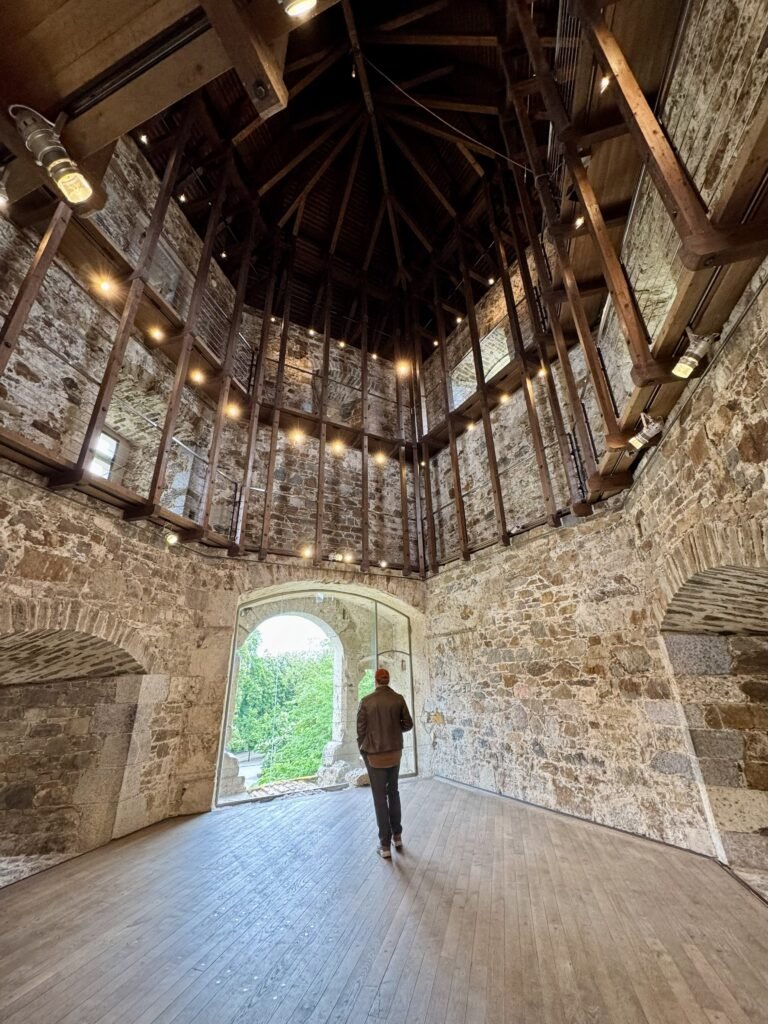
We walk along the castle walls. From the observation tower, there’s a wide view over the entire city, although Ljubljana is fairly flat, so there isn’t really much to grab the eye from up there. The old castle has been renovated in a modern way, successfully respecting the historic walls and other traces of the past while integrating the spaces for 21st-century use. Several restaurants
and cafés are now housed within the complex. We have coffee and a very good tiramisu at the castle before moving on.
Before heading back down, we spot a cozy little bar built right into the castle wall at the edge of the hill. We stop for a drink with a panoramic view.
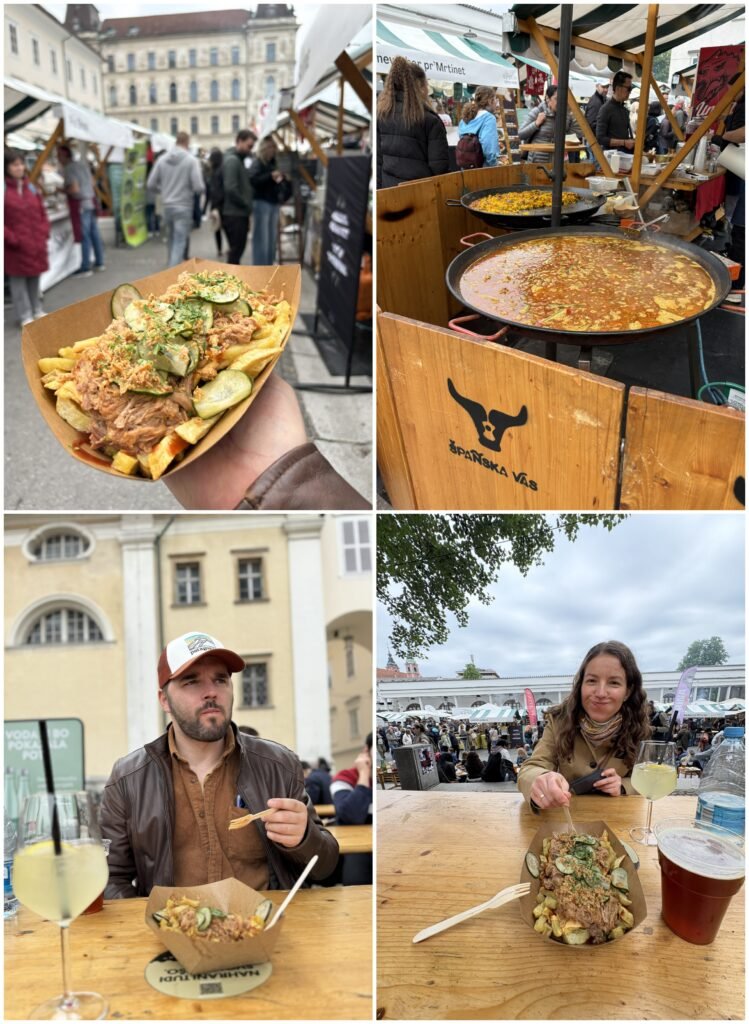
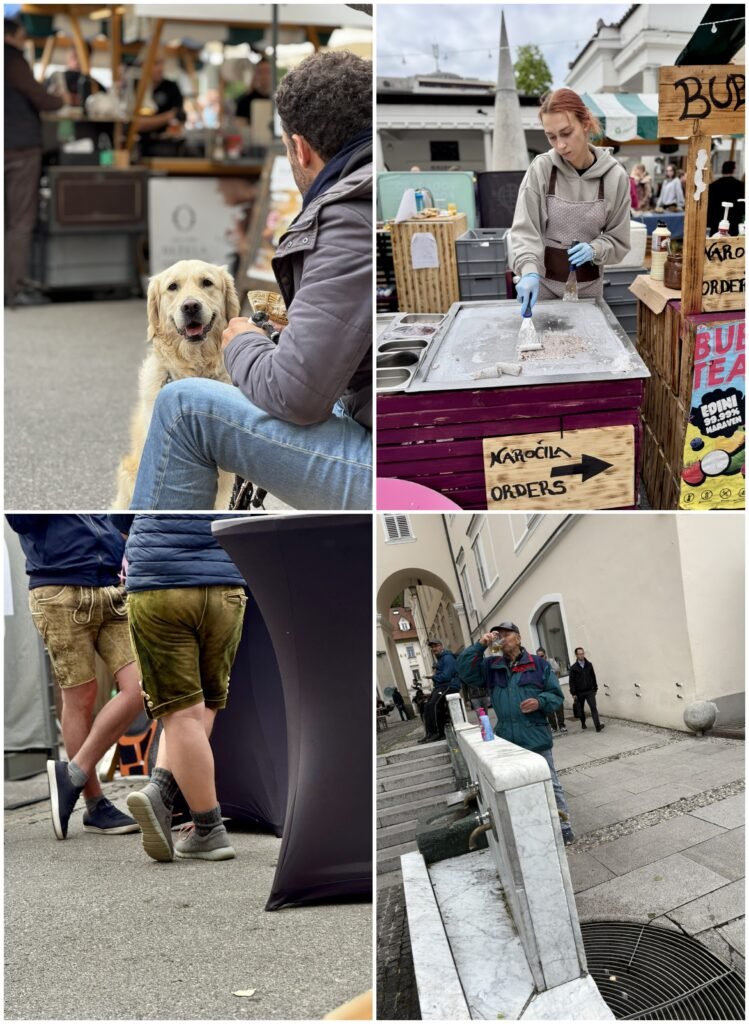
Our next stop is Pogačar Square, where every Friday Ljubljana’s Open Kitchen takes place — a street food market featuring both local chefs and well-known restaurants. We stay for lunch. Fries topped with pulled pork — one portion is more than enough for the two of us. Very good. Before moving on, we also “give in” to ice cream.
SLAP SAVICA
10.05.2025: After breakfast, we head straight off to pick up our car for the next five days. This time, we’re renting from AvantCar. A white Mercedes awaits. The pickup is quick and straightforward — although the security deposit turns out to be absurdly high – 1 700 euros.
Everything is, of course, refunded in the end, but it’s definitely one of those moments where you’re very glad to have a credit card handy and a limit that can handle a number like that. Once that’s sorted, we’re good to go.
We drive straight to Vintgar Gorge, about a 50-minute drive from Ljubljana. The first attempt, however, doesn’t quite work out — it turns out tickets for the gorge have to be purchased online in advance, and the nearest available time slot is only at 3:00 p.m., five hours later. We regroup quickly, buy tickets for 4:00 p.m., and adjust the day’s schedule accordingly. Good thing we have our own car — travel freedom at its best.
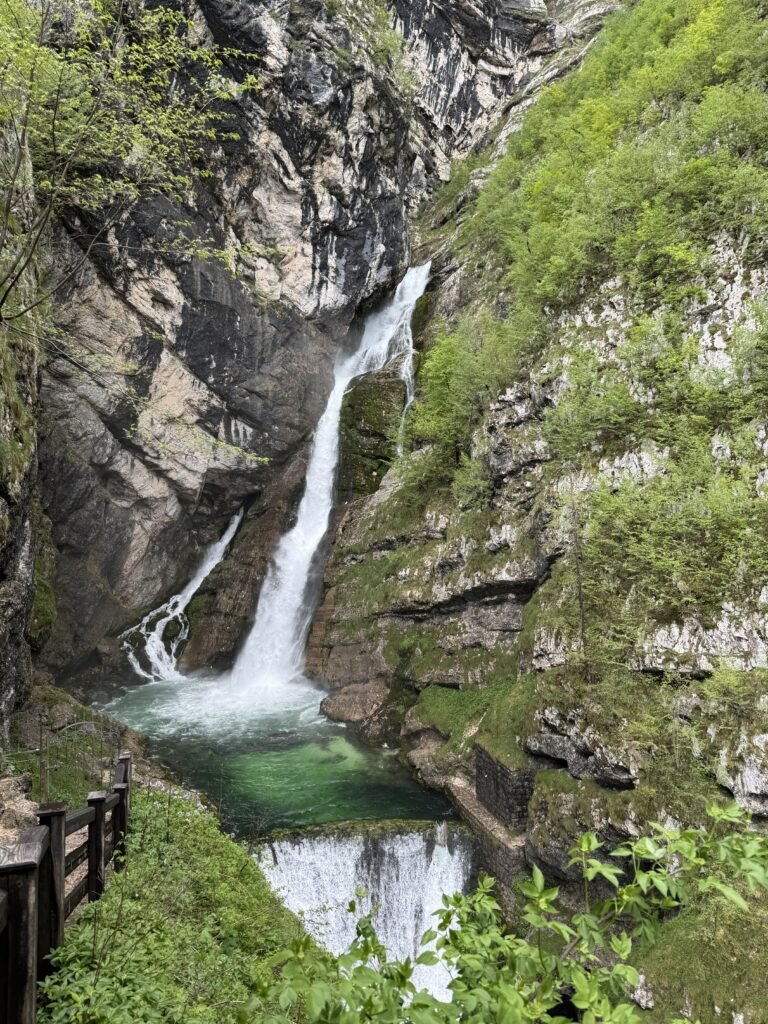
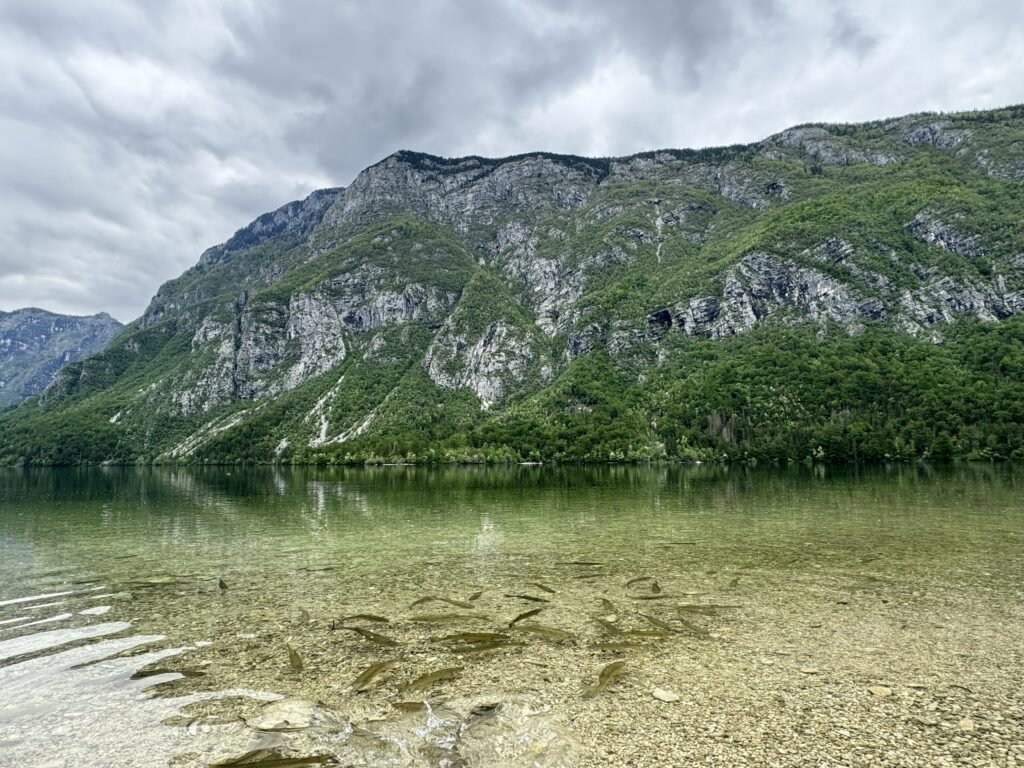
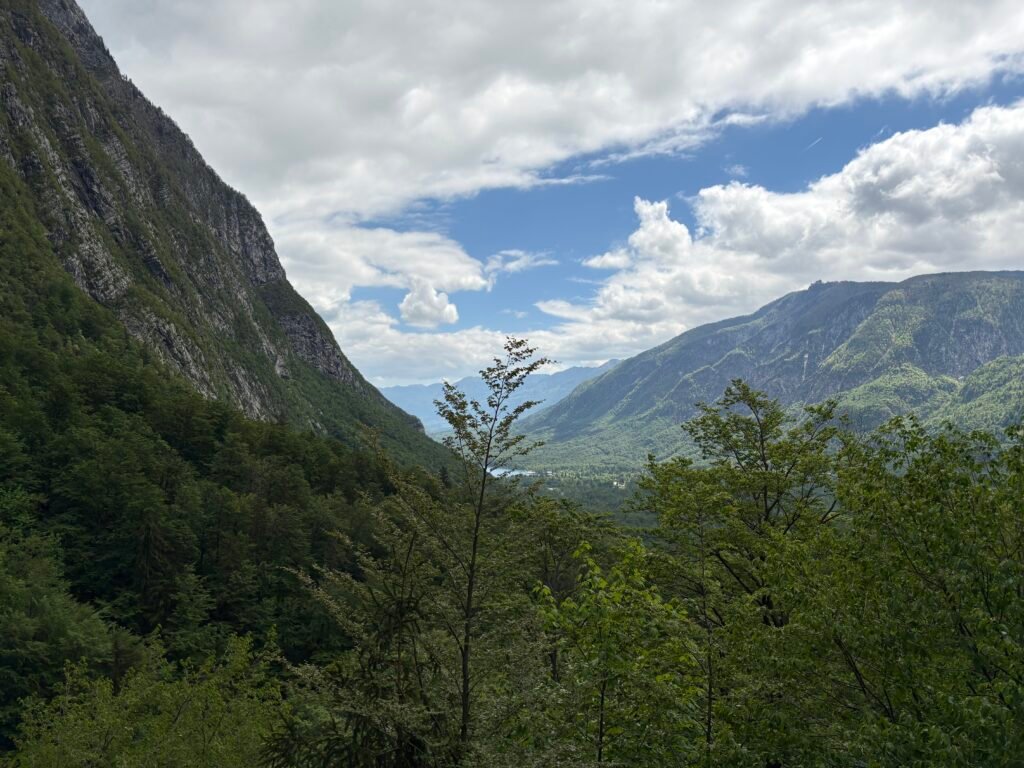
We then head to the region’s second-most famous lake — Lake Bohinj. It’s the deepest and largest permanent lake in Slovenia, surrounded by the landscapes of Triglav National Park. Nearby, we also visit the Savica Waterfall (Slap Savica), Slovenia’s most visited waterfall, cascading from a height of 78 metres. The walk to the waterfall takes about 20 minutes along a well-maintained trail. Not long into the hike, layers start coming off. Even though it’s not particularly warm outside, constantly climbing stairs quickly does the trick.
We also stop for lunch by the lake — the weather is good, so this ends up being a perfectly acceptable Plan B. There was a thought about taking the cable car up to Mount Vogel, but it’s quite expensive for what would have been only a very short visit. If we could have dedicated at least a few hours to it, it would absolutely have been worth it. That one’s for next time.
VINTGAR GORGE
10.05.2025: Entry to Vintgar Gorge with a purchased ticket is strictly timed to the exact minute — no early access allowed. The entrance fee is €10 per person. Since we arrive almost an hour too early, we sit down at a local café for a coffee. At the entrance, everyone is issued a safety helmet — safety first. We end up being among the very last visitors to enter the gorge today.
At first, it seemed a bit strange that the final entry slot is already at 4:00 p.m., but later it becomes clear why — after finishing the gorge trail itself, there’s still about a 5 km walk through forest
paths back to the starting point. It’s not exactly a one-way stroll.
The schedule is clearly designed so that visitors make it back to the parking area before dark.
A whole group of German retirees heads out onto the trail just ahead of us, which means we’re forced into a leisurely pace whether we like it or not. Along the way, there’s the option to listen
to an audio guide — unfortunately rather monotonous and dull, though delivered with great enthusiasm.
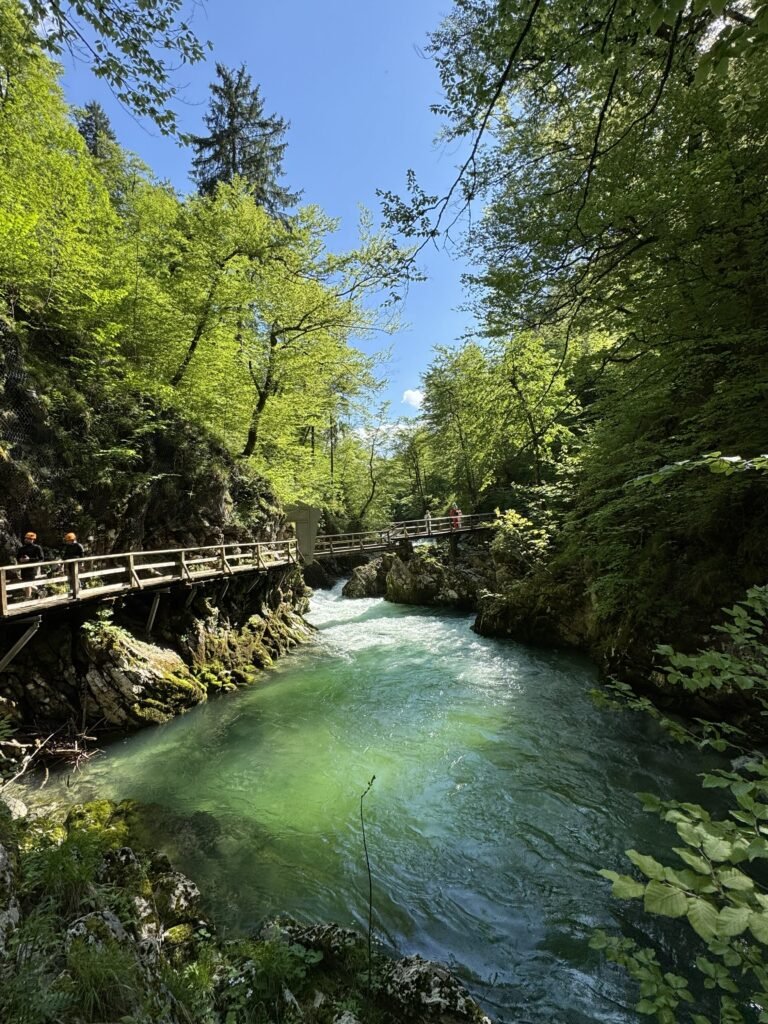
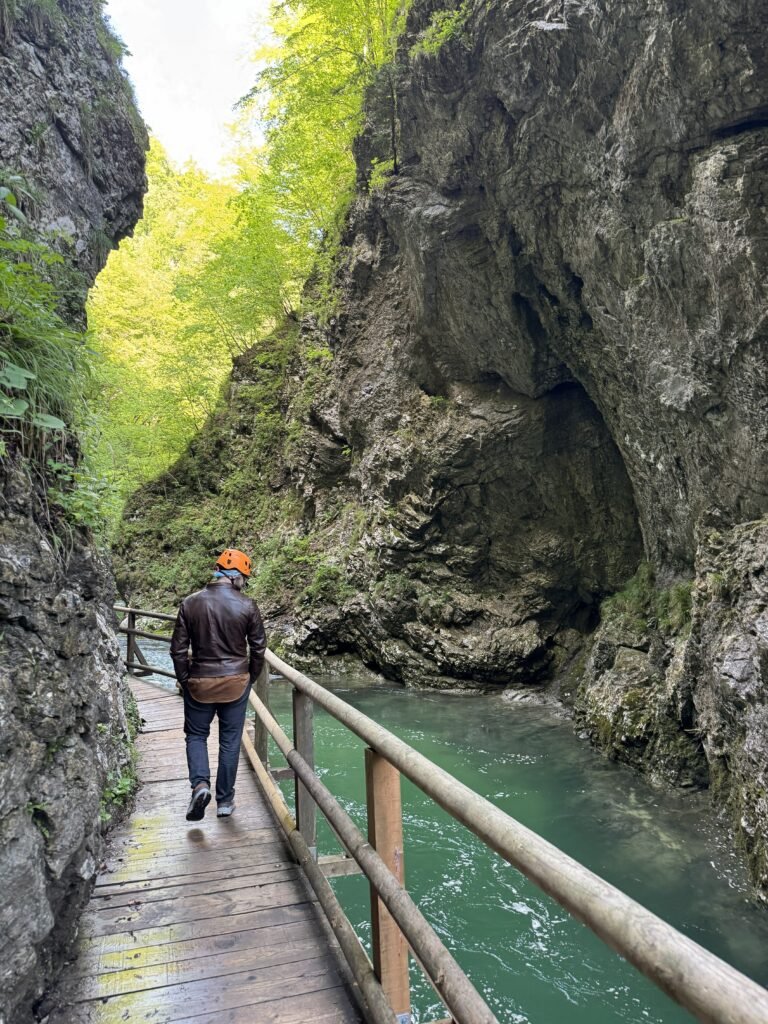
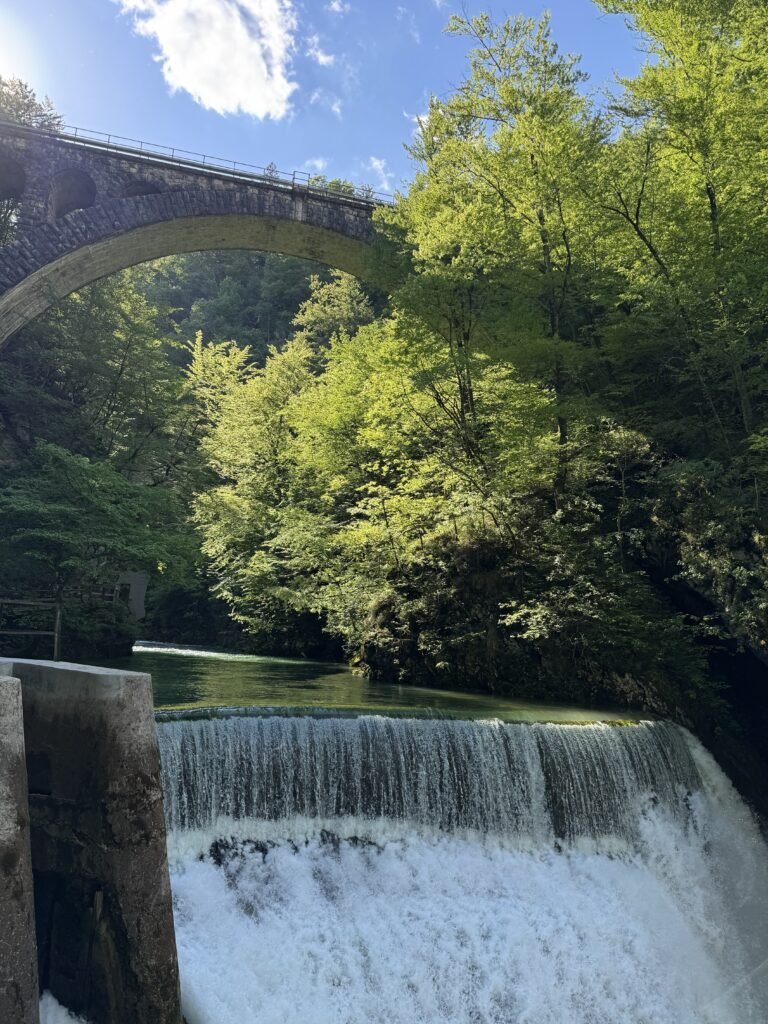
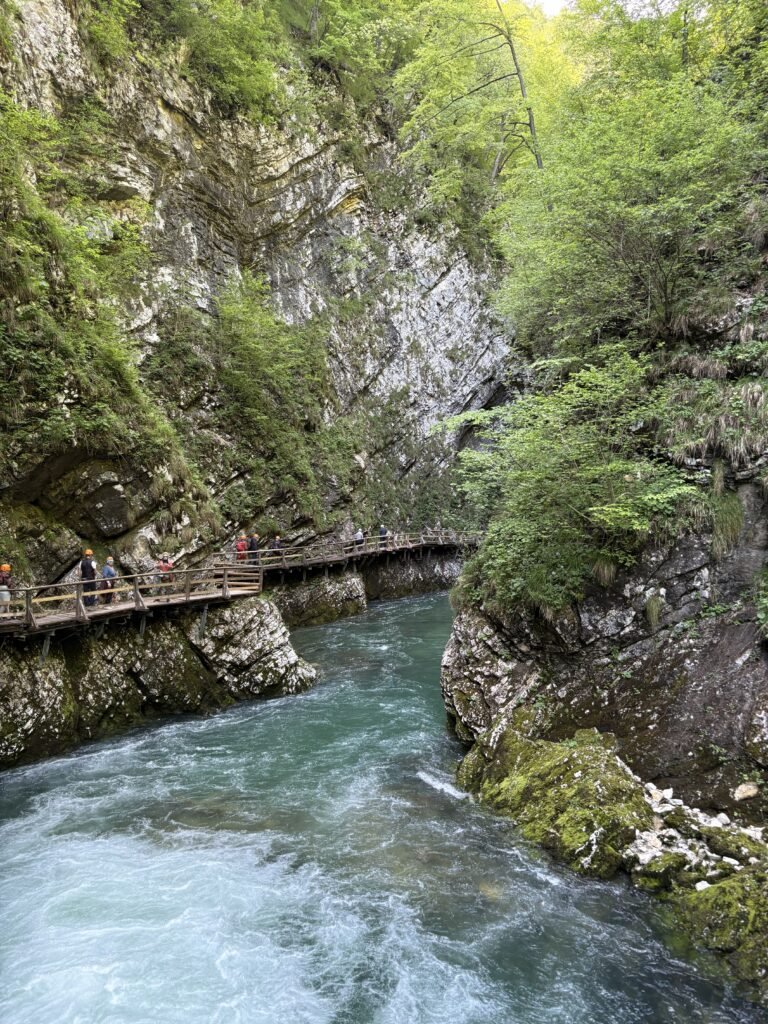
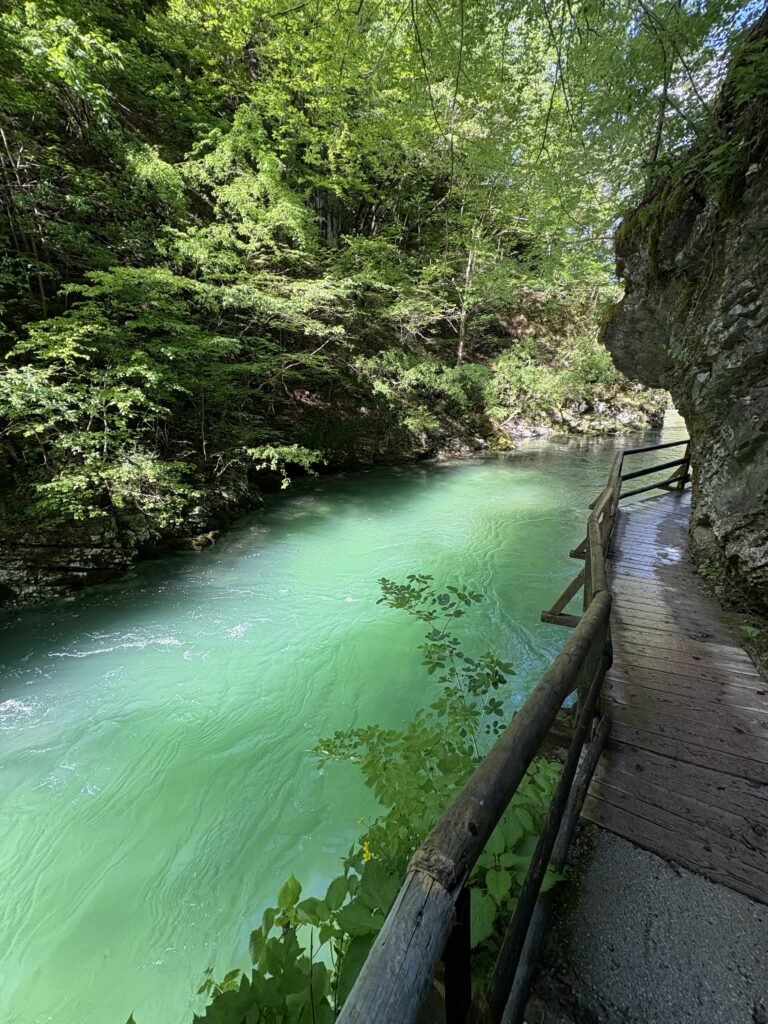
The gorge itself is genuinely impressive. Vintgar is one of Slovenia’s most popular nature trails, with wooden walkways running along the rapids and waterfalls of the Radovna River. It’s been raining heavily over the past few days, so the water levels are high, making everything feel more dramatic — stronger rapids, bigger splashes, and a constant roar. Definitely worth the visit.
In the evening, after settling into our accommodation, we stop by a small bar on the lake shore — a calm way to end the day. The roar of the gorge’s rapids is replaced by the clink of tourists’ beer glasses. Still, it doesn’t quite feel like everyone around us is a tourist. It’s not high season yet, and it seems there are plenty of locals — or at least Slovenians — around as well.
BLEJSKI GRAD
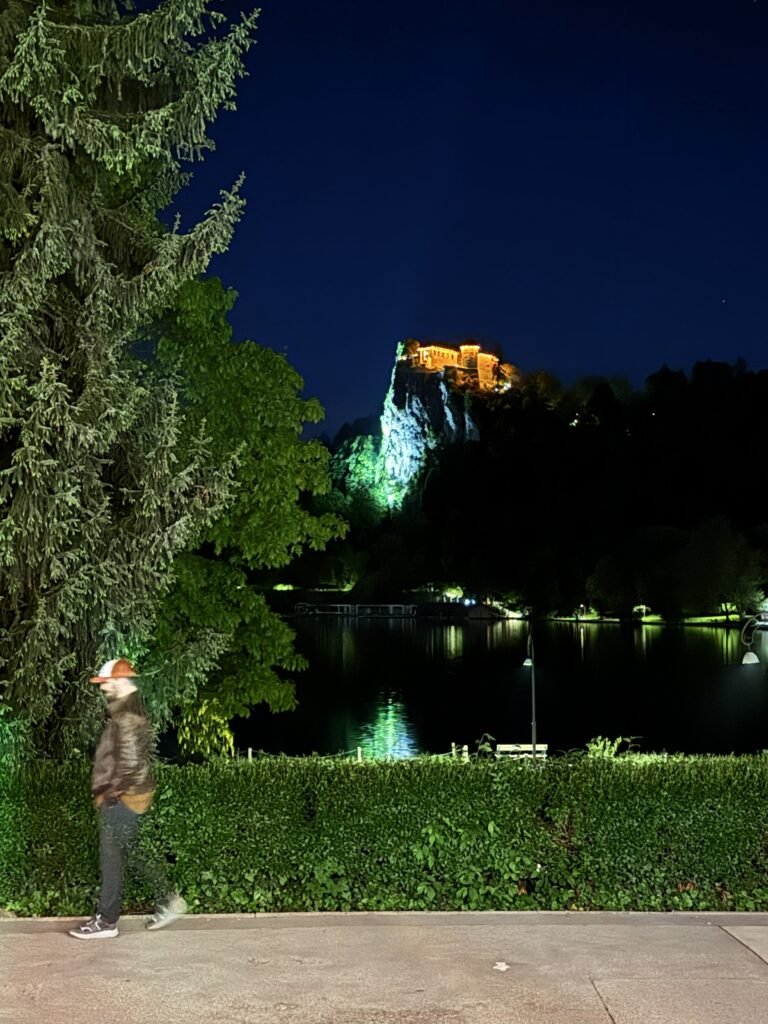
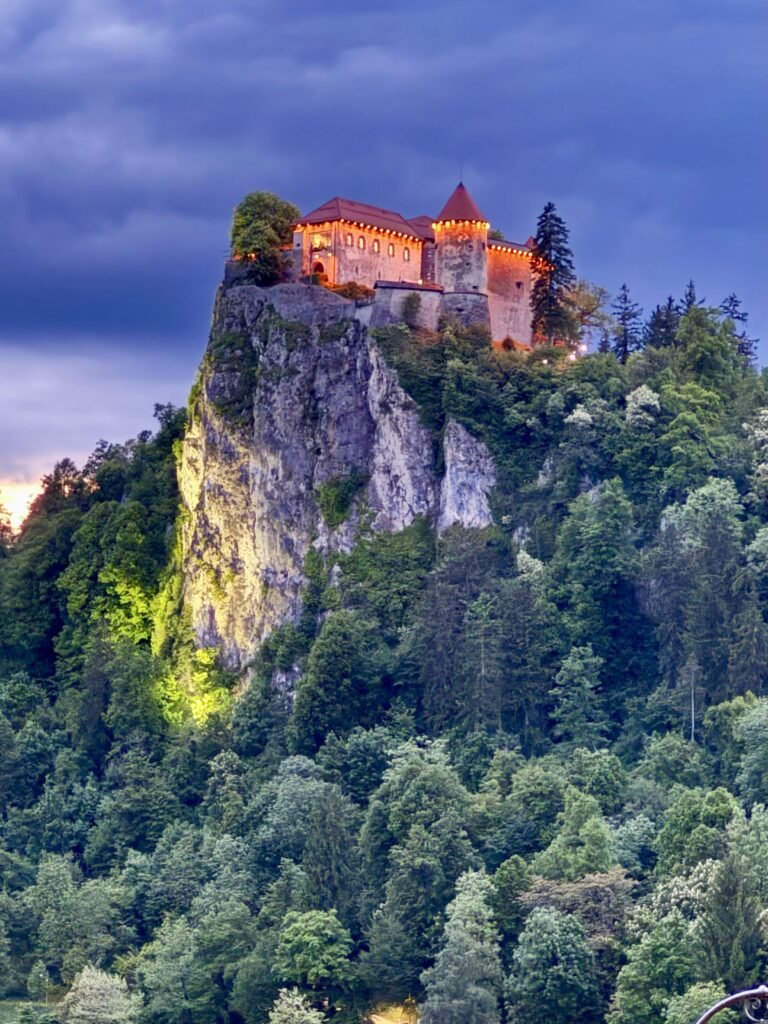
11.05.2025: We start today’s walk around Lake Bled with a climb up the hill to Blejski Grad — Bled Castle. We hadn’t planned on going inside, but it turns out you can’t get past the first wall without a ticket. So, not wanting to turn back empty-handed, we end up buying tickets and heading in. €18 per person.
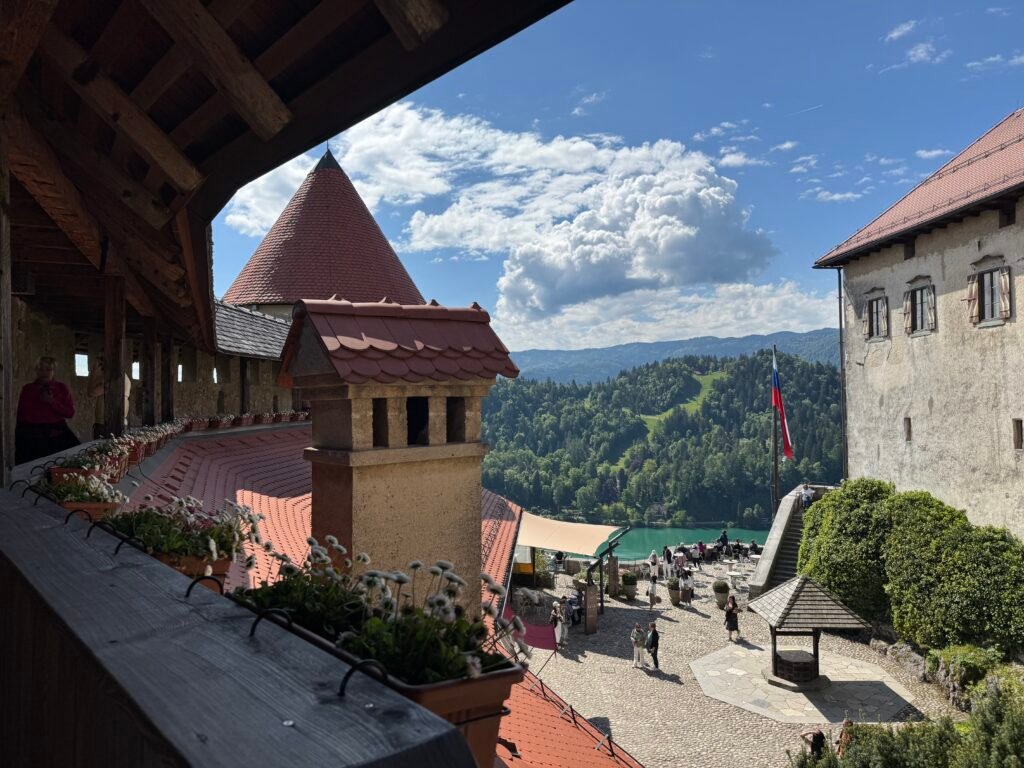
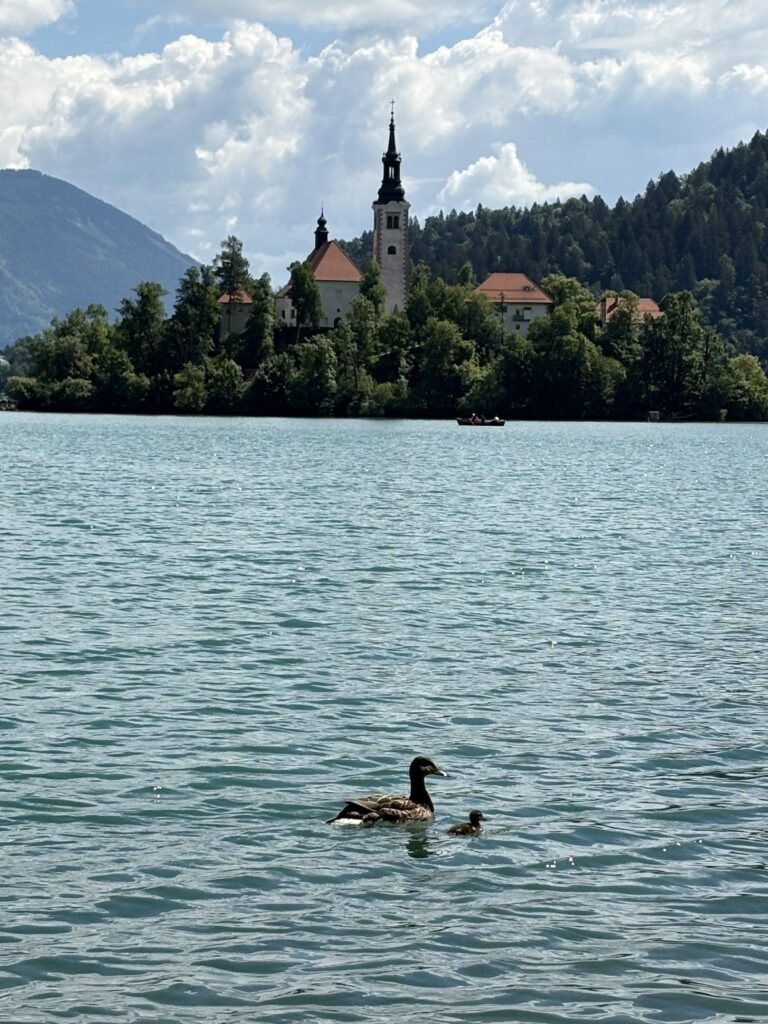
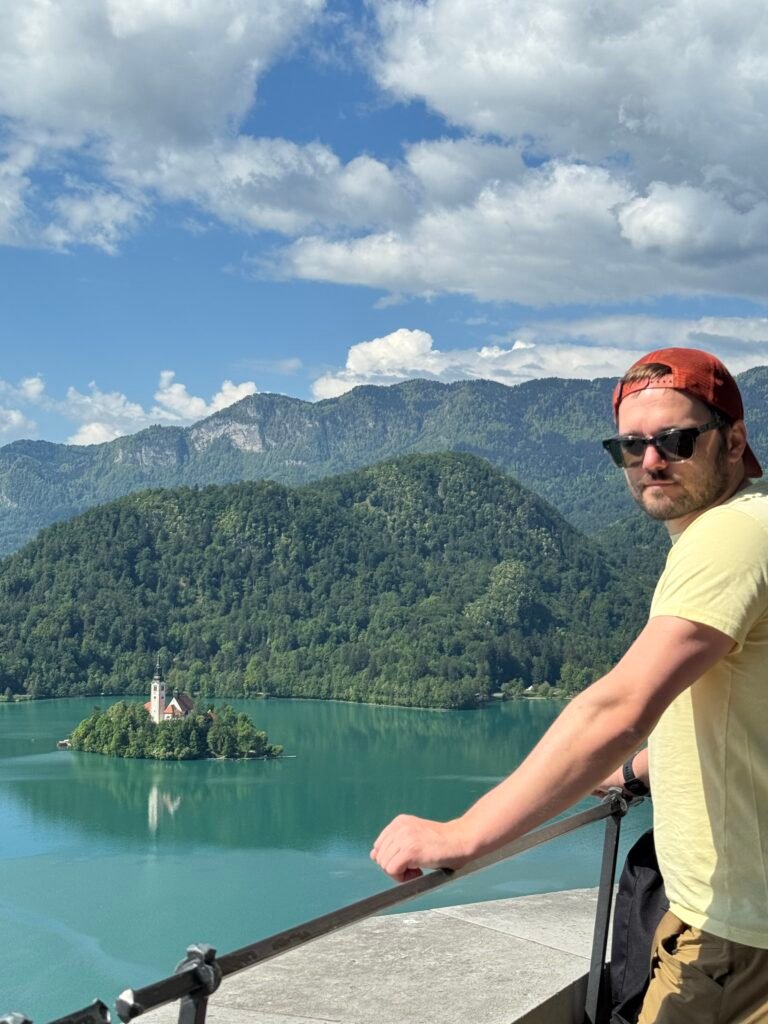
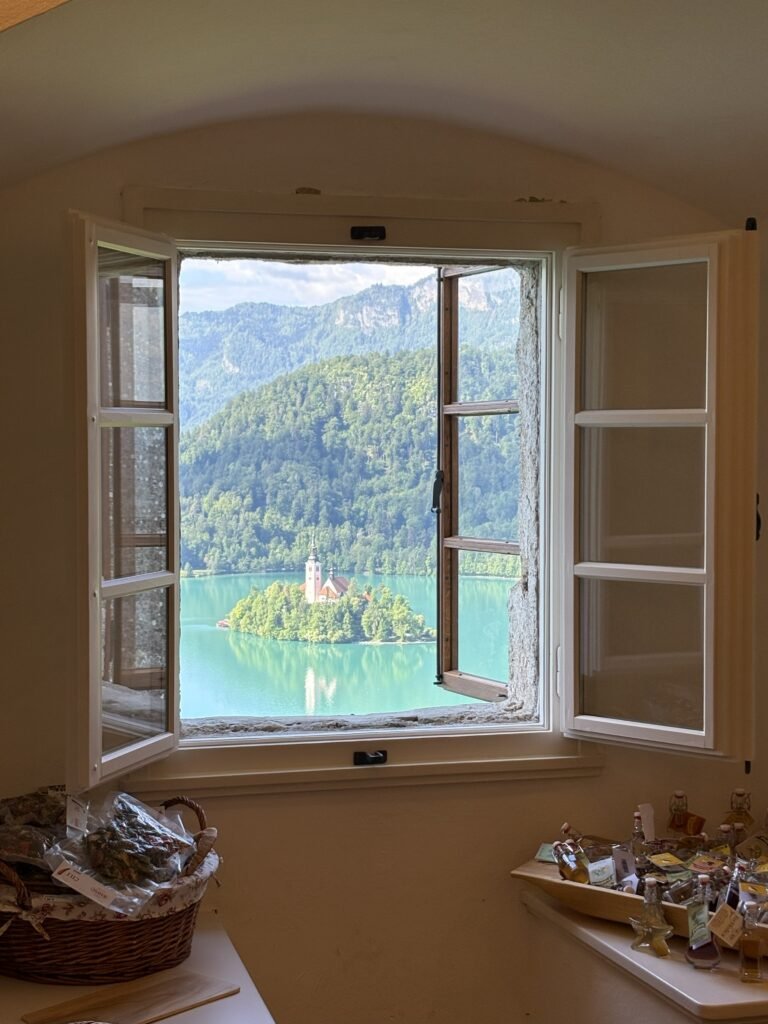
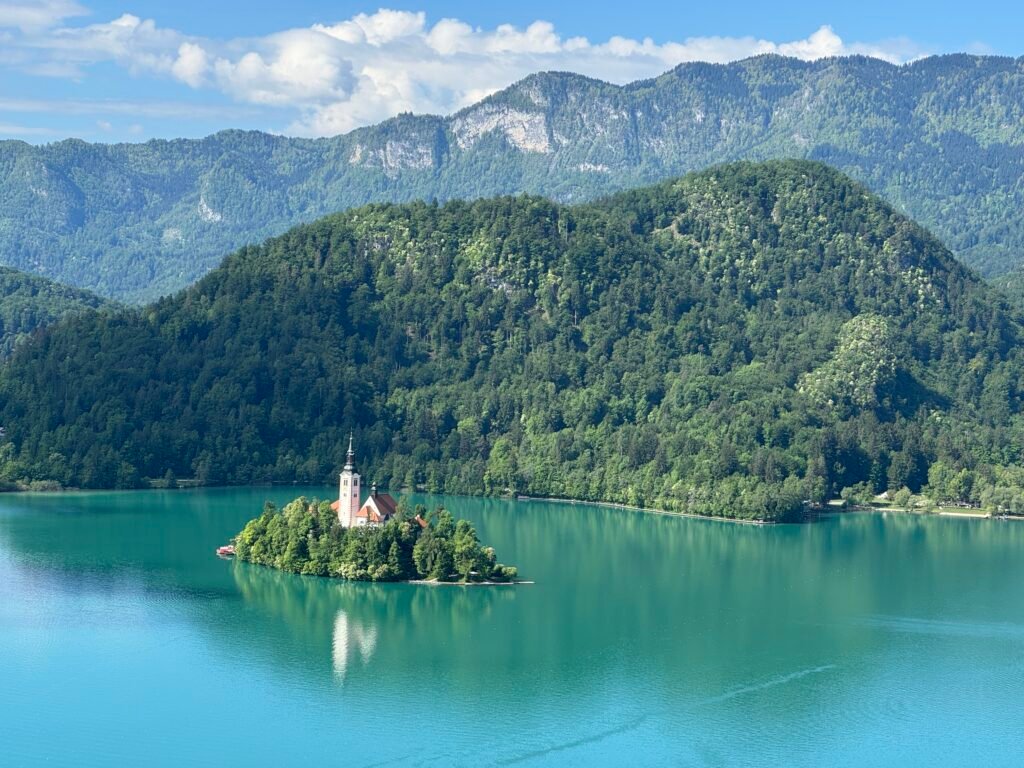
The castle museum itself is clean and well maintained, and I’m sure it’s interesting — just not today. We’re not really in the mood to read and study exhibits; today is more about walking and looking at things. The real highlight is the view from the castle balcony: one of Slovenia’s most iconic sights — the lake with the little church on the island in the background. By the way, Blejski Grad is the oldest castle in Slovenia, first mentioned as early as the 11th century.
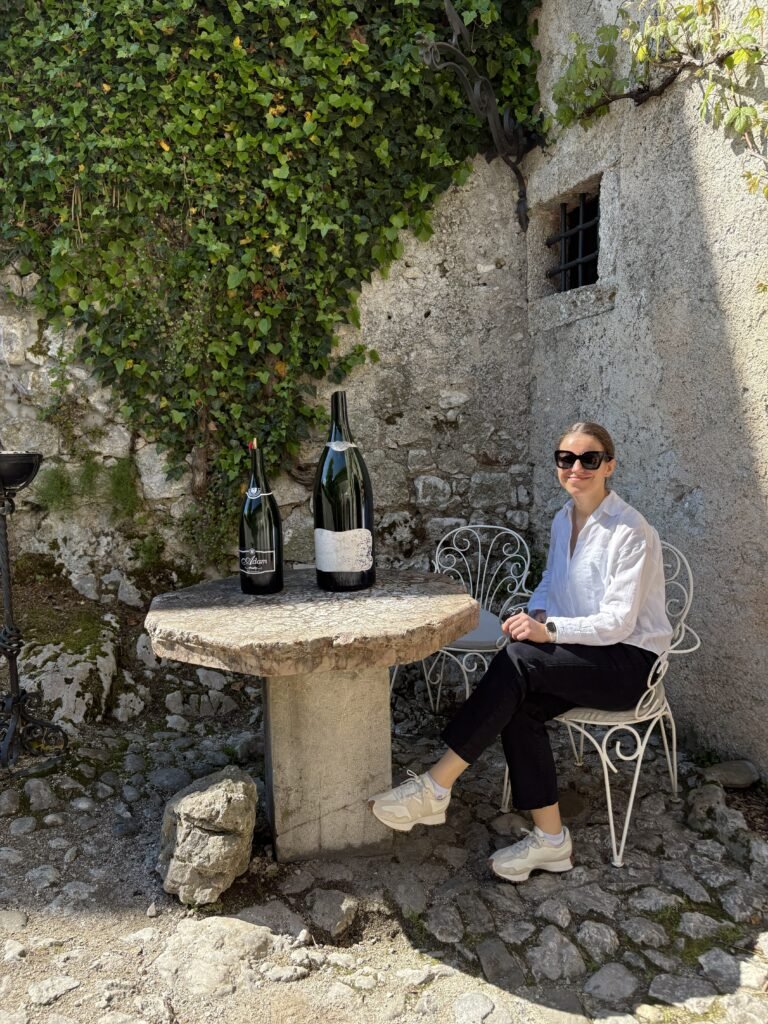
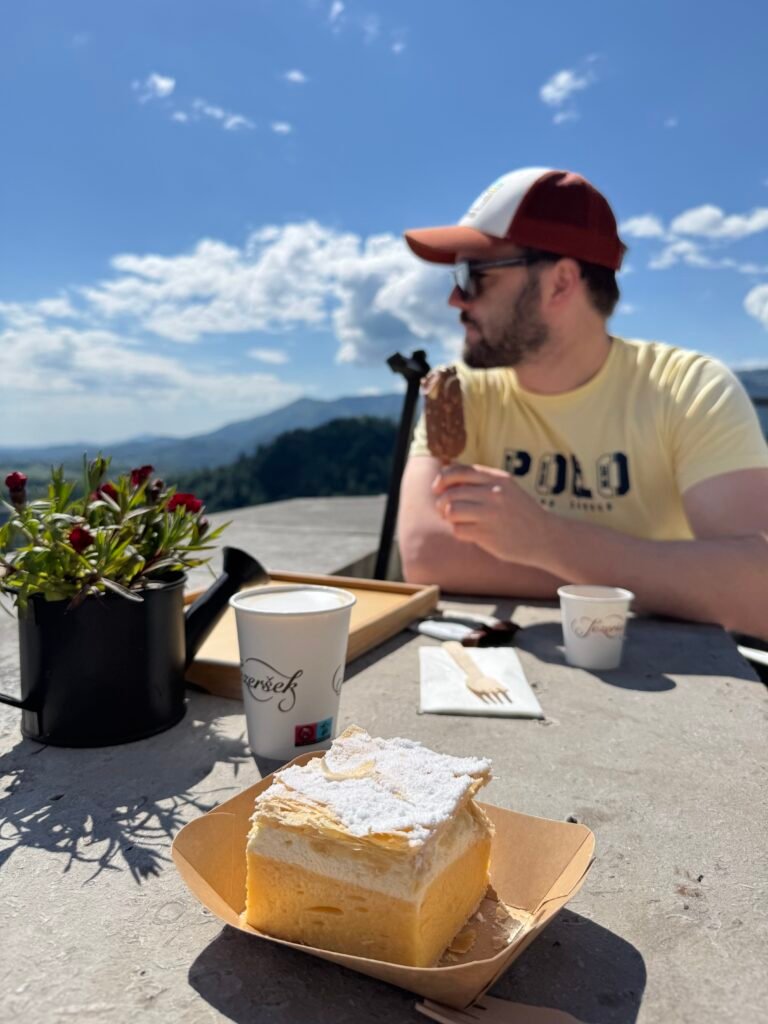
In the castle shop, we buy a colouring book with scenes from Slovenia for our goddaughter — at least a souvenir with some potential for creative post-processing. From the museum shop window, there’s also a particularly picturesque view over Bled Island and its church. Before moving on, we grab a coffee on the castle balcony, and Madara finally gets her hands on the famous Bled cream cake (Blejska kremšnita) — a classic, tower-like dessert of puff pastry and vanilla cream, as iconic to locals as the lake itself.
OJSTRICA/ MALA OSOJNICA
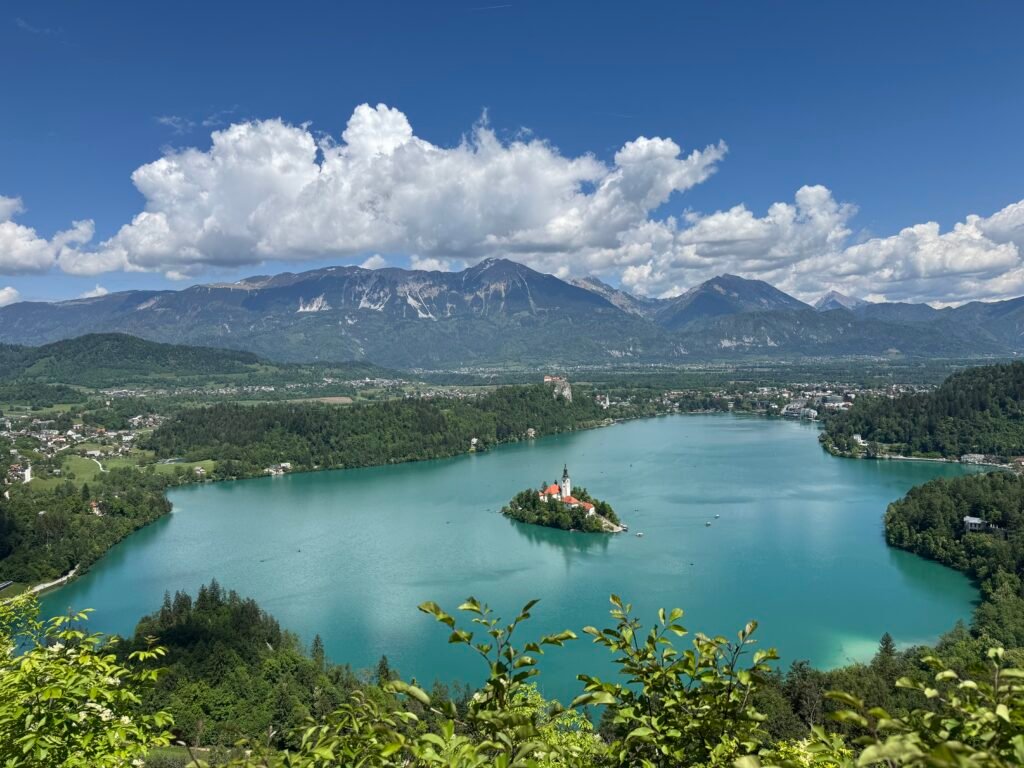
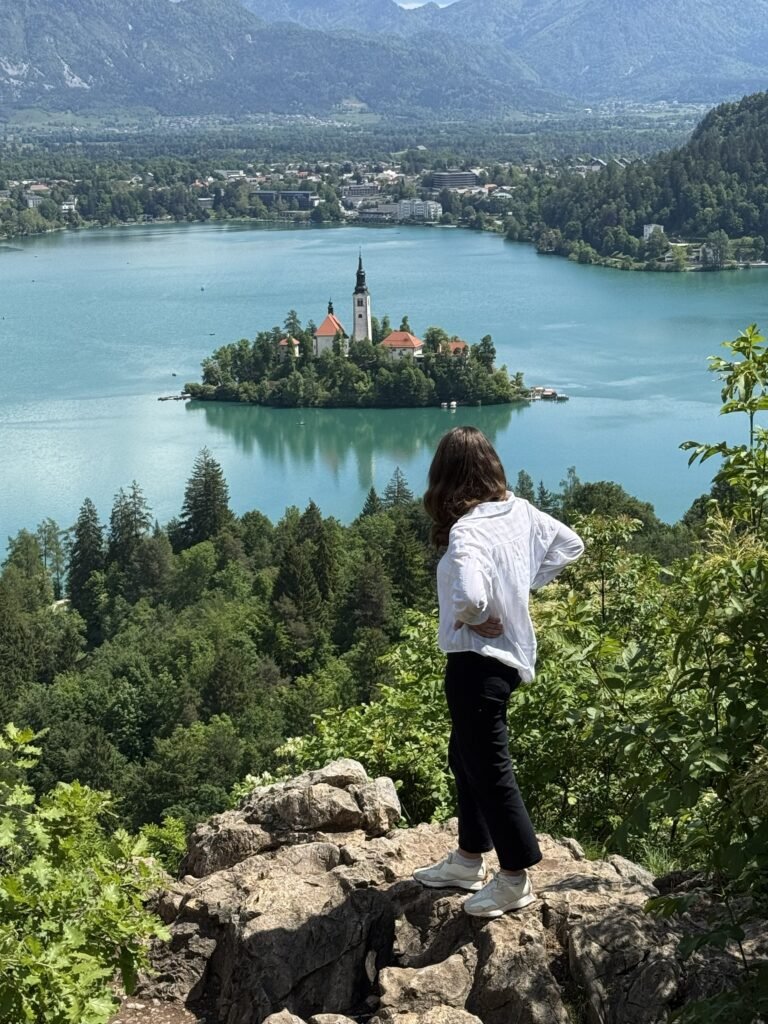
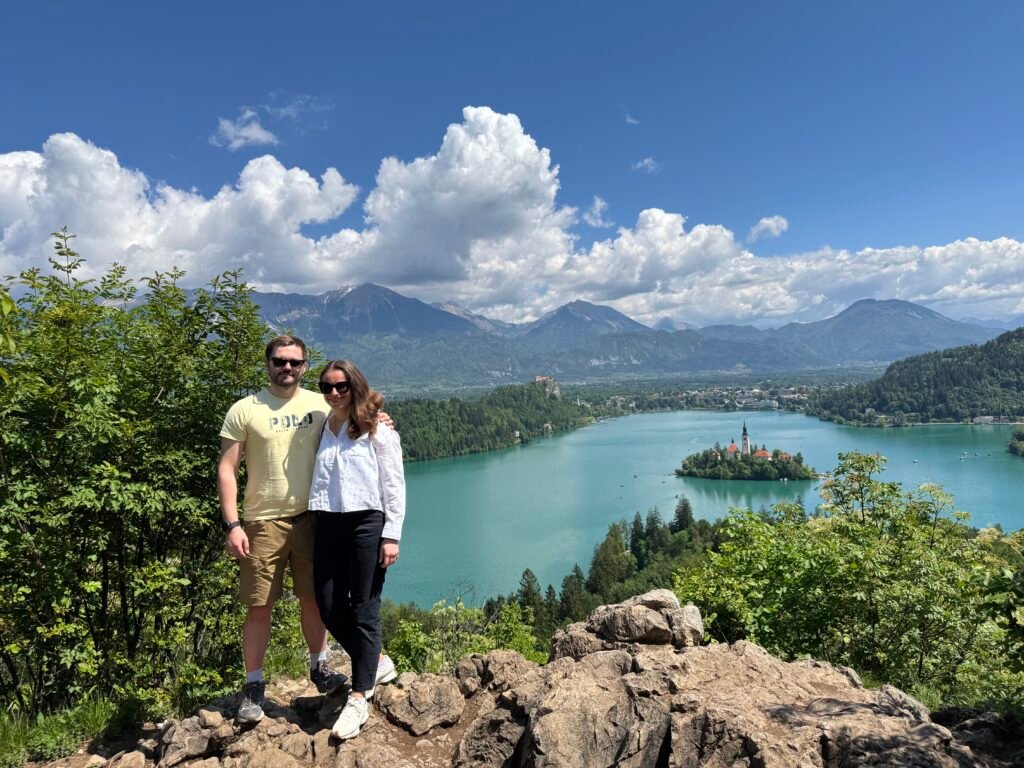
11.05.2025: The route along the lake follows a well-maintained, paved promenade. Despite earlier forecasts, we’ve been lucky with the weather — sunshine, pleasant temperatures around +16–18°C. Every now and then, a cloud peeks over the Julian Alps, but overall the conditions are ideal for a hike. To see Bled Island from above, a fair bit of effort is required. The climb up to the Ojstrica viewpoint, located on the slopes of the hill of the same name, is steep and rocky. Going up is manageable, but on the way down people clearly struggle — the loose stones are slippery and unforgiving. Good thing someone planned this hike in the opposite direction for us.
From the top, the view is genuinely impressive: the clear turquoise water of the lake, tiny boats
moving like ants toward Blejski otok — the only natural island in all of Slovenia — topped by a
17th-century church. In the background, the recently visited Blejski grad sits right on the edge of
the cliff.
After a quick call to parents back home in Grobiņa, Latvia , we continue on to the next viewpoints. In total, we visit three today. There’s no major difference between them — just changes in angle and sunlight — while the island and the castle remain the same. Still, the scenery is impressive every single time. The hike between viewpoints also gives us time to “digest” what we’ve seen and reset before the next lookout.
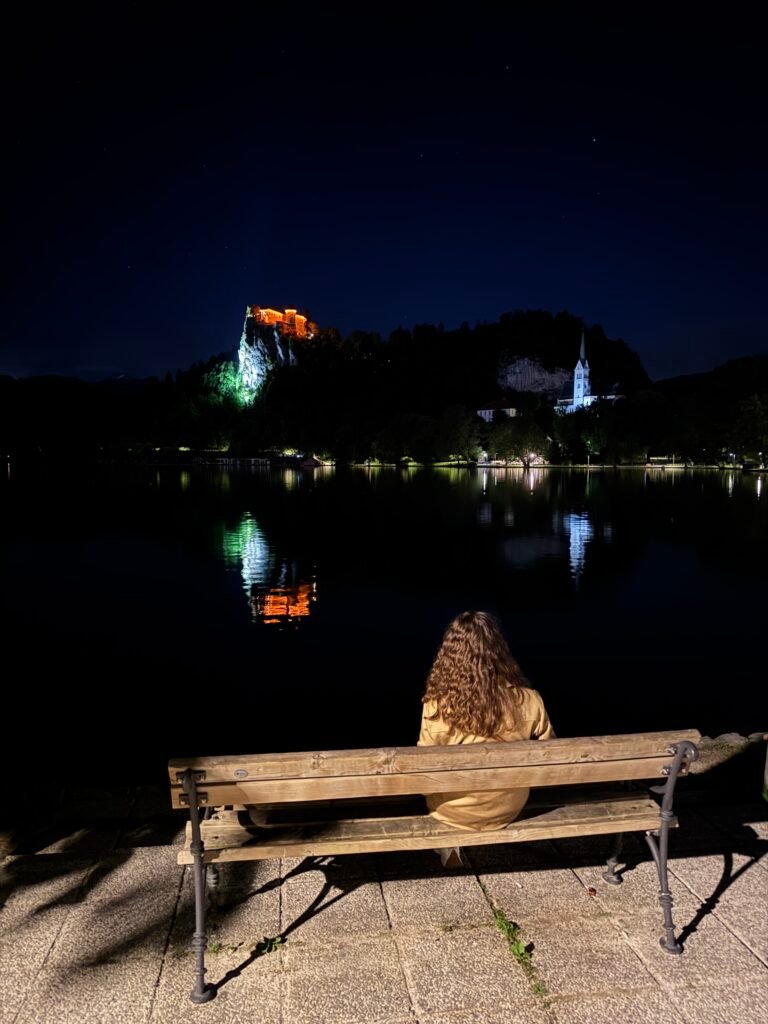
After roughly four hours of hiking, we finish the day with a meal at a restaurant by the lake. From
our table, Blejski otok is visible over our shoulders. Sitting by the water and resting our legs, we
also give my Grandma a call.
KOBARID
12.05.2025: In Bled, they’ve come up with a really nice idea. You can order a breakfast box that gets delivered to your door early in the morning. It’s not particularly cheap — €28 for two — but what arrives is a full box of local produce: sausages, bread, eggs, muesli, yoghurts, and more. So much food, in fact, that we can’t finish it all. At least there’ll be something left for an afternoon snack.
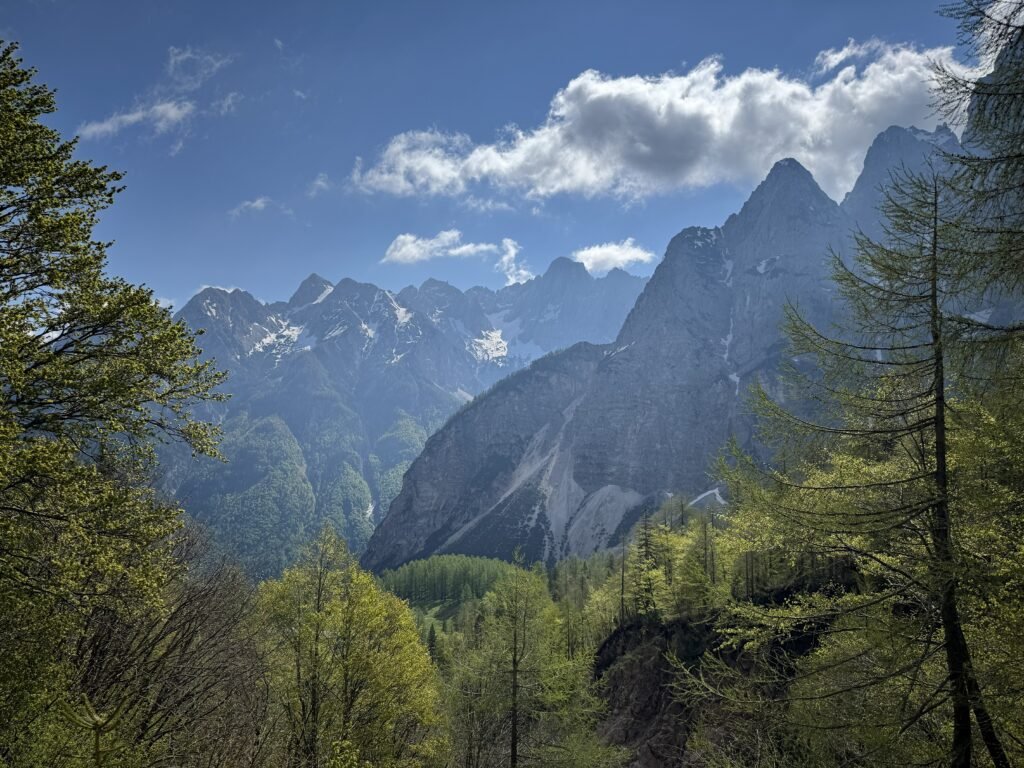
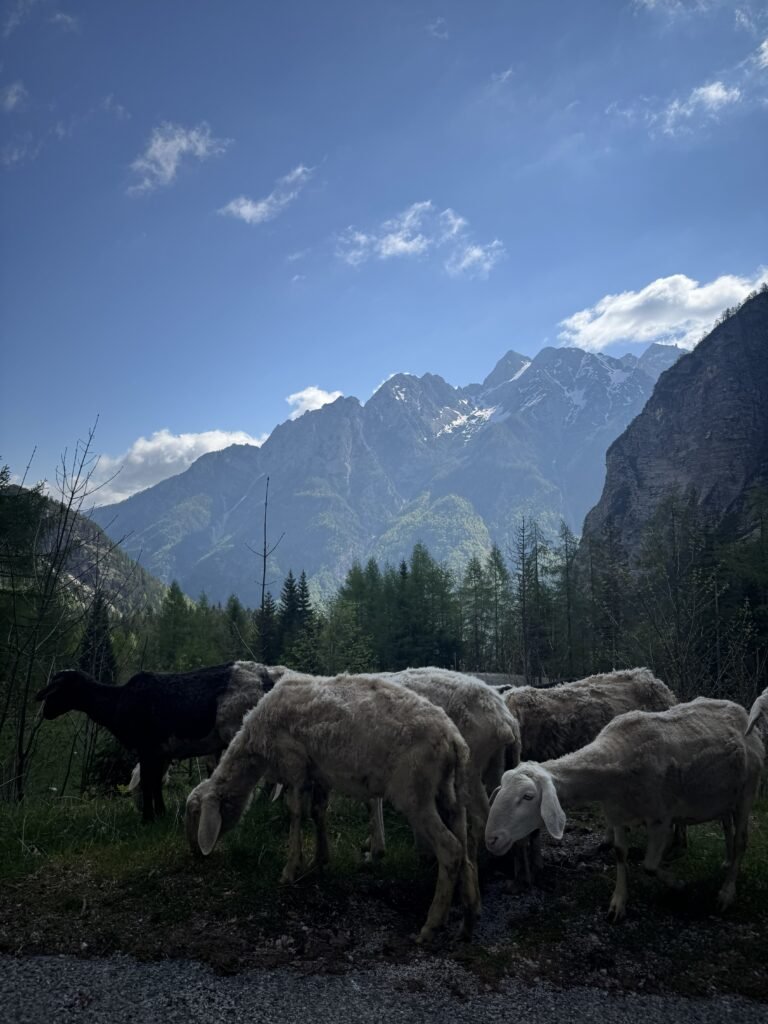
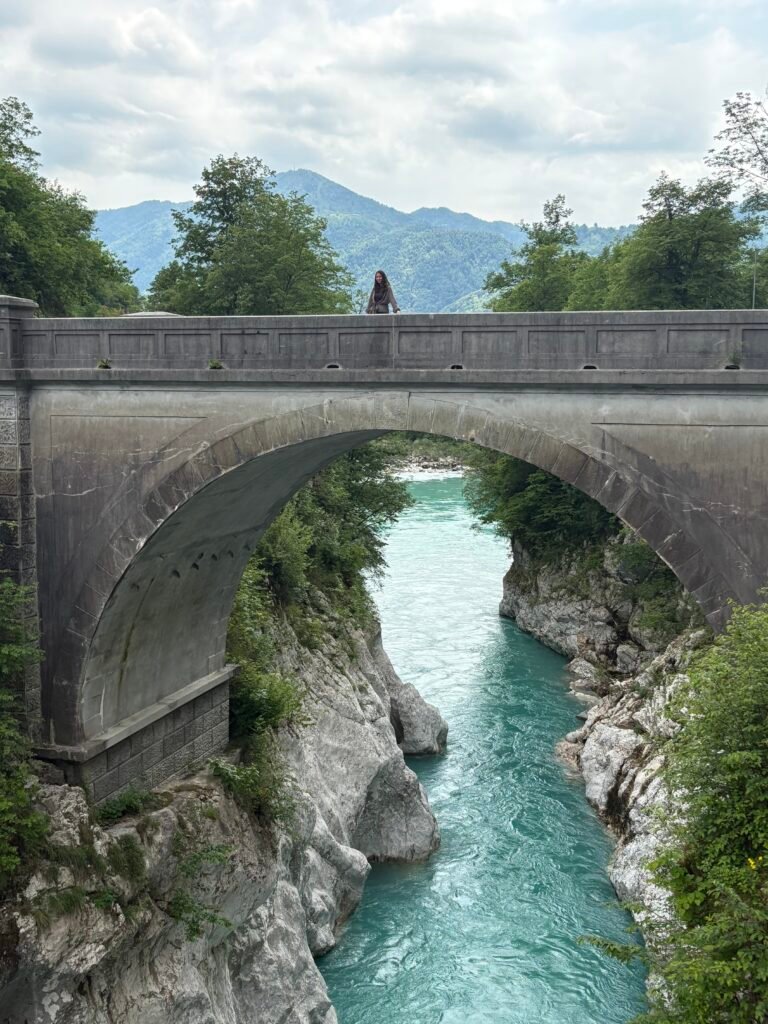
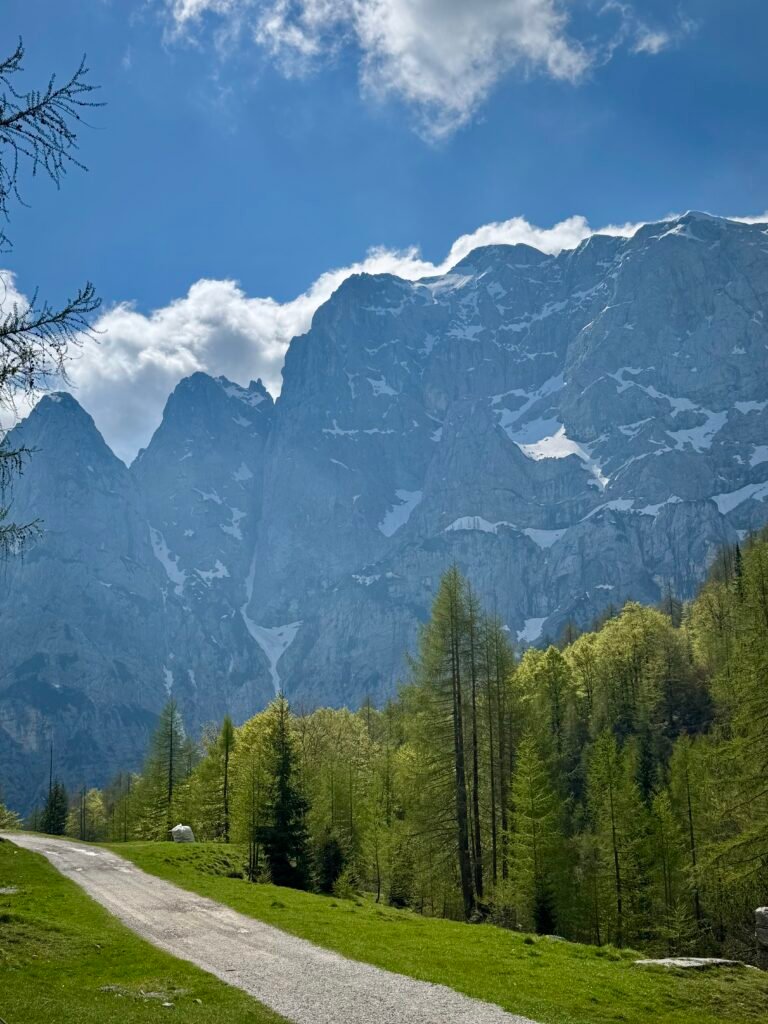
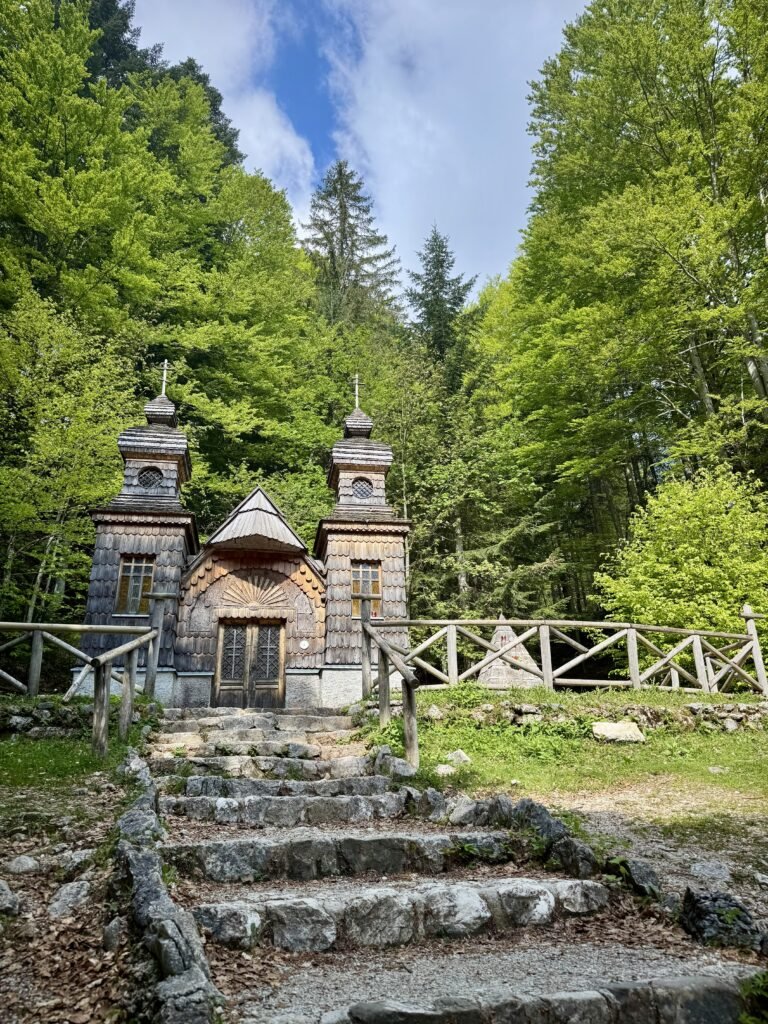
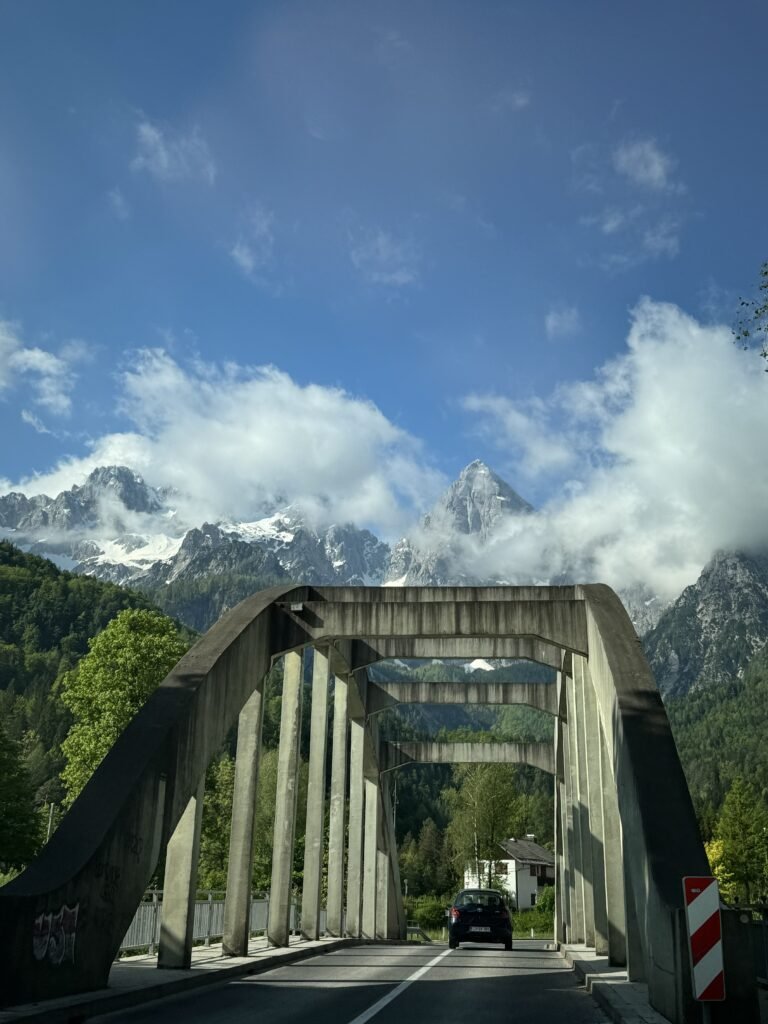
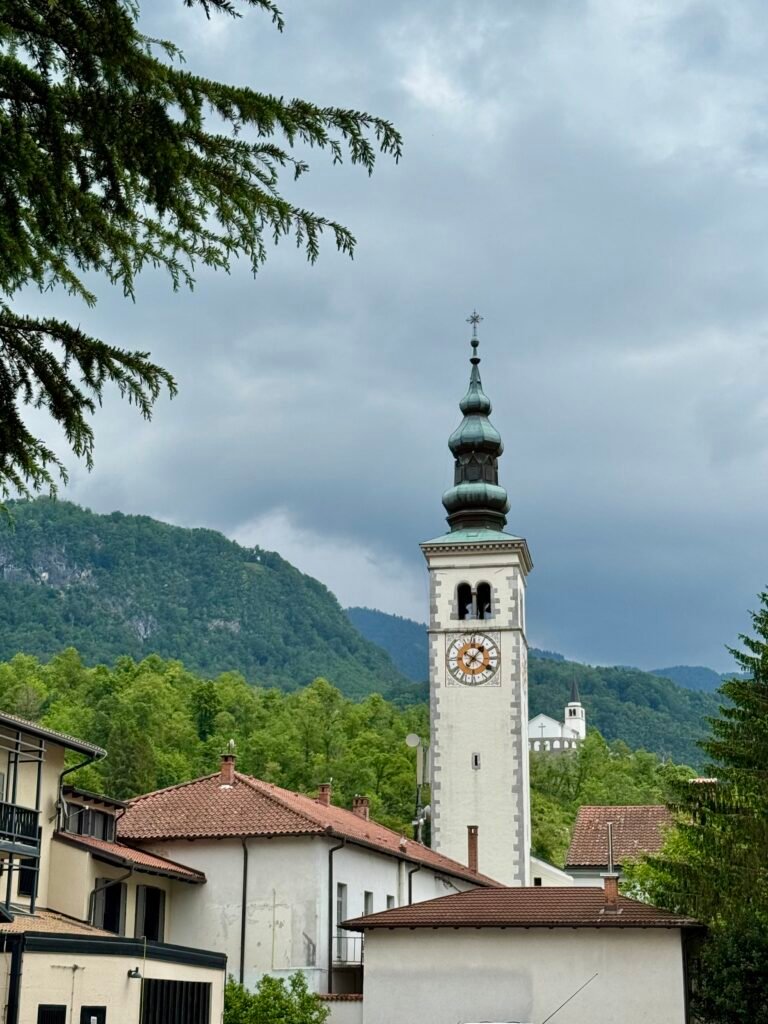
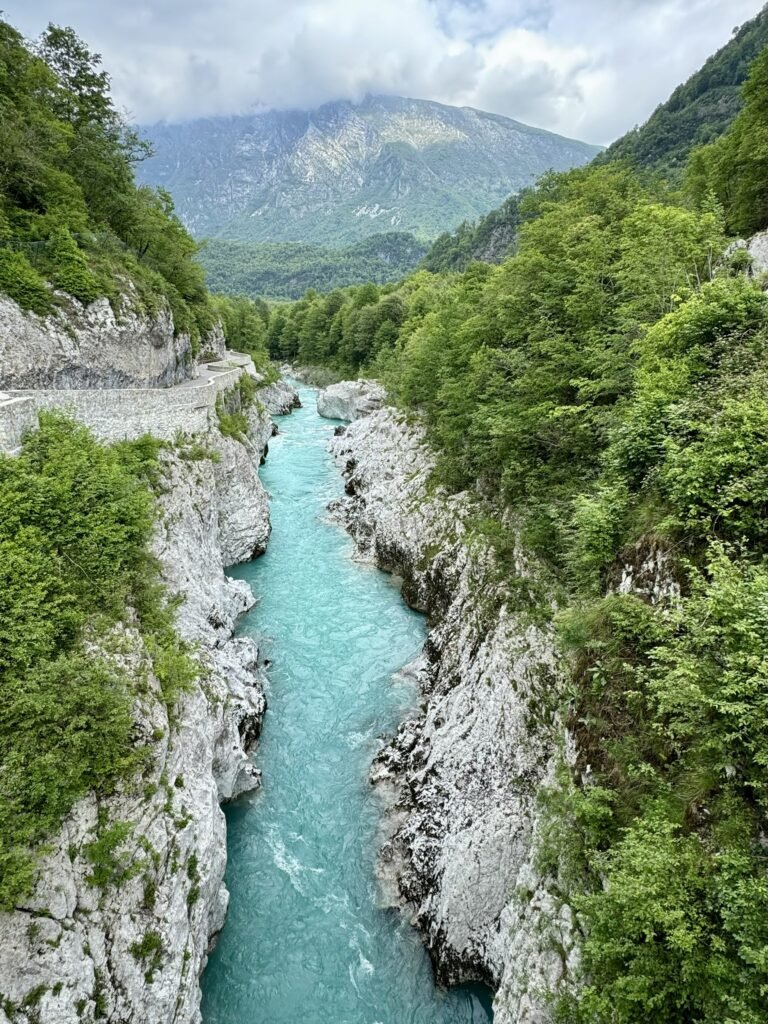
A bit later than planned, we finally hit the road — heading toward the mountains. Our first stop is the Russian Chapel. Back in 1916, Russian prisoners of war were building the serpentine road over the Vršič Pass and also constructed this small wooden chapel for themselves. It’s an interesting spot for a short 10-minute stop. In 2016, marking the chapel’s centenary, even Putin attended a commemorative event here. Personally, though, my attention during this stop is drawn to a road sign announcing that the Vršič Pass is closed due to roadworks. The information isn’t entirely clear, so we decide to try driving on anyway. Unsurprisingly, about ten minutes later we run into a roadblock. There’s still some movement visible further up the road, which makes the situation even more confusing. A group of four motorcyclists seems just as unsure about what to do. Luckily for us, the construction site manager drives down at that exact moment and speaks good English. He explains the actual situation: roadworks are ongoing from 7:00 a.m. to 5:00 p.m., and during that time only cyclists and motorbikes are allowed through. The bikers are in luck — we, on the other hand, have to turn around. After a bit of discussion, we conclude that the best option is to detour through Italy toward Soča and Trenta — about a two-hour loop, but at least along a scenic route. We could have skipped the Soča Valley altogether, since we can’t reach the second viewpoint either due to the same roadworks on the pass, just from the other side. But no matter — at least we get a proper drive along the Soča Valley’s winding roads, after which Madara conveniently makes room in her stomach for lunch. We stop for lunch in the village of Kobarid. It seems to be a popular destination for kayakers on the Soča river. Naturally, it’s off-season now, so everything is quiet. After a short walk to stretch our legs, we sit down at a local café. I order what I think are potato pancakes with cheese, but what actually arrives are
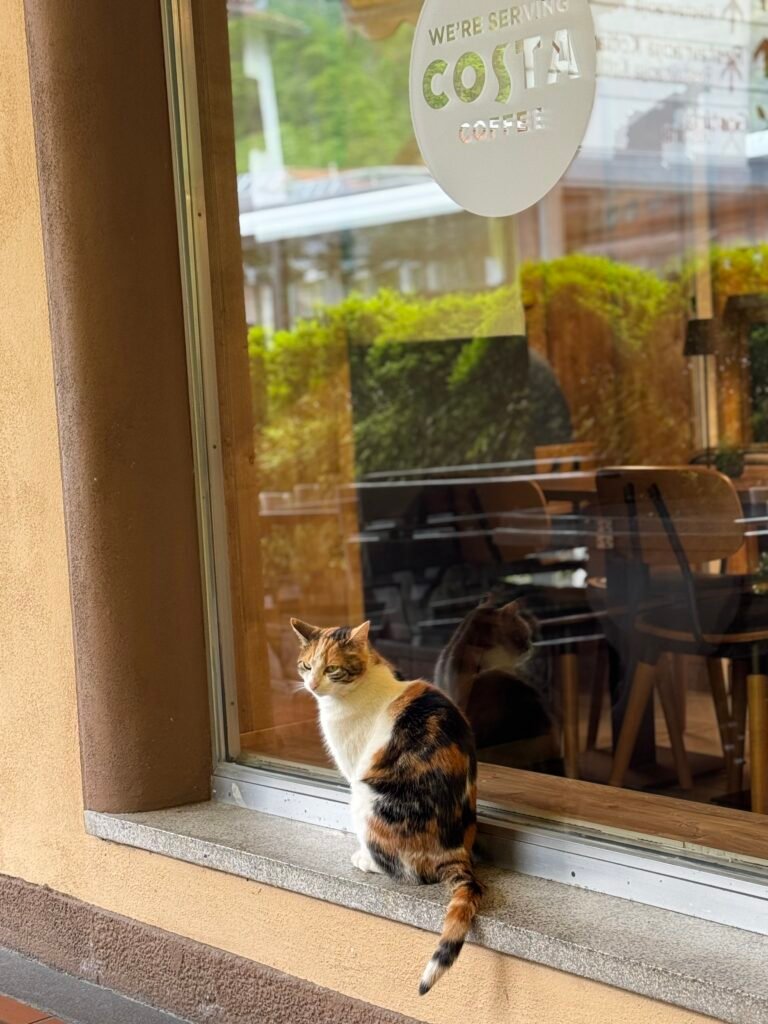
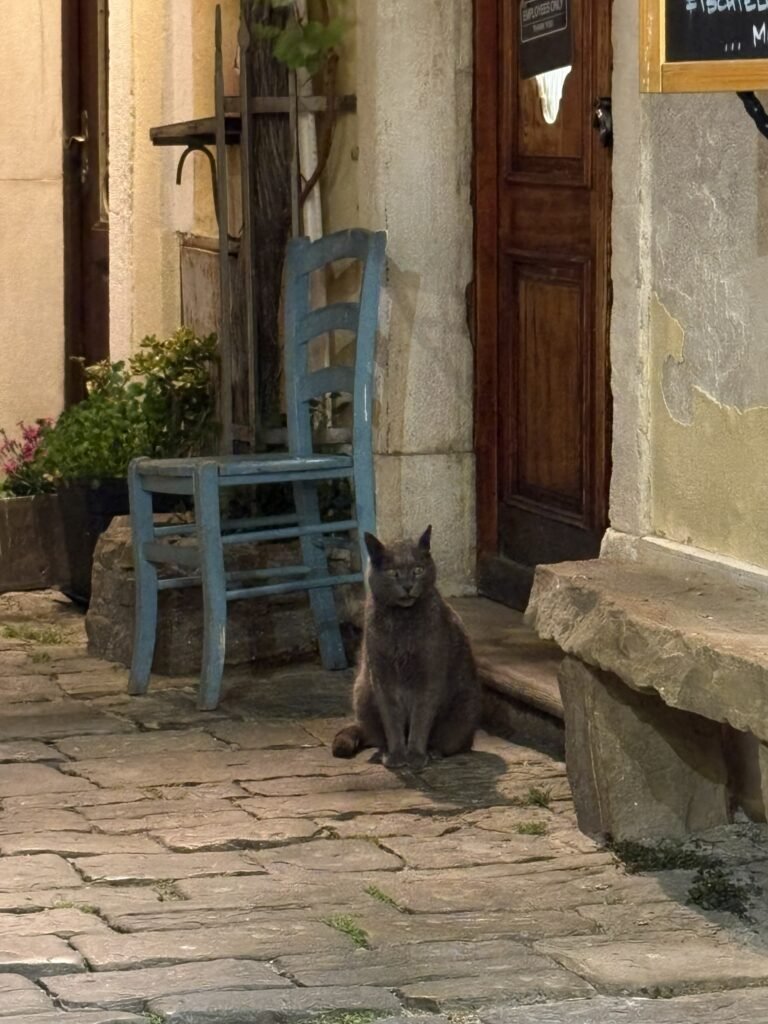
potato slices topped with a massive block of cheese. Apparently, it’s a traditional Slovenian snack in this region. Madara goes for the classic — a Caesar salad. We also encounter our first Slovenian cat, who emerges from the café kitchen, shows us absolutely zero interest, and then goes on his way.
TRIESTE, ITALY
12.05.2025: From Kobarid, the drive isn’t long in terms of distance, but the winding mountain roads make it fairly time-consuming. We’re also running a bit behind schedule due to the closed Vršič Pass. The approach into Trieste is stunning. We drive along the top of coastal cliffs, overlooking the wide expanse of the Adriatic Sea. After a brief moment of mild stress, we manage to find a place to park. The same parking app we’d already used back in Bologna in March — where paying for parking also required a mobile app — comes in handy again here. Payment is quick and painless. Two hours cost just €2.15. Very reasonable.
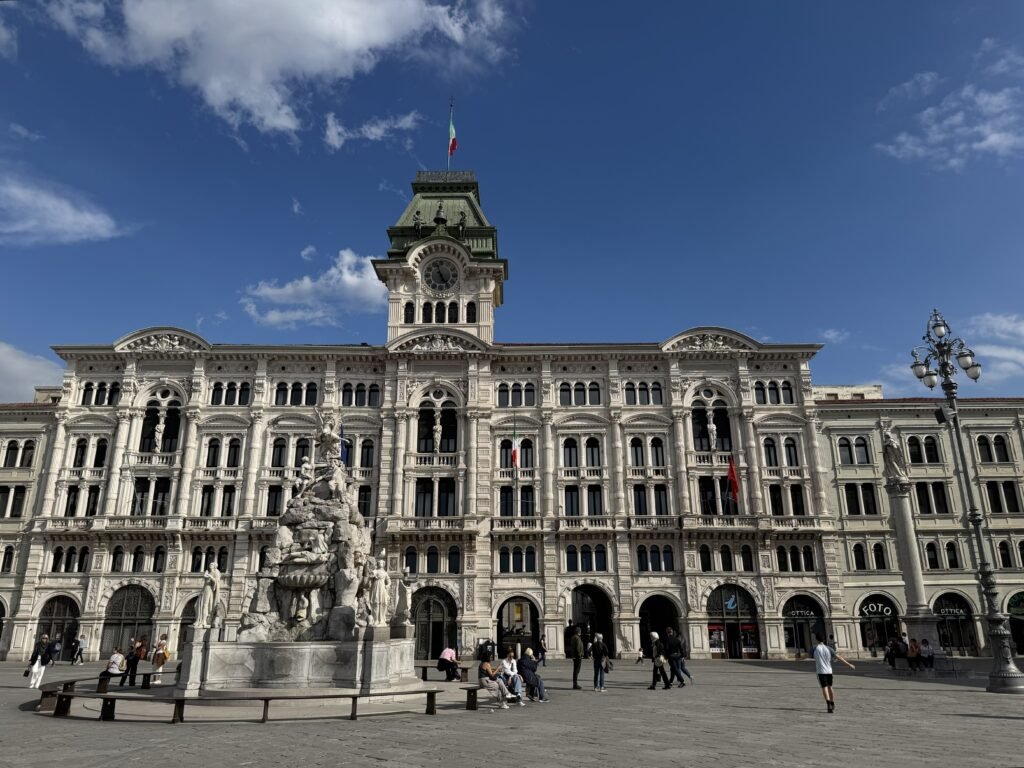
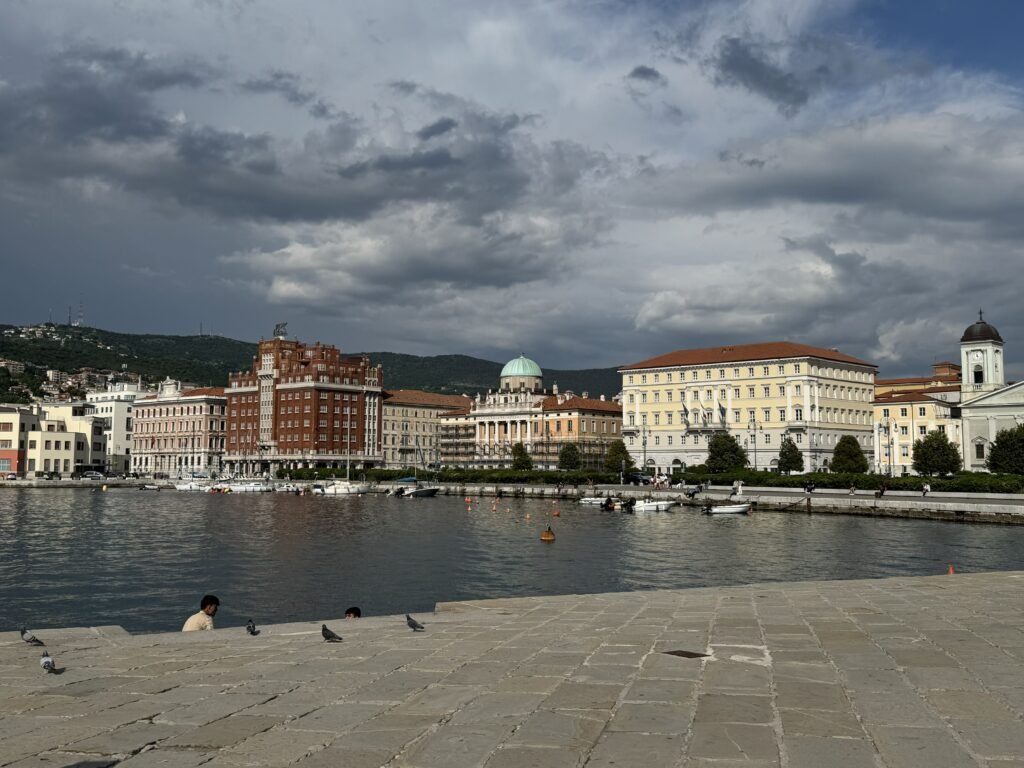
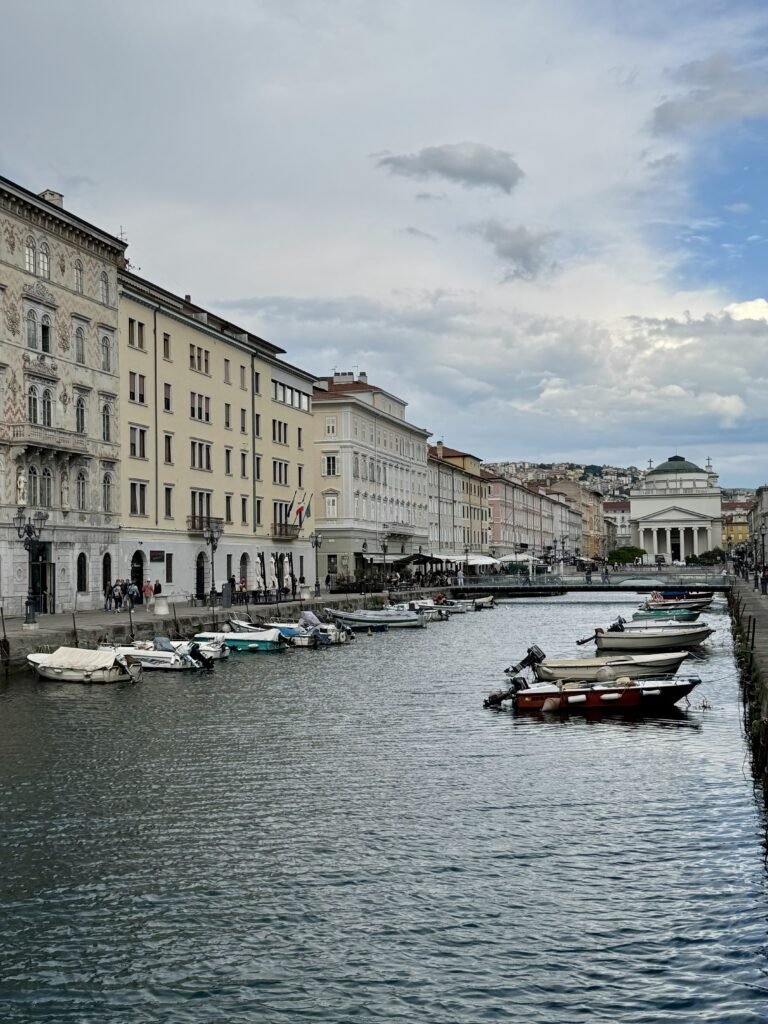
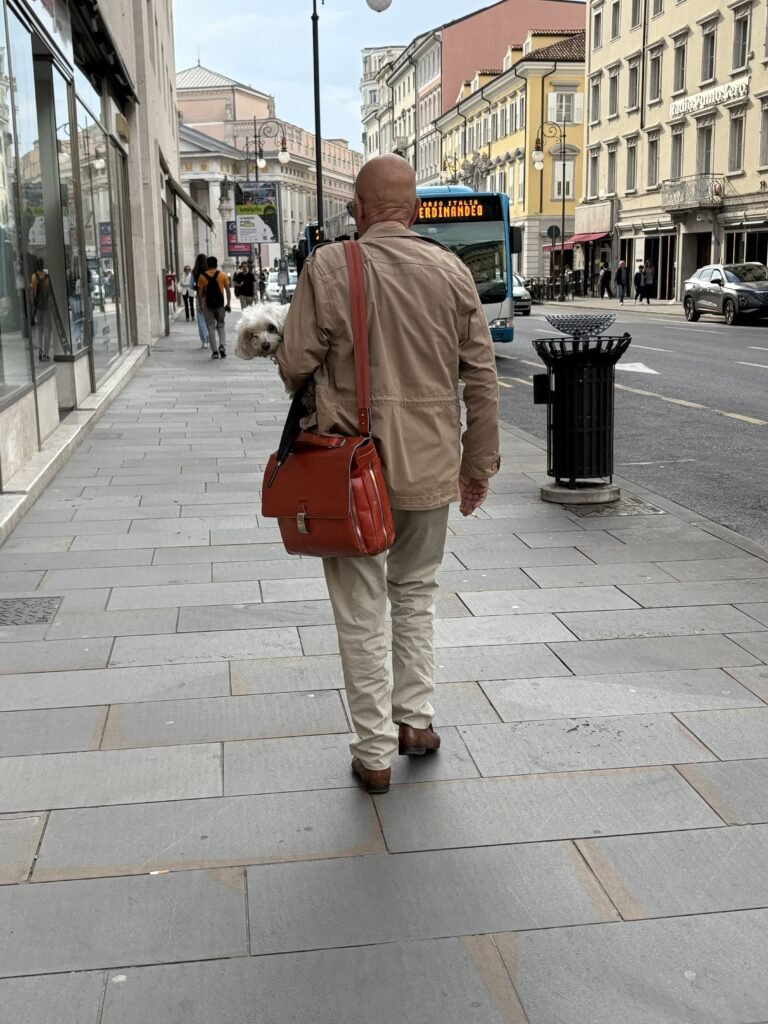
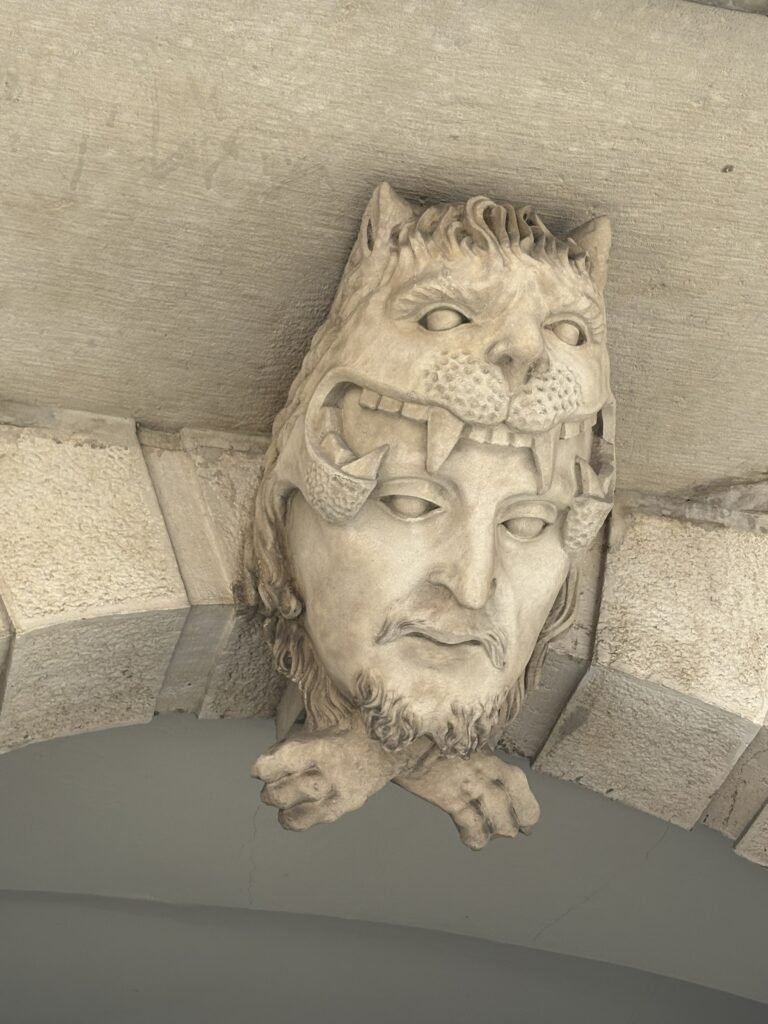
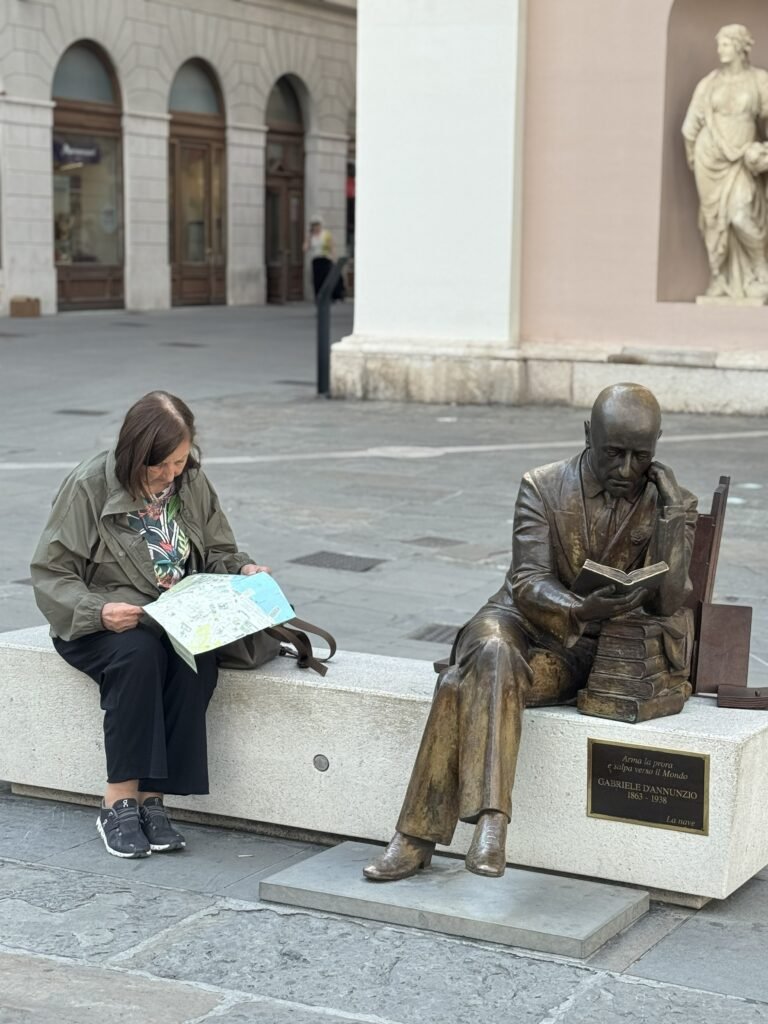
We have about two hours to do a quick loop around Trieste. There isn’t one single must-see spot on the list, but the city itself is a charming coastal Italian gem with around 180,000 inhabitants. We head to the main square, Piazza Unità d’Italia. As is typical in Italy, nearly every second building is decorated with detailed ornaments and sculptures, complemented by fountains and statues across the square. A canal also cuts through the city — the Canal Grande di Trieste — which, from certain angles, is a bit reminiscent of Venice. And why wouldn’t it be? Across the Adriatic Sea, Venice is only about 100 km away.
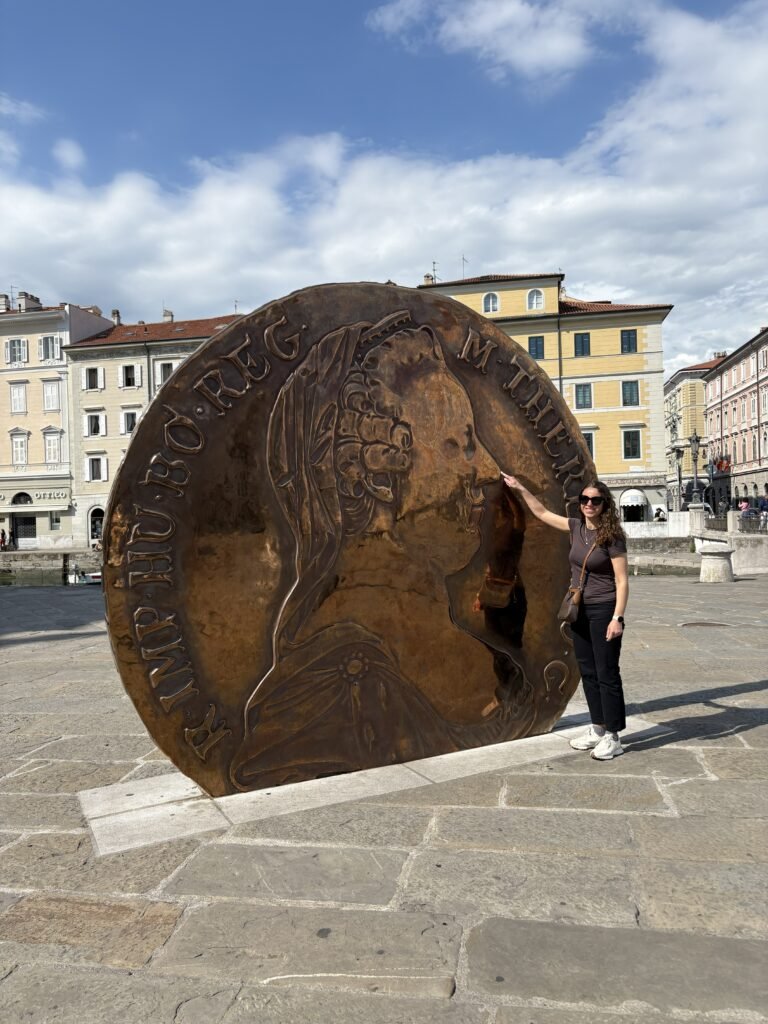
PIRAN – EVENING
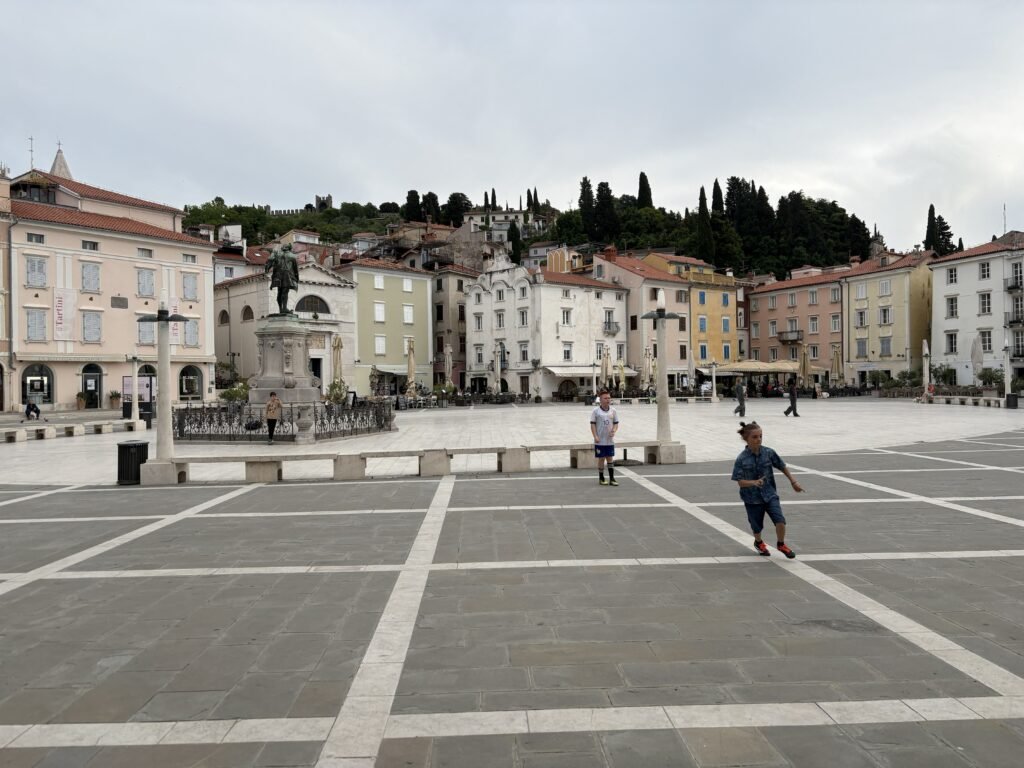
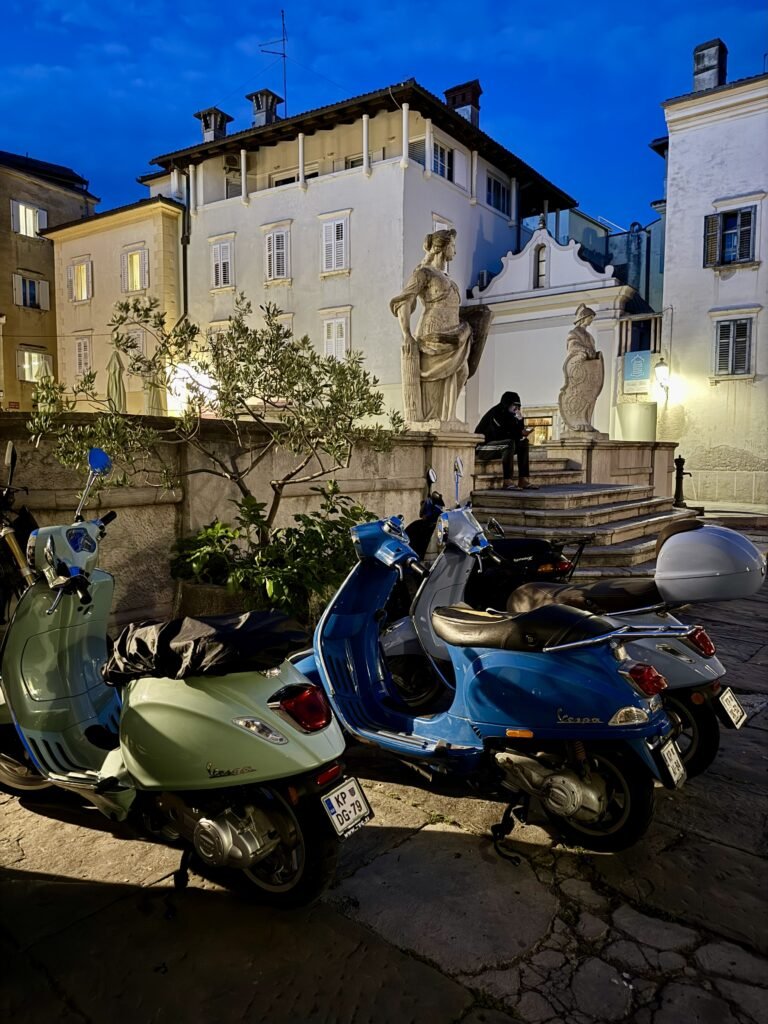
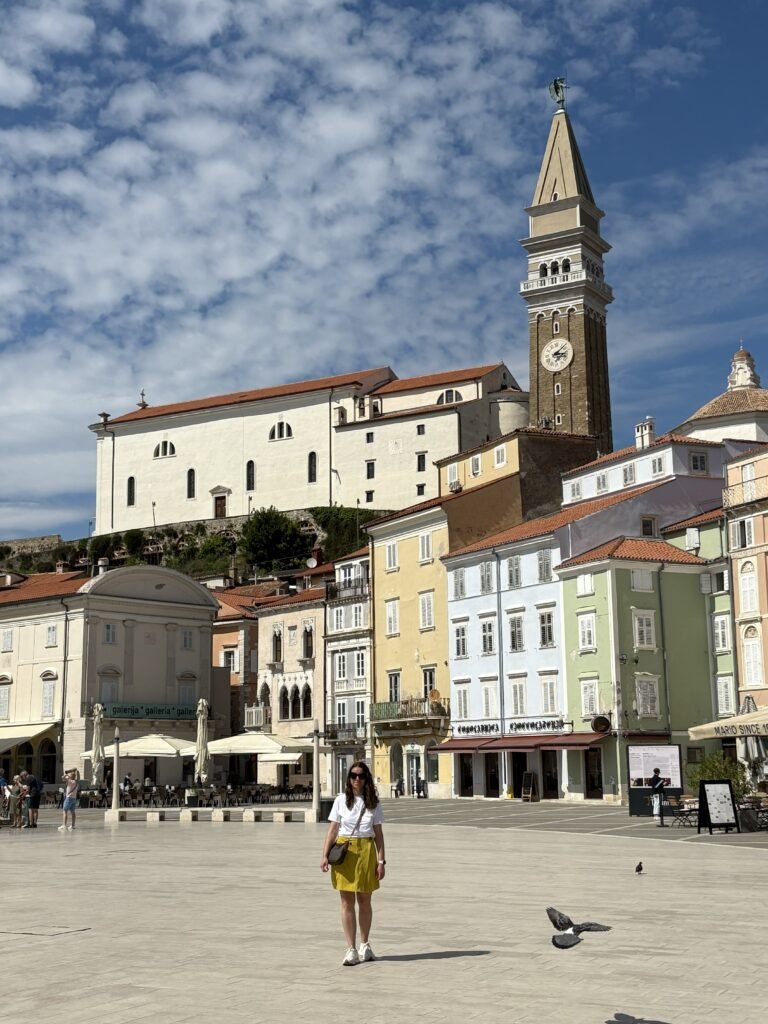
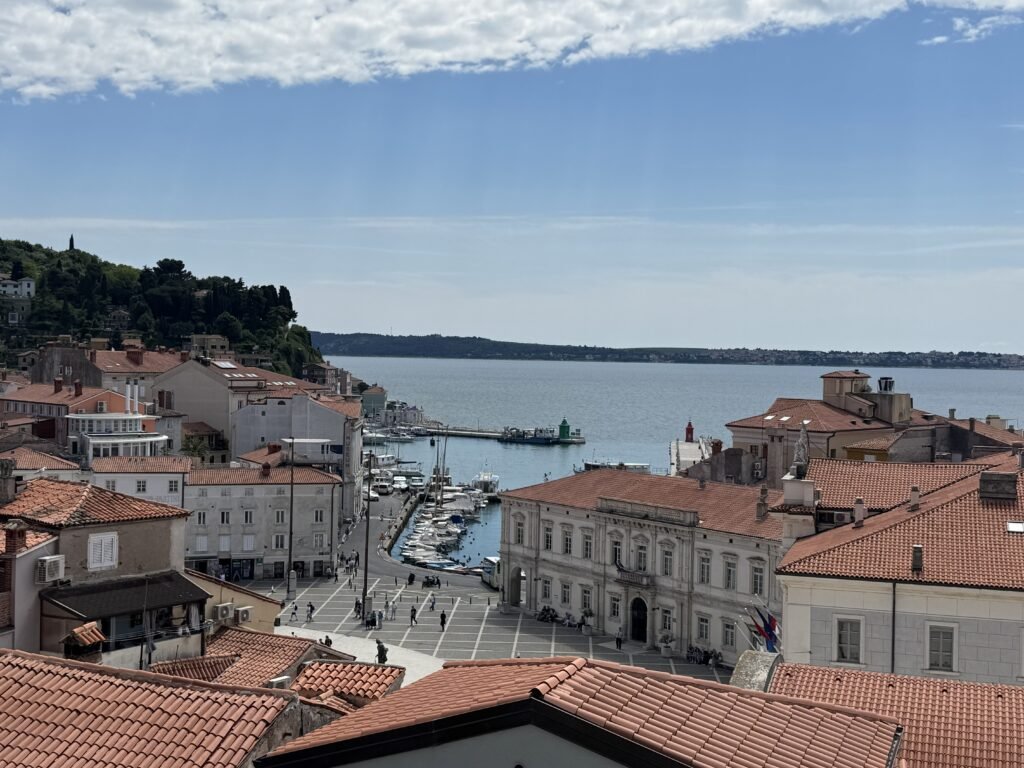
12.05.2025: We head toward the furthest point of this trip — Piran, a small seaside resort town in southwestern Slovenia, right on the Adriatic coast near the Croatian border. Following the host’s instructions, we find a public parking garage, since cars aren’t allowed into the Old Town. Technically impressive: a parking structure with seven underground levels. Quite a feat of engineering to dig something like that right next to the sea. From there, it’s a 7–8 minute walk to the Old Town, where we’re meeting our host. The apartment is located right next to Tartini Square (Tartinijev trg) — Piran’s main square, named after the famous violinist Giuseppe Tartini, who was born here. Although “famous” might be a stretch outside Slovenia, since we, of course, had
never heard of him.
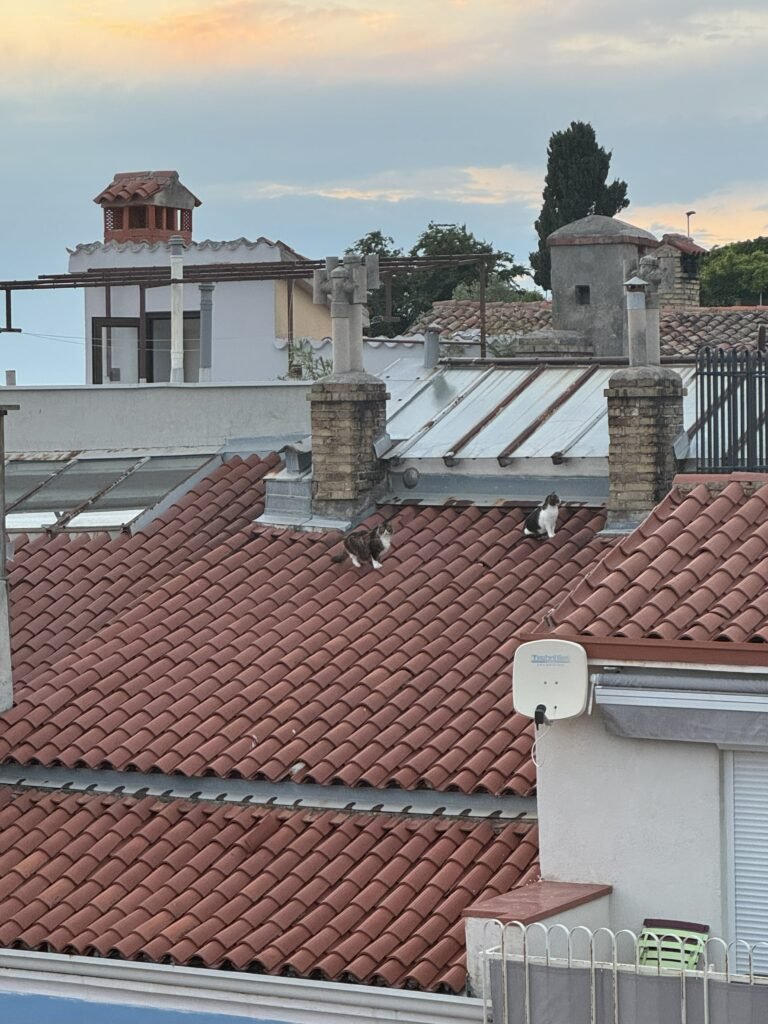
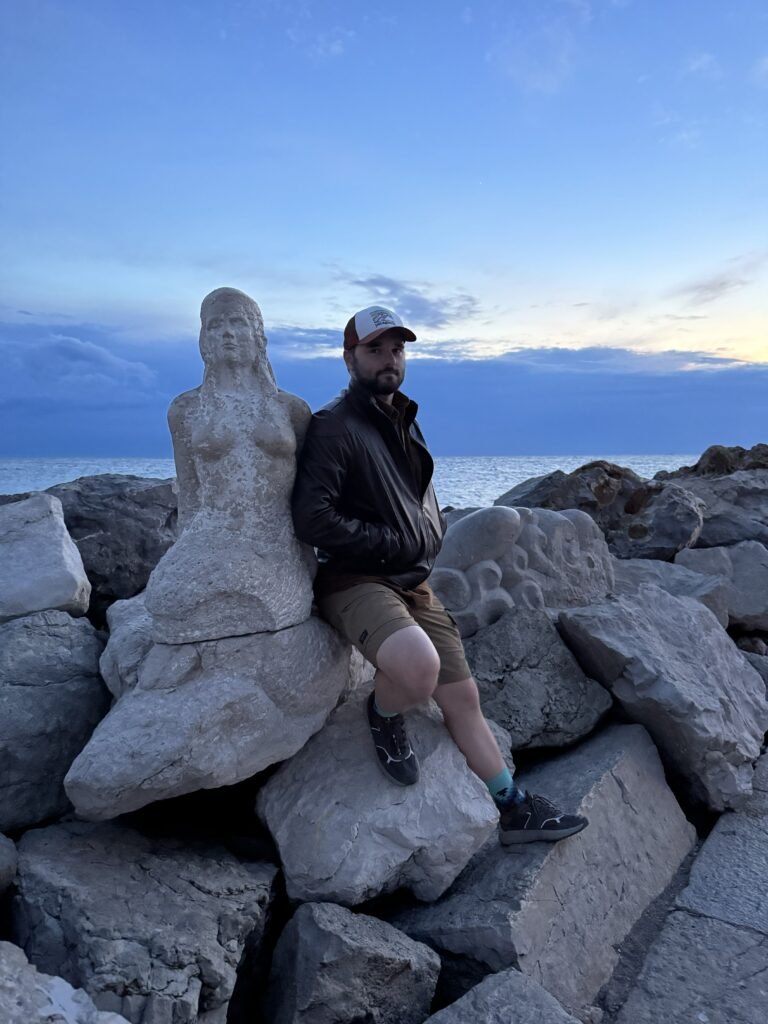
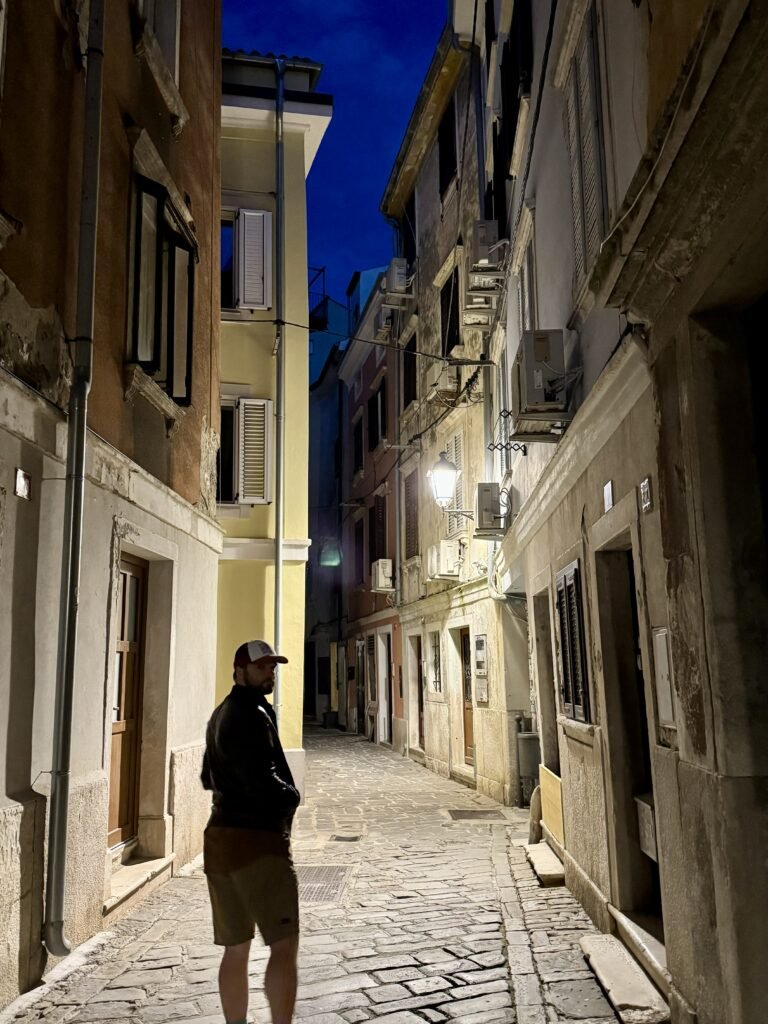
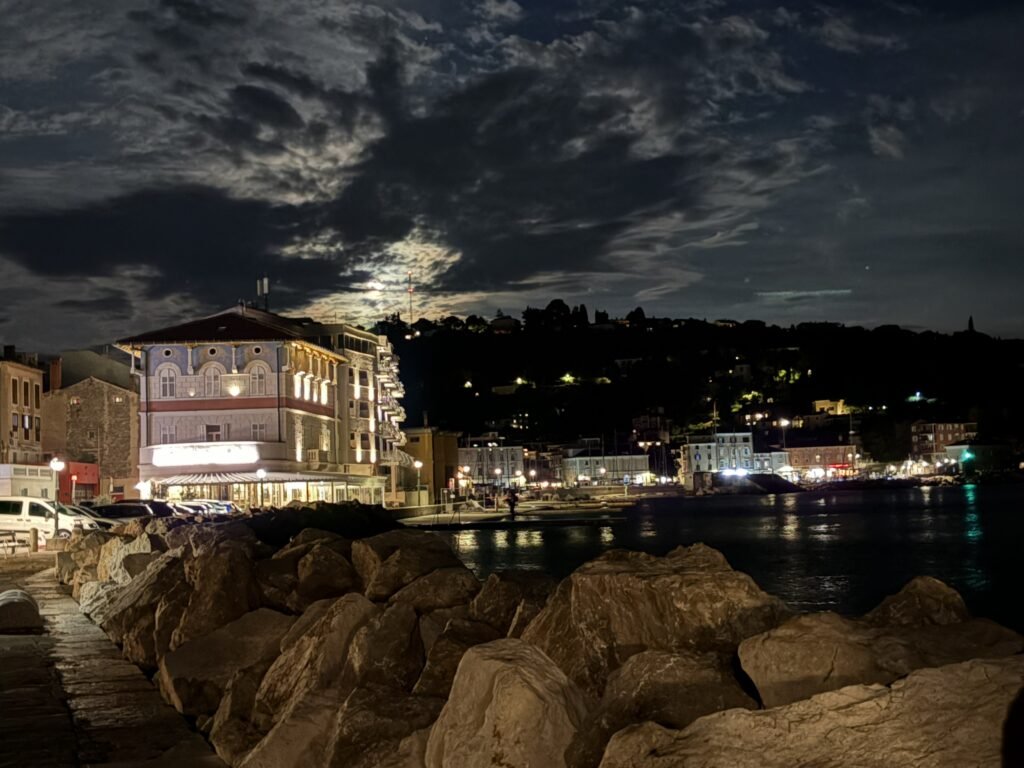
A small but cozy room with a balcony and a rooftop terrace in the very heart of the Old Town. We’re welcomed with a bottle of white wine — welcome drinks included. We settle in, then have a light bite on the terrace and make a FaceTime call to Grobiņa. While we’re chatting, three tomcats roam across the neighboring rooftops — all three lazily strolling in the evening sun, as if it were a promenade made just for them. In the evening, we take another loop through Piran’s nighttime streets. We walk along the promenade to the far end of town, where the Mermaid Statue (Morska deklica) stands — a local legend embodied in maritime form. There are no canals here, but the streets are so small, narrow, and full of sharp turns that getting lost is just as easy as in Venice. Fortunately, the Old Town is compact, and if you keep roughly heading in one
direction, you’ll soon end up back by the bay.
We start feeling a bit peckish, so we stop by Trg 1. maja — 1st of May Square — for some fried calamari and baby octopus. Simple, seafood-forward, and seemingly authentic. An interesting fact: Piran is close to one of the oldest sea salt production areas in Europe. The Sečovlje Salt Pans have been in operation since the 9th century, and salt is still harvested here by hand using traditional methods. We’ll see them tomorrow as we pass by on our way to another small coastal town in Croatia — Umag.
UMAG, CROATIA
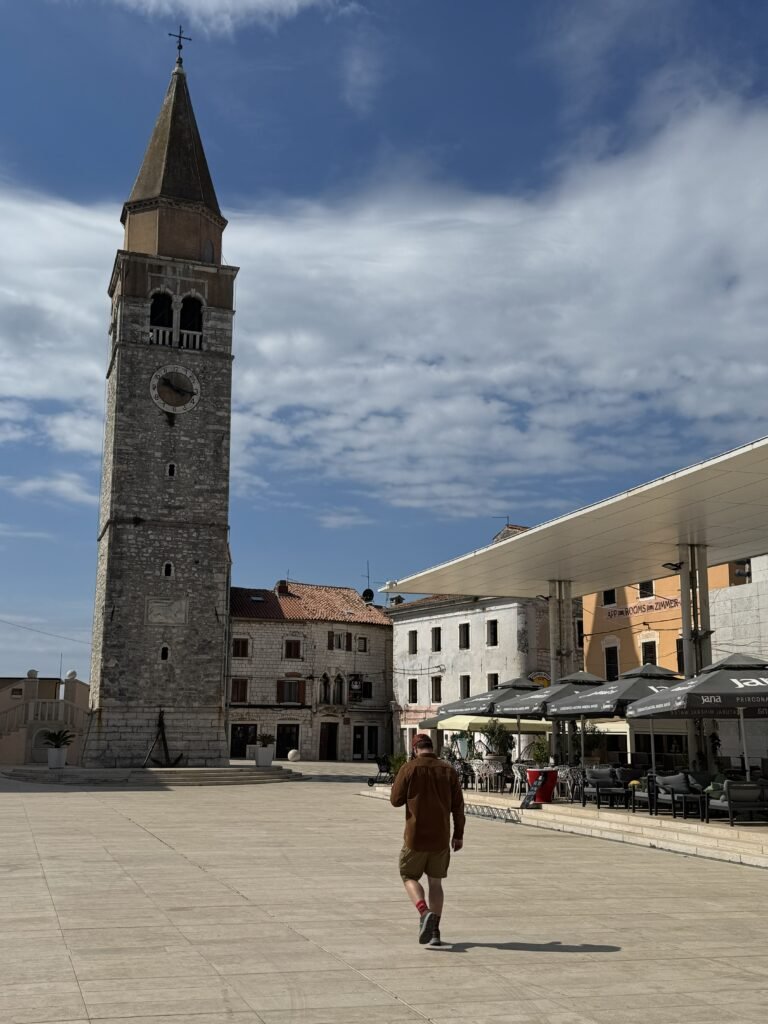
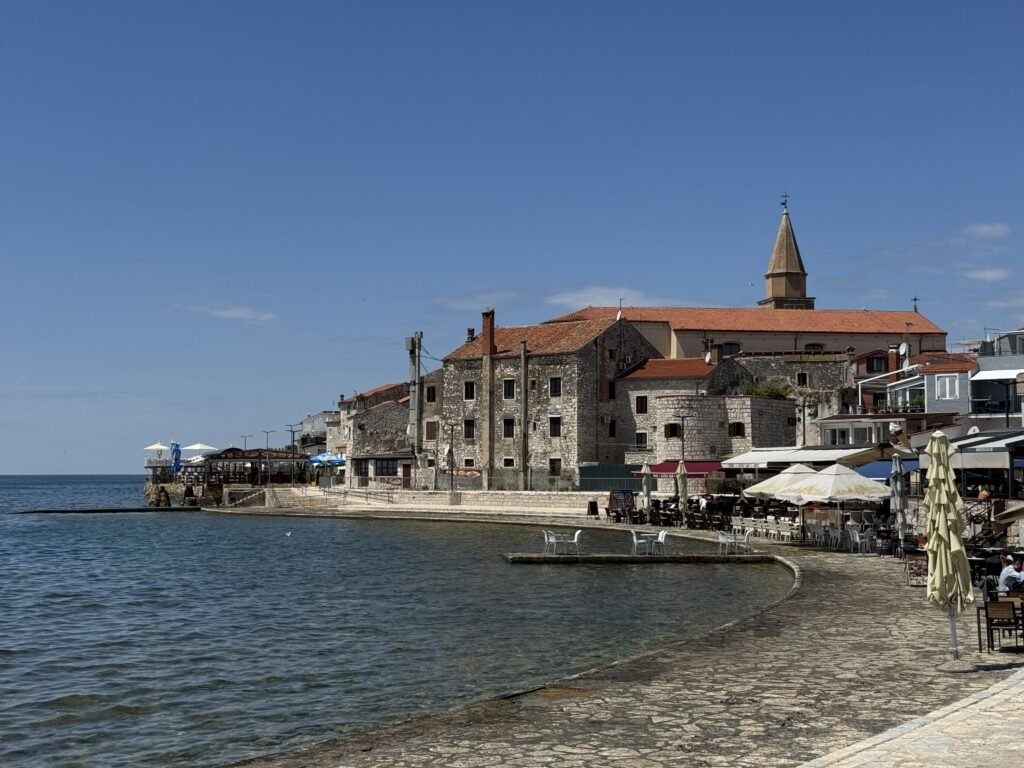
13.05.2025: Today, we decide to officially tick off Croatia as well. We’re heading to the coastal town of Umag, about a 30-minute drive away. This Adriatic fishing town is small — roughly the size of two Grobiņas – my hometowns in Latvia.
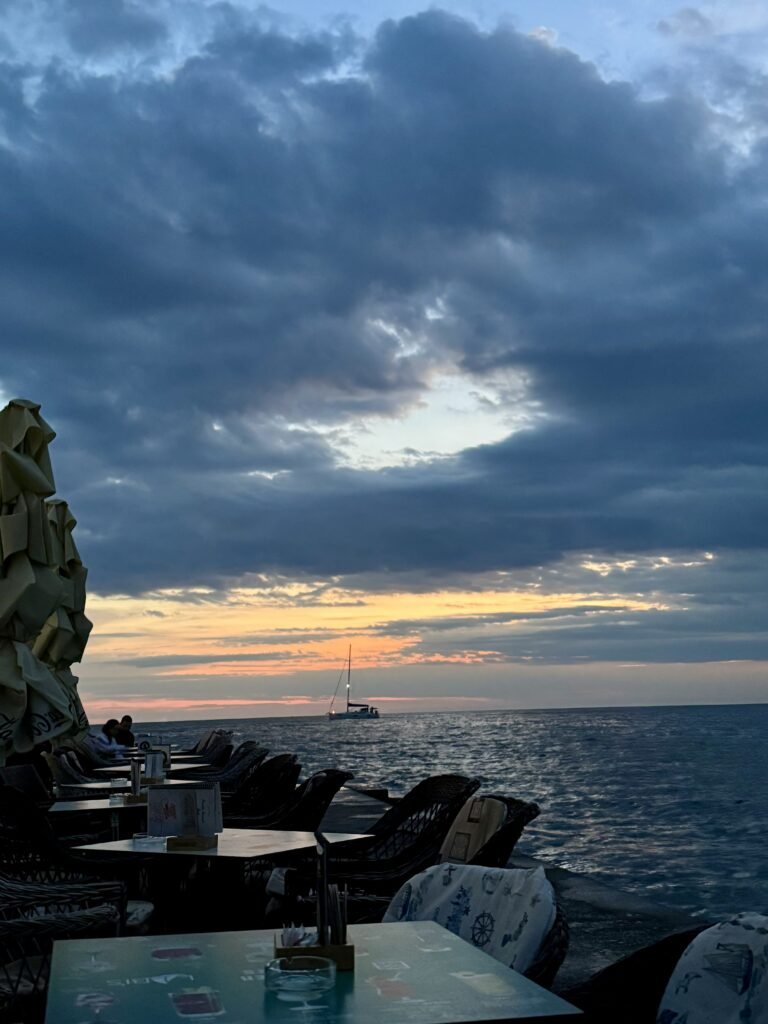
The harbour area can be walked through in about 15–20 minutes. Judging by the restaurant menus — and by what we hear from the waiters — it’s clear that the main target audience here is German retirees. Menus are primarily in German, only then followed by English or other languages, and most of the service staff seem perfectly comfortable communicating in German. Why that might be is anyone’s guess. I had assumed this was a quiet little town with little tourist traffic, but it turns out that in summer the place is absolutely packed. In May, though, everything is still calm, peaceful, and pleasantly slow.
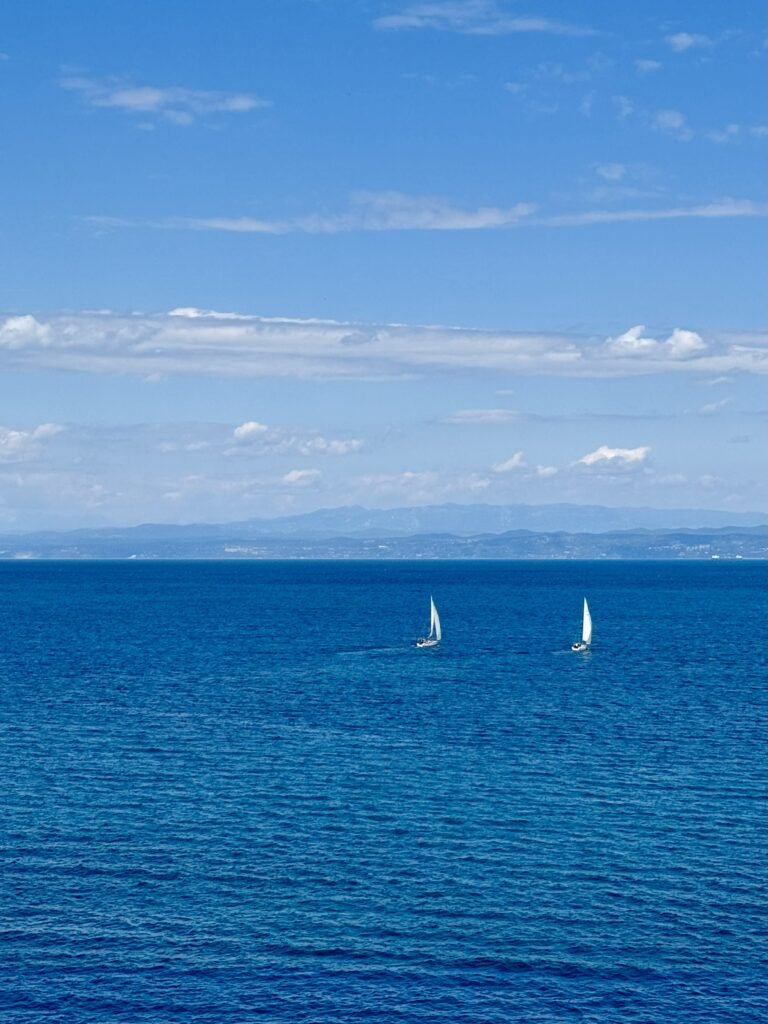
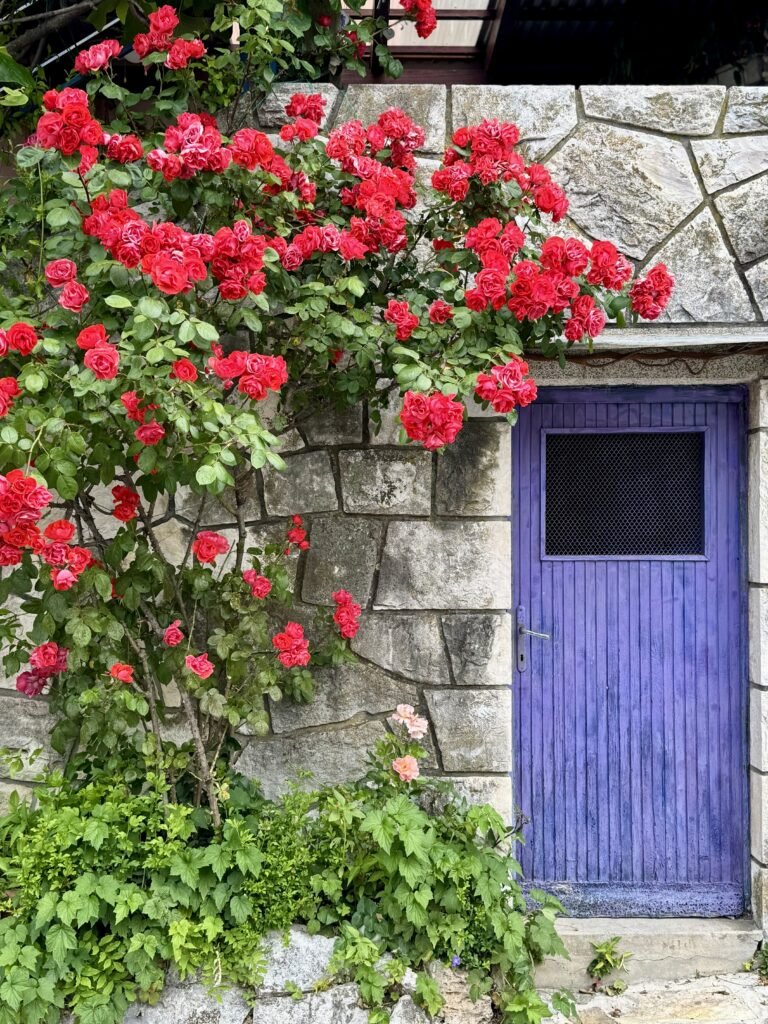
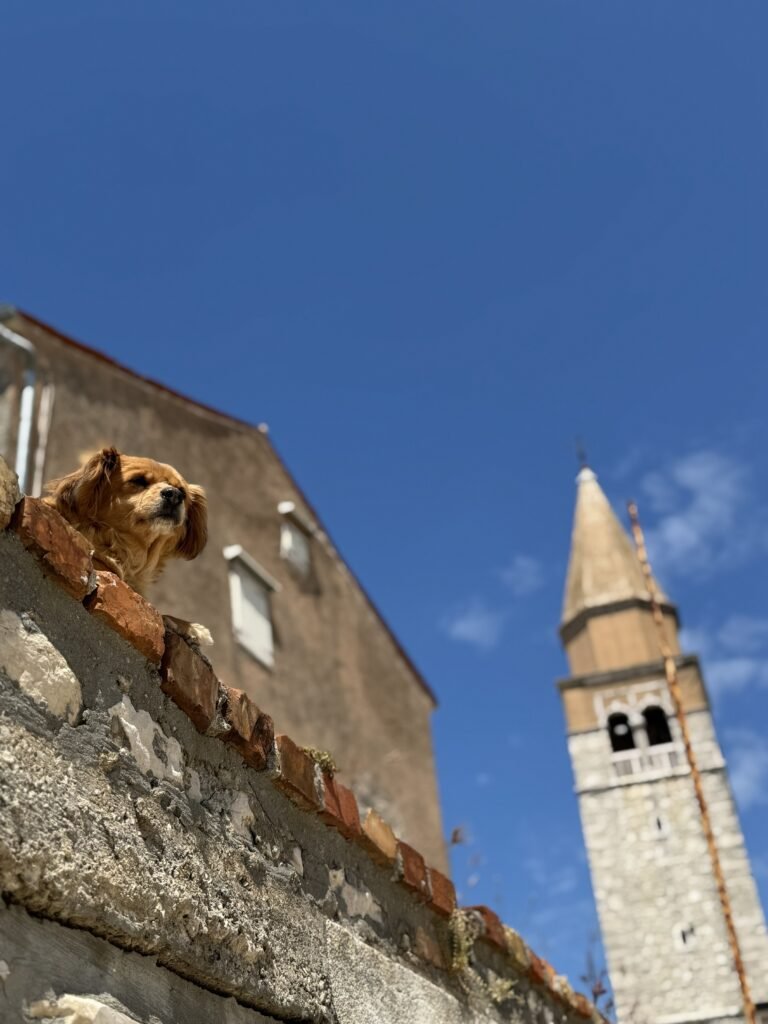
With no fixed schedule and time on our side, I decide (Madara insists) to visit a local barber. The hairdresser speaks good English and is quite chatty. She tells us that during the summer months prices here increase by about 50%, and that locals even drive to nearby Italy — to Trieste, where we were yesterday — to do their grocery shopping. Tourists, apparently, are a serious business. Over coffee, we read up a bit on the town. Interestingly, Umag was once part of the Venetian Republic. And if you pay attention, you can still see it in the narrow streets: plenty of Venice-style pinkish stone houses with blue wooden shutters. Even place names are written in two languages — Croatian and Italian.
PIRAN – AFTERNOON
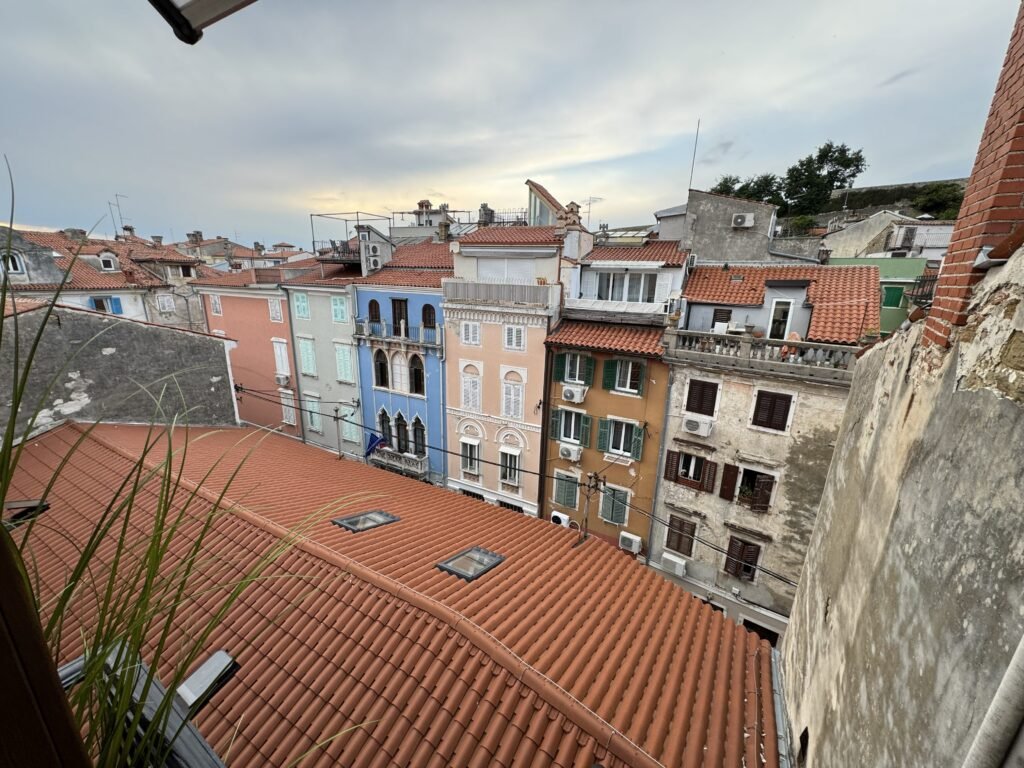
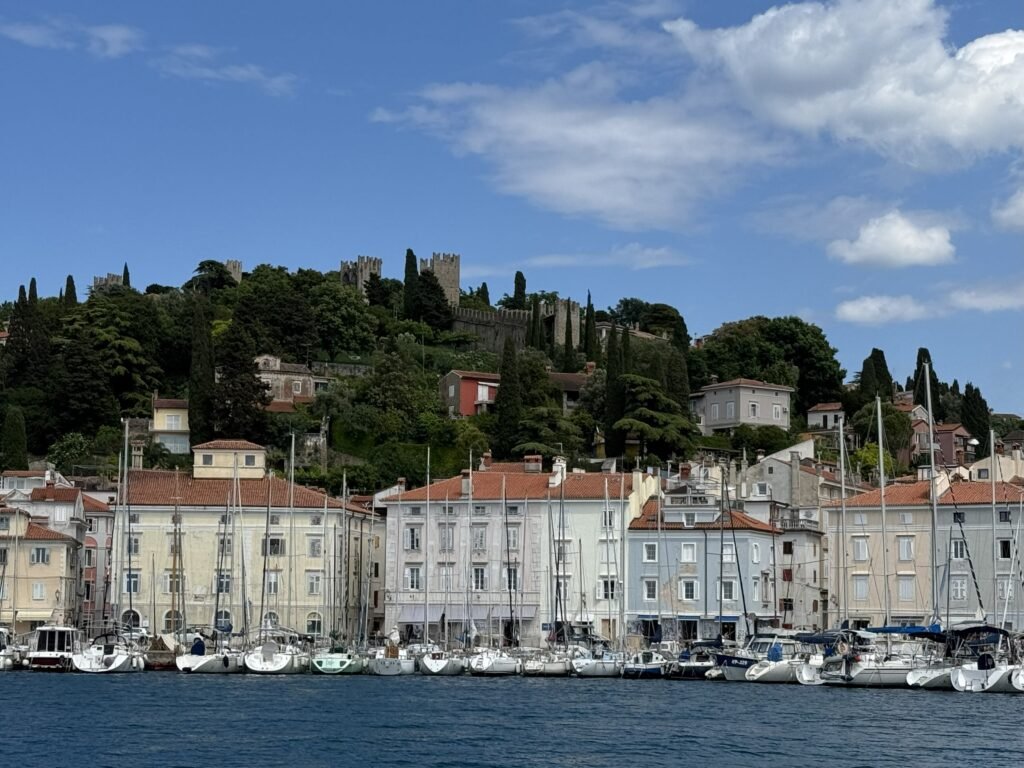
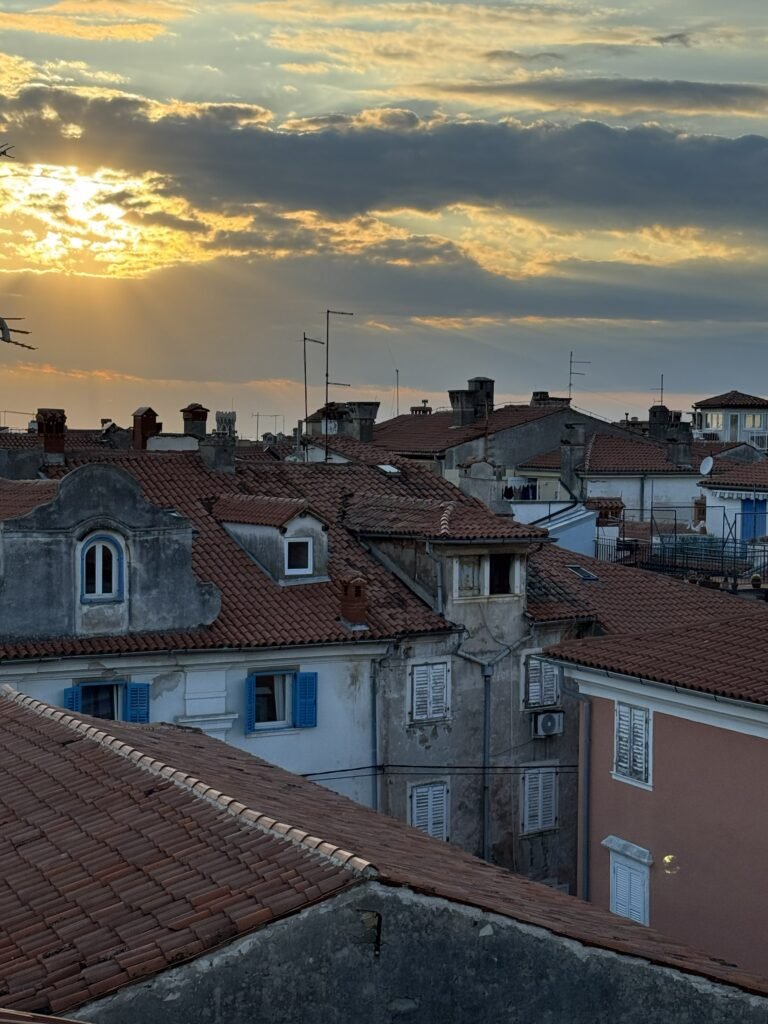
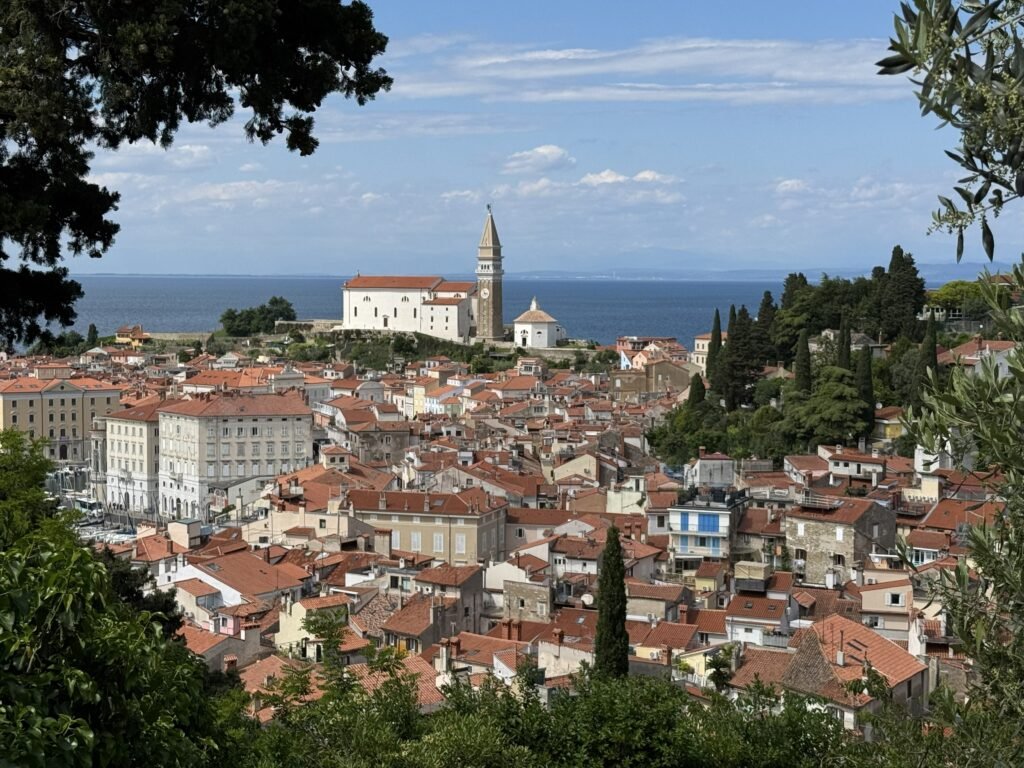
13.05.2025: After returning from abroad and taking a short rest at the hotel, we head back out into the streets of Piran. We start by climbing up onto the city walls near the church bell tower. I came here quite deliberately, planning to go up the tower itself. But even though the entrance costs only €3.50, the panoramic view from the city walls — overlooking Piran’s red clay roof tiles — is so good that it honestly feels like those few extra metres of height wouldn’t add much to the experience.
We also walk along the promenade again in daylight, passing the city’s mermaid statue. There are, of course, more people around than late last night, but still very few overall. Cafés have just one or two occupied tables. Which suits us perfectly: slightly lower prices, no risk of missing lunch, and always a table with the best view available.
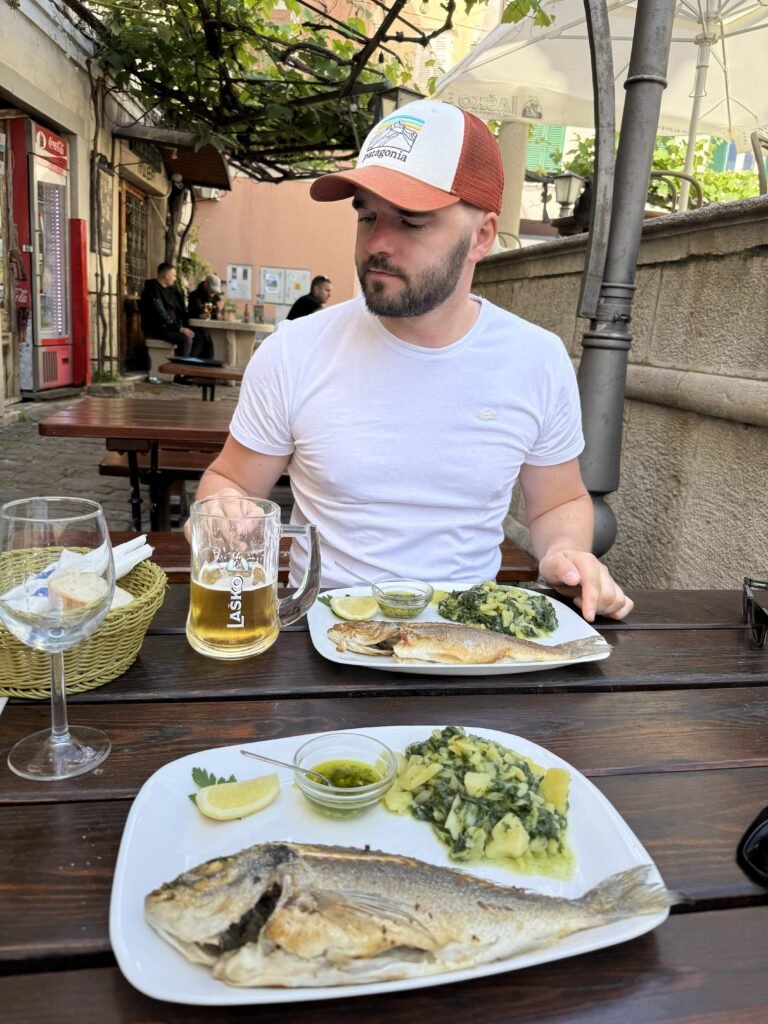
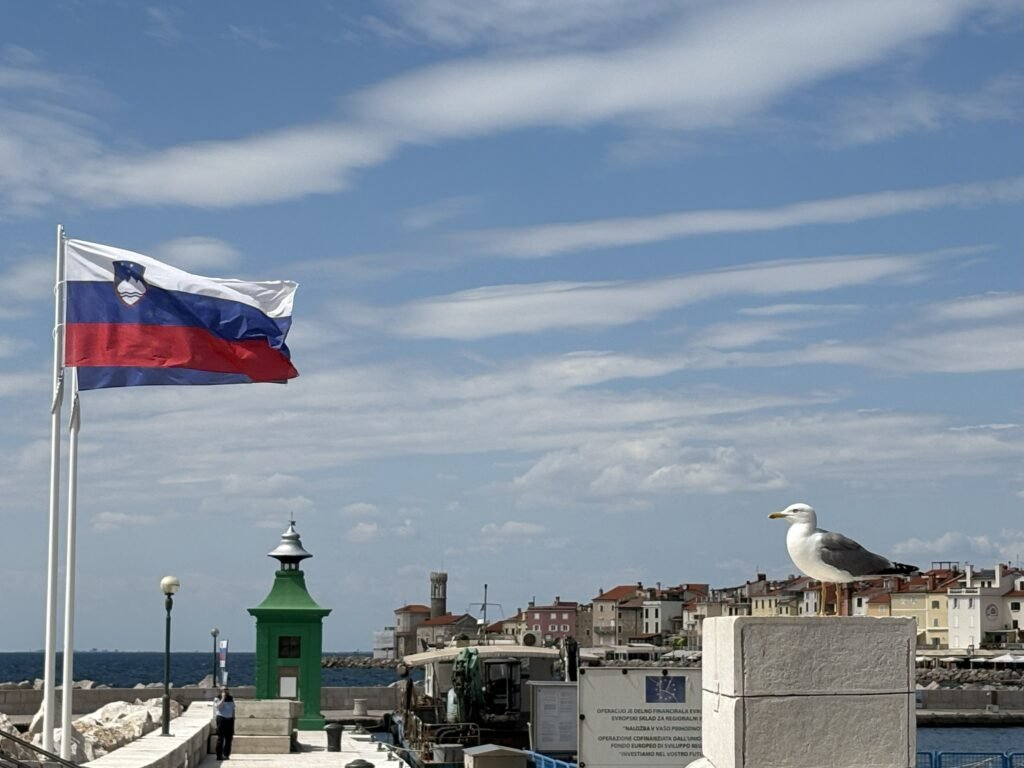
We make our way to the oldest functioning lighthouse on the Adriatic Sea. It’s a very small lighthouse, marking the entrance to Pristanišče Piran — Piran’s harbour. We also climb up to Oljčna pot, a perfectly ordinary street, but one that still offers a lovely view over the Old Town rooftops, with the church tower right in the centre. It’s time to find lunch, and we end up at the same place as yesterday. You order your fish at a window, kiosk-style, and then wait while it’s prepared right there. We have excellently grilled trout and perch, served with an oily garlic sauce and potatoes with herbs. Truly delicious.
There’s a lot of activity on the main square — but local activity, not tourist crowds. Kids are playing football, clearly because this is the only flat and spacious area where such a game is possible. Judging by the jerseys, it’s a serious match: slightly out-of-shape Messi versus Ronaldo and Mbappé. The winner remains unknown.
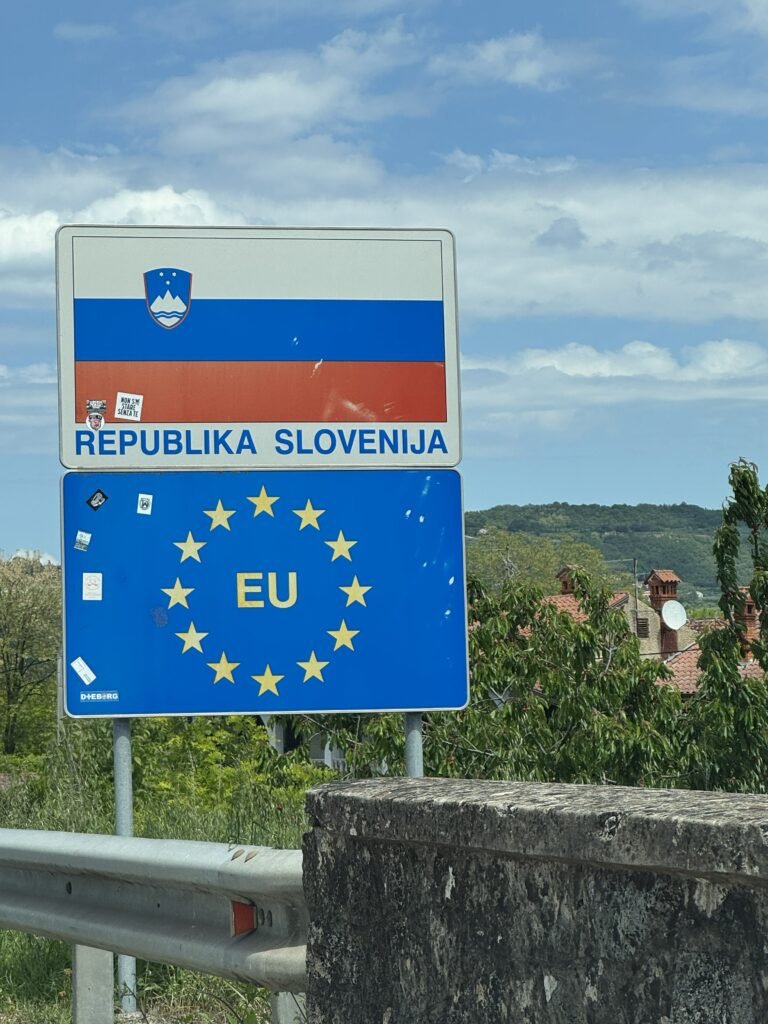
POSTOJNA JAMA
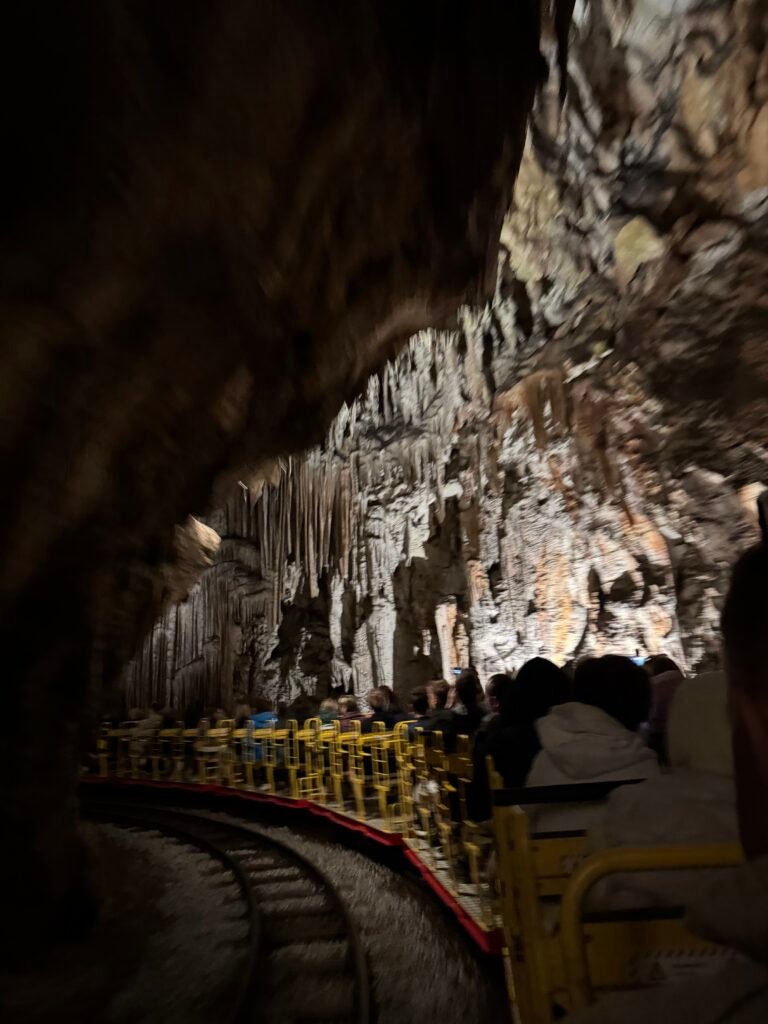
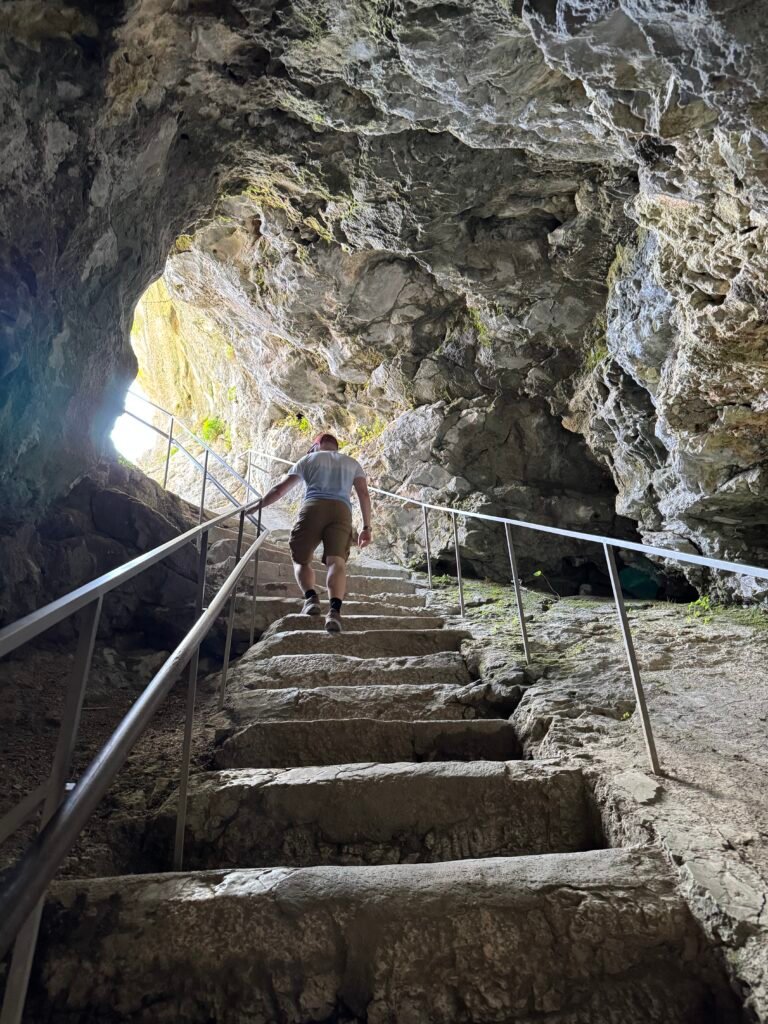
14.05.2025: Today’s main attraction is Postojna Cave — the second place on this trip that we’ll be able to tick off in our 500-destinations travel book. This cave system is the largest in Europe. It extends about 115 metres below the surface and stretches for at least 24 kilometres.
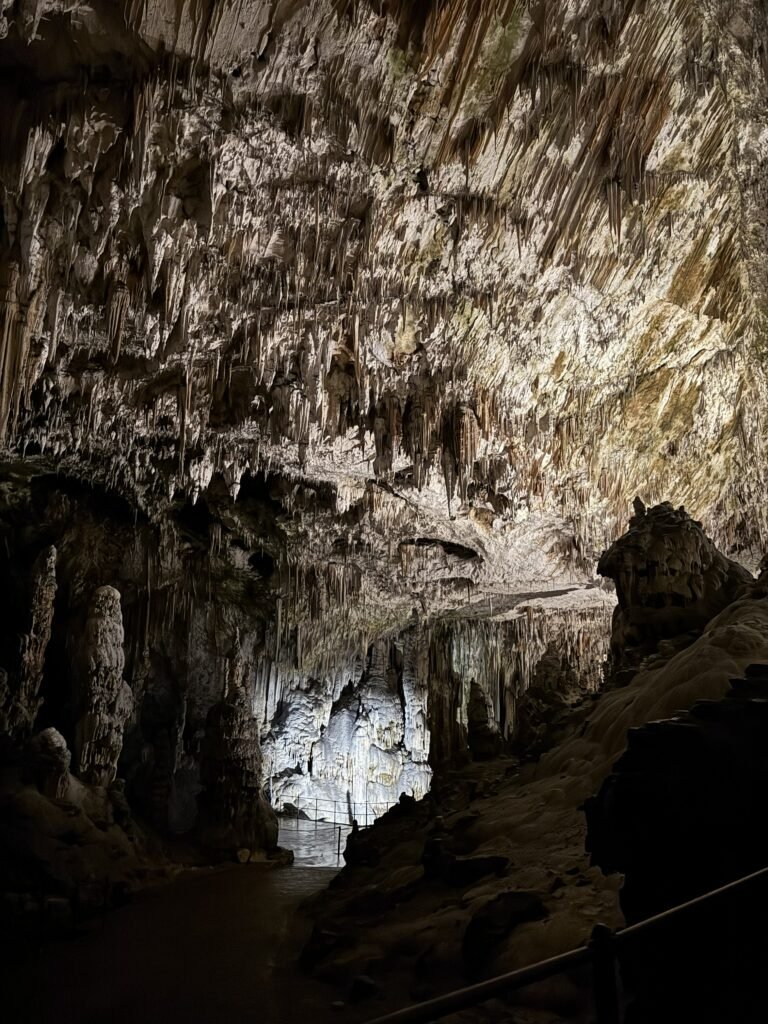
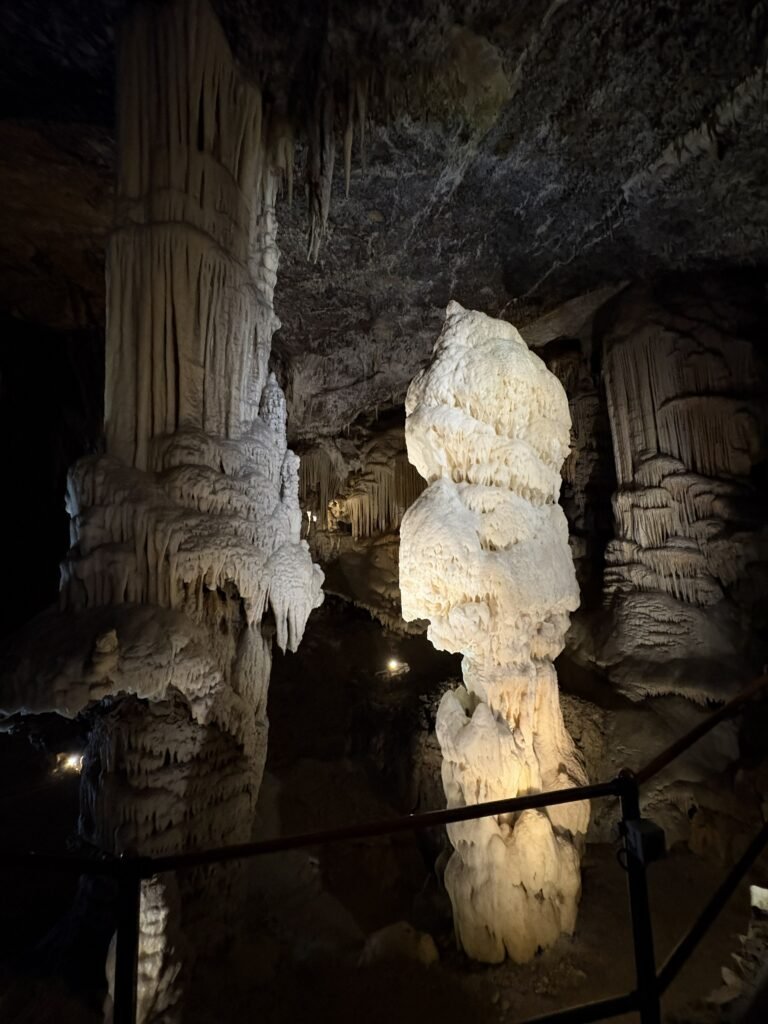
The tour begins with a 15-minute train ride deep into the cave — because even the most enthusiastic tourist would struggle to walk that distance. This is followed by roughly an hour-long walk along a fixed route through the cave’s vast “halls.” While the process itself stays the same, the constantly changing conditions and the different minerals carried by surface water mean that each chamber has stalactite formations in completely different colours — from bright, sparkling white to dark, clay-red tones. In some sections, the cave ceiling rises to nearly 14 metres. Impressive!
On a warm summer (or spring) day like today, the caves offer a welcome escape from the heat, as the temperature inside never rises above +10°C. These caves are also home to the legendary “baby dragon” — Proteus anguinus. A blind, pale amphibian, roughly 30 cm long, resembling a small lizard with four tiny legs. In the past, locals genuinely believed these creatures were baby dragons. Their ability to survive is remarkable: Proteus can live for around 100 years and, in the harsh cave environment, can survive without food for several years at a time.
While the baby dragon isn’t directly connected to Ljubljana’s green dragon, it does feel like yet another reminder that Slovenians seem to have a bit of a thing for mythical dragons.
PREDJAMA GRAD
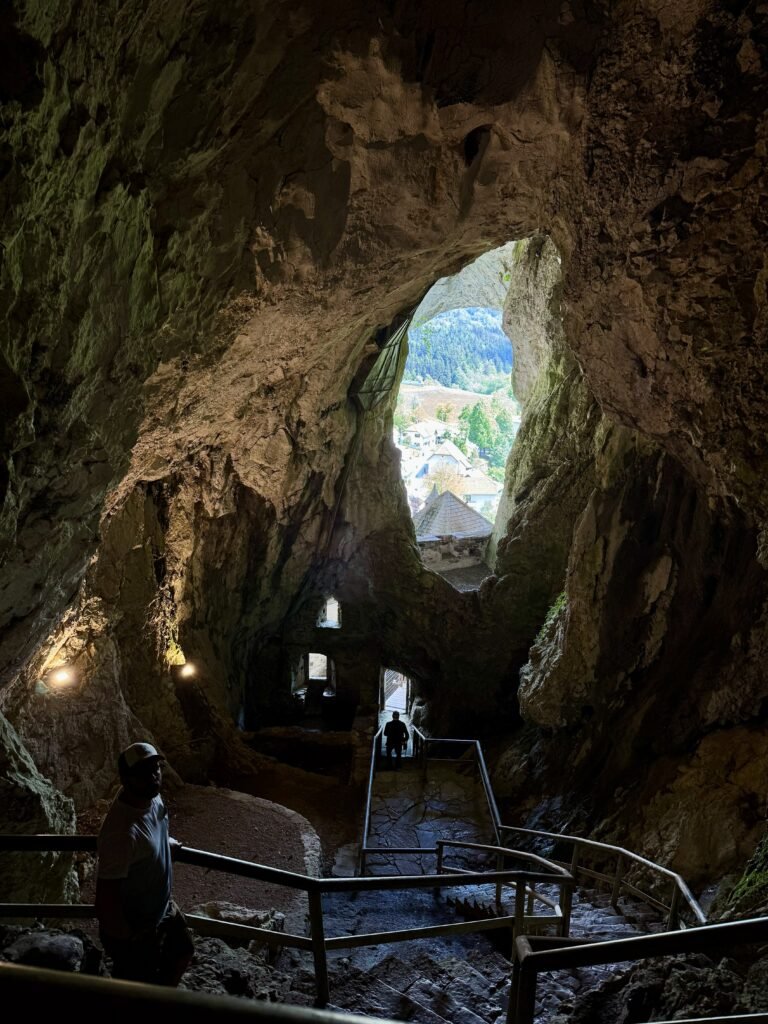
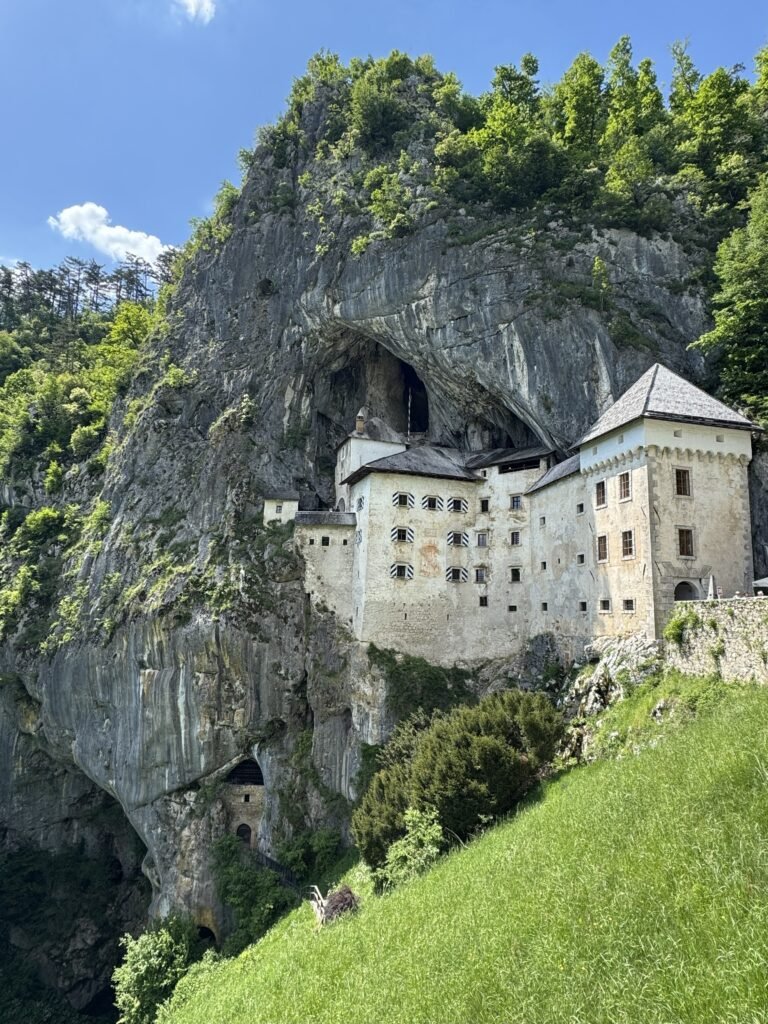
14.05.2025: The cave ticket also included a visit to Predjama Castle. At first, I assumed the castle would somehow be part of the previously mentioned cave system — after all, it’s often described as “the largest castle in the world built into a cave.” It turns out, however, that you need to drive about 9 km to the nearby village of Predjama.From the outside, the castle looks quite impressive. The building really is tucked beneath a cliff, and while walking through the interior you can clearly see that some of the inner walls are, quite literally, solid rock. That said, the castle makes a much stronger impression from a distance than it does while wandering through its rooms.
One particularly interesting feature is the drinking water collection system. Water filtered through the rock is collected at the top of the castle and then distributed to specific rooms via a carefully designed drainage system. The small stream next to the castle — which effectively also runs through it — was not used for drinking water, as it could easily have been poisoned by enemies.
We also stop for lunch right at the foot of the castle. It’s advertised as a local family-style home kitchen, but in reality it feels more like a Lidl freezer aisle in disguise. Still, we’re fed — and that counts for something.
LJUBLJANA – COCKTAIL EVENING
14.05.2025: It’s time to head back to Ljubljana, where we also need to return our white Mercedes. We managed the entire trip on a single tank of fuel — surprisingly economical. Mountain serpentine roads, Slovenian motorways, the lot. Around 700 km in total, all on one 35-litre tank.
We then spend an unnecessarily long time wandering around Ljubljana’s streets by car before finally finding the right little street to drop it off. After that, everything goes smoothly.
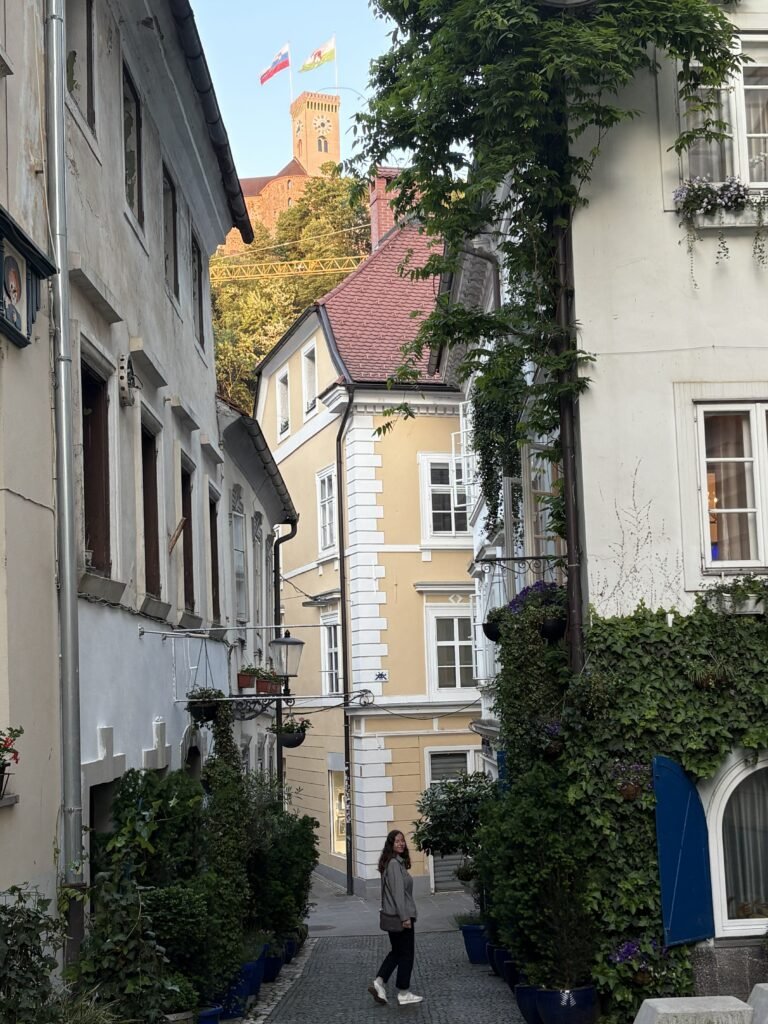
For our last night, we stay at ArtHotel, right in the heart of the Old Town. Unexpectedly, we even have a view of Ljubljana Castle’s flag tower from our window. After a short rest and answering a couple of work emails, we head back out into the city.
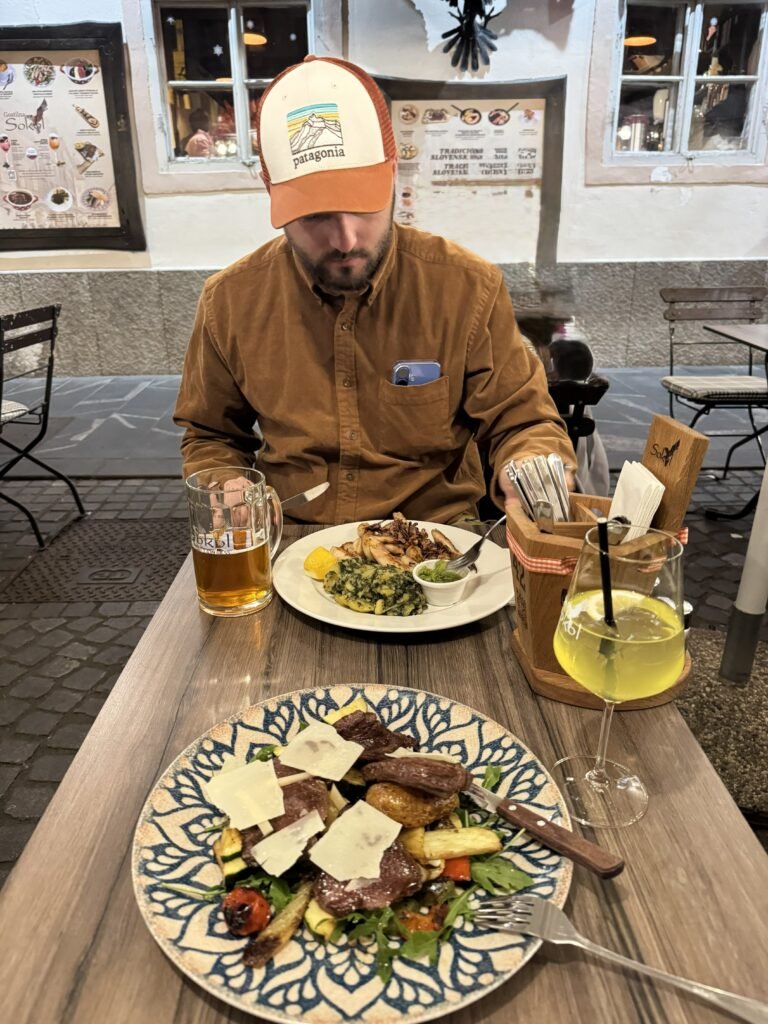
Ever since our first day at Ljubljana Castle, one particular drink has stuck in my mind: the Espresso Martini. By now, I’m completely done with Slovenia’s mass-market beers like Union or Laško, so tonight feels like a good moment to experiment with something different. According to Google Maps, there’s a highly rated cocktail bar right next to the hotel — and they have exactly what I’m looking for. Unfortunately, once we arrive, we discover that their espresso machine is broken. No luck here. Onward we go! We have dinner on the pedestrian street Ciril-Metodov trg, at a traditional Slovenian restaurant. I go for mushroom soup served in a bread bowl and grilled calamari. Madara chooses beef with grilled vegetables. The food is very good, but by evening there’s a cold, sharp wind outside, making outdoor seating only moderately enjoyable.
Before heading back for the night, we finally succeed in finding that elusive Espresso Martini. If you like black coffee, you’ll like this too — just don’t get carried away, since each cocktail really does contain a full shot of espresso. Last evening in Slovenian have ended in a classy fashion.
Total costs:
Accommodation and meals: ~€1,300
Transport (flights, car rental, fuel, public transport): ~€500
Entertainment: €450
Total: ~€2,300 –> Or ~€290 per day for two people