TAIWAN: ROAD-TRIP
Dates: 24.04.2026 – 06.05.2026
RIX – ARN
24.04.2026: It’s been five months since our last trip or flight. I’m honestly starting to feel like I’ve got flight withdrawal symptoms!
This year there are some other major financial events happening in life in the form of a new apartment, so the travel budget has been noticeably cut. Still, I’m very happy that despite all that we’ve managed to organise something and here we are again! Sitting in our usual pre-flight café, where I traditionally write the first lines of the new trip diary.
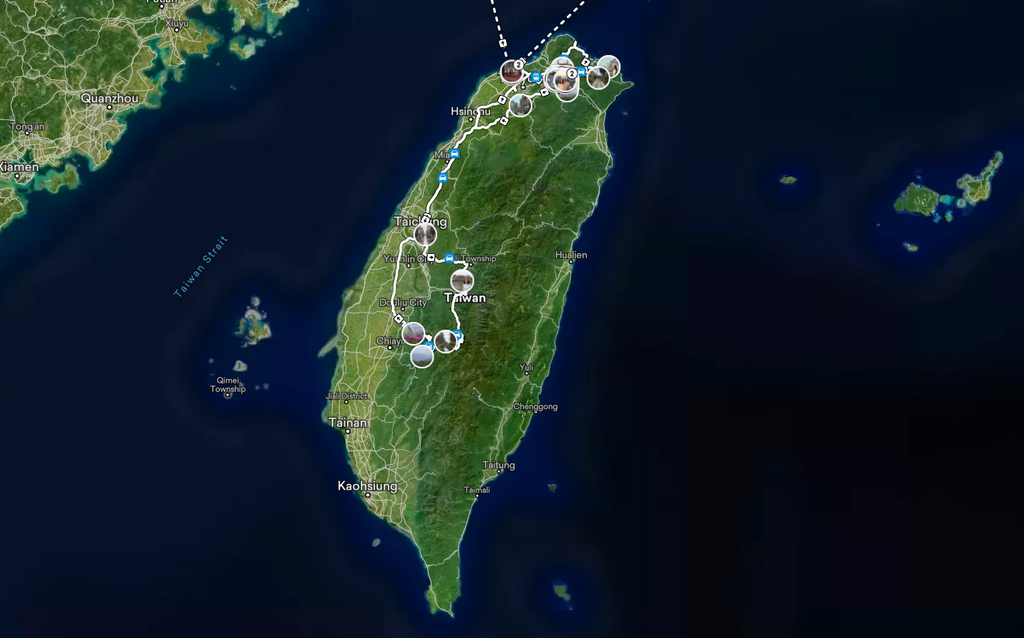
We’re heading back to Asia – Taiwan. This tropical island is almost twice smaller than Latvia in area but has around 12 times more people. Around 70% of the island is covered by mountains, with the highest peaks reaching almost 4,000 metres above sea level. It’s a fairly unusual destination for travellers from our part of Europe, partly because of its politically “interesting” relationship with China, which considers Taiwan part of China. The people living on the island tend to have a different opinion.
But as usual – wherever we can find good flight tickets, that’s where we go. Riga – Stockholm – Beijing – Taipei and back = €380 including luggage. Let’s go!
To be fair, the €380 fare starts in Stockholm. We still need a positioning flight to the Swedish capital, but that one I painlessly exchange for AirBaltic loyalty points.
STOCKHOLM, SWEDEN
24.04.2026: The flight is only 55 minutes. Towards the end, the plane shakes quite a lot. Maybe some young captain has been given the steering wheel for the first time?
The Arlanda Express gets us into central Stockholm in 18 minutes. Expensive, but very efficient – €85 for both of us return.
Our bags are still very light, so we decide not to leave them in airport storage. We’ll save the €40 and simply walk around with everything on our backs. We’re strong, supposedly!
We don’t complicate things and have McDonald’s burgers for breakfast right next to Stockholm Central Station for €16. Firstly, this avoids the eternal stagnation of searching for the perfect café.
Secondly, you know what you’re getting. I’m sure there will be plenty of mysterious food to taste later on this trip. The city is only just waking up. Most shops and cafés are still closed.
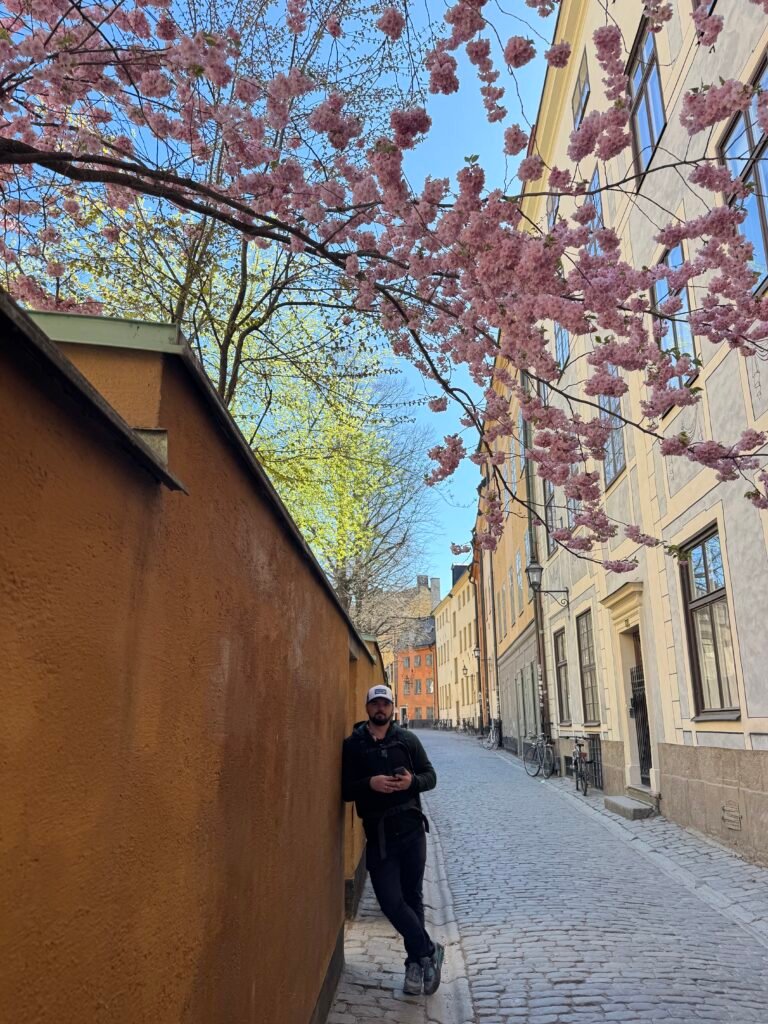
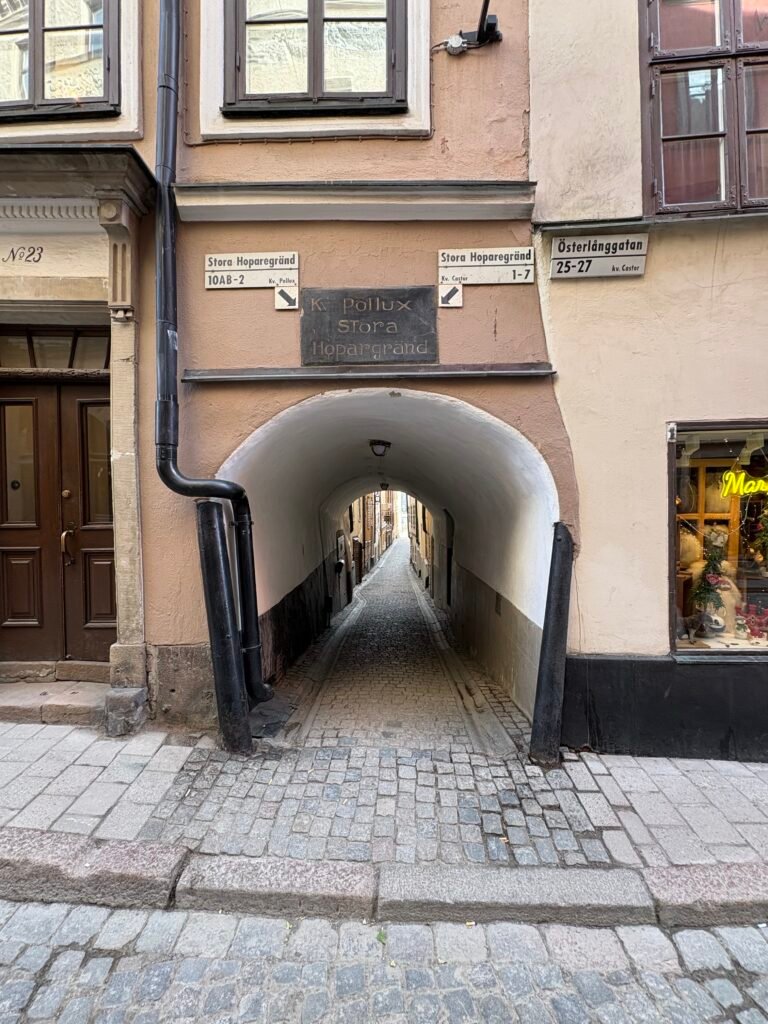
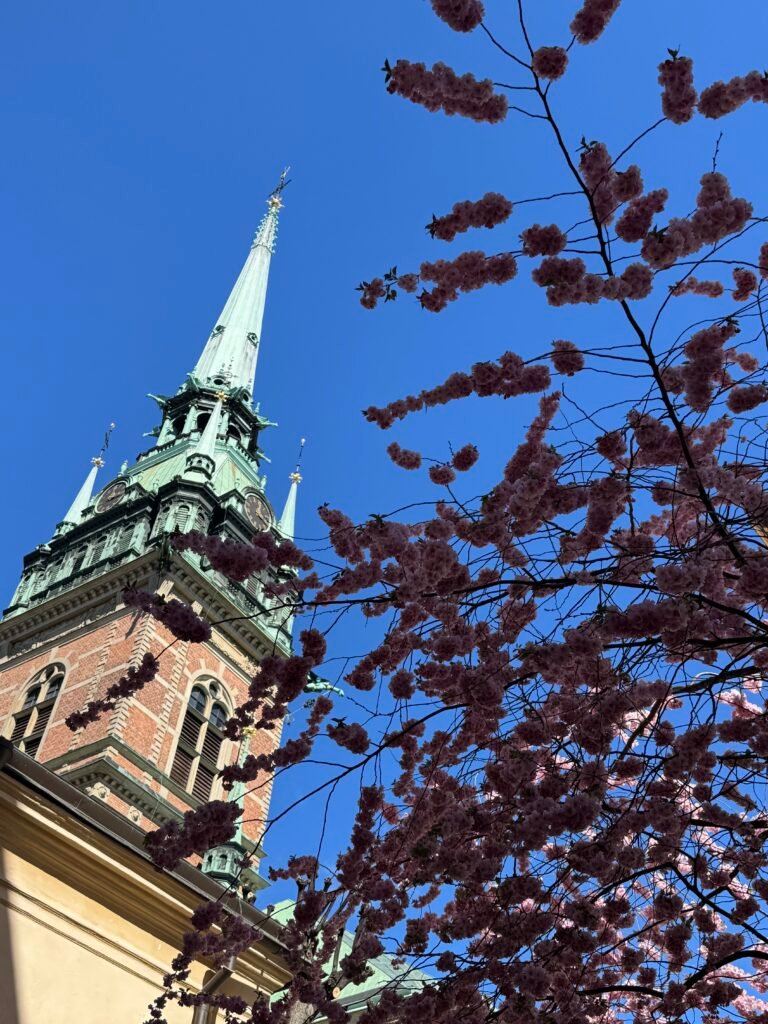
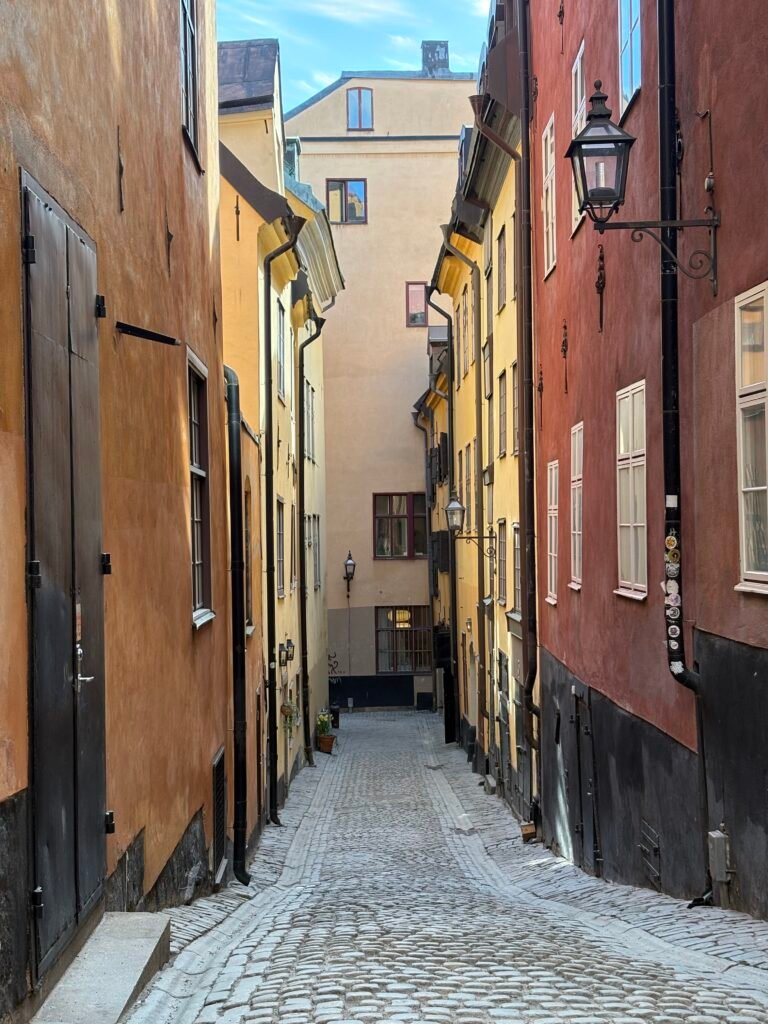
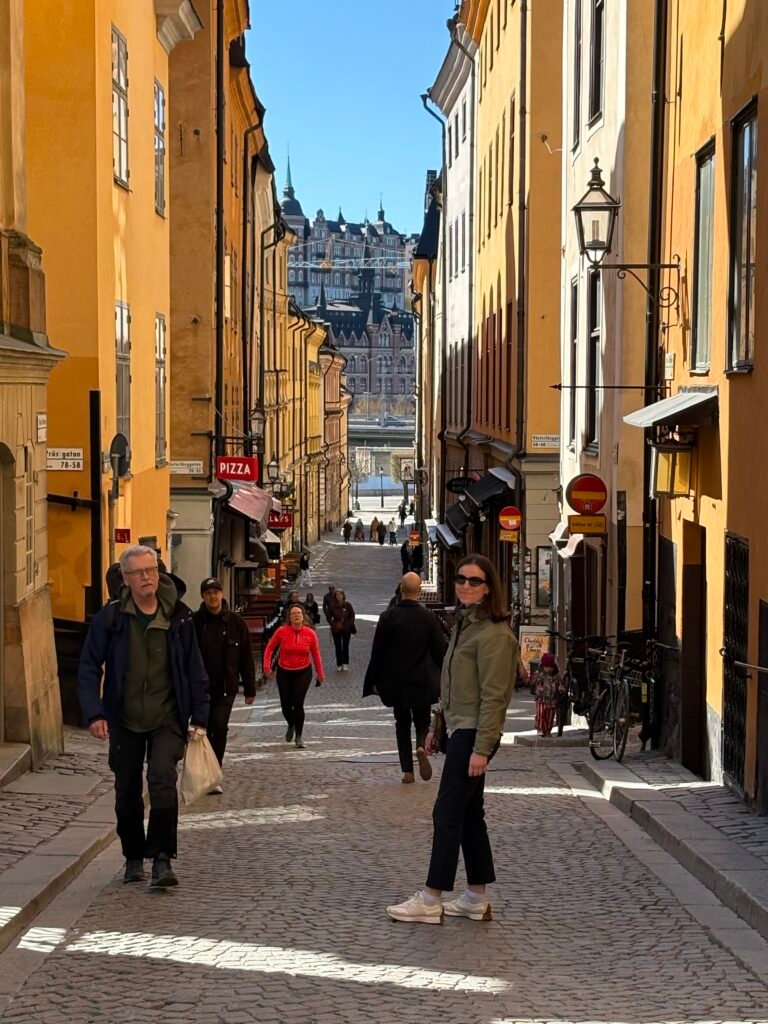
The weather is cool but sunny. Perfect for a relaxed walk through Gamla Stan.
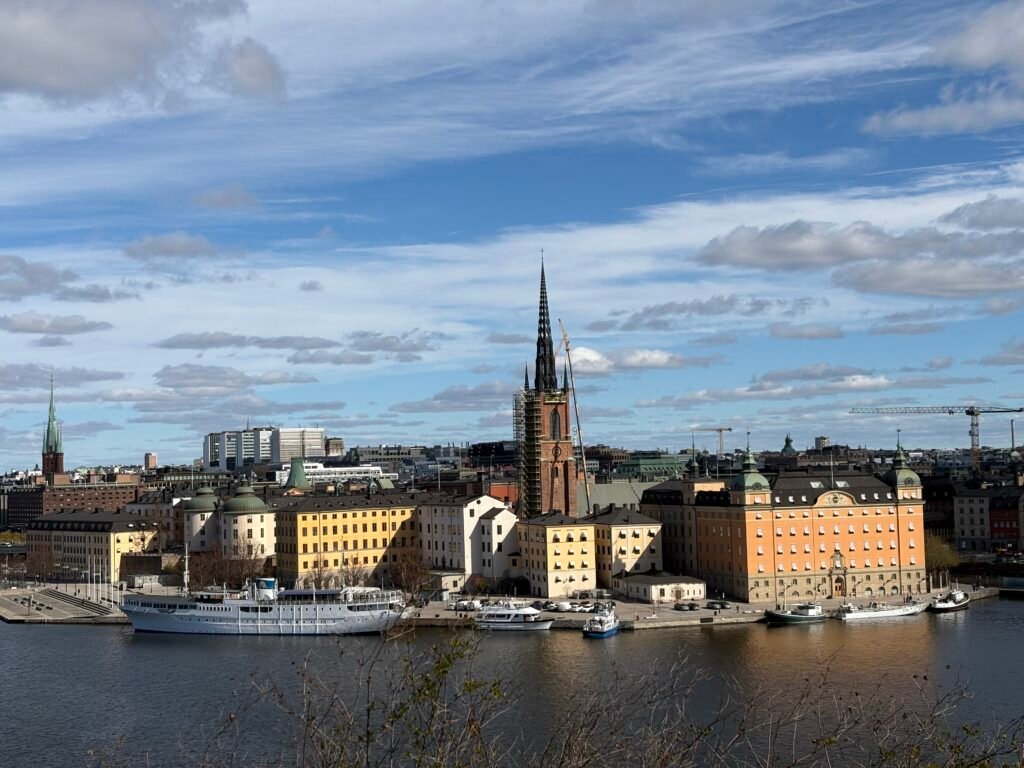
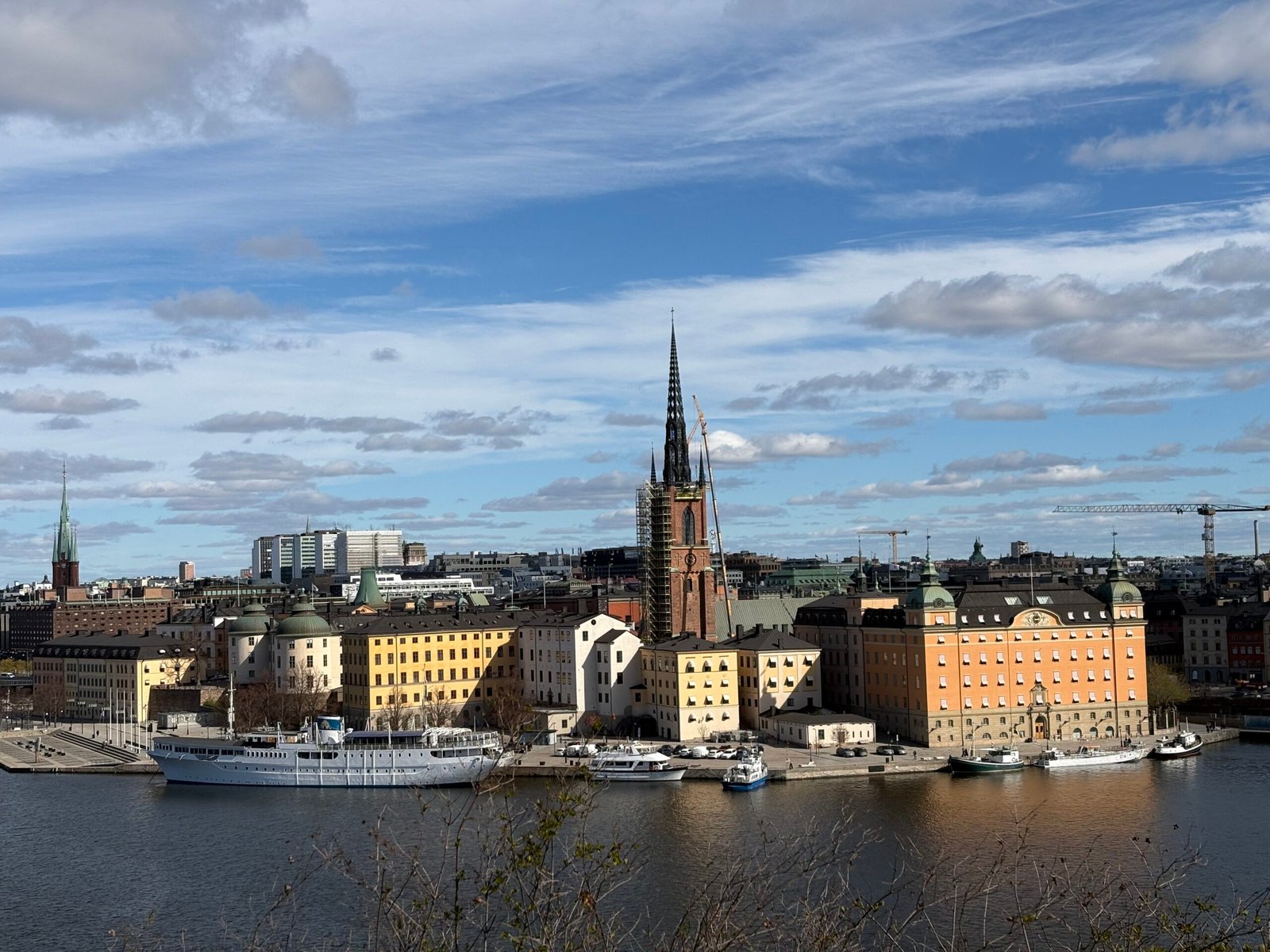
We cross the island to a viewpoint with probably one of the best views of Riddarholmskyrkan across Stockholm’s waterways. Then slowly back across the river into the Old Town, where we stop at a café. And just like that – 12,000 steps already.
To my surprise, Stockholm has quite a noticeable amount of elevation, which we definitely start feeling in our legs later, especially with backpacks on our shoulders. Nothing that can’t be “sat out” during the upcoming nine-hour flight though. We don’t have any real programme today, and we don’t particularly feel like walking around with purpose either, because we slept barely four hours last night and it’s starting to show. So we spend another couple of hours slowly working our way through the little bars in the charming Old Town streets, which themselves are only just waking up after midday. On the train back to the airport, I sit down and the next thing I know I wake up at the airport. Teleportation!
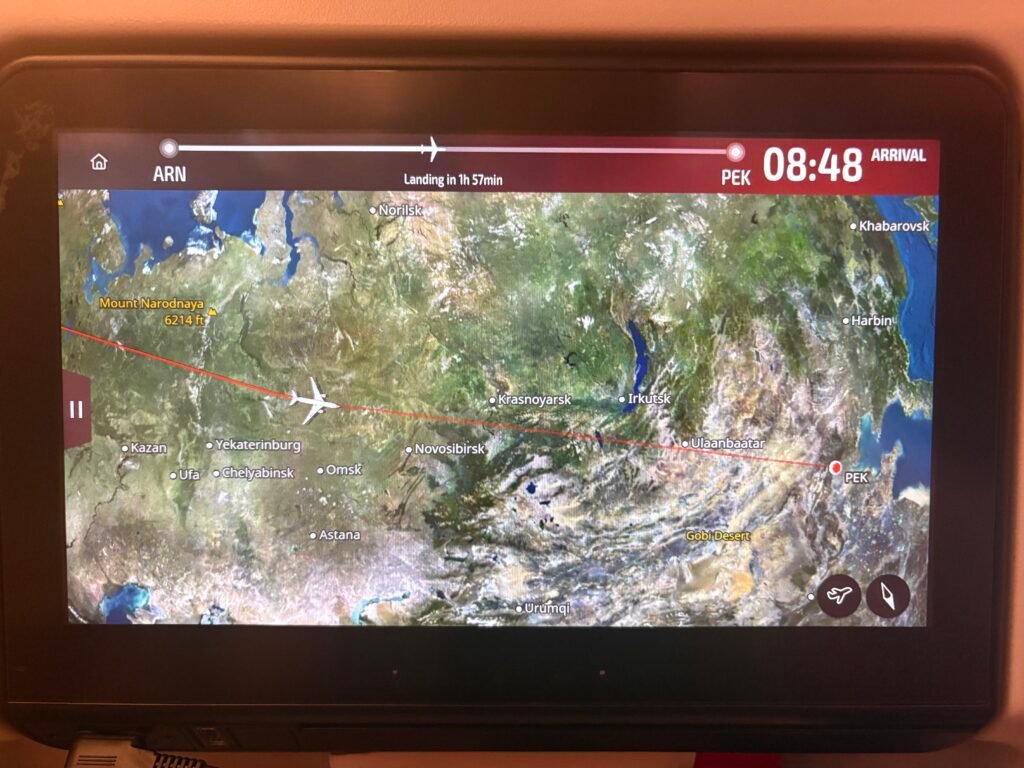
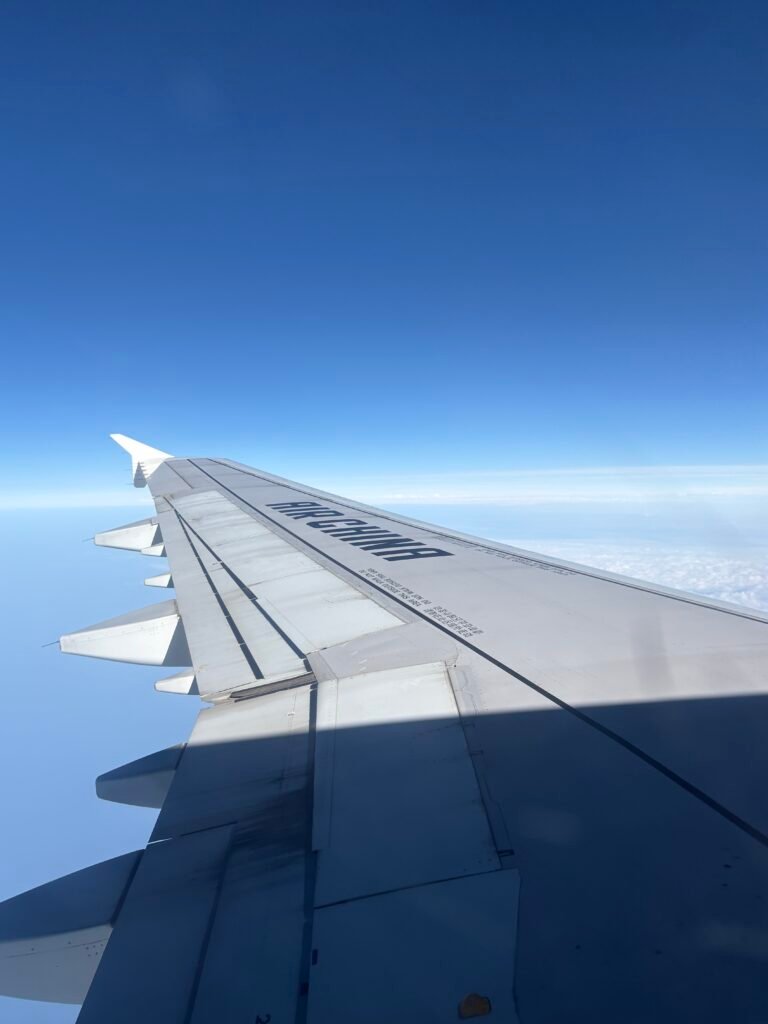
Next up is nine hours with Air China to Beijing – the capital of China. Saying that out loud still sounds slightly unreal. On this trip, though, Beijing is only a secondary stop – the little “cherry on top” for the journey home. One slightly exotic detail right now is that Air China is one of the relatively few airlines still allowed to use Russian airspace, so we’ll basically be flying “straight across”.
ARN – PEK
25.04.2026: After our express visit to Stockholm, we board the nine-hour Air China flight to Beijing. In the end, we actually arrive almost an hour earlier than scheduled.
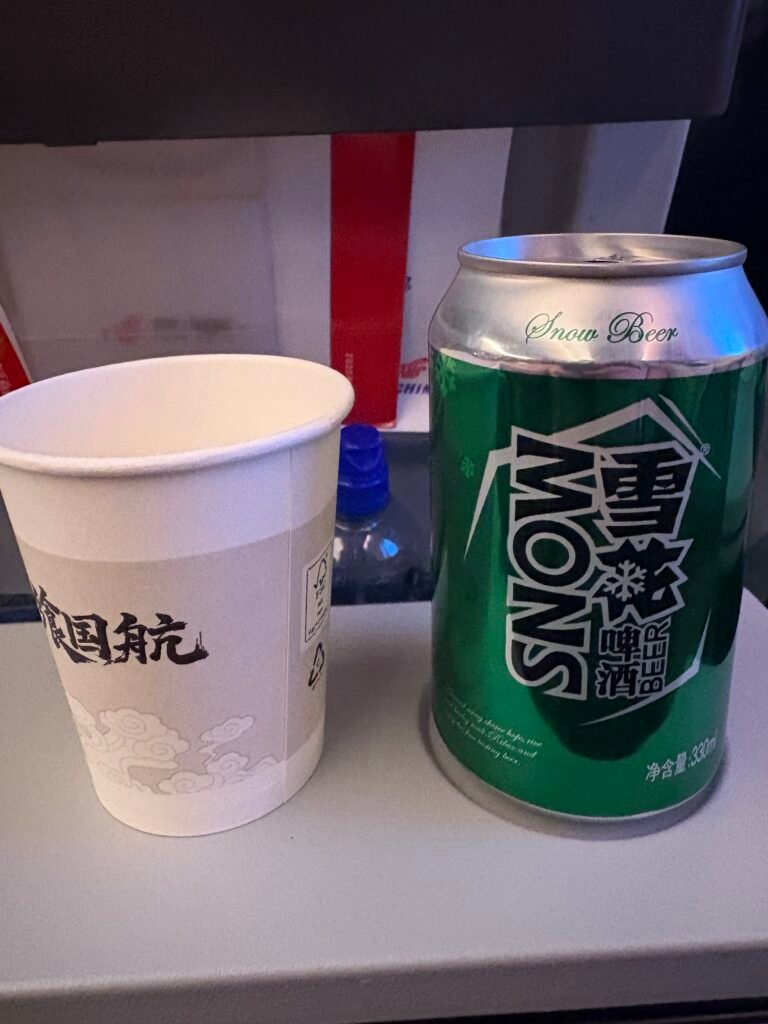
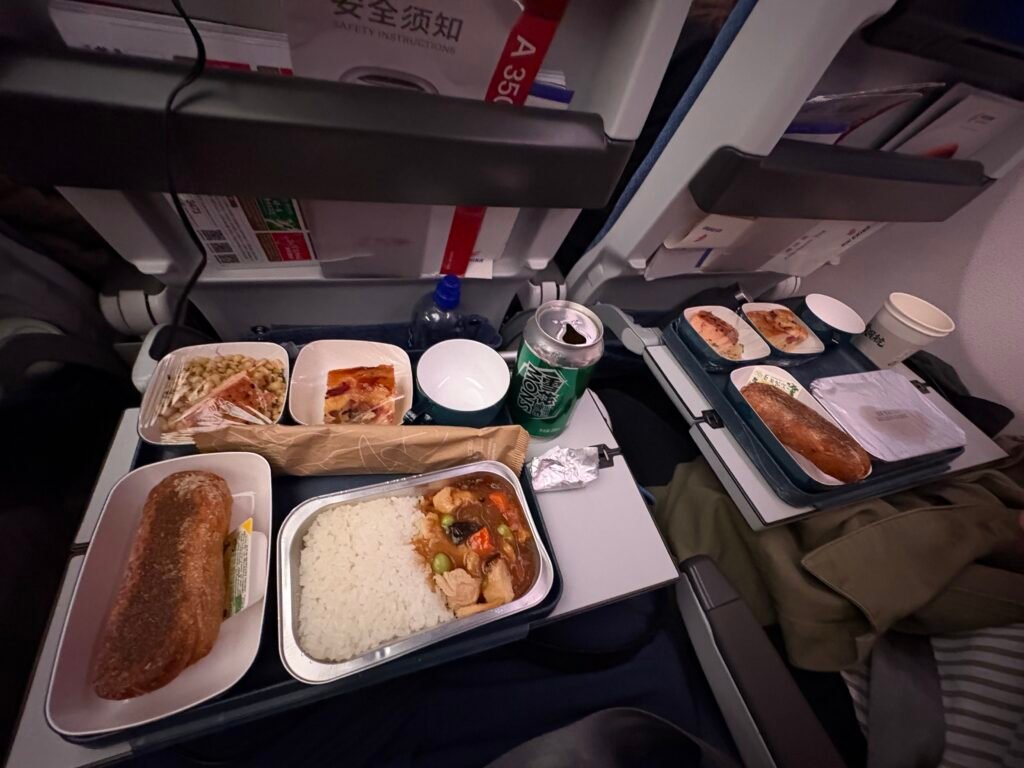
The flight seems to pass reasonably quickly, but it’s still exhausting because the plane is full and I have the honour of sitting in the middle seat. I watch one movie and, after a surprisingly tasty dinner, try to arrange myself into some kind of sleeping position. Not particularly successful. In total, maybe I collect two hours of broken sleep. At breakfast, I manage to dump the noodles into my lap and almost onto the Chinese guy sitting next to me as well. Good thing I’d already managed to eat some of them first. Anyway – we’ve made it to China.
Now we have another four hours to spend at the airport before the final flight towards Taiwan.
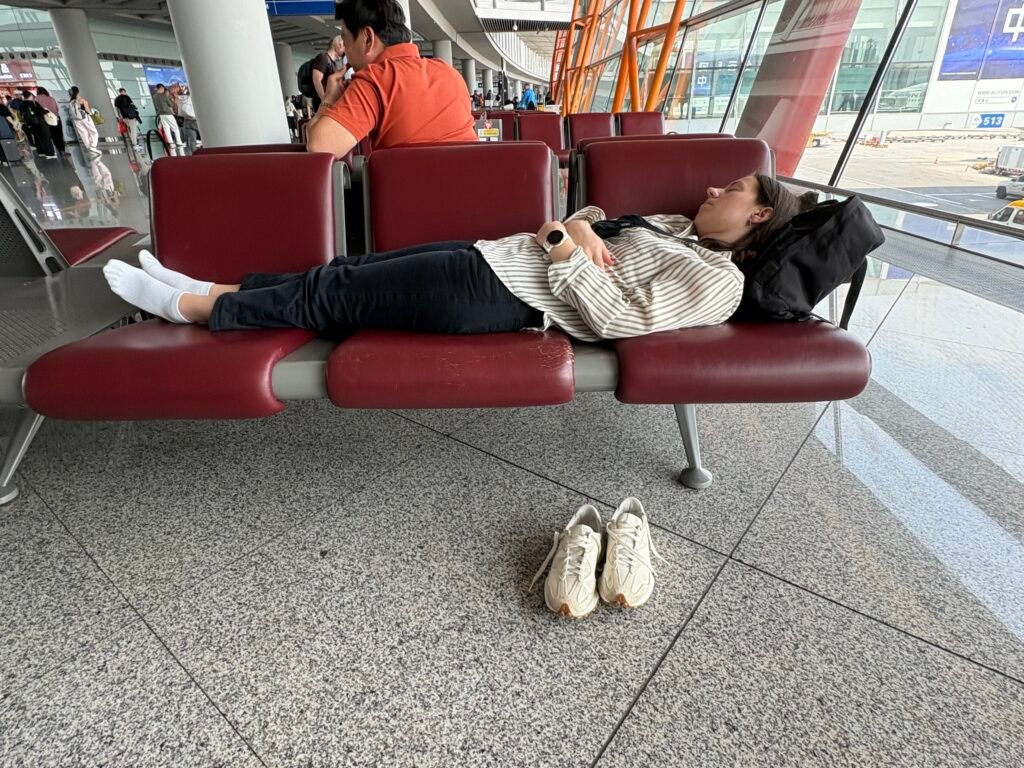
Passengers connecting in Beijing to Taiwan, Hong Kong or Macau seem to have been allocated a particularly sad little corner of the airport with very few options for entertainment.
Coincidence? Probably not.
PEK – TPE
25.04.2026: While flying to Beijing, knowing we had a 4.5-hour connection – which eventually turns into 5.5 hours because we arrive almost an hour early – I thought the time would disappear quickly. After all, this is one of the biggest airports in the world. Reality turns out slightly different for us. Transit passengers heading to Taiwan, Macau and Hong Kong have, intentionally or unintentionally – perhaps because of the political relationship between these places? – been assigned some random corner of the airport where there’s almost nothing to do. And we’re not allowed to enter the other areas.
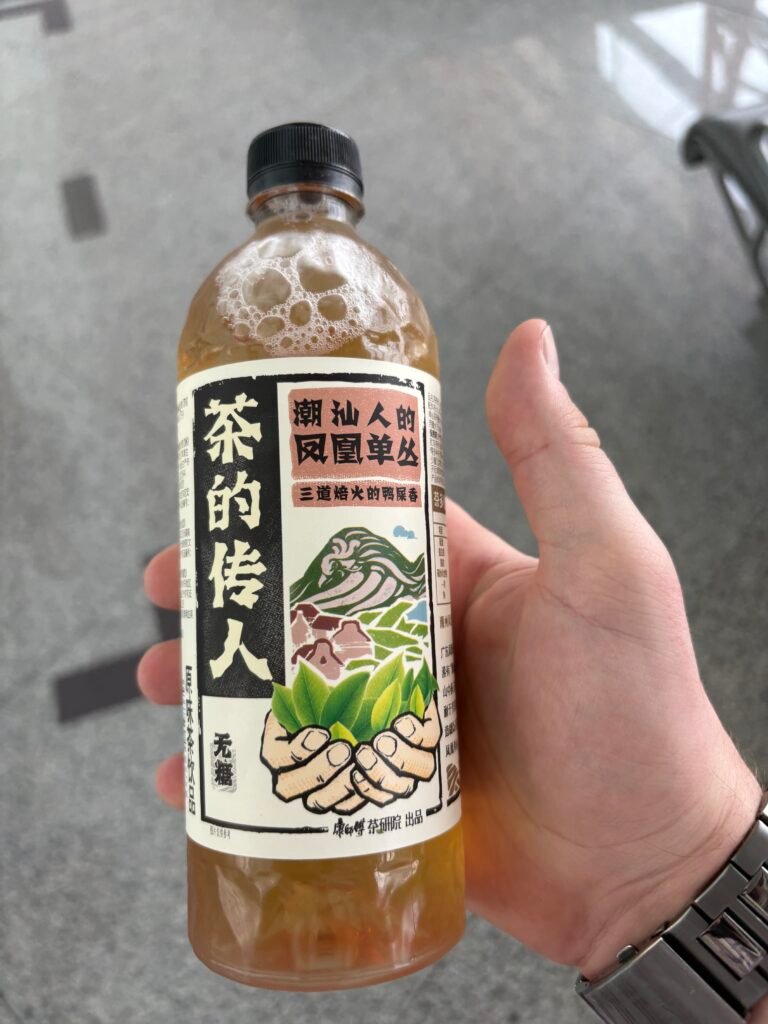
So we find a massage chair and let it shake us around for a while. Then we spend about 30 minutes trying to walk life back into our sausage-like toes, eat rice at a pizzeria and go to sleep.
Ironically, the worst thing you could order at this particular pizzeria seems to be pizza. Madara is the only person within our field of vision who makes that mistake. Everyone else is eating classic rice dishes. The sleep deficit is getting serious, so we lie down for the rest of the wait. I then sleep like the dead for almost the entire 3.5-hour flight from Beijing to Taipei. I even sleep through lunch, but when the Chinese guy sitting next to us notices I’ve woken up, he calls the flight attendant back so she can bring us food as well. Nice!
The last time we showered was around 40 hours ago. During that time, we’ve probably managed about six hours of sleep. But the most important thing is that we’ve finally arrived in Taiwan.
Time to see what they’ve got here!
TAIPEI, TAIWAN
25.04.2026: The Taiwan dollar is quite an exotic currency and practically impossible to get in Europe beforehand. Even in other Asian countries, it isn’t exactly lying around everywhere.
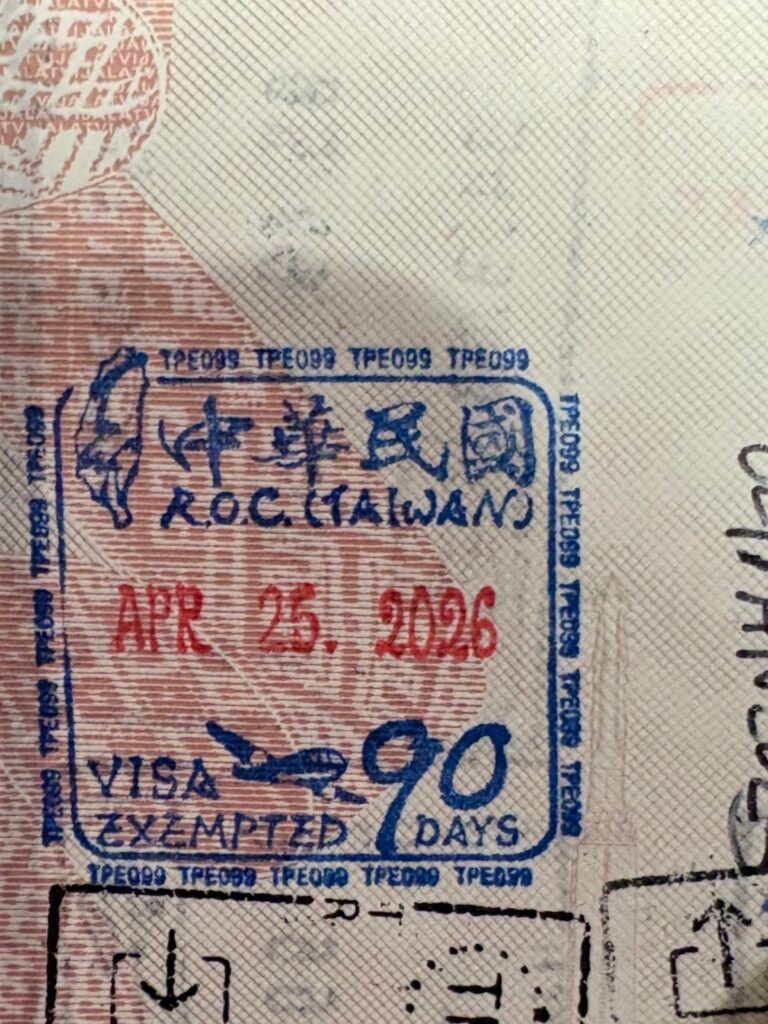
So the first thing we do after landing is exchange some money at the airport. Unlike most airports – certainly unlike Europe – the exchange rate here is actually civilised. We go through immigration again. Since checking in at Stockholm Airport, we’ve been checked another three times. Bags scanned, bodies scanned, passports inspected, faces photographed. But since we look trustworthy enough and don’t appear to be protesting against communism – at least on the Chinese side – everything goes smoothly and we get a nice Taiwan stamp in our passports. And then the super-modern Asia begins – the kind we already experienced in Singapore last autumn.
An express train quickly gets us from the airport to Taipei Main Station.
At first, there’s some mild confusion with directions and Chinese characters, but with enough faith and hope we somehow manage to board both the correct train and in the correct direction.
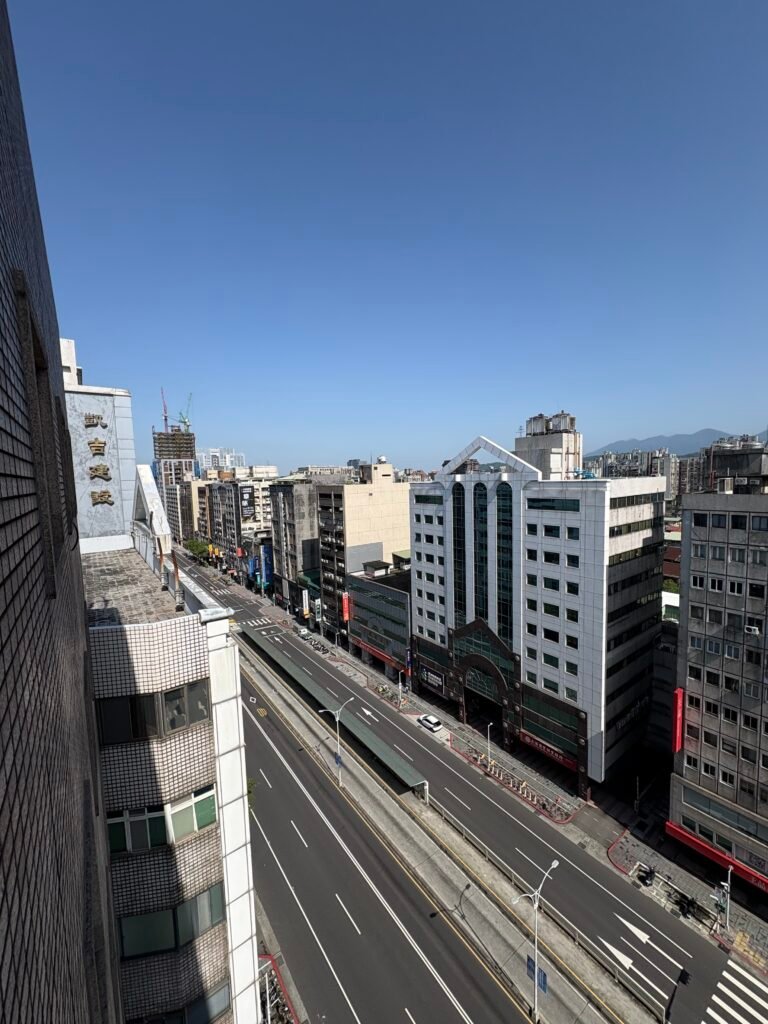
At Taipei Main Station, we switch to the metro, and around ten minutes later we reach the area around our hotel – Hej Taipei Arena. Supposedly quite central. We’ll see how true that is over the next few days. At the hotel, we make use of the Wi-Fi and call home. Mum is currently in Talsi visiting Grandma, so we get two greetings in one call.
And according to our home time zone, Grandma’s birthday starts in just a couple of hours.
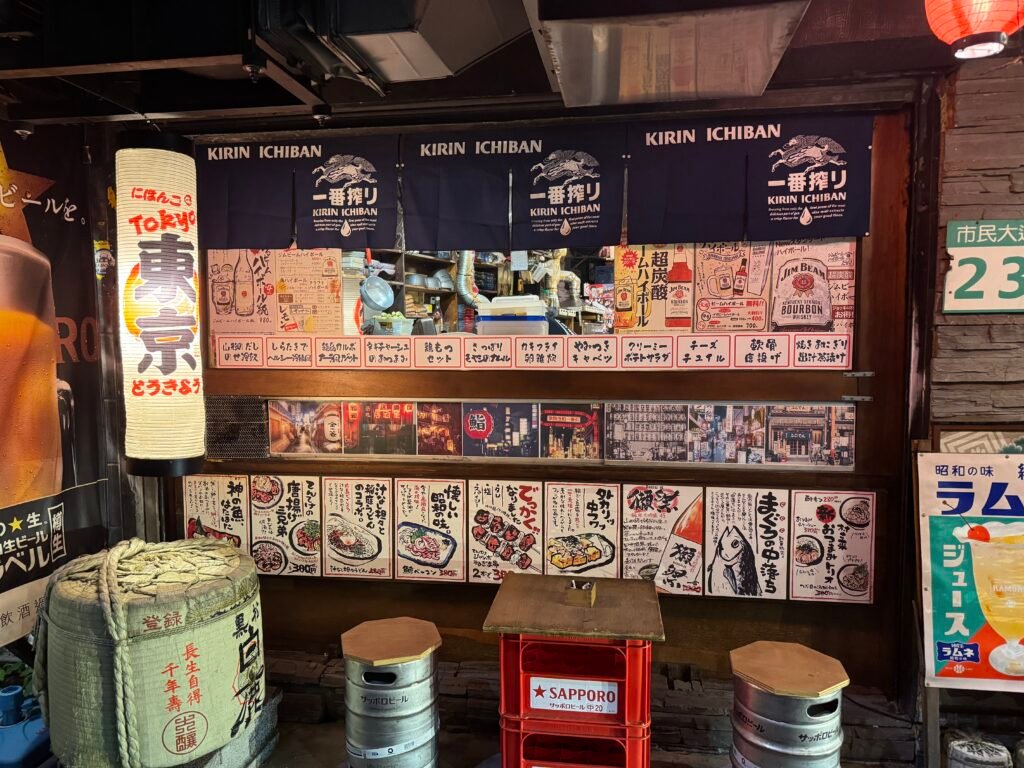
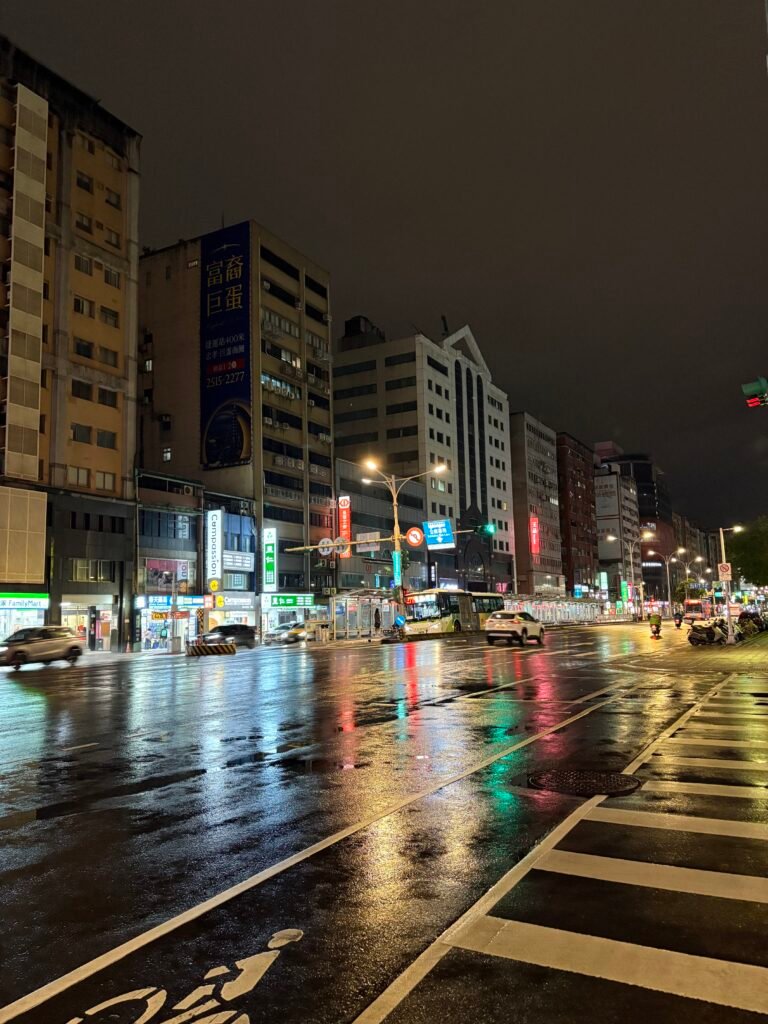
We still need to go outside tonight, otherwise we’ll collapse into bed at 21:00 and completely fail to adjust to the new time zone. So we head to a nearby bar called OriginBAR 源.
Turns out it’s Saturday and the place is so full that without a reservation there’s no chance.
Doesn’t really matter tonight. The main goal is simply to walk, move around and stay awake.
Tomorrow we’ll properly hit the streets. We settle into another bar for a while, but it’s really not our style, so we move on fairly quickly. Before leaving, a local woman catches me and, sounding genuinely surprised, asks why we came to Taiwan. Not aggressively or negatively.
Just genuine curiosity. Apparently Taiwan receives only slightly more tourists per year than Latvia.
And tourists from somewhere as far away as us are even less common. We’ll have to answer this question several more times during the trip.
CHIANG KAI-SHEK MEMORIAL HALL
26.04.2026: No surprises – we sleep from the moment our heads hit the pillow until the alarm goes off, without opening our eyes once.
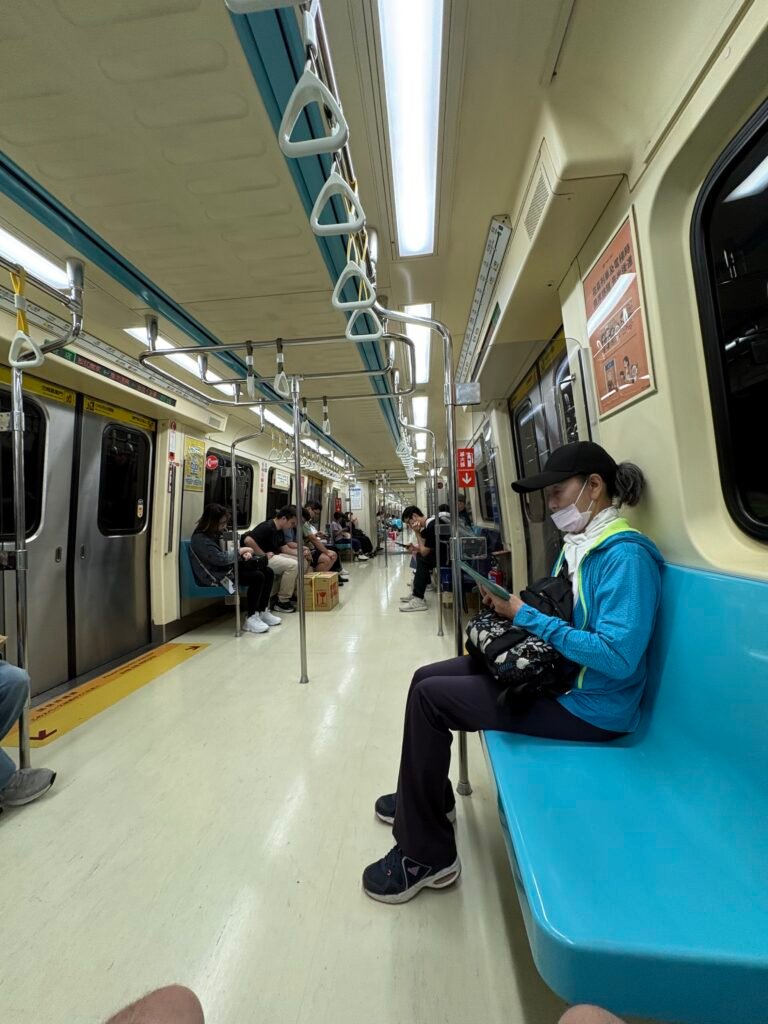
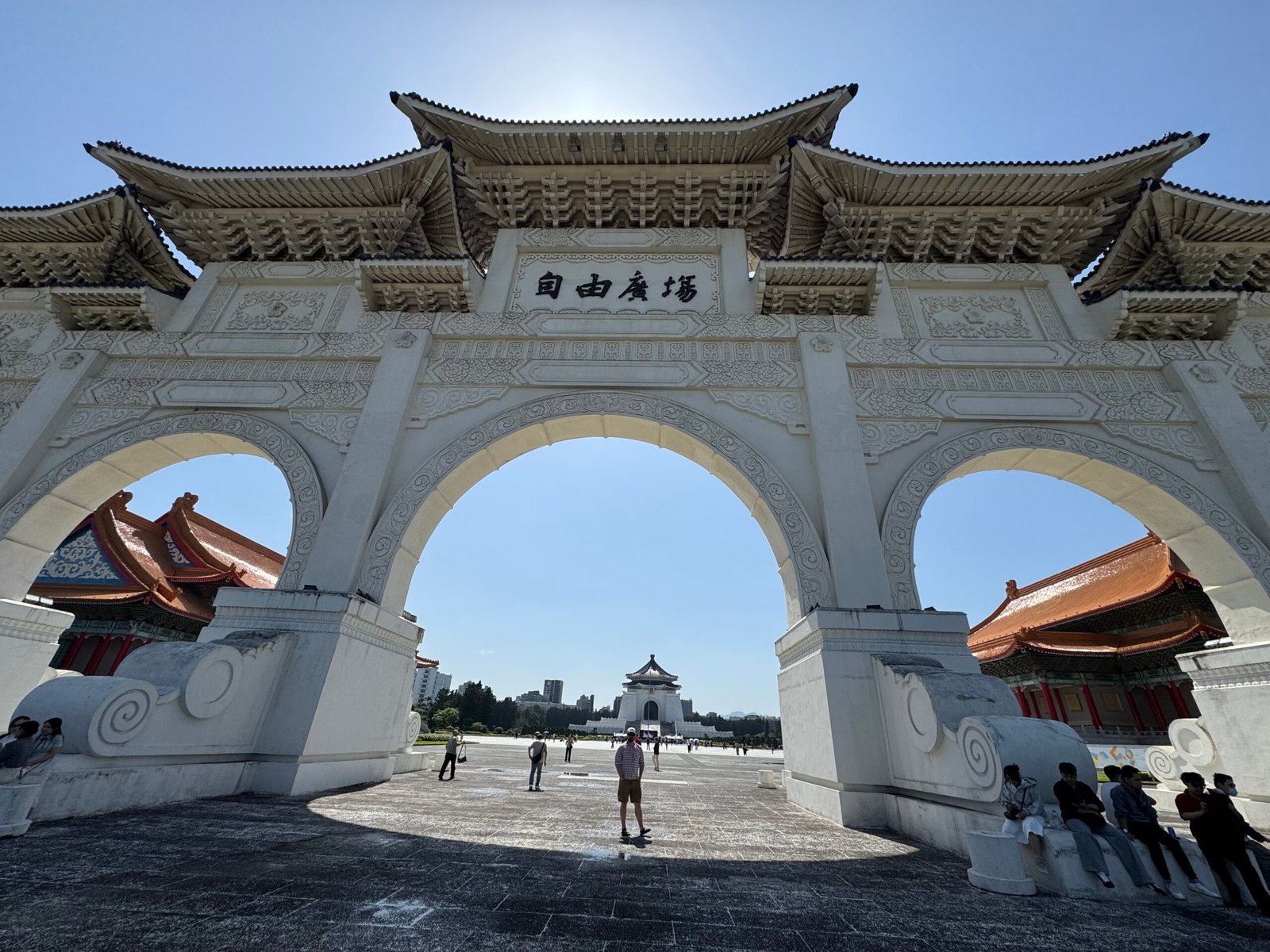
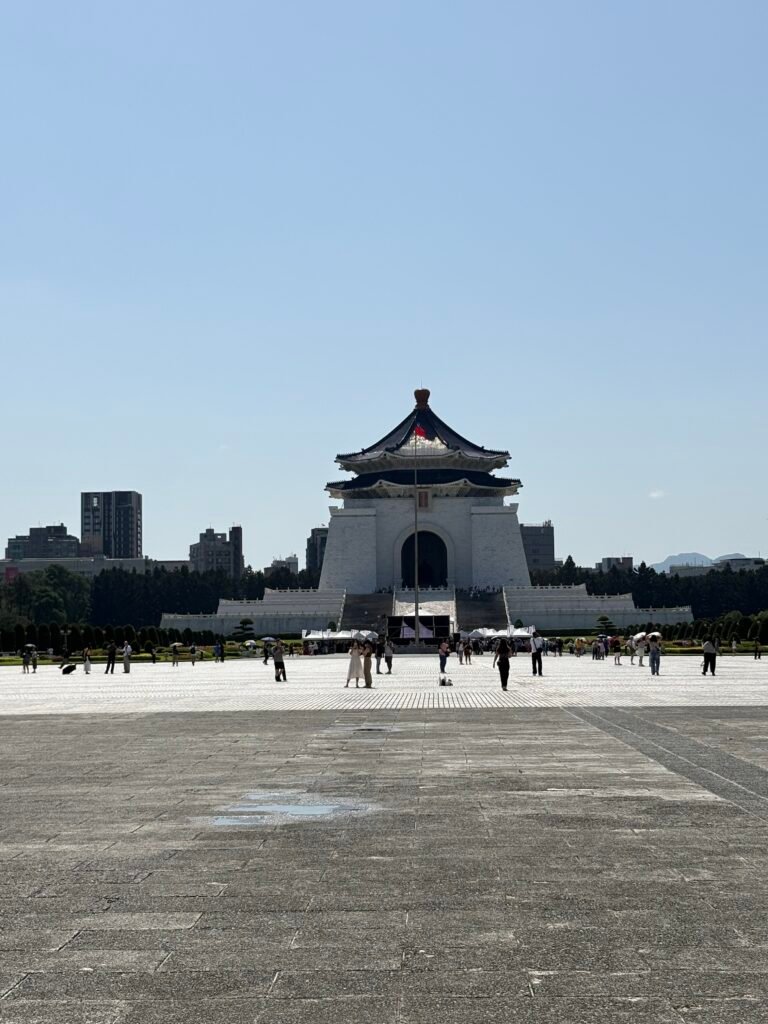
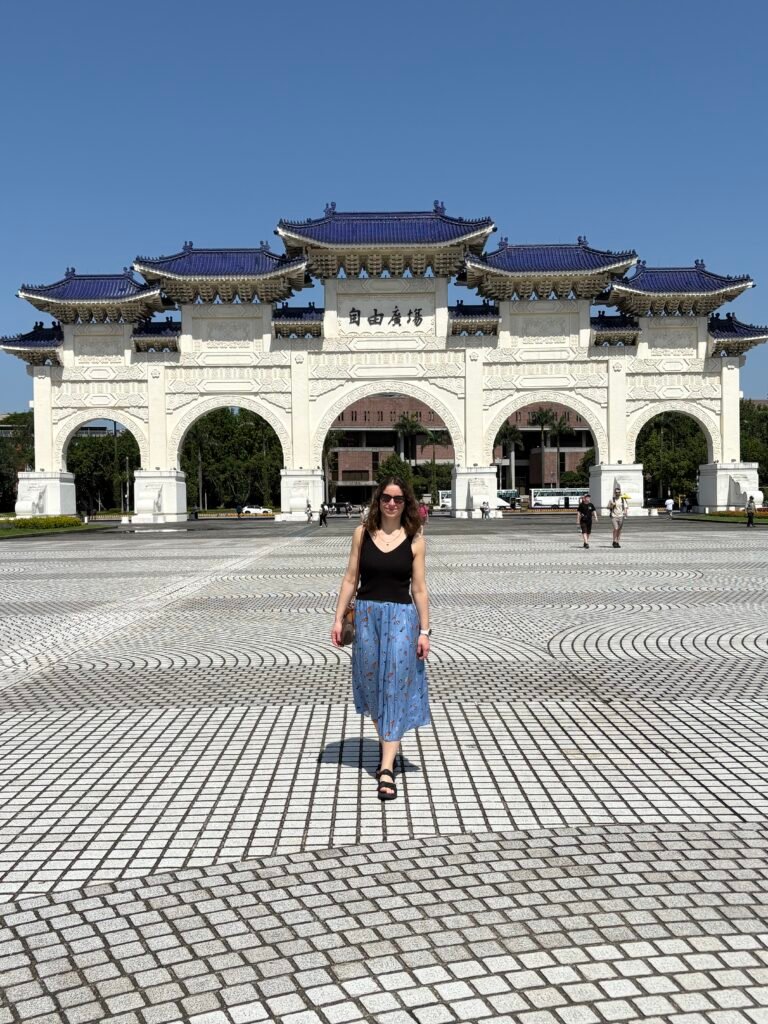
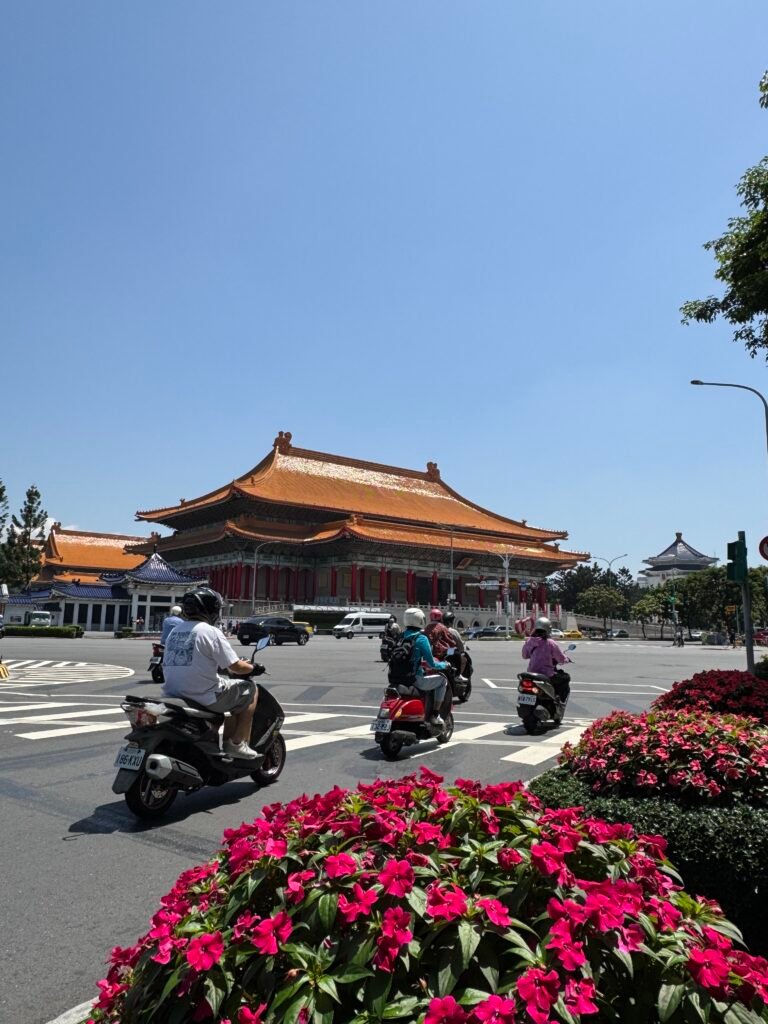
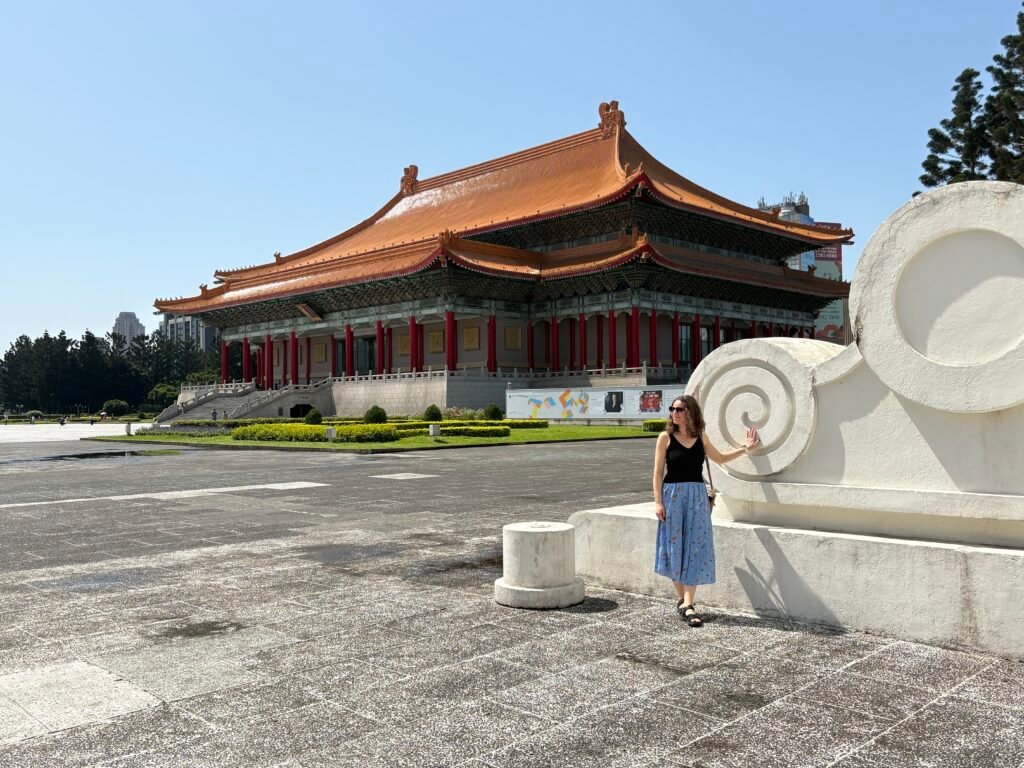
The morning looks very warm and promising from our 12th-floor window. We take the unbelievably clean metro to our first official attraction – Chiang Kai-shek Memorial Hall (國立中正紀念堂). The square feels very grand in a distinctly Taiwanese interpretation of grandeur.
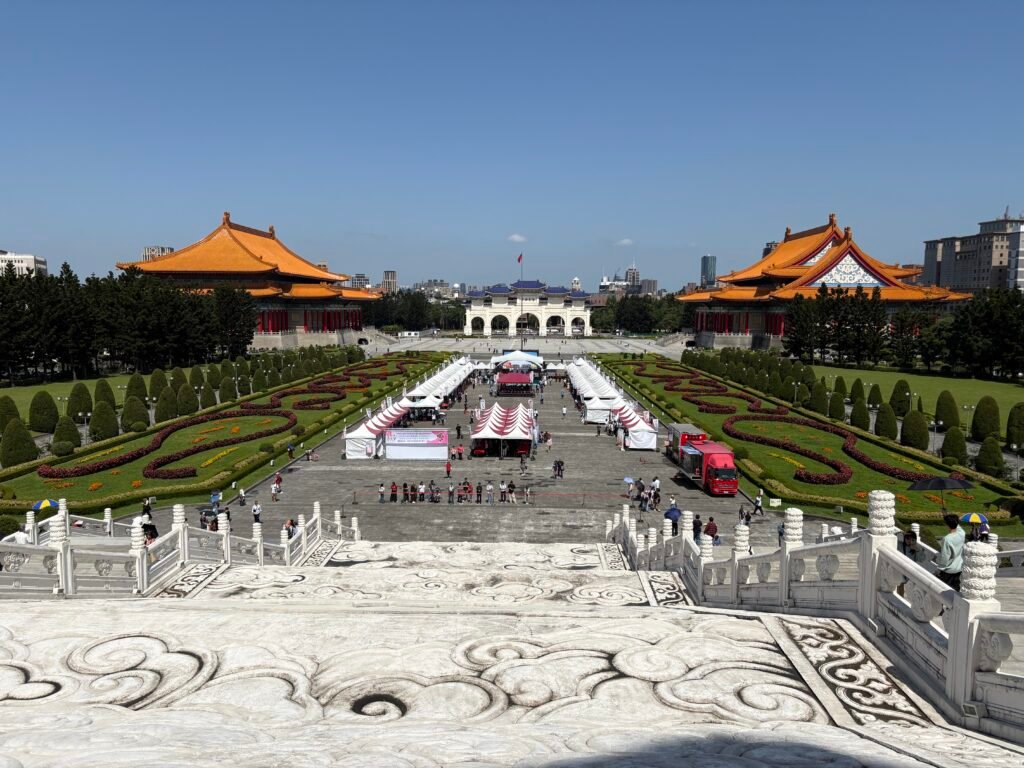
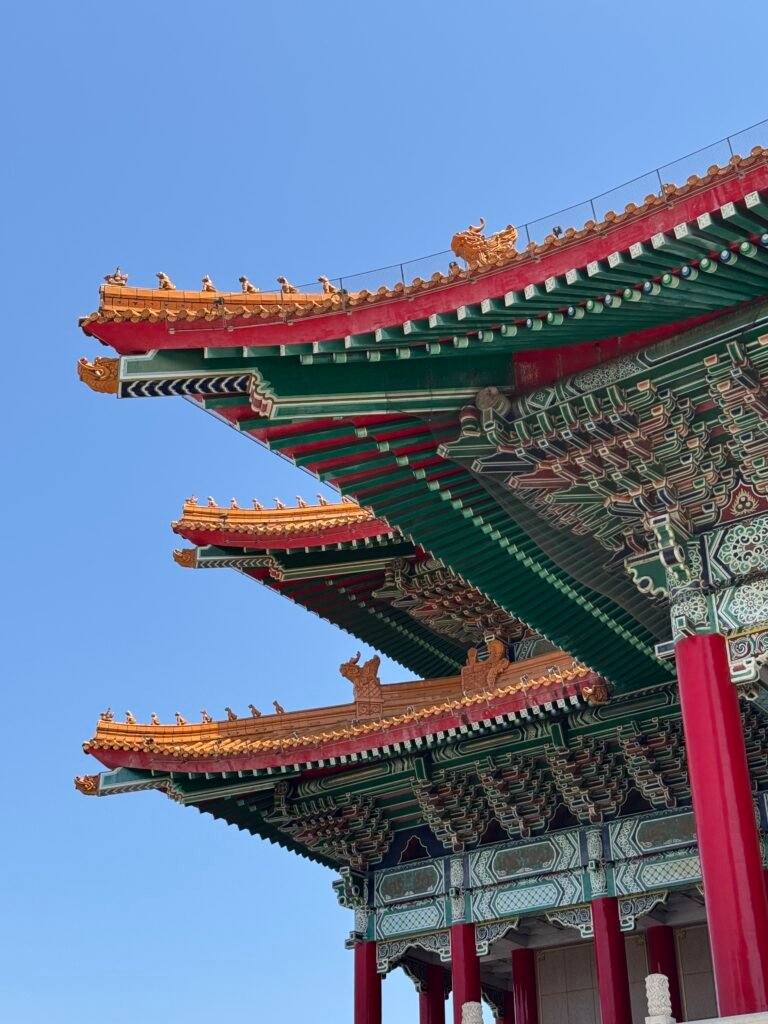
Huge entrance gates and an enormous open plaza surrounded by traditional-style buildings.
In front of the main building, the red-and-blue Taiwanese flag waves proudly in the breeze.
The only thing slightly ruining the overall view is a collection of white tents where some kind of children’s dance event is taking place. Must be lovely dancing in direct sunlight at +30°C with 85% humidity. I suppose they’re used to it.
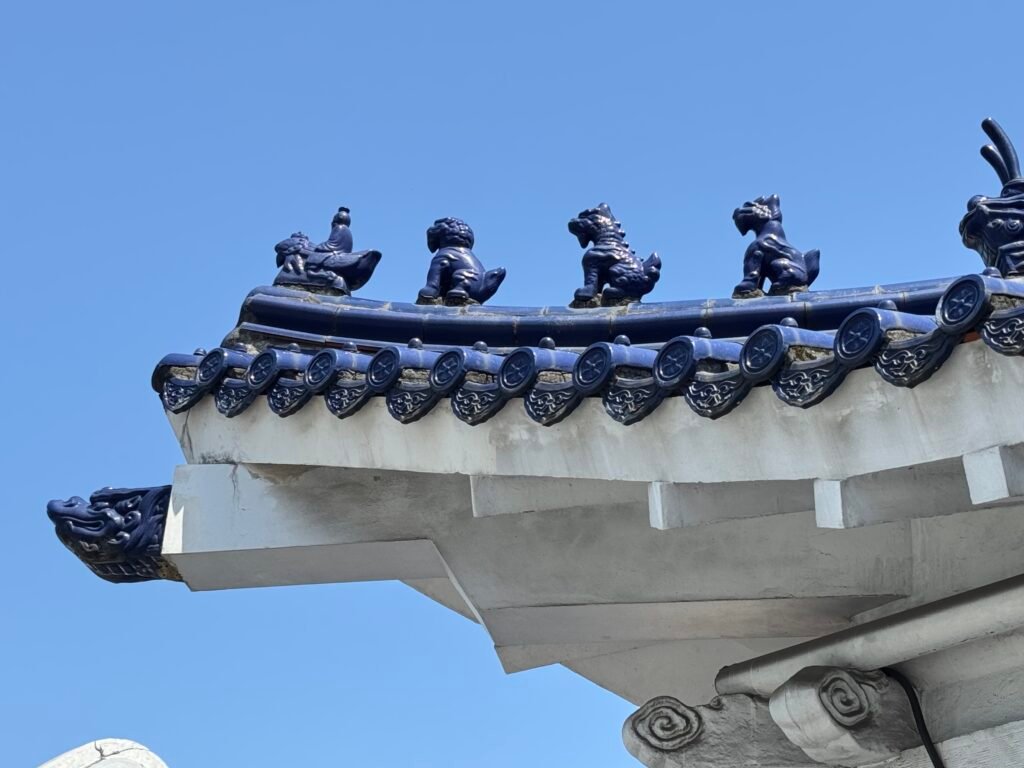
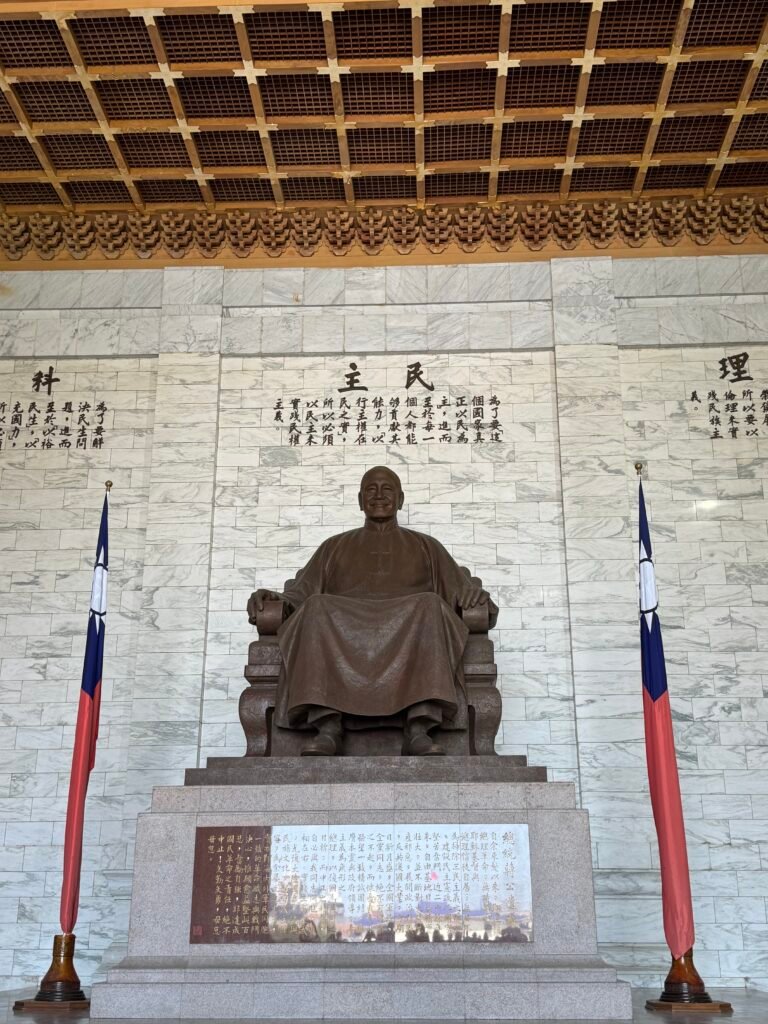
The main building is the memorial dedicated to Chiang Kai-shek. It opened in 1980 in honour of the former military and political leader who moved the government of the Republic of China to Taiwan after the civil war and played a major role in Taiwan’s later development. He spent his life fighting communist forces in mainland China. At the same time, the memorial is also effectively a museum about democracy and major struggles for it around the world. The memorial hall is white and four-sided. Its roof is blue and octagonal, reflecting the symbolic importance of the number eight, traditionally associated with prosperity and good fortune in Chinese culture.
Two staircases lead to the main entrance, each with 89 steps, symbolising Chiang’s age when he died.
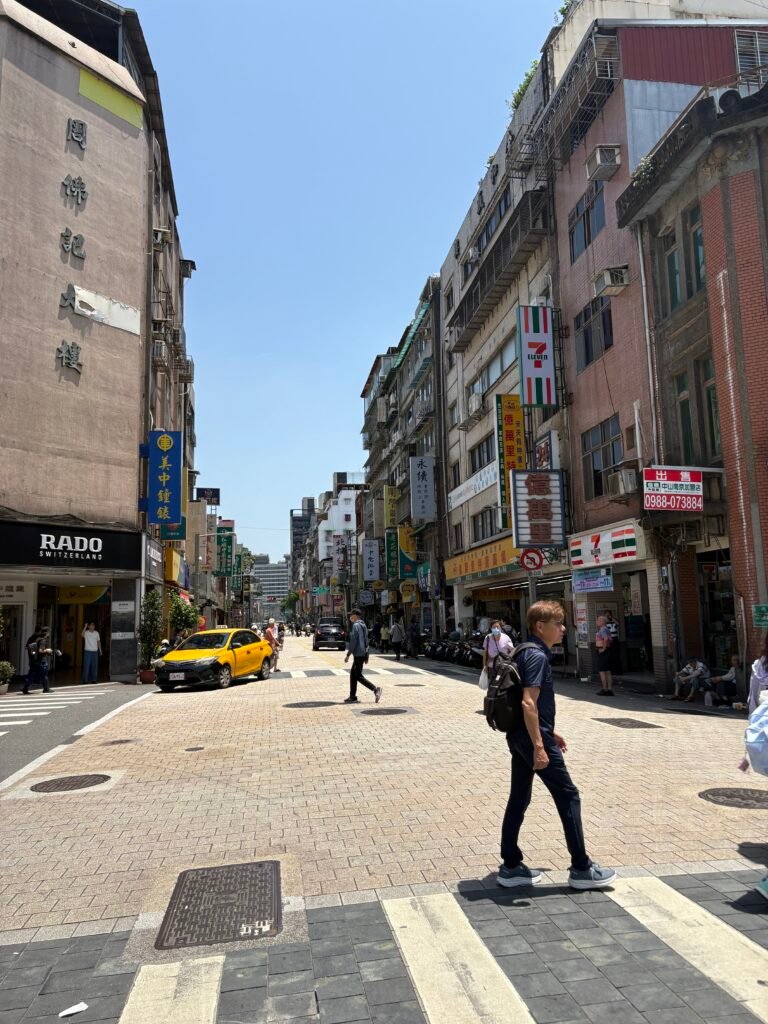
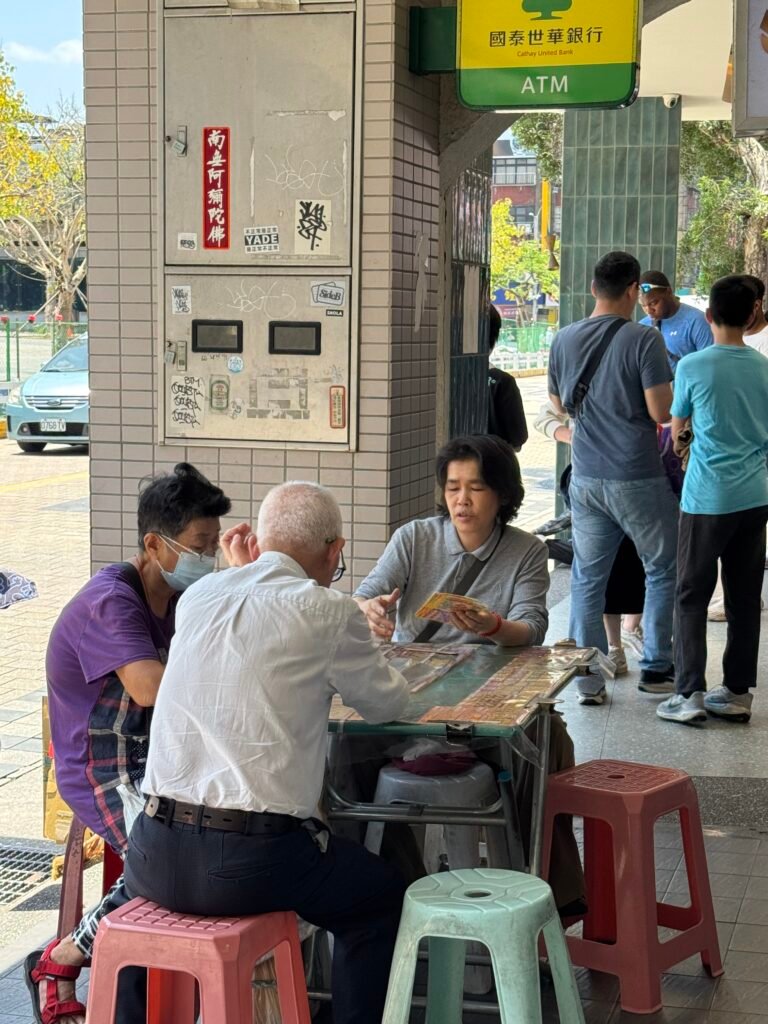
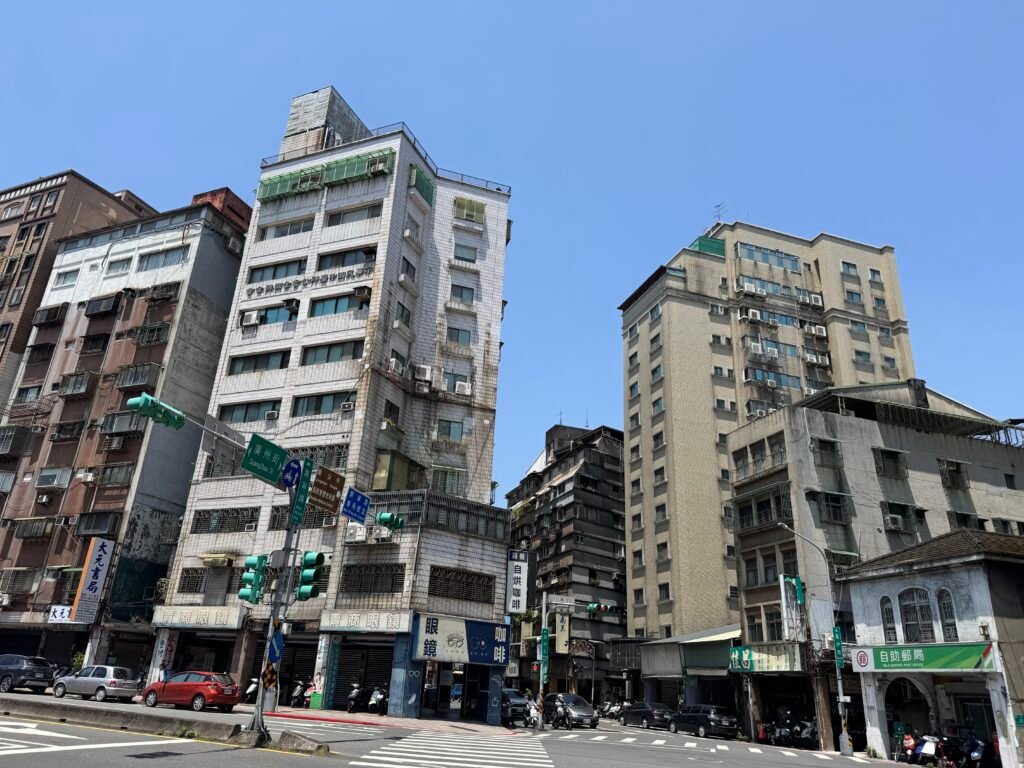
Next, we head towards another temple about 30–40 minutes away on foot. We walk through loads of small, interesting and unique streets. Tiny shops selling practically every object imaginable. And you never have to walk more than a couple of minutes between one little street-food place and the next. Taiwanese people are definitely not going to starve.
We stop at a café for coffee. Extremely strong espresso. But good!
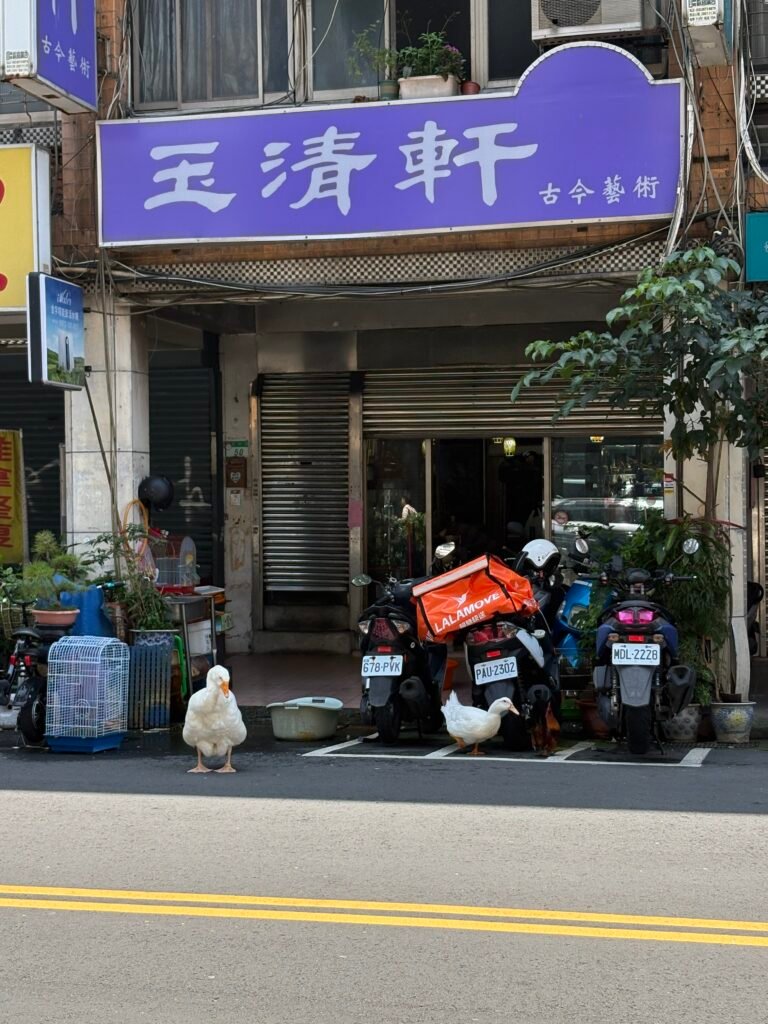
While drinking it, we look through the window and notice roosters and geese casually walking between cars in the traffic. Someone’s lunch escaped? By lunchtime, as we continue towards the next temple, we notice that practically every one of these countless tiny food places is full.
Apparently there’s enough demand for everyone.
LUNGSHAN TEMPLE
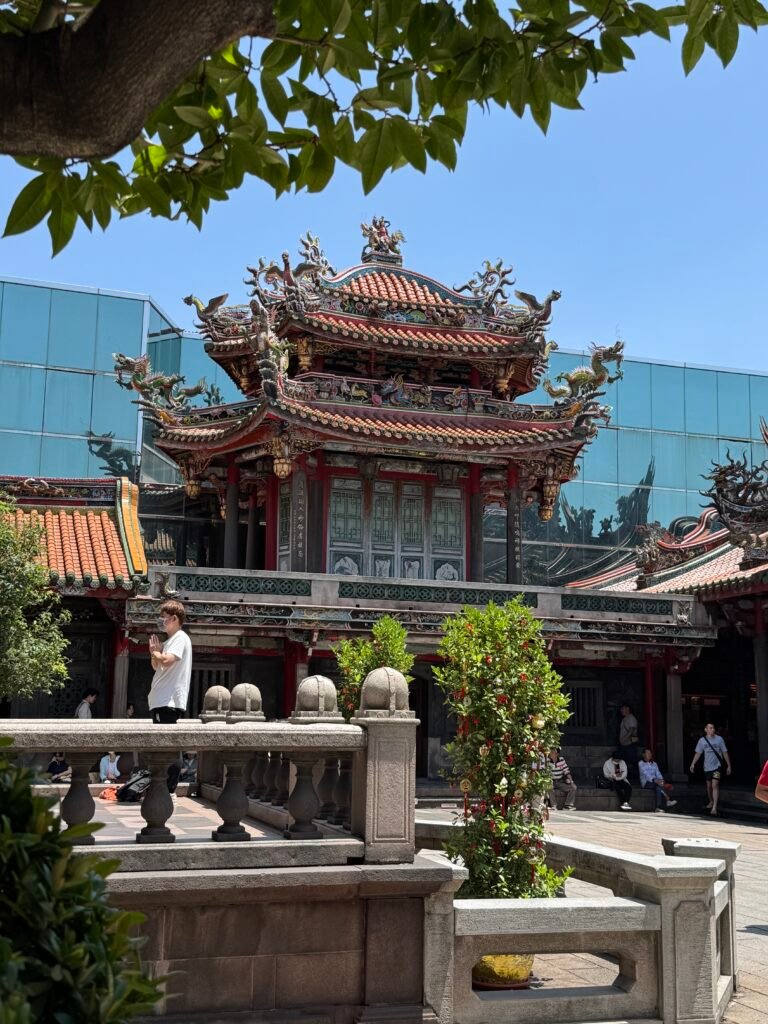
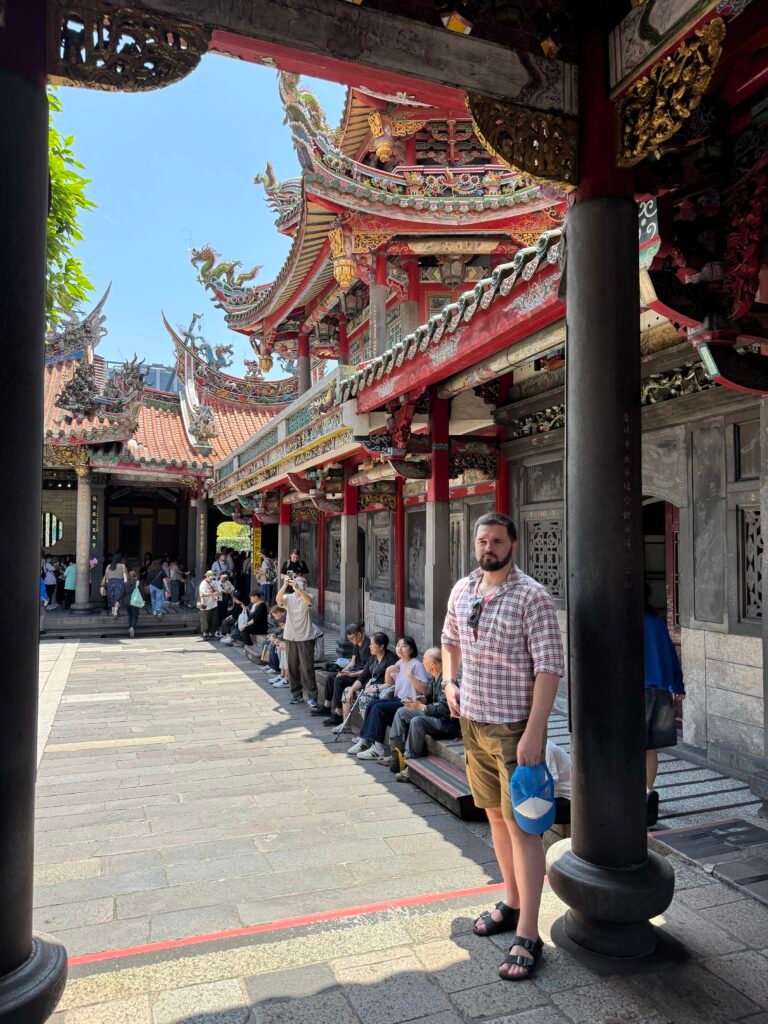
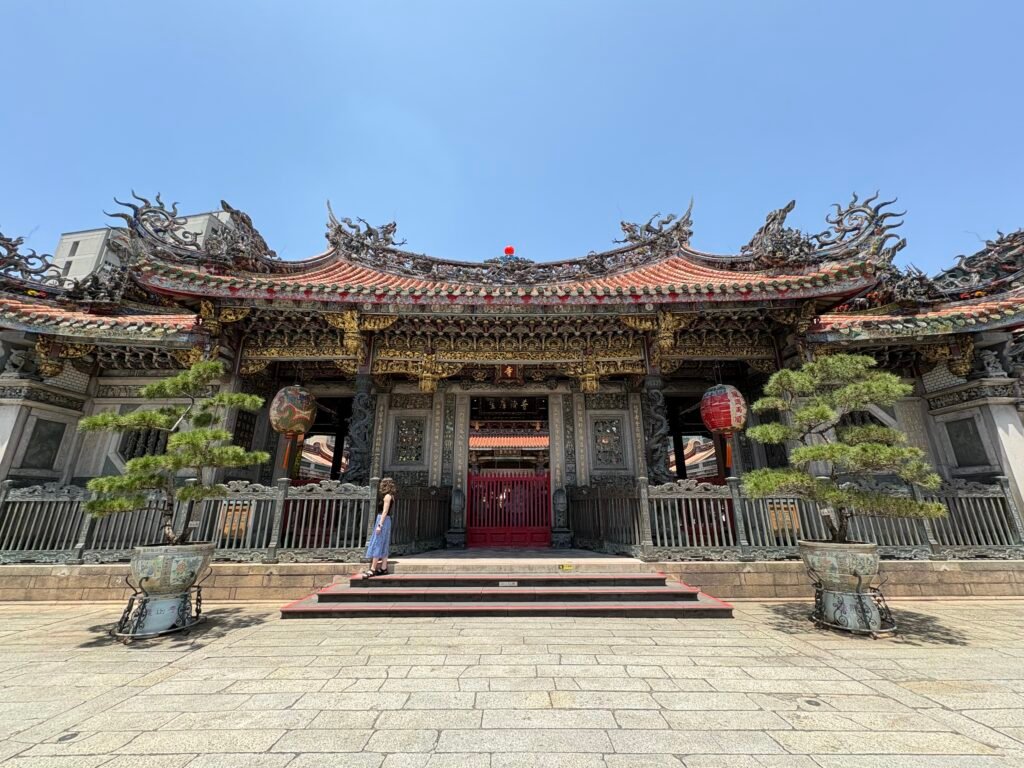
26.04.2026: Our next attraction, Lungshan Temple, is already a proper sacred place. First of all, we’re practically the only non-Asians here. Most people are genuinely here to go through their prayer rituals. Watching from the side, it looks as though everyone takes incense sticks and then moves anticlockwise around the different sections of the temple. At each one, they say a prayer, bow three times and continue. Interestingly, after some prayers people throw strange little wooden pieces onto the ground and then study how they landed. Some kind of fortune telling?
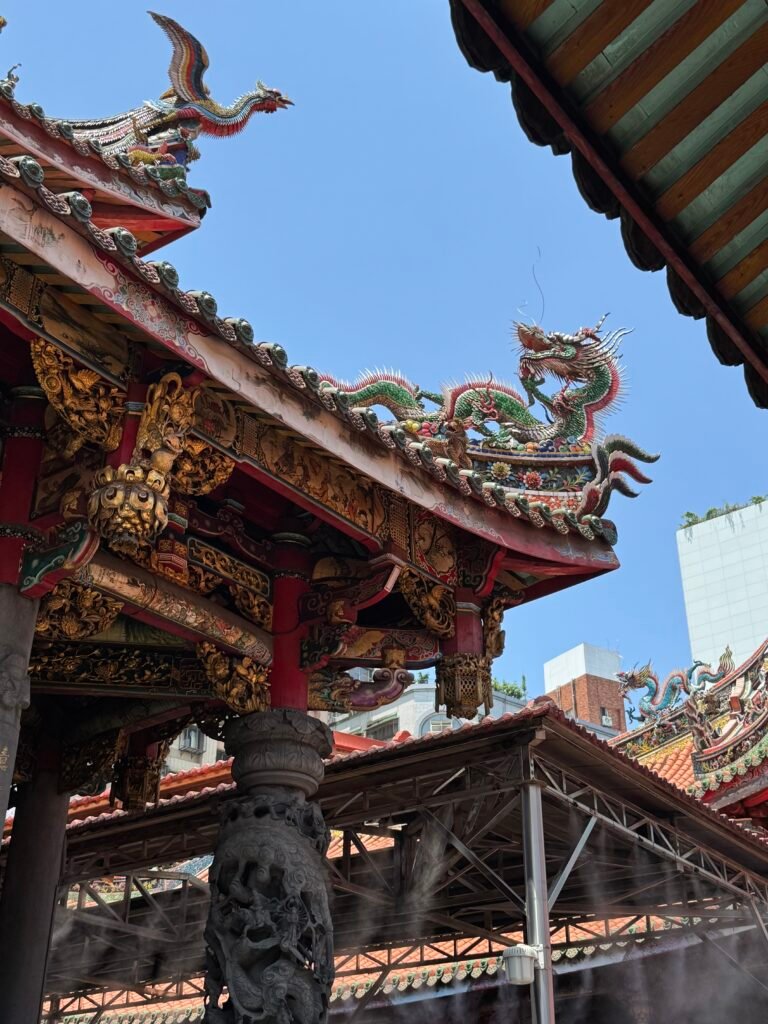
The temple itself isn’t particularly large, but it’s extremely impressive. It was built in 1738, during a period when settlers from Fujian Province in China were moving to Taiwan. The architectural detail is incredible. Tiny elements carefully worked into every column, every wall and every roof edge. The name “Lungshan” means “Dragon Mountain” and refers to the original temple in Fujian. This is one of Taipei’s most famous and important Buddhist and Taoist temples.
Several gods are worshipped here at the same time because traditional Taiwanese religion often mixes Buddhism, Taoism and folk beliefs. The building has repeatedly suffered damage from earthquakes, fires and bombing during World War II, but locals have always rebuilt it.
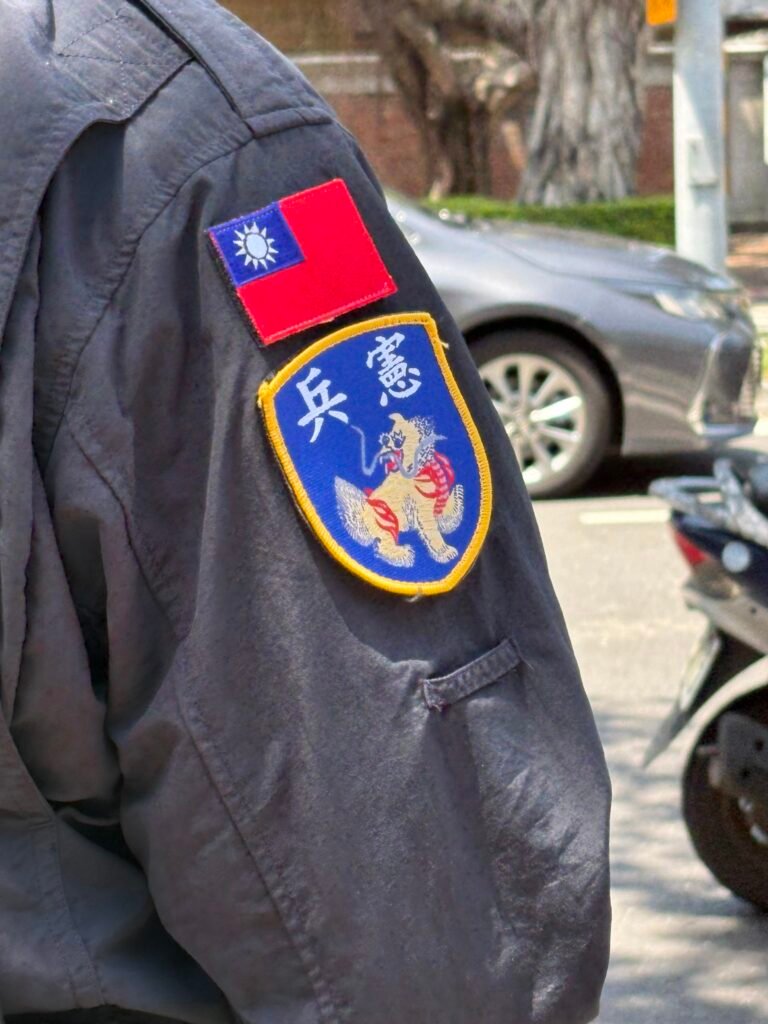
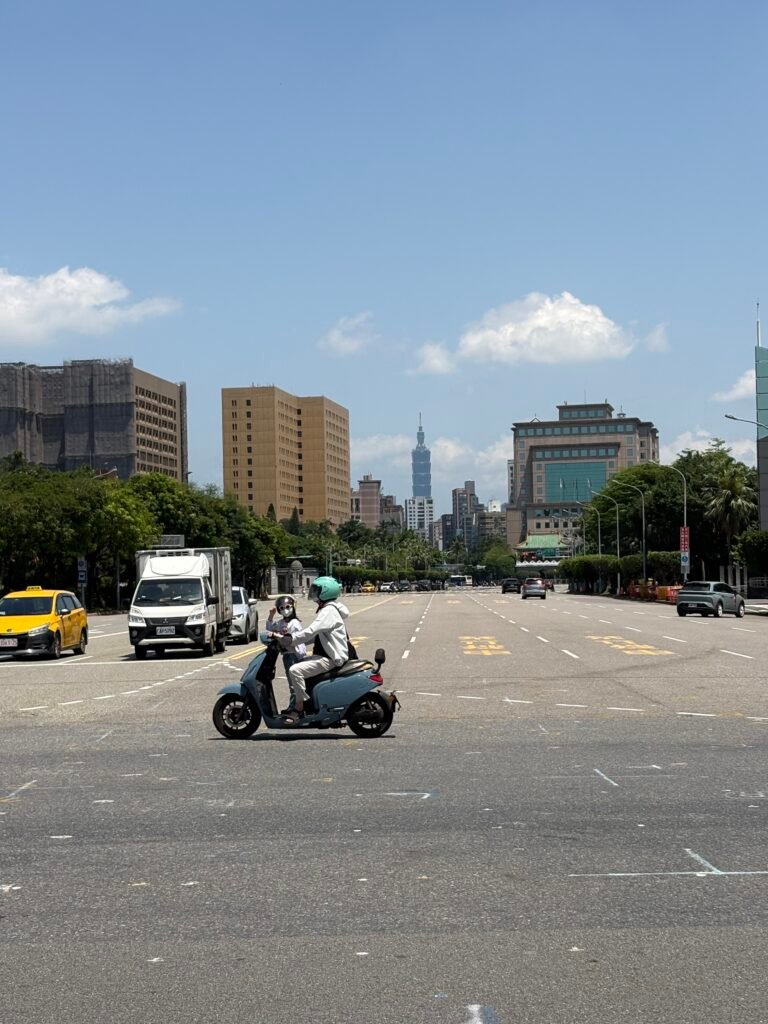
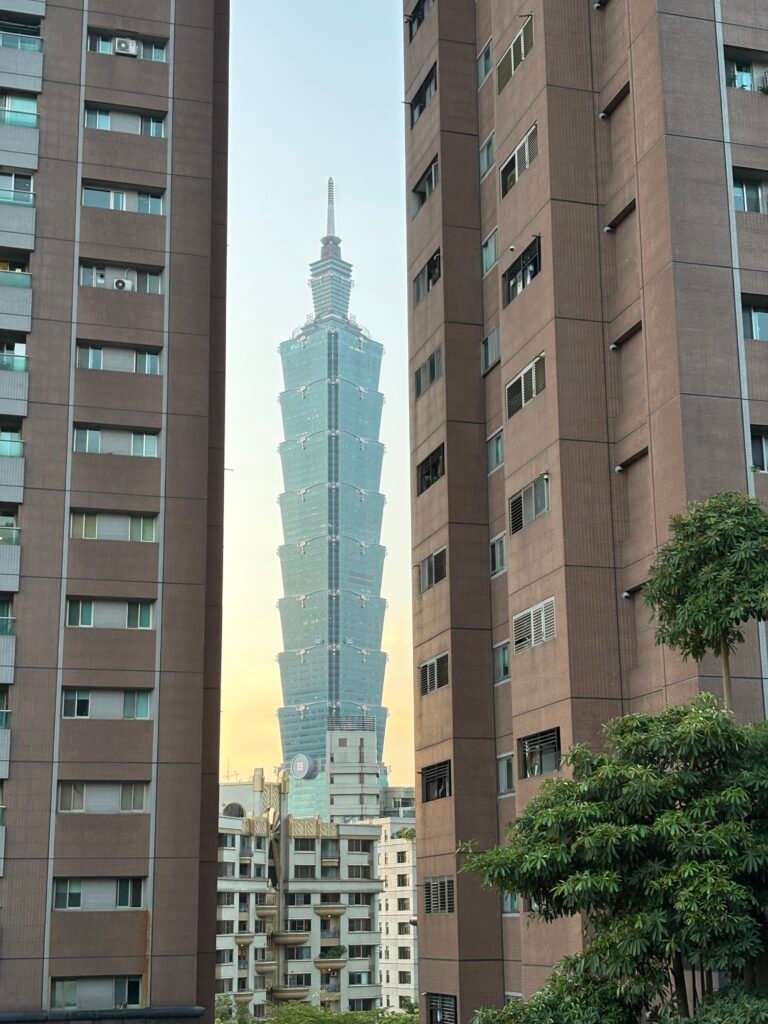
Interestingly, during the bombing, the main altar section survived almost untouched, something many locals interpreted as a miracle. The temple roof and columns are unbelievably detailed – full of dragons, mythological creatures and traditional wood carvings. There’s also a special feeling here because this is all real. We’ve seen similar temples in Chinatowns in other major cities, but there they’ve always represented a minority community within the city. Here, we’re the guests. And that makes you respect what’s happening around you even more. We don’t stay too long because obviously we don’t exactly belong here. Slowly, through more little side streets, we make our way towards the National Taiwan Museum. We also pass the Presidential Office Building, guarded by very serious-looking men carrying very serious-looking weapons. The building sits at the end of the enormous Ketagalan Boulevard. Across the ten-lane road, Taipei 101 stands proudly in the distance. The museum turns out to be quite different from what we expected. It’s more of a natural history museum than a museum about Taiwan’s history.
Relatively simple, but large and full of things to read. I don’t have the energy for that much text.
We move through it fairly quickly and head back to the hotel to rest before the evening.
On the way, Madara slips into UNIQLO and comes out with some loot – a dress and a few shirts.
Meanwhile, I test the shop’s chairs.
TAIPEI 101
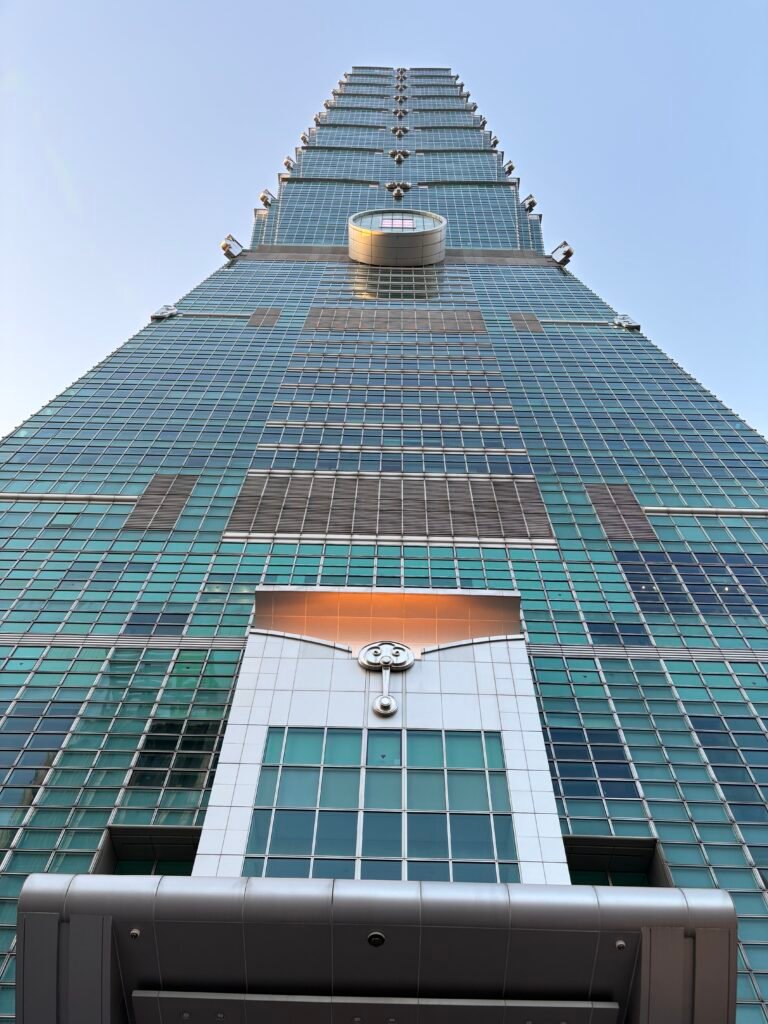
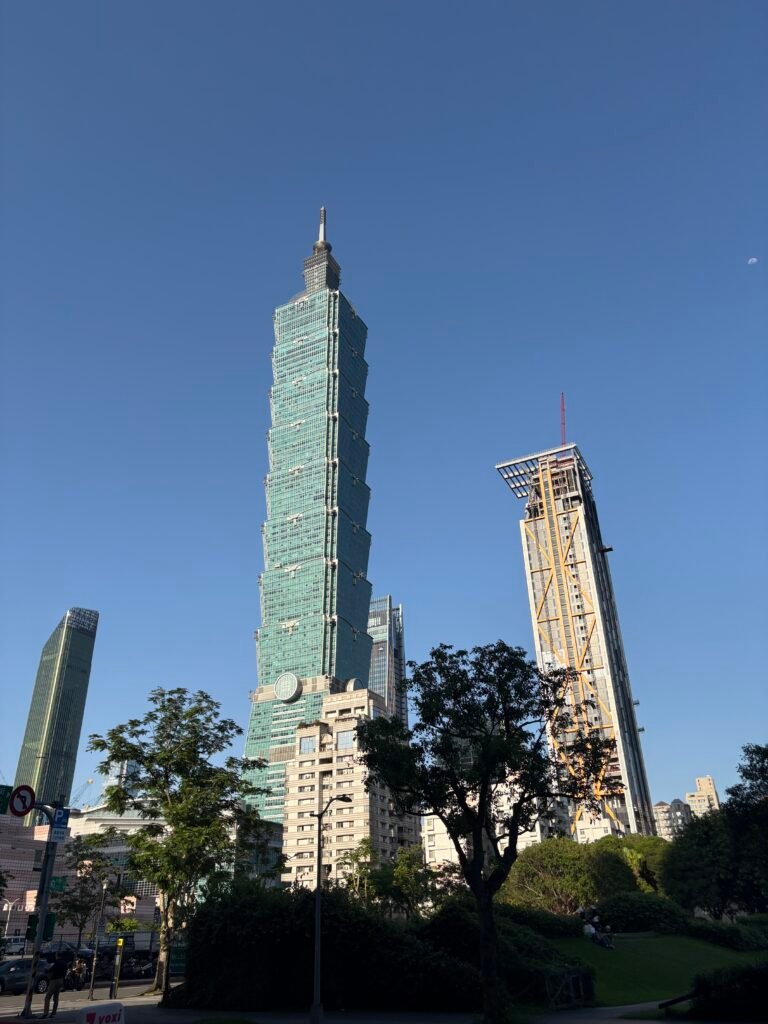
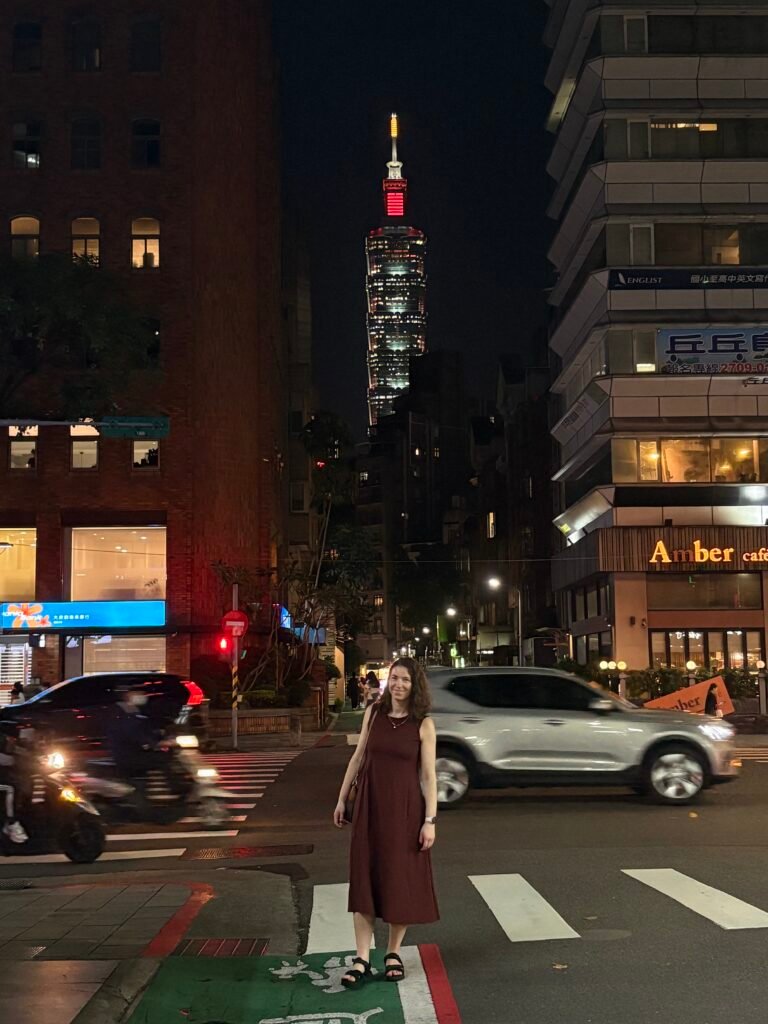
26.04.2026: After a very valuable hotel nap, we head towards Taiwan’s most famous landmark – Taipei 101. A building that entered architectural history for several major reasons.
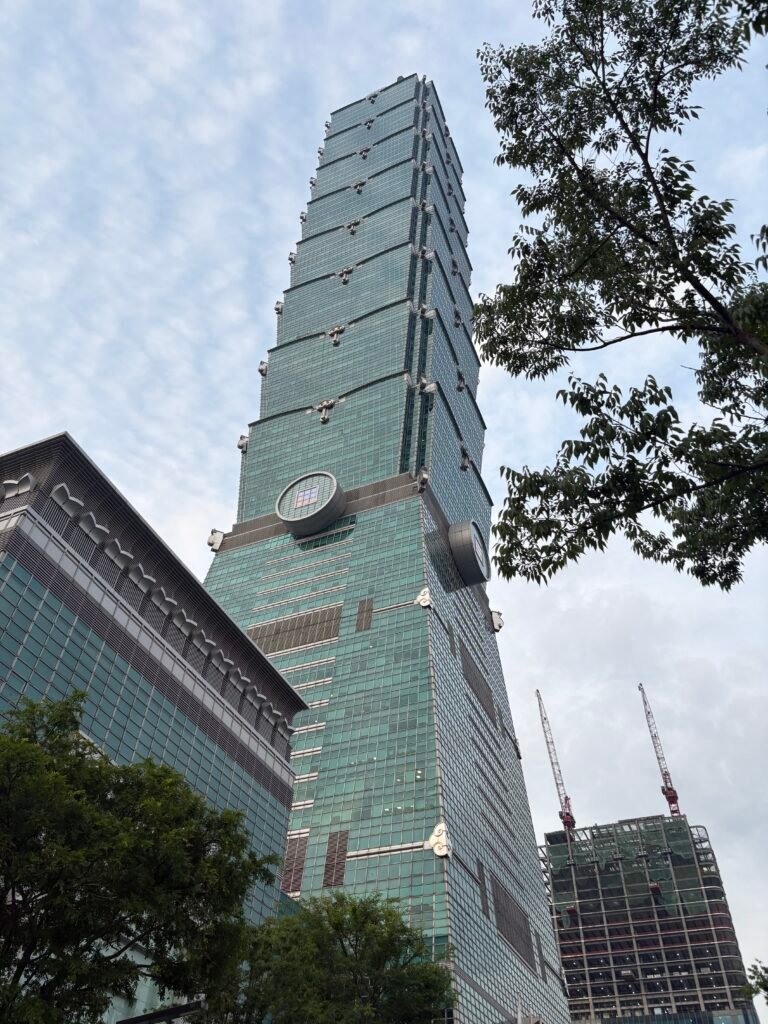
It was the first building in the world to exceed 500 metres in height and, after completion in 2004, became the tallest building in the world. Until Dubai finished the current record-holder, Burj Khalifa, in 2009. Even though Taipei 101 is now only the 11th tallest building in the world, I still find the investors’ original idea slightly absurd: “Let’s build the world’s tallest skyscraper in one of the most seismically active regions on Earth!” He who pays the piper calls the tune.
Anyway, we get on a bus and go take a look. Entry costs 1,200 Taiwan dollars, around €32 for both of us. Compared with European standards, that’s actually fairly cheap, although here it seems to be one of the most expensive attractions. We shoot up to the 89th floor in 35 seconds.
For a long time, this elevator held the Guinness World Record as the fastest in the world.
It travels at almost 61 km/h – even faster than the Burj Khalifa elevators. Each of the building’s eight sections is eight floors high. The number eight symbolises prosperity in Chinese culture.
Stylised dragons placed around the corners represent spiritual guardians in feng shui culture, protecting the building during difficult conditions and times. So that’s in addition to all the innovative engineering solutions! Each section also slopes outward by seven degrees.
And the number seven symbolises good fortune. Basically, the building is armed with every possible good-luck wish and feng shui dragon it could find.
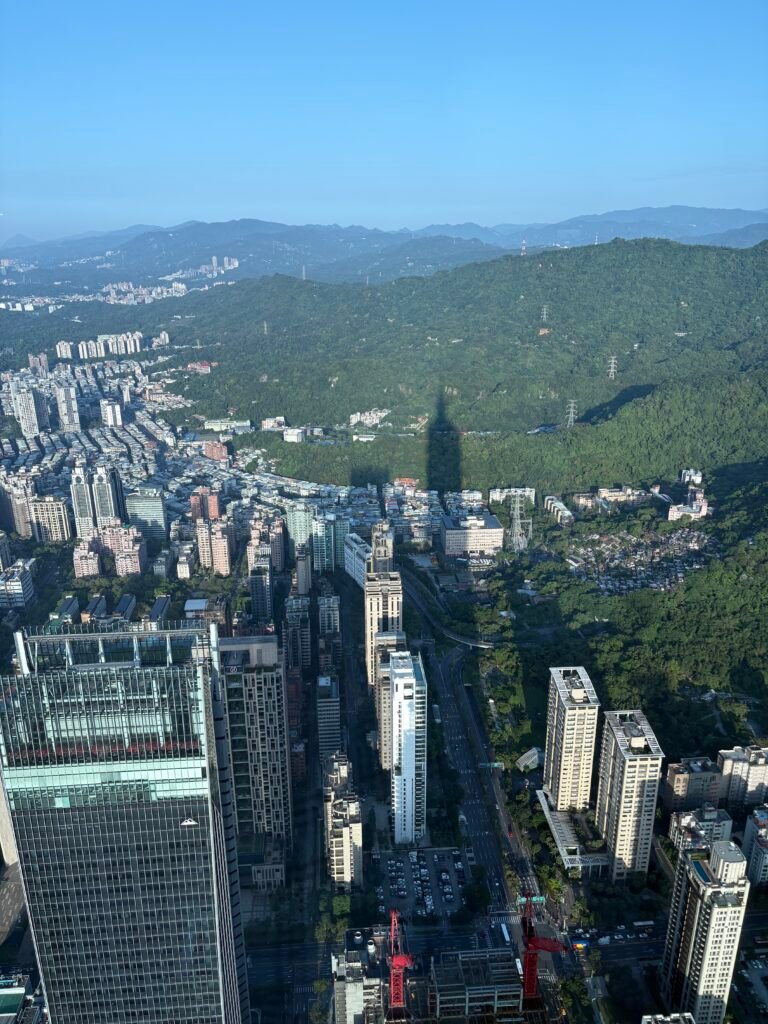
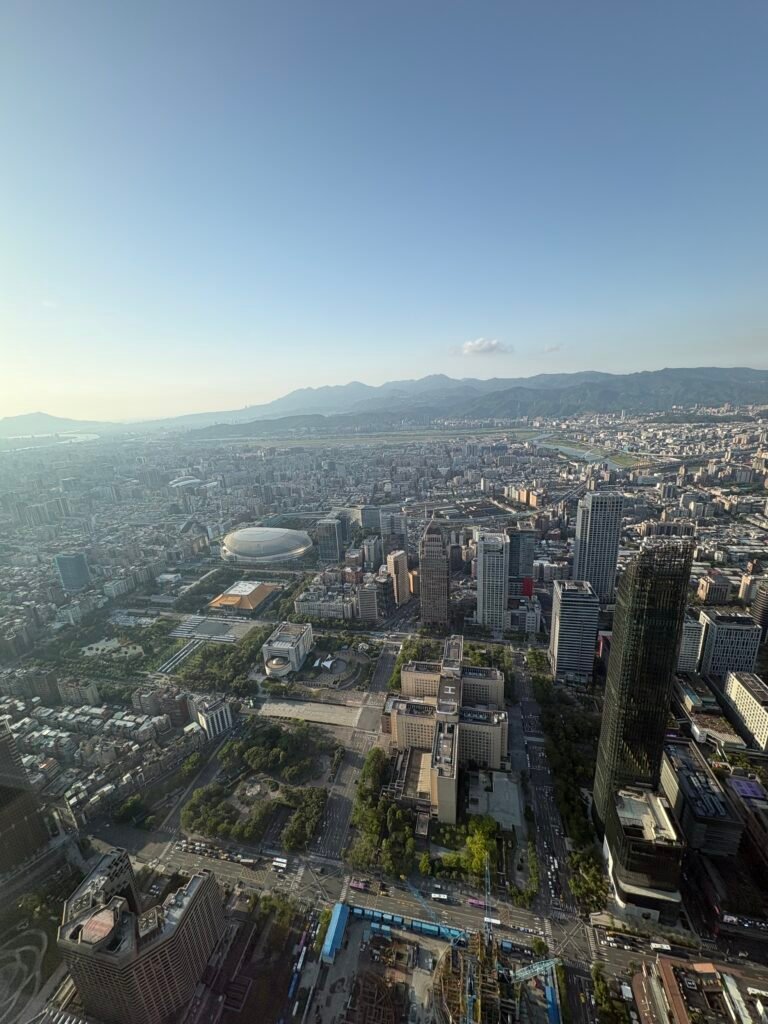
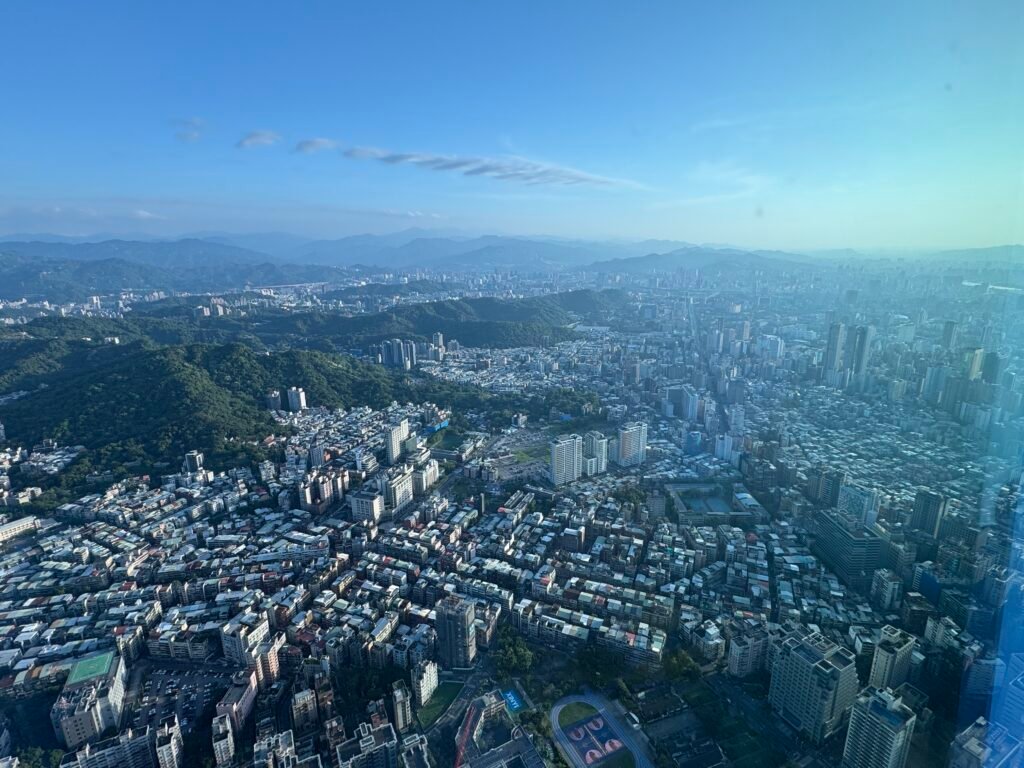
As for actually visiting the observation deck, there is one obvious problem: as usual, you can’t see the city’s main landmark when you’re standing inside the city’s main landmark. And Taipei from above isn’t an especially iconic or uniquely beautiful skyline – and we’ve seen quite a few by now.
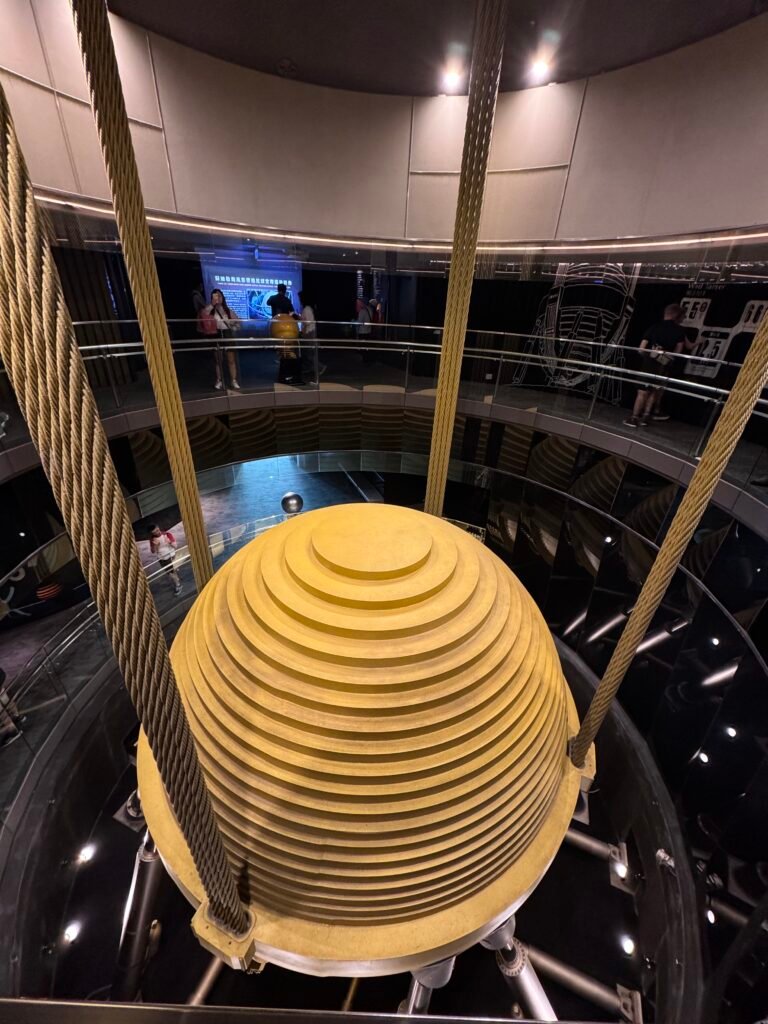
Don’t misunderstand that as me saying Taipei isn’t beautiful. It definitely is. Its charm is in the narrow streets at ground level, not from a bird’s-eye view. If Taipei 101 didn’t contain the engineering masterpiece that is its tuned mass damper, I’m not sure I’d specifically recommend coming up here.
The enormous steel ball is around five storeys high and weighs 660 tonnes. It hangs between the 87th and 92nd floors. By swinging in the opposite direction to the building’s movement caused by wind or seismic activity, it reduces the effects of those forces by around 40%. An extremely impressive number. Even though the sun is still shining and the sky is relatively clear, a light haze covers the city and limits visibility. It seems to be moisture evaporating in the heat.
ELEPHANT MOUNTAIN
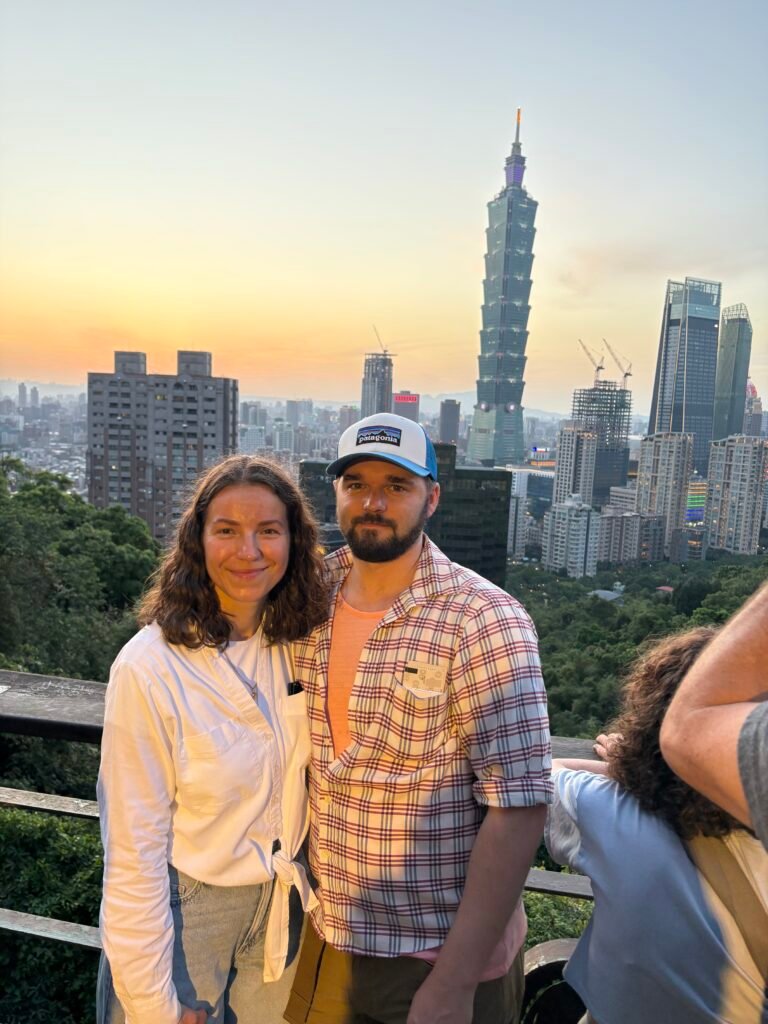
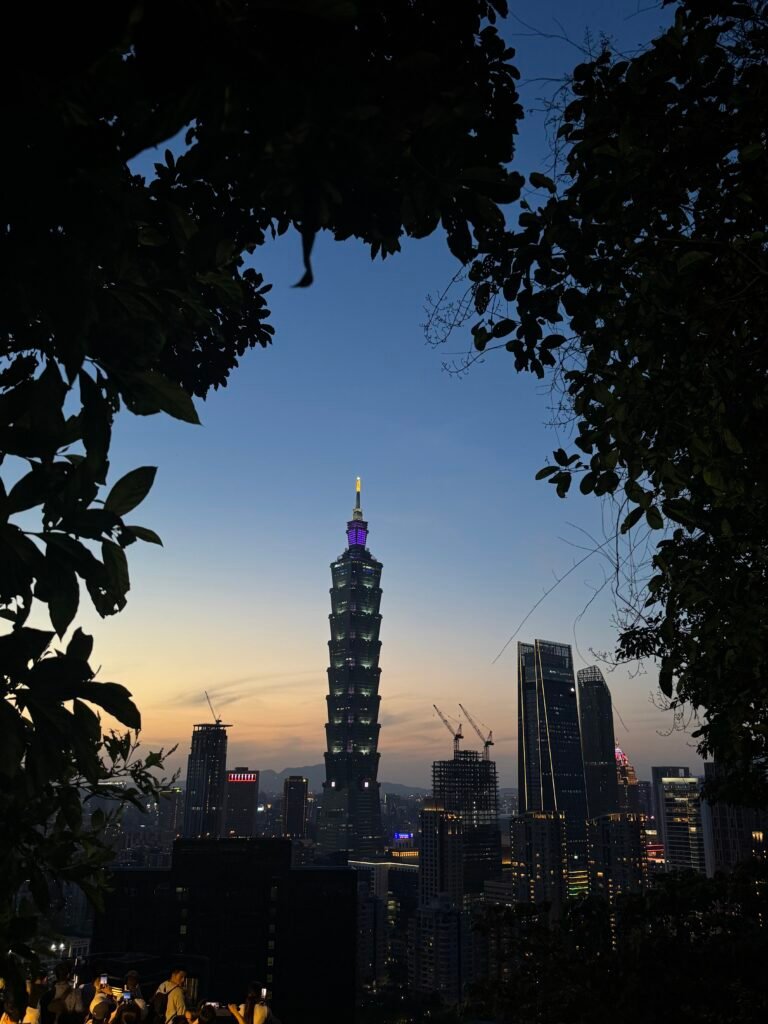
26.04.2026: Once we’re up Taipei 101, we realise there’s no way we need the full 1.5 hours we had planned here. So we make a quick decision: try to reach the Elephant Mountain viewpoint by sunset. Sunset is in exactly 33 minutes. Google Maps also says the walk takes exactly 33 minutes.
Challenge accepted. We do it in 27.
The result is completely soaked backs because the route includes a serious climb – 1,086 steps and around 180 metres of elevation. We make it just in time for the final rays of sunlight.
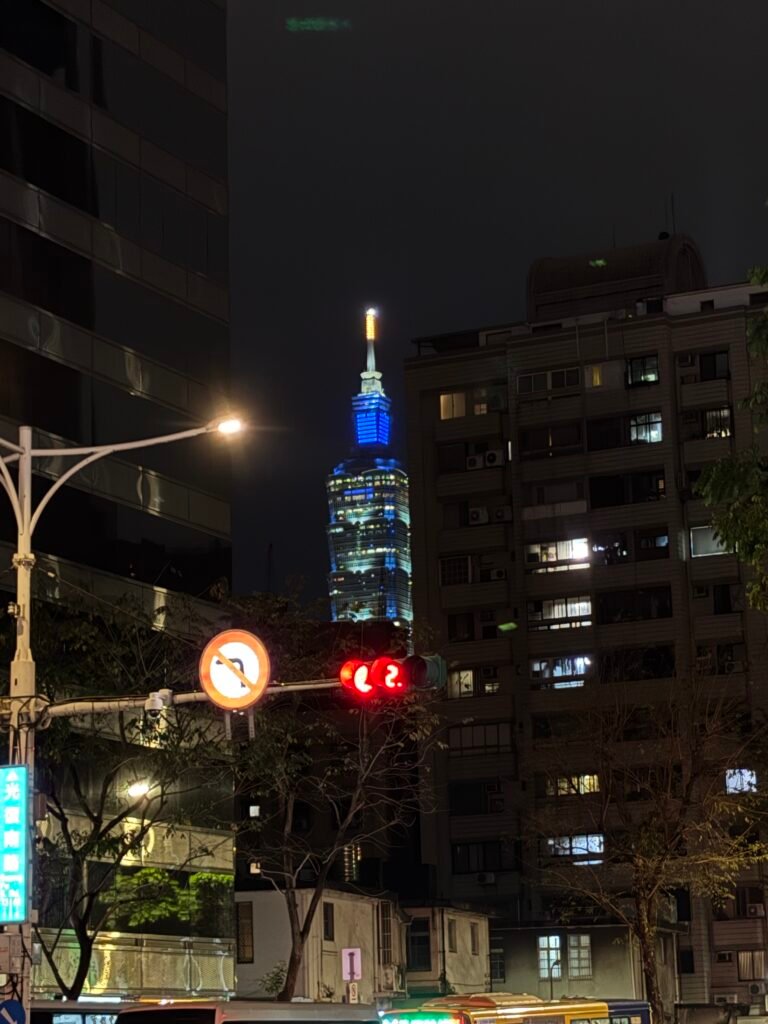
The viewing platform overlooks probably the most recognisable part of Taipei, with the brightly illuminated Taipei 101 standing proudly right in the middle. It’s packed with people.
The name isn’t random. In Chinese, the mountain is called Xiangshan (象山), meaning Elephant Mountain, because its silhouette is said to resemble a lying elephant.
Together with plenty of other people, we take our photos and then continue into the darkness.
On the way, some old man intercepts us and tells us we should follow him further along a small, narrow path. So there we are – following a completely unknown old man into a forest, in a foreign city, in complete darkness. Apparently there’s a really good viewpoint. Well, we follow him. And he isn’t lying.
The view is excellent and there are far fewer people. Firstly, I doubt we would accept an invitation like that in almost any other city in the world. But Taipei has created such a strong feeling of safety that for not even one second does it seem like a bad idea. Secondly, I had actually marked a viewpoint somewhere in that direction myself, but because of the darkness I had decided not to go there. Until we met the old man.
So the photoshoot continues before we start heading towards tonight’s food marathon at Rahoe Night Market. On the way to the viewpoint, we once again have to answer the question: why did we come to Taiwan? We probably need to prepare an official answer.
RAHOE NIGHT MARKET
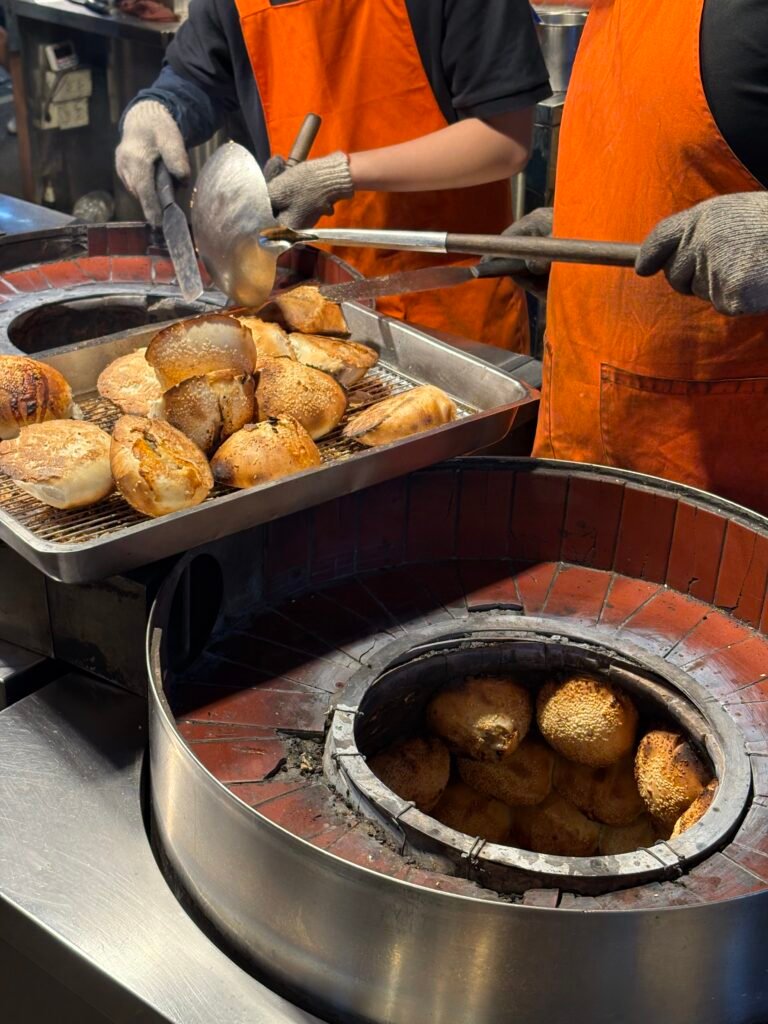
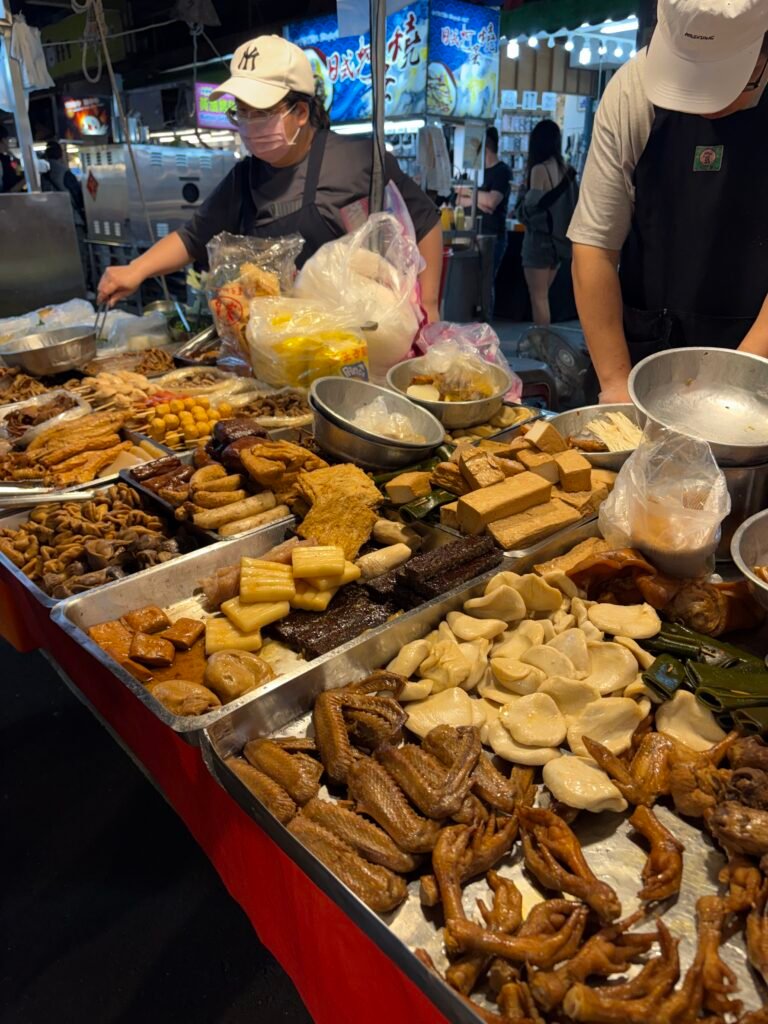
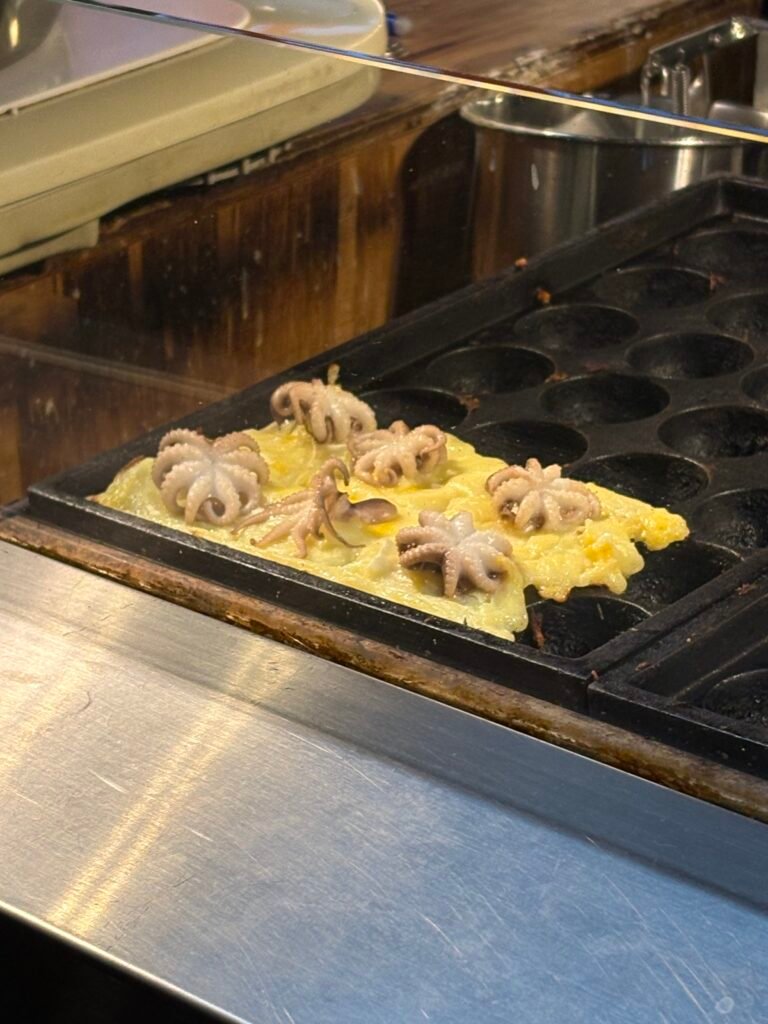
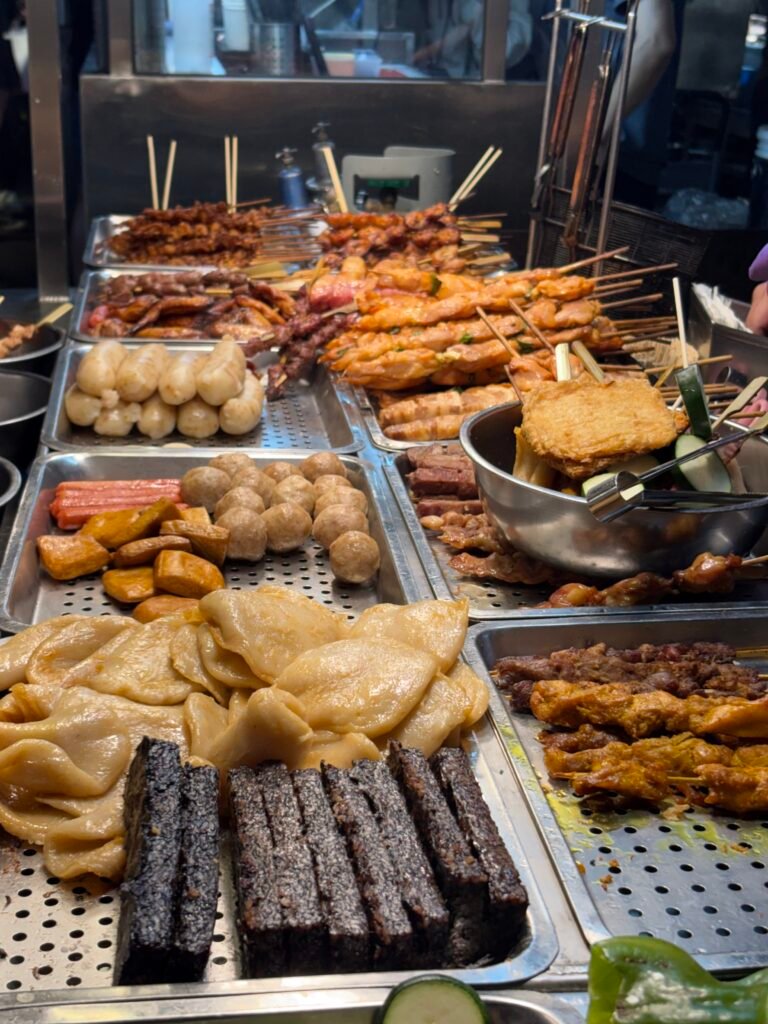
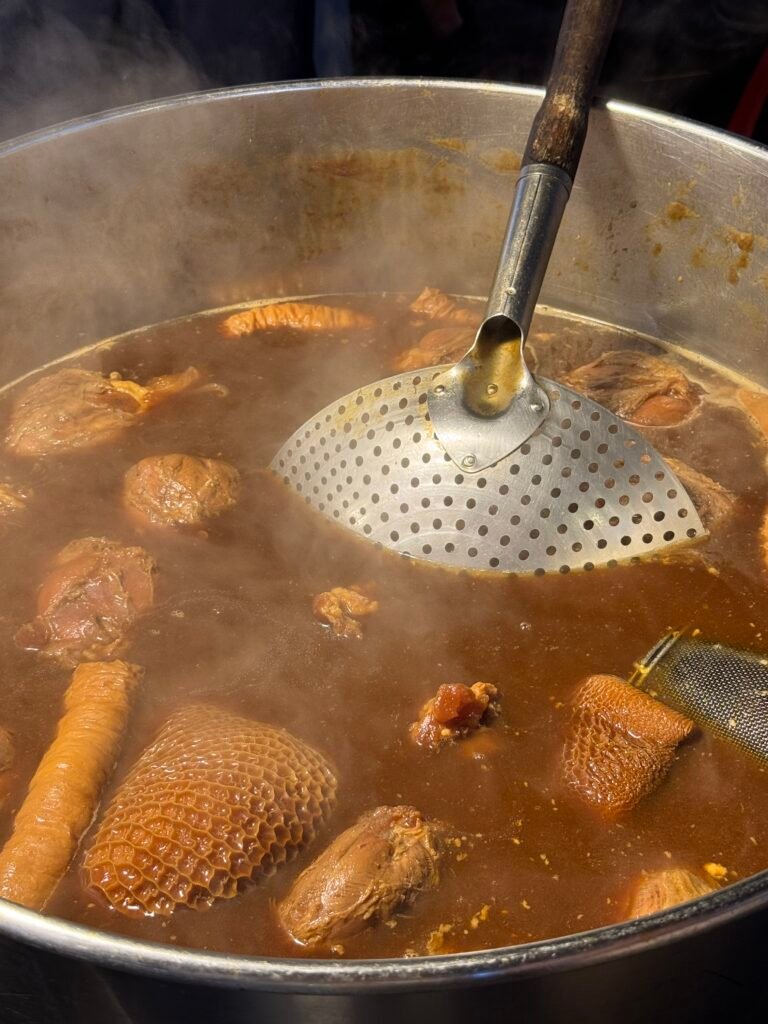
26.04.2026: We arrive at Rahoe Night Market right at peak time – around 20:00. The street cooks have already prepared their first batches and everyone has had enough time since lunch to get hungry. As soon as we enter, we go straight for what is probably the market’s most famous dish – the Fuzhou black pepper bun, which has even been mentioned in Michelin recommendations.
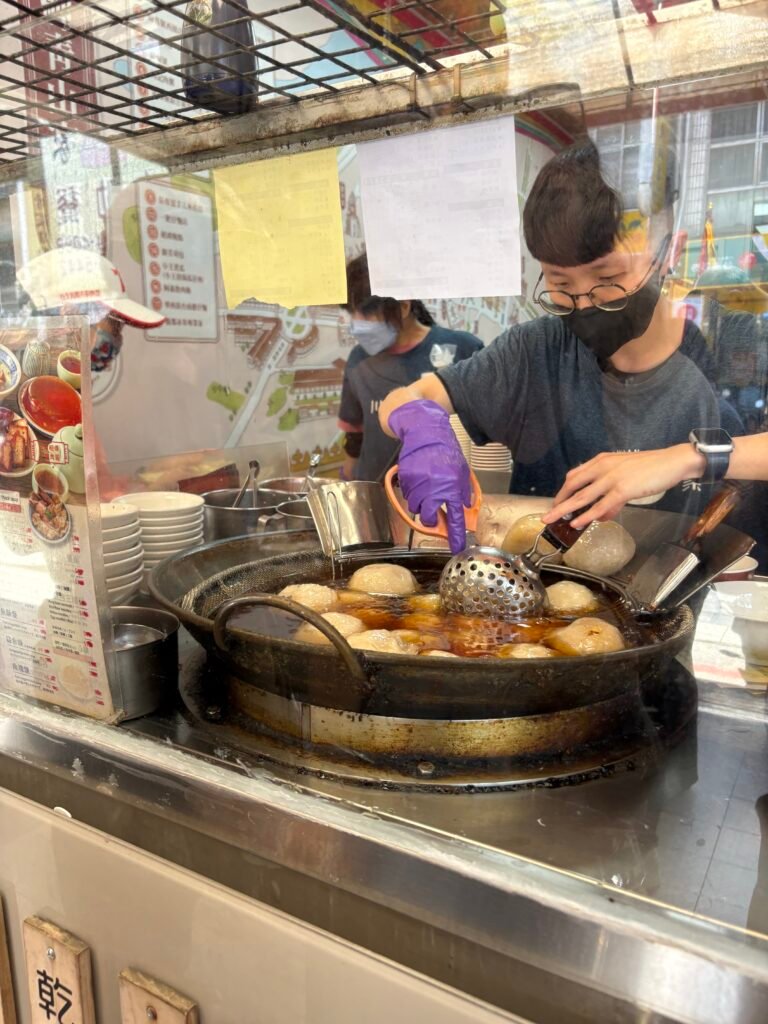
It’s baked inside a special cylindrical oven and filled with black pepper and pork. Slightly spicy, but not too much. Even I’m fine with it. Genuinely tasty.
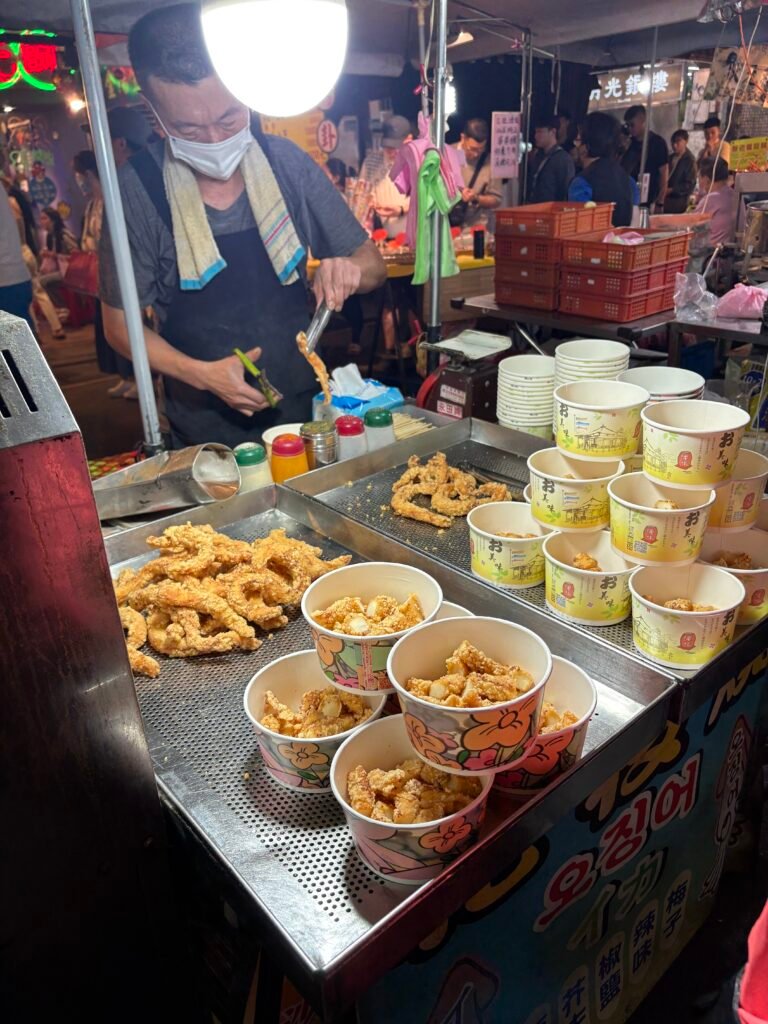
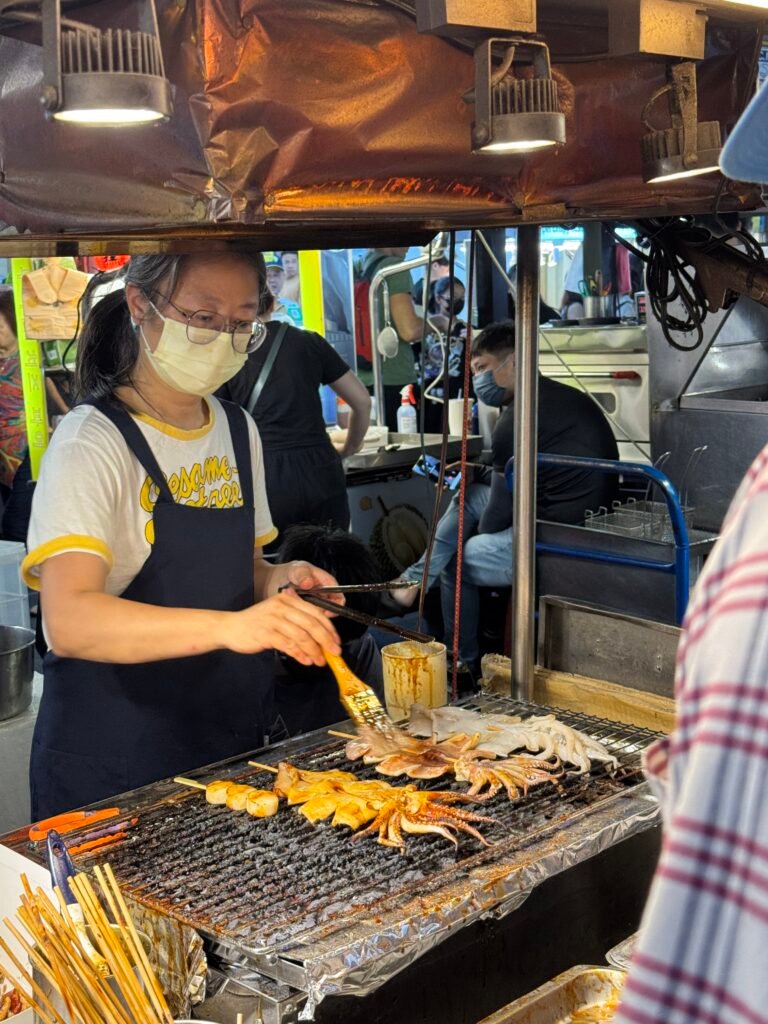
Although objectivity might be slightly reduced by the fact that I’m extremely hungry. We adopt a strategy: one portion of everything, so we have space to taste as many different things as possible. There are enormous numbers of people and everyone is eating. But even though there are queues almost everywhere, everything moves surprisingly quickly. We barely have to wait anywhere. Next up – grilled squid. I really like those rubbery multi-legged creatures. Madara is more so-so. Influenced by a long queue, we join the line for grilled mushrooms. The mushroom itself is the same for everyone, but you can choose the seasoning. We play it safe with classic black pepper, afraid of accidentally choosing something ridiculously spicy. The mushroom is nicely crisp on the outside while still very soft inside. Pretty good.
But out of the first three things we’ve tried, I’d currently rank it third. We need a small break before continuing this gastronomic evening. We also need to solve the issue of getting our 40% “vitamin dose” to protect the stomachs, so we start looking for a local bar. On the way, I’m seduced by prawns wrapped inside an omelette-and-cheese roll. Extremely tasty.
Also an epic calorie bomb. At the bar, we order a cocktail and beer for appearance’s sake, but what we’re primarily interested in is a shot of vodka. I’m not exactly a vodka expert, but I’m fairly sure that thing had been diluted. Later, we buy proper classic 50 ml bottles from a shop so we can genuinely disinfect the insides. Time to continue the gastronomic madness. We gradually move on to desserts. Sweet rice-flour balls catch our attention. Basically sweet doughnuts.
Dangerously easy to eat. We remain disciplined and move on without ordering another portion, despite wanting one. Next dessert – a taro doughnut.
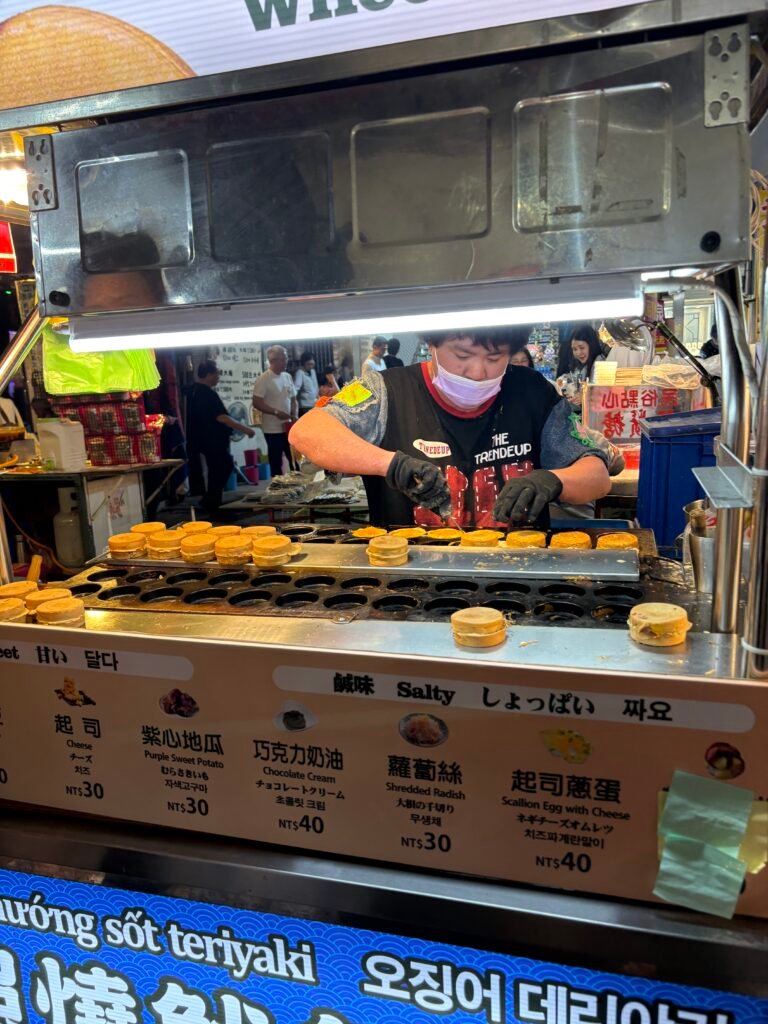
Honestly, I have no idea what I just ate. But it’s a pretty tasty doughnut with a purple, moderately sweet cream filling. Not bad! The stomach is getting close to its limit, but the lady selling little waffle cakes still manages to lure us in. We negotiate six pieces instead of the standard ten.
Three with cheese filling and three with vanilla cream. The cheese ones are excellent and somehow slide down very easily despite the fact that we’re no longer particularly hungry.
The vanilla ones are weak.
We don’t throw them away, but they’re definitely not great. We wash the whole operation down with a mango smoothie. Tasty. Ice cold. Our first night-market experience is extremely positive and interesting. In total, we spend around €30 on these eight different foods. The portions are generous, so it doesn’t feel expensive at all. Especially compared with European food entertainment. We don’t really want to go home yet, but finding an open bar here on a Sunday turns out surprisingly difficult. Eventually we settle into a tiny music bar called Riff Raff.
Tonight, some local band is basically testing out its own songs accompanied by an unbelievably committed tap dancer. Very nice background entertainment. All this for an audience of maybe four or five people. Afterwards, the keyboard player – a Taipei local named Benjamin – comes over to talk to us. Who are we and what are we doing here?
Obviously we stand out slightly compared with the locals. We have a really nice 10–15 minute chat. His English is excellent! By now we’ve missed the last bus, so we have around 25 minutes of walking back to the hotel. Even after midnight, the streets of Taipei feel completely safe.
Not once does your brain start producing negative thoughts about dark streets or anything like that. First full day in Taipei successfully and very thoroughly completed.
SONGSHAN FENGTIAN TEMPLE
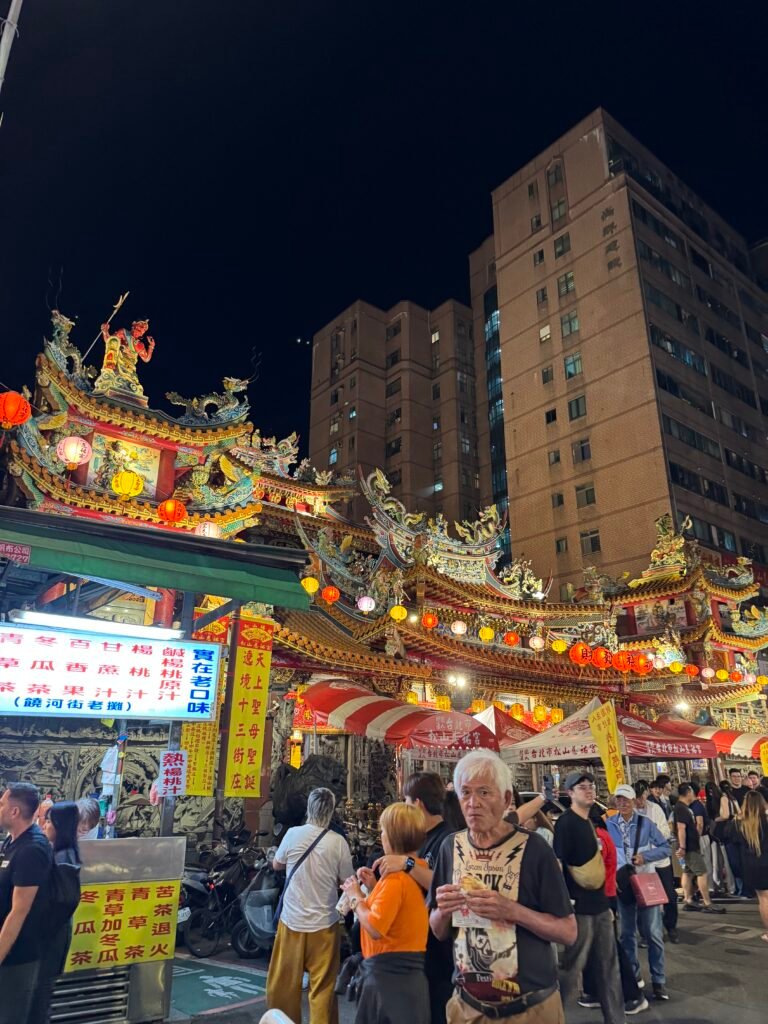
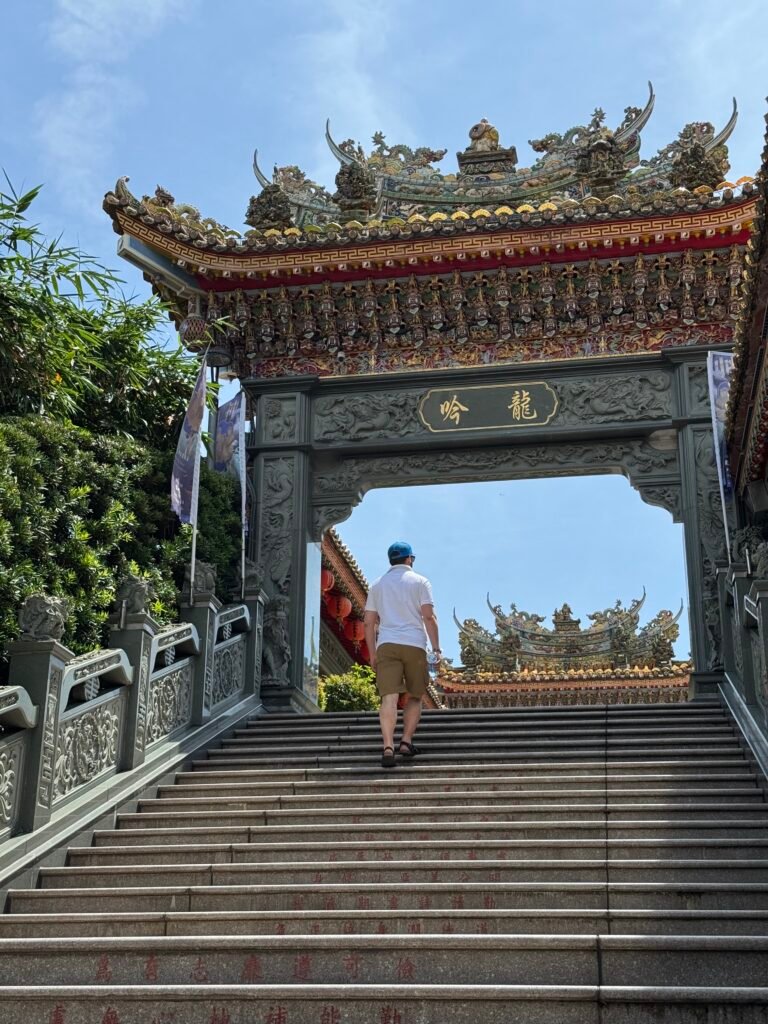
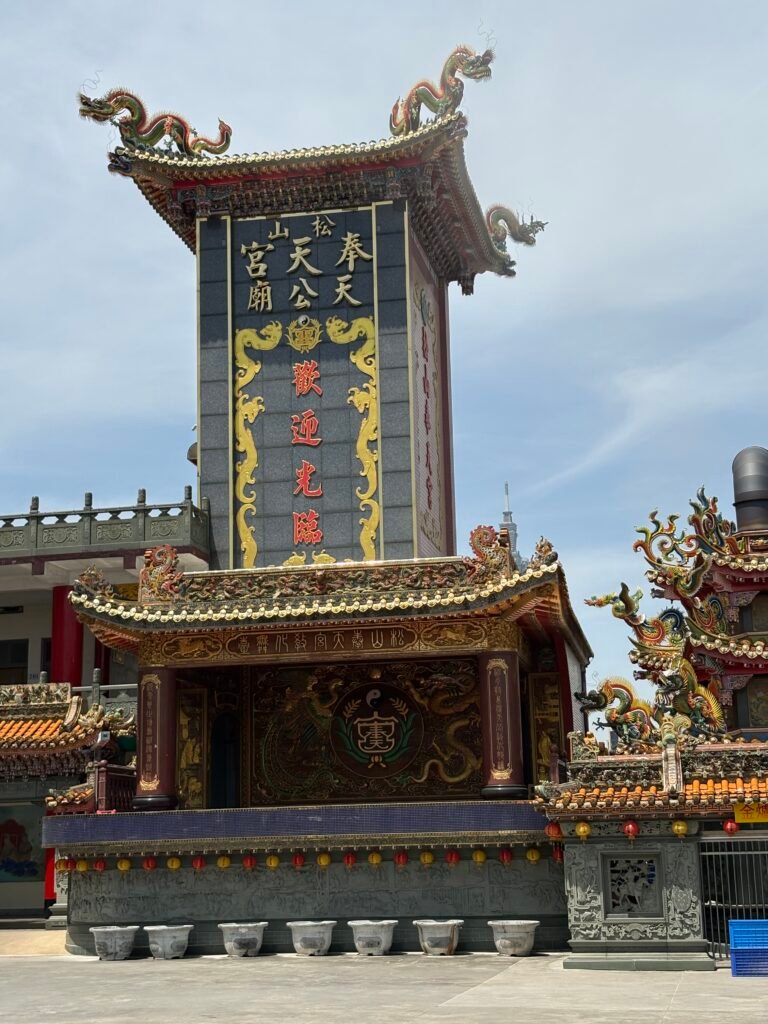
27.04.2026: Because of both the time-zone change and last night’s late finish, we start the morning slightly later. No stress though. Today’s plan is fairly flexible. We take a bus to Songshan Fengtian Temple. When we arrive, you’d never guess from the street that there’s anything here for a tourist to see. Slightly uncertain, we walk up some stairs without any obvious signs.
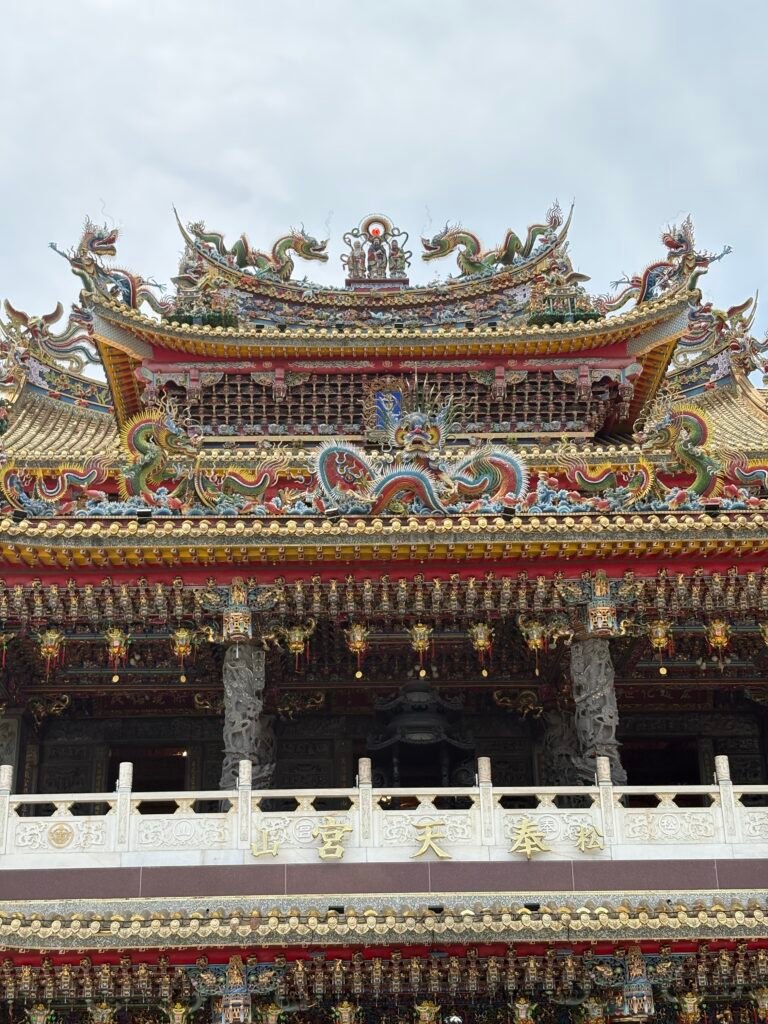
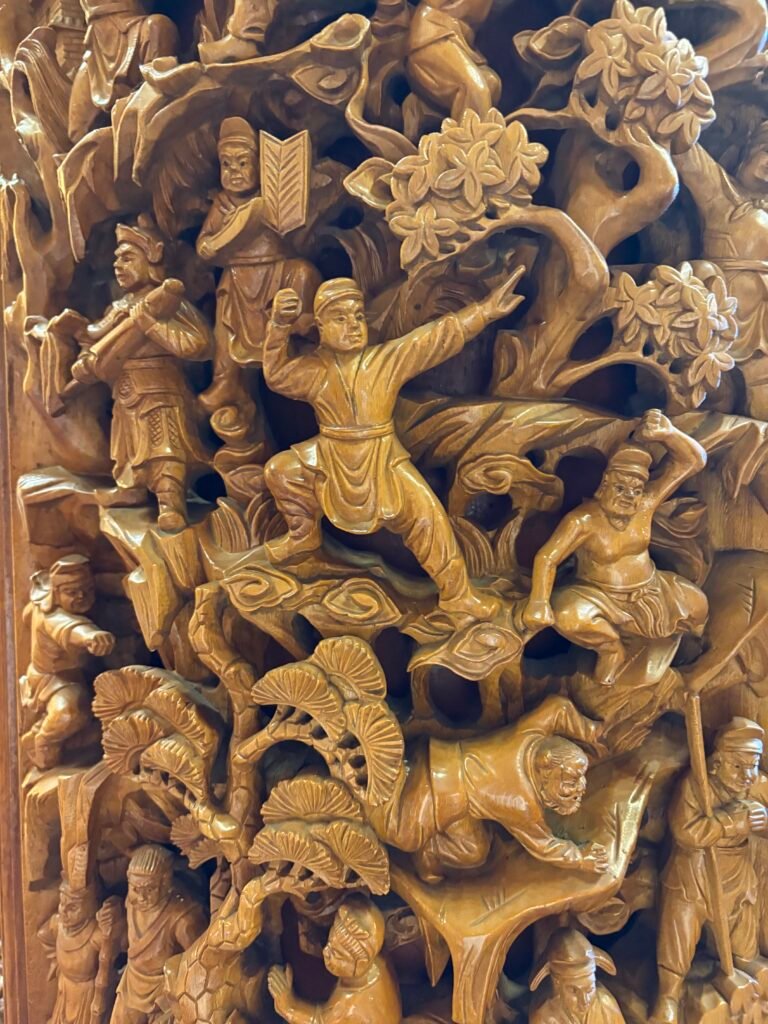
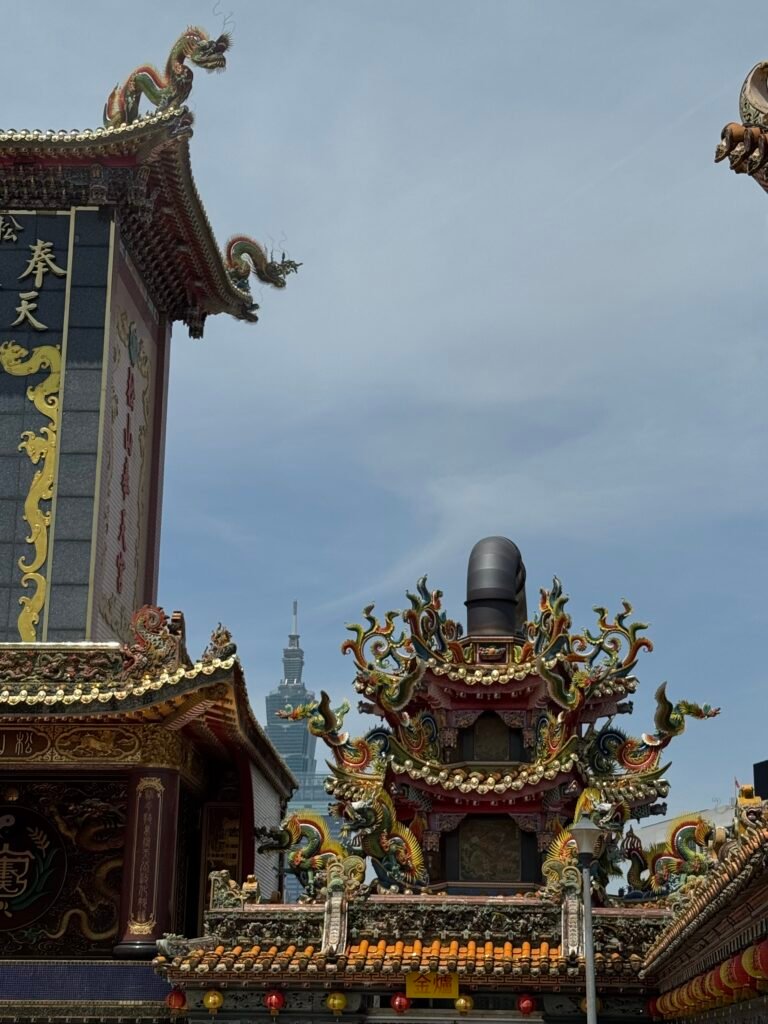
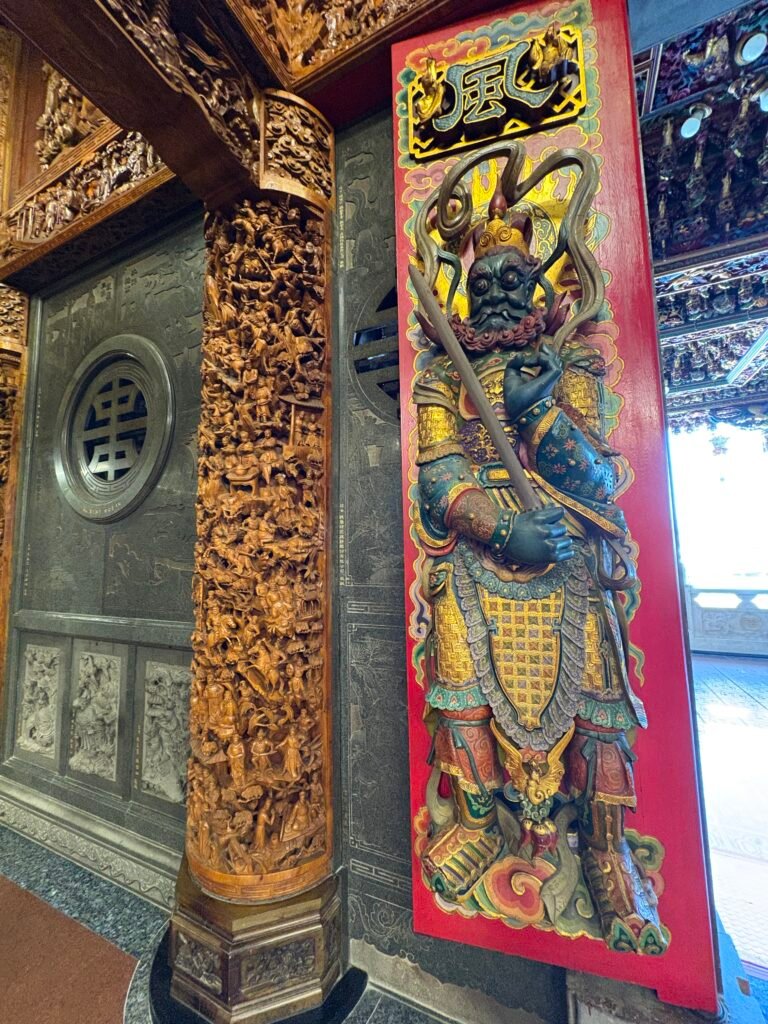
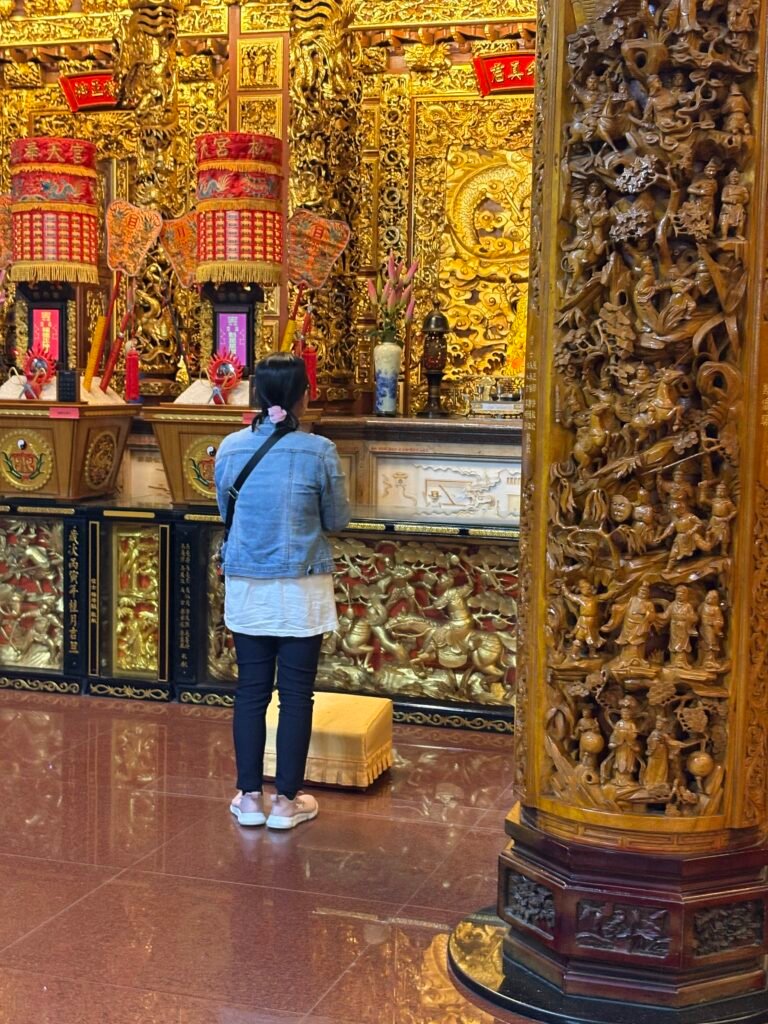
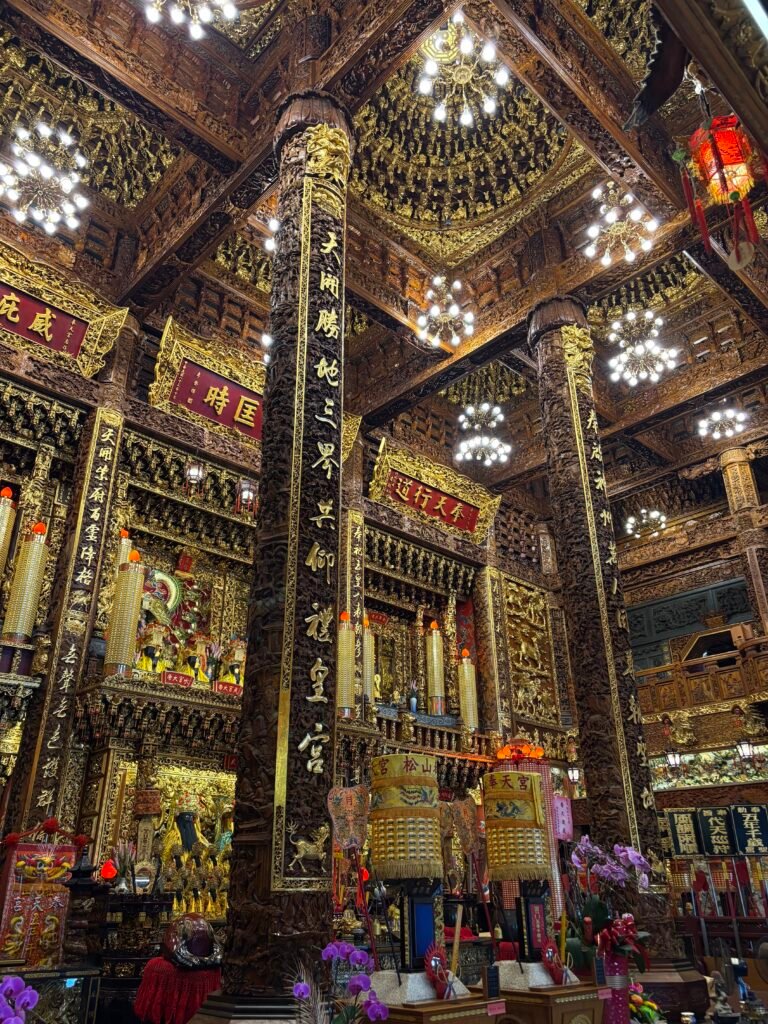
Once we reach the top, it becomes very clear that we’re in the right place. I don’t even know how to describe what we’re looking at. The temple isn’t huge, but every single surface is unbelievably detailed. Every column, wall, ceiling, corner, cornice and capital. Everything.
Wood carvings detailed down to facial expressions and individual fingers. A genuine work of art.
Apparently there’s an unofficial tradition of walking through the temple and counting all the dragons hidden in the decorations. That seems basically impossible. There must be several hundred. The temple’s name translates roughly as “Temple of Heaven”.
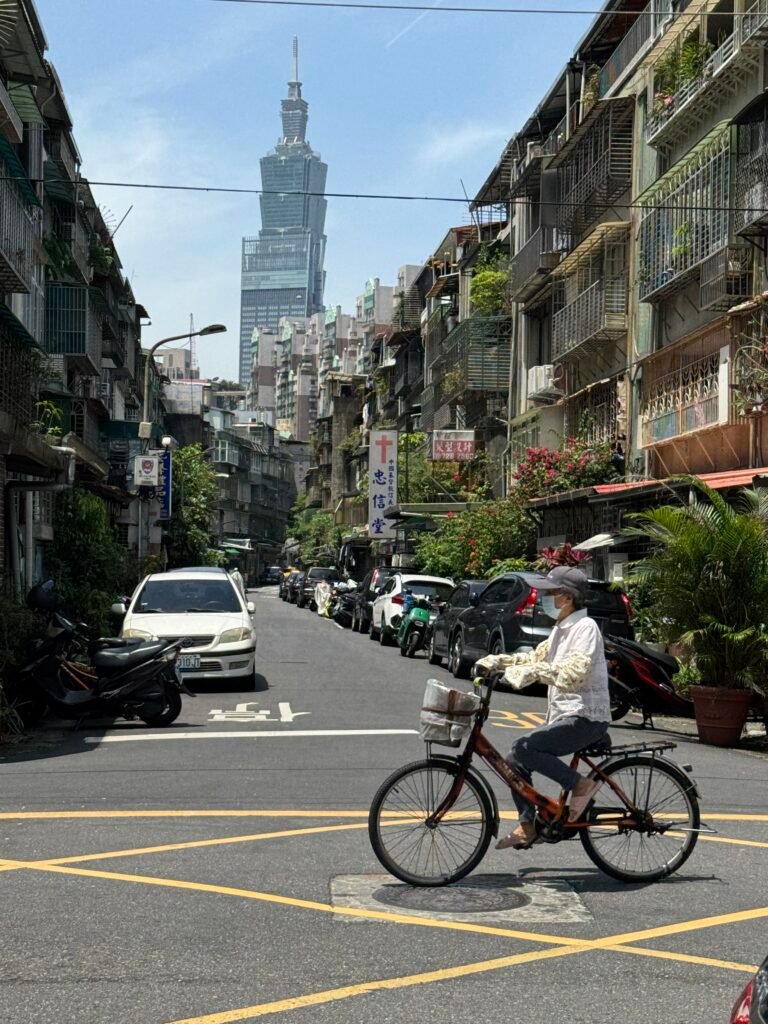
It is dedicated to the Jade Emperor, who is also often called the Emperor of Heaven – hence the name Songshan Feng Tian Temple. Historically, the place of worship developed from a small shrine established here among bamboo at the foot of Tiger Mountain in 1862. Over time, it grew into one of Taipei’s more important temples. Today it’s not only an important religious site, but also an excellent viewpoint overlooking central Taipei and several important landmarks – the Presidential Office, Sun Yat-sen Memorial and the Taipei 101 area.
Since the actual prayers aren’t particularly relevant to us, after a respectful lap through this impressive place of worship, we move on towards Taipei Zoo. I seem to have made a slight planning error. Originally, I thought the zoo was a long walk away from the temple. Turns out it’s more than two hours on foot. Fortunately, Taipei’s excellent public transport saves the situation and 25 minutes later we’re already there.
TAIPEI ZOO
27.04.2026: Taipei Zoo is located in the Muzha district, a bus ride away from the centre.
And it needs the space because this place is huge. It’s one of the largest and most diverse zoos in Asia, covering an impressive 165 hectares. It has operated since 1916.
More than 1,600 animals live here, including rare and protected species such as giant pandas, Formosan black bears and koalas. The zoo is divided into 12 themed areas. The Formosan Animal Area introduces species native to Taiwan, while the Insect Museum – unfortunately closed for maintenance during our visit – covers all kinds of flying and crawling creatures.
Other areas are divided geographically – African savannah, Australian animals and so on.
One particularly popular attraction is the Koala House, where you can see Australian koalas.
Some of the koalas have what looks like a VIP section in a natural outdoor zone with proper trees and branches where they can lazily sleep. Their life looks pretty good. A few of the koalas kept indoors seem to have slightly weaker conditions. Plenty of space but not much greenery.
Then again, maybe a koala naturally doesn’t need much more than one tree to sleep in?
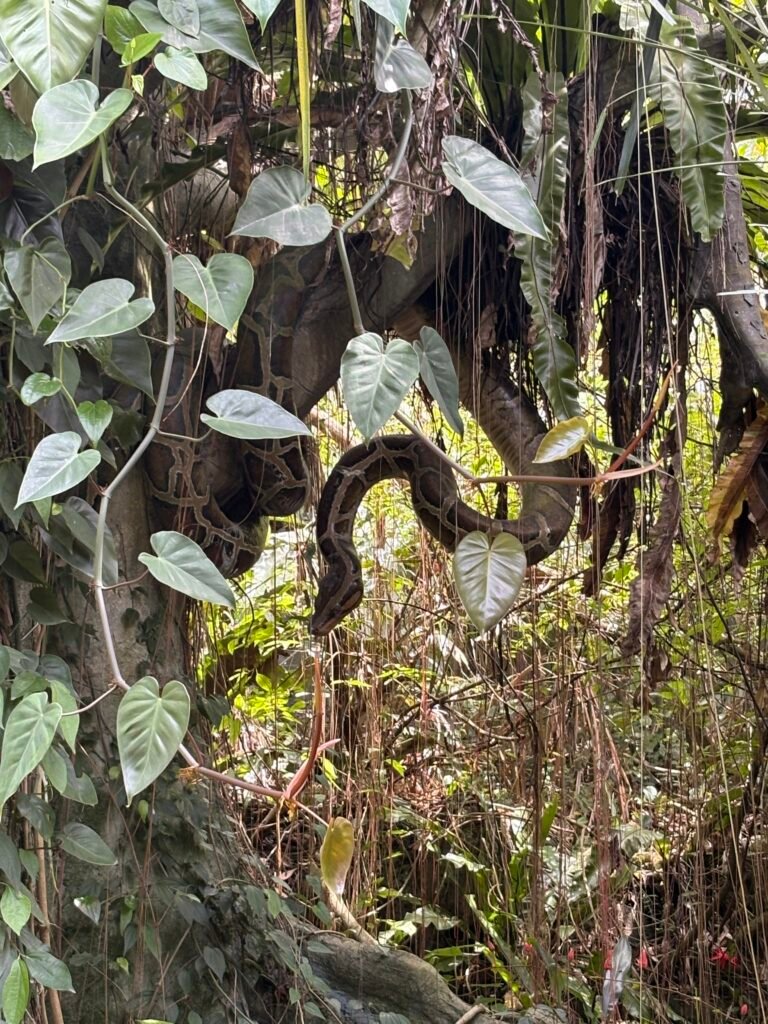
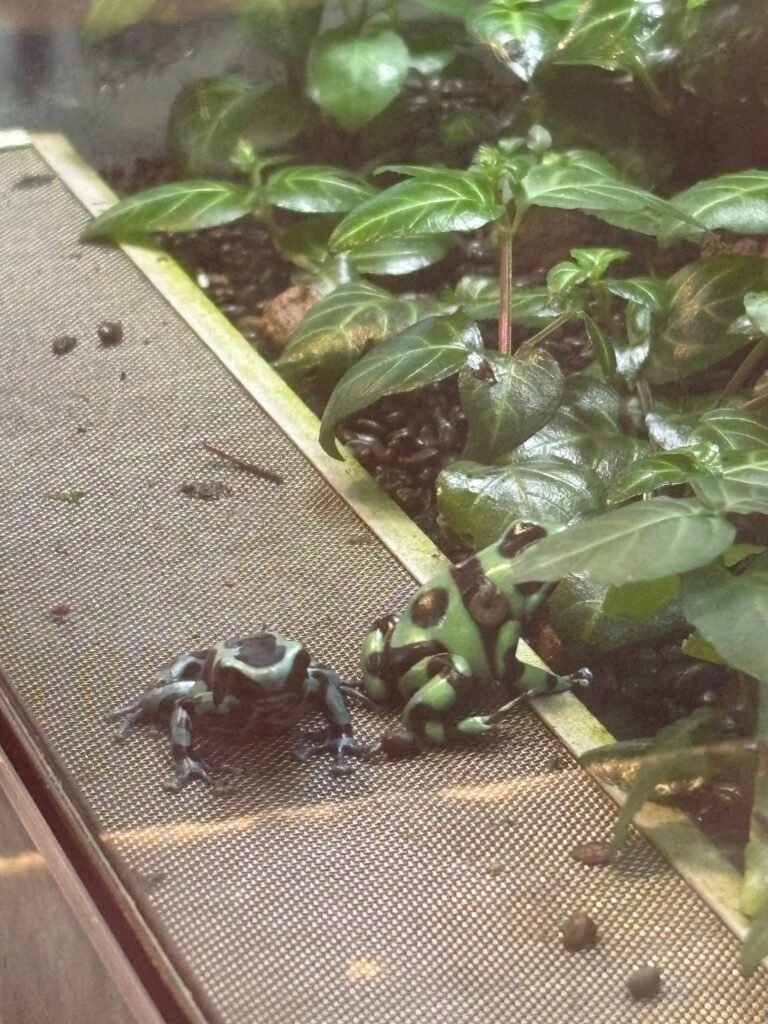
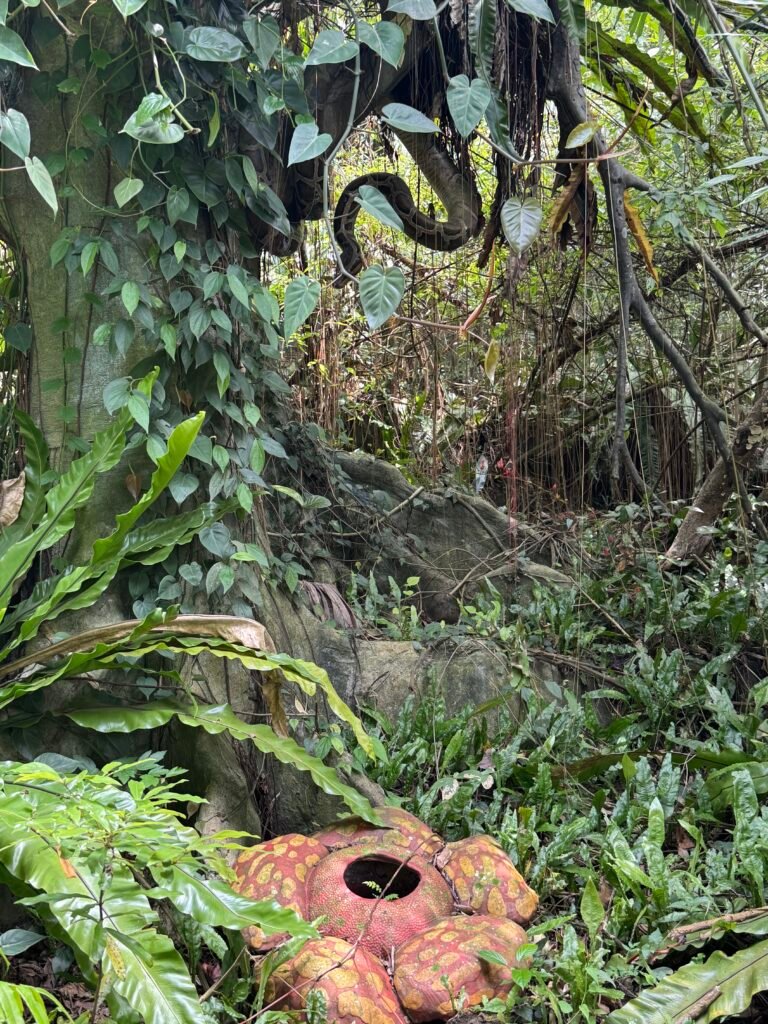
We also visit the impressive rainforest pangolin dome – a 1.5-hectare dome-shaped building recreating a tropical rainforest environment and housing pangolins and other exotic animals.
Interestingly, different animals here are allowed to move, fly and crawl relatively freely.
They aren’t all separated into individual cages and enclosures and sometimes move right among the visitors.
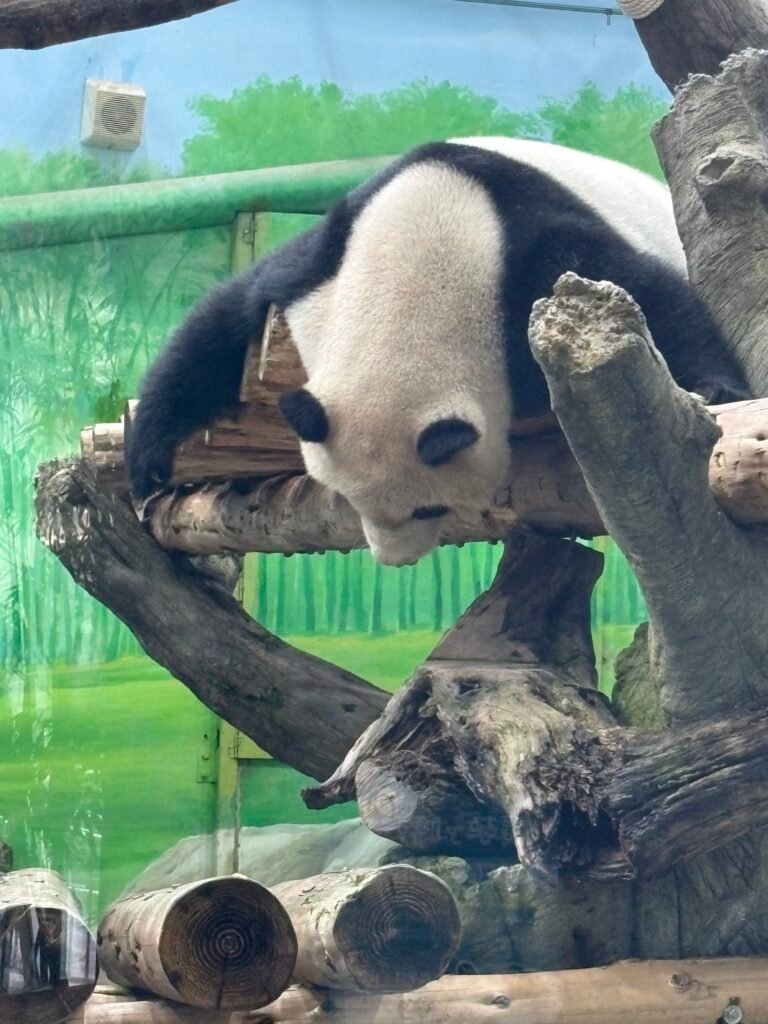
Overall, Taipei Zoo is apparently not only an entertainment attraction but also an important conservation and educational centre, combining a huge animal collection with modern exhibition spaces and themed areas. Of those 165 hectares, roughly one third is used by scientists for research. Our primary mission is to see pandas. We’ve never seen these soft and lazy creatures anywhere outside a TV screen. Two pandas live here in their own dedicated building.
During our visit, the pair Tuan Tuan and Yuan Yuan are enjoying a very deep nap, hanging head-down from their tree. No major performance for us. But at least we can tick the panda box.
And the entrance fee for all of this is 100 Taiwan dollars – around €2.70… Overall, this is a very pleasant zoo. You can tell serious thought has gone into the animals and their spaces. The enclosures are large and spacious. The animals don’t look squeezed in or miserable.
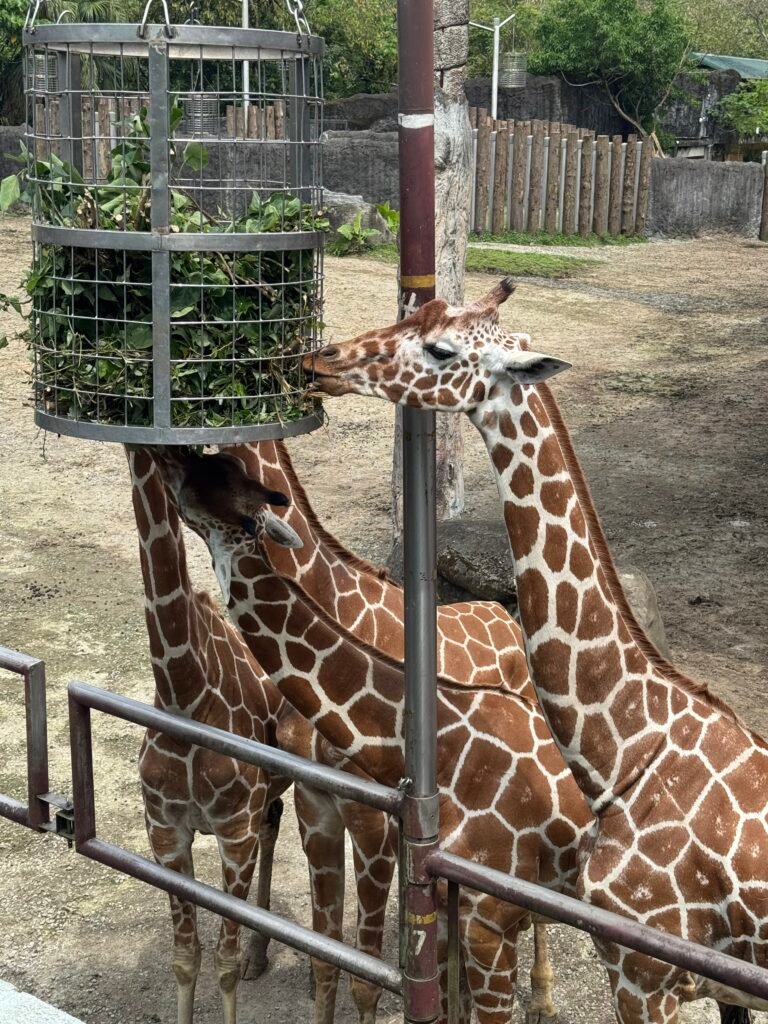
In fact, they have so much room that quite often we can’t even find where the “exhibit” has hidden itself. During the 2.5 hours we allocate to the zoo, moving at quite a serious pace, we probably manage only around one third of the main visitor area. We see pandas, rhinos, camels and giraffes. The gorilla and Bengal tigers are apparently so good at hiding that we never find them. There’s no point even trying to list all the other large and small animals we see along the way.
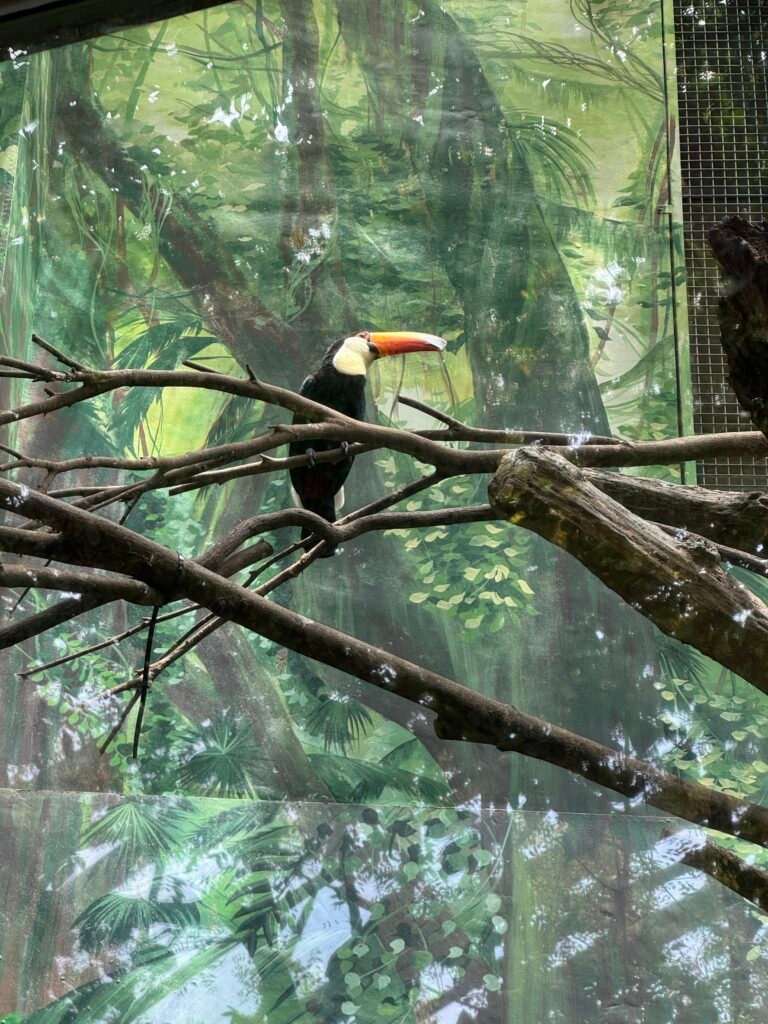
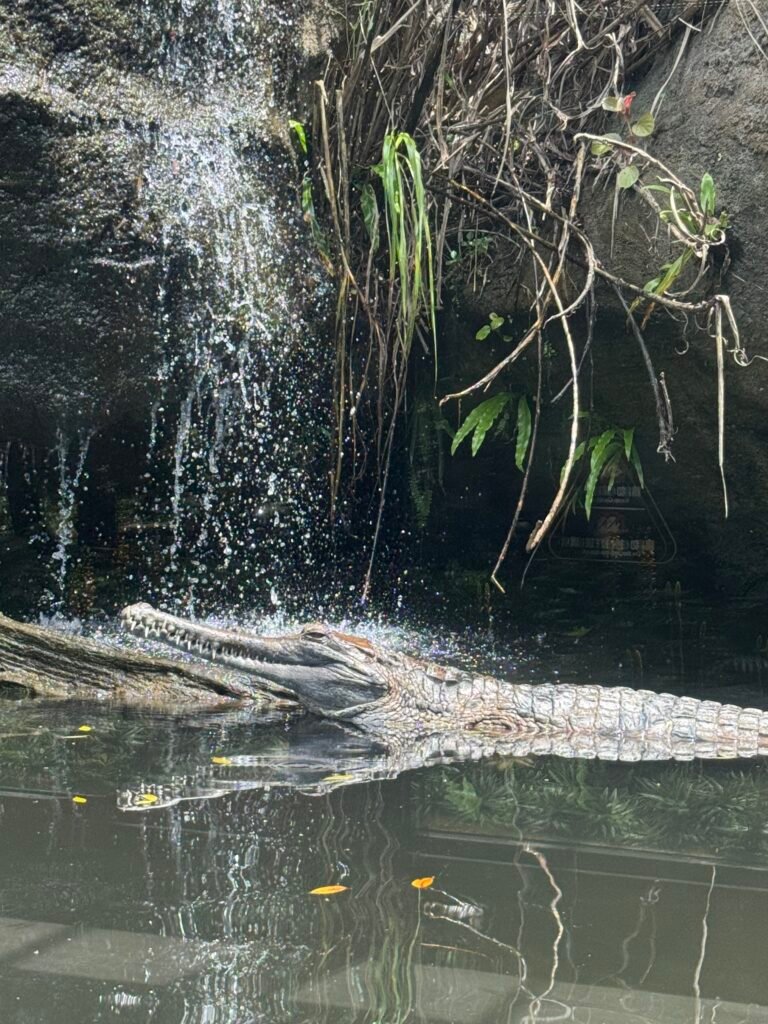
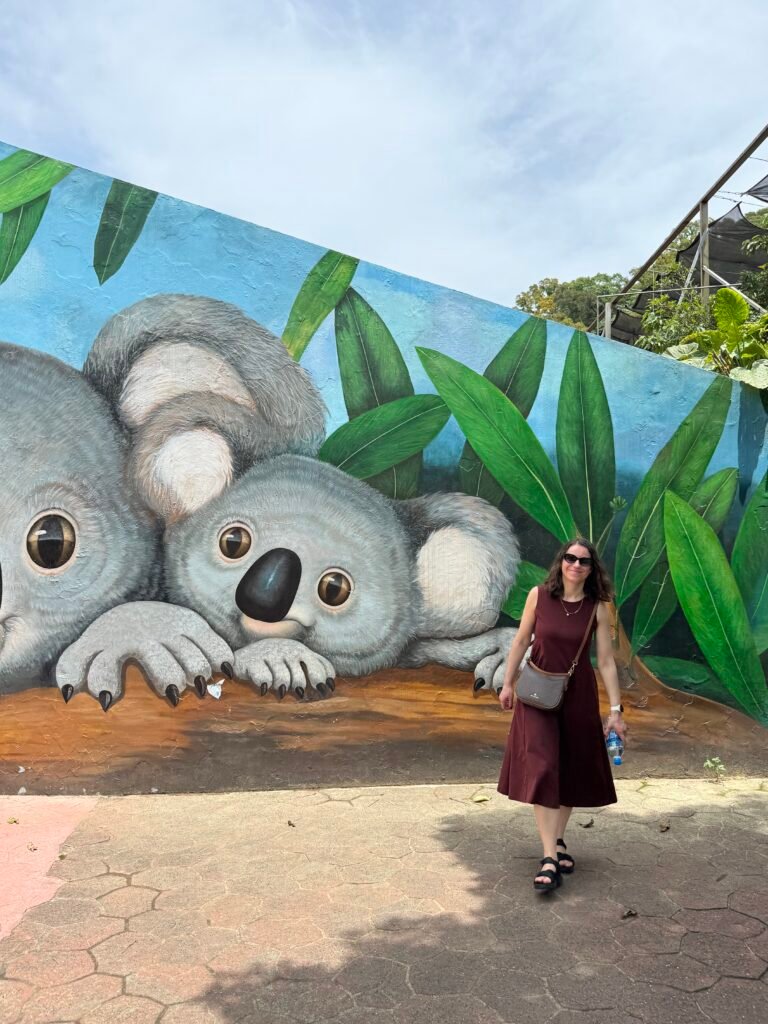
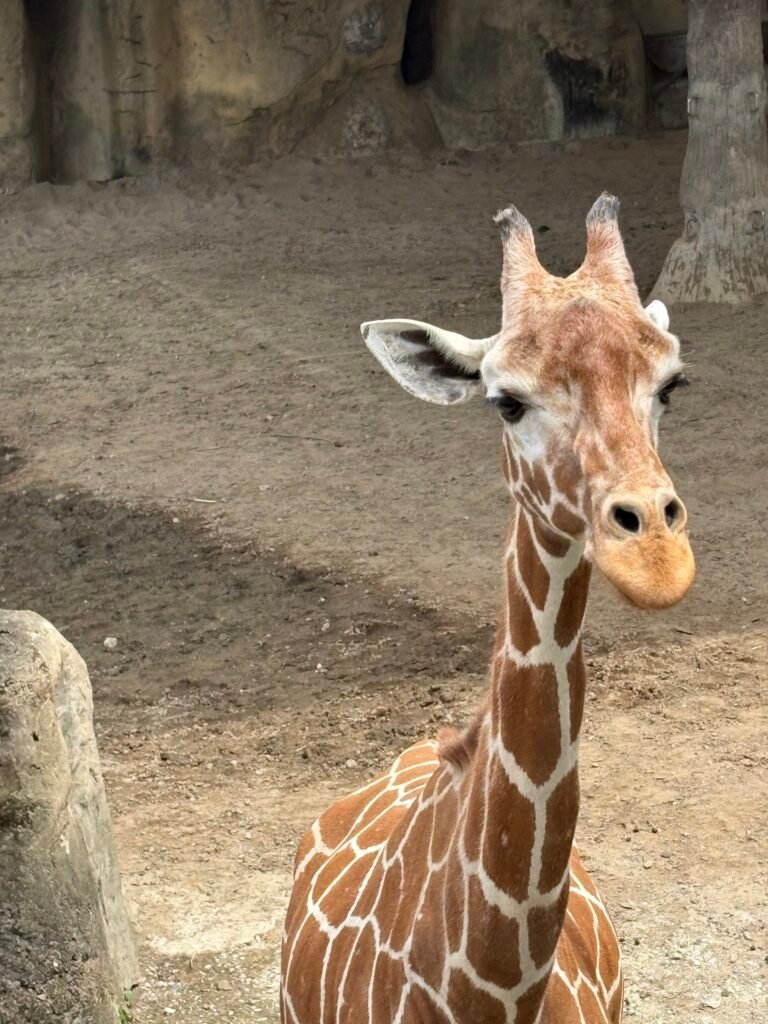
ZHANGSHAN TEMPLE
27.04.2026: After the zoo, we somehow get ridiculously lucky and arrive at the bus stop exactly when our bus to the next destination – Maokong Mountain – is coming. Normally, there’s a gondola from the zoo up here, which is an attraction in itself. Of course, on Mondays it’s closed for maintenance. Although even if today wasn’t Monday, the gondola still wouldn’t help us because it’s currently closed for a longer annual maintenance period before the summer season.
We get up the mountain by bus. The moment we step off, it becomes obvious that the entire local area lives according to the gondola schedule. Every shop and café is closed.
A shame. I had already imagined myself drinking coffee here, because it’s now afternoon and the inevitable post-lunch crash is coming. While walking towards Zhangshan Temple, we decide there’s no point returning afterwards to this completely closed village.
Instead, we’ll continue forward along the trail and walk down the mountain towards the nearest town – Wanxing – where we can catch public transport back towards Taipei. On the way to Zhangshan Temple, we don’t meet a single human. The only personality we pass is a very self-satisfied cat lazily washing itself on a stone wall. He communicates with us for a while.
After a short discussion, we move on. Zhangshan Temple sits on the slope of Maokong Mountain with a proud view across the Taipei skyline – naturally with Taipei 101 in the middle.
Because everything is so quiet today due to the gondola closure, there are only four other people in the temple besides us. Extremely peaceful.
The temple itself, like the others we’ve already seen, again features impossibly detailed decoration – this time with an even stronger focus on dragons. You could probably spend an entire day studying all of it. But we need to continue. Also, because there are no other tourists here, we feel slightly out of place. The remaining four people are smiling and friendly, although we don’t manage to extract a single word of English from any of them.
About 100 metres from the temple, there’s a café that looks suspiciously like it’s also the owner’s house. A tiny but very nice terrace hangs over the mountain slope. And the café is actually open.
So obviously we go in. Relying completely on Google Translate, smiles and pointing fingers, we manage to get an excellent iced tea and a fairly average ice cream. After loading up on carbohydrates and views, we continue along the trail. The constant downhill walking over stairs and steep paths eventually rubs a hole in my left foot because I’m wearing sandals. We patch the hole with tape and continue. It’s fine.
The plan is to take a bus from Wanxing back towards Taipei 101, which has a shopping centre on its lower floors. At the bus stop, the huge timetable contains not one single letter we can understand. The only thing we recognise is the bus numbers. When one of those buses might actually arrive is another question. After a nervous ten-minute wait, a promising-looking bus appears. We jump in. Correct one!
We eat lunch in the Taipei 101 food court while watching the locals. There’s nothing specific planned for the rest of today, but we don’t really want to go back to the hotel yet either.
So we continue along one of the city’s main boulevards – Xinyi Road – hoping to find a café.
We walk into a fancy place called Bird Café with an enormous coffee selection.
When ordering espresso, I’m asked to choose several different parameters about exactly what type of coffee I want. Obviously, I don’t know the answers. So I point at things on the menu based entirely on instinct. The result is an extremely strong but tasty little shot. I then completely confuse the waitress by also wanting iced tea after the coffee. Apparently the concept of drinking both tea and coffee at the same time doesn’t compute. They perform the same function.
Why would anyone drink them in parallel? Taking a few detours through the city on the way back to the hotel, we pass through Sun Yat-sen Memorial.
Surprisingly, the building itself isn’t illuminated, but the surrounding skyscrapers reflect perfectly in the fountain next to it. For the sake of the excursion, we also visit two of Taipei’s famous themed 7-Eleven stores. The first is cat-themed, which is extremely popular here, and the second is completely decorated around Snoopy. We don’t actually need to buy anything, so we don’t stay long. If you had enough time and interest, though, you could turn this into a full-day tour.
Apparently Taipei has around 60 themed 7-Eleven stores, each more elaborate than the last.
And it isn’t just a few stickers on the windows. The entire interior, shelves, walls, coffee areas and even seating are designed according to a specific character or brand. We finish the day back at the hotel with 30,000 steps on the clock. Completely exhausted, we collapse into bed.
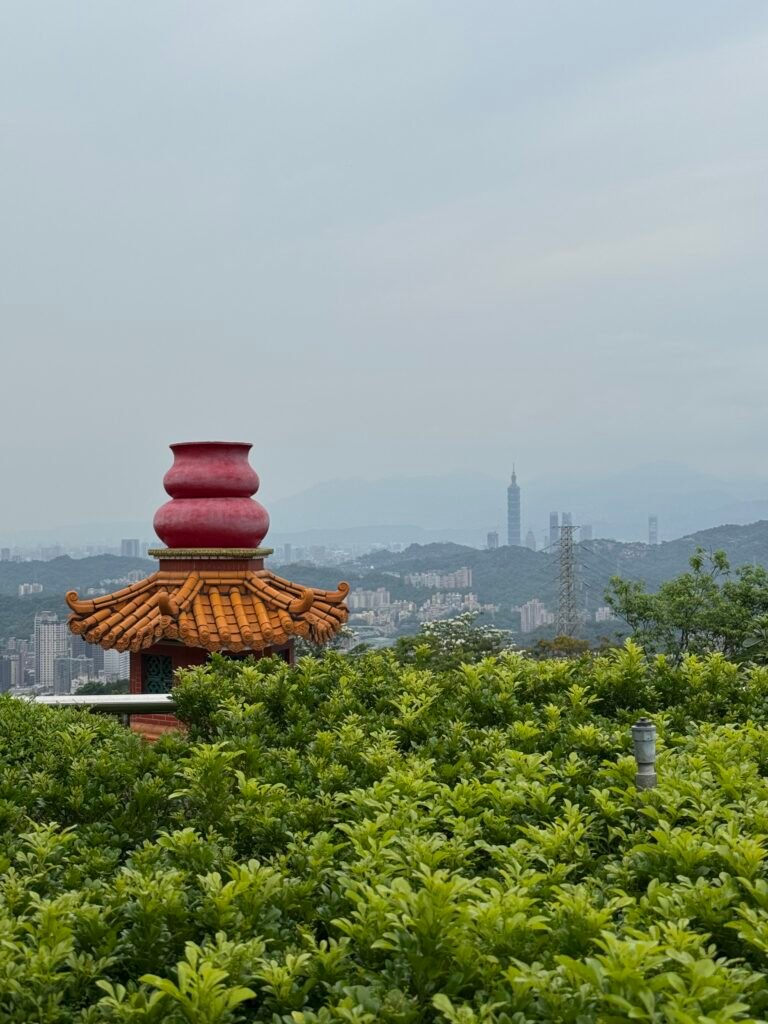
SHIFEN
28.04.2026: Today begins the second part of the trip – the one where we have our own car.
In Taipei’s giant concrete jungle, we somehow find the tiny street containing the GoodCars rental office. Generally speaking, Latvian driving licences give us quite a lot of freedom around the world, but Taiwan also requires an IDP – International Driving Permit. It’s basically nothing special.
CSDD takes €18 and sends you a little booklet by post containing your licence information in five languages – none of which, in my opinion, a Taiwanese person is likely to understand. The main thing is simply knowing beforehand that you need the extra document. Anyway, collecting the car goes smoothly and fairly quickly we’re standing next to a white Toyota Yaris. The price is very reasonable. To be fair, the car matches the price.
It’s relatively new, but its only optional extra seems to be a radio. Still, it’ll get us from A to B.
We start with a warm-up drive to the small town of Shifen, around 40 minutes away. The navigation looks very promising because everything is written exclusively in Chinese characters.
With only a couple of wrong turns, we manage to reach the first stop.
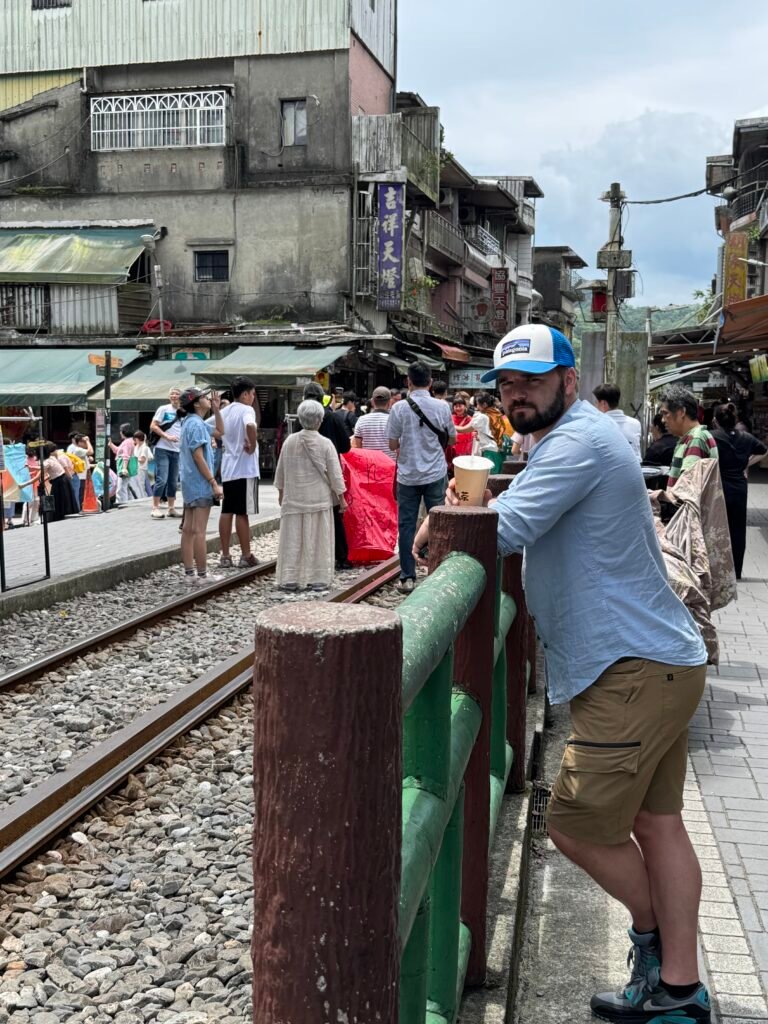
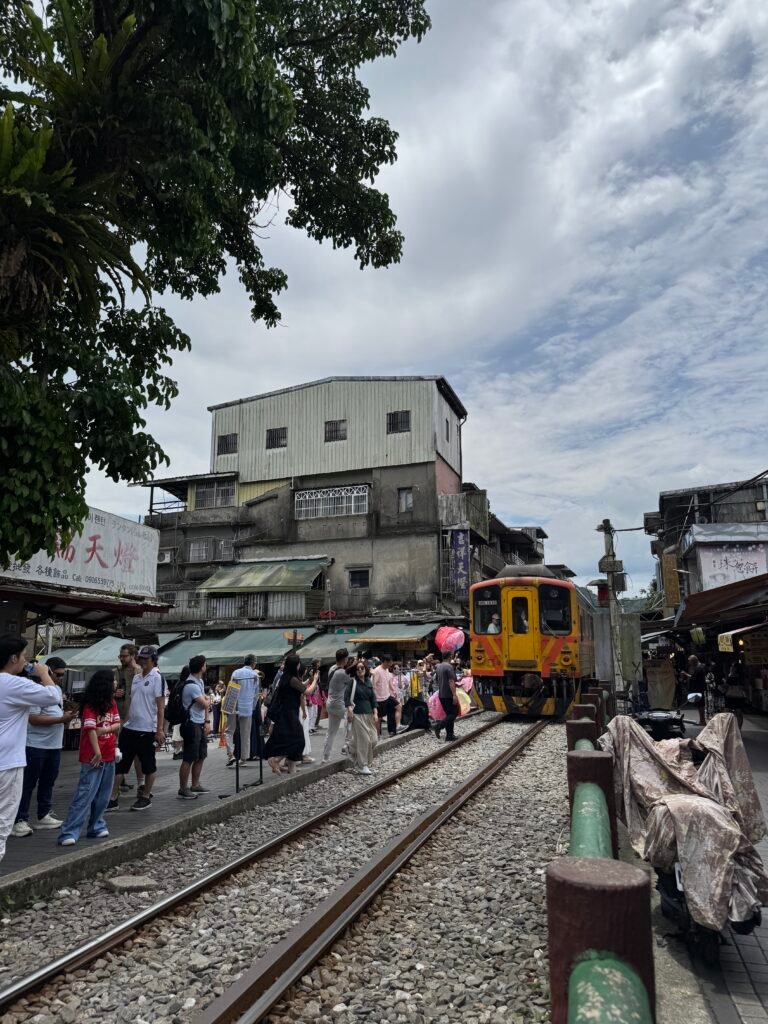
It’s a small town that became popular with tourists because of its unusual railway station. The railway basically runs straight through the street. A train passes every 30 minutes and between trains, the tracks essentially become a market. Cafés and shops operate right beside them.
Shifen was originally a coal-mining village. The railway was built during the Japanese colonial period to transport coal from the surrounding mines to the ports. The most popular activity here is releasing paper lanterns into the sky. Before launching them, people seem to write wishes on them. The number of lanterns being released is enormous.
I wonder how quickly they break down once they eventually fall into bushes and trees. To be fair, we don’t see any rubbish lying around. I also wouldn’t be surprised if a local clean-up team is sent out every evening to collect everything. This is apparently the only place in Taiwan where this kind of activity is still allowed because the area is very humid and mountainous almost all year, significantly reducing the risk of fire.
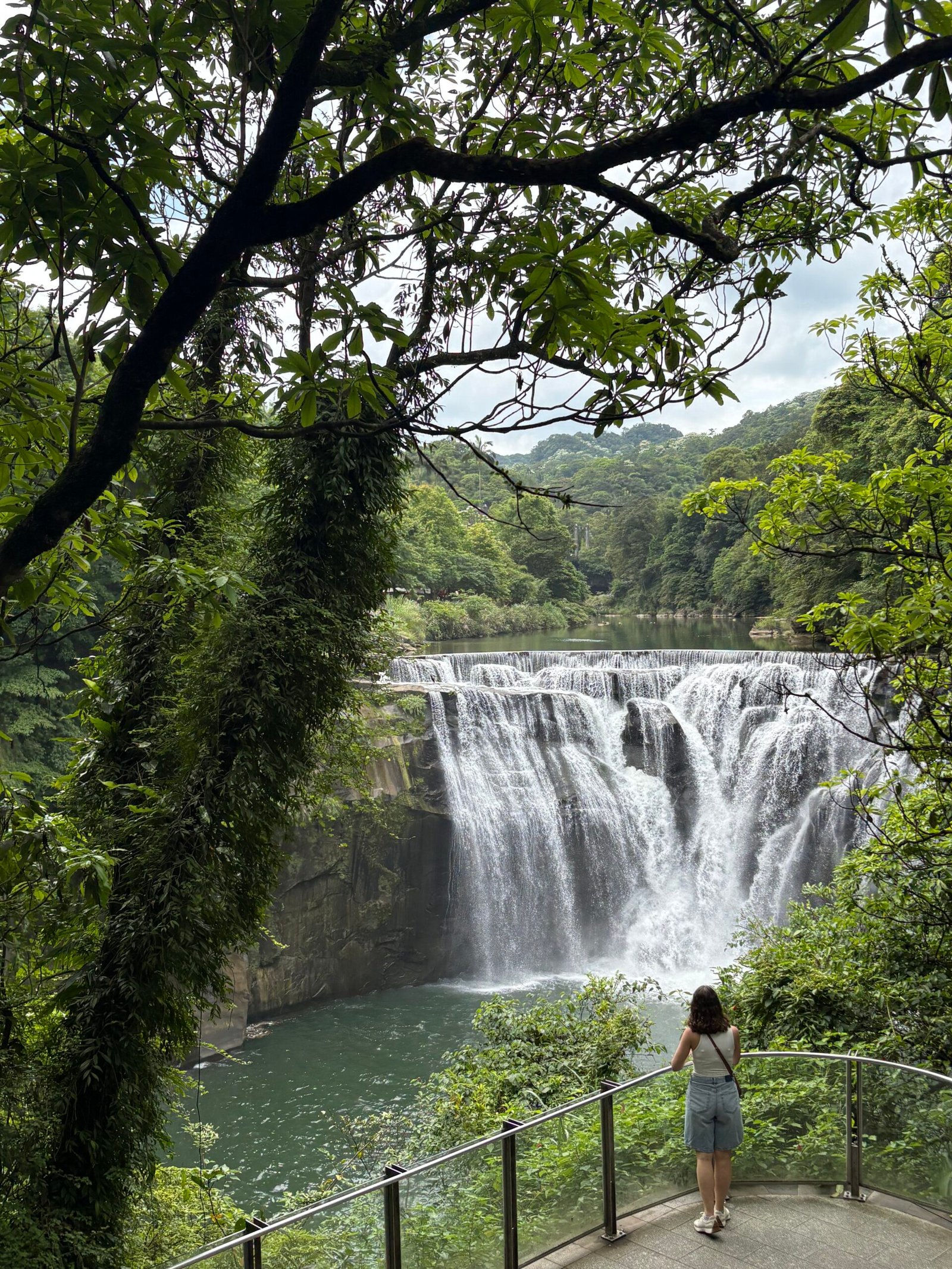
Historically, the lanterns were supposedly used as safety signals for mountain villages. If a lantern was released, it meant the bandits had left and residents could return home. Considering how safe Taiwan feels today, it’s hard to imagine what kind of bandits they’re talking about. After exploring the town, we walk to nearby Shifen Waterfall. Locals call it the Niagara Falls of Taiwan, and it’s also the widest waterfall in the country. Around a 20-minute walk along a nicely built path and viewing platforms. The waterfall is roughly 20 metres high and 40 metres wide.
The surrounding environment is very jungle-like, which makes the whole scene interesting.
If we had travelled here by public transport and spent an entire day on the excursion, I’d probably be slightly disappointed and wish we’d stayed in Taipei. But in our case, where we’re passing through by car and continuing onwards, it’s completely fine. Interesting little town.
No real wow moment though.
JIUFEN
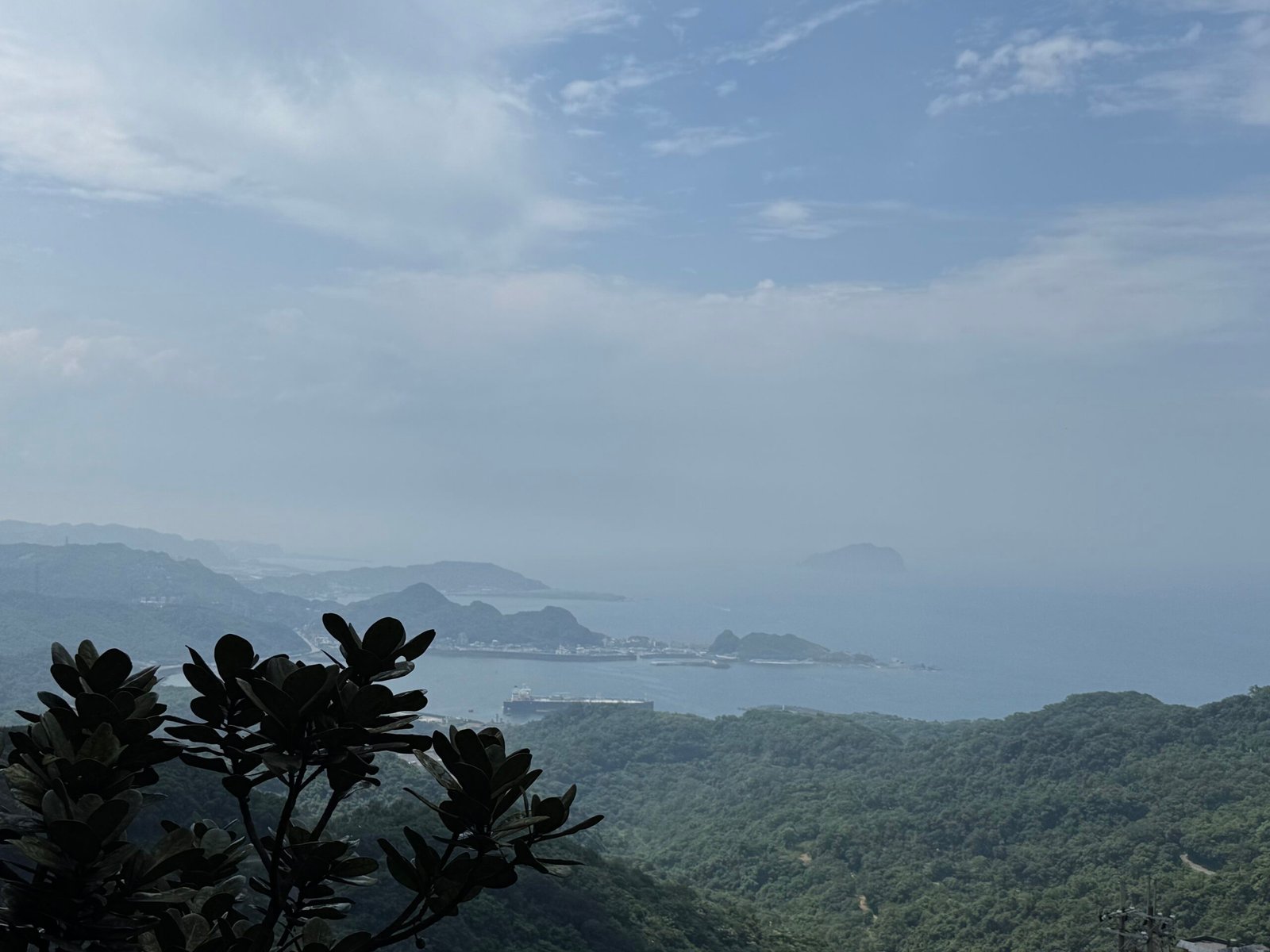
28.04.2026: The next town, Jiufen, is around 40 minutes away along narrow serpentine roads.
Our Yaris is no rocket on roads like these, but it gets the job done. Jiufen is built on a steep mountainside overlooking the East China Sea in northern Taiwan. Parking in towns like this is always a challenge. Not far from the main tourist street, some local guy with a baton starts waving us into a garage. We don’t have many alternatives, so I accept his invitation.
For 200 local monies, we’re parked. The whole process is slightly interesting.
We arrive in a completely unfamiliar town, drive into some random garage, hand a local guy our car keys in exchange for a pink piece of paper… and he drives our car away. Will we ever see it again? From the first steps, Jiufen already feels much more charming and pleasant than Shifen.
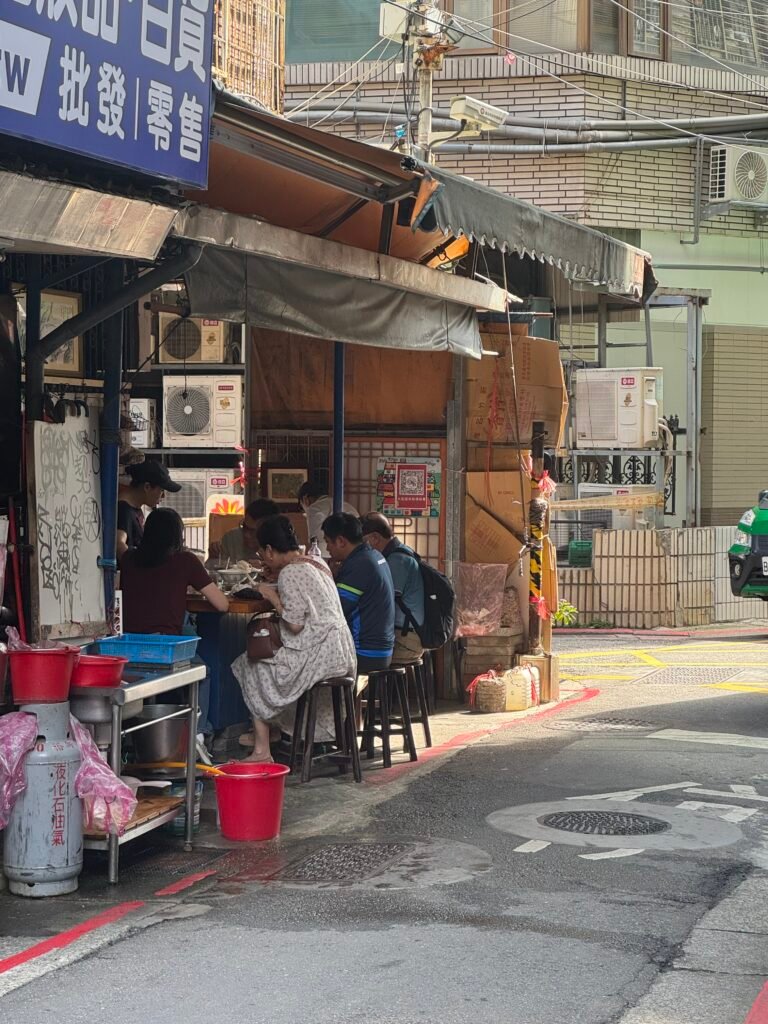
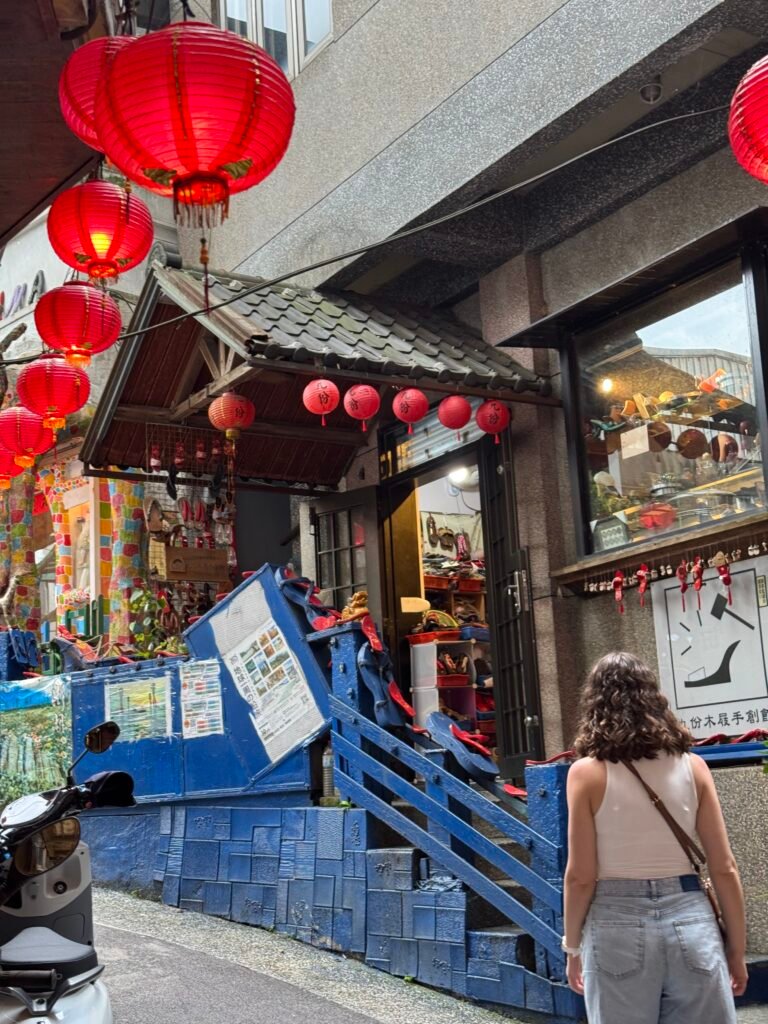
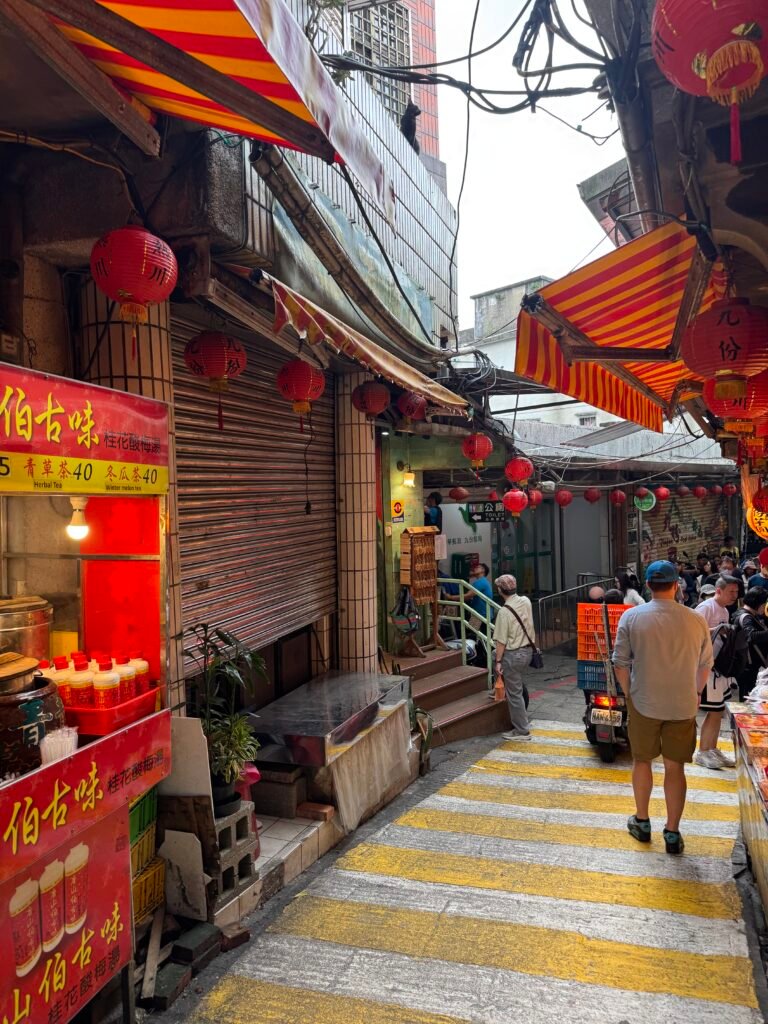
Even though there are more people here, it doesn’t really feel touristy. At least not foreign-tourist touristy. The main attraction is Jiufen Old Street – a narrow pedestrian market winding between tiny buildings built into the steep hillside. Jiufen was originally a small gold-mining village.
The name “Jiufen”, meaning “nine portions”, supposedly comes from a time when only nine families lived here and ordered food and other supplies together from surrounding areas.
The shops are packed.
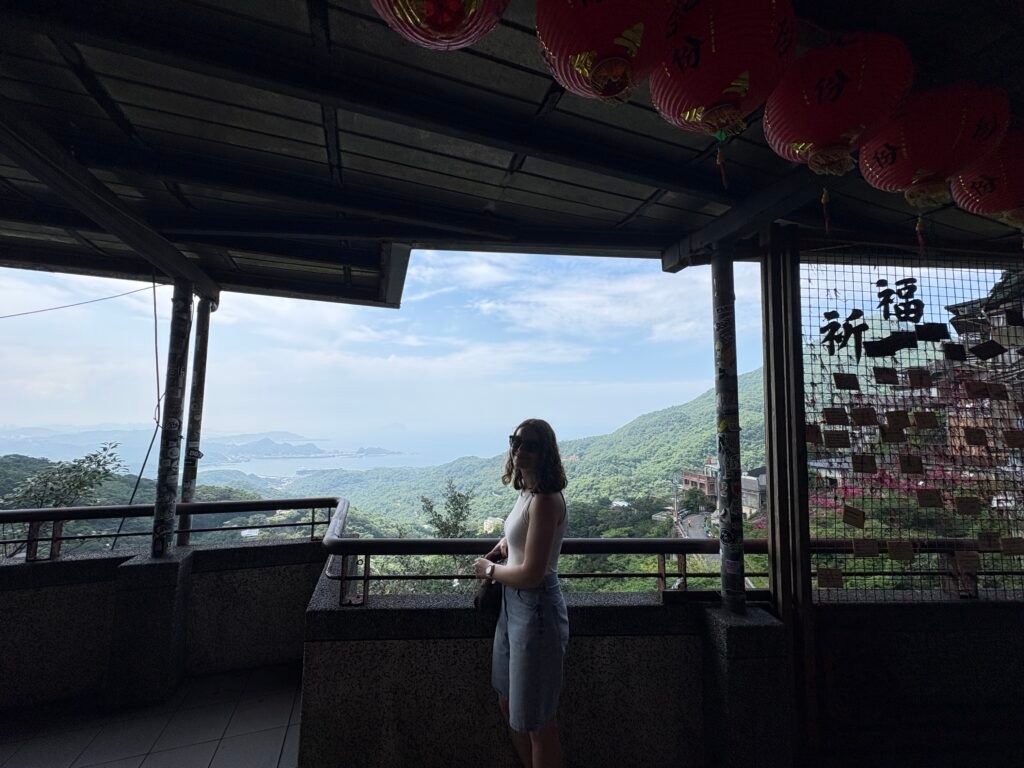
Tiny Asians run around like ants in a colony from one café to another. We slowly make our way through and eventually settle into a restaurant overlooking the bay. Because of the view, it’s probably one of the more expensive cafés here. Even so, prices are reasonable. Lunch for both of us fits within roughly €20. While eating, we can watch a gigantic cargo ship trying to squeeze itself into Keelung – one of Taiwan’s busiest ports.
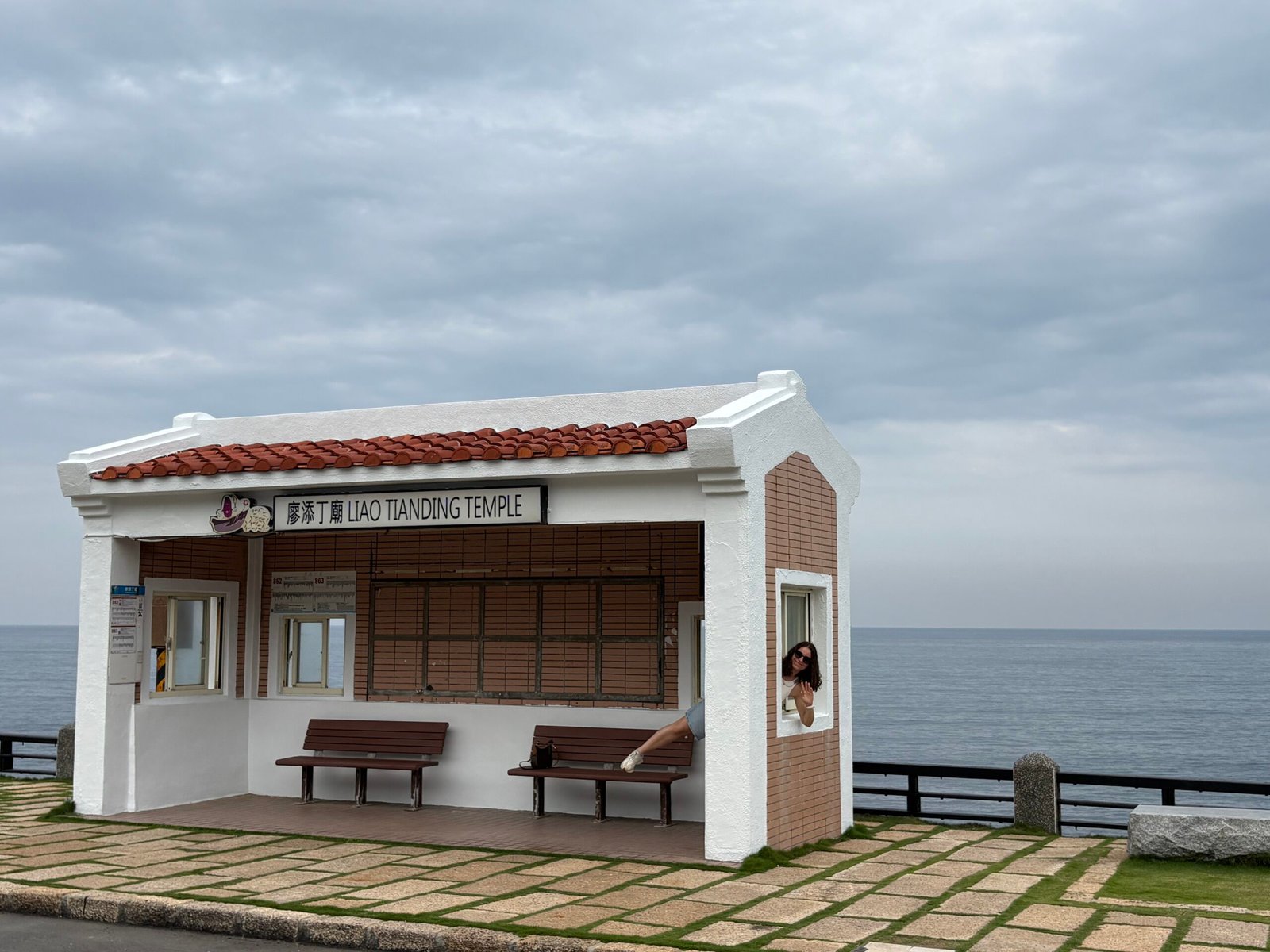
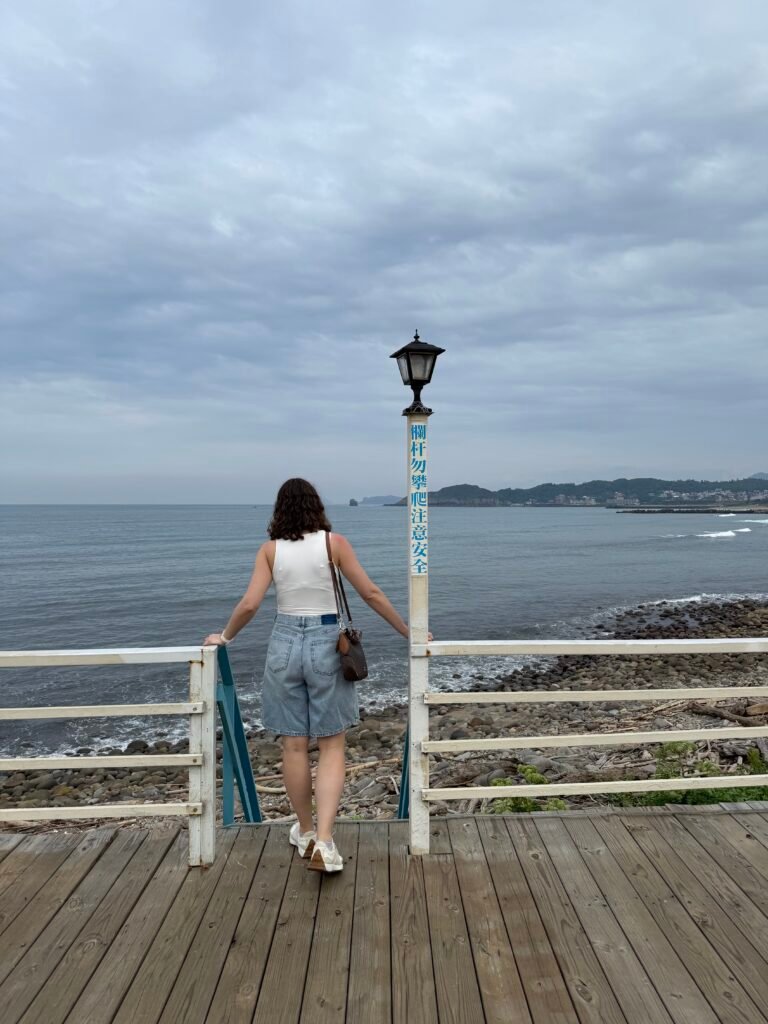
After lunch, we more or less start heading back towards Taipei, taking a small detour around the very northern tip of the island. Along the way, we stop for coffee and a few photos. The bus stops right on the coastline are surprisingly cute. They look like tiny white houses from southern Europe, with tiled roofs and little wooden shutters that can be opened on the sides. We make another stop in Taipei’s outer Shilin district for dinner at a café we found online beforehand – David & Alpacas.
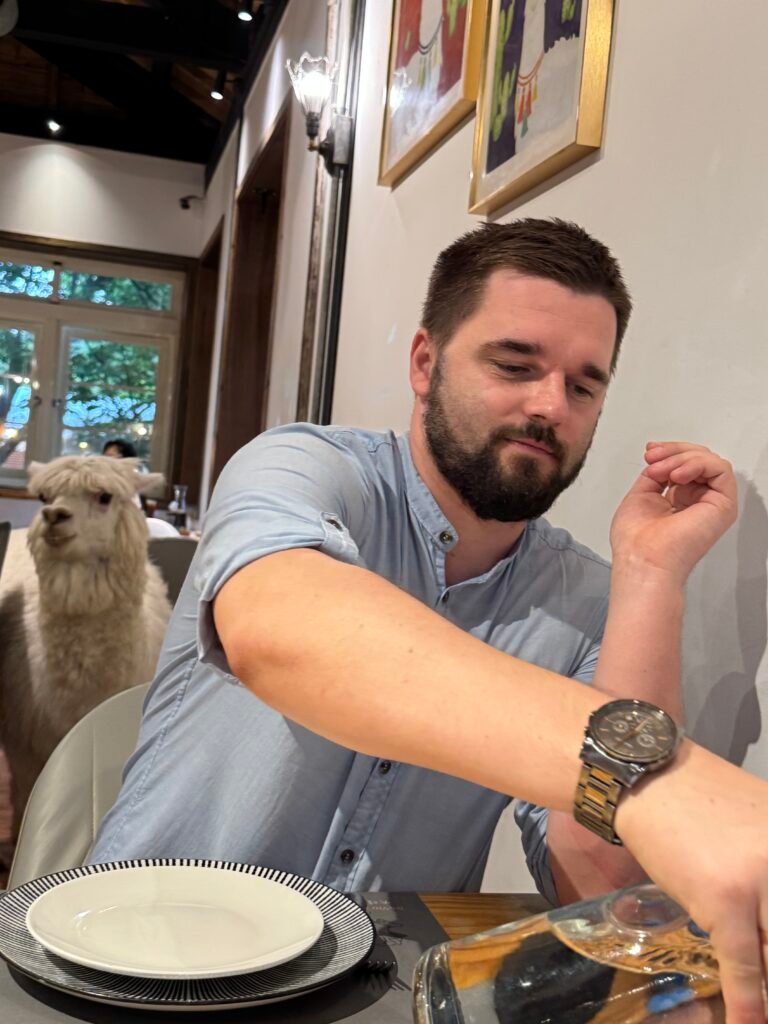
A café where two white alpacas wander freely around the place. While waiting for our food, we watch both of them carefully scanning visitors’ tables. If you’re not paying attention, you may have to share your meal with a curly-haired friend. Madara manages to get some photos with the stars of the place. In reality, neither of us is even hungry because all we’ve done all day is sample random food. But Madara wanted to visit the alpacas so badly that apparently we now need to eat our fourth lunch of the day. Soup conveniently fills the small gaps between solid food units and goes down surprisingly easily.
By the time we return to our area of Taipei, it’s already dark. I decide not to take any risks and head towards the safest and largest parking option close to our hotel – the underground car park beneath Taipei Arena. We drive in and park. Everything is great. Then comes a fairly complicated conversation with the security lady about how exactly payment works. Eventually, we all agree that this is tomorrow’s problem when we try to leave. Smiling at each other and understanding absolutely nothing, we part ways as friends
DAXI
29.04.2026: Today begins the first proper day of our road-trip section. We’re heading towards Taichung, Taiwan’s second-largest city. Getting out of Taipei turns out to be quite a challenge.
We use our usual Waze navigation. I follow the line on the map because every road sign and everything on the screen is written in Chinese characters. As long as I’m on the line, everything is fine. The line turns right. I turn right. And suddenly the road ends. There’s a river in front of us.
Turns out we’re on the wrong level of the interchange. We’re supposed to be about 15 metres higher!
We zigzag through little neighbourhood streets trying to get back onto the correct road at the correct level. Around 15–20 minutes later, we finally rejoin the route in the correct direction.
Navigation victory achieved. We continue towards Taichung but stop in Daxi on the way.
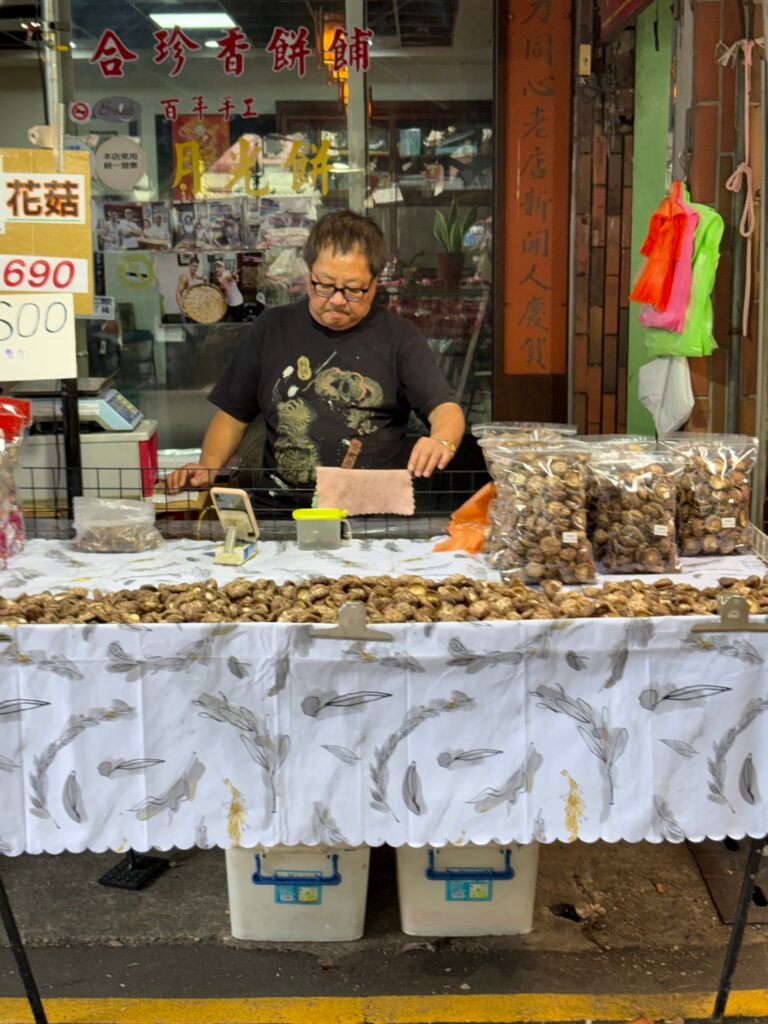
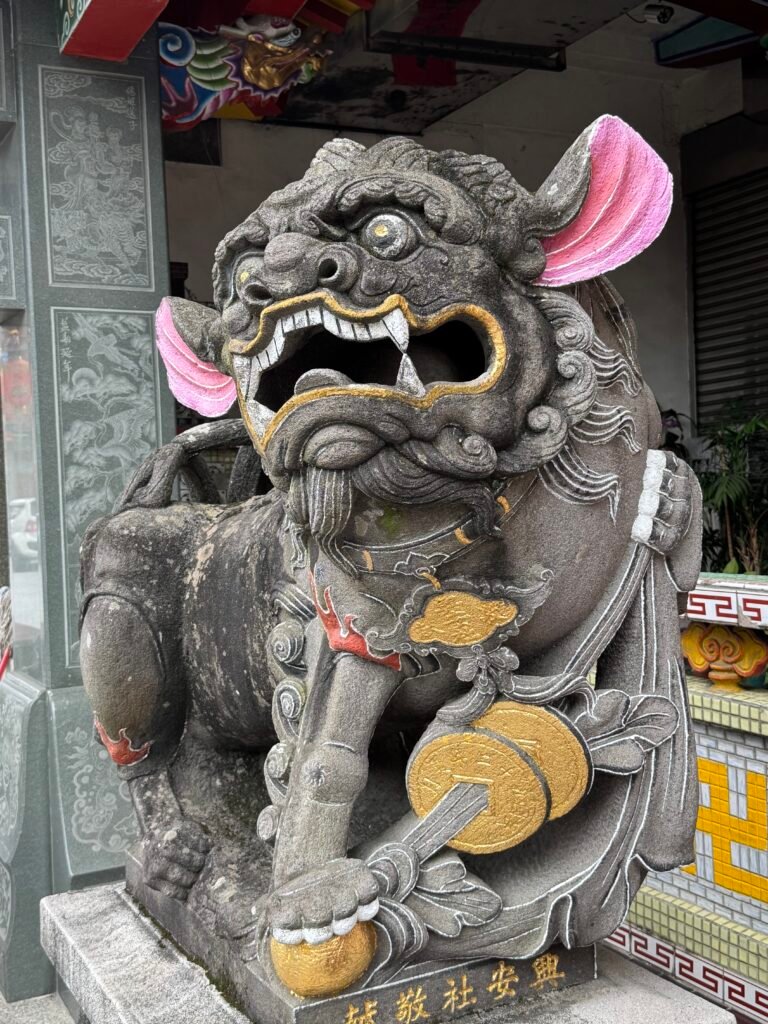
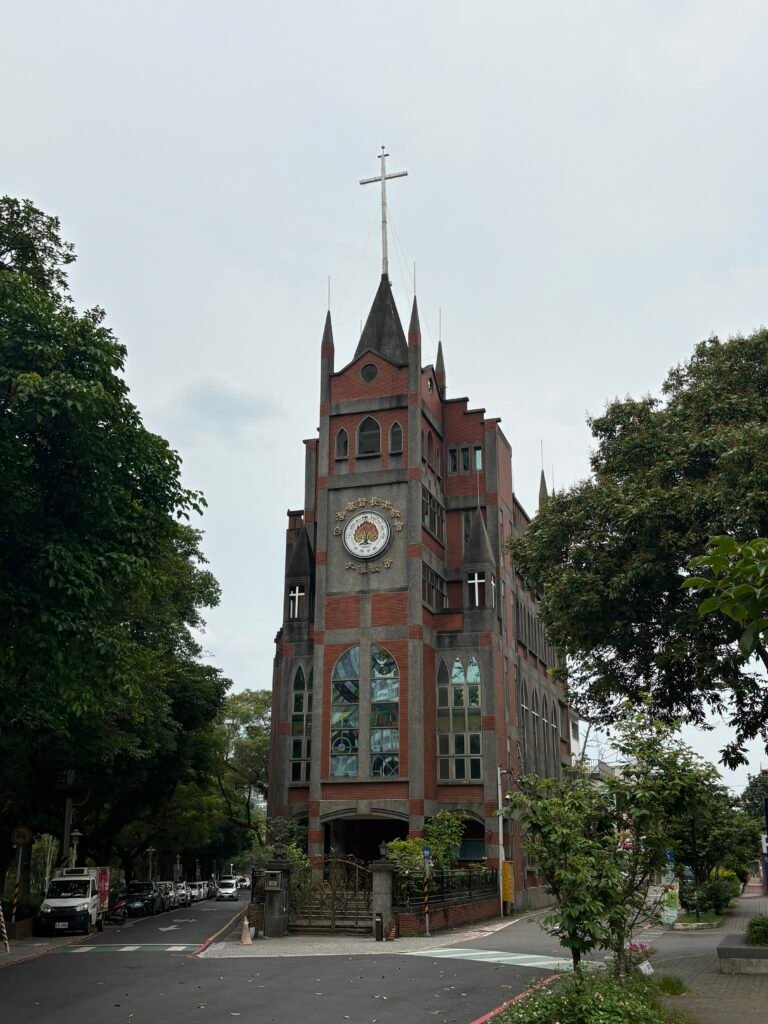
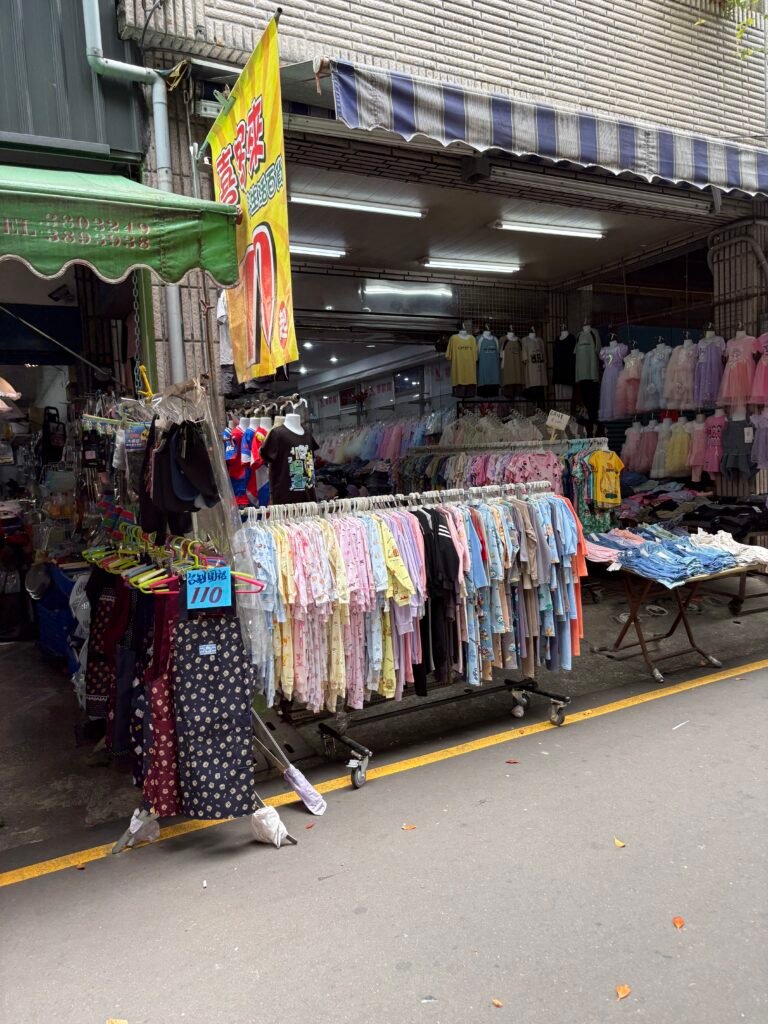
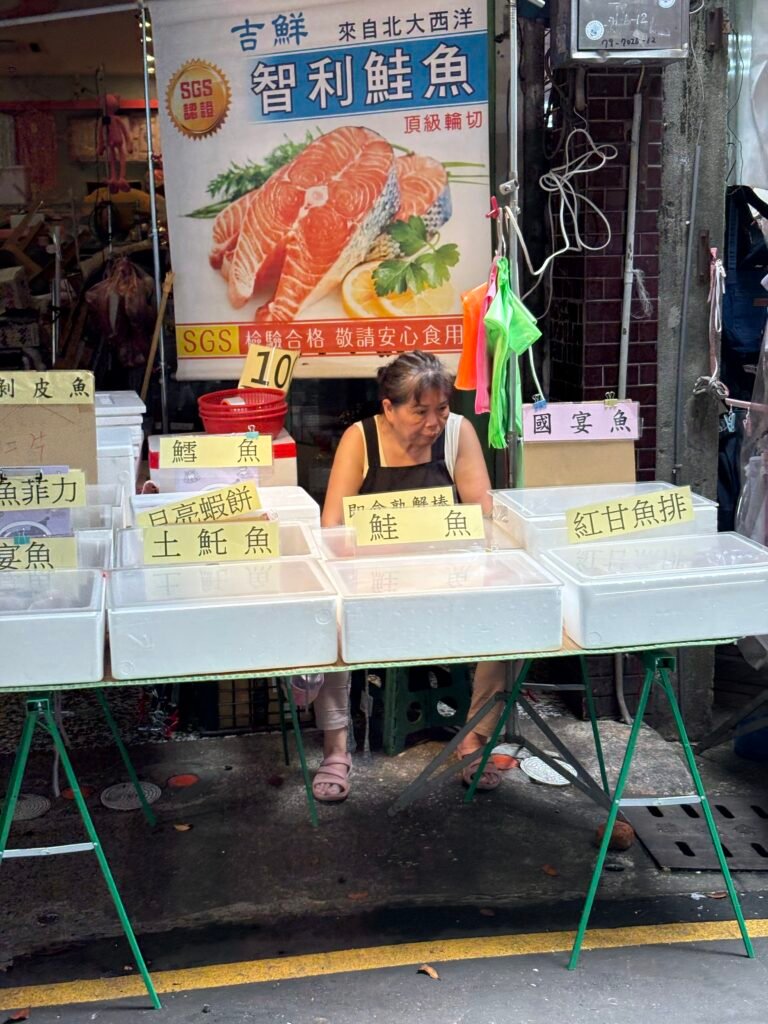
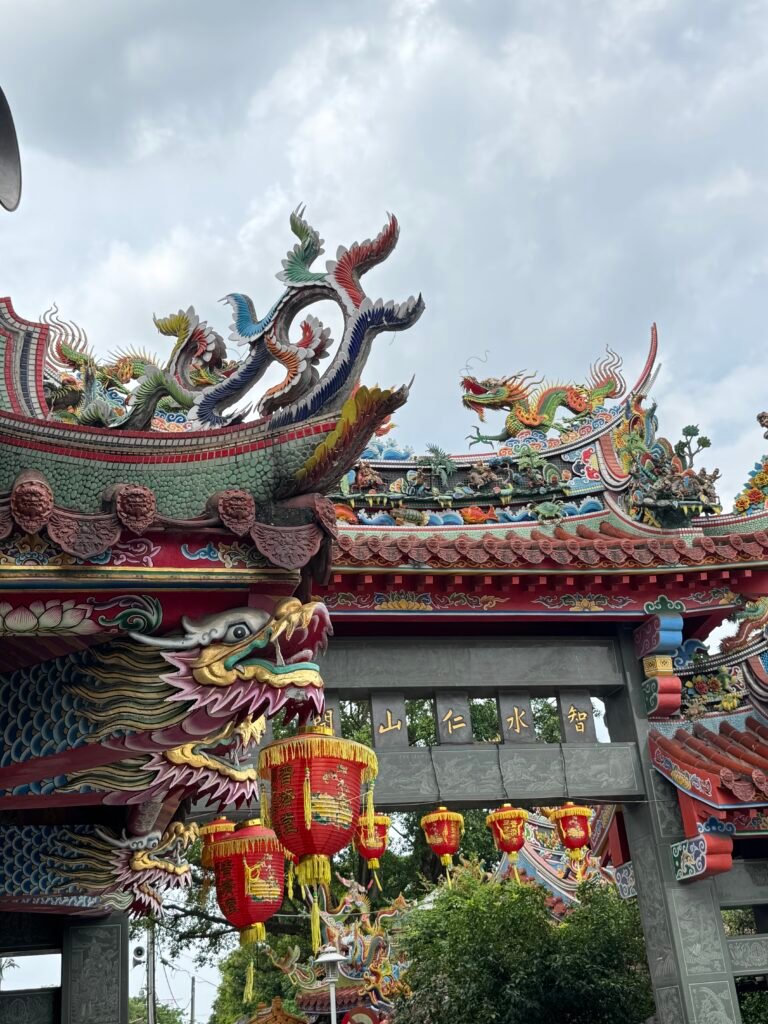
Turns out this is not some little village like I had imagined. It’s a properly sized town – certainly by our standards. We walk around the Old Town, where a local market is busy and full of life.
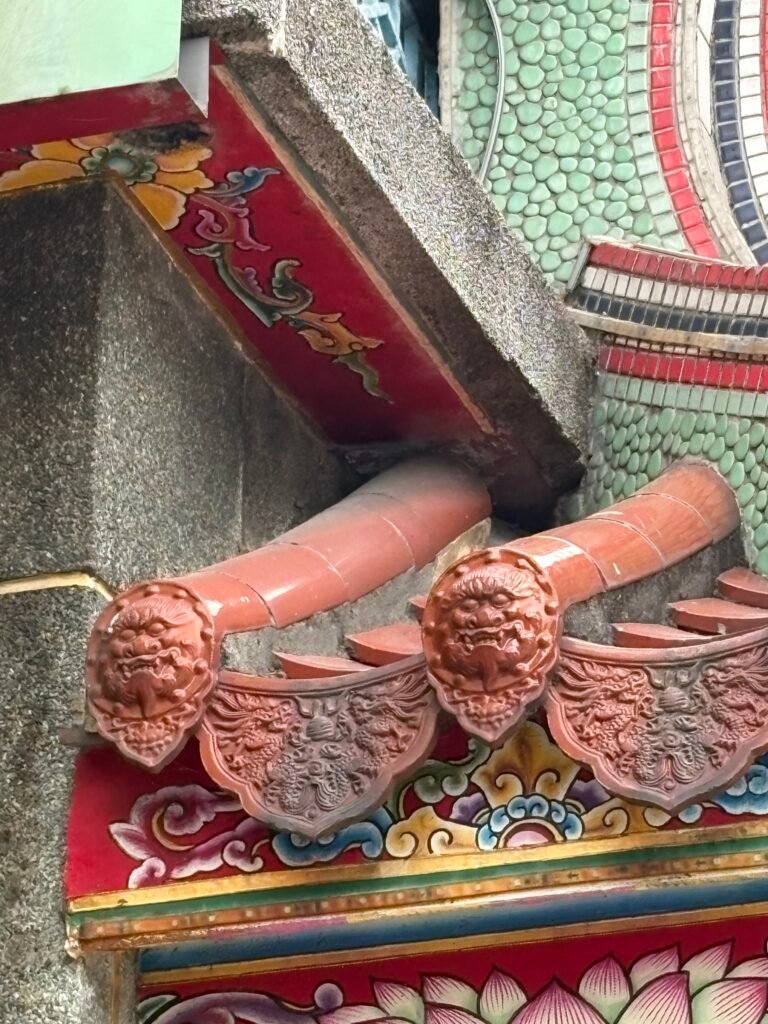
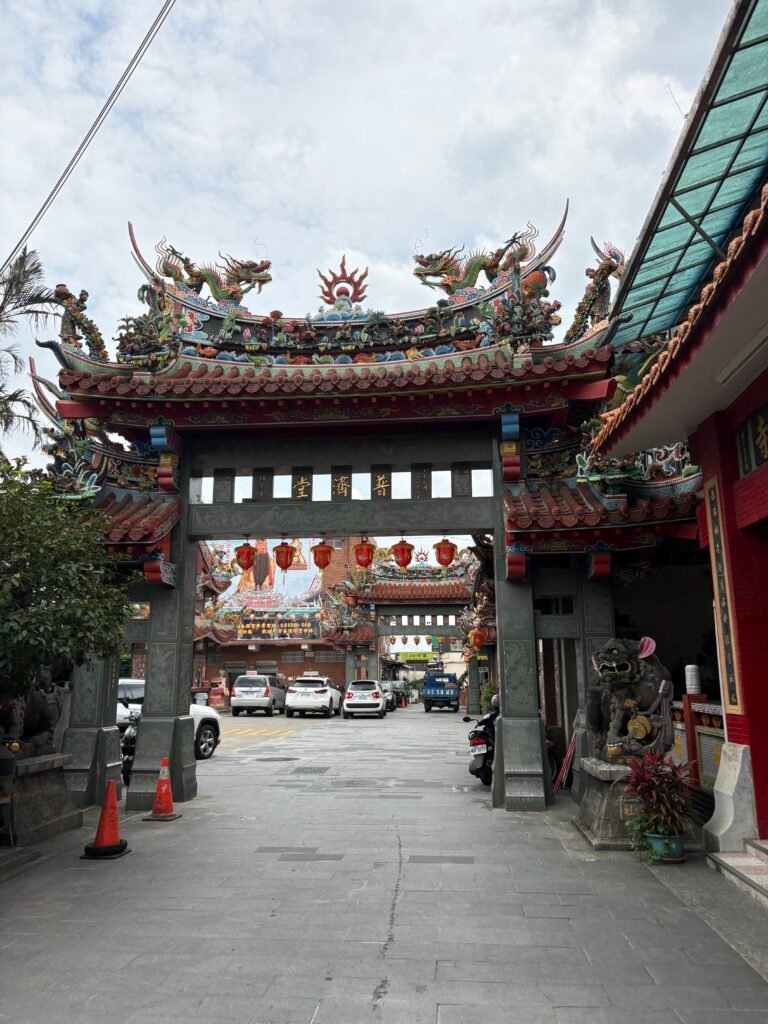
The architecture is quite unusual – a mixture of Japanese colonial-era Baroque and traditional Chinese architecture. Some façades almost look like European Baroque, only decorated with Chinese symbols, dragons and traditional ornaments. Many buildings were rebuilt around 1910–1920 during the Japanese occupation, when Daxi was experiencing an economic boom. Rich merchants tried to outdo each other with increasingly elaborate façades. Today we’re still experiencing that classic fourth-day-of-the-trip fatigue, so we’re not signing up for any extreme activities. We walk around the market, Madara buys something in a local ceramics shop, we shoot down a strong espresso and continue onwards.
TAICHUNG
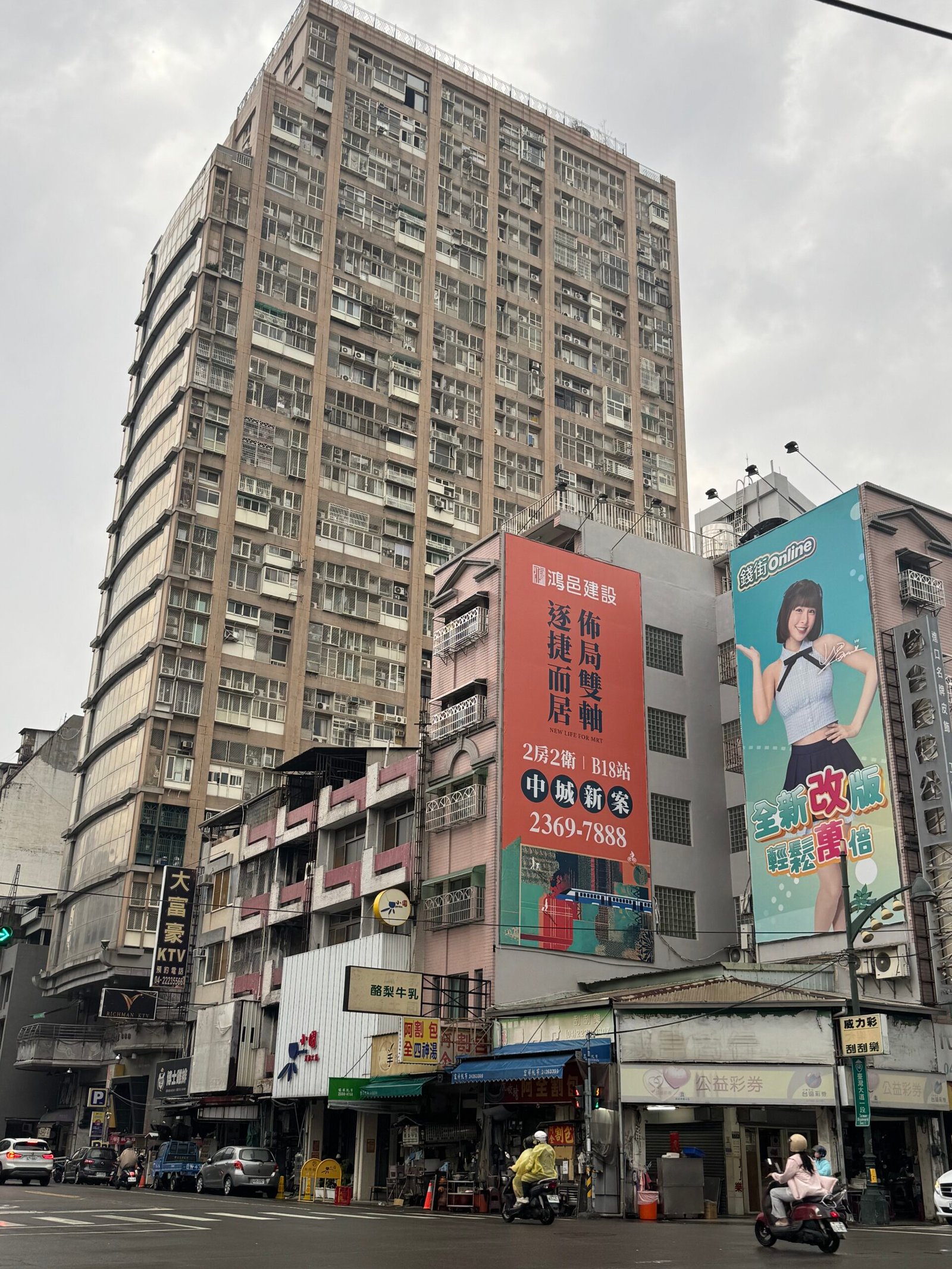
29.04.2026: We arrive in Taichung slightly earlier than planned. Another enormous city with considerably more inhabitants than the entire population of Latvia. We successfully find our hotel – Micasa Hotel. Very convenient that there’s also somewhere to park immediately. Taiwanese people, much like Germans, seem very strict about rules and order, so there’s absolutely no chance of entering the room before the official 15:00 check-in time. Not that we desperately need to. We leave the bags in the car and go stretch our legs after the long drive. It’s late afternoon on a weekday, but the city feels completely deserted. Many shops are closed.
Same with cafés and bars. It’s genuinely difficult to find somewhere open where we can eat.
Eventually, on one of the city’s main roads – Section 2, Taiwan Boulevard – we settle into ABV Bar & Kitchen. It’s apparently considered fairly exclusive because it serves imported European beers and Italian food. Since almost nothing else is open, our choice is limited. It’s fairly expensive, and Belgian or German beer with an Italian Margherita pizza doesn’t feel particularly exotic to us.
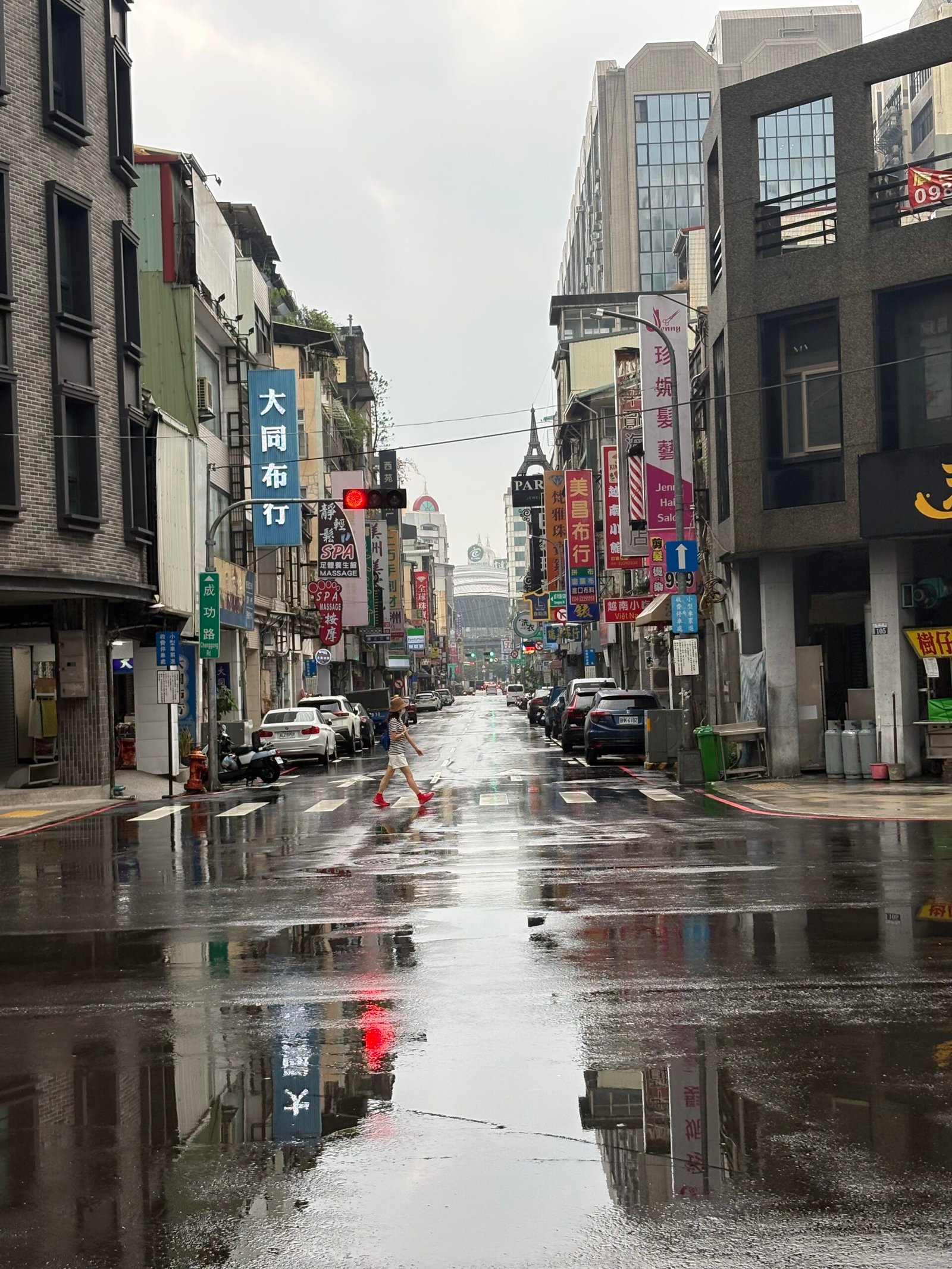
Still, we refuel slightly and head back towards the hotel. On the way, I use the internet to understand why the streets are so empty. Apparently Taichung has historically had a very distinct two-part daily rhythm. One active period until lunchtime, then the city only really wakes up again after around 18:00. That explains why everything around 14:00–15:00 looks abandoned.
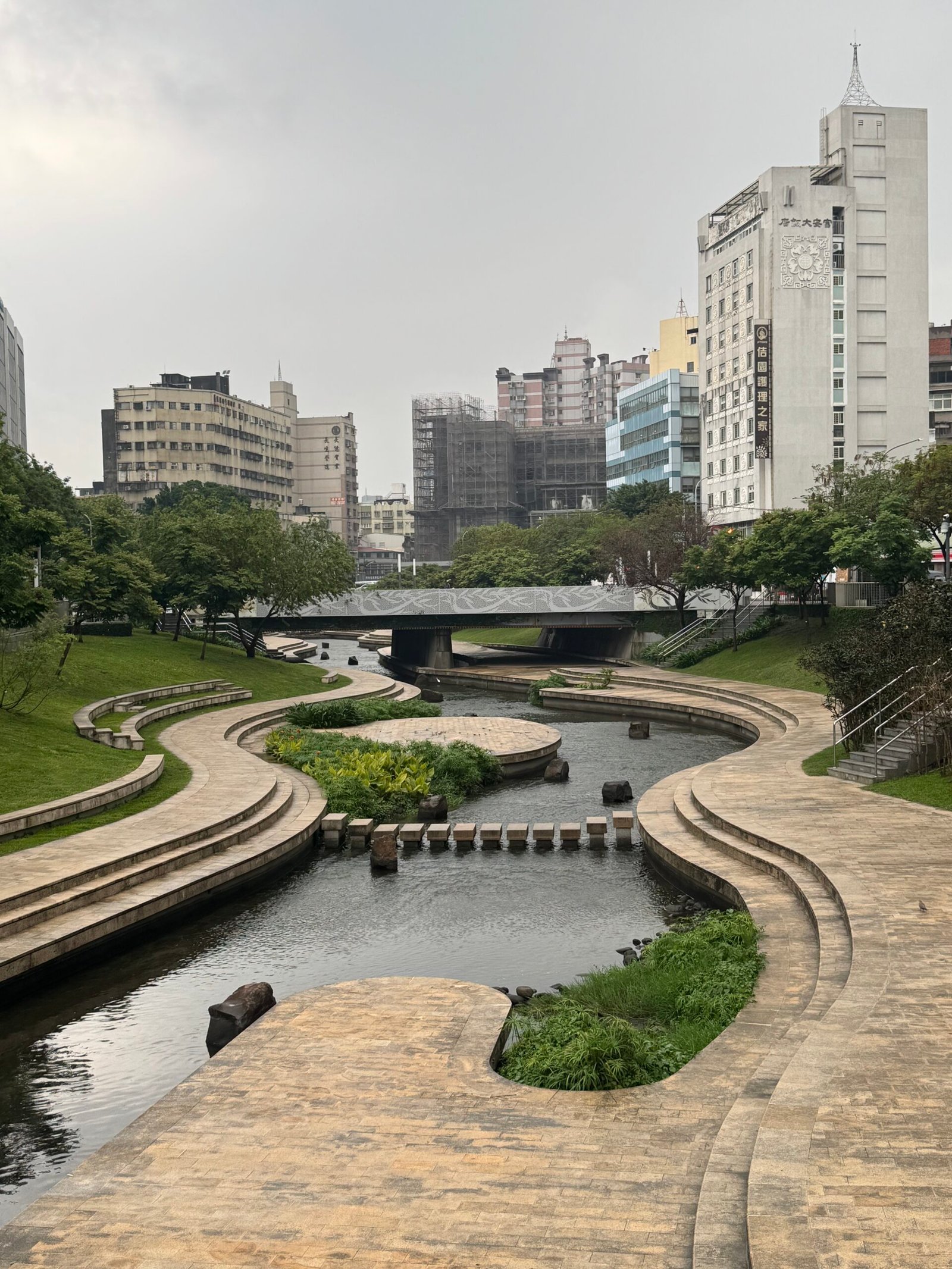
Taichung is often described as “Taiwan’s most comfortable big city” – calmer than Taipei but supposedly more authentic than highly touristy places. Many Taiwanese people consider Taichung the most pleasant city in the country for everyday life. At this moment, we can definitely agree with the “calm” part.
The name “Taichung” literally means “Central Taiwan”, because the city sits roughly in the middle of the island. The idea of Taipei being particularly touristy, though, is harder for me to agree with.
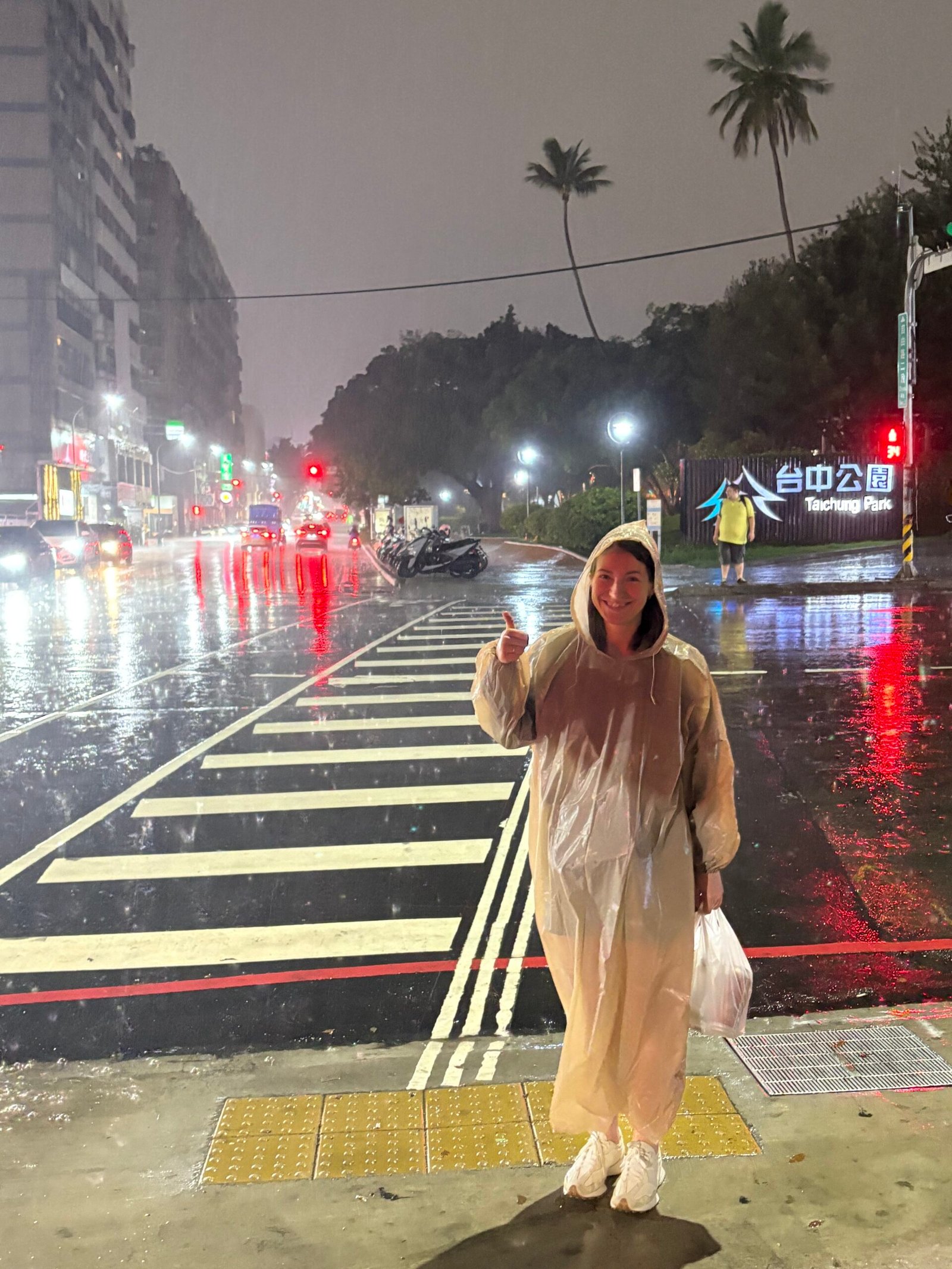
We haven’t encountered big tourist crowds or long queues anywhere on this trip. After a short nap at the hotel, we head back out towards Taichung’s street-food night market. It starts pouring on the way, so we duck into a bar for a while. Now in the evening, the choice of open places is incomparably better. After half an hour, though, it becomes obvious that if we wait for the rain to stop, we won’t see any market tonight. We go into a 7-Eleven, buy raincoats and continue with purpose. Our legs and shoes become completely soaked, but the raincoats hold up well. The situation is saved by the fact that it’s still very warm outside. Completely wet feet don’t feel like such a disaster. Still, sandals or flip-flops would definitely have been smarter than trainers.
There are far fewer street-food stalls than we saw in photos, especially compared with Taipei.
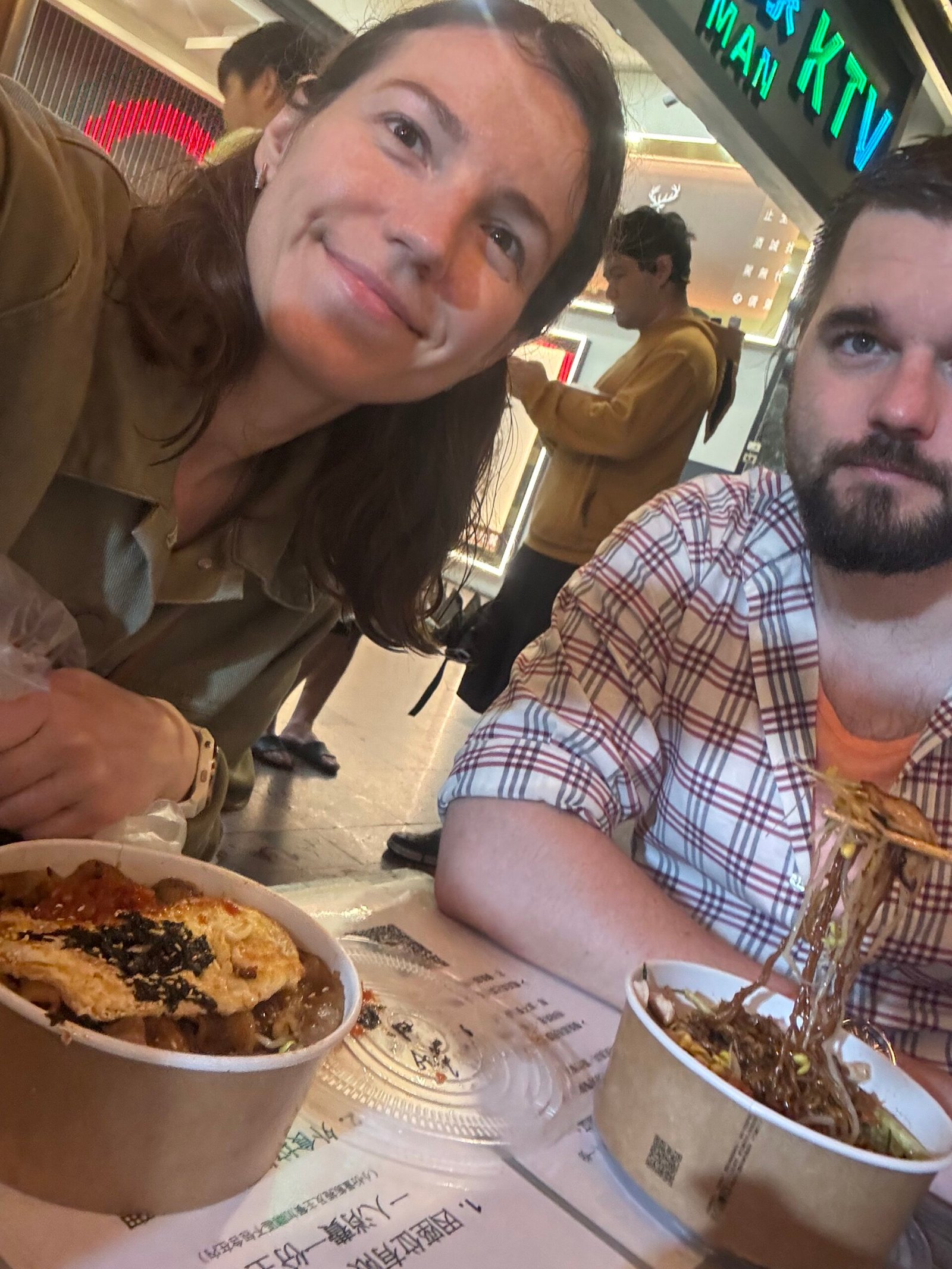
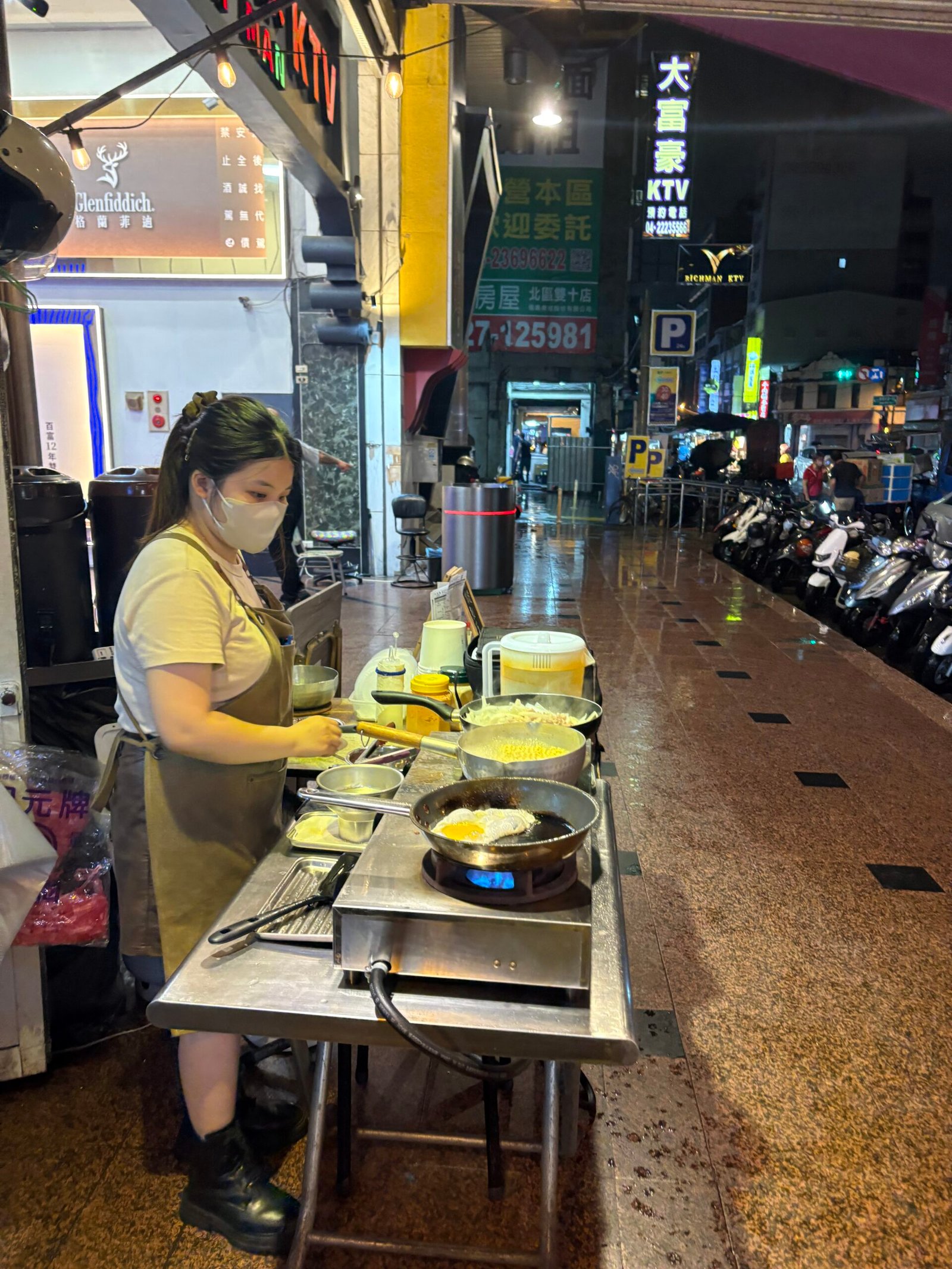
But despite rain pouring down like somebody has opened a bucket above the city, enough vendors are still frying dumplings, boiling eggs and grilling squid that at least we know we won’t starve. We eat very tasty chicken noodles from a woman who is practically the same height standing up as I am sitting on a stool. To be fair, it’s not like I’m Porziņģis either. It isn’t particularly late yet, but fatigue has somehow built up again. Time to slowly head towards the hotel and become horizontal.
SUN MOON LAKE
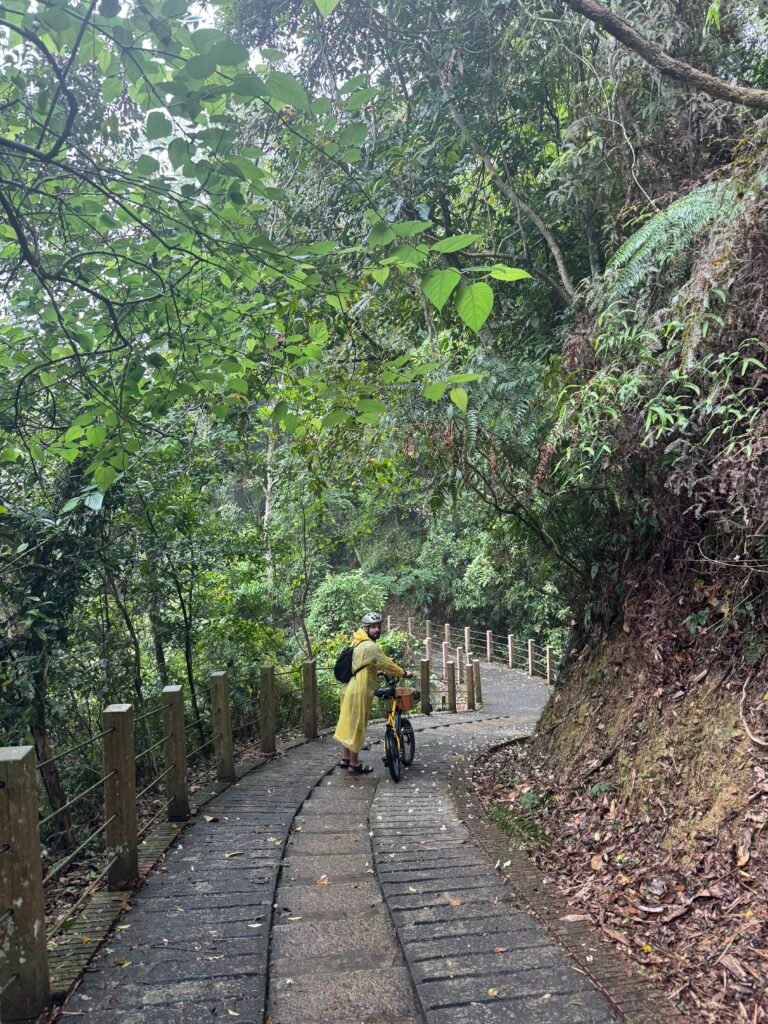
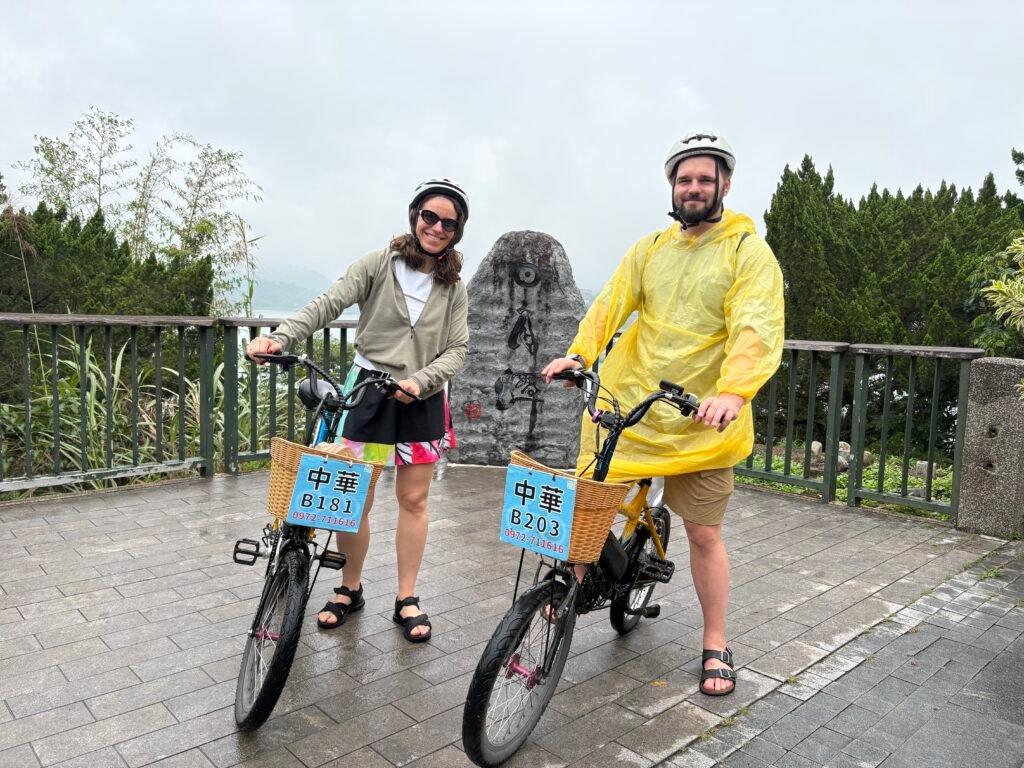
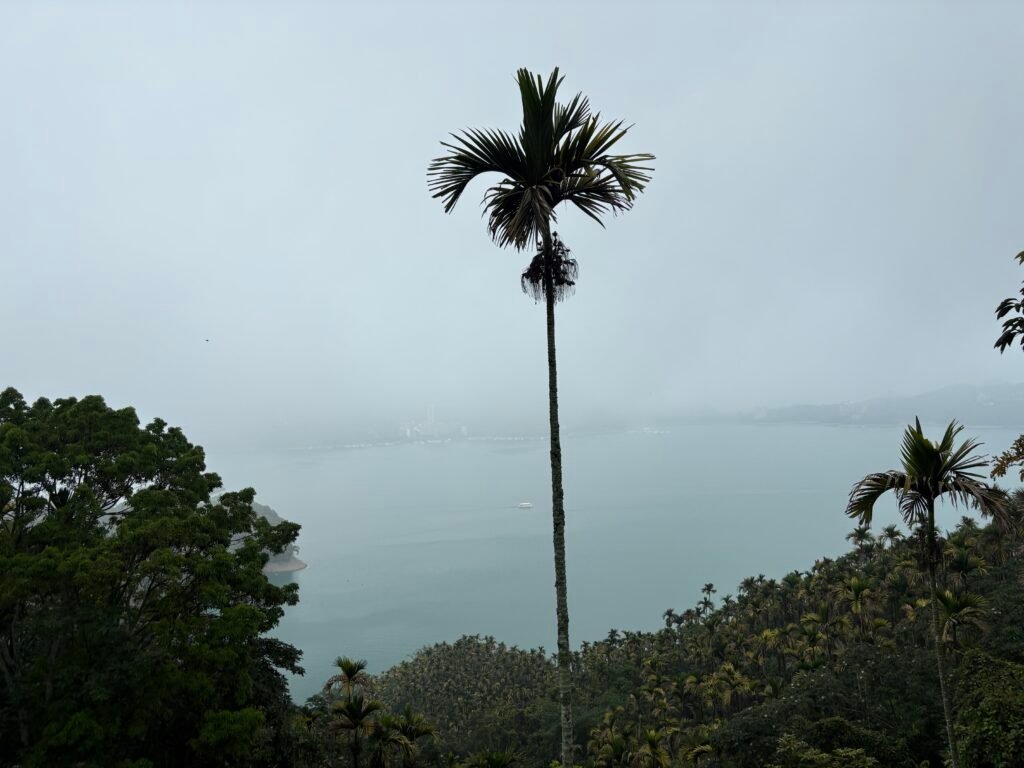
30.04.2026: It’s around an hour from Taichung to today’s destination – Sun Moon Lake in the Yuchi area. As soon as we leave Taichung, we’re once again winding along narrow and steep mountain roads. As we approach the lake, it becomes very clear that hoping for the sunny, dry cycling trip we had planned is slightly optimistic. Everything is already wet and it’s still raining.
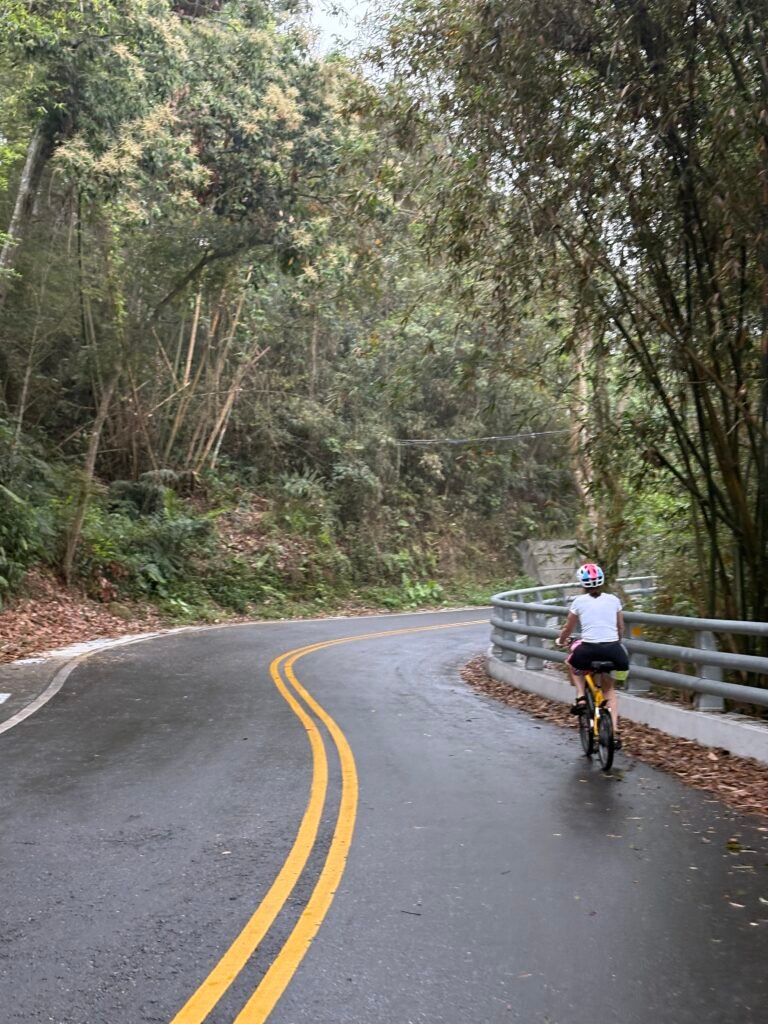
Despite that, we decide we’re cycling anyway because apparently CNN once called this one of the most beautiful cycling routes in the world. It’s also worth mentioning that there really isn’t much else to do in the tiny village of Riyue besides a small market street. Okay, there’s also a gondola up the mountain. But when everything is cloudy and foggy, that has limited value too.
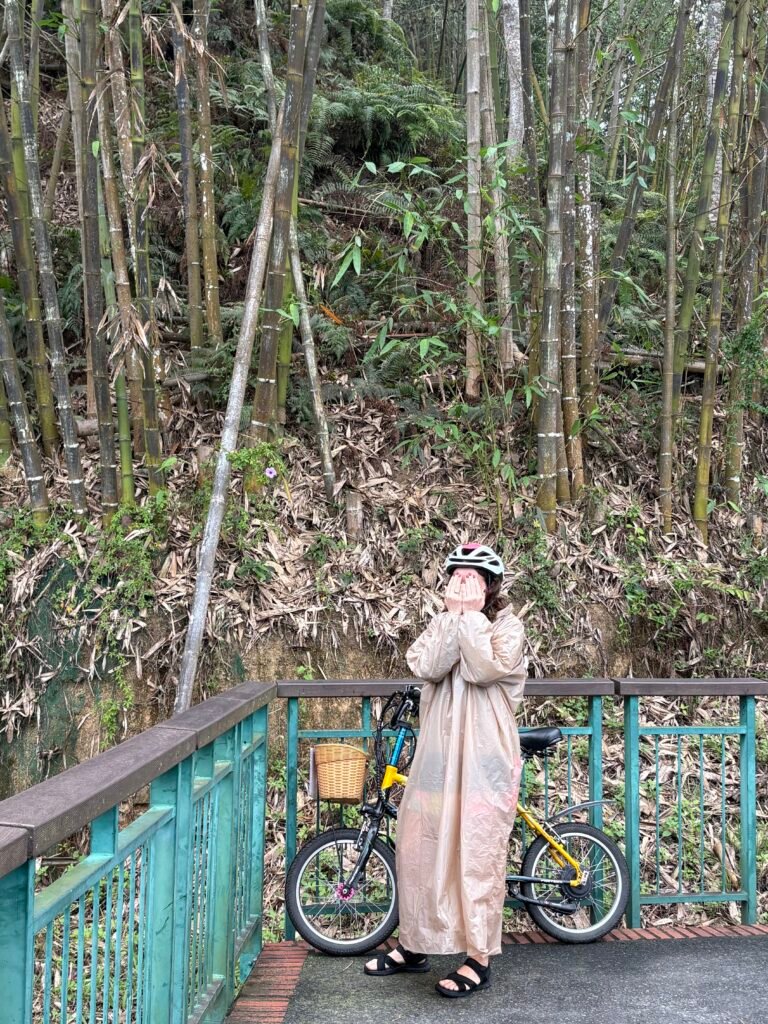
Because of the bad weather, we rent basic electric bikes instead of normal bicycles. There are plenty of climbs expected as well. If we’re going to be wet, at least we don’t need to suffer while pedalling uphill. They also give us helmets. Completely enormous helmets. I have no idea what sort of pumpkin you’d need instead of a head for these to fit properly. After a while, we take them off because they’re not really performing their intended function anyway. I have to admit the little e-bike climbs surprisingly easily. I expected to have to contribute more effort myself.
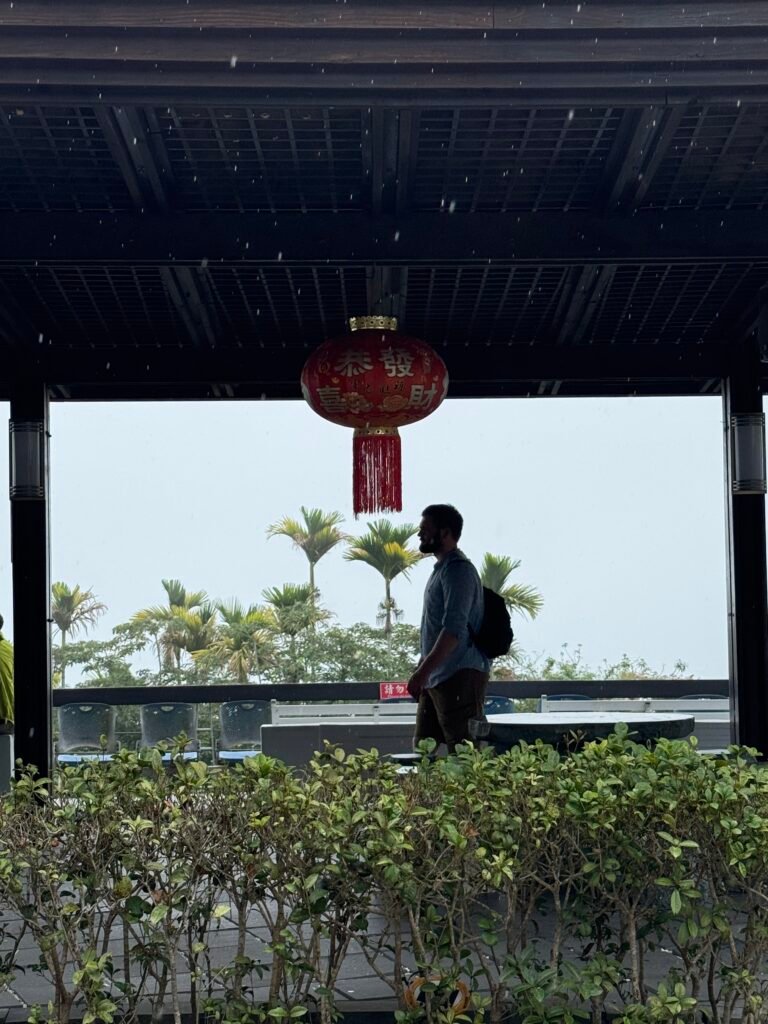
Every now and then we stop at viewpoints, but usually don’t stay very long because visibility is poor. We can only imagine what it might look like in clear weather. At one temple, we stop for tea hoping the rain might calm down. Nope. We continue.
This lake is apparently a very special place for Taiwanese people. Sun Moon Lake is one of the most iconic locations in the entire country, and almost every Taiwanese person has supposedly visited it at least once. It’s also the largest natural lake area in Taiwan. The name comes from its shape: the eastern side supposedly resembles the sun and the western side a crescent moon.
I try finding either of those shapes on Google Maps. Can’t see a sun or a moon. But fine.
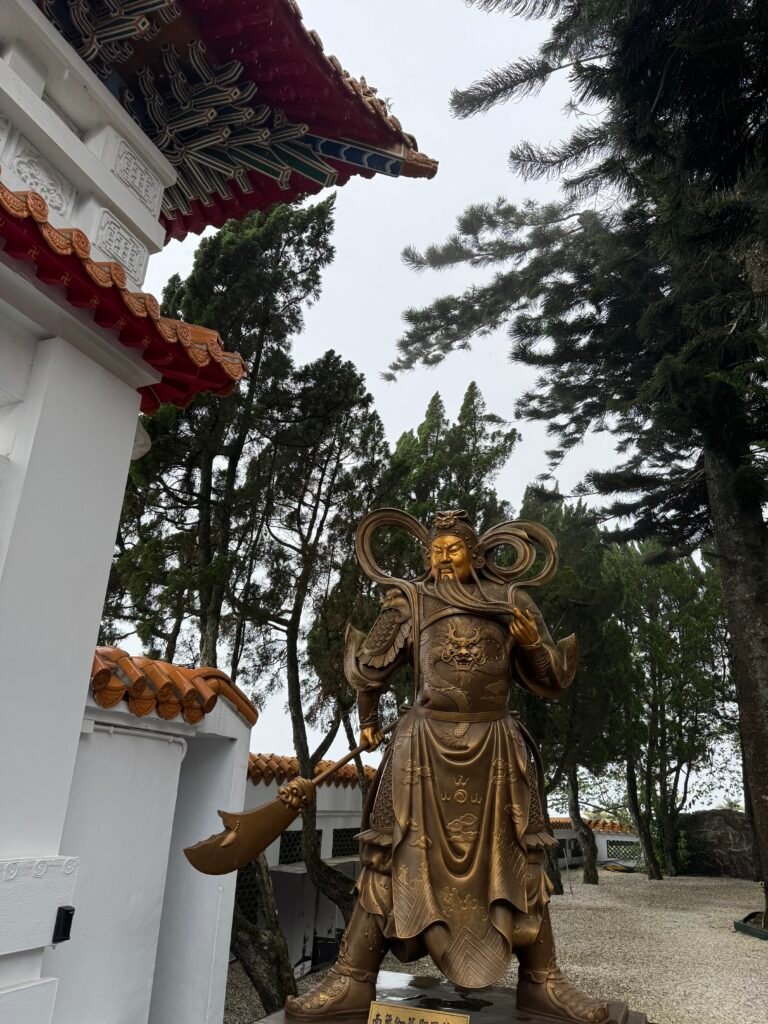
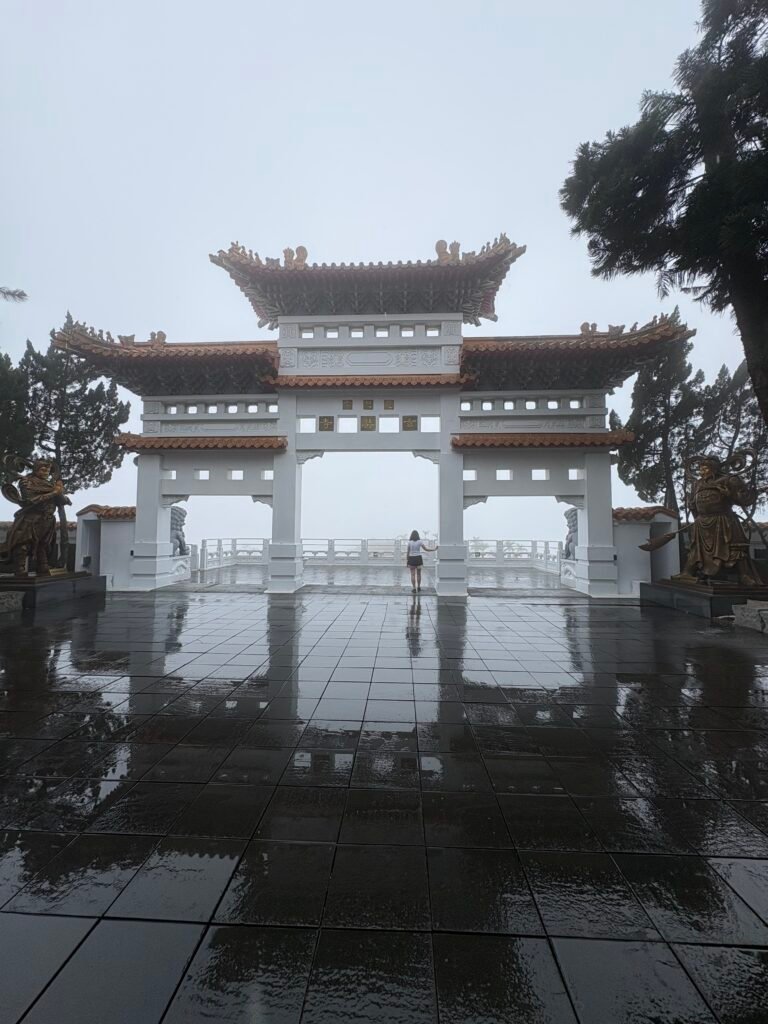
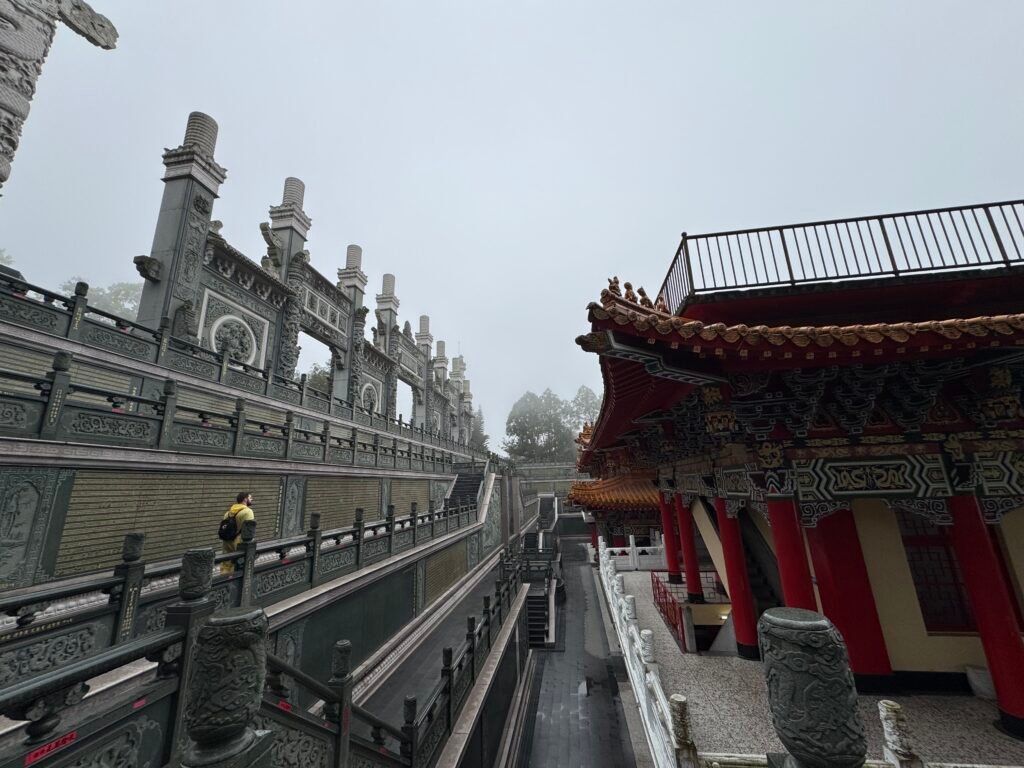
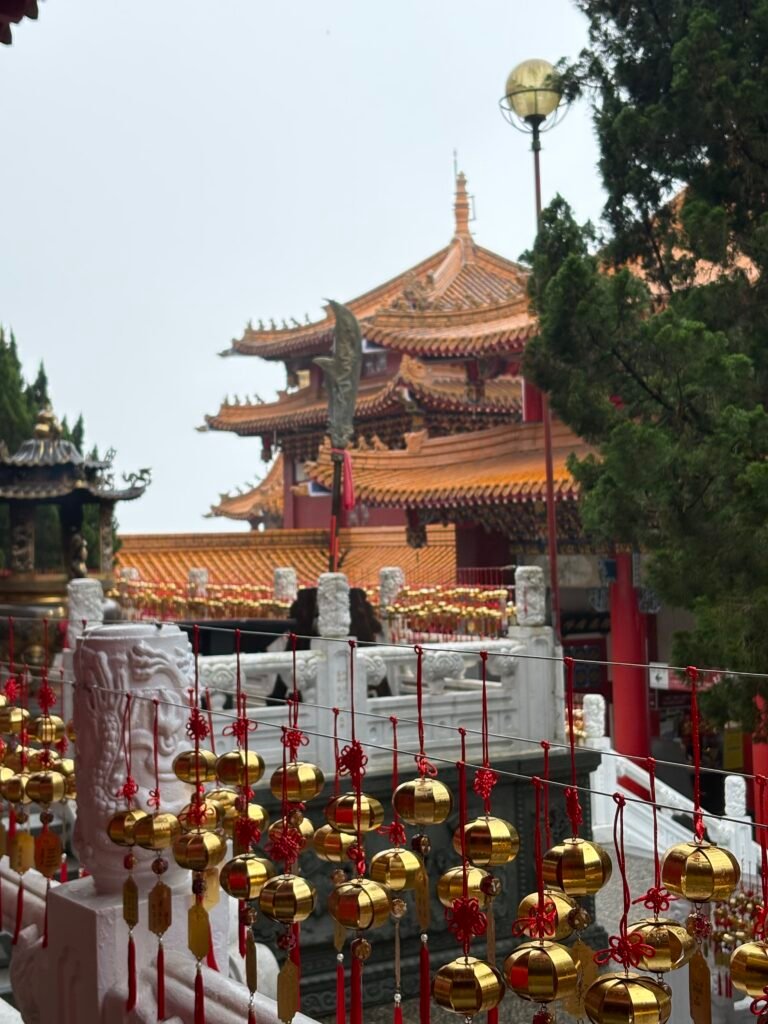
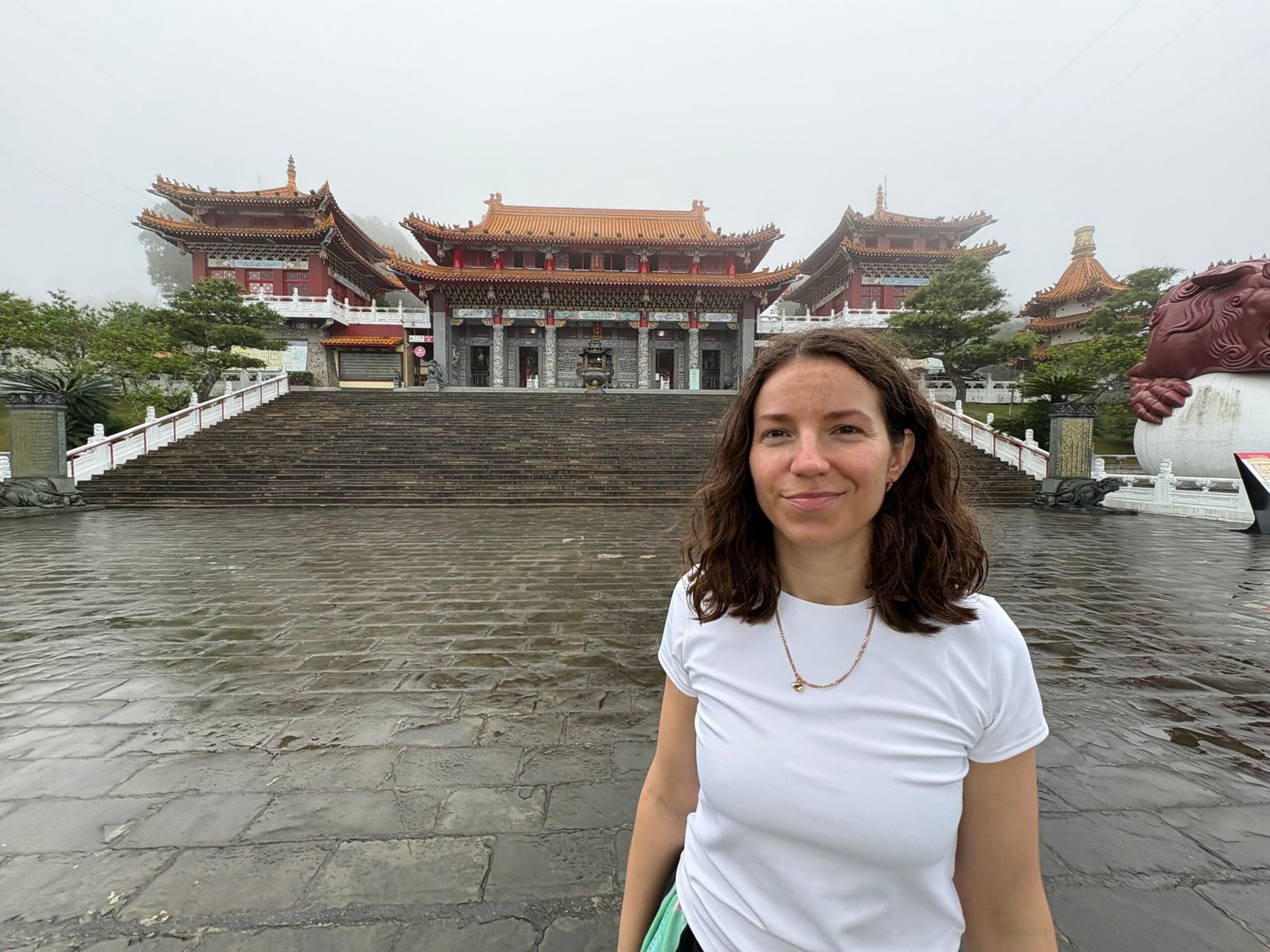
I’ll believe them. Our longest stop is at Wenwu Temple. Now this is impressive!
Once again, I can repeat myself about the almost artwork-level detail of every single element.
Two enormous lions guard the temple, with a proud staircase rising between them towards the entrance. The temple itself sits high on the hillside and, on a clear day, apparently overlooks the entire lake. Today we stick to admiring the temple itself. It’s divided into three levels, each progressively higher up the mountain. The name “Wenwu” means “civil and military”, symbolising the balance between wisdom and strength. Confucius is honoured here as a symbol of wisdom, while Guan Yu represents loyalty, war and honour. To reach the highest third section of the temple, you have to climb 366 steps, symbolising every day of the year. Why 366?
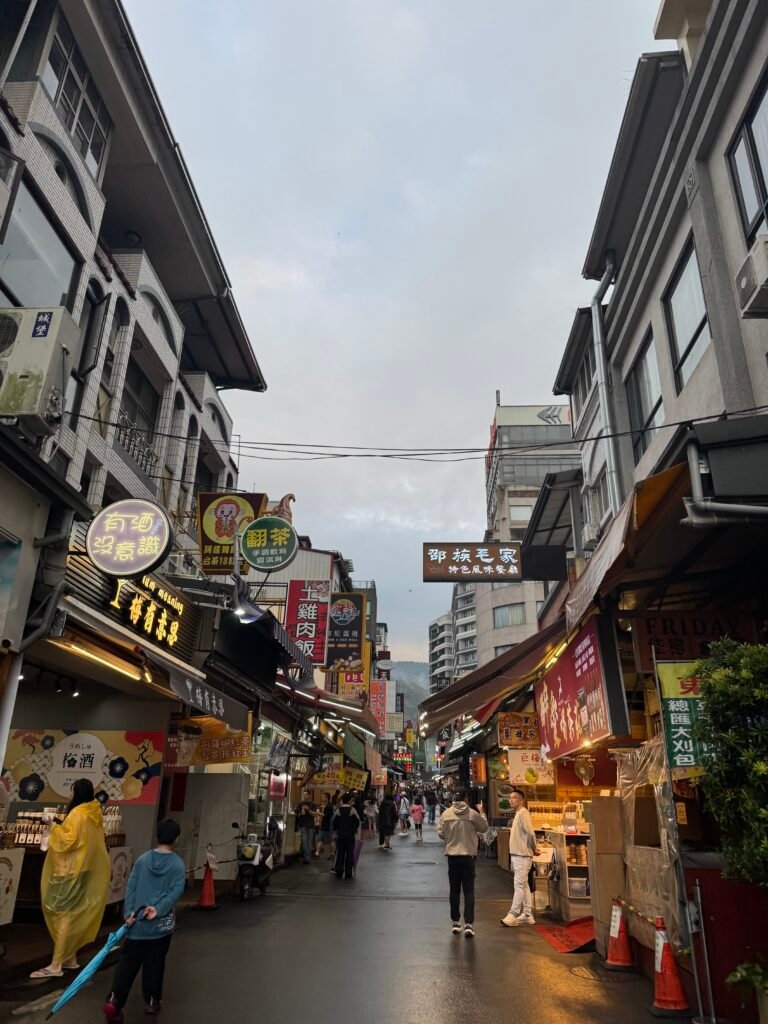
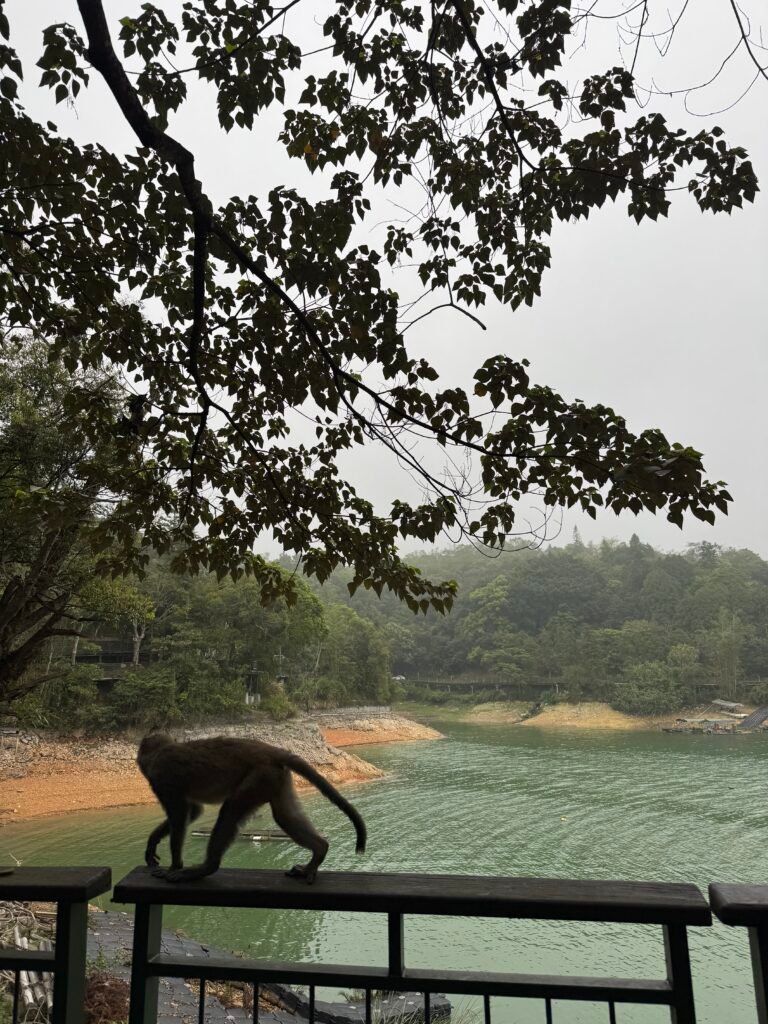
Because they’ve even included the occasional 29th of February. Locals apparently like finding the step corresponding to their birthday and hanging wind chimes or prayers there. Since we’re practically the only visitors today, we don’t witness that particular entertainment. As our cycling loop approaches its end, we meet a few macaques beside the lake. They also seem slightly annoyed by the weather and try stealing whatever they can grab from the bikes. We don’t spend too much time negotiating and pedal onwards. After 35 km, we head to the hotel to wash off the mud and rest before going out to find dinner. The constant rain is probably to blame, but the streets remain fairly empty even in the evening. That doesn’t stop the food vendors from operating. At one little café, we eat beef with rice and noodles with pork and tofu.
This time even the tofu doesn’t smell like it usually does. A tasty and filling dinner for both of us costs less than €7. We’d like to visit a local bar, but there simply don’t seem to be any – at least none that are open tonight. It’s also too early to go back to the hotel. Eventually we end up in a karaoke bar where we’re the only customers besides the owner and her four cats. We have one drink each and eventually return to the hotel because nobody else ever arrives. Before leaving, I successfully step in one of the cats’ piles of poo. Fortunately, I’ve worn the sole of my sandal so smooth that the poo doesn’t really have anywhere to grip. Situation fairly easy to resolve.
ALISHAN
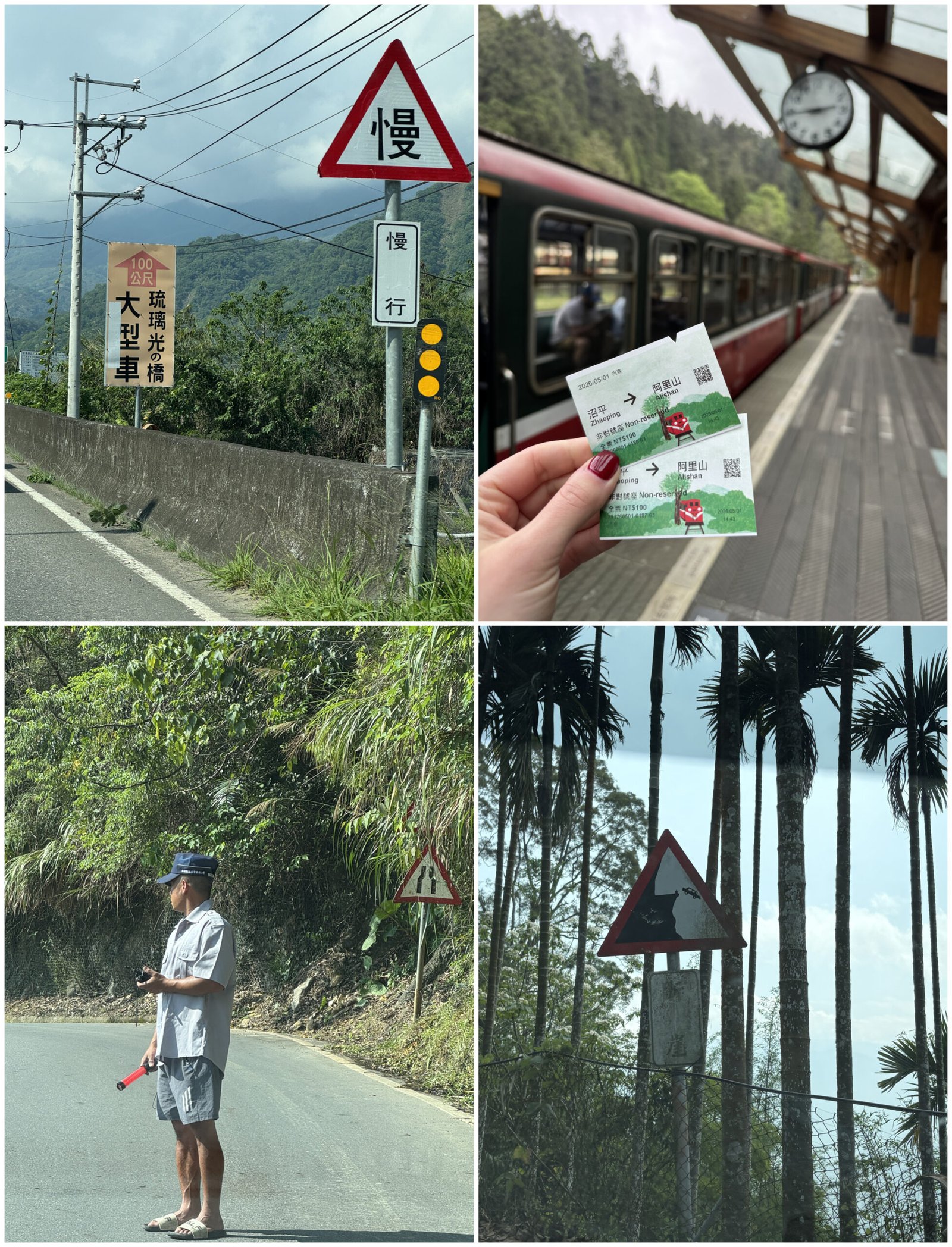
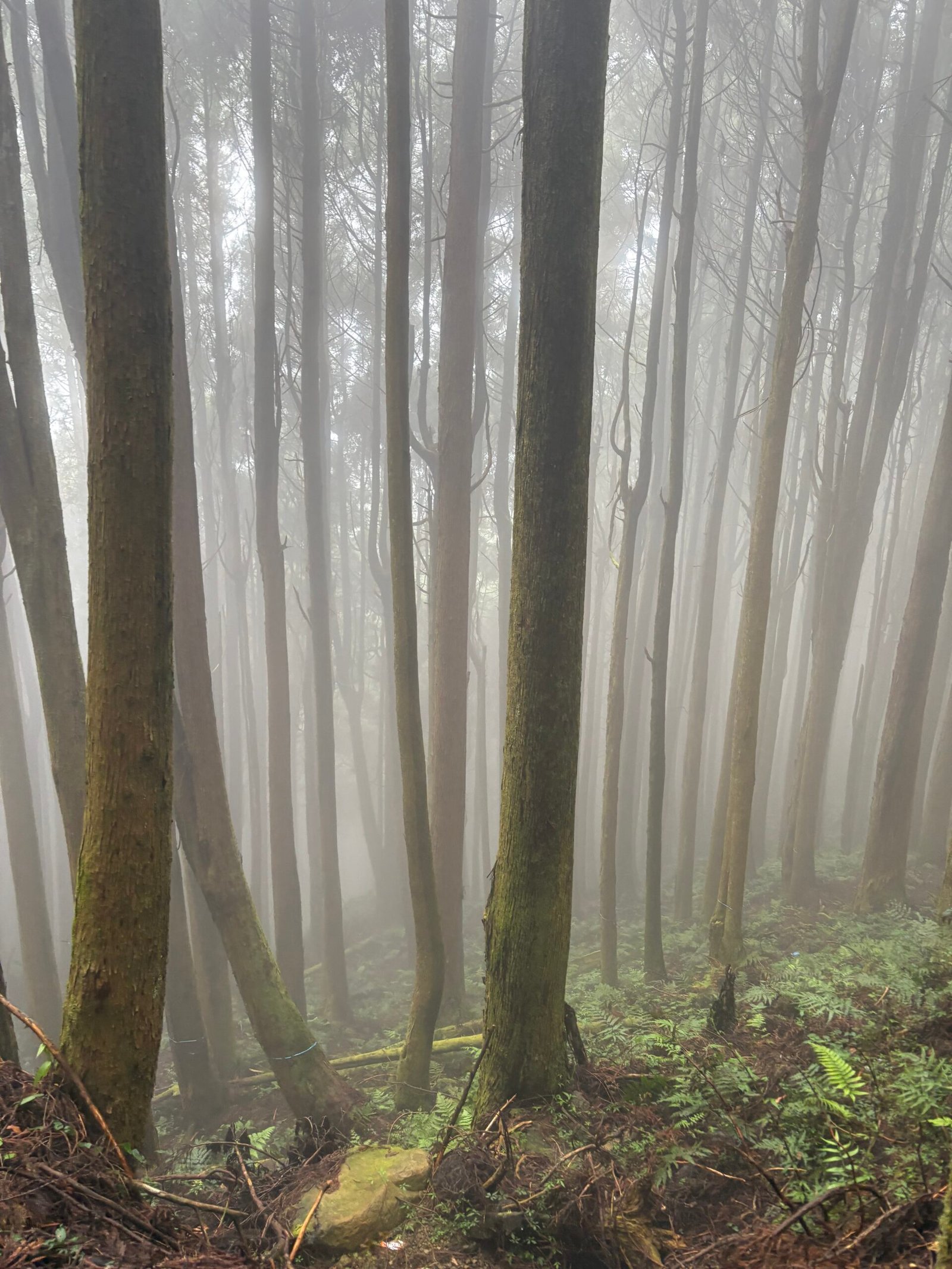
01.05.2026: Today is going to be fairly intense, so we’re already behind the wheel at eight. The weather is noticeably better than yesterday. At breakfast we even manage to see what Sun Moon Lake actually looks like. The drive from Dehua village (德化社) to Alishan National Scenic Area takes around three hours. Not because the distance is huge, but because of the narrow mountain serpentines. Along the way, we pass loads of cyclists grinding away on their pedals trying to climb the mountains. Even our Yaris is struggling slightly, but we still manage to complete the task a little faster than the cyclists. Even on these roads in the middle of nowhere, the Taiwanese have installed large mirrors at practically every sharp corner so drivers can see approaching traffic. It genuinely makes navigating these extremely tight bends safer and faster. Once we reach around 2,000 metres above sea level, we enter Alishan’s famous thick fog. So thick that the white van driving in front of us completely disappears from view. Can’t really complain though.
Apparently this region gets heavy fog on average 265 days per year.
The name Ali-shan literally means “Ali Mountain”, although the region actually consists of an entire mountain range rather than a single peak. Once inside the park, we see roadsides completely full of parked cars. Finding a spot for ourselves looks pretty hopeless. Today is also a national holiday in Taiwan. A mild feeling of despair appears. We drive slightly in the opposite direction and find a larger area intended for buses. A few normal cars are parked there too.
We decide: whatever. If there’s a fine, there’s a fine. Better to park here and enter the park than waste valuable time searching for an impossible parking space or leave the car five kilometres away. May holiday problems. We miss the park’s little historic red train by four minutes.
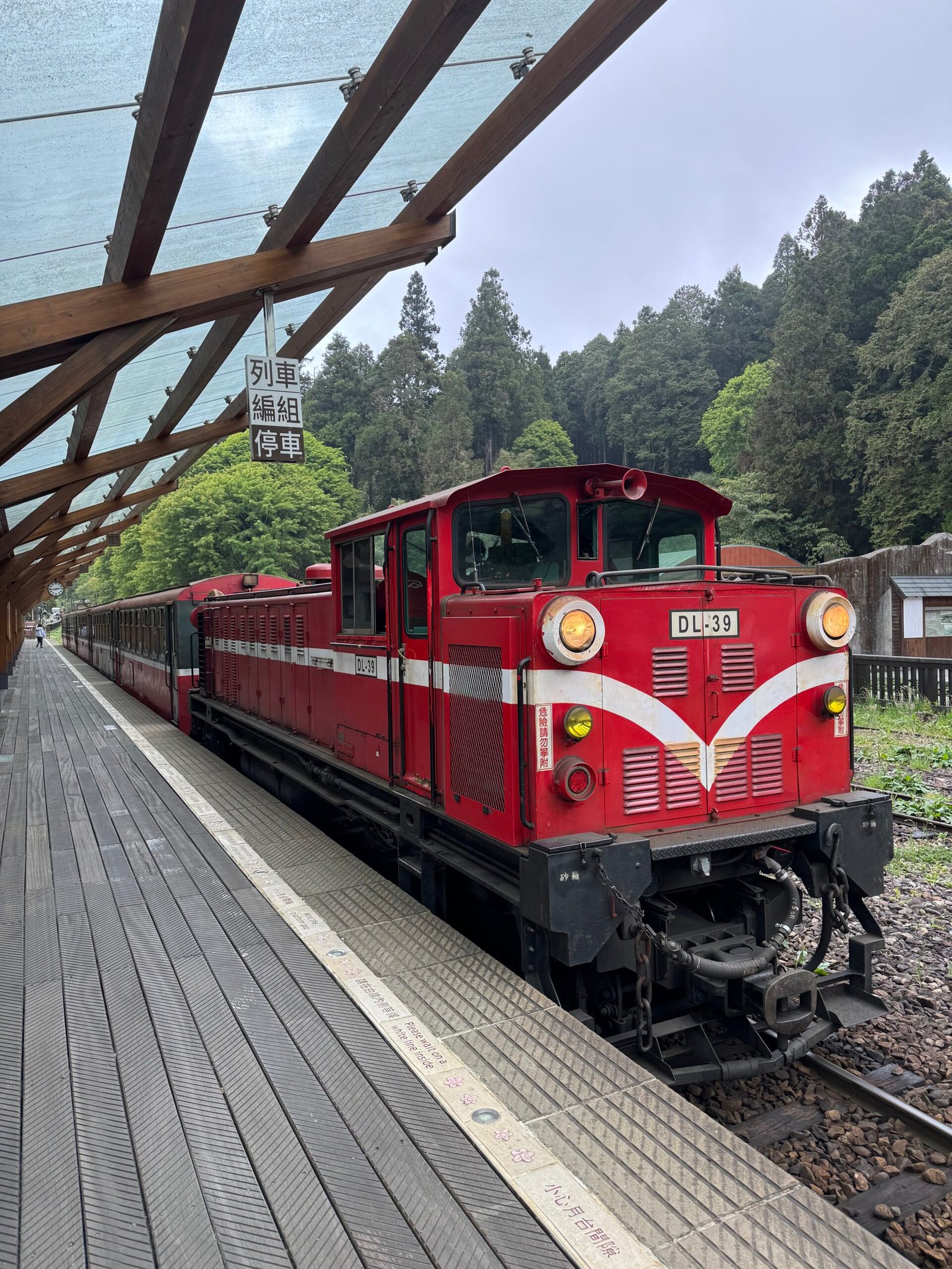
No big tragedy. We’ll walk there and take the train back. The Alishan Forest Railway wasn’t originally created for tourists at all. It was built by the Japanese colonial administration in the early 20th century to transport valuable cypress timber out of the mountains.
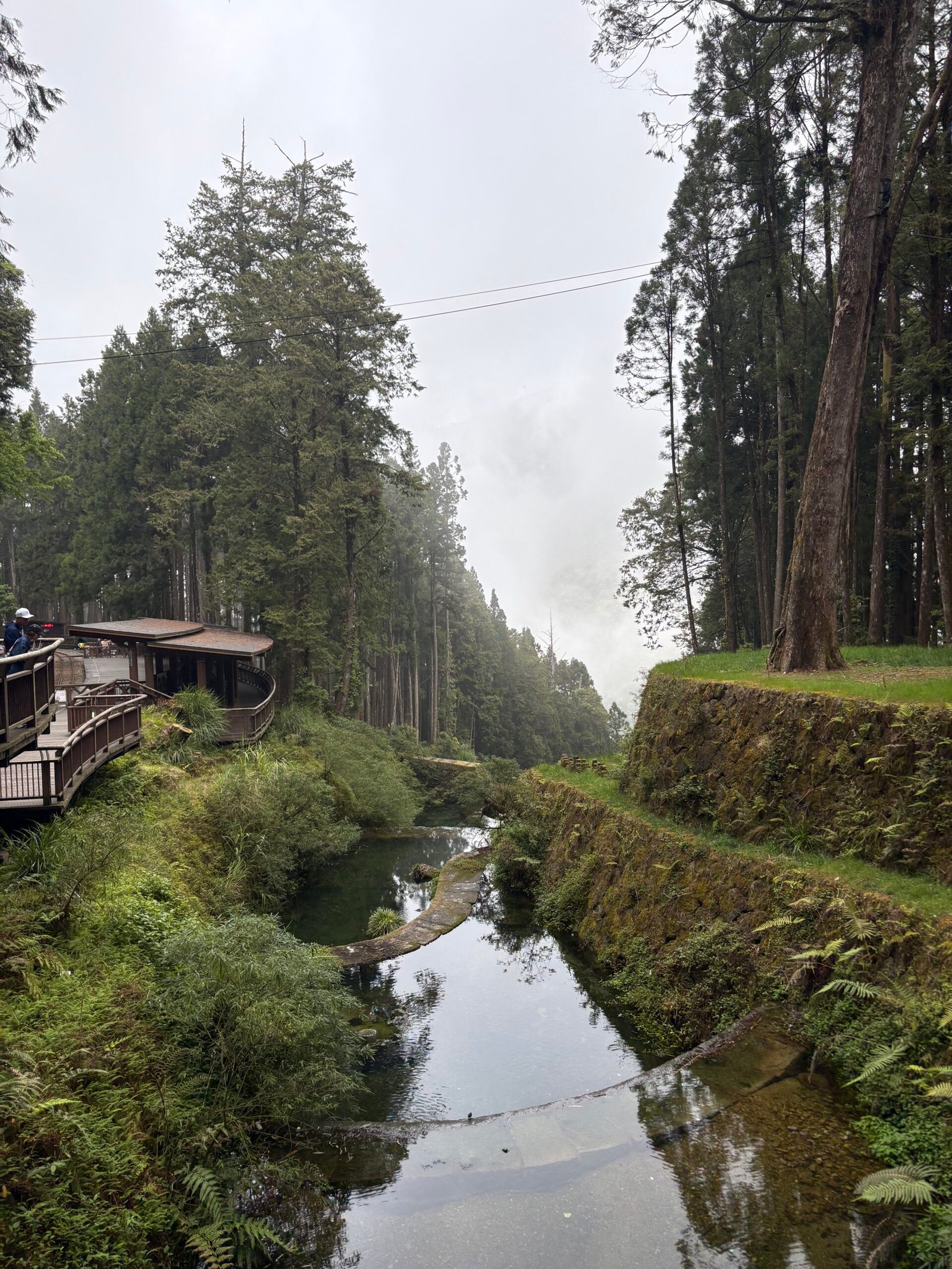
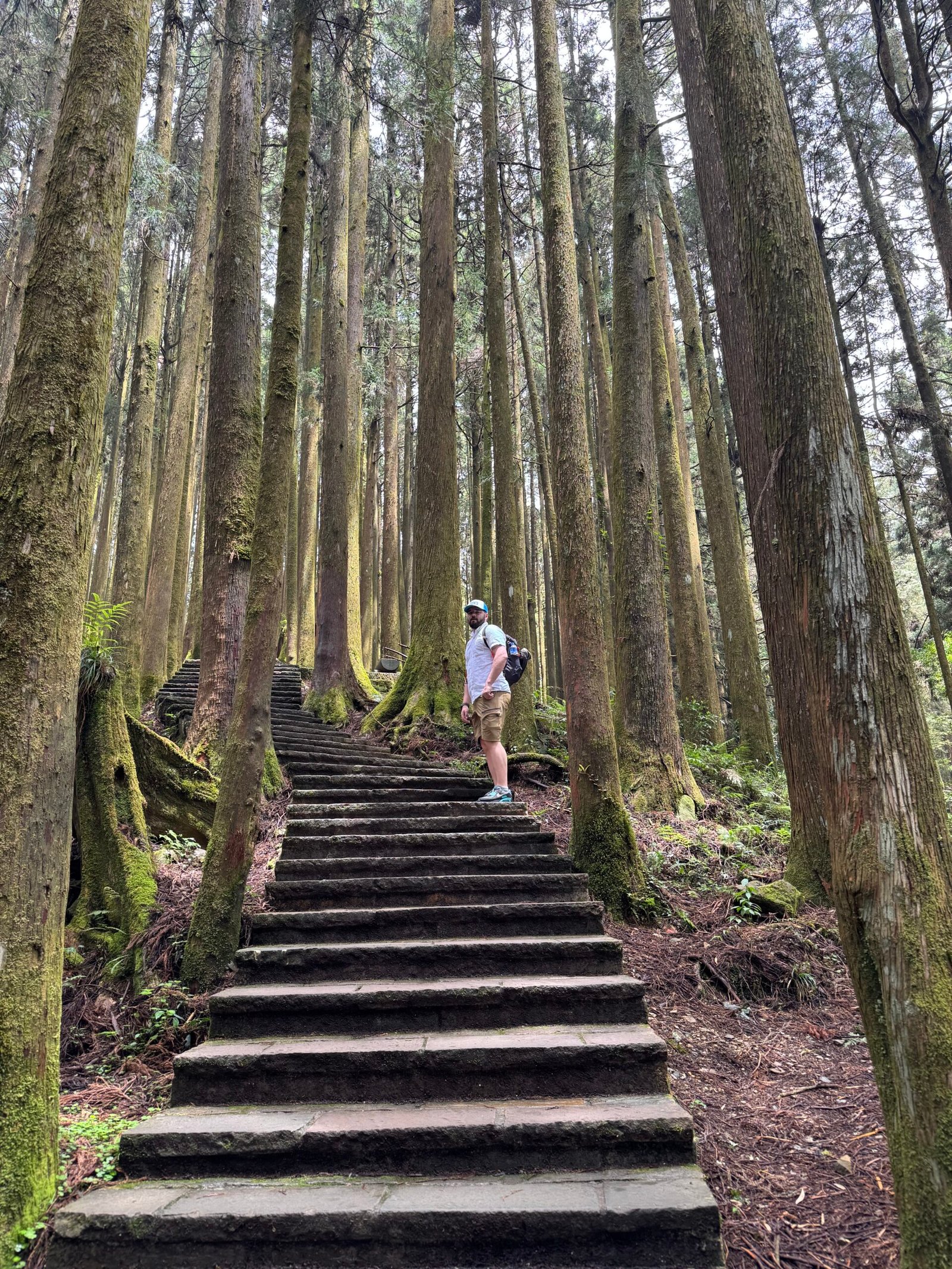
Today, it’s one of the most famous mountain railways in Asia. We buy some snacks because there’s going to be plenty of walking today. The route initially climbs gently uphill for quite a long stretch. We immediately start breathing like we’ve just run a cross-country race. Apparently 2.2 km above sea level does have an effect on people from sea-level countries. Maybe continuing to walk while simultaneously eliminating the rice snacks we just bought wasn’t the smartest idea either. Our first stop is the Two Sisters Ponds, around 1.5 hours away on foot. Two small lakes.
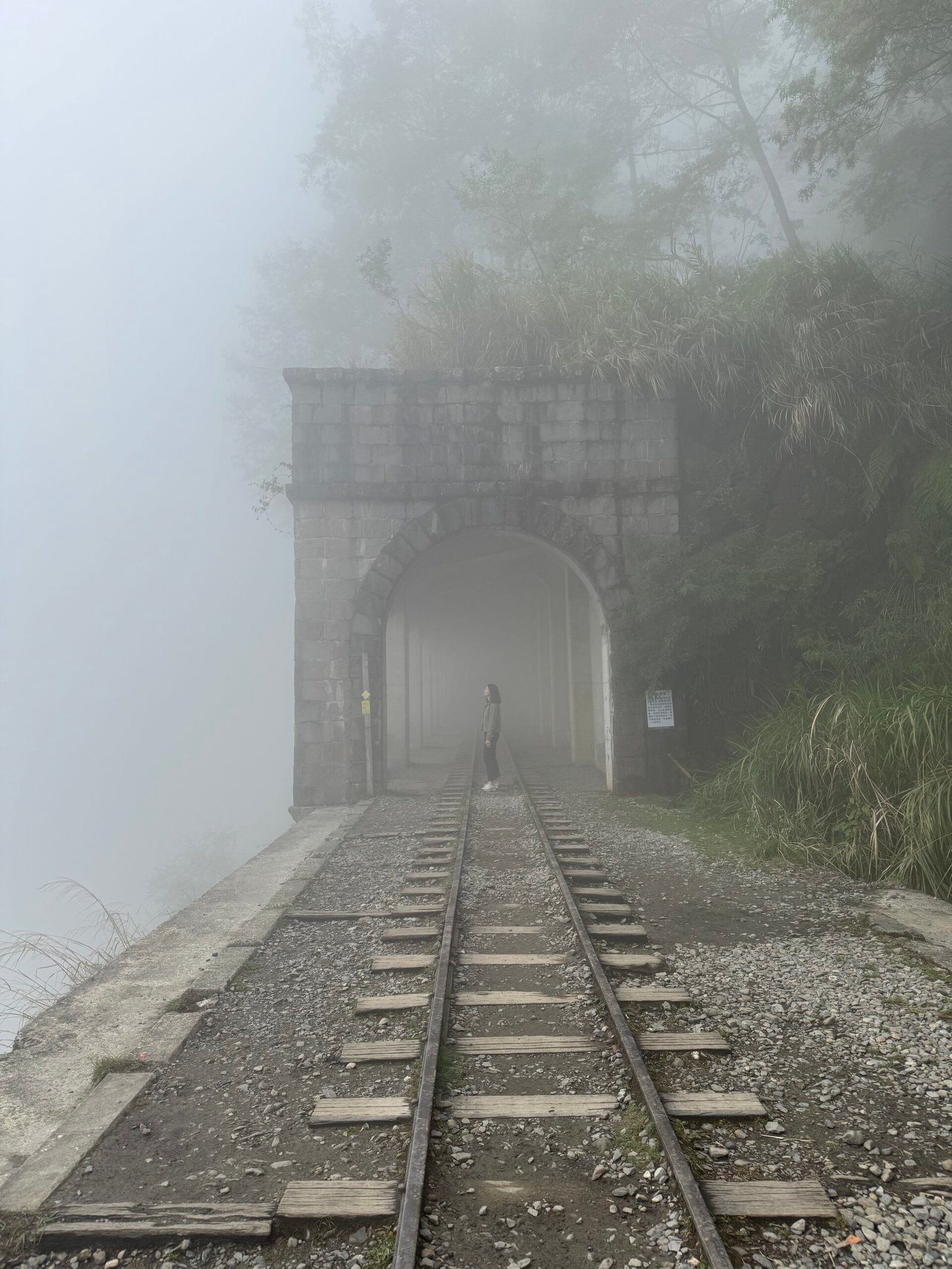
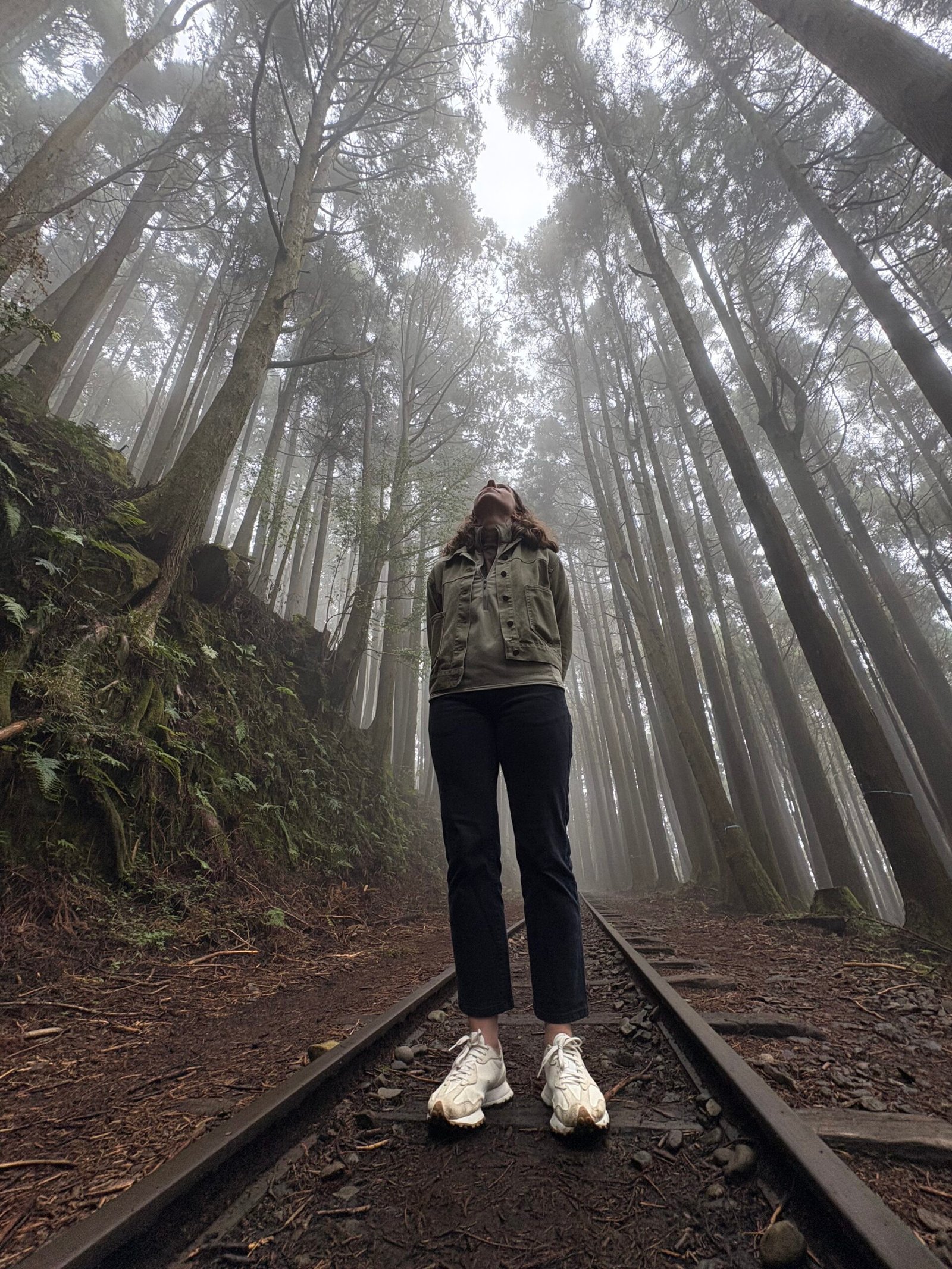
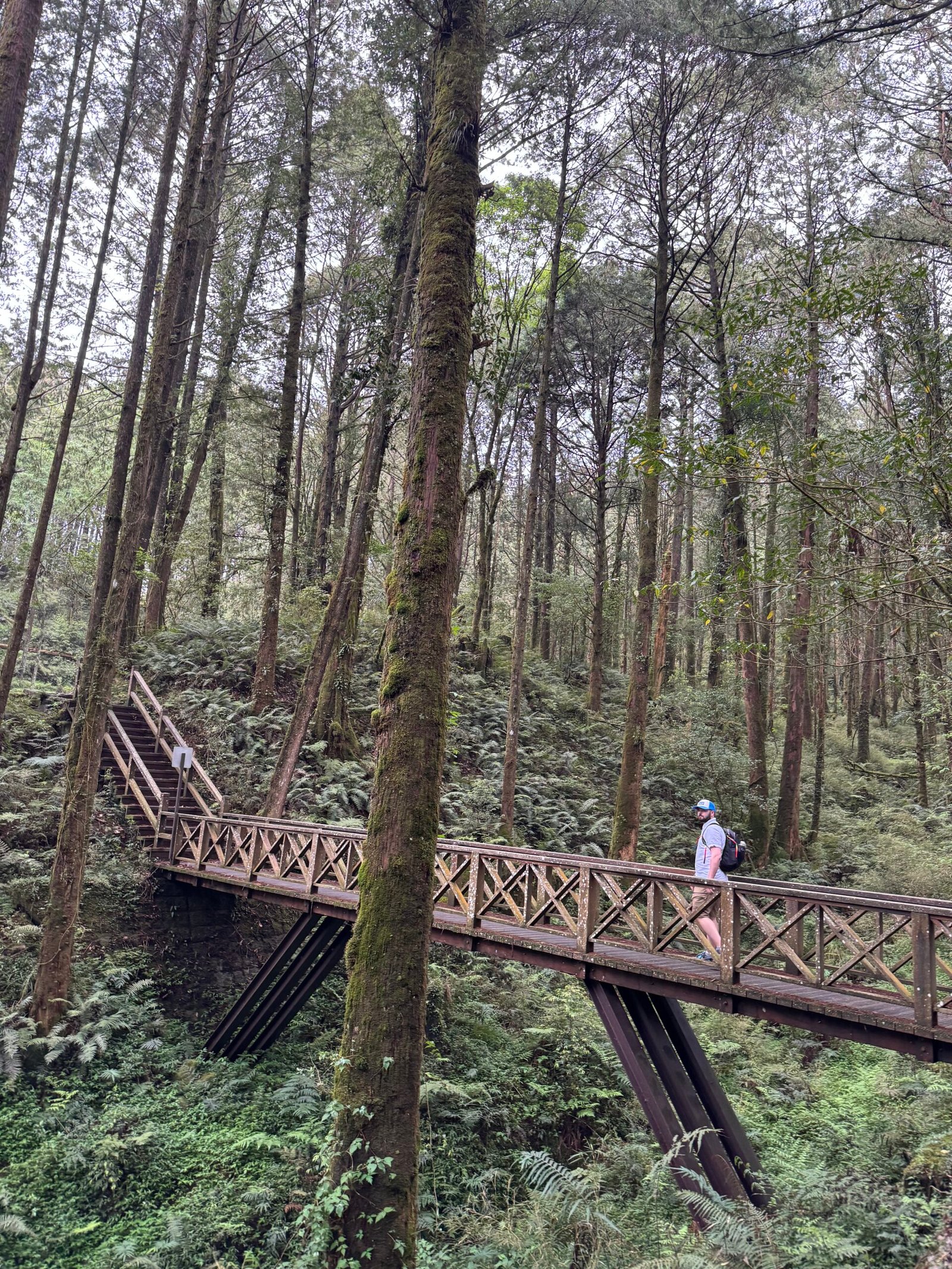
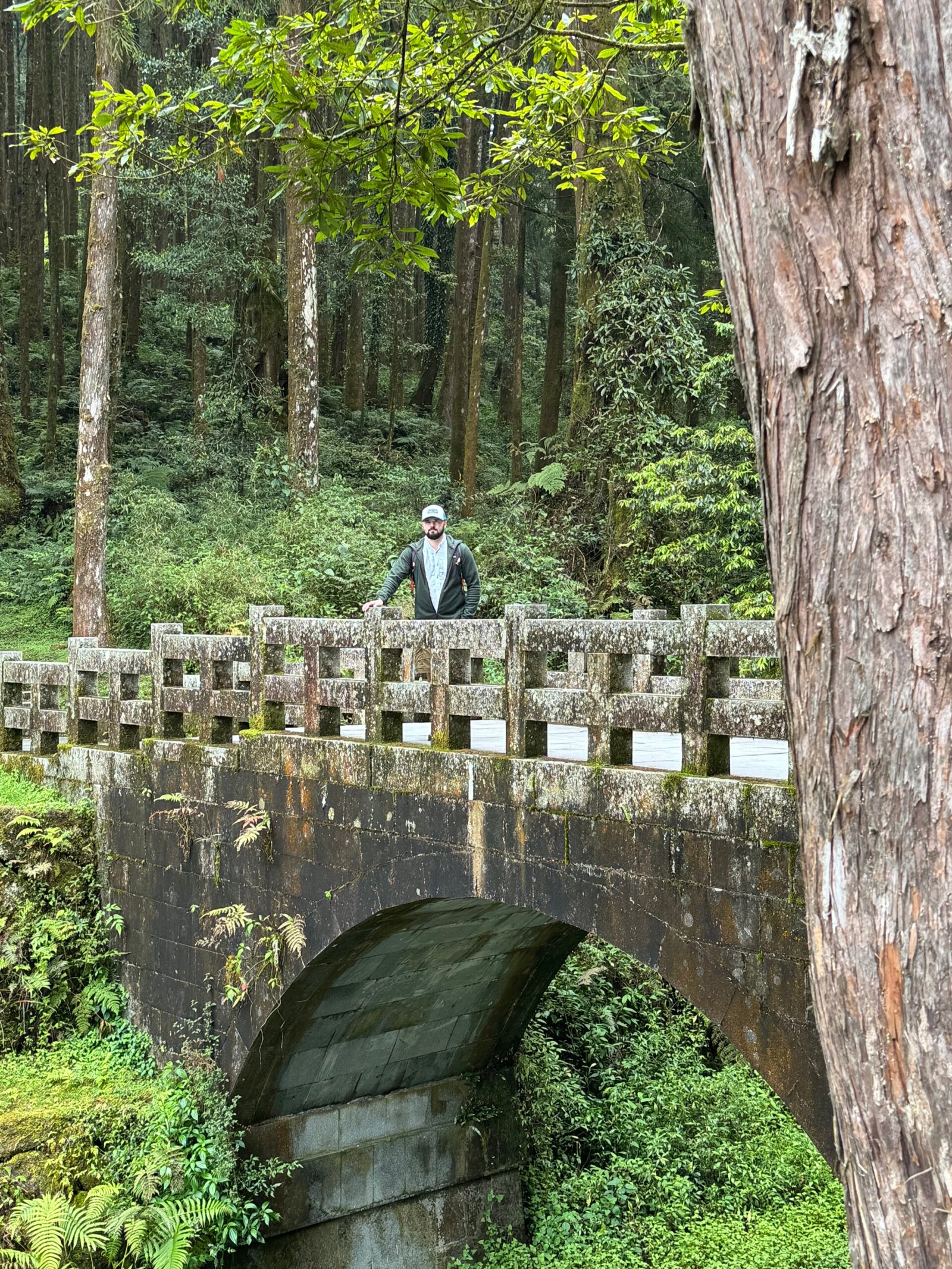
A boardwalk and little pavilion have been built over the larger one – the Elder Sister Pond – where everyone takes photos and enjoys the reflections in the smooth greenish water. The Younger Sister looks more like a small pond than a lake. Some unfamiliar bluish birds have found more entertainment there, constantly picking at something in the shallow water. The furthest point of our hike is an old railway tunnel – Mianyue Line No. 1 Tunnel (眠月線第一明隧道) – which partly collapsed after an earthquake and has since become an attraction. Getting there involves countless stairs going both up and down. Thick fog wraps around the jungle-green trees. Everything looks slightly surreal. Almost like a horror film. The collapsed tunnel sits in a kind of valley with constant airflow, so the fog clouds move ridiculously quickly. One moment you can’t see beyond the end of your nose. Three minutes later, there’s blue sky.
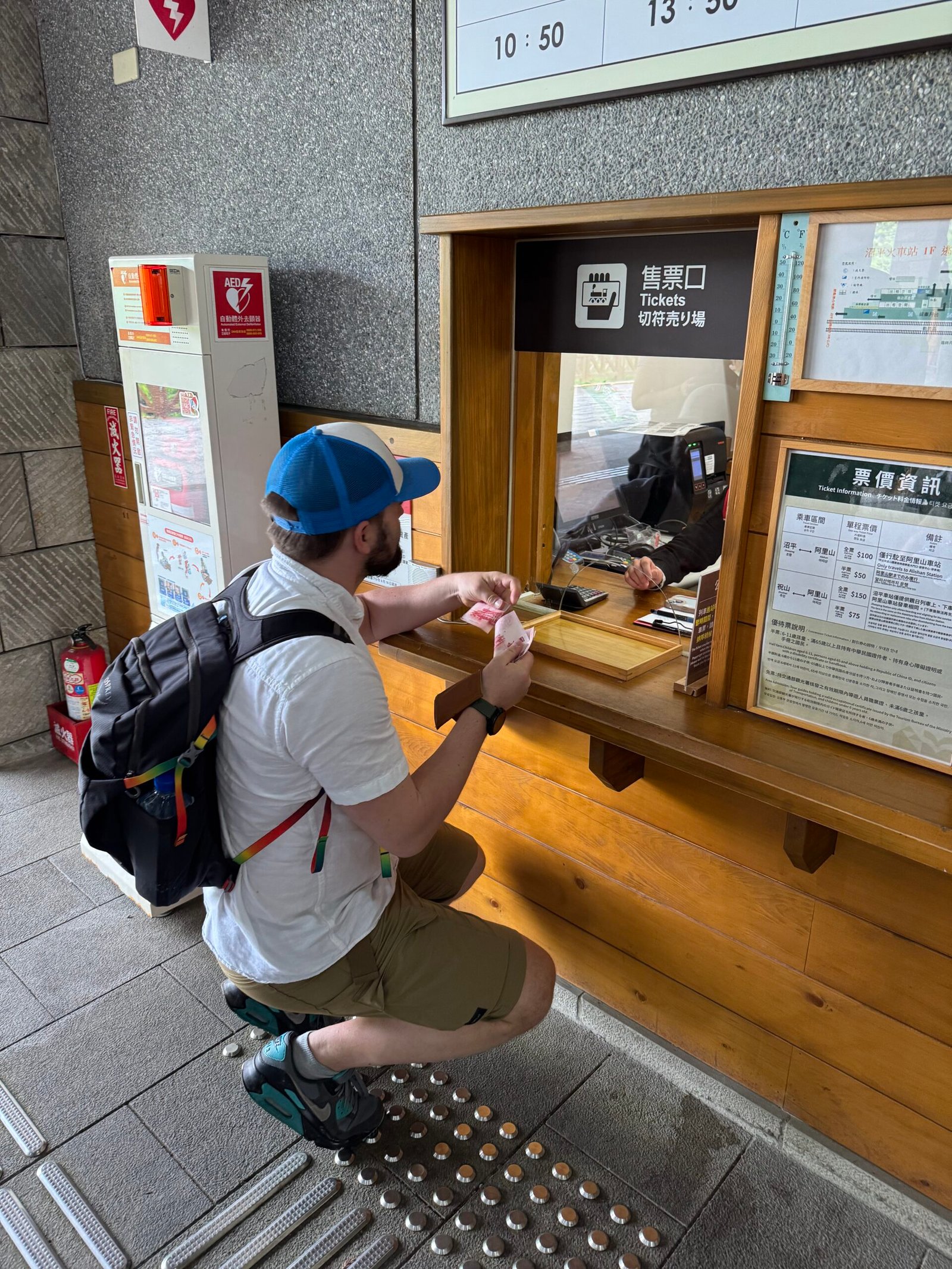
Walk another 200 metres into the forest and you’re back inside fog so thick you feel like you can physically touch the moisture. The effect is amplified by the trees, which are obviously extremely old. Many have accumulated multiple layers of their own little ecosystems. There are apparently cypress trees here up to 2,000 years old. Meaning some of them started growing at a time when most modern European countries didn’t even exist. On the way back, we decide to walk along the railway tracks. Partly to save energy and partly to save time. The official trail follows stairs almost parallel to the tracks. Back at Chaoping Station, we arrive just in time for the train. I buy tickets from a ticket window designed for tiny dwarfs and we climb aboard. Why tiny dwarfs? Because to get my face level with the ticket window I literally have to squat. And it’s not like I’m particularly tall myself… Before continuing towards our accommodation in Xiding, we eat here in Alishan village and refuel the car. Petrol stations aren’t exactly everywhere up here.
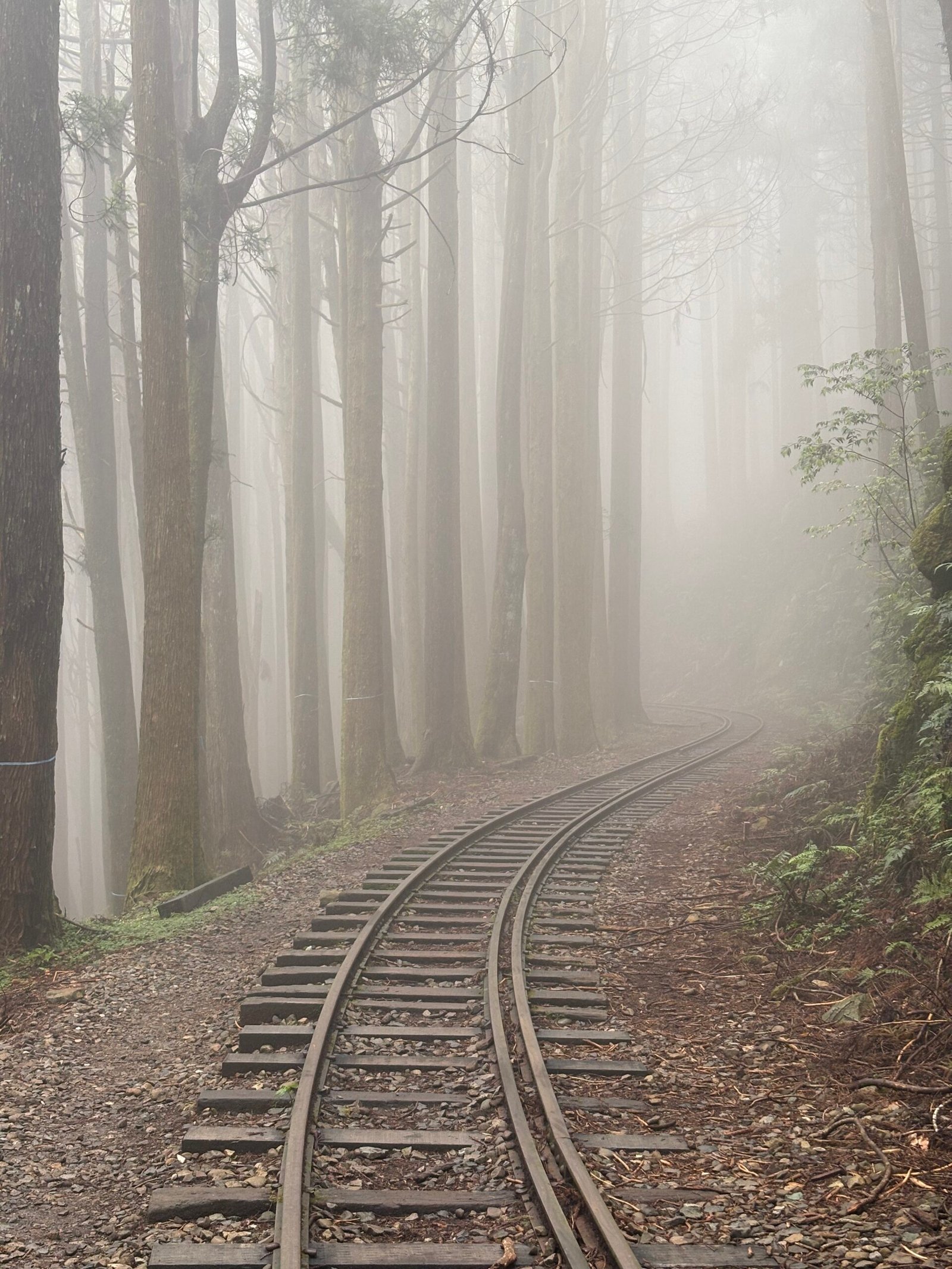
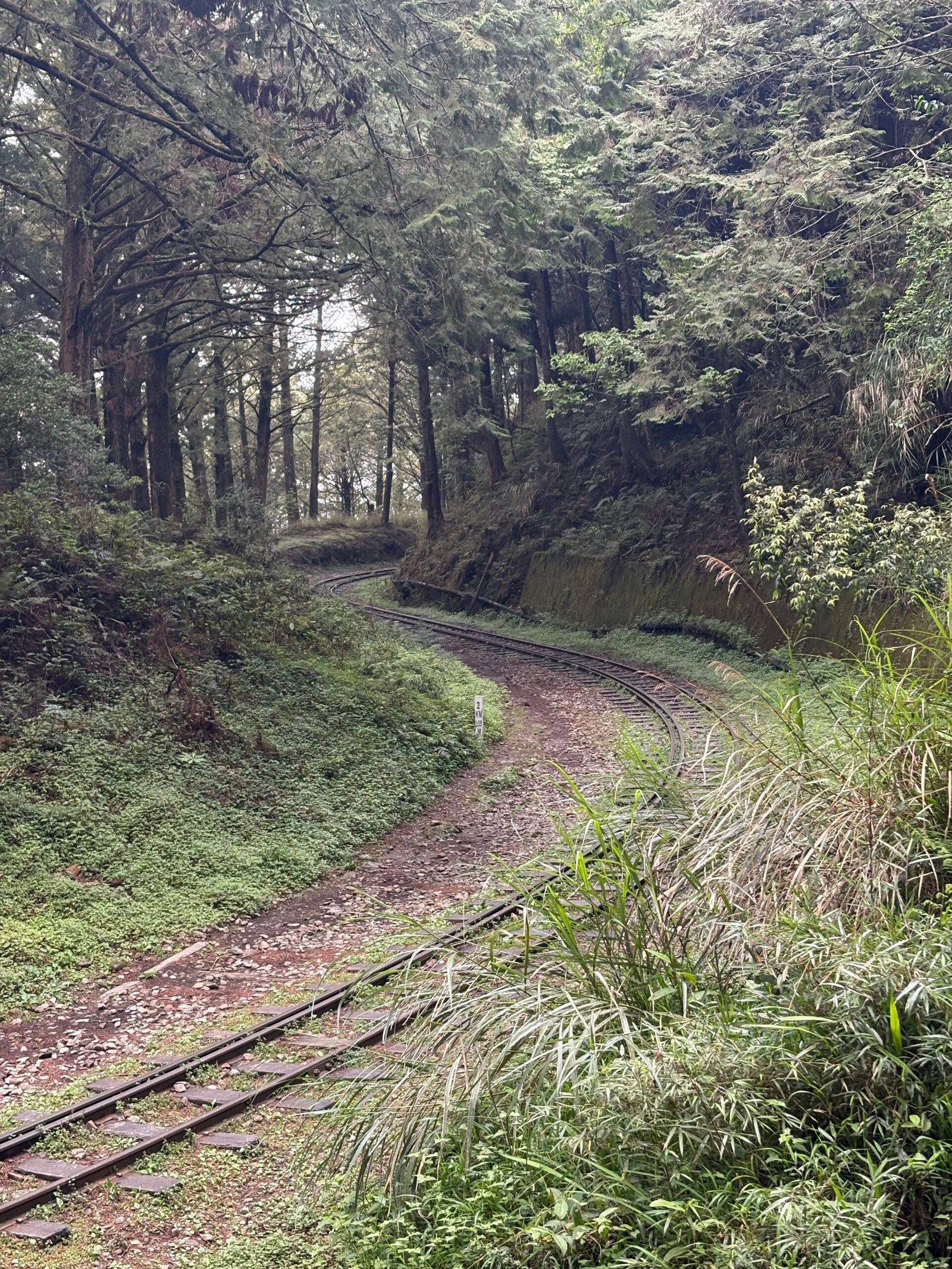
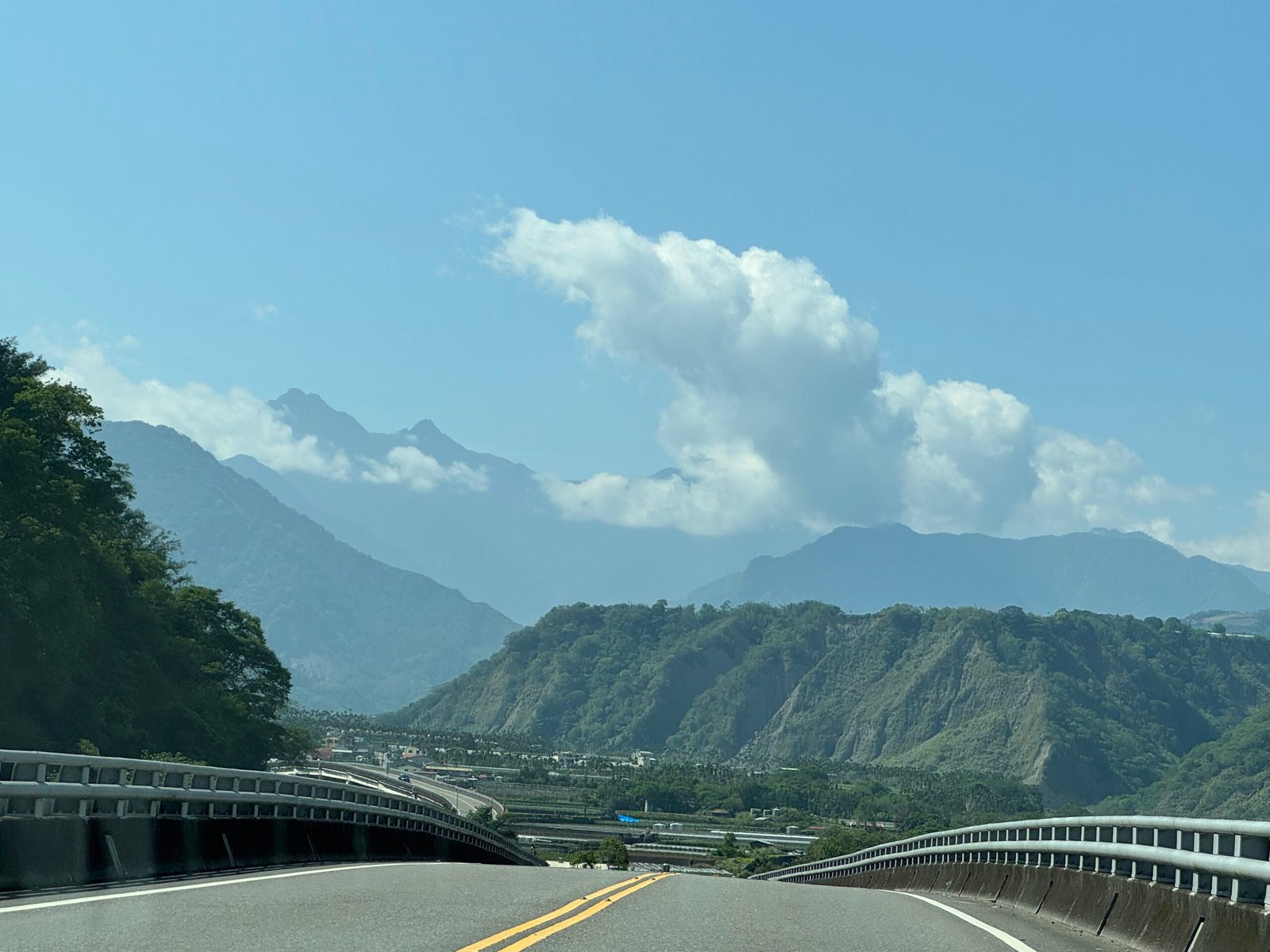
XIDING
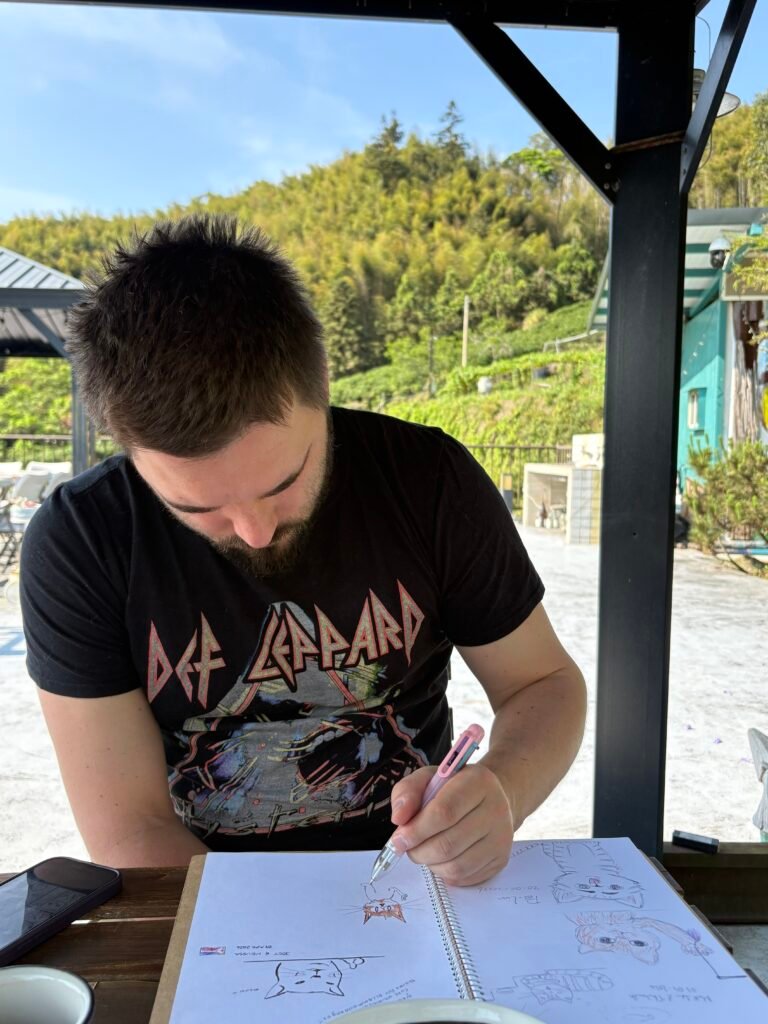
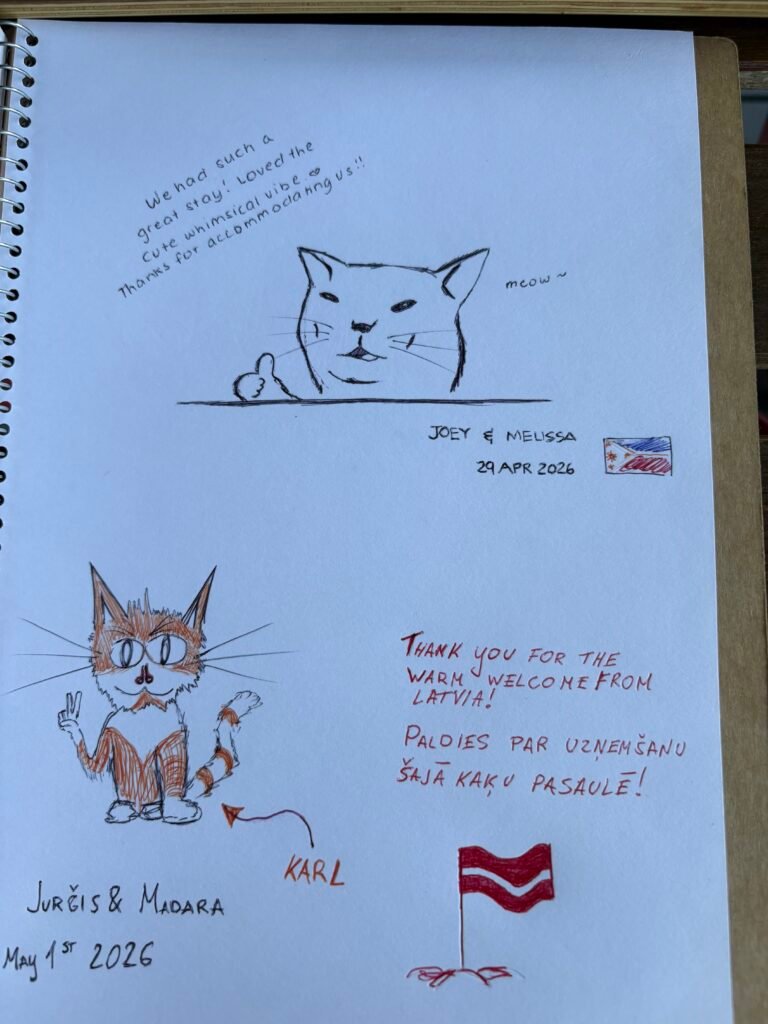
01.05.2026: Tonight’s accommodation is around an hour’s drive from Alishan in a tiny village called Xiding. We manage to arrive while it’s still light. We’re staying at a place called Miao Homestay. At first, I assume “Miao” is some local place name. Turns out it means exactly what it sounds like: “meow”.
The entire hotel is cat-themed – from the wall decorations to the breakfast dishes and cutlery.
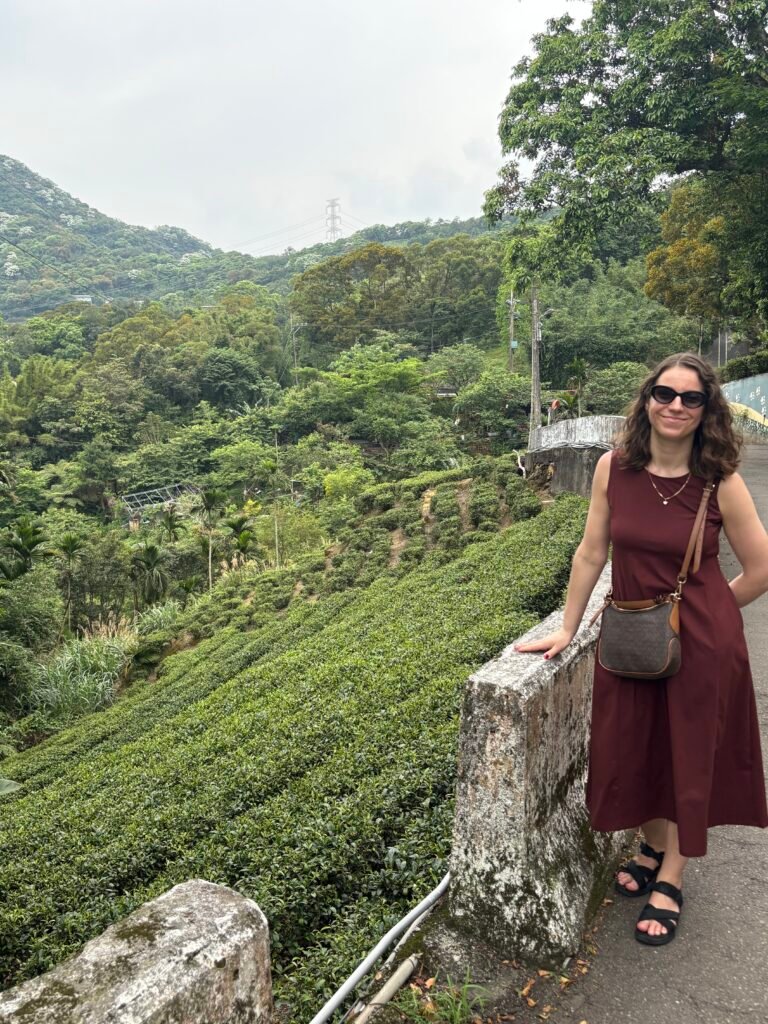
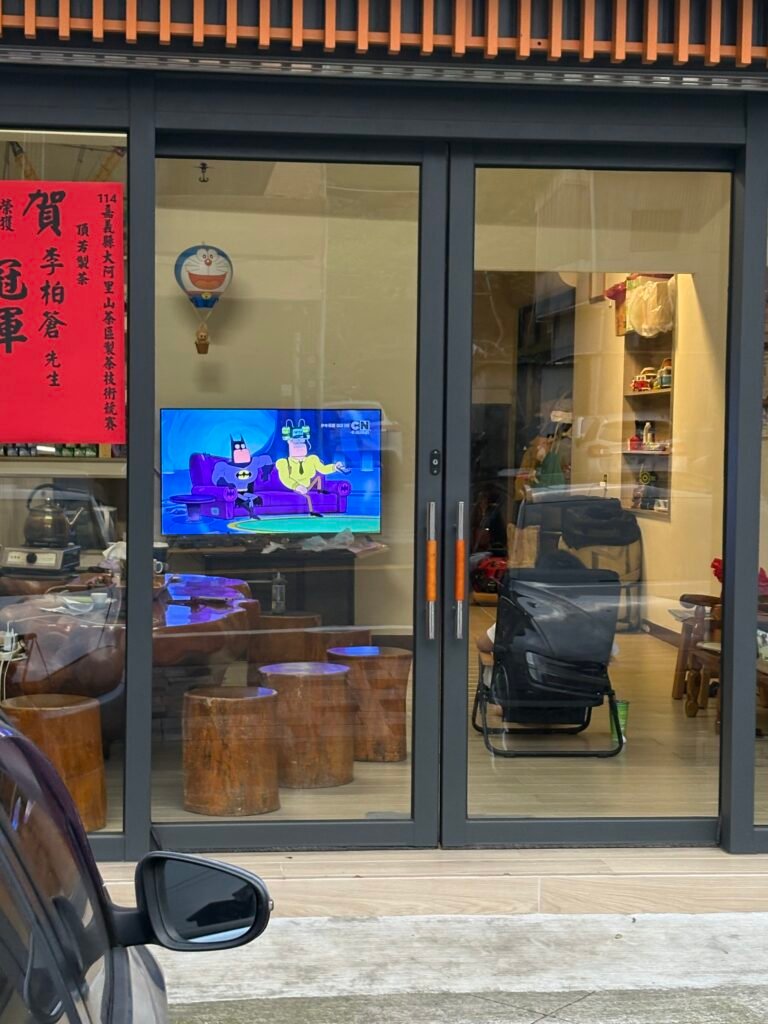
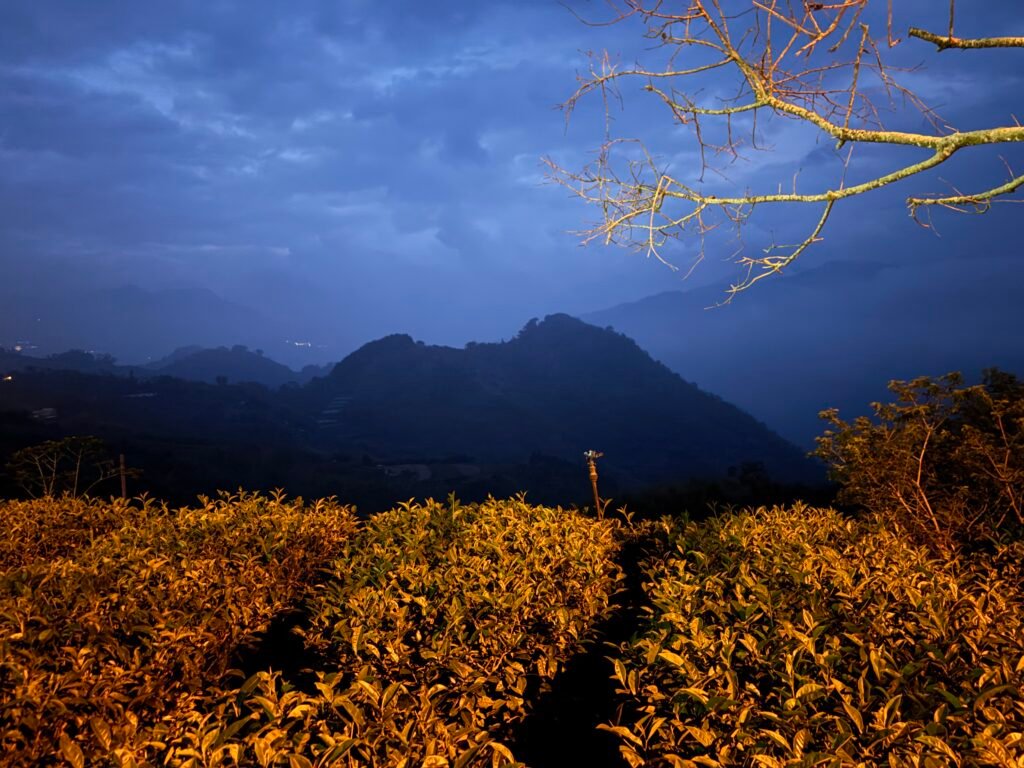
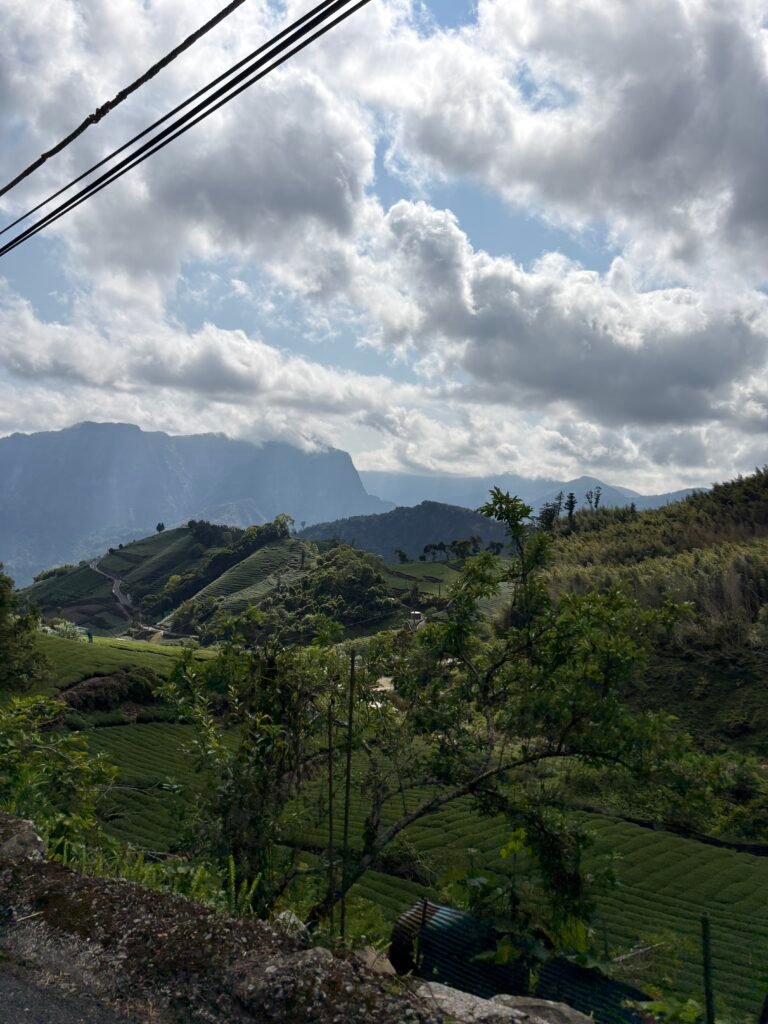
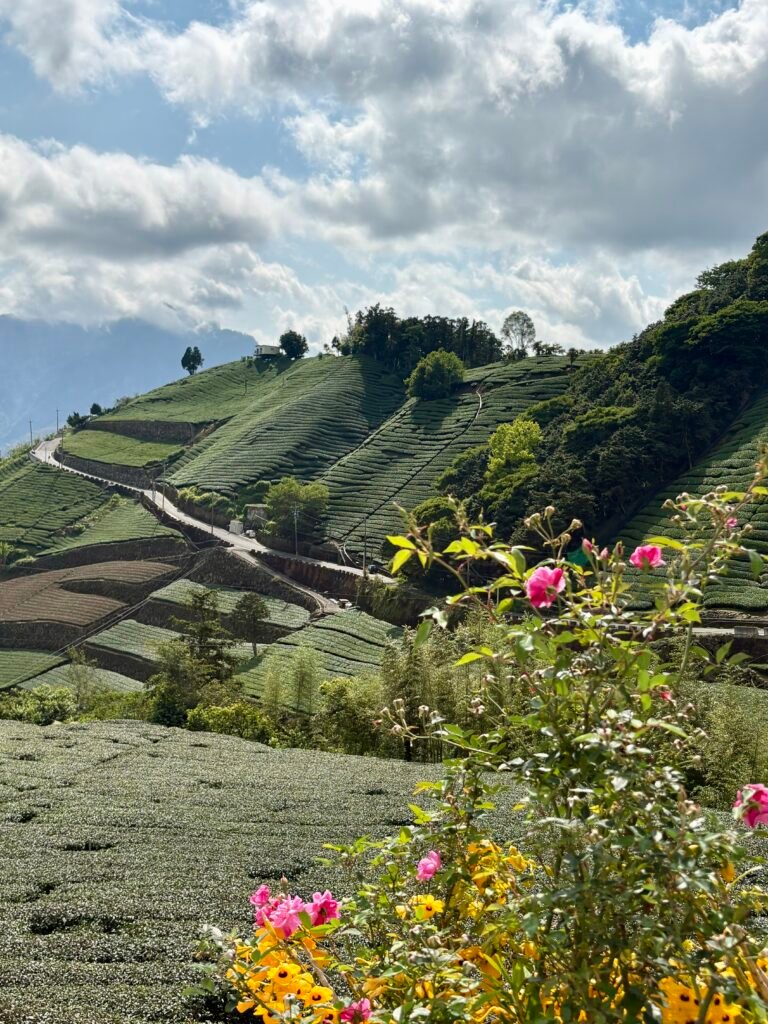
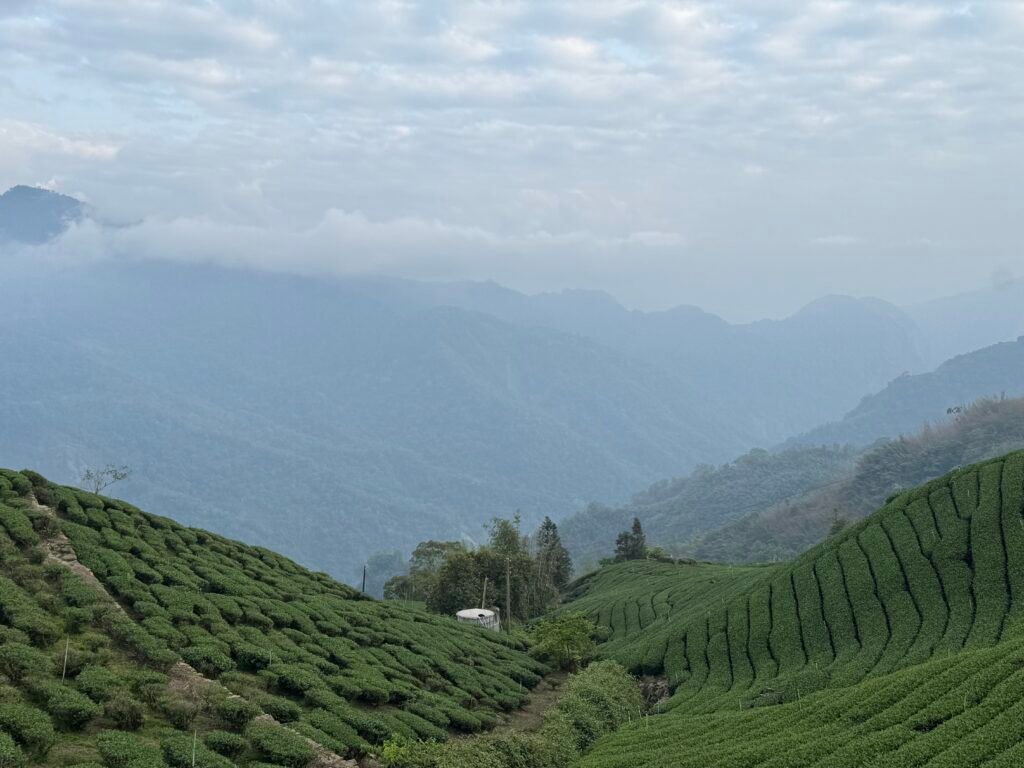
Naturally, there’s also a resident mother cat followed everywhere by two tiny kittens. They’re all fairly shy though, so establishing diplomatic relations is unsuccessful. We quickly drop off our things and go for one more short walk while there’s still daylight because we’re staying in a fairly special place. We’re basically right in the middle of Alishan’s famous oolong tea plantation region. Even while driving here, we could see huge tea fields covering the hillsides. Walking through the village, it looks like the only people who don’t directly work in the tea industry are the petrol-station employees. Everyone else grows, processes, sells or prepares tea.
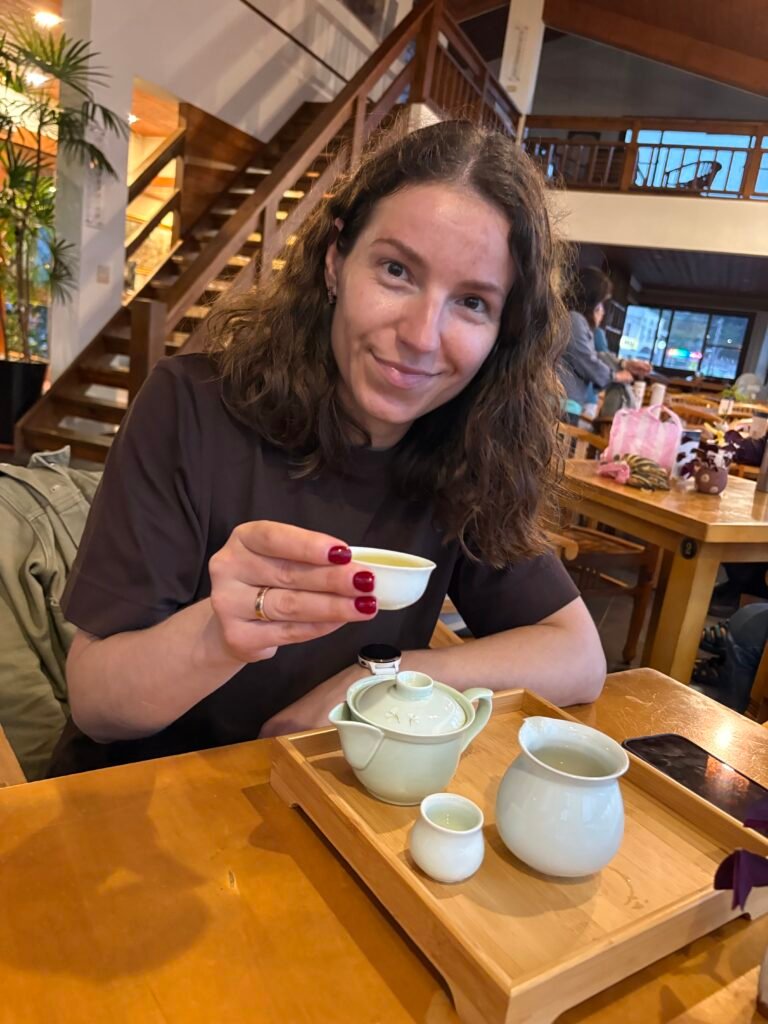
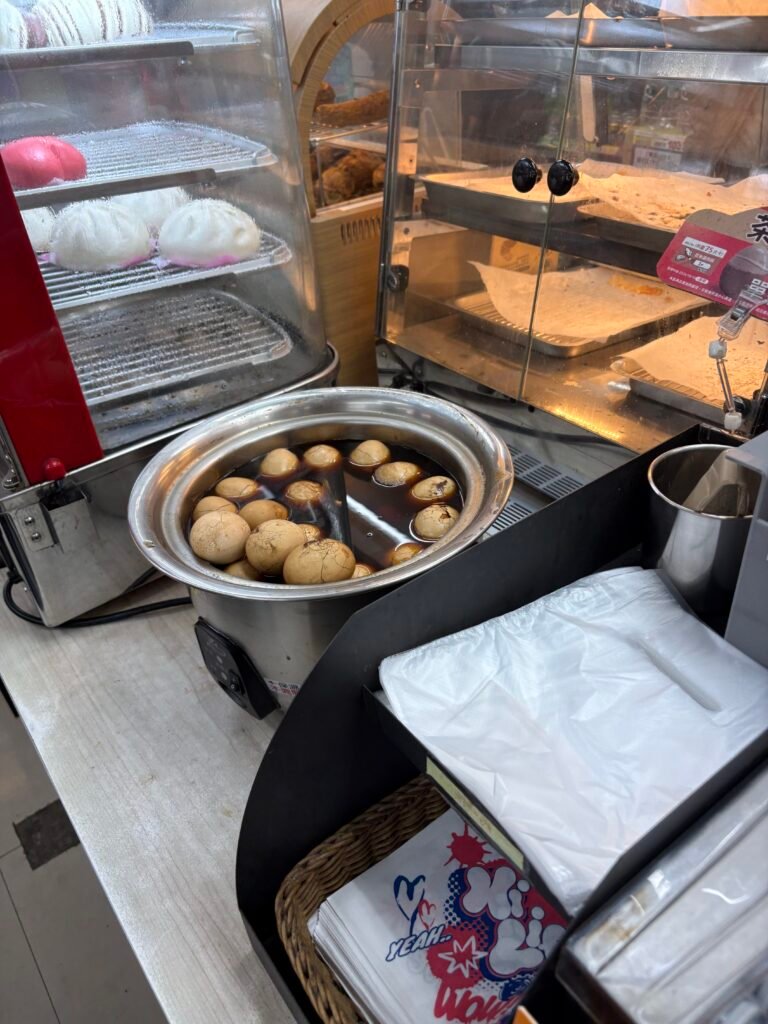
Tea isn’t exactly our main hobby, but right now it feels extremely appropriate to go into a tea house and drink some. Madara chooses classic Alishan Oolong green tea. Considering the heat outside, I go for an iced black milk tea made from the same oolong. Both are, unsurprisingly, excellent. A short description of this special tea based on what I can find online: Alishan Oolong is a high-mountain Taiwanese oolong tea grown on these slopes at roughly 2,000–2,500 metres above sea level. The cool and foggy climate, slow growth of the tea leaves and large temperature differences give it a very soft, sweet and creamy flavour with floral and slightly milky notes.
It’s considered exclusive because high-altitude plantation areas are limited, harvests are relatively small and much of the work is done by hand. Producing high-quality Alishan oolong is very labour-intensive. Some of the highest-grade harvests are sold for very high prices and often end up in premium tea markets in Japan and China.
Interestingly, Alishan’s fog not only contributes to the tea quality but also protects the leaves from direct sunlight, helping them retain more natural sweetness and aromatic oils. Oolong itself sits somewhere between green and black tea in terms of oxidation. The name comes from the Chinese 烏龍 – wūlóng – meaning “black dragon”. By the time we finish our tea, darkness has arrived and we slowly head back to our cat house.
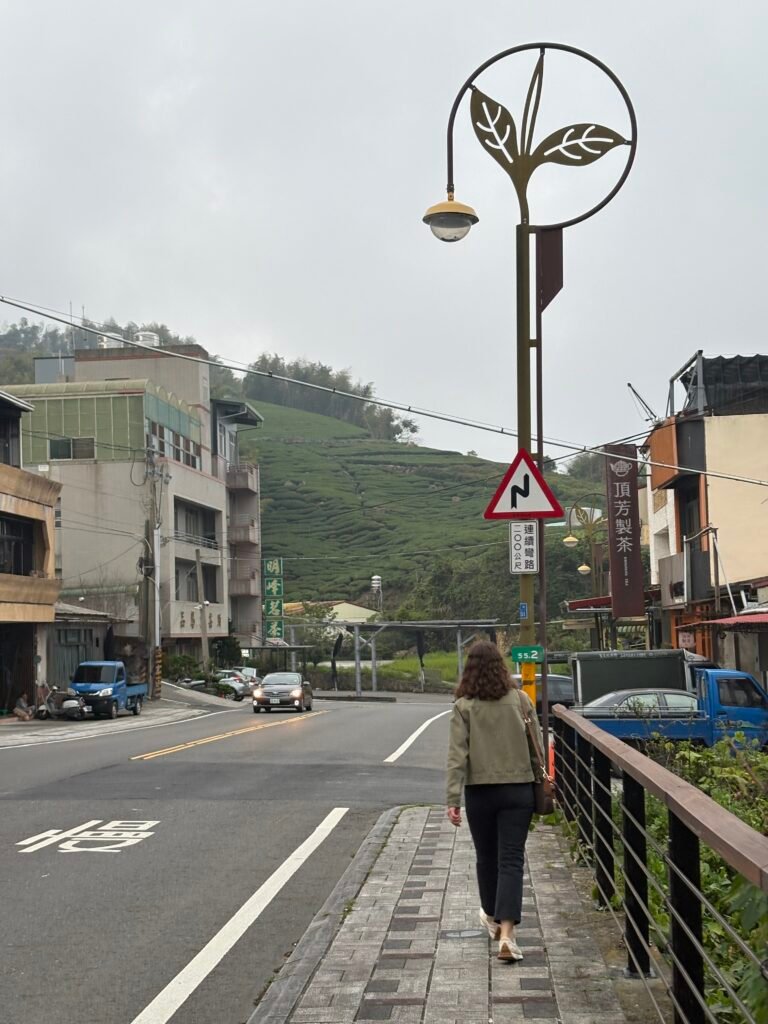
TAIPING
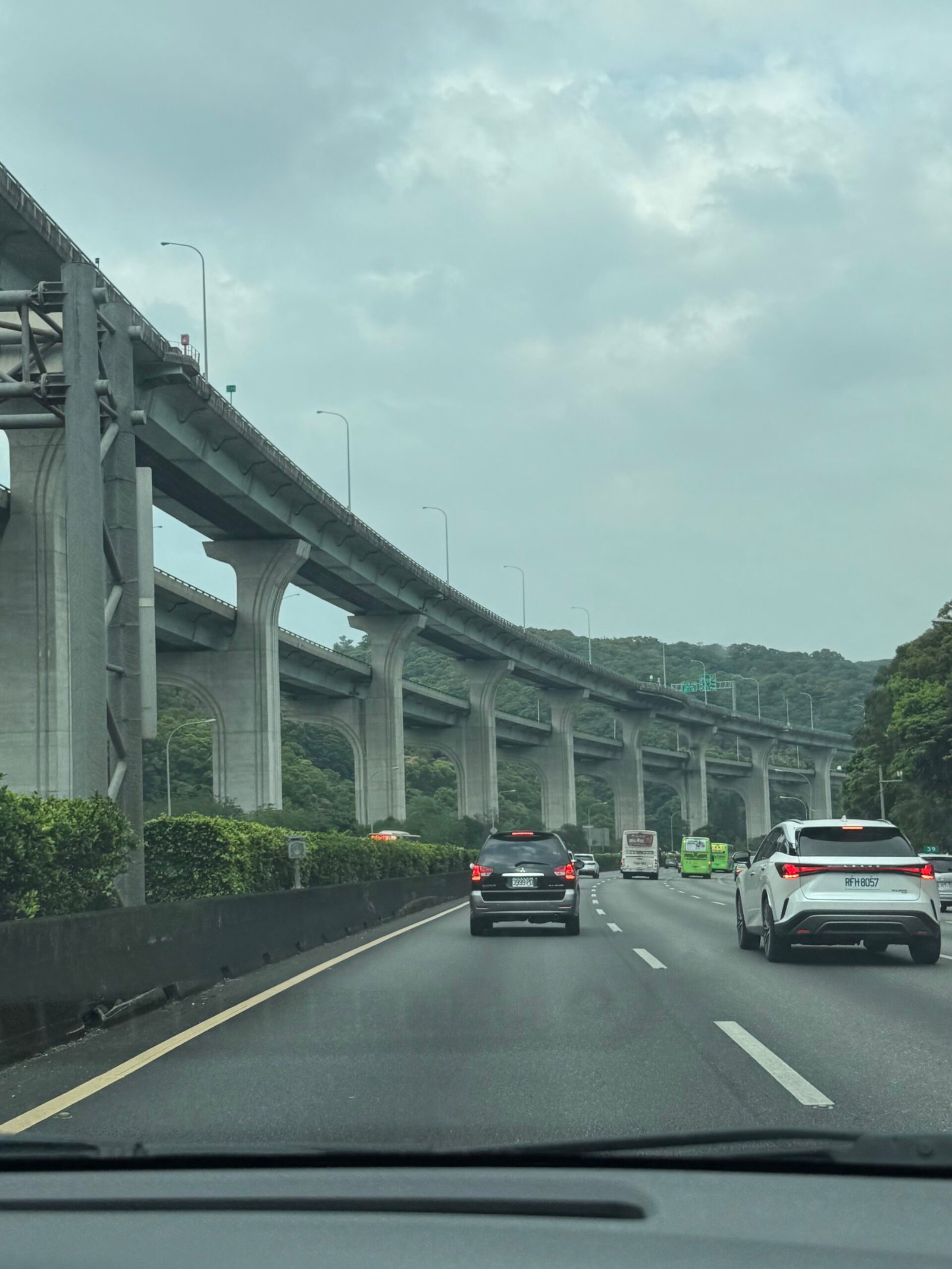
02.05.2026: Since we had a total of 315 km to cover today, much of it on narrow winding mountain roads, I decided to skip the Longgong Waterfall hike and drive straight to Taiping Old Town instead.
On the way, we try to stop at a few spontaneous viewpoints overlooking the tea plantations and, if possible, find a local shop where we could buy some tea. As we soon realise, most of these roadside shops seem to be aimed more at wholesale buyers rather than tourists passing by looking for just a few packets. So we leave the tea shopping for Taiping.
We arrive a little before 11. At the entrance to the car park, you simply drop NT$100 into a small bucket. A very high-tech security system, but apparently it works.
The main shopping street is already full of both vendors and visitors. At first, we simply walk through and take a look around. The town library has been converted into a café and a small shop selling rather expensive teas and tea accessories. We just admire the nice products here and continue on.
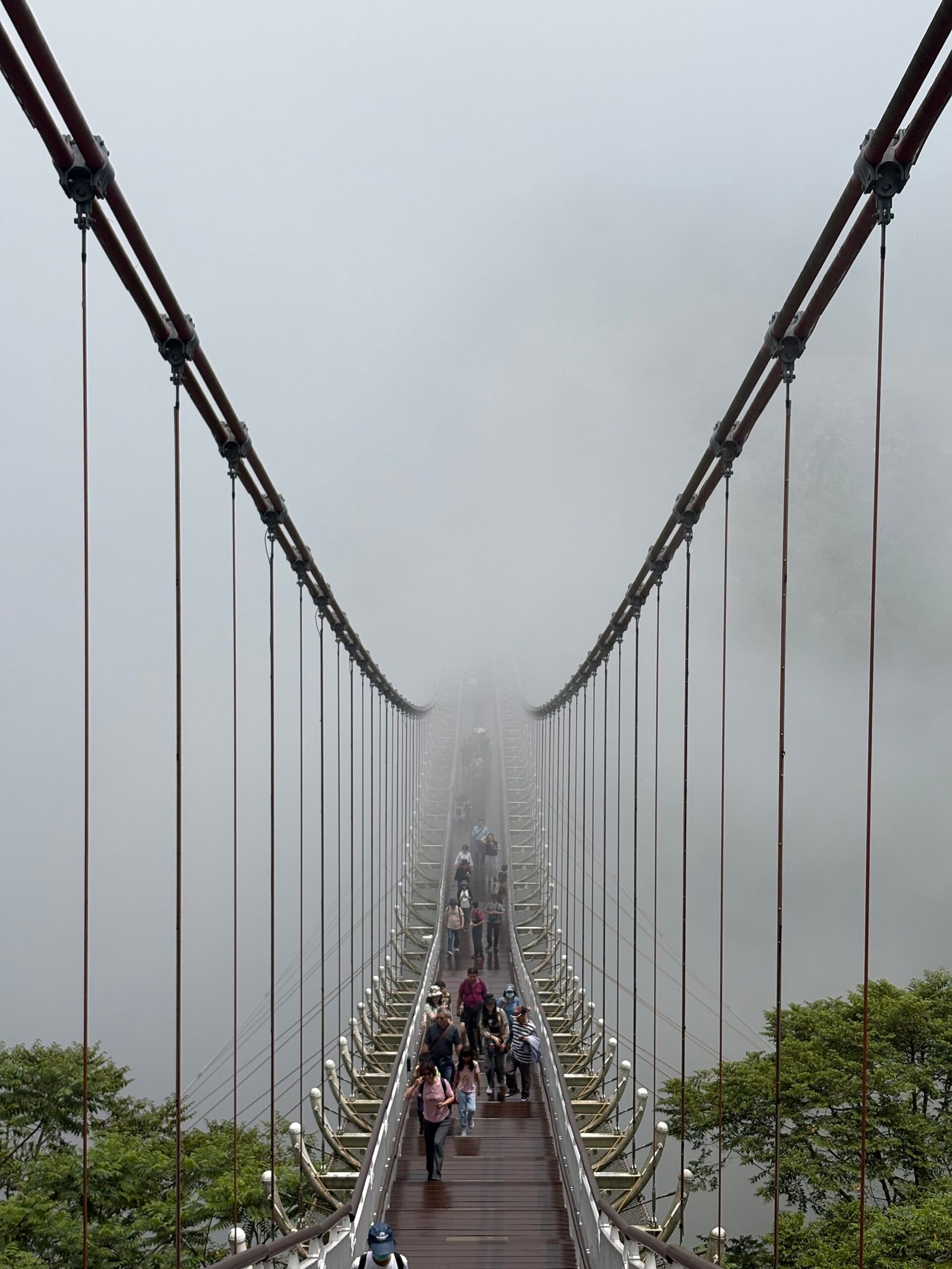
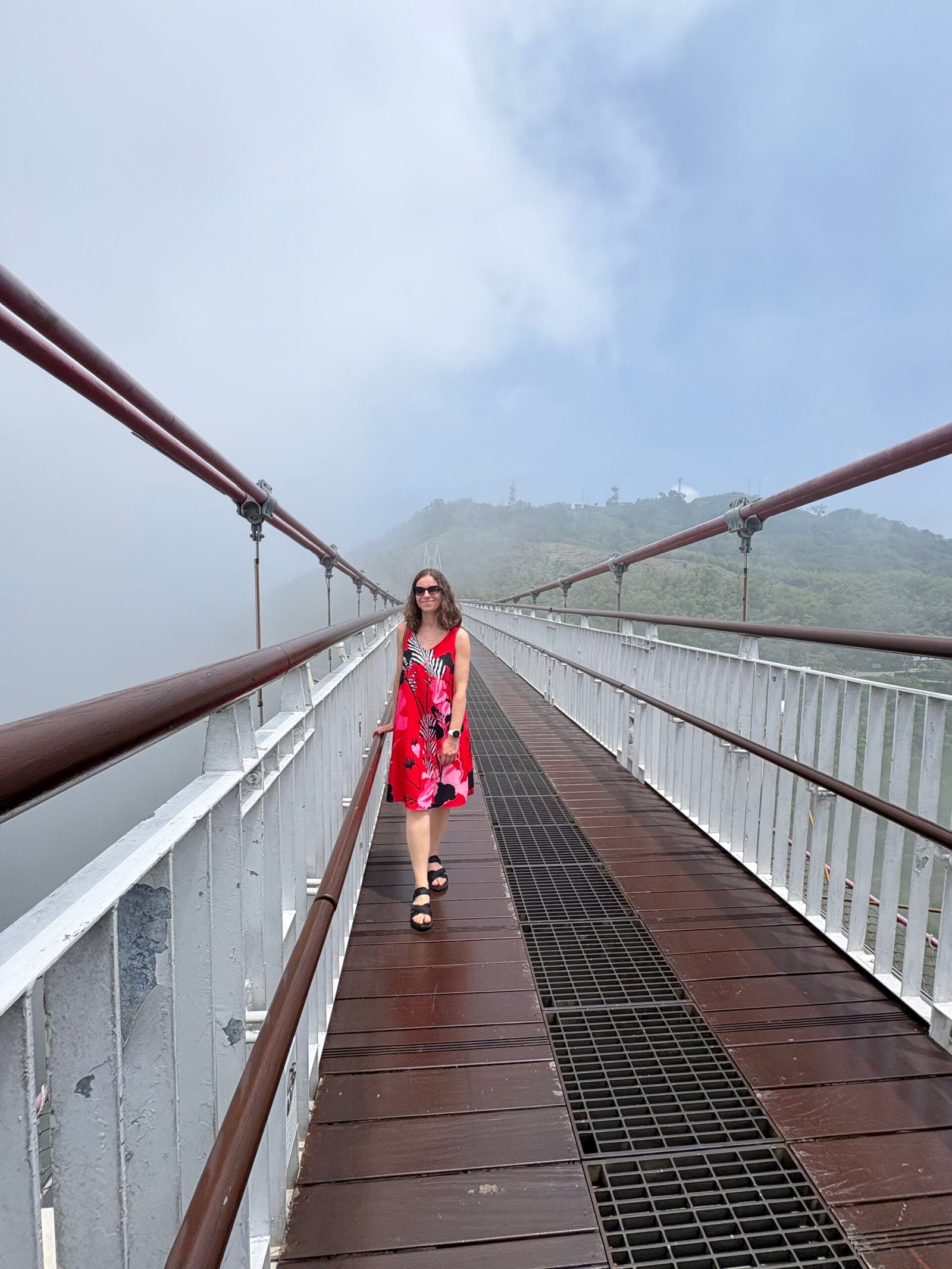
The main attraction in town is the Taiping Suspension Bridge (嘉義梅山太平雲梯). Literally translated, its name means the “Taiping Cloud Ladder”. And today the name fits perfectly, because we cannot even see the other end of the bridge — it completely disappears into the thick fog.
We pay NT$100, or around €2.70 per person, to walk across this “cloud ladder”. At 281 metres long, it is also the longest pedestrian suspension bridge in Taiwan. On a clear day, you can apparently see the famous 36 hairpin bends of the road leading up to Taiping. We will get a much closer look at those later when we continue driving.
The bridge is one-way only, so on the way back we follow a trail lower down along the hillside.
Once we return to town, I buy a banana and milk smoothie. It is so filling that I definitely will not need lunch anytime soon.
We also complete our mission of buying some Alishan oolong tea. It is not exactly cheap — one packet costs around €11 — but it is supposed to be a fairly exclusive local product. Later I find online that the same packet apparently costs around €75 in Europe. Suddenly, €11 feels like a very good deal.
To be fair, we are probably not experienced enough with tea to properly appreciate what we bought.
On the way back to the car, I also pick up several packets of local sweets — fruit juice jelly candies.
DIHUA STREET
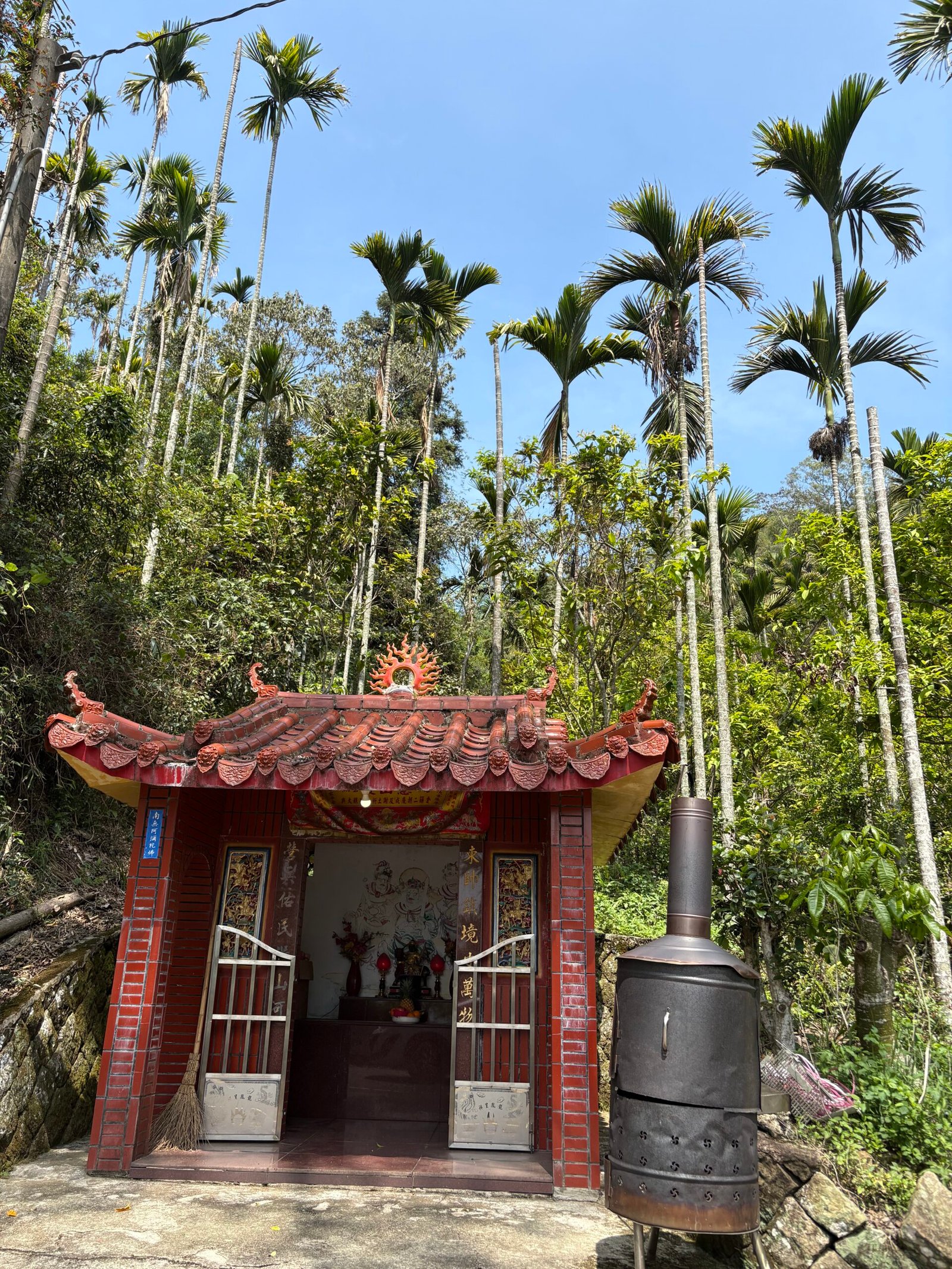
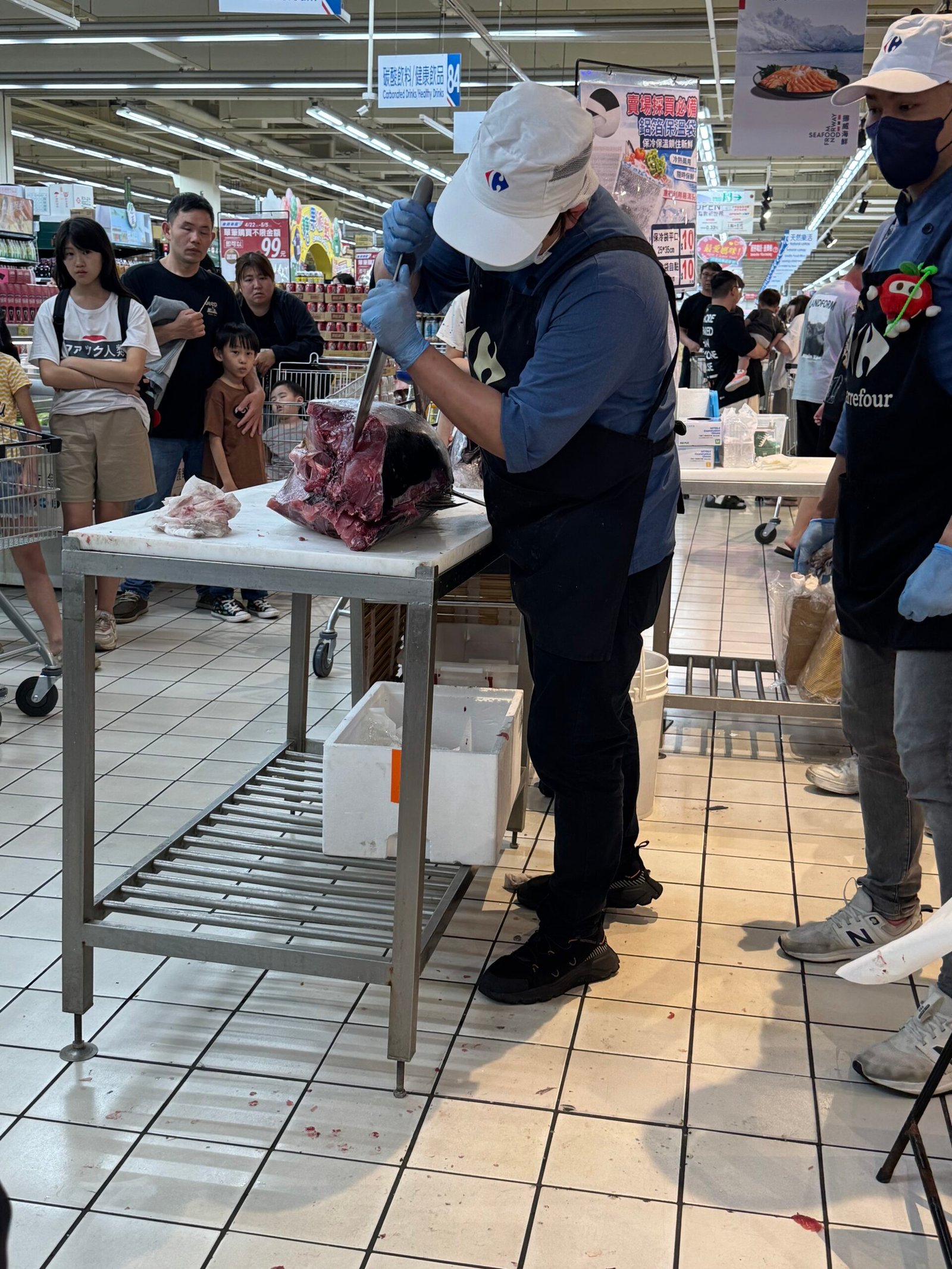
02.05.2026: On the way back towards Taipei, before returning the rental car, we look for a supermarket where we can browse some local sweets to take home. Eventually, we stop in Taoyuan. The shop is enormous. You could easily spend hours walking around like it’s an excursion, inspecting one food aisle after another. All kinds of strange and completely incomprehensible things. We buy a huge bag full of random wonders and spend only slightly more than €30. Back in Taipei, we stop at the hotel and quickly unload our luggage so we can return the car. For around 850 km of driving over steep mountain serpentines, fuel and toll roads together have cost us roughly €70. Not bad!
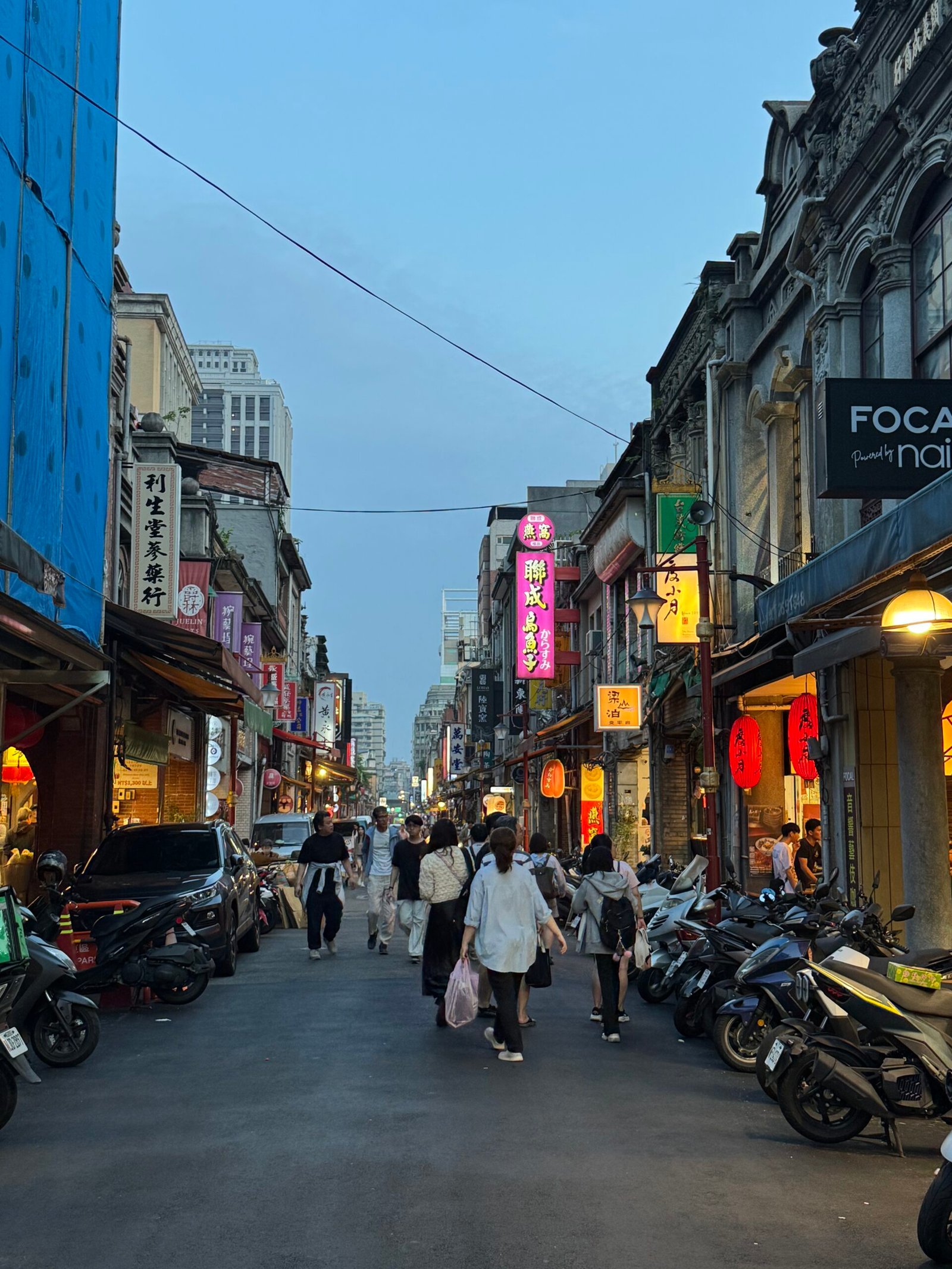
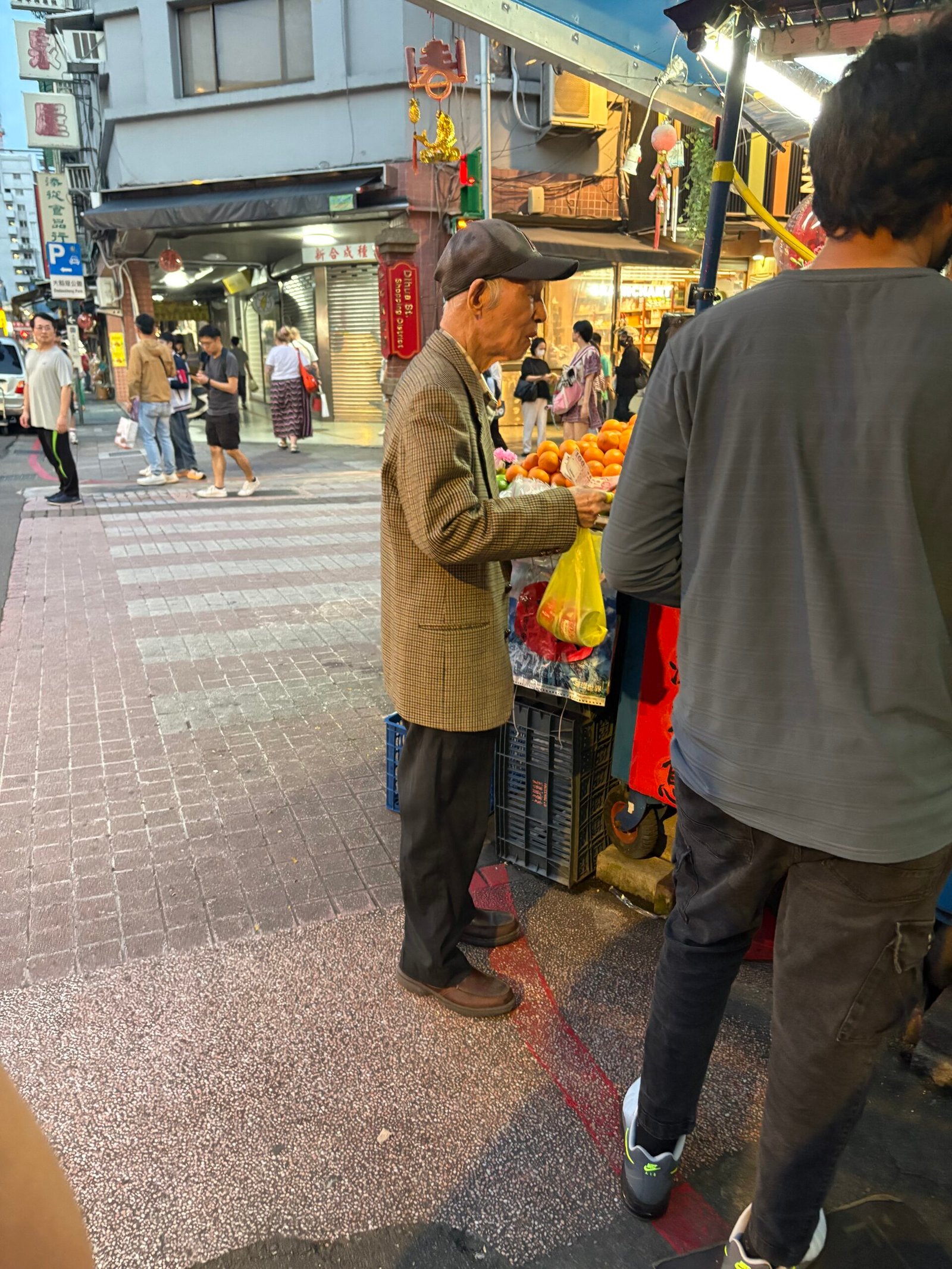
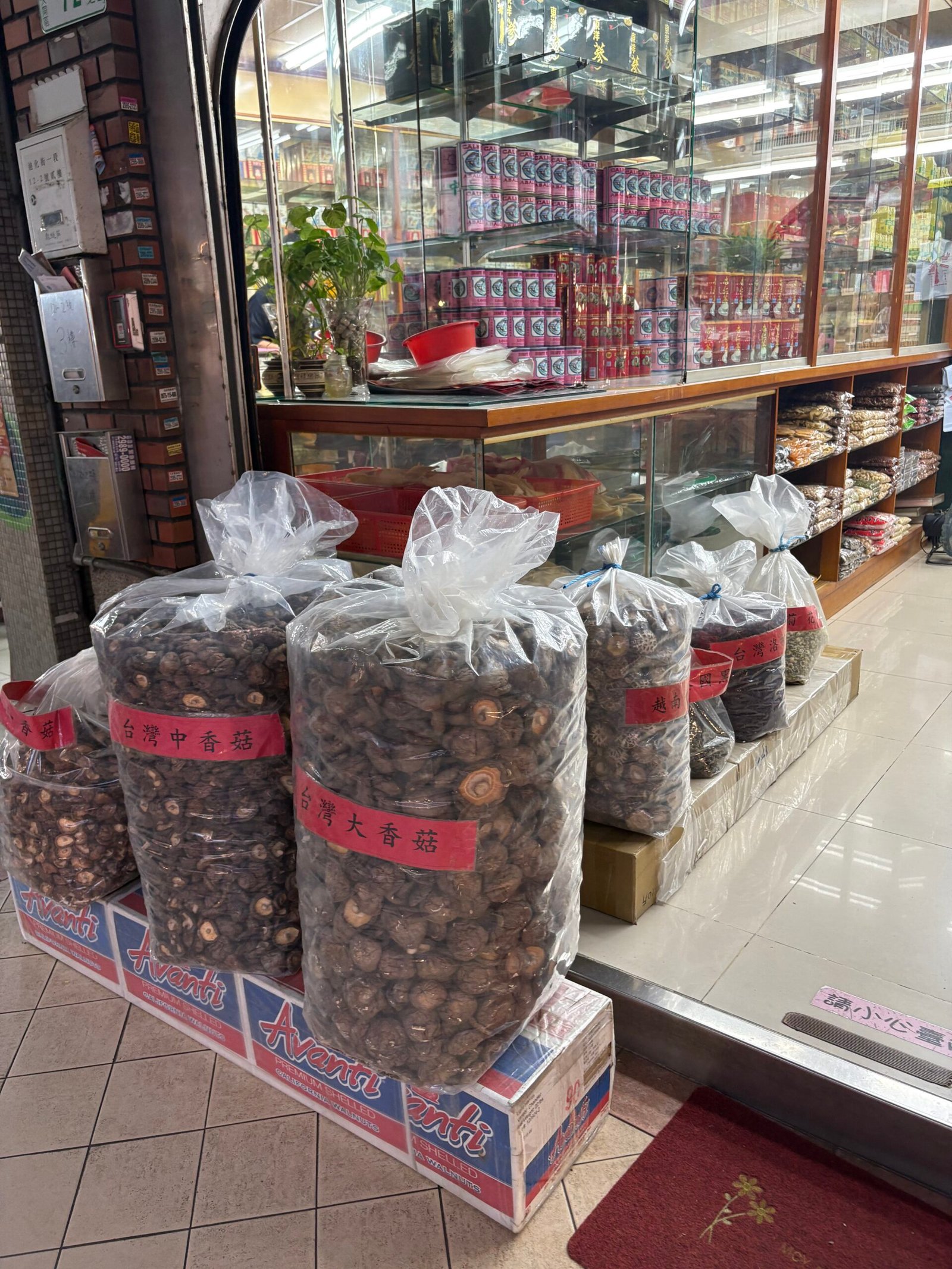
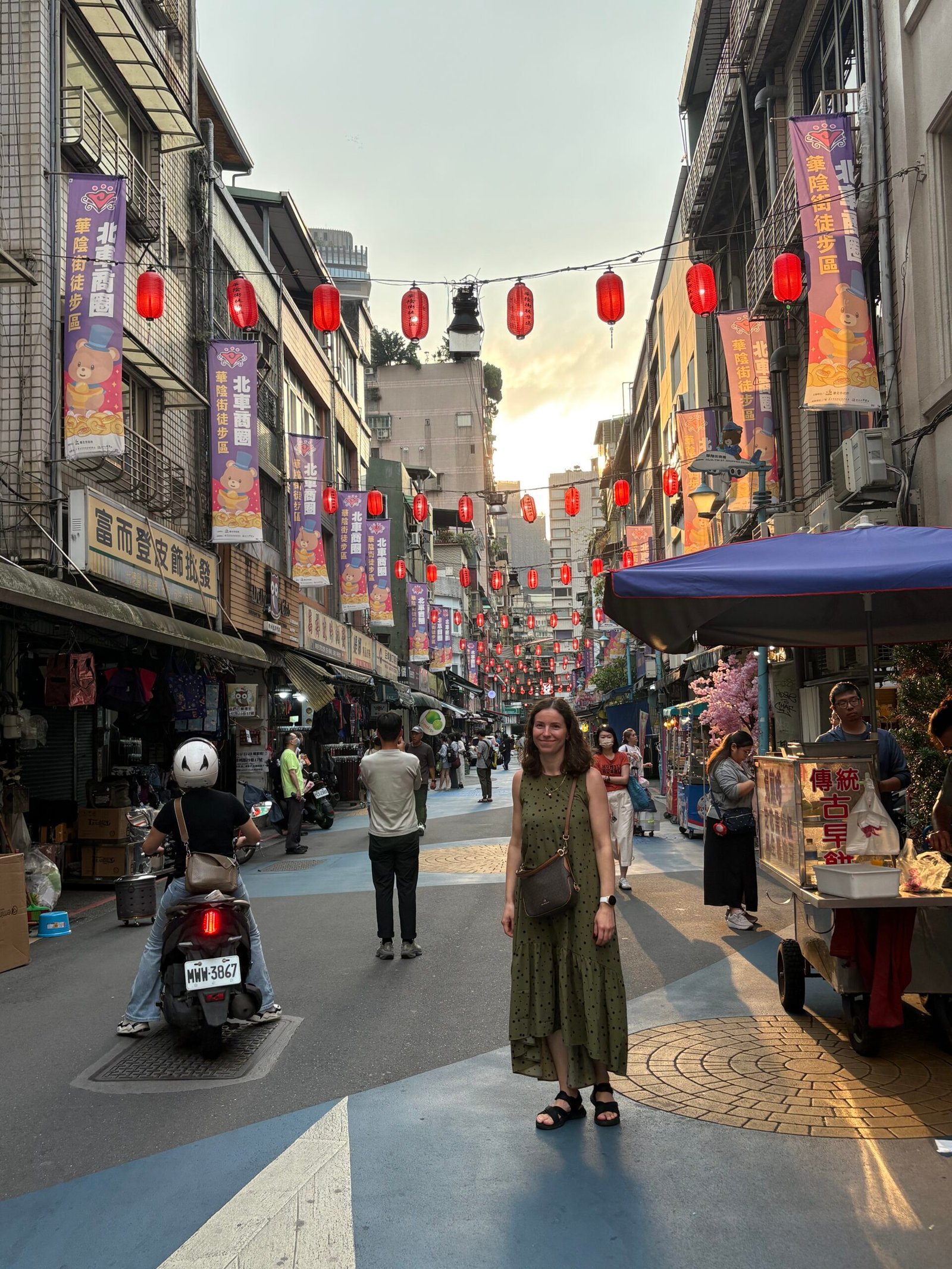
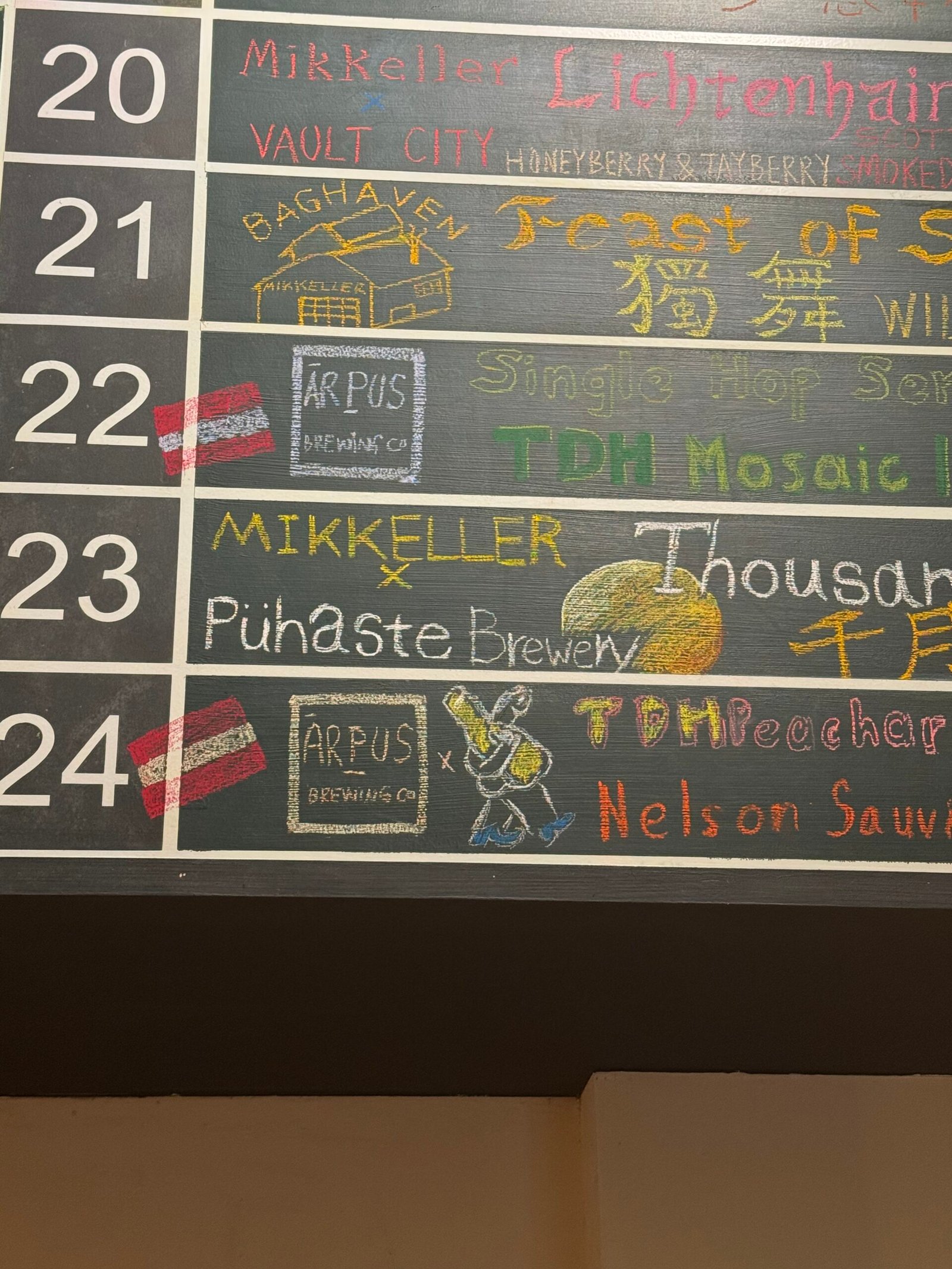
Returning the car is extremely simple and quick. Now we can get back to the streets. We head towards Dihua Street, which is also full of interesting little shops and street vendors. Apparently it’s the oldest street in Taipei. Dihua Street began developing in the 1850s, although some parts existed even earlier. It became the main commercial centre of the Dadaocheng district and remains one of Taipei’s most historically important streets. After the long drive, we stop at Mikkeller Bar Taipei. There are 24 different beers on tap and, to our huge surprise, two of them are Latvian! From the brewery Ārpus. We share one grapefruit American Pale Ale. Very fresh and fruity. Not really my thing. Madara likes it.
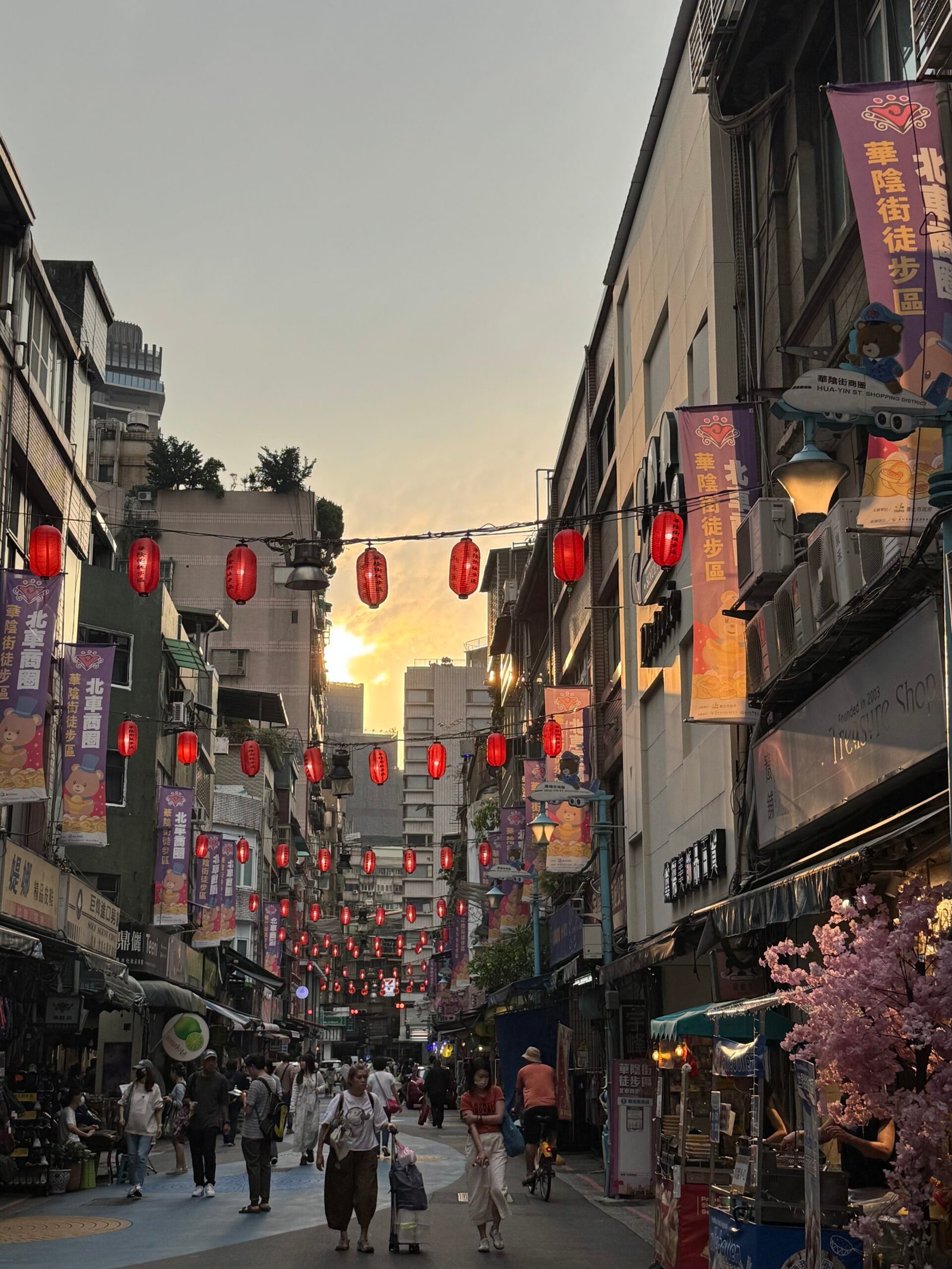
Then we continue into the crowd of Dihua Street vendors. We don’t buy anything specific, but it’s interesting just to slowly walk through and watch everything around us. The whole environment looks completely different from anything we normally see in Europe. We still need to visit Ningxia Night Market tonight, but neither of us is hungry yet. So we keep walking to shake some extra space into our stomachs. Soon we reach the large international brand stores. I wanted to buy a new pair of Nike Air Max using my Grobiņa name-day co-financing. Turns out that particular model basically doesn’t exist here. Mission currently considered unsuccessful. Eventually we head back towards the market. At one stall, we get a huge bowl containing four different types of mushrooms that have first been cooked and then deep-fried. Not our finest purchase.
Feels like we’re eating solid oil. Various chicken dishes look good, but our stomachs are already so full that we can’t manage anything else. Better to sit down in a bar with a beer and discuss the day’s impressions. When we enter Mikkeller again, the bartender shouts: “Welcome back, Latvia!”
Apparently our excitement about the Latvian beer made us memorable. Nice! After another 25,000-step day, we really don’t feel like walking all the way back to the hotel. So we call a Bolt taxi and shortly afterwards we’re already in bed.
NATIONAL PALACE MUSEUM
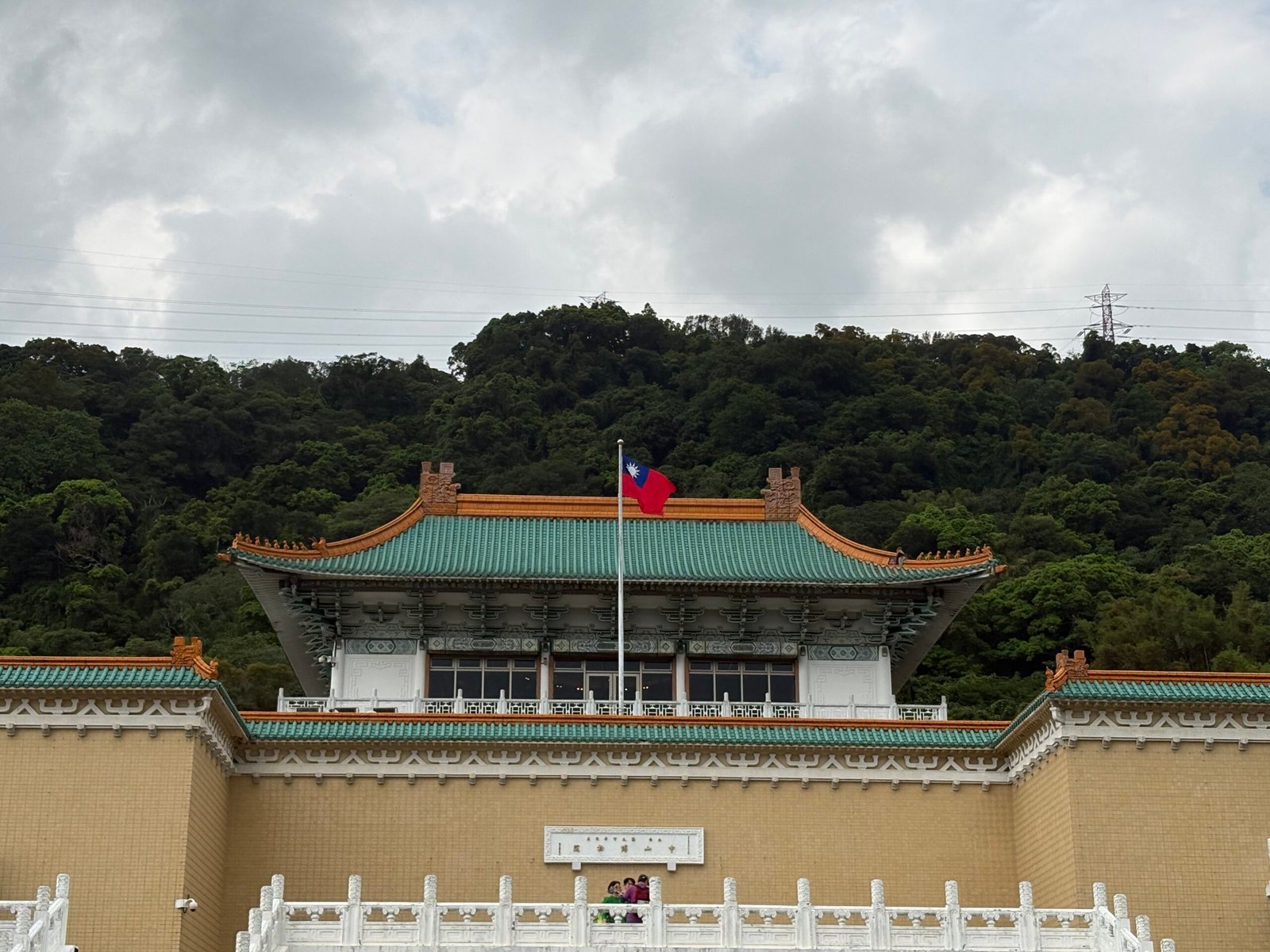
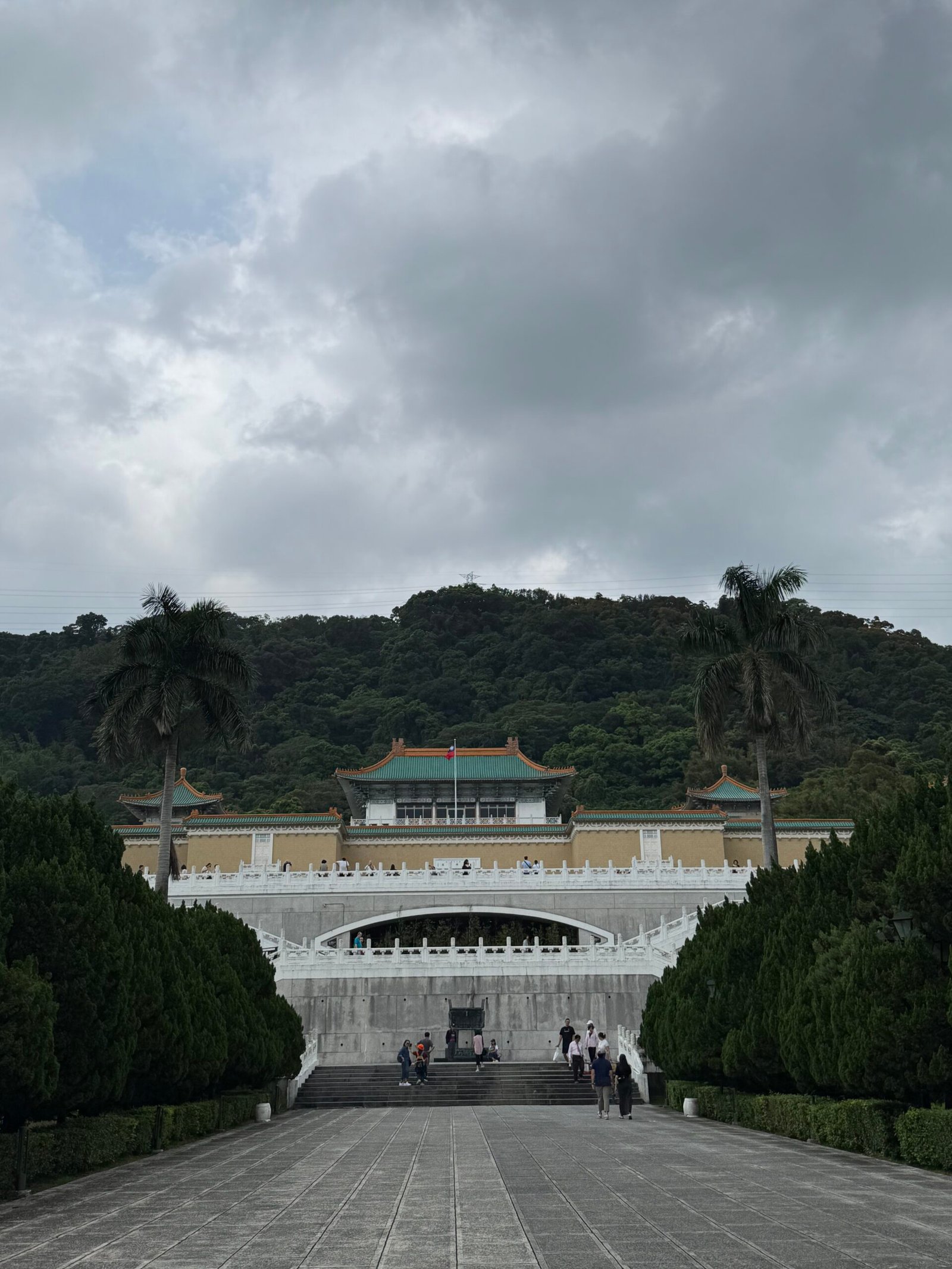
03.05.2026: We start the final full day of the trip with probably Taiwan’s most famous museum – the National Palace Museum. It’s one of the most important museums of Chinese art in the world.
Everything says that even if you’re not particularly interested in history, it’s still impressive because almost 5,000 years of Chinese civilisation are represented in one place. Since today is still a national holiday, public transport runs significantly less frequently. In the end, we take a Bolt to the museum because we don’t want to waste too much time connecting between several buses.
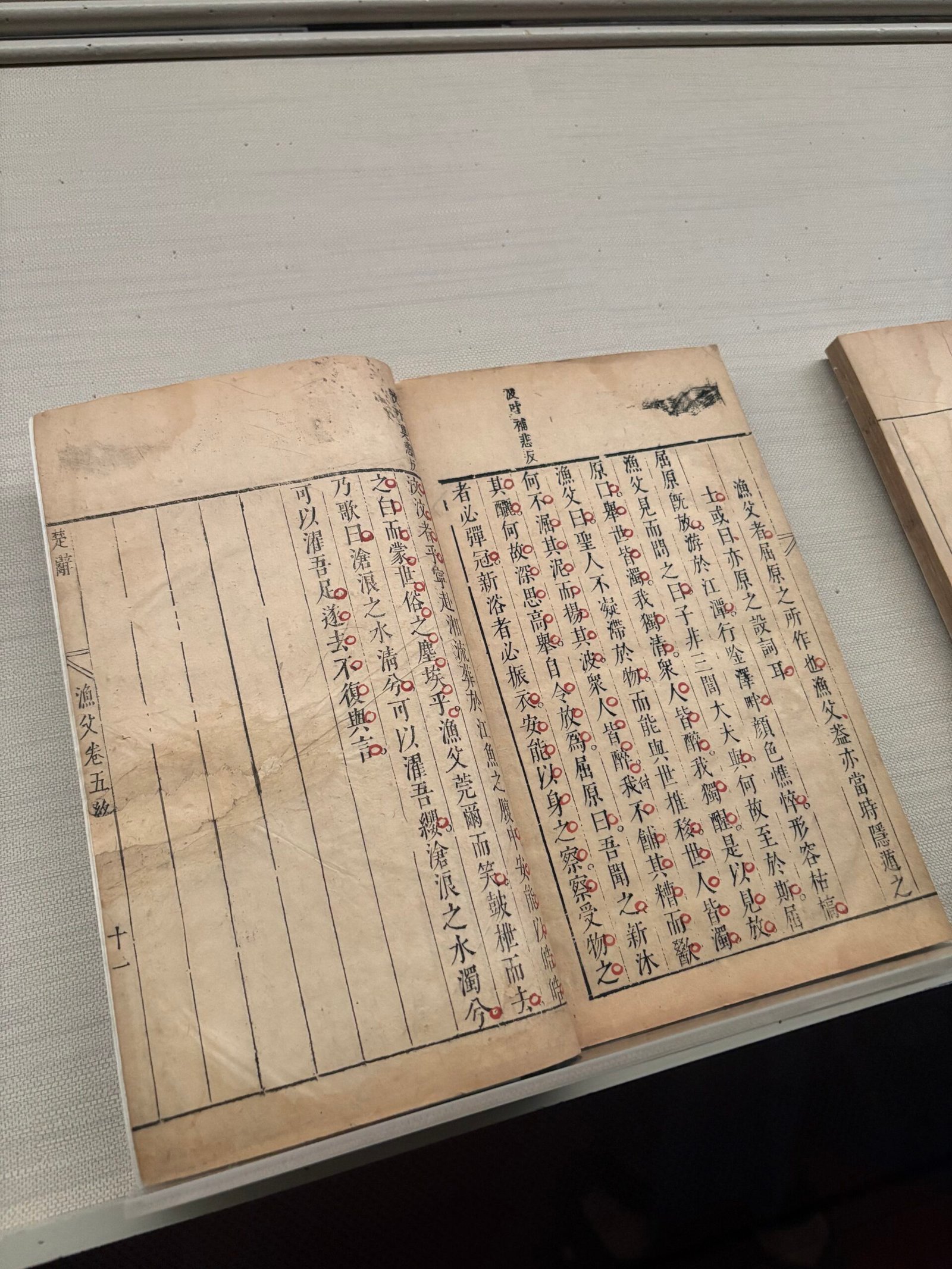
I think I expected something different from this museum. Maybe something similar to Singapore’s National Museum, where walking through the building essentially takes you through the history of the country. Taiwan’s history certainly has enough twists for that. This museum, however, is much more focused on historical objects – ceramics, calligraphy and every other kind of artefact imaginable. If you’re deeply interested in these subjects, I have no doubt many of the pieces are unique. For an ordinary mortal tourist, though, it gets very deep and detailed. There’s no way to read everything or pay proper attention to every exhibit. The collection contains more than 690,000 artworks and historical objects, ranging from the Neolithic period to the Qing dynasty. If you spent just one minute on every object, seeing the entire collection would take more than a year.
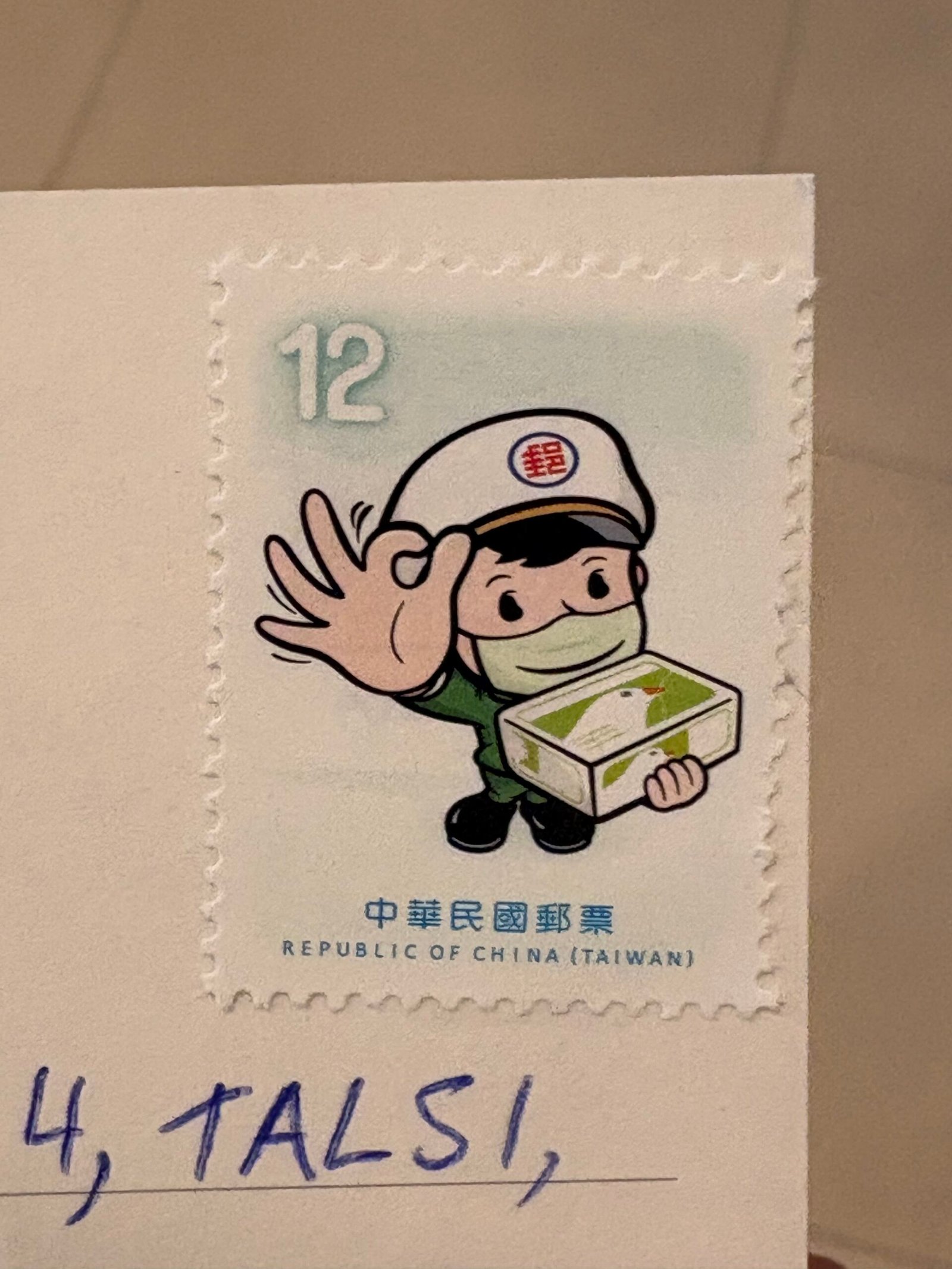
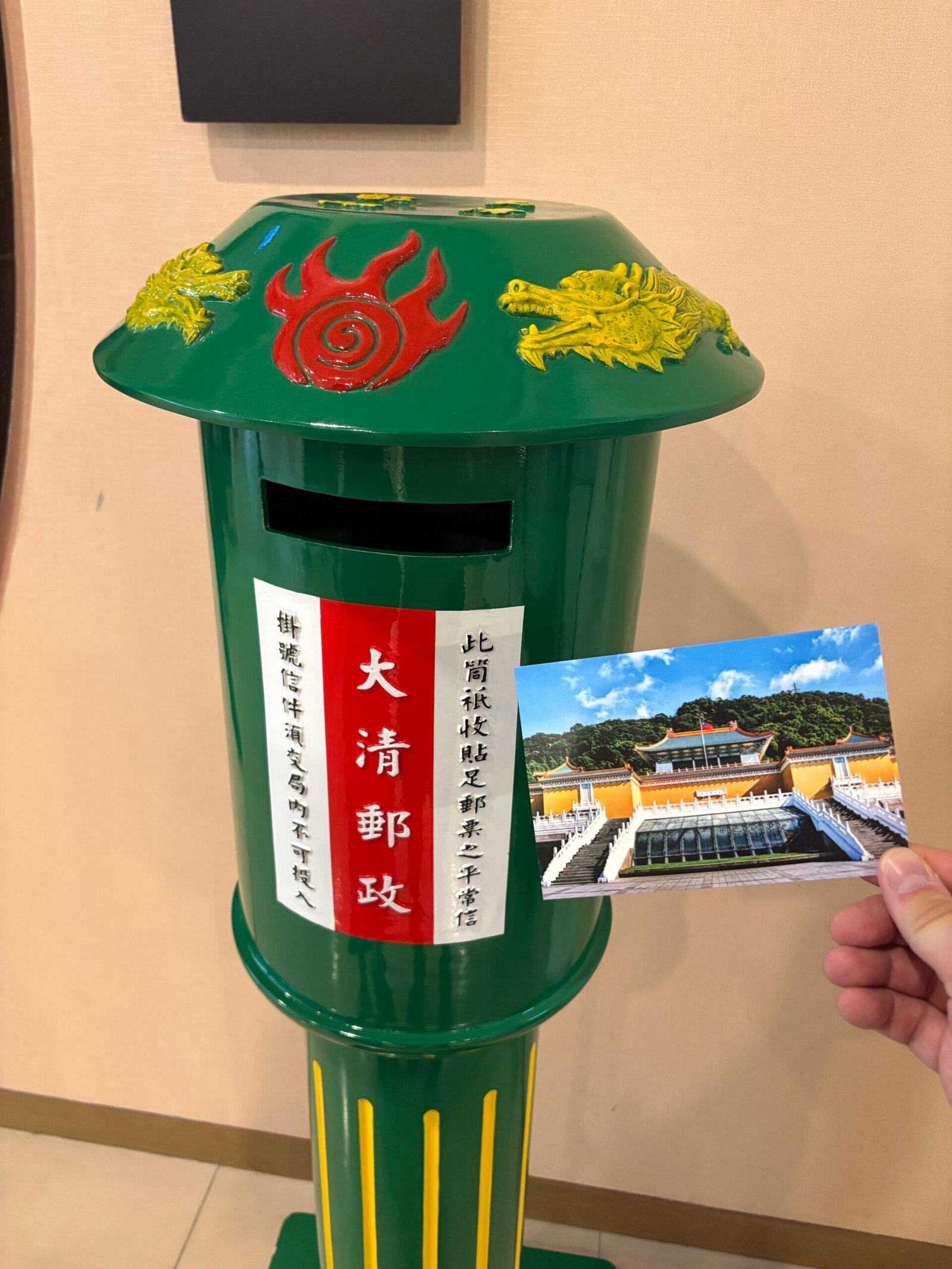
Considering the current geopolitical relationship with China, it also feels very interesting that many of these exhibits originally came from Beijing’s Forbidden City. During the wars and political upheavals of the 20th century, the most valuable objects were repeatedly moved around China before eventually arriving in Taiwan in 1949. That means some of the Chinese Empire’s greatest treasures are now kept here in Taipei. One of the most important stops during our museum visit is sending a postcard to Grandma. We learn from Arnita and clearly write “EUROPE” on it as well, just so the Taiwanese postal worker knows which general direction of the planet it needs to go. Madara shops in the museum store and comes away with a tea set and a bag.
We take a few more photos on the museum steps and then start thinking about lunch.
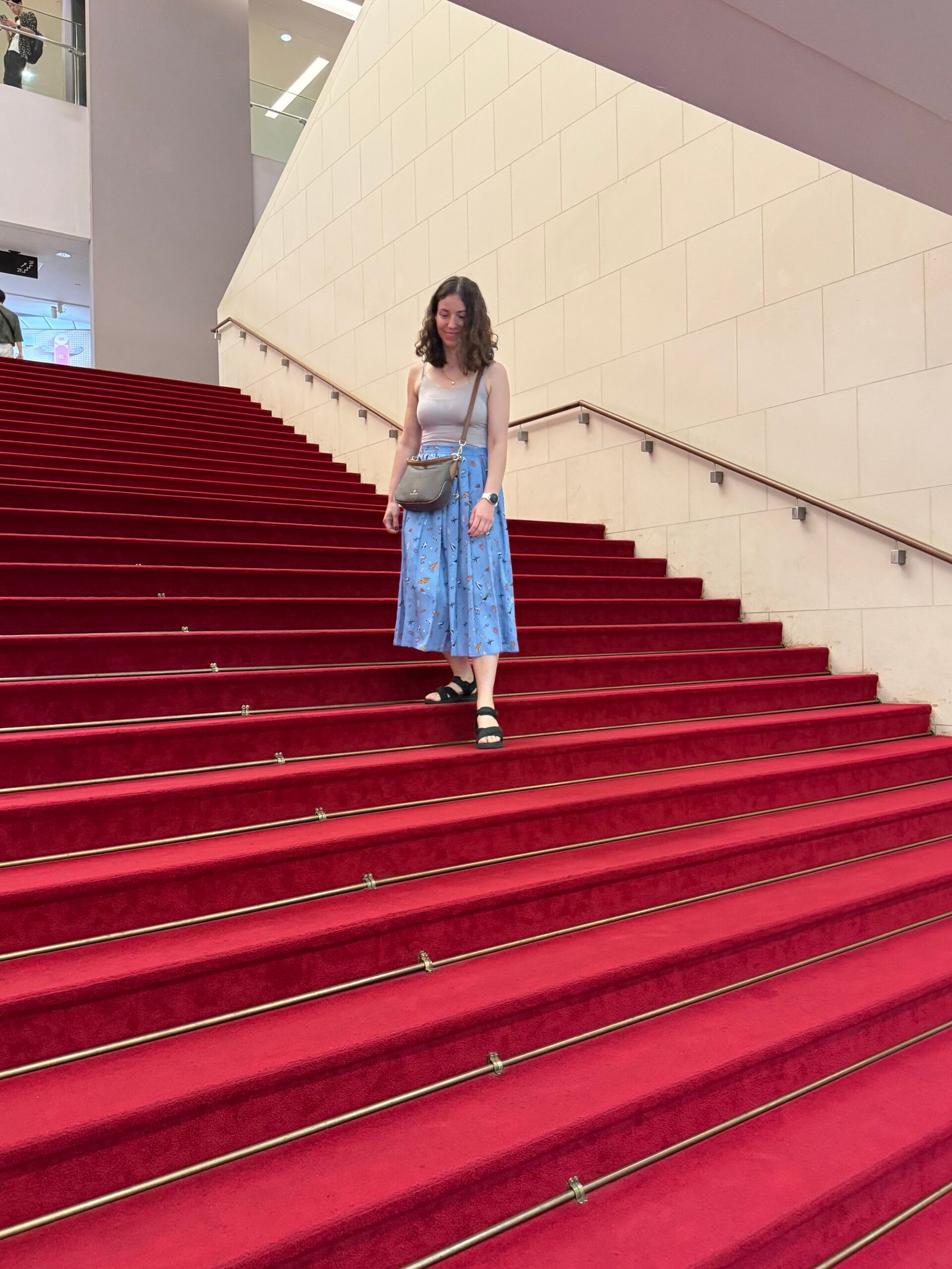
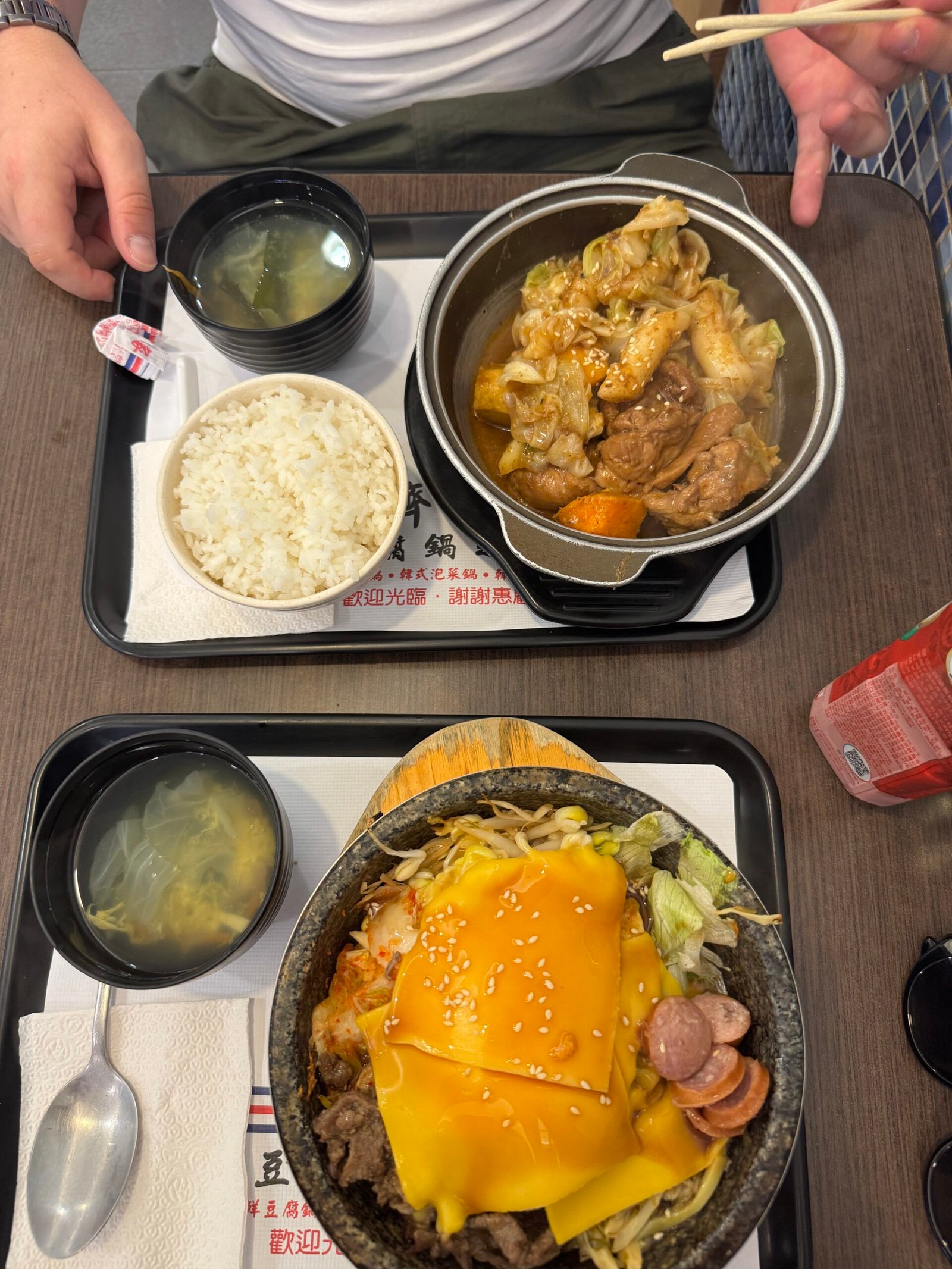
DATONG DISTRICT
03.05.2026: Since today is Sunday, buses run far less frequently. We wait around 20 minutes at the stop, during which a proper crowd gathers. We’re near the front, so at least we know we’ll get in. The Taiwanese queue politely without creating unnecessary chaos. Sitting near the back of the bus, we get bounced around like we’re riding a horse, thrown forwards and backwards for the entire journey. I still somehow manage to sleep for around 20 minutes.
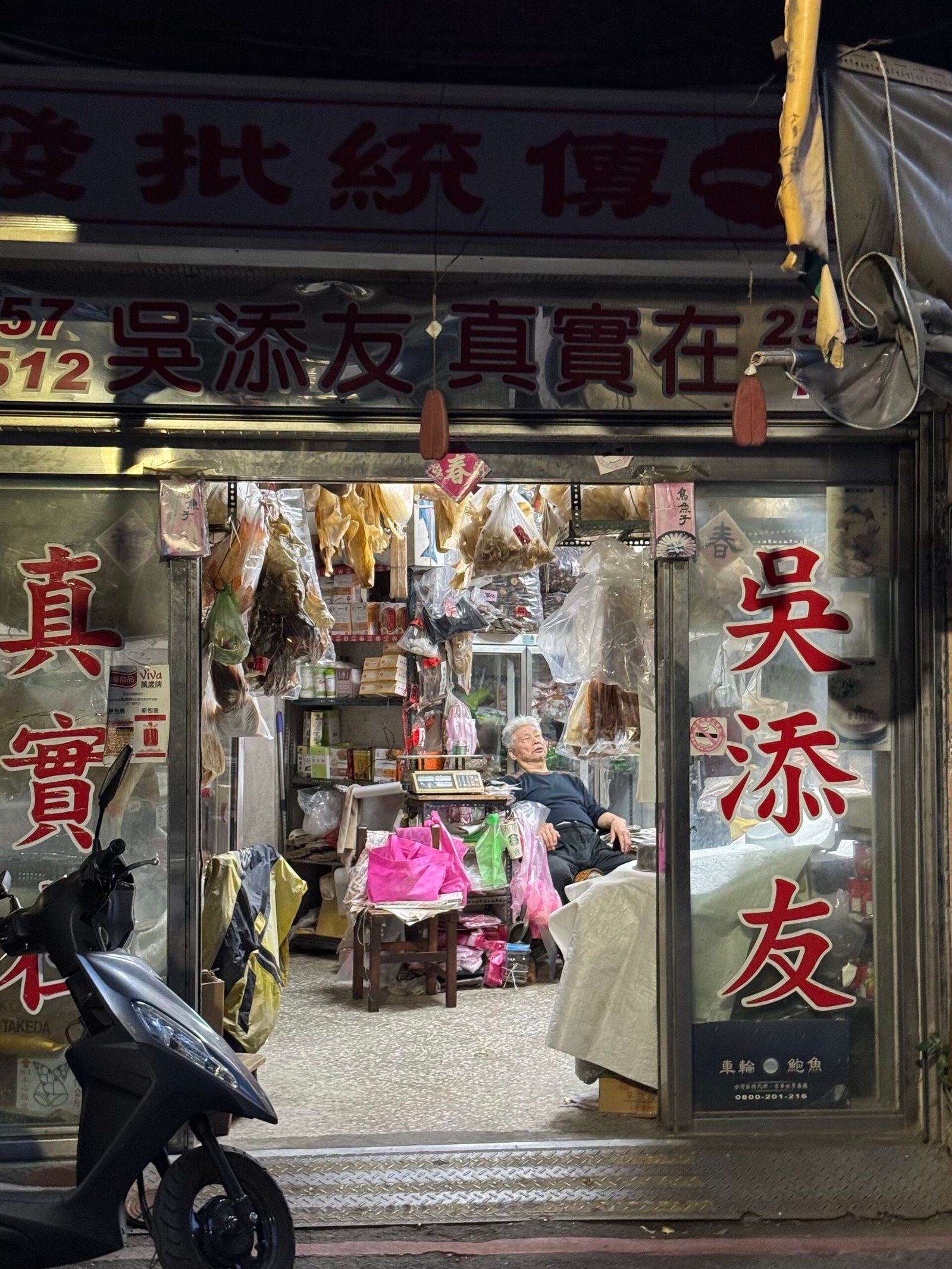
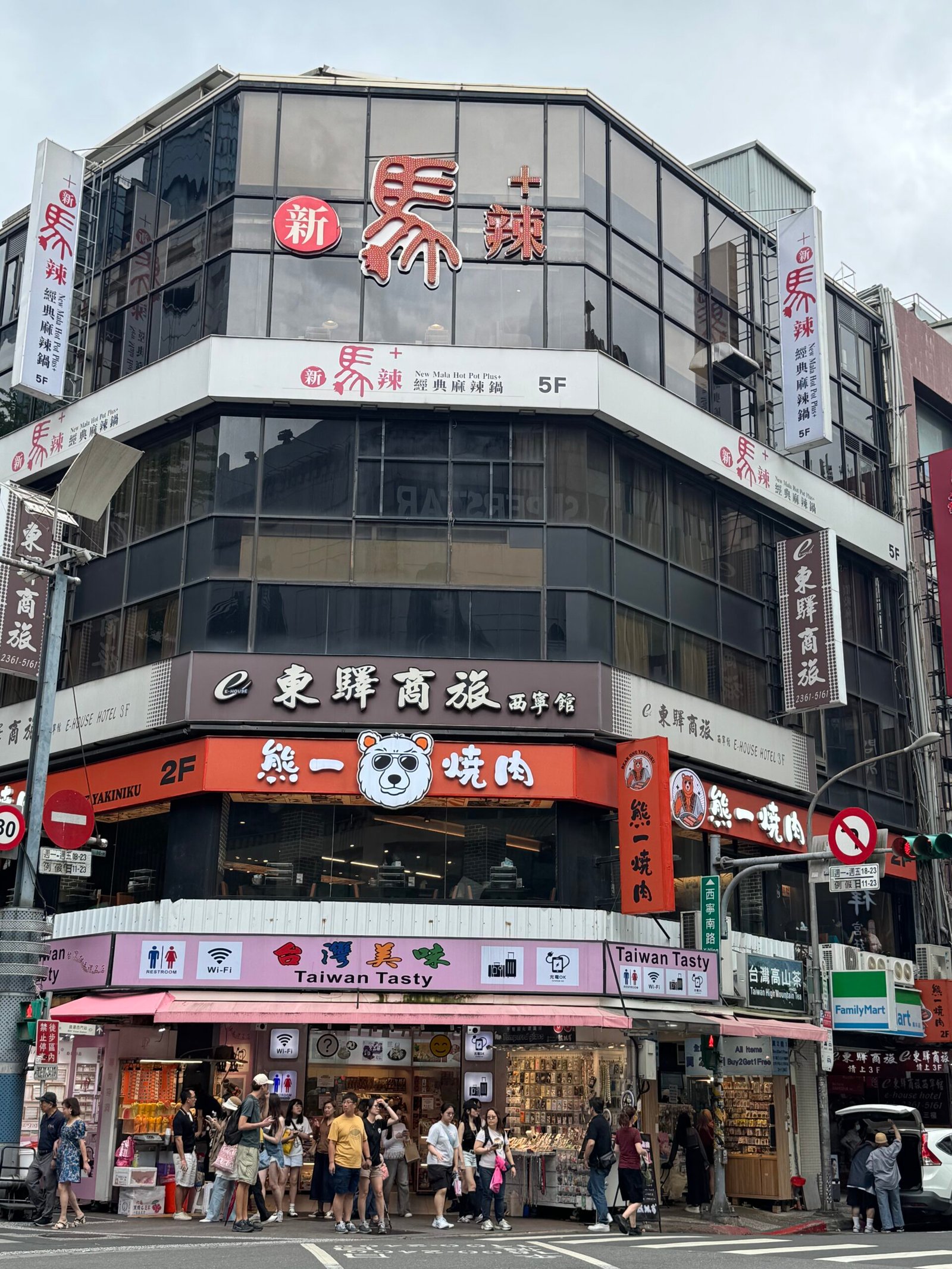
We arrive in the Datong shopping district. Plenty of activity here too. After my bus nap, I need coffee, so that becomes the next mission. We find a fairly fancy-looking place called Nostalgia Café. As soon as we enter, there’s a local guy completely passed out at the first table. Didn’t survive long enough to receive his coffee? The café is full, so we decide we’ll come back later because the place looks good. I’ve managed to get fairly overgrown during the trip, so today seems like a good opportunity to visit a local barber. There are plenty of salons visible on the streets, but most are fairly full. Eventually, I end up in the chair of a Taipei woman who doesn’t speak English. Still, we successfully agree on a price and approximate hair length. At first she says she doesn’t cut beards. Eventually she agrees. The haircut itself is extremely quick and professional. The beard is more difficult. But where exactly would she practise?
I don’t think I’ve seen a single Asian guy with a proper beard here. Anyway, I’m technically serviced and ready to continue! Now it’s time to return to the shoe mission. After a longer walk, we reach a huge four-storey New Balance store where I finally get a pair of moss-green trainers from the new collection. Post-shopping fatigue has arrived. Time to return to Nostalgia Café.
This time – success. The coffee is extremely strong and extremely good. The place is still completely full. Apparently it really is a good café.
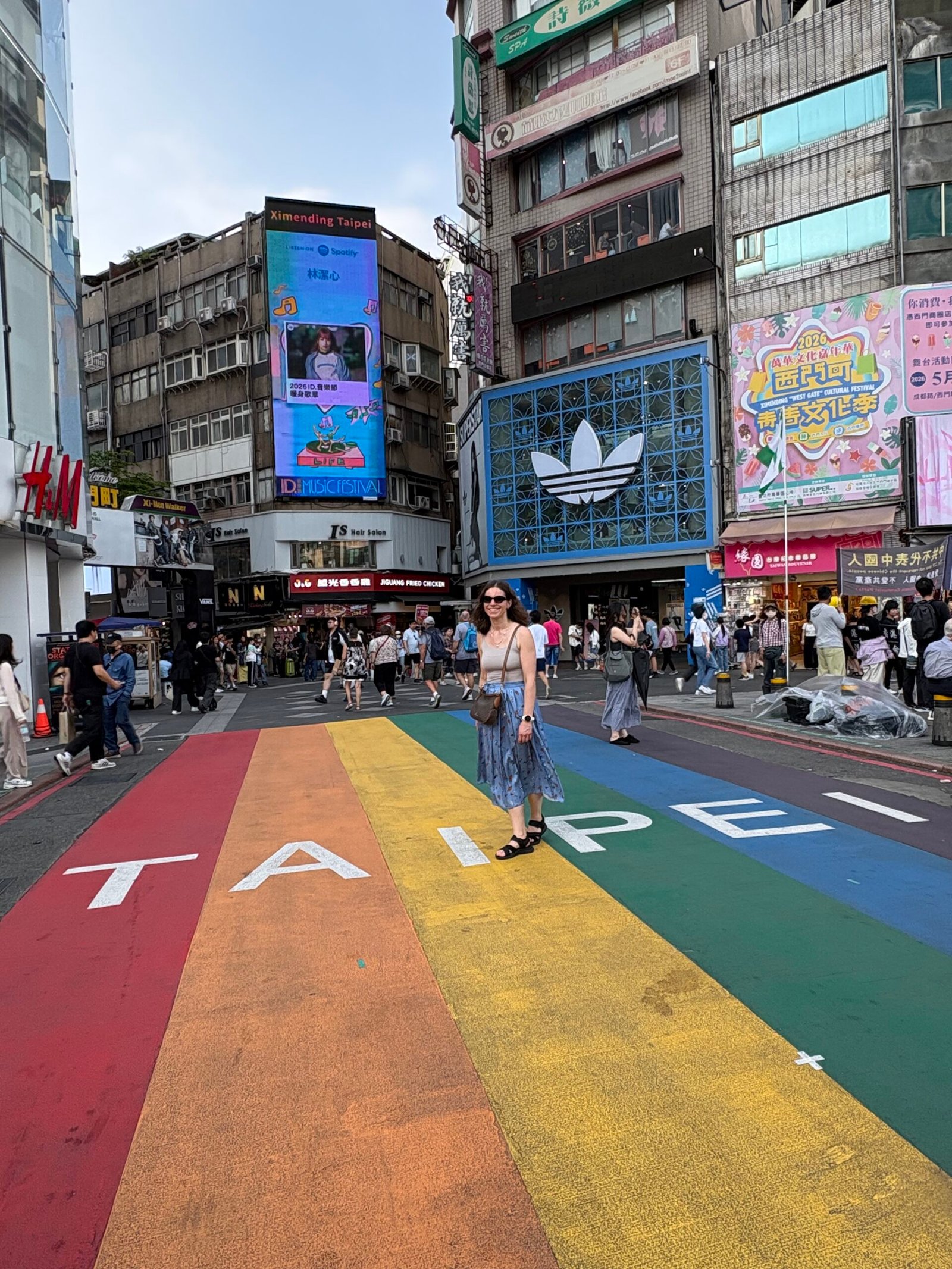
Eventually we reach what might be Taipei’s equivalent of New York’s Times Square. A huge intersection surrounded by countless screens and advertisements. There’s also supposedly a famous attraction here – a rainbow pedestrian crossing with “TAIPEI” written on it. Out of everything we’ve seen, I personally wouldn’t even put this in the top ten. But Madara gets her tick-box photo and we move on. We need somewhere to sit and rest our legs.
Technically, we should probably start heading towards the hotel because we still need to finish packing. But neither of us wants to pack. Because packing means the trip is quickly coming to an end.
TPE – PEK
04.05.2026: Time to start heading home. But there’s one final cherry on top – a 20-hour stop in China’s capital, Beijing. We’re going to try seeing the Forbidden City from outside and climbing the Great Wall of China. Sounds slightly adventurous. But we have to try. Who knows when we’ll appear in Beijing again?
On the flight to Beijing, I pick up a copy of China Daily and get an entertaining introduction to the heavily propagandised Chinese media interpretation of world events. For us, it’s almost light entertainment. But when you actually think about how one-sided the information is, it’s pretty crazy. After landing at Beijing Airport, we try – as politely as possible – to overtake as many people as we can between the aircraft and immigration. There’s a queue, but nothing terrible.
For a country like China, getting the 240-hour transit visa turns out to be surprisingly quick and efficient. Basically, if you arrive in China from country A and already have a ticket onwards to country B, you can stay in China for up to ten days without a regular visa.
So after literally around 15 minutes of bureaucracy, we get a Chinese stamp in our passports.
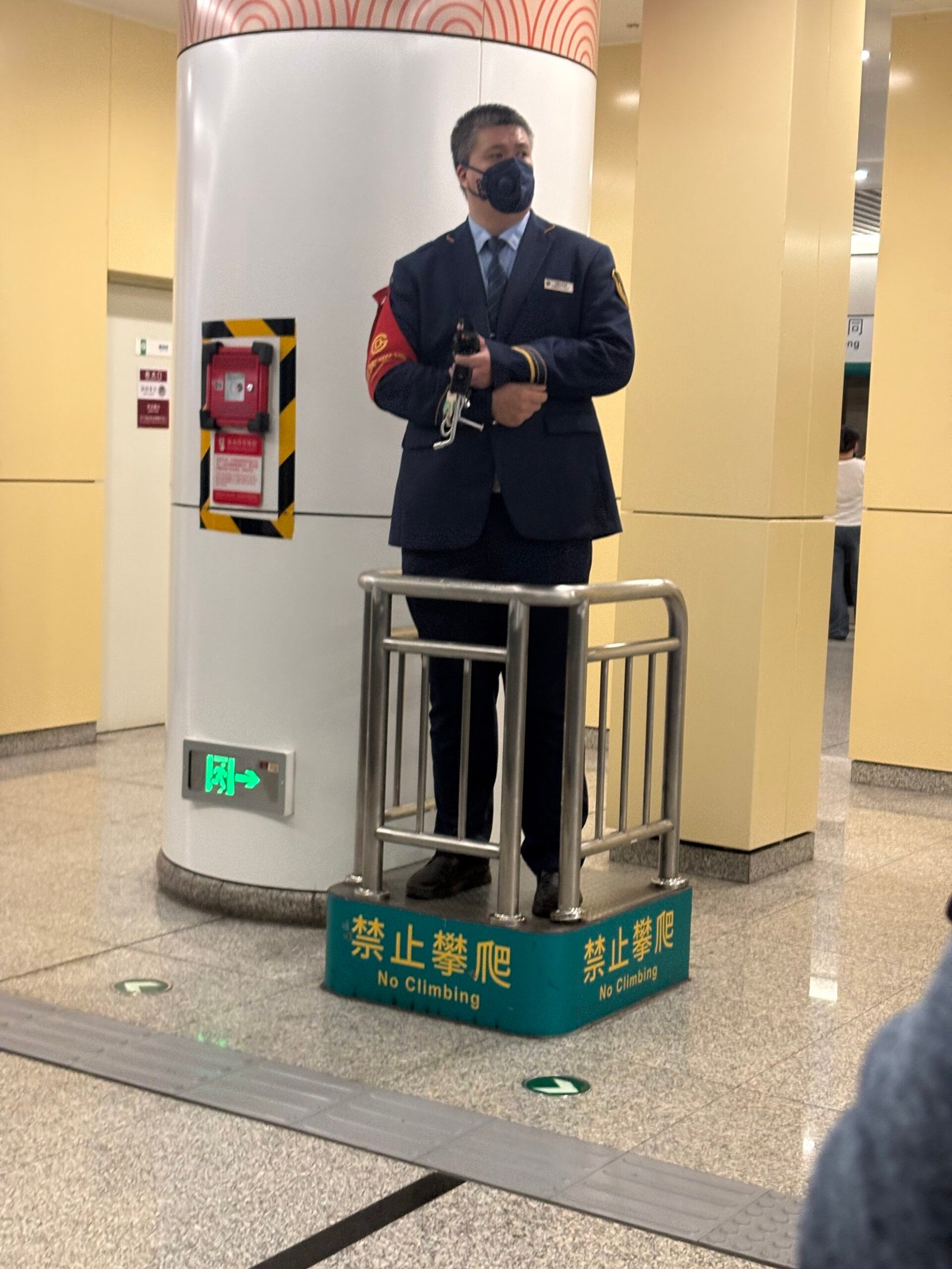
From there, everything is relatively simple – at least as simple as it can be in a foreign country where you can neither read nor say anything. First, we take the airport’s internal train to the exit terminal. Then we need tickets for the Beijing Airport Express, which gets us into what can loosely be called central Beijing in around 25 minutes. The hardest part is buying metro tickets because all the information is in Chinese. If you select English, you basically only get station names and not much else. We catch a local metro employee. A young guy who, naturally, doesn’t speak English. With Google Translate, though, we quickly manage to get the tickets.
The station we need is, for some reason, closed until 18:00 today, which is why we couldn’t buy the normal tickets. The guy shows us which line to change onto so we can go around it. That’s what we do. Or at least what we attempt to do.
THE FORBIDDEN CITY IS ACTUALLY FORBIDDEN
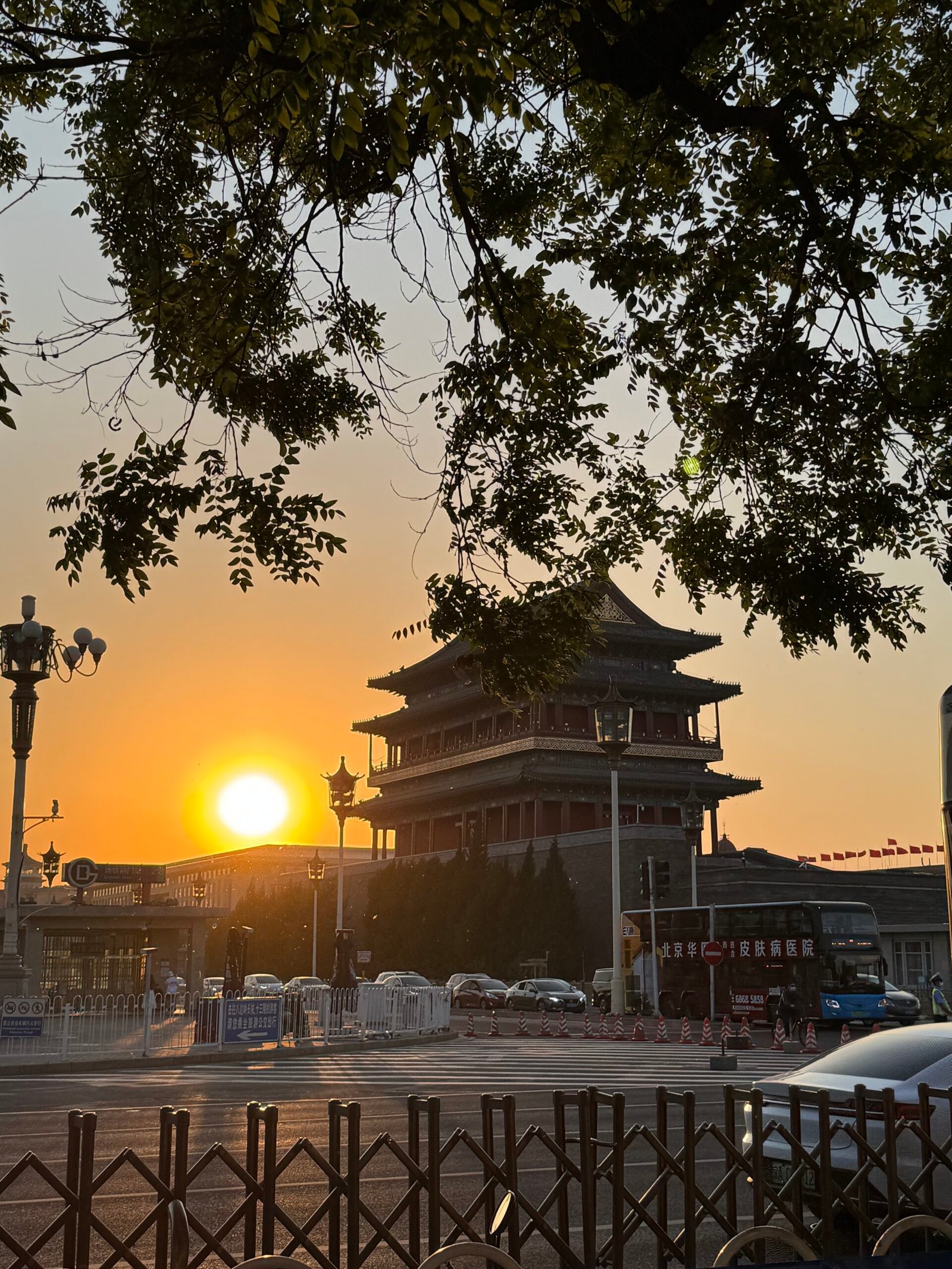
04.05.2026: The moment we step out of Qianmen metro station, the number of security personnel on every corner is impressive. Loudspeakers everywhere declaring something.
Little soldiers standing guard while simultaneously being filmed themselves. Maybe the cameras are there to make sure they don’t slack off? Metal barriers everywhere. The directions we’re actually allowed to walk are extremely limited. Even Red Square in Moscow would look relaxed compared with this. We don’t get into Tiananmen Square. As our guide explains the following day, every morning at 07:00 and every evening at 19:00 the Chinese flag is ceremonially raised or lowered. It’s an event you need tickets for, and apparently local people attend in huge numbers.
And from the sound of it, participation is perhaps slightly “voluntarily mandatory”. For us, it results in walking around two whole city blocks. Around 7.5 km and at least an hour and a half.
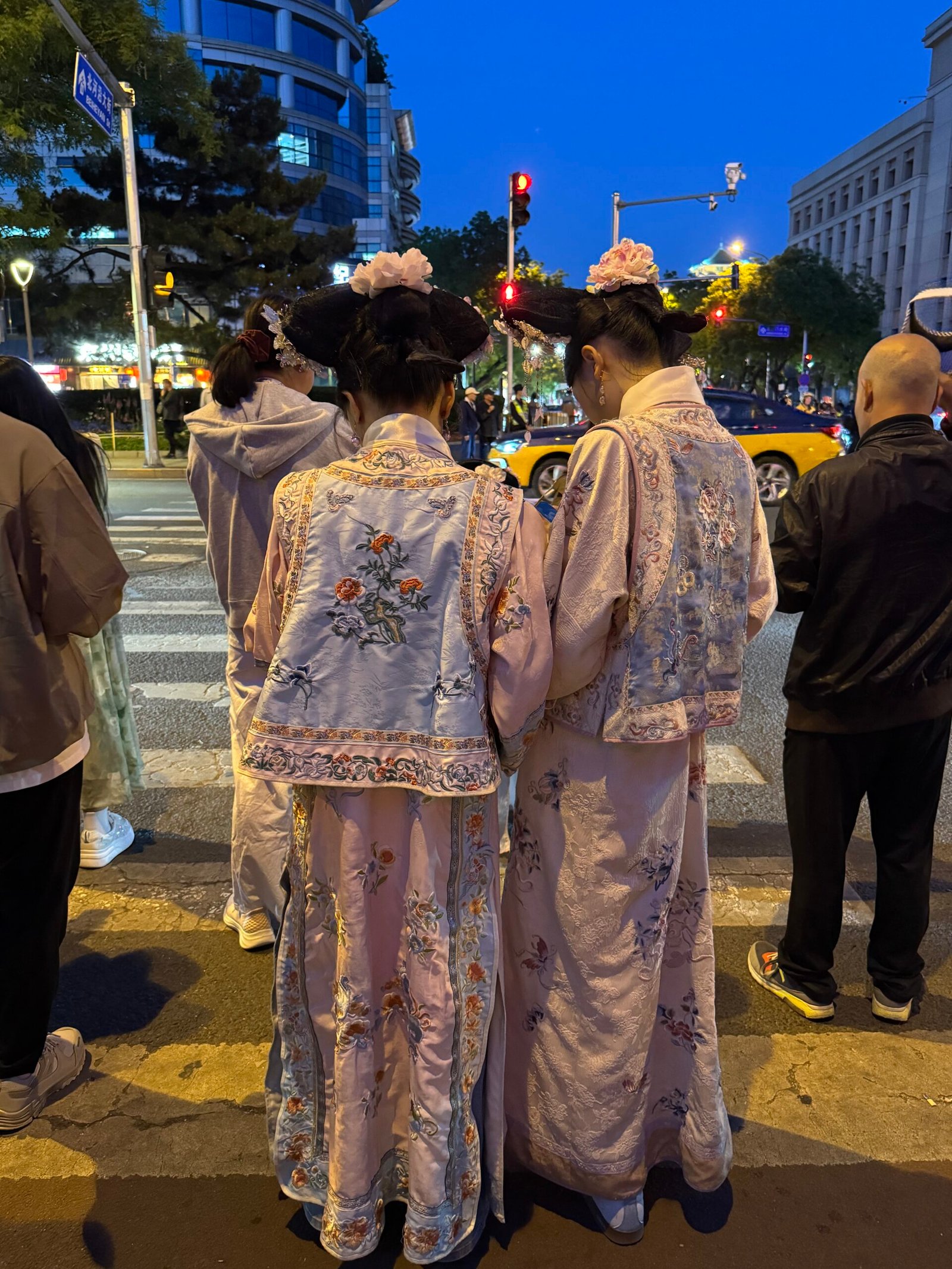
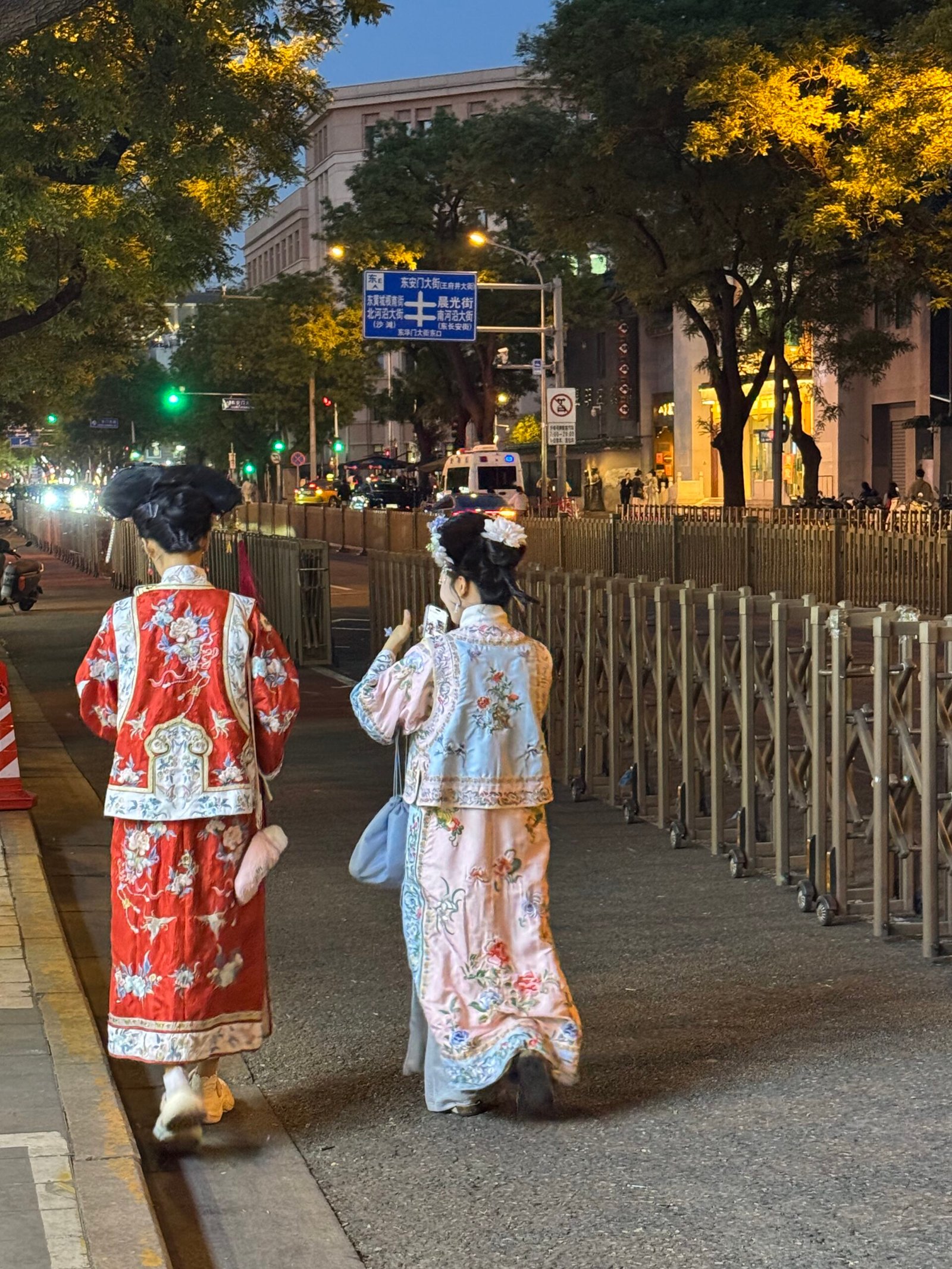
In the end, all we manage to see is one side gate of the Forbidden City. Today, the Forbidden City genuinely is forbidden. At least for us. Eventually we reach a less propaganda-heavy part of the city – the Hutong area around Nan Luo Gu Xiang. Here the atmosphere is completely different.
Shops are full. Everyone is eating in cafés. Loads of people.
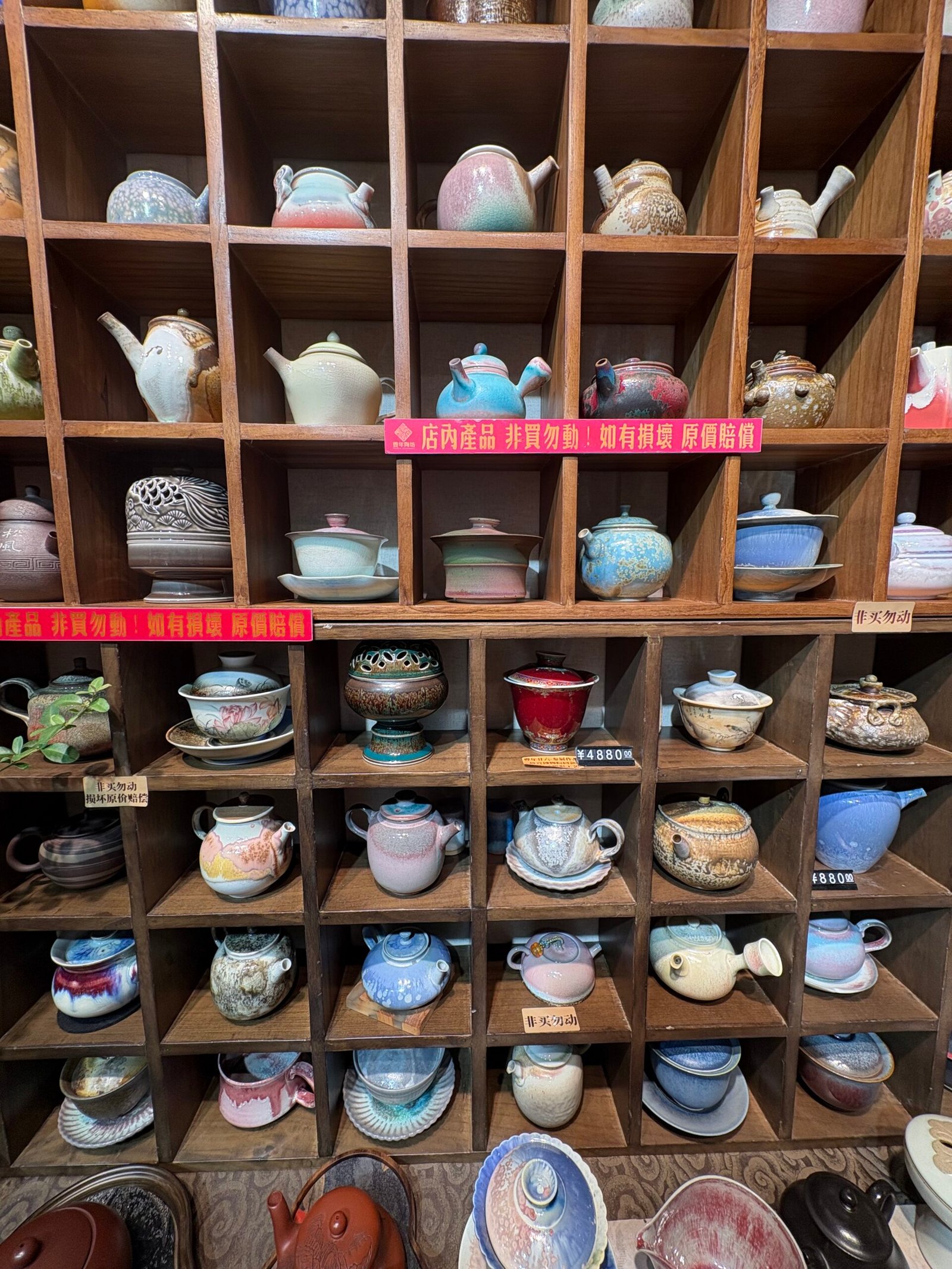
We also finally get dinner, after which Madara once again goes shopping in a tea-pot store.
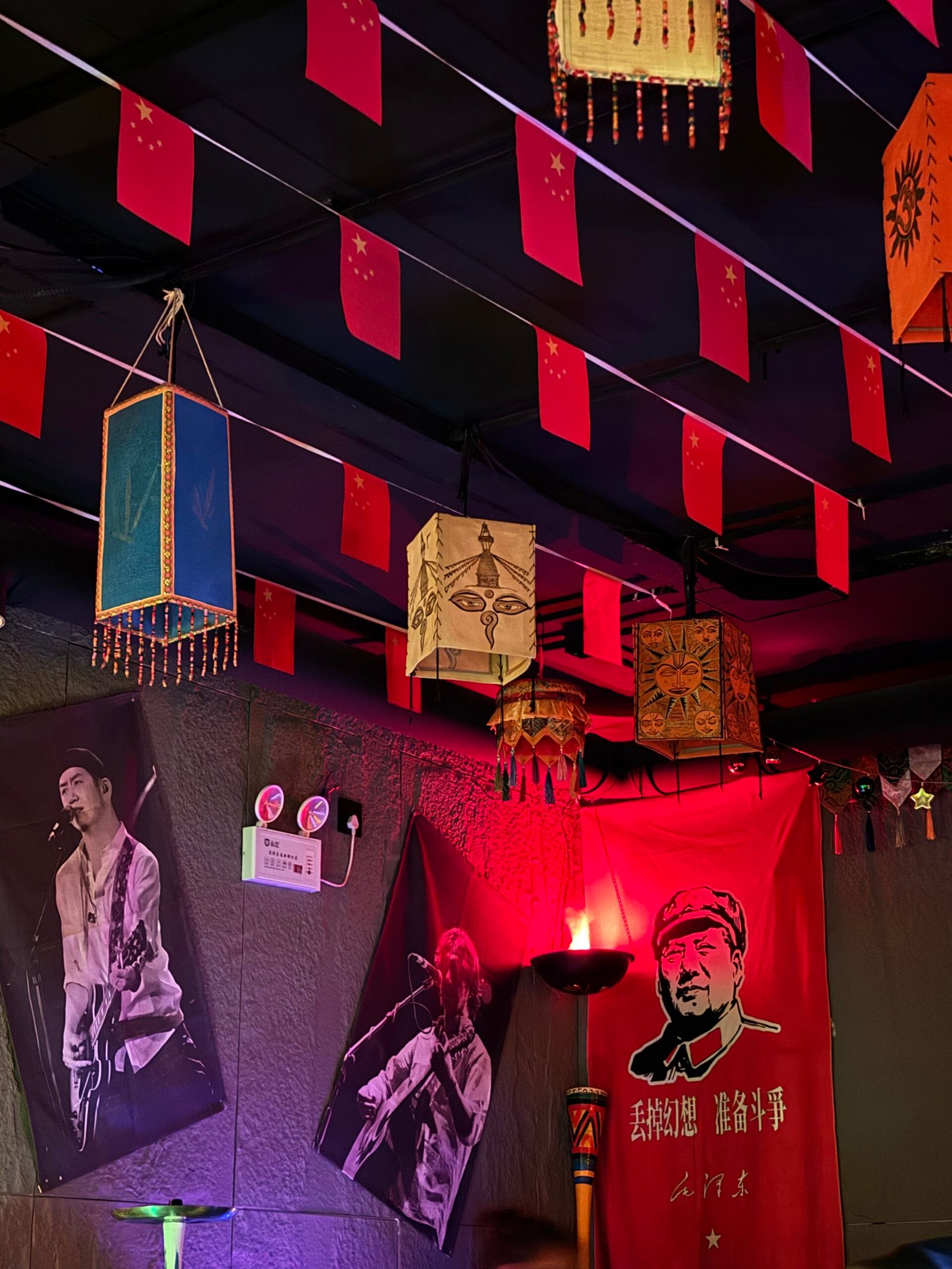
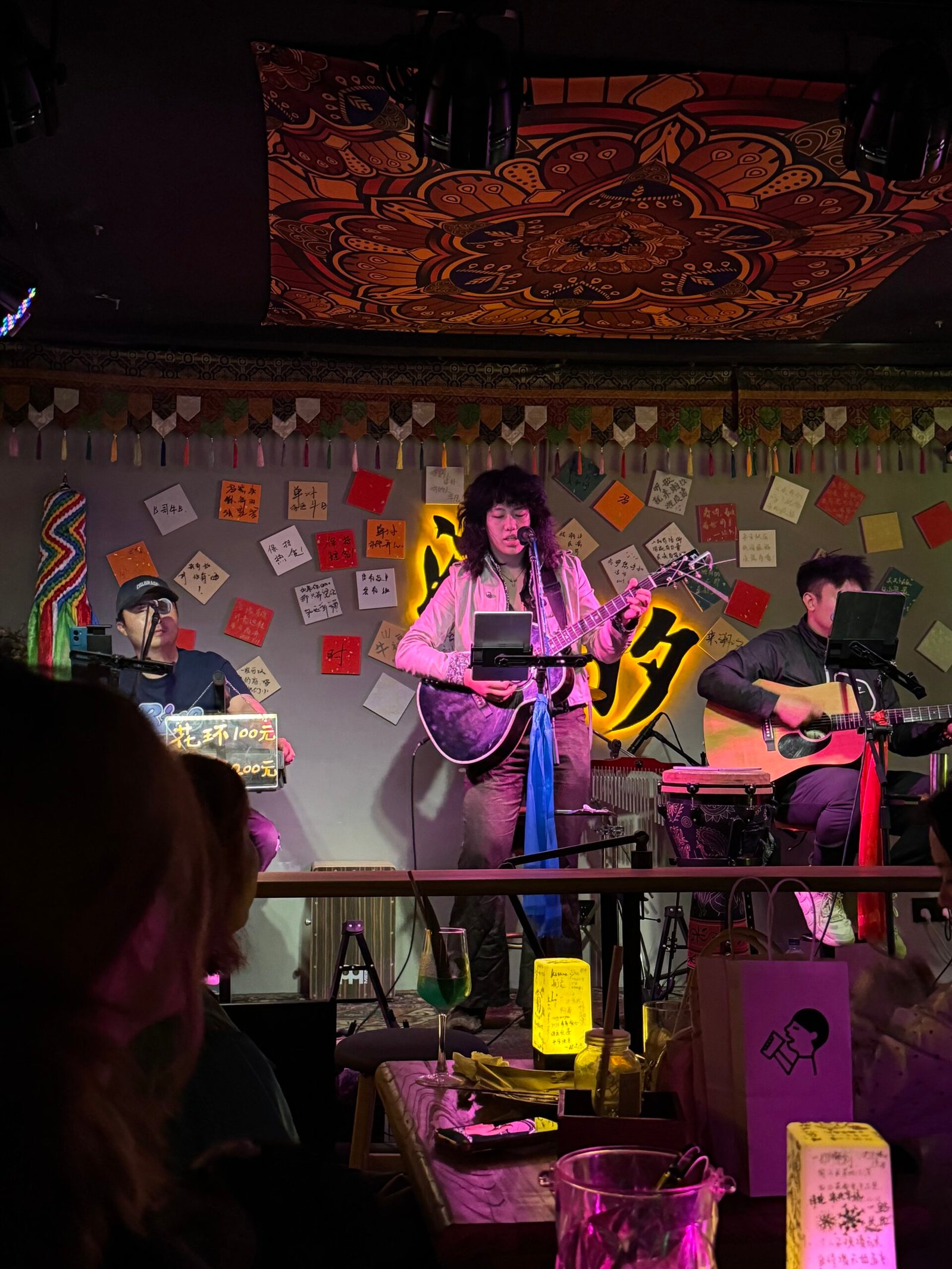
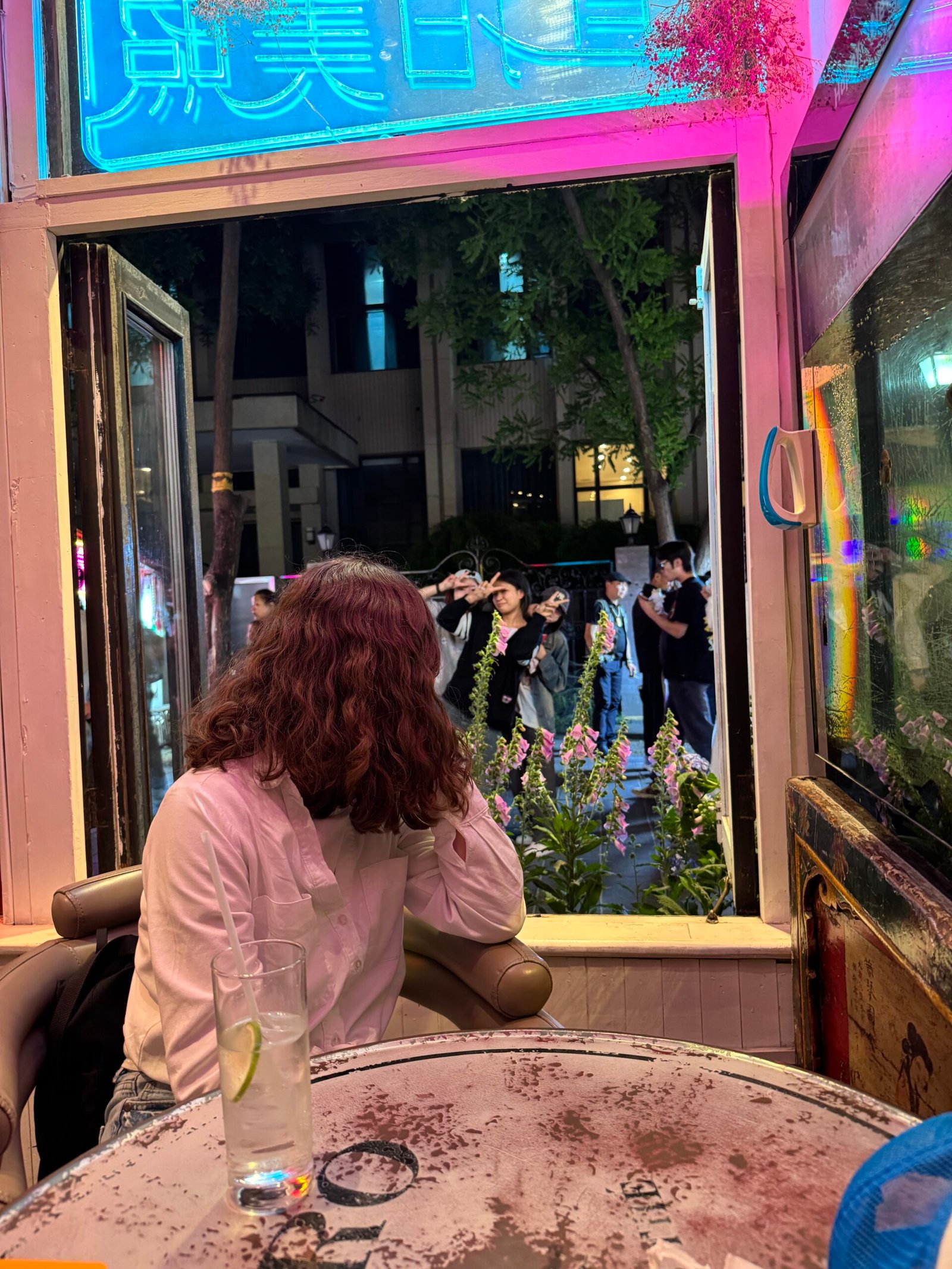
That particular purchase eventually ends up on a shelf in Grobiņa and actually gets used. We sit in a bar where I get a locally brewed Beijing draft beer. Genuinely fresh and tasty! While sitting by the window, every now and then we become an attraction for local people ourselves. I’m taking photos of Madara. Local girls are also happy to pose for pictures with Madara. Nice! Slowly, we start moving towards the hotel. We stop at another bar because we hear live music from the street. Three guys are playing something like rock ballads. And everyone in the place – apart from us, obviously – sings along. Apparently these are well-known songs. It’s already pretty late.
I don’t feel particularly sleepy, but tomorrow starts ridiculously early, so I arrange a taxi to the hotel. Neither of us feels like walking another five kilometres. Everything works smoothly.
Five minutes later the driver arrives, and another 20 minutes after that we’re in our hotel room.
The hotel is gigantic. Yet during our one-night stay, we don’t see another single guest besides the girls at reception. China’s everyday payment culture is so extremely digitalised that even a normal credit card seems to have become a forgotten object. At the hotel, I hand over my card to pay. The employee initially looks confused and doesn’t really understand what she’s supposed to do with it. Eventually, she pulls some dusty old payment terminal out of a drawer and manages to charge the card. Interesting. At least in Beijing, there’s definitely no reason to search for cash.
Maybe smaller towns are different. Another slightly strange detail: every hotel room contains gas masks. Some training from Šopets would be useful to know how to actually put one on.
GREAT WALL OF CHINA
05.05.2026: Today begins ridiculously early. The alarm goes off at 05:00. We went to sleep around 01:00, so it feels like I fell asleep half an hour ago and now I already have to get up. But we have a mission. And this one is worth leaving the bed for! Before leaving, we eat a microscopic breakfast that looks basically like instant noodles and go. Madara’s separately packaged boiled egg and chicken leg bought yesterday don’t exactly make for an appealing breakfast either.
Before the trip, I had already managed to find a local guide who will meet us at the hotel in the morning, drive us to the Great Wall of China and then take us directly to the airport. Arranging something like this purely through an email conversation with somebody I found on a slightly questionable-looking website feels fairly adventurous. But here we are.
At exactly 06:00 on the morning of May 5, our guide Yan is standing in the hotel lobby exactly as agreed. Ready to go!
The first thing she asks is how we can possibly have so little luggage and whether we’re going to freeze in shorts because it’s “only” +24°C outside. We reassure her that we’ll survive and climb into the van. Around an hour later, we arrive. Traffic is good because today is the final day of the national May holiday and people are apparently using it to sleep in. On a normal working day, this journey would take significantly longer. Our driver has a pretty fancy and comfortable Buick minivan. Separate seats for everyone, perfectly conditioned air. Very nice. On the way, Yan tells us all kinds of interesting things about both Chinese history and Beijing. Naturally, though, our focus is the main attraction – the Great Wall. There’s loads of information and it’s genuinely interesting.
But absorbing that much new knowledge this early in the morning is difficult. We arrive basically right when the site opens. Yan does everything for us. Buys the tickets, puts us in the correct line, explains what happens and where to go. All we need to do is physically exist. So this is how Madara travels all the time!?
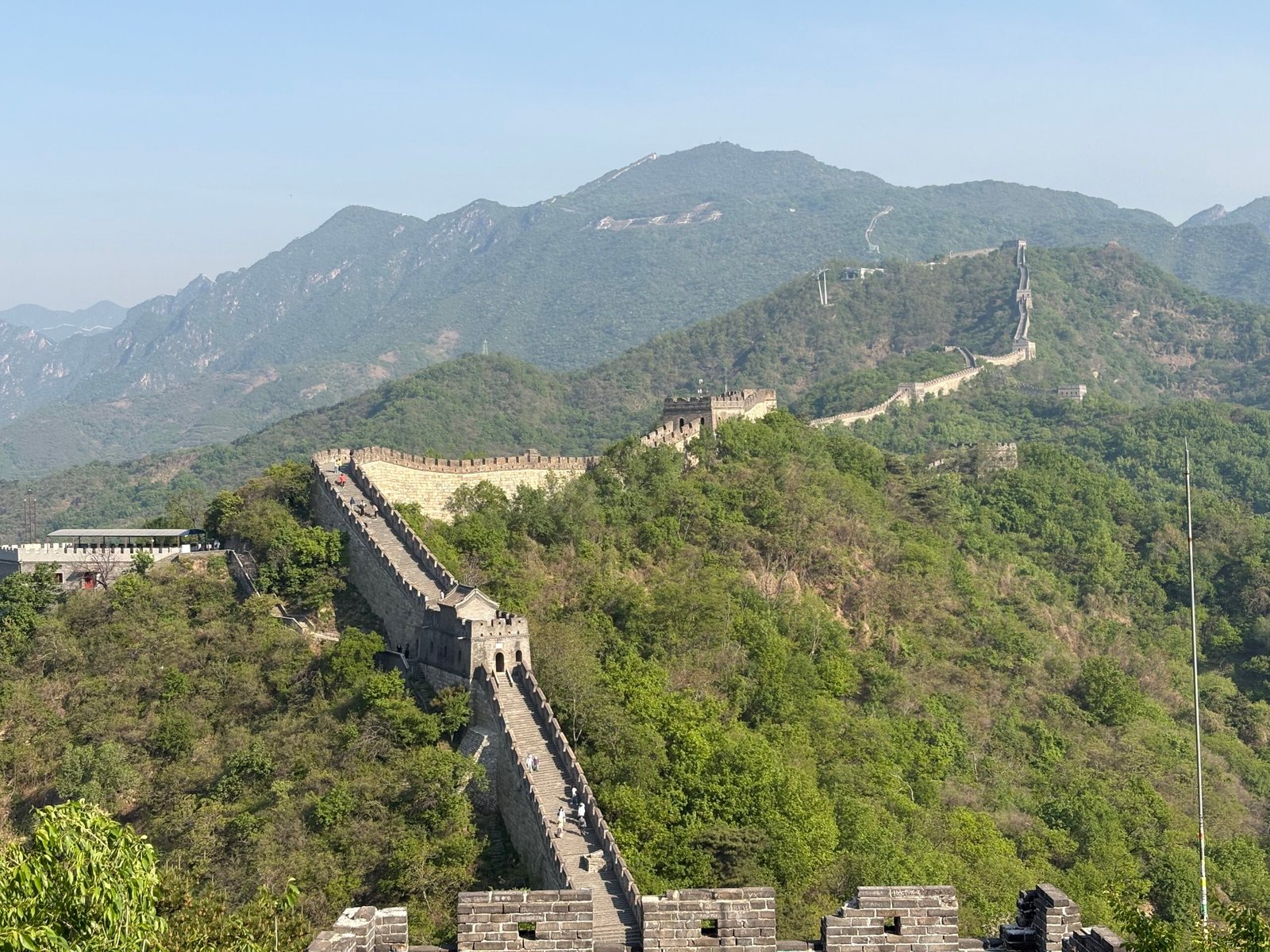
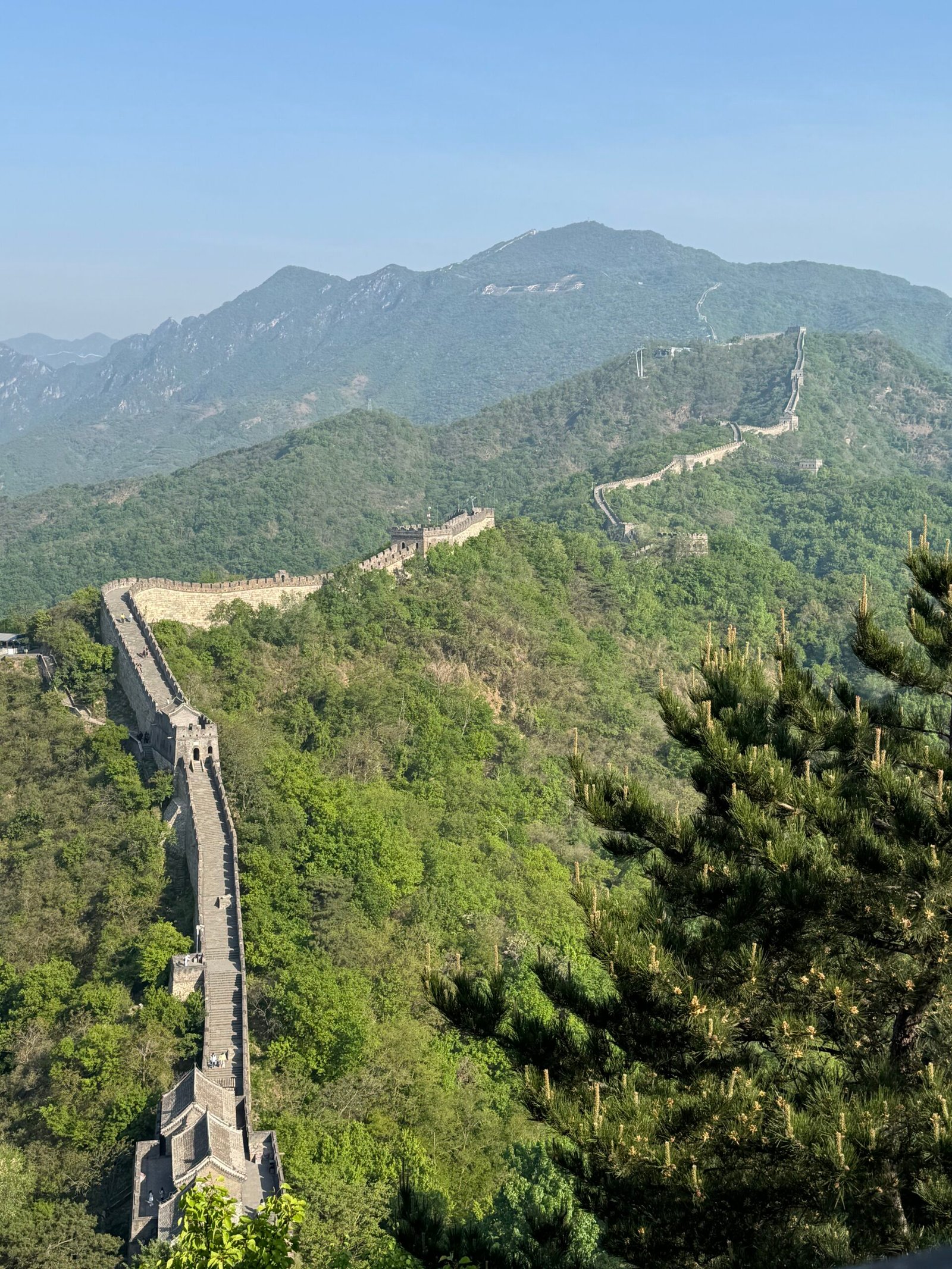
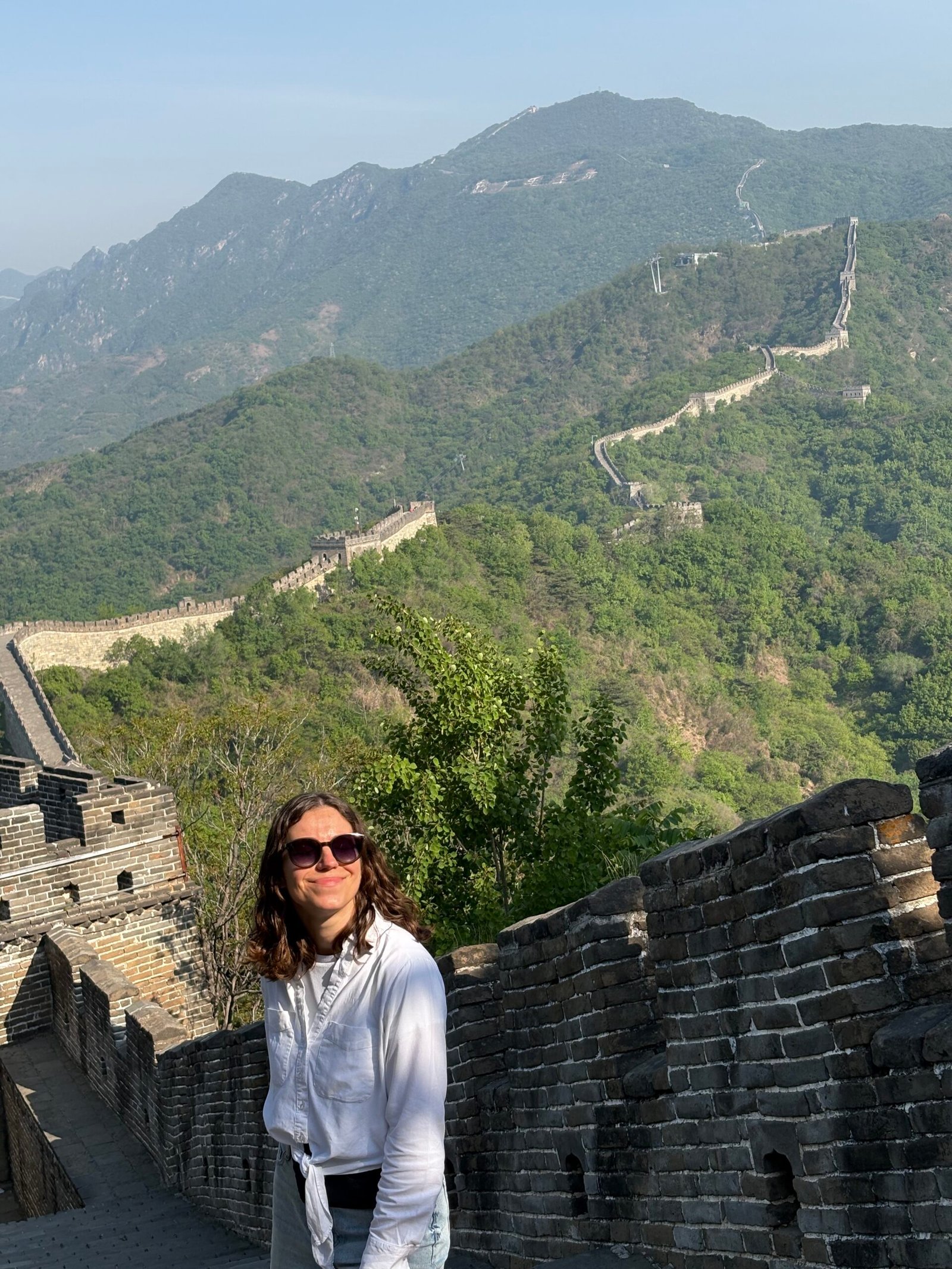
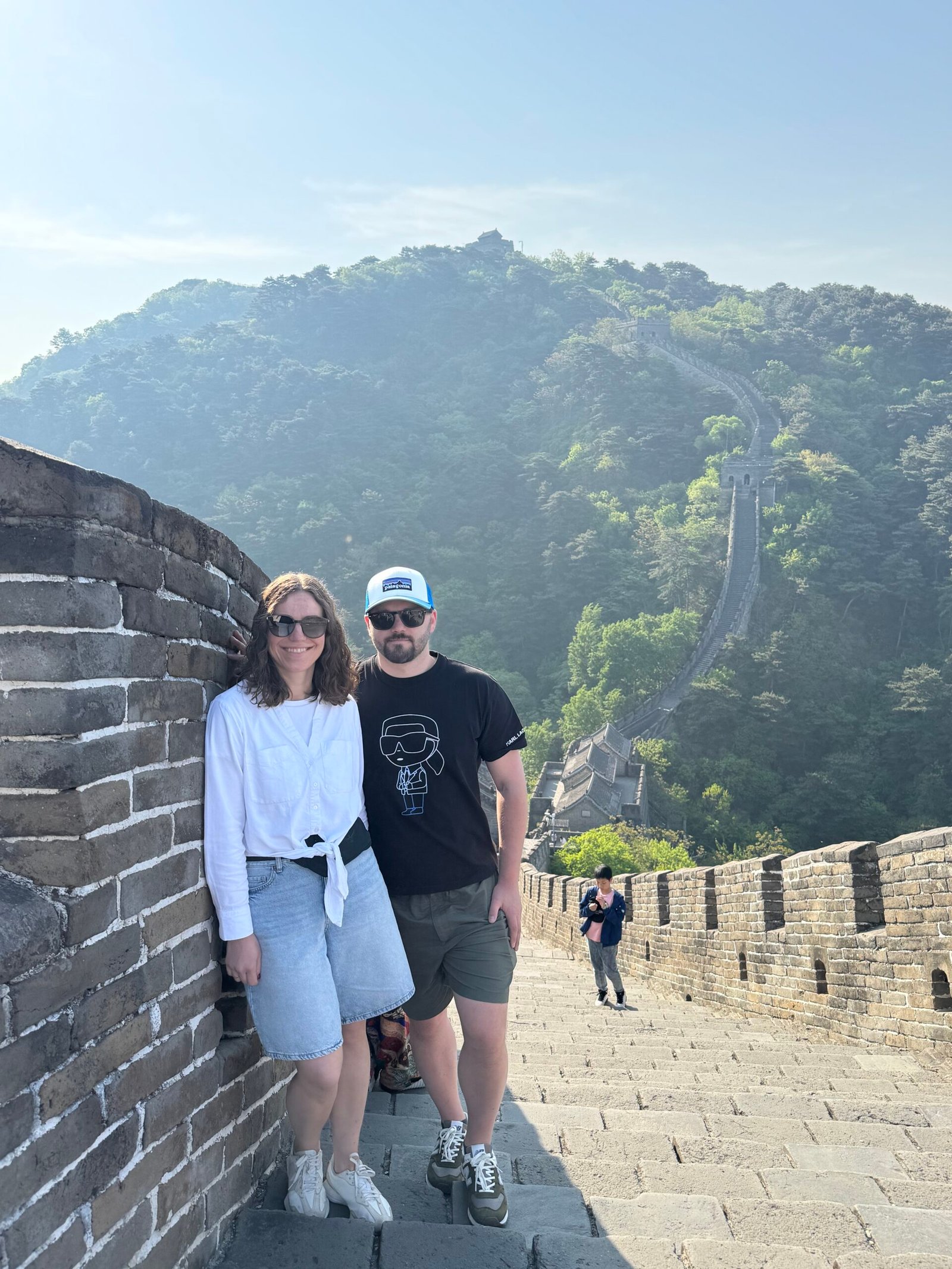
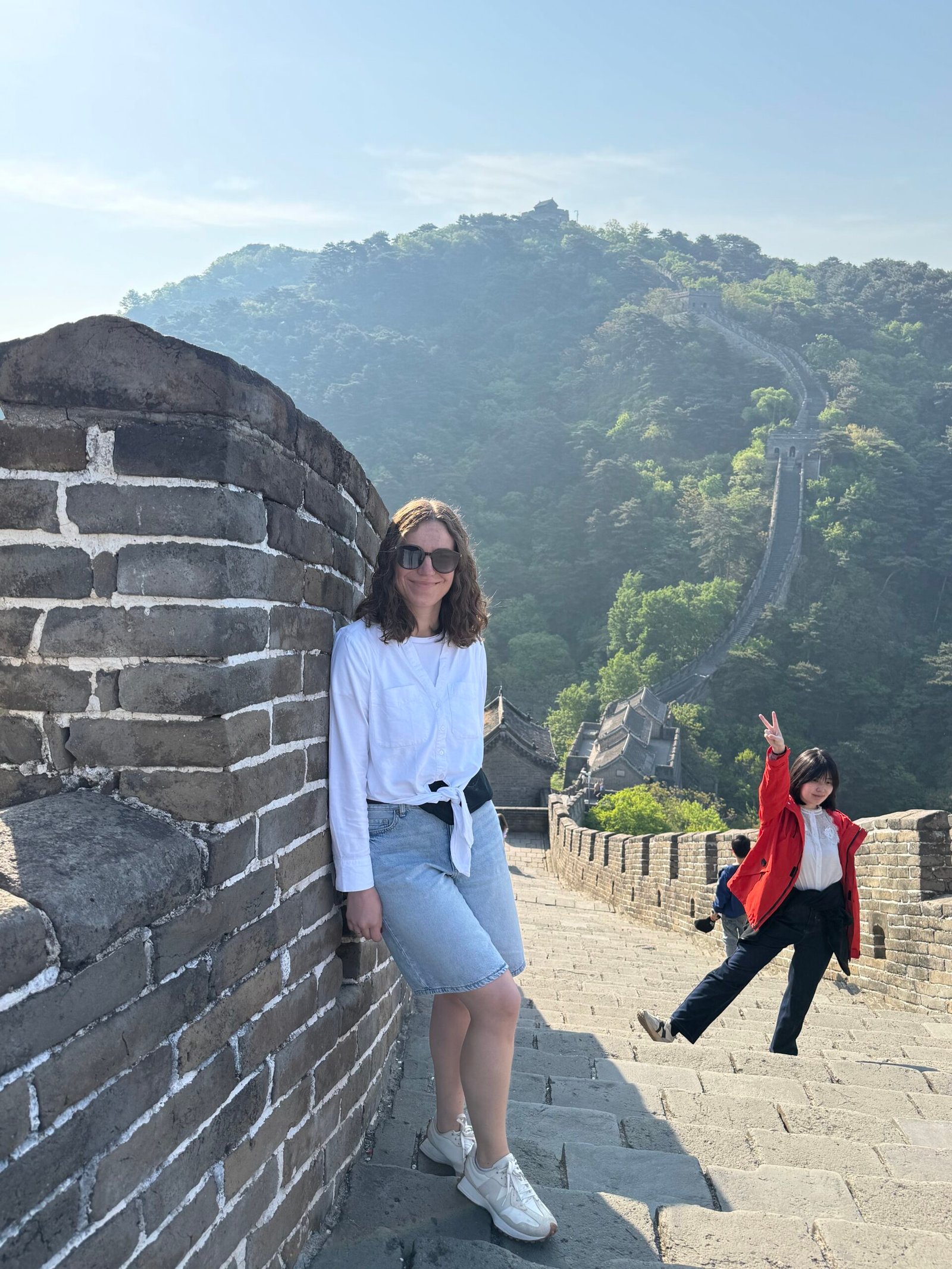
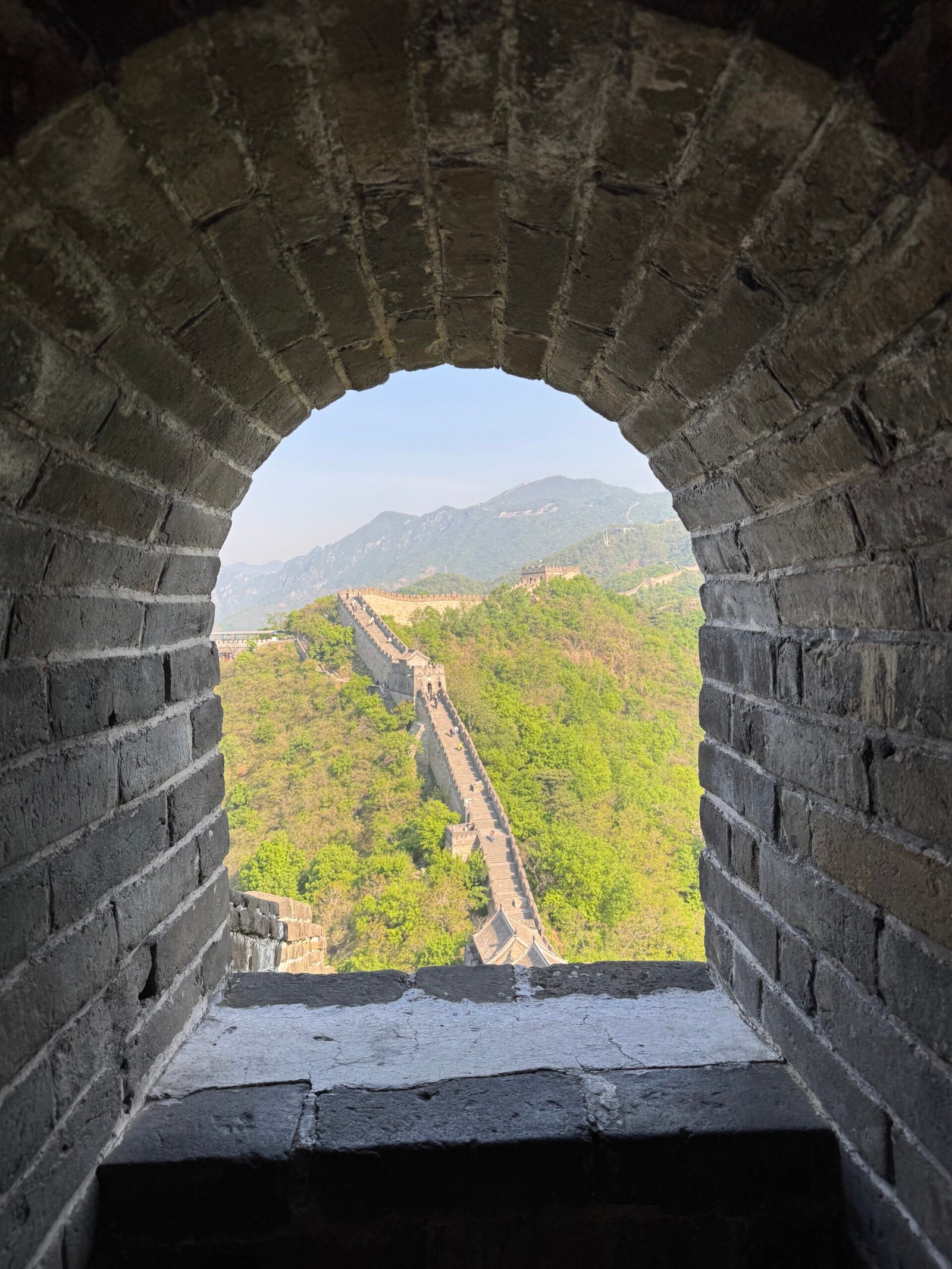
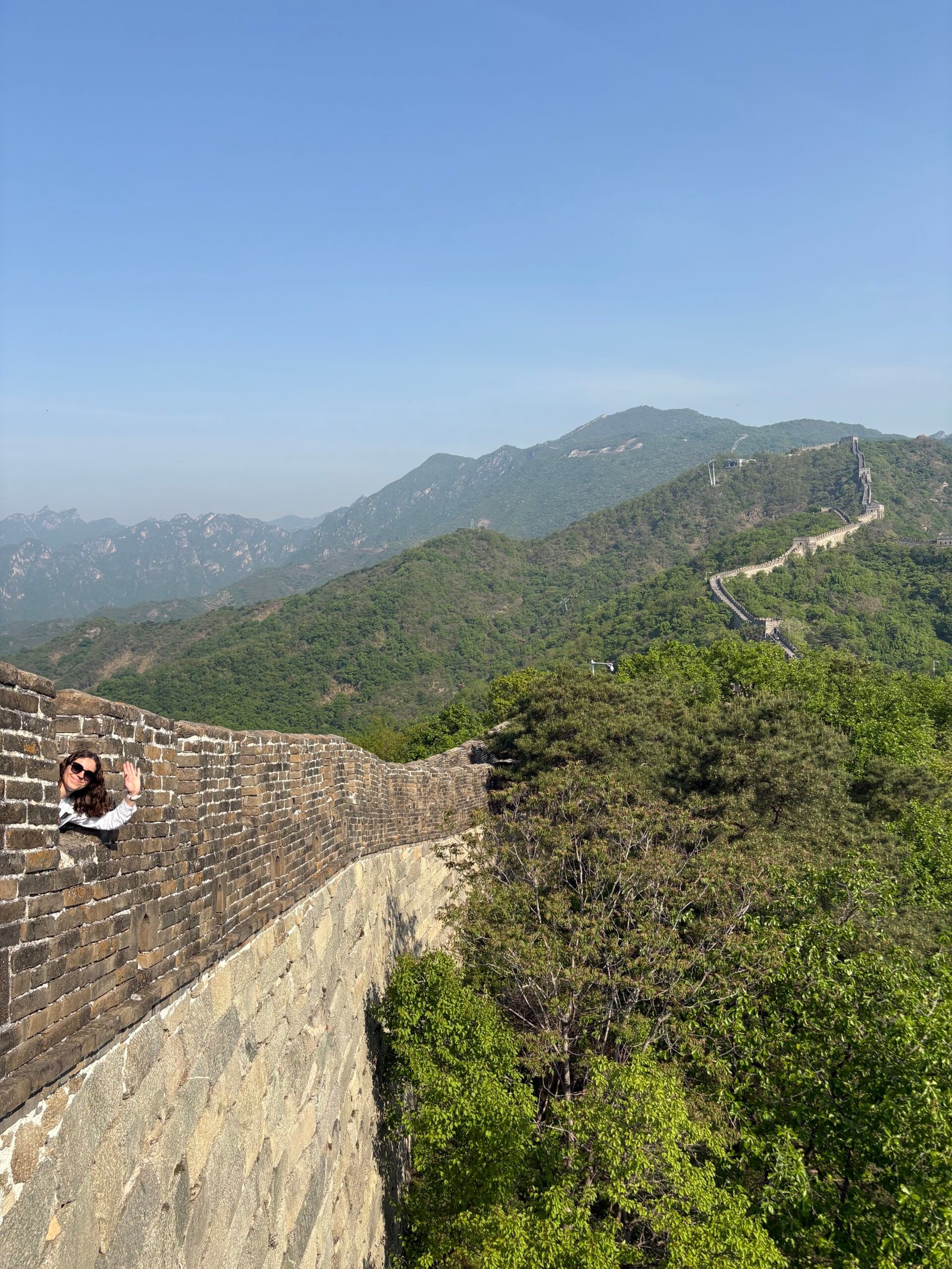
Today we’re among the first ten people to step onto this world-famous wall. A cable car takes us up in around five minutes. And there it is! We get unbelievably lucky with the weather. Clear skies and almost exclusive views because there are so few people this early. We even get some of our rare proper photos together. Yan obviously knows all the best spots and photo angles, which Madara fully takes advantage of. The two of us continue towards one of the steepest sections, where a serious staircase climb begins. Yan tells us our legs are very long, so we’ll manage easily.
She’ll wait down here. The steps are high and the slope is extremely steep. But Yan is right.
It doesn’t cause us too much trouble. We’re strong!
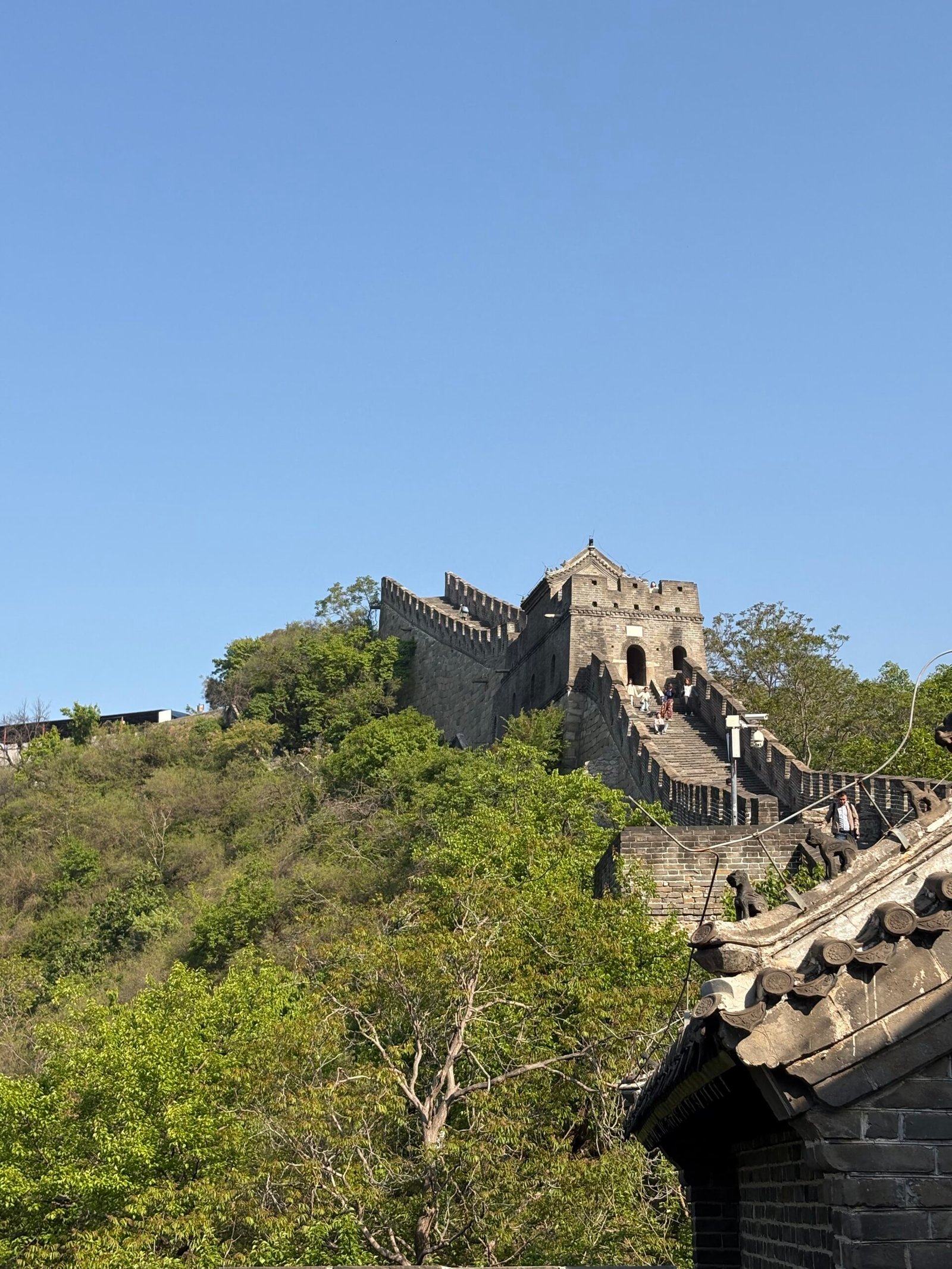
We’re visiting the Mutianyu section of the wall, one of the easiest parts to reach from Beijing.
Construction of the Great Wall continued for almost 2,000 years. The earliest sections appeared in the 3rd century BC during the Qin dynasty, while the best-preserved sections – including Mutianyu – were built or rebuilt during the Ming dynasty between the 14th and 17th centuries.
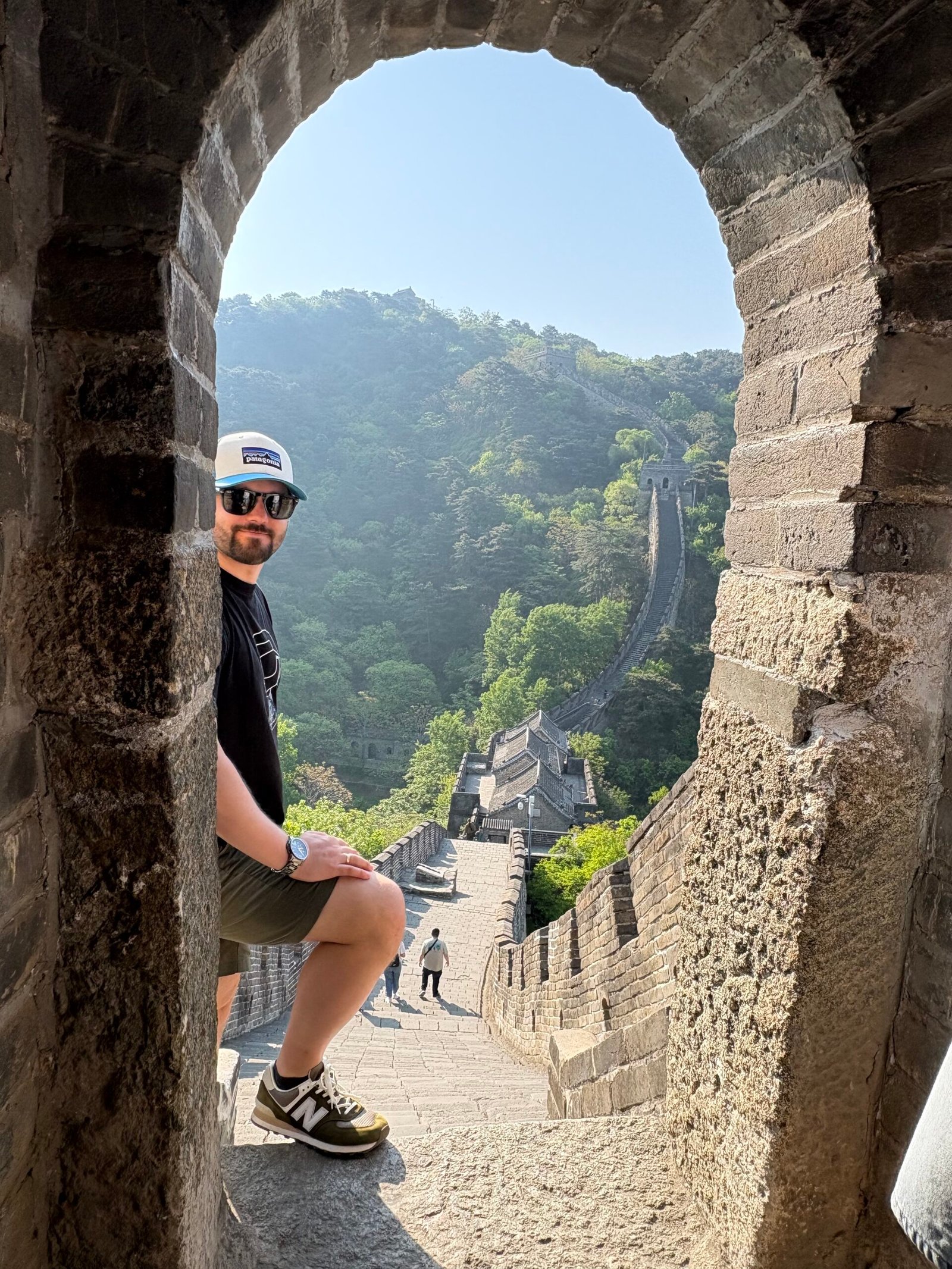
Mutianyu is one of the relatively rare sections where defensive walls and shooting openings were built on both sides, allowing defenders to fight enemies approaching from either direction.
Climbing higher up the steep steps reveals the true scale of the Wall. You can see it bending across ridge after ridge, disappearing into the distance in both directions as far as the eye can see. UNESCO World Heritage.
The Great Wall has been on the UNESCO list since 1987 and is considered one of humanity’s greatest engineering achievements. Obviously, we have an almost disrespectfully short amount of time to spend at one of the world’s great wonders. But we’re extremely happy we managed to organise even this 1.5-hour visit. Absolutely worth it. Especially after yesterday’s Tiananmen Square fiasco. There’s an interesting way to get down from the Wall: a toboggan ride.
Everything would be great if there wasn’t a rather large man stuck ahead of us whose sled absolutely refuses to move properly. He creates a massive traffic jam. Anyway. Another world wonder successfully visited. Before heading to the airport, we sit with Yan over coffee, discuss the experience, pay for the tour and start towards the airport. Yan gives us a little Great Wall figurine as a gift. Very nice gesture. The figurine itself is admittedly just a little piece of tourist junk.
But at least here, when it says “Made in China”, it genuinely means the product is local! 😆
Now begins the long trip home. Interestingly, in a straight line Beijing to Stockholm is less than 7,000 km. That’s roughly three times shorter than the total length of the Great Wall of China.
That thing is basically half the length of the Equator!
PEK – ARN
05.05.2026: Yan and our driver proudly deliver us to the terminal doors like VIPs and even offer to accompany us to the check-in desk. We politely decline. I think we’ll manage from here.
We say goodbye and head inside. A very enjoyable tour!
For many years, before Beijing’s second airport opened, PEK was the world’s second-busiest airport by passenger numbers. Around 100 million passengers passed through each year.
After the Covid pandemic and the opening of the new PKX airport, that number dropped to “only” around 70 million. For comparison, Riga Airport handles around seven million passengers per year. Our big backpacks were already checked all the way through to Stockholm back in Taipei, so all we need to do is get ourselves through the airport. The immigration queue isn’t too long, and fairly quickly we get our Chinese exit stamps. We’re inside Terminal 3. And referring back to the size of this airport: it’s so enormous that within one terminal you need trains to travel between three different sections. At most other airports, trains are only needed between separate terminals. When we get off the train, though, I suddenly get that feeling: that’s it.
We’re going home.
Home is obviously the best place. But travelling is also extremely fun. That emotional moment is quickly interrupted by my growling stomach. The instant noodles I ate at five in the morning have long since been burned off on the Great Wall stairs. I’m seriously hungry. The positive thing is that while flying through here earlier, I already spotted somewhere we could eat. It’s not Asian at all, but there really aren’t better options in this terminal. So we go for Chicago-style burgers in Beijing. Madara chooses something more like shashlik – meat and vegetables on skewers, grilled.
Her mistake is not checking what one particular vegetable is before eating it. Turns out it’s a red chilli. The redness then transfers itself to Madara’s face. After ten minutes, she looks like she’s been crying for an hour. After 20 minutes, she’s a functioning human being again. My burger is simply a burger. Tasty.
On the flight, we get lucky and receive poor man’s business class: the last row with nobody sitting next to us. Long-haul flights become incomparably easier when two people have three seats and there are more options for stretching out and rearranging yourself. On the way, I watch two good movies – Mercy and Furiosa: A Mad Max Saga – eat twice, sleep a little and still have time left to listen to music. The nine hours actually pass surprisingly quickly. We land in Stockholm around 15 minutes ahead of schedule. That’s helpful because our connection to the next flight is slightly tight. Flying home, I think about how nicely our last two big trips have worked out. Both had a little “cherry on top” during the journey home, which distracts you from the fact that the main trip is actually over. This time it was obviously the Great Wall of China.
On our previous Asia trip, we spent two days in welcoming Abu Dhabi on the way home. If there’s an opportunity in the future, we should definitely keep planning trips this way. Very refreshing and very enjoyable.
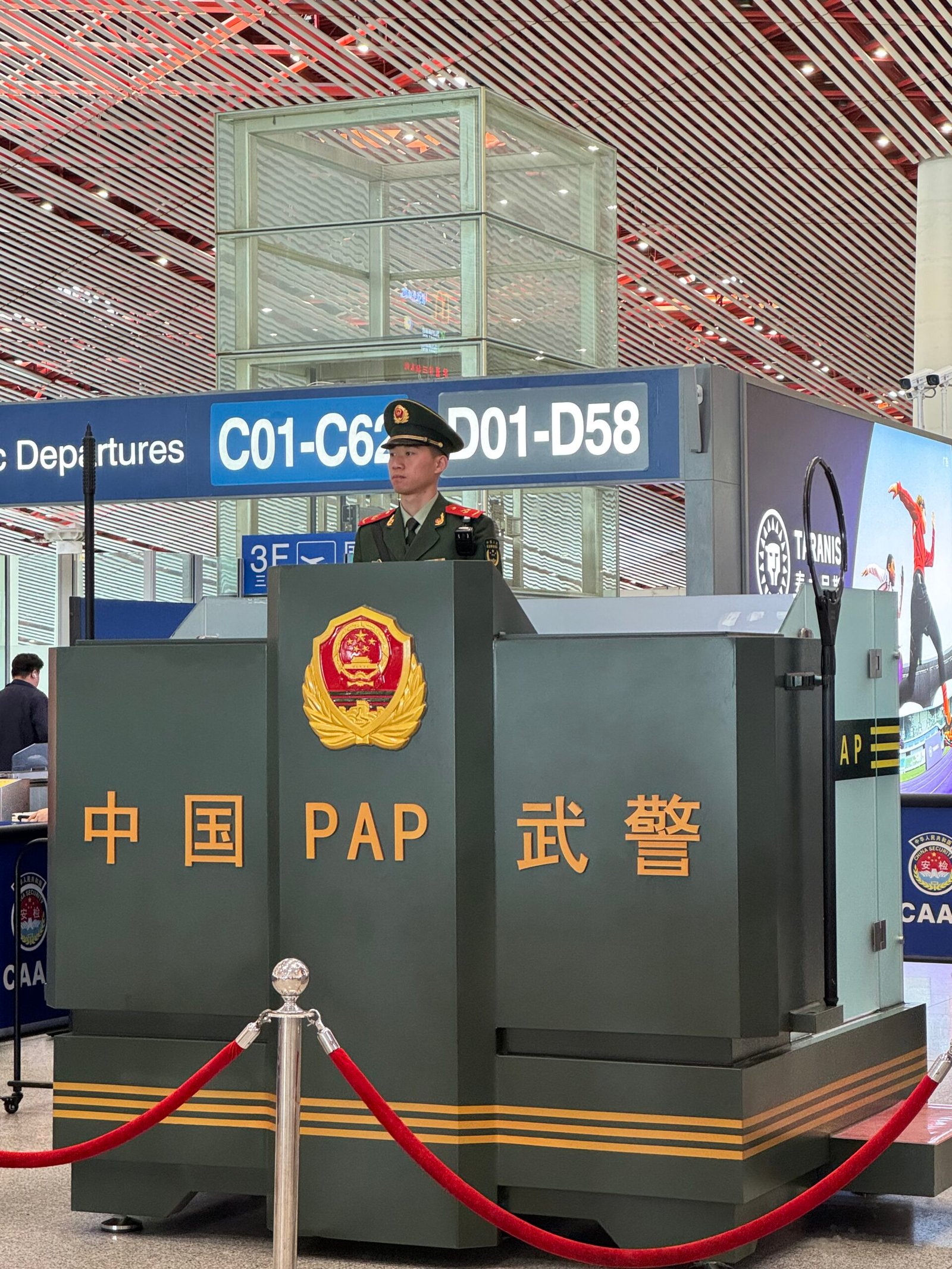
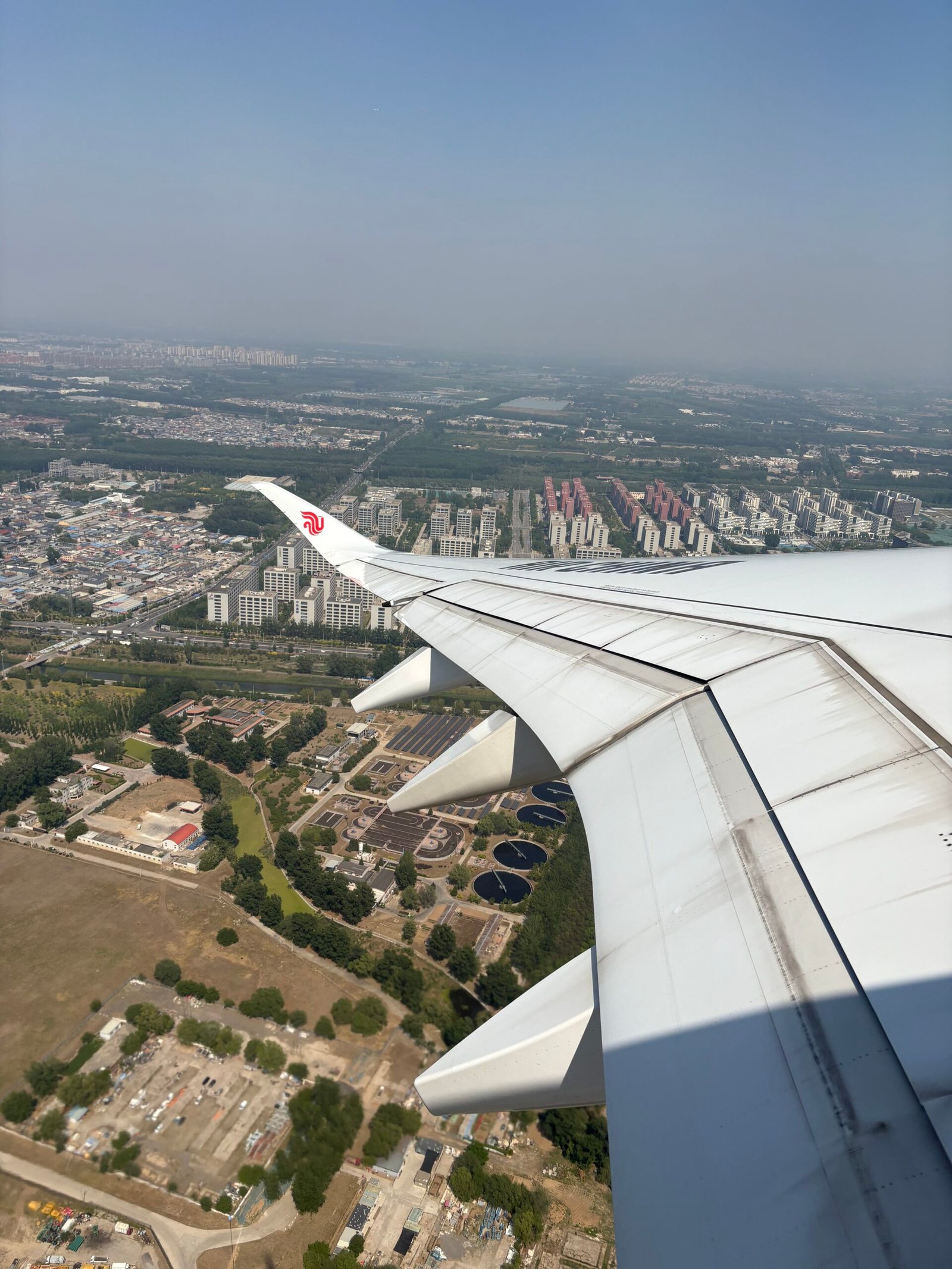
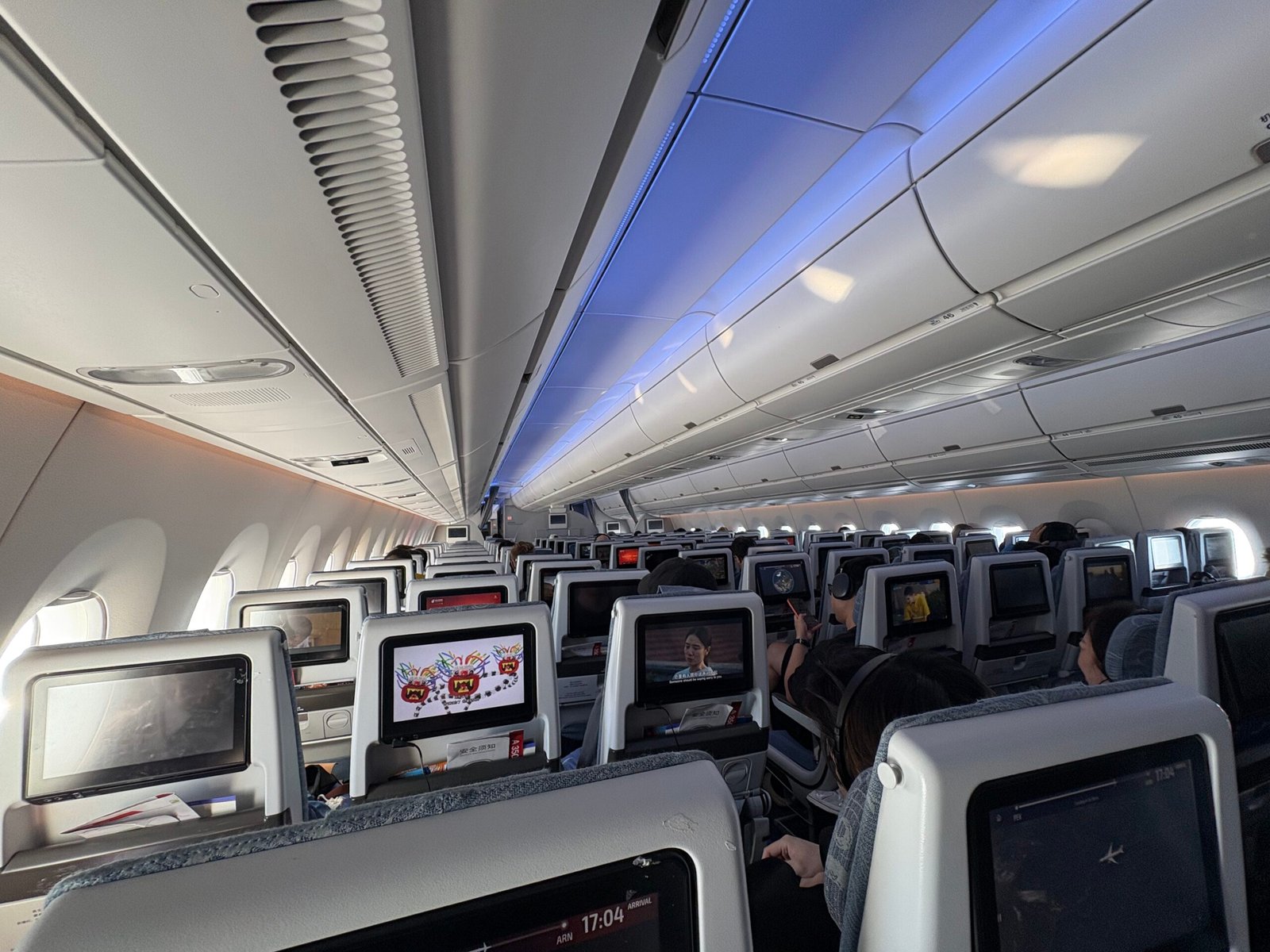
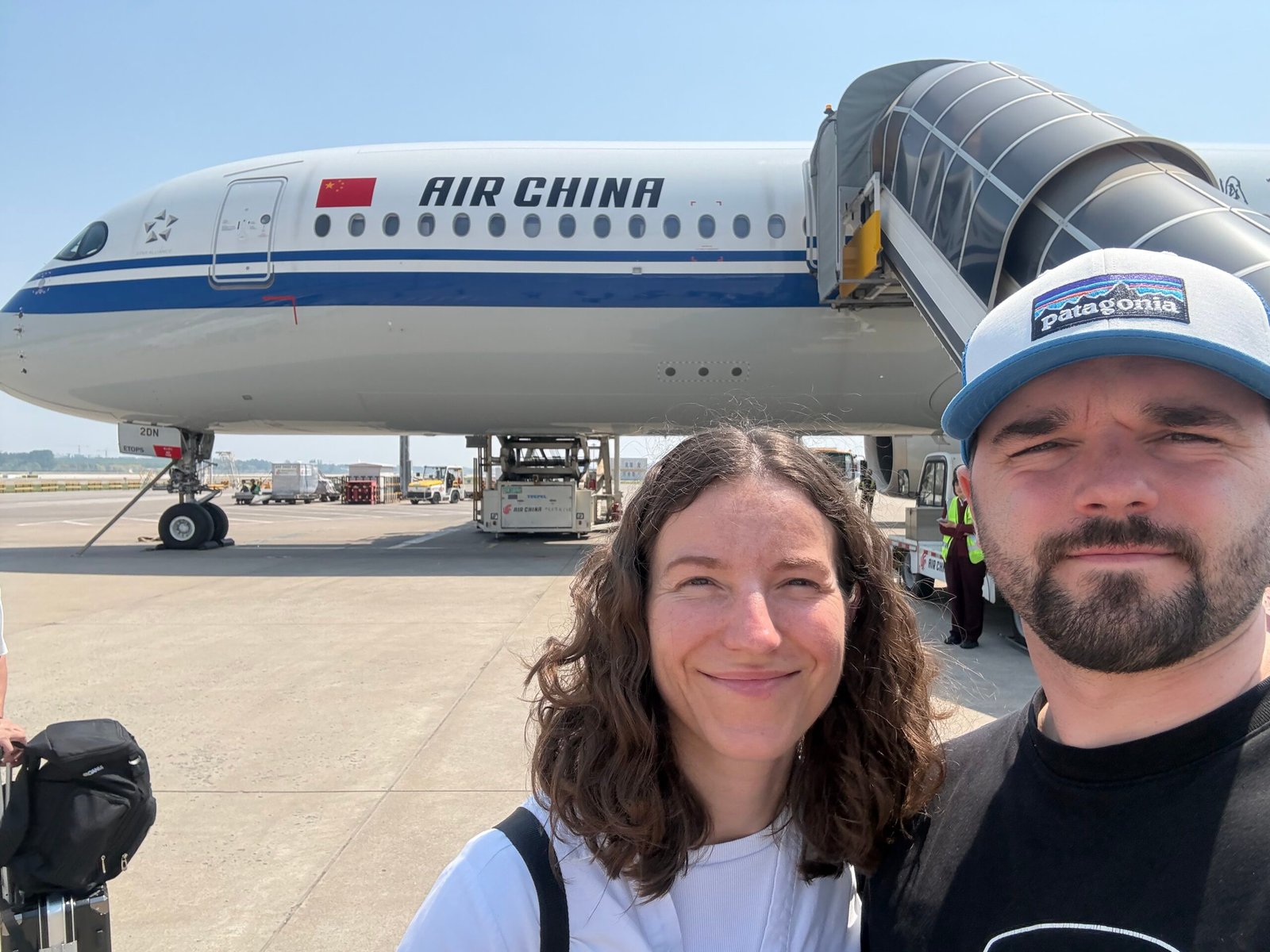
ARN – RIX
05.05.2026: Arriving in Sweden initially creates a little bit of stress. We have less than three hours between flights, and they’re separate tickets. That means we need to collect our luggage, technically leave the airport and then check in again from scratch for the flight to Riga. On top of that, the intercontinental and European flights aren’t operating from the same terminal – at least not today. Madara’s bag is one of the first onto the baggage carousel. Mine takes another 30 minutes. The positive thing is that I can see on my phone that the bag has at least landed in Stockholm together with us. Honestly, simply standing here in Stockholm waiting for luggage already feels like being home. Once the bags arrive, we quickly head to the train to move from Terminal 5 to Terminal 2. We check the bags for Riga with practically no queue, and security doesn’t take long either. This is the European Union after all!
And somehow we still end up with a full hour of free time before the final flight of the trip. The cool-down flight. We now have five different Asian countries on our travel list. Okay – Malaysia is basically only Kuala Lumpur. Indonesia is only one island, Bali. And China can barely be counted based on our 20 hours in Beijing. But still. In every place we breathed some local air and got at least a small taste of the culture. Singapore and Taiwan, I’d say, we explored fairly properly.
And every one of these countries is completely different. Taiwan is clearly a very self-sufficient place. The large majority of people appear to live fairly comfortable lives. Most drive decent and relatively new ordinary cars. There are practically no homeless people on the streets and the pavements are unbelievably clean. Because of the geopolitical situation and the relatively difficult access, there are few tourists in Taiwan. And you notice it. Convenience has been thought about on every corner. But it has been designed for local residents, not tourists. Okay, if you’ve come here – great. People are kind because that’s simply how they are. Not because they want something from you.
Practically nothing here exists purely for tourists. And that creates a very special feeling of authenticity. Nobody sponsored us, nobody gave us anything for free and we got here entirely by ourselves. But somehow there’s still a slightly privileged feeling in being able to visit and travel around Taiwan. We really loved it. This was also one of the hardest trips I’ve ever had to plan, both because of the language barrier and because there’s comparatively limited information available. Apart from the small Beijing fiasco involving the Forbidden City and Tiananmen Square, I feel like taking my hat off to myself. Everything worked out brilliantly. We went everywhere, saw everything, communicated our way through everything – and even managed to get home on time despite AirBaltic cancelling and rescheduling our flight.
Trip costs:
Flight tickets: €790
Car rental: ~€300
Total transport costs (including flights, car rental, public transport, fuel, parking fees, etc.): ~€1,350
Hotels: €800 (12 nights, ~€33 per person per night)
Total living expenses (including meals, groceries, etc.): ~€1,200
Entertainment (including entrance tickets, bars, and cafés outside of meals): ~€1,000
Total trip costs: €3 600 (€138 per person per day)