SINGAPORE, KUALA LUMPUR, AND BALI IN 20 DAYS
Dates: 16.09.2025 – 05.10.2025
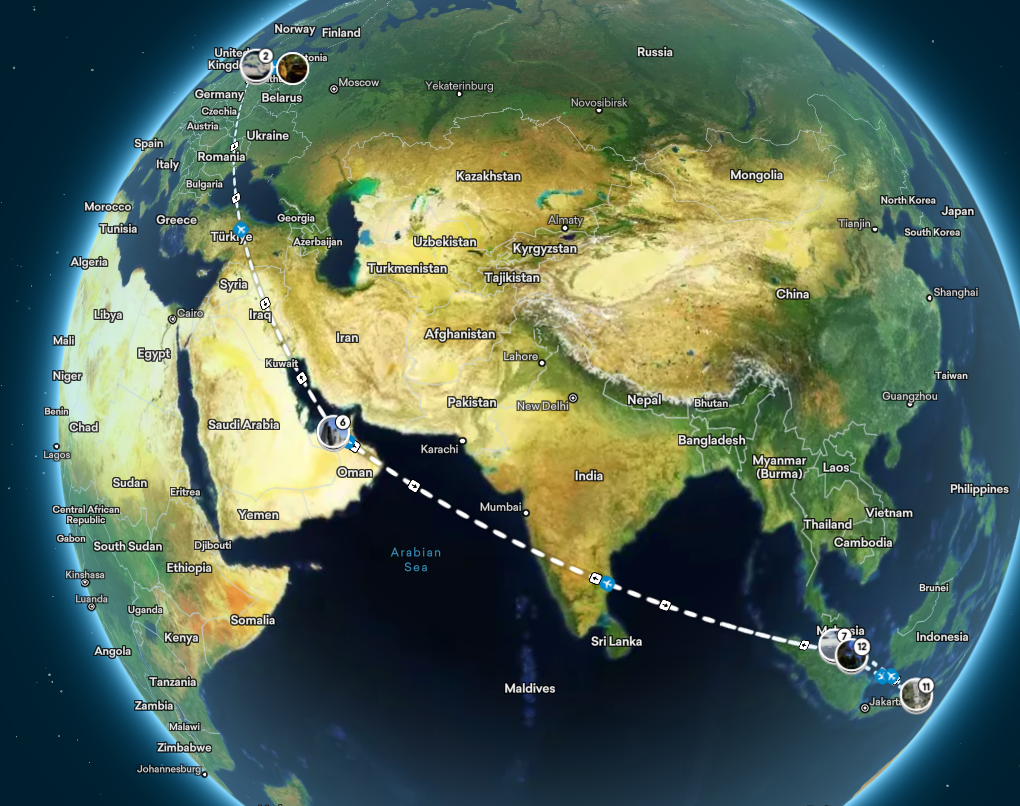
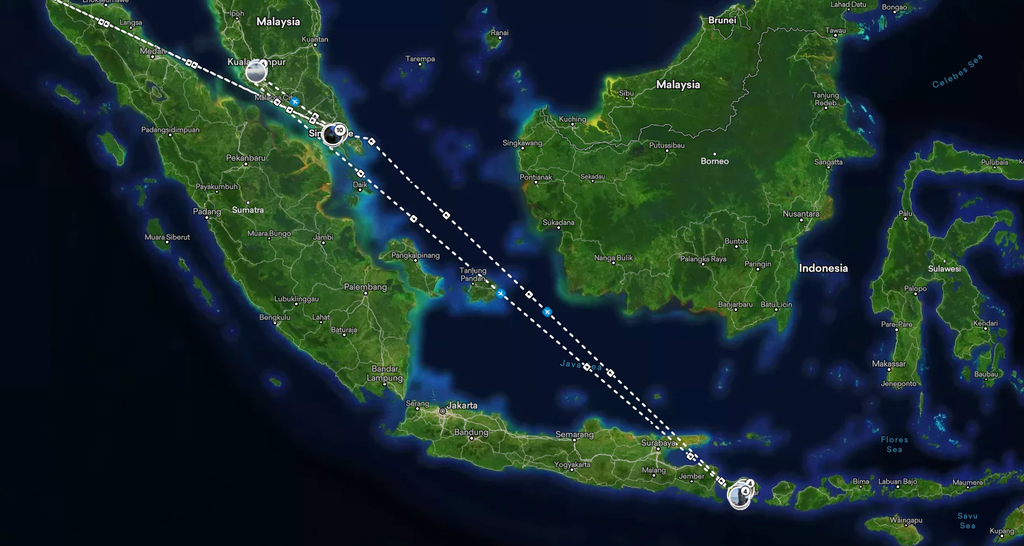
RIX-CPH
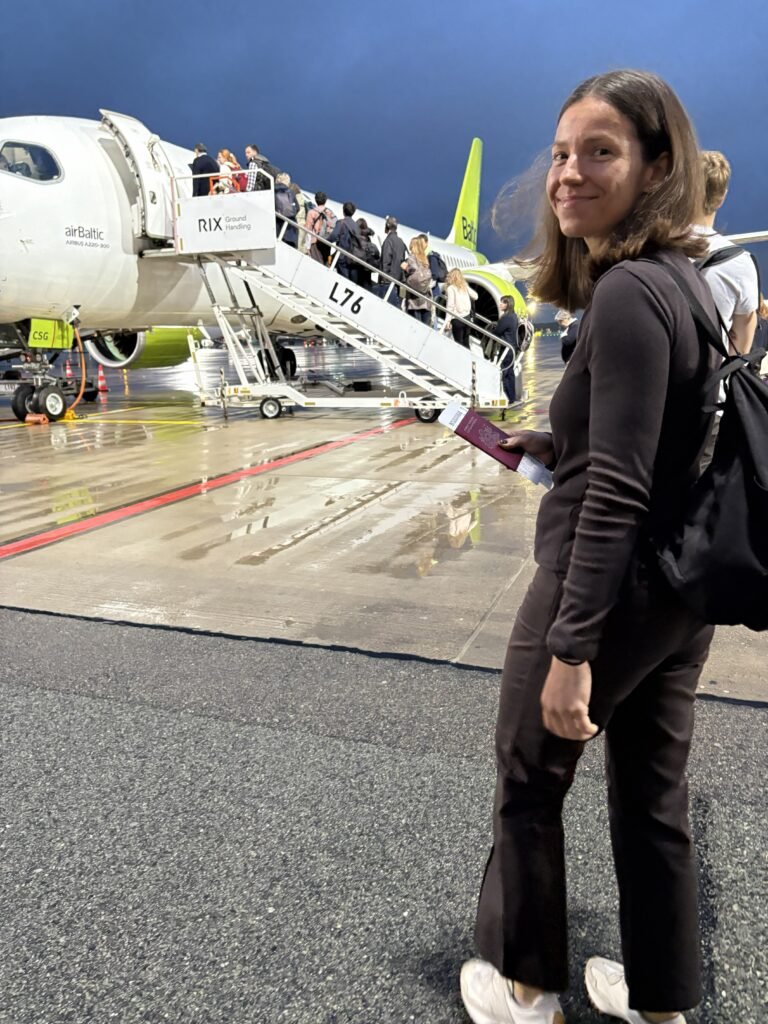
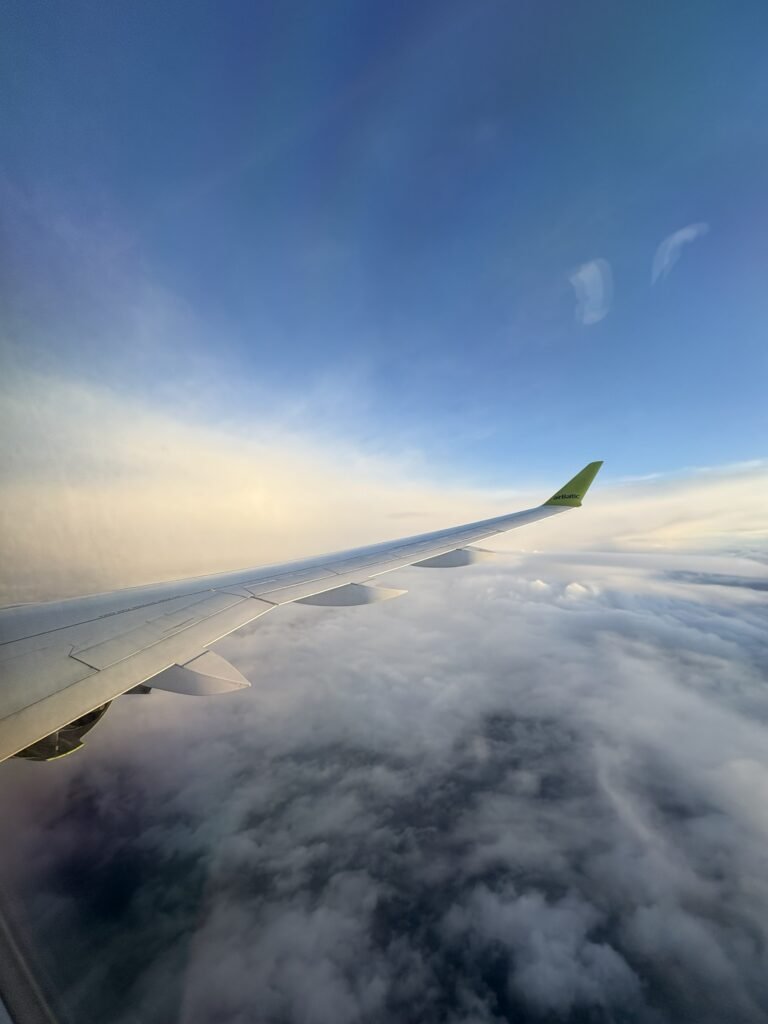
16.09.2025: The day starts indecently early. Around 4:15 a.m., it’s absolutely pouring outside, and I have to run out to grab a Bolt Drive car so we can head to the airport and kick off the biggest trip of the year. Ten minutes later my feet are soaked, and the already drenched moccasins have managed to rub my skin on the heel raw. A promising beginning.
As usual, we’re traveling with our hiking backpacks. For the long-haul flight, we check them in. The airport employee looks at the luggage tags rather suspiciously and says, “Well… let’s hope
they don’t come off.” Meaning: if they do, there’s a fairly high chance we’ll never see those bags again. Nothing left to do but join her optimism and move along. It’ll be fine. Probably.
At airport security we realize we’ve left our small “medical supplies” at home — and the airport no longer runs that lovely promotion where buying three mini strong alcohol bottles makes them
significantly cheaper. After browsing several travel forums, I concluded that, purely for preventive reasons, one should consume about 50 ml of strong alcohol at least twice a day — just to give a
European stomach a fighting chance against Asian cuisine and its… unique hygiene standards.
So naturally, we stock up on some starter material at the airport.
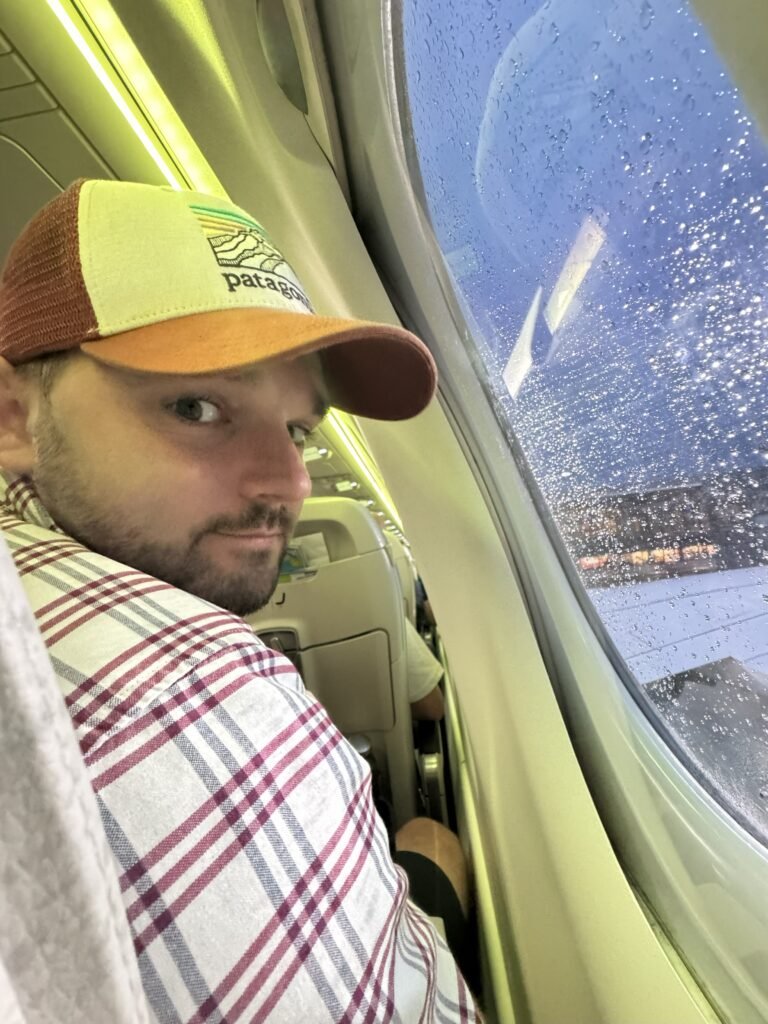
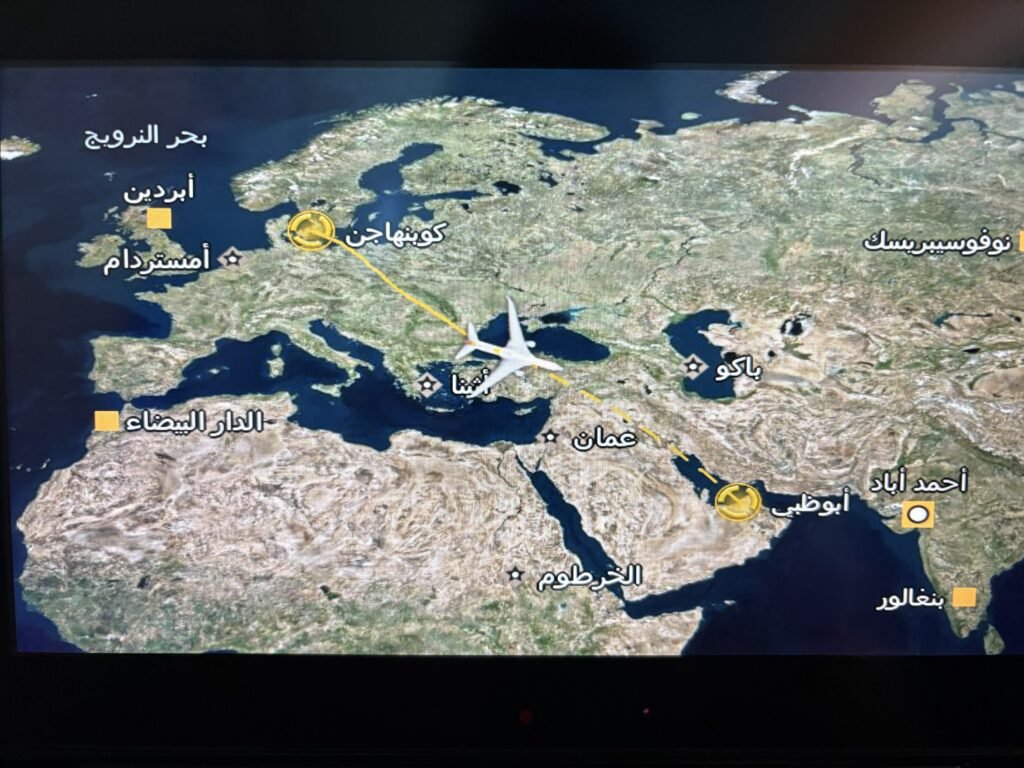
CPH-AUH
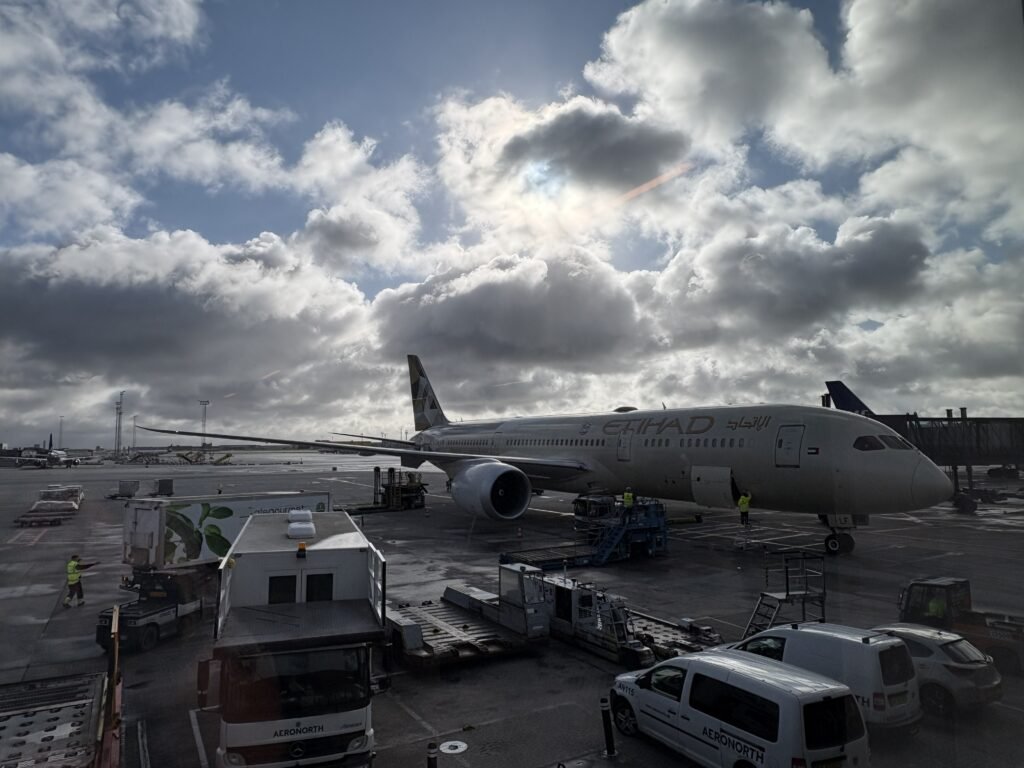
16.09.2025: After just under an hour and a half, we land at our first stop — Copenhagen, the capital of Denmark. The airport restrooms here might genuinely be the cleanest public toilets I’ve ever experienced. There is a certain underrated pleasure in handling your business in a spotless,
calm environment. Travel luxury comes in many forms.
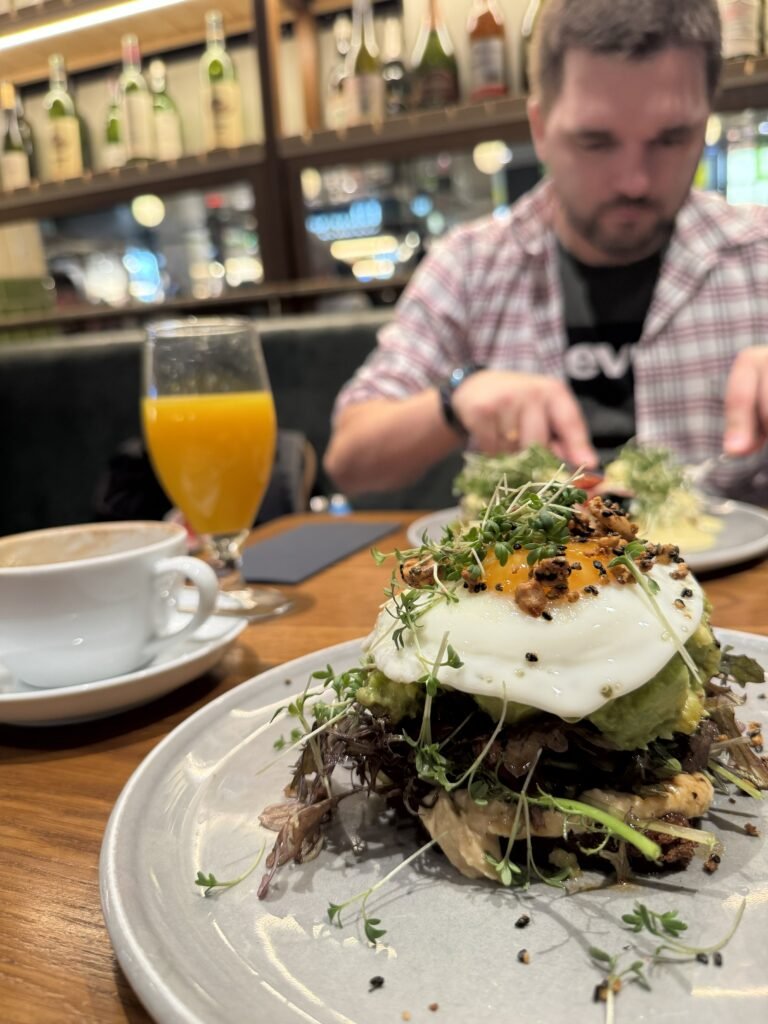
Breakfast turns out to be on the expensive side, but we end up in a rather charming airport
restaurant — mostly because it was the only place that didn’t offer standing tables or bar stools next to a beer tap as the last remaining options. I had completely forgotten that Denmark doesn’t use the euro. I paid in cash with EUR and received Danish kroner in return. Oh well — another fine addition to my growing banknote souvenir collection.
The three-hour layover flies by surprisingly fast. Partly because of that light pre-trip excitement buzzing in the background, and partly because the airport itself is actually quite interesting. Plenty of little shops to wander through and browse — even if you have absolutely no intention of buying anything.
On the nearly six-hour flight to Abu Dhabi, Madara makes a very dedicated attempt at
sleeping — understandable, considering she managed barely three hours of shut eye the
night before. I, on the other hand, go for movies. I watch Jungle Cruise and Coach Carter. Both
are solid choices, and together they help erase almost four hours of flight time just like that.
AUH-SIN
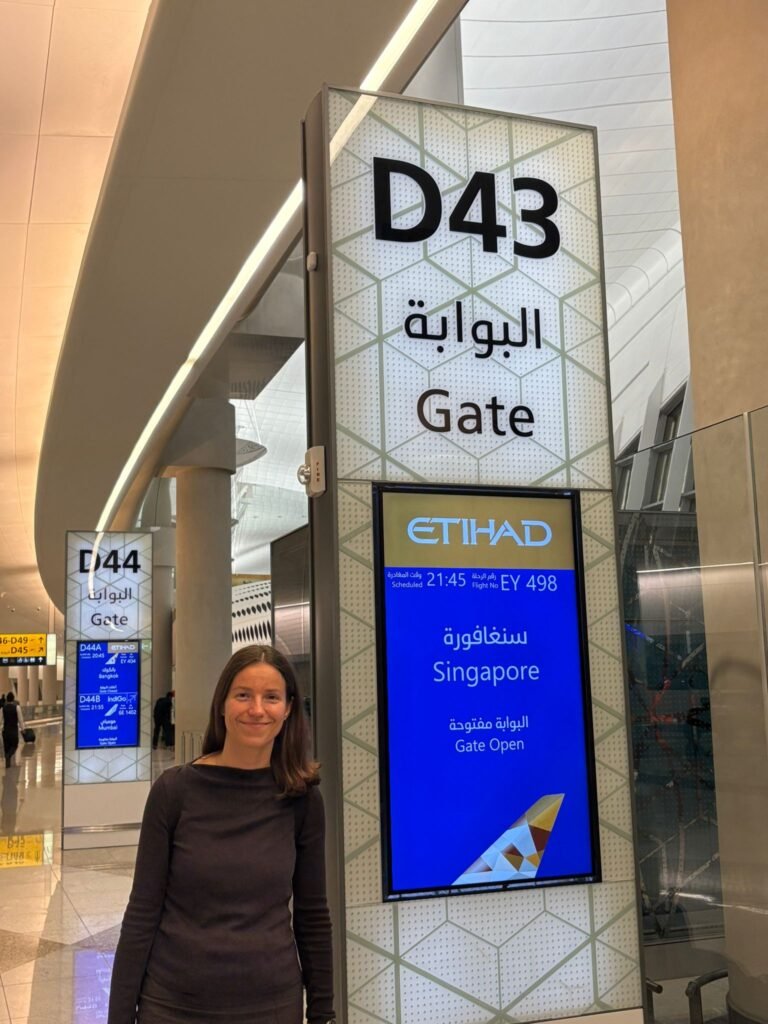
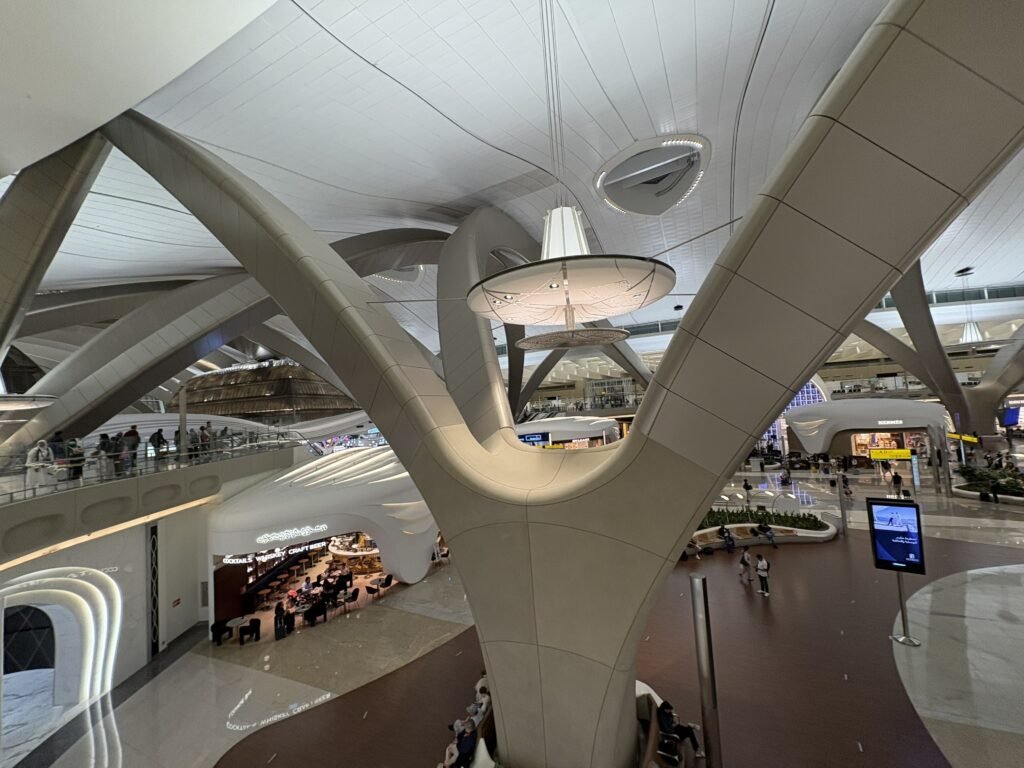
17.09.2025: The flight to Abu Dhabi is only very slightly delayed, but by the time we pass through local security, we’re left with less than two hours between flights. First impression — Abu Dhabi Airport is intense. Modern, polished, and buzzing with energy. It feels like an anthill: people moving in every direction at full speed, rolling suitcases trailing behind them like loyal pets.
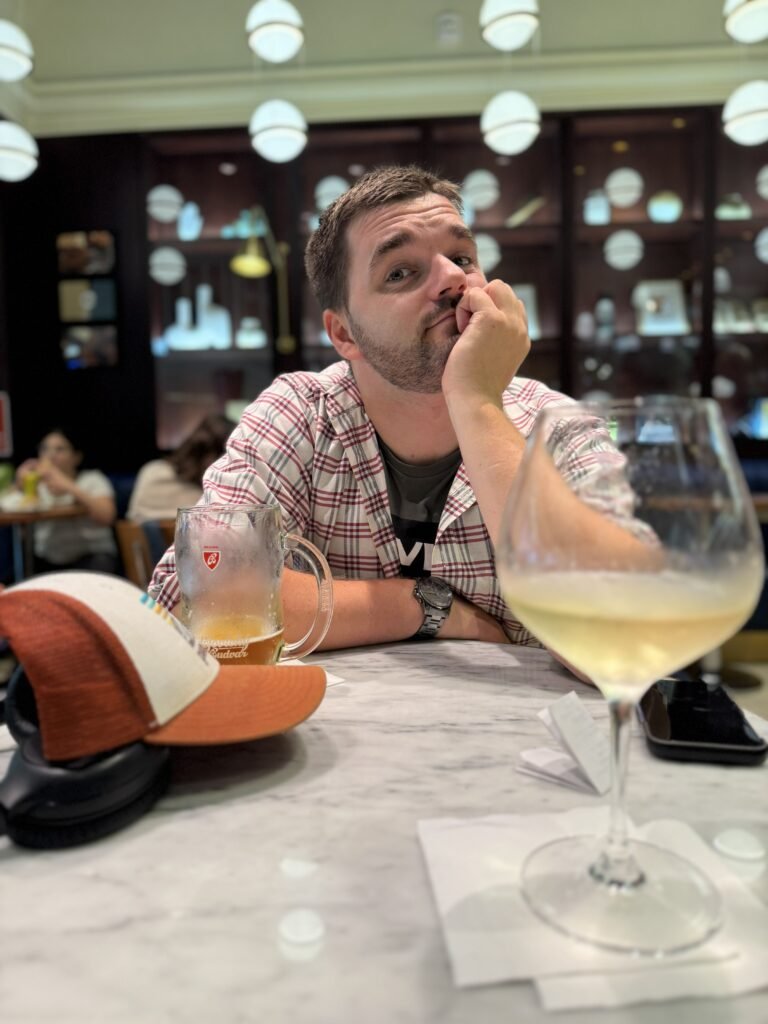
We manage a very quick stop at a bar for a round of drinks before heading off to the final stretch of the day — an eight-hour flight. The aircraft is impressive in size. You could probably fit the entire population of Latvia’s smallest town, Durbe — nearly a thousand people — and still have room left over. It’s also our first time boarding a double-decker plane. We’re assigned row 80, which, surprisingly, isn’t even the last one. It feels like a full-on hike just to reach our seats.
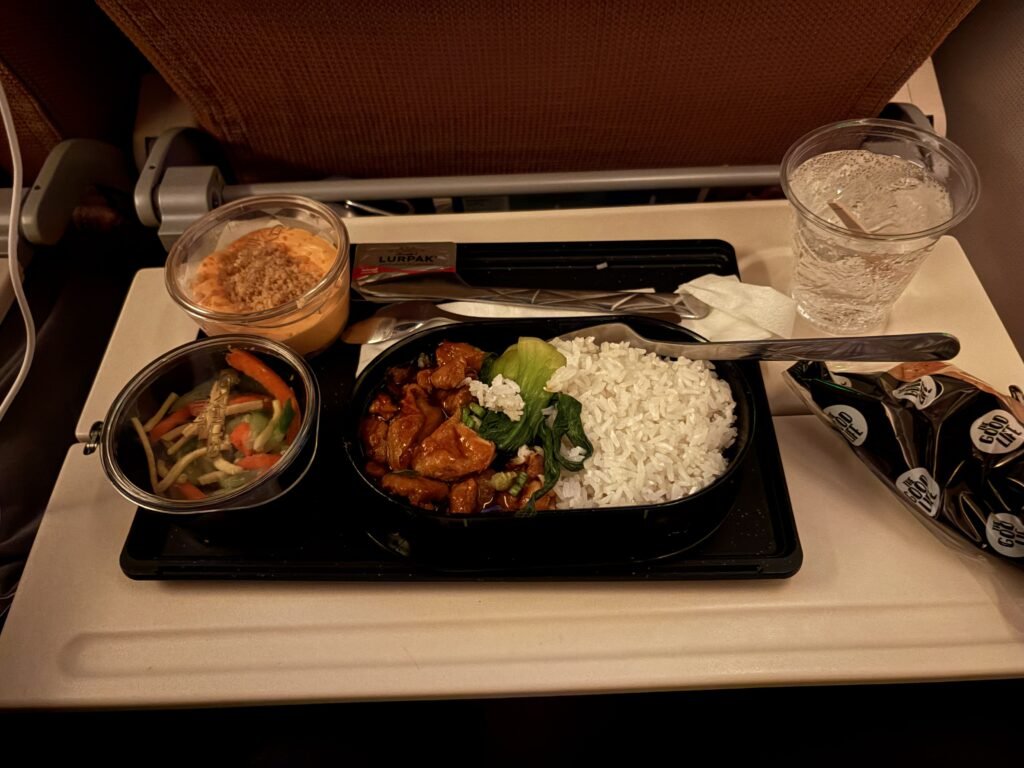
I watch one movie — the Tom Cruise classic Top Gun. After that, I attempt to sleep, but it’s not exactly easy. I manage to squeeze out maybe three to four hours. Probably because it’s the second long flight in a row. The body just wants to fidget and shift every ten minutes. After three flights, 17 hours in the air, and 23 hours of total travel time, we finally arrive at the starting point of our Asian adventure — Singapore.
SINGAPORE: LITTLE INDIA
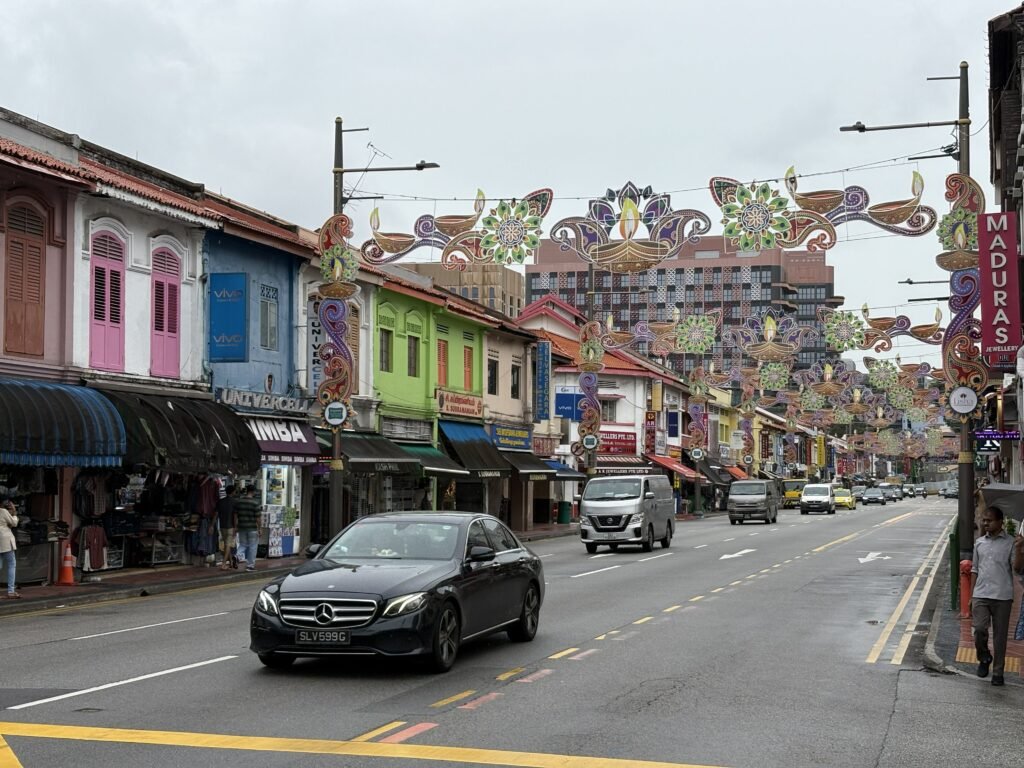
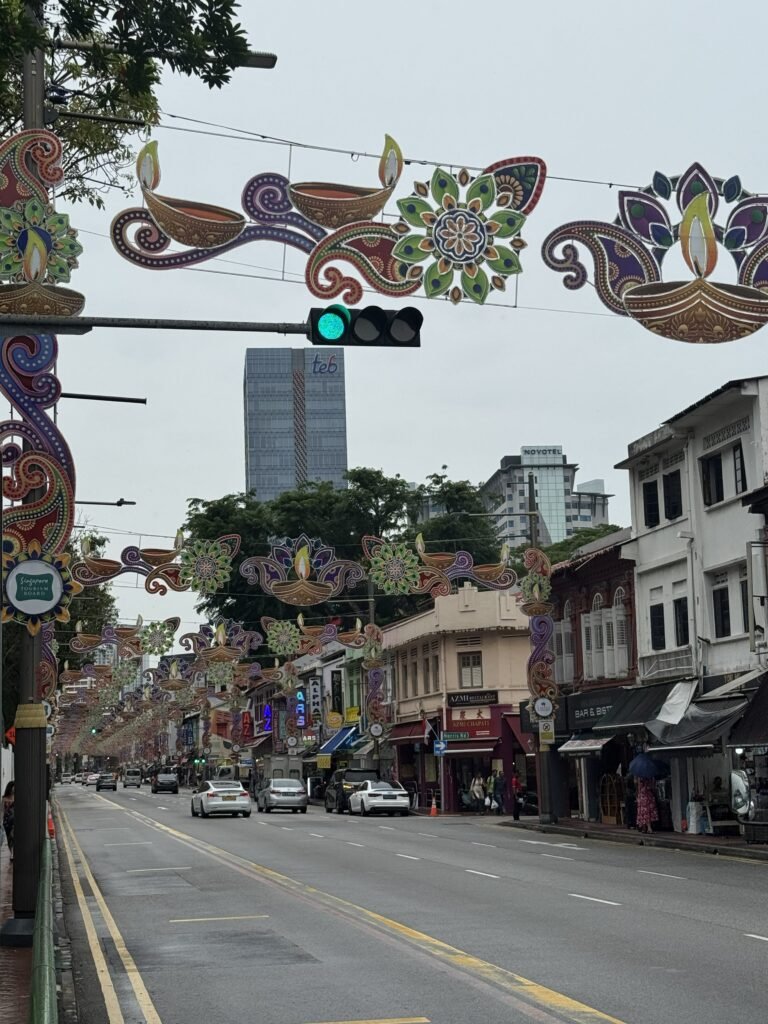
17.09.2025: With Singapore’s impressively easy-to-navigate train system, we reach Little India in about 30 minutes — our base for the next three days. The moment we step out of the subway the tropical equatorial climate hits us. It feels like walking straight into a botanical garden’s tropical greenhouse. Pleasantly warm. Wildly humid. The air practically hugs you with its misty
arms. After a short rest and a modest attempt to repay our sleep debt, we head out into the streets. Today’s main objective: stay awake until at least 11:00 p.m., so we can reset properly and wake up tomorrow as functional human beings on local time.
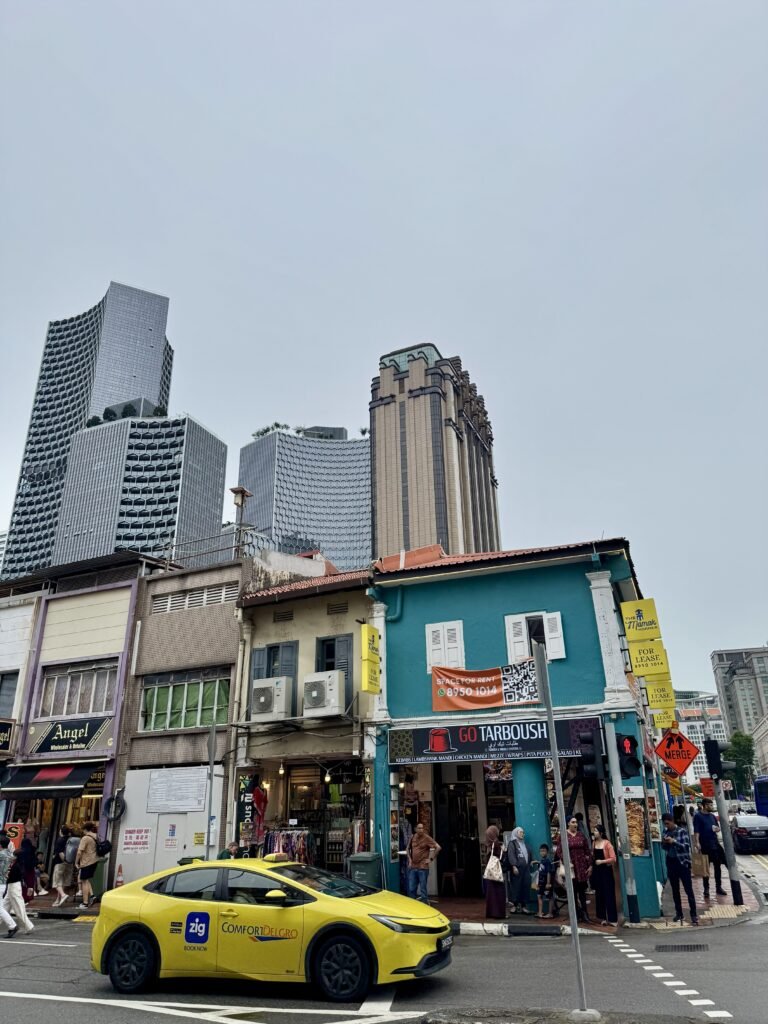
The first thing that stands out — construction everywhere. Skyscrapers rising in all directions, all at once. Singapore is clearly in no mood to slow down. We wander through Little India. Endless small shops. Clothes for just a few dollars — T-shirts for 2–3 SGD, jeans for 5–8. Right there on the sidewalk, local Indian tailors are sewing similar pieces. No obvious fake luxury brands in sight
— most items don’t even carry labels. And honestly, the quality probably isn’t that far off from something you’d grab at Reserved or H&M.
Sri Veeramakaliamman Temple – We arrive at Sri Veeramakaliamman Temple — a riot of color, covered in intricate figures of gods, animals, and mythological beings. Built in 1880, it stands on Serangoon Road, which turns out to be one of Singapore’s oldest and most vibrant streets. We don’t go inside, but it’s clear that entry requires bare feet. Judging by the steady stream of visitors, I can only imagine the impressive collection of tropical foot fungi one might encounter within. Hunger starts making decisions for us.
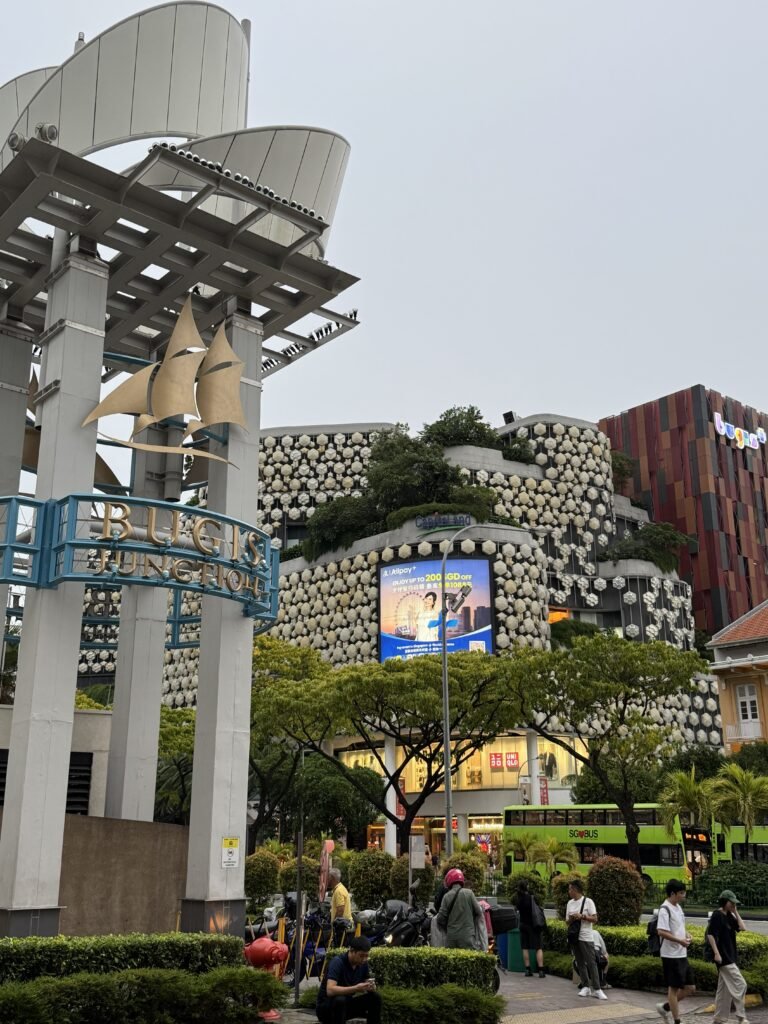
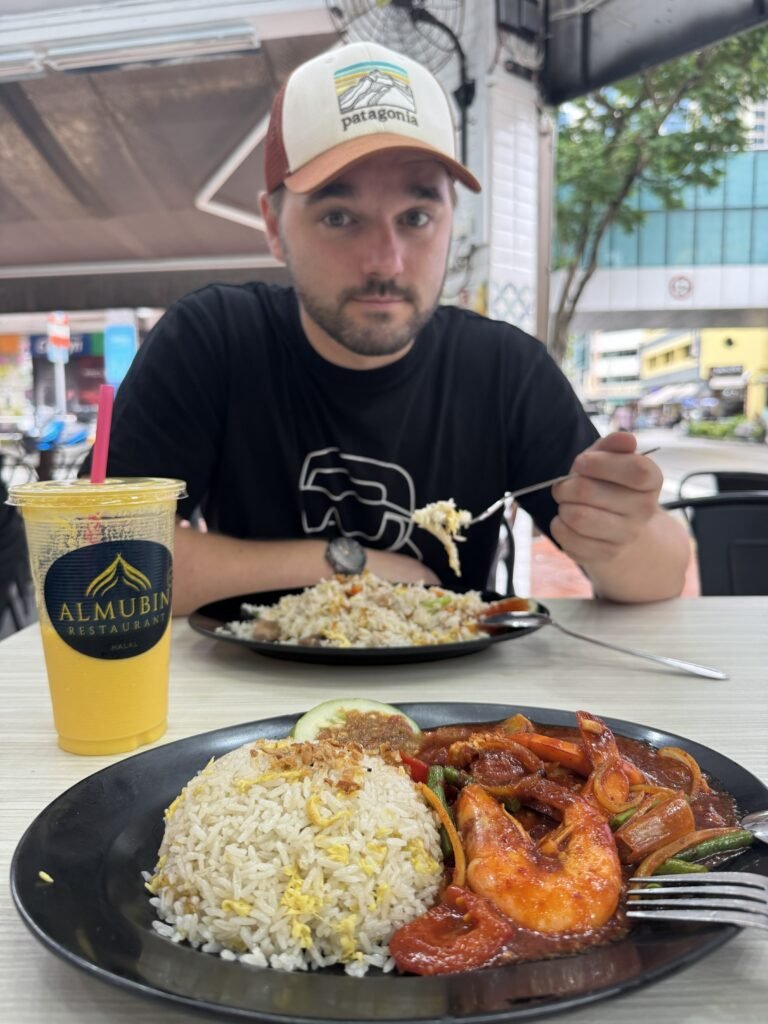
Earlier, on the way from Bugis toward the hotel, we had spotted several tempting lunch options. But here in Little India, the vibe feels closer to the India travel videos we’ve seen online — including the full “authentic kitchen hygiene” package. To be fair, I’m sure India itself is far more intense, but even here we see cooks plating food with their bare hands, and a quick glance through the kitchen doorway does not exactly boost confidence. Eventually, we settle on a small Indian bistro called Al Mubin. I go for what feels like the safe choice — fried rice with chicken and a mango lassi. Madara chooses rice with shrimp and an aggressively red, spicy sauce — Nasi Sambal Udang. Let’s hope our European stomachs are ready for cultural exchange. Lunch costs us 23 Singapore dollars — about 15 euros. Fair enough.
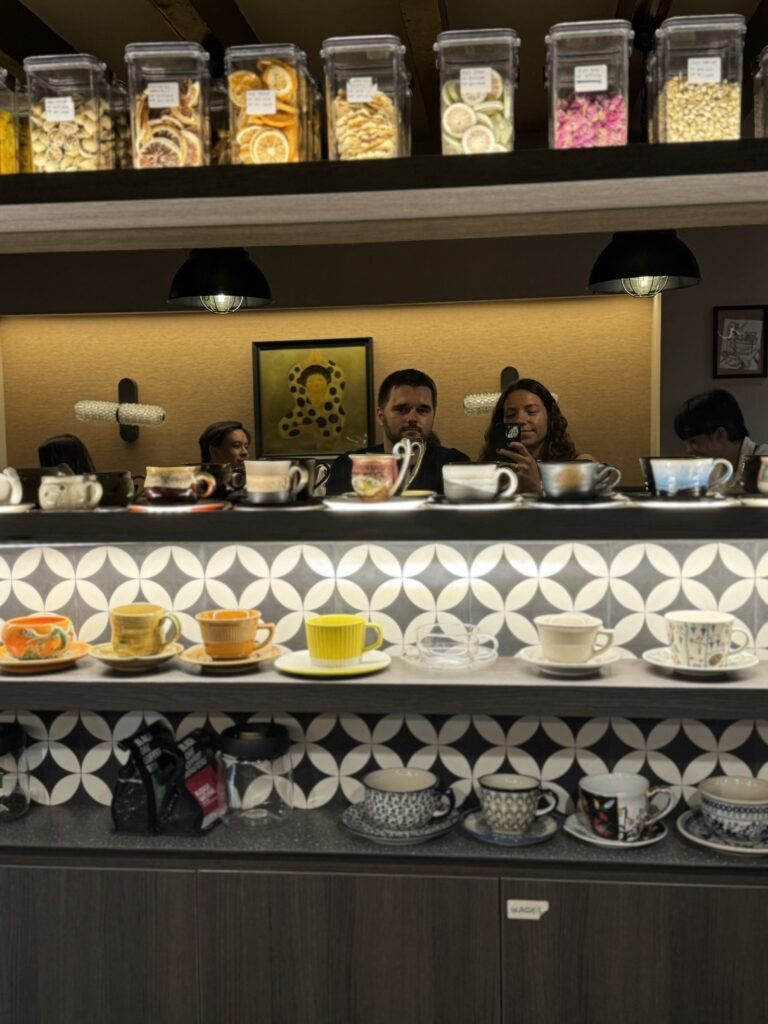
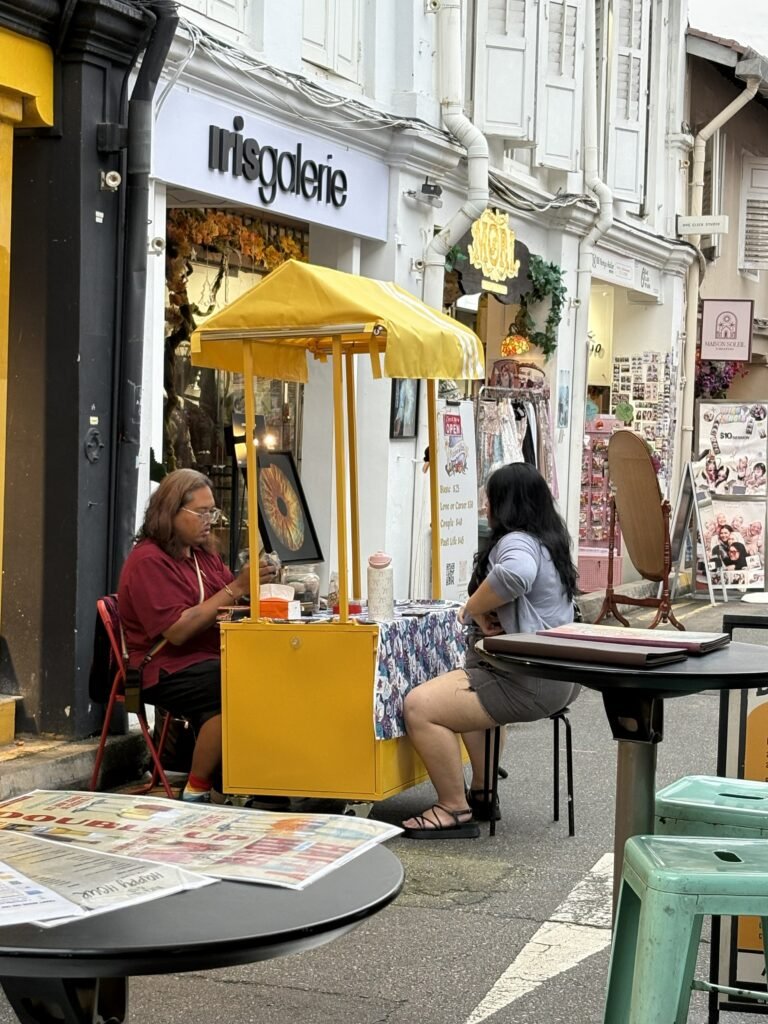
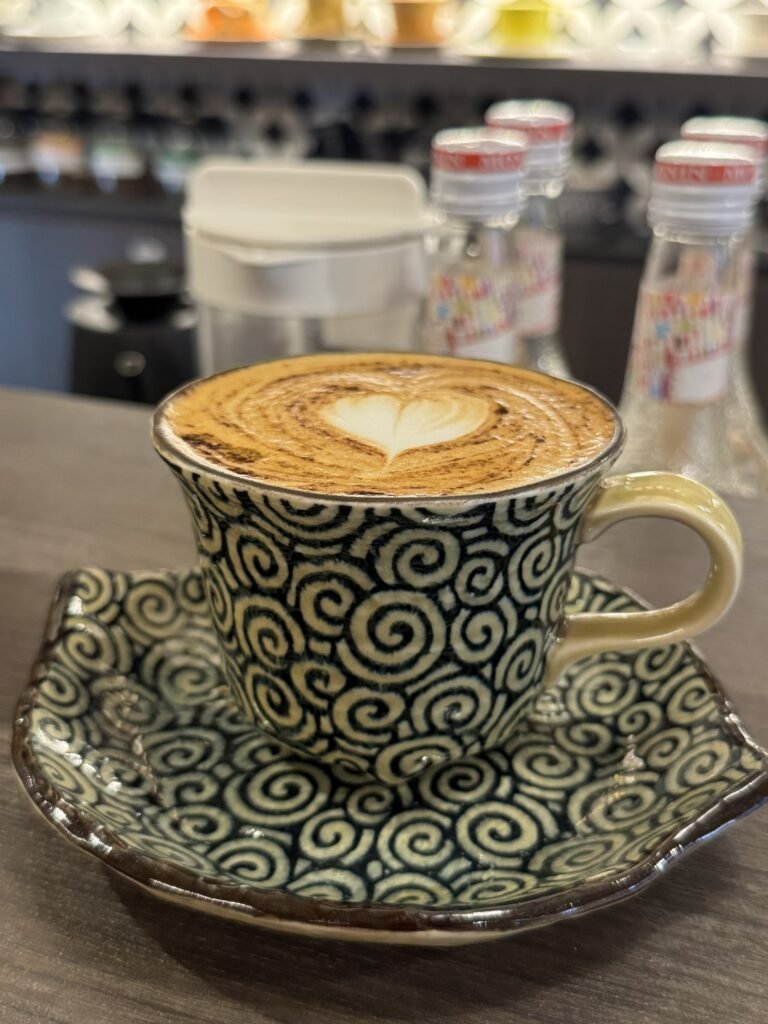
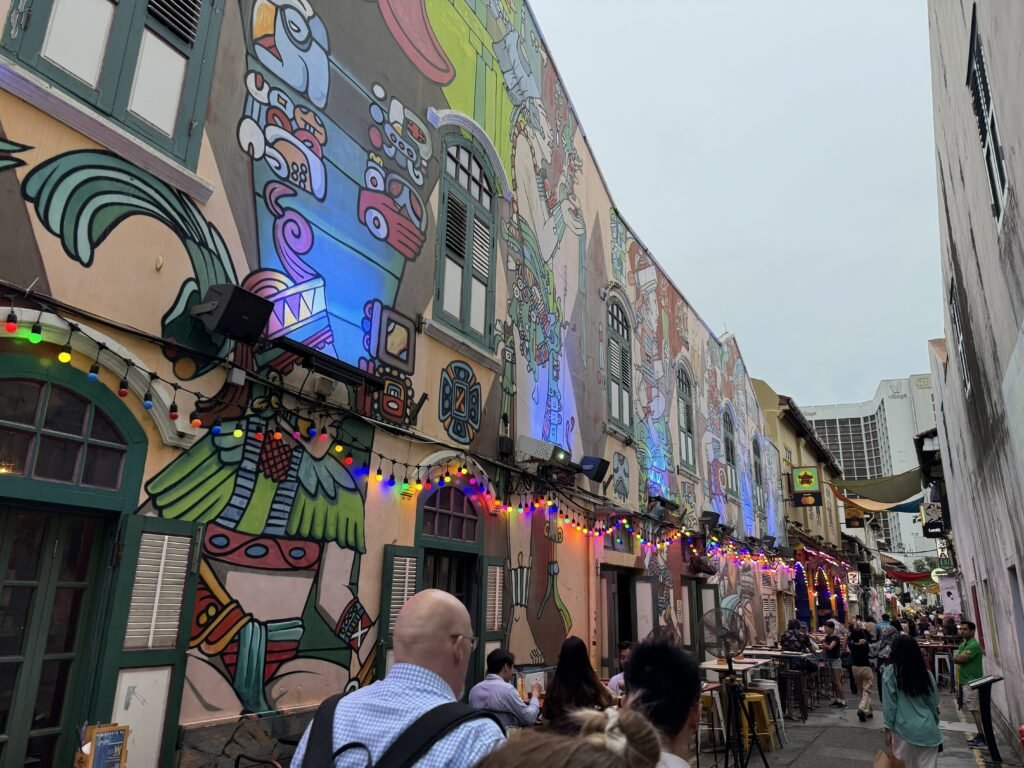
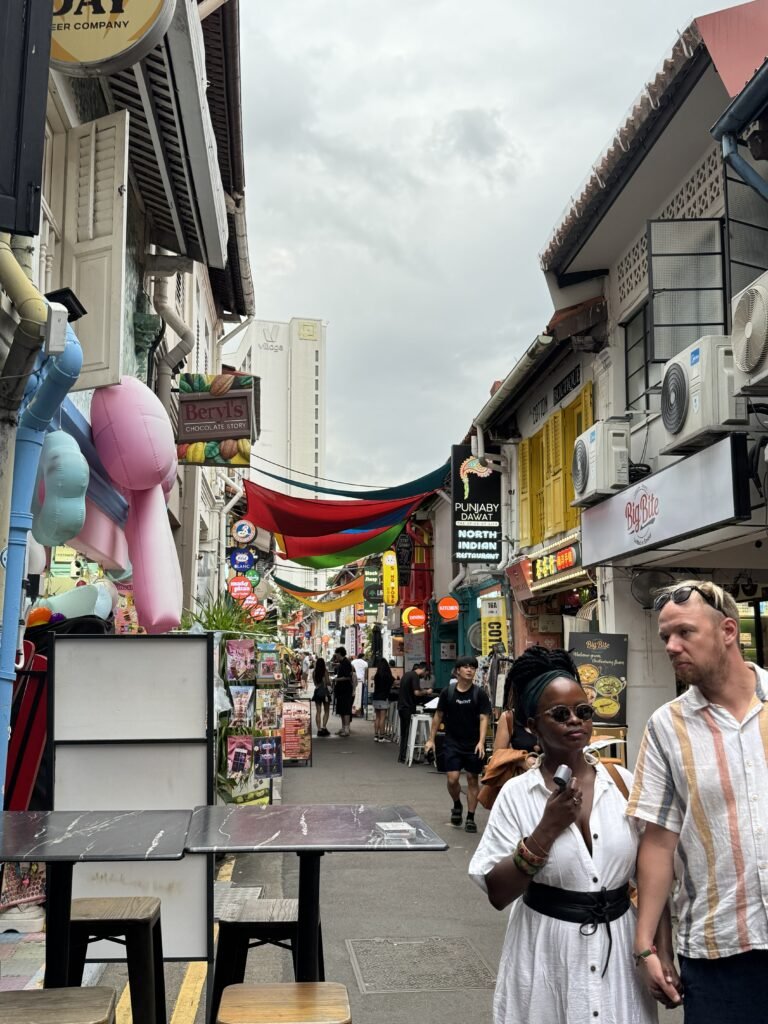
After eating, we head toward Haji Lane — a narrow, popular street packed with boutiques and cafés. We stop at Donkey Café for a dose of black fuel. Madara claims it’s the best cappuccino of her life. It certainly looks convincing. My espresso is brutally strong and excellent — no complaints. A little further down Haji Lane, we sit at a cozy-looking bar and order our first Singaporean beer. While sipping, we strategize the real challenge of the day: how to remain conscious for a few more hours.
SINGAPORE: GARDENS BY THE BAY
17.09.2025: To increase our chances of surviving the day without collapsing face-first into the hotel bed at 7 p.m., we decide to take public transport to Gardens by the Bay. The plan: admire the illuminated “concrete flowers” in the evening darkness.
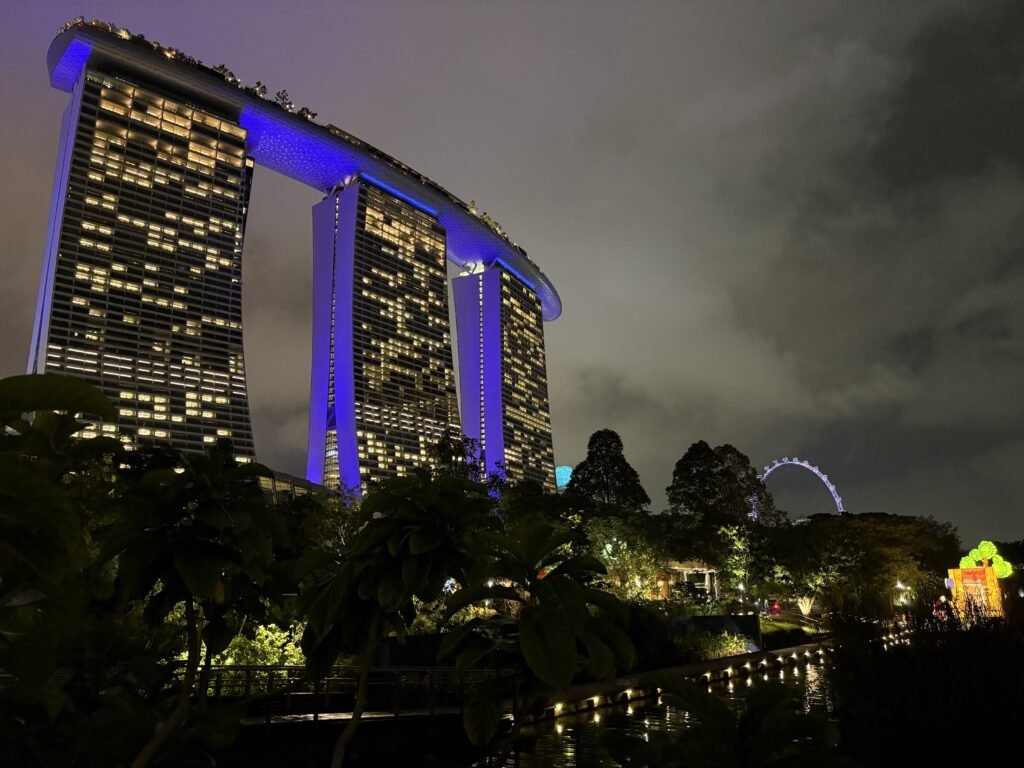
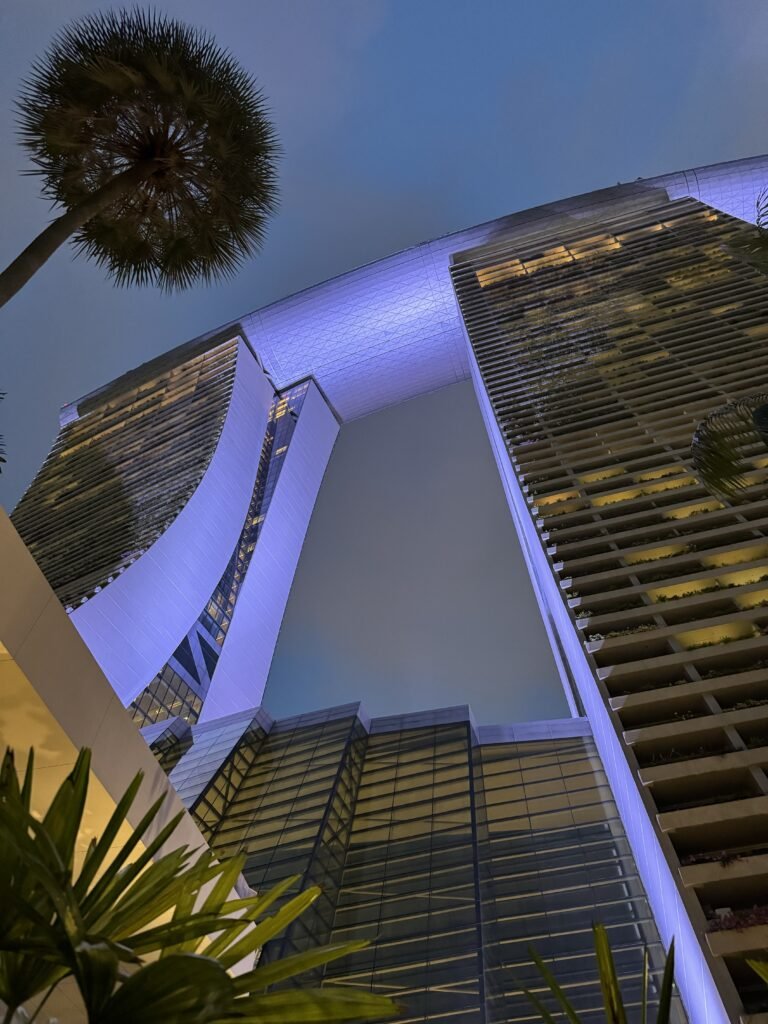
Before heading out, however, we have a mission — currency exchange reconnaissance. We swap some Malaysian ringgit. Technically, the exchange booth converts our euros to Singapore dollars first and only then into ringgit, but judging by the Google rate, we lose only a very small amount in the process. Surprisingly good exchange rate. No tourist trap drama this time. We get off the metro next to Singapore’s most iconic hotel — and one of the most recognizable buildings in the world. Marina Bay Sands!
On its rooftop sits the famous infinity pool — accessible only to hotel guests. The cheapest room
here starts at around €900 (at least in next couple of nights) per night, while the upper-floor rooms with panoramic views of the skyline or Gardens by the Bay can reach an eye-watering €20,000 per night. Maybe next time…
Judging by the number of lit windows, even off-season the hotel doesn’t seem to struggle with
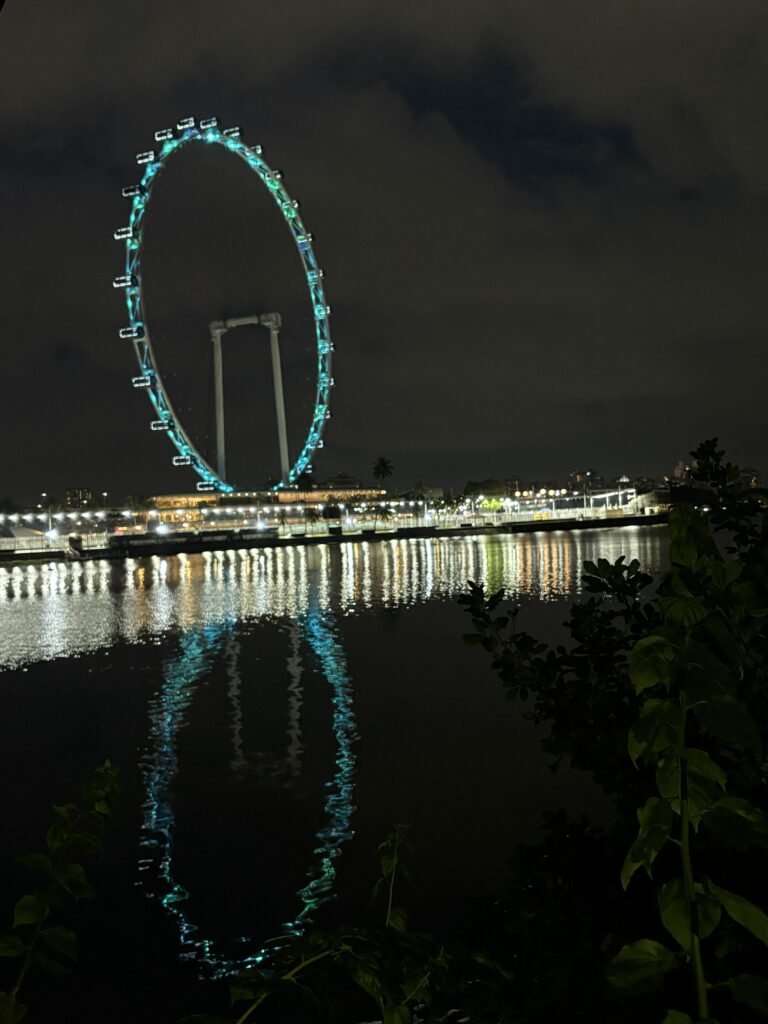
occupancy. We take a short walk along the promenade. Across Marina Bay, the giant observation wheel lights up the skyline. In the evening, runners flood the streets — during the day it’s simply
impossible to exercise in that kind of heat and humidity.
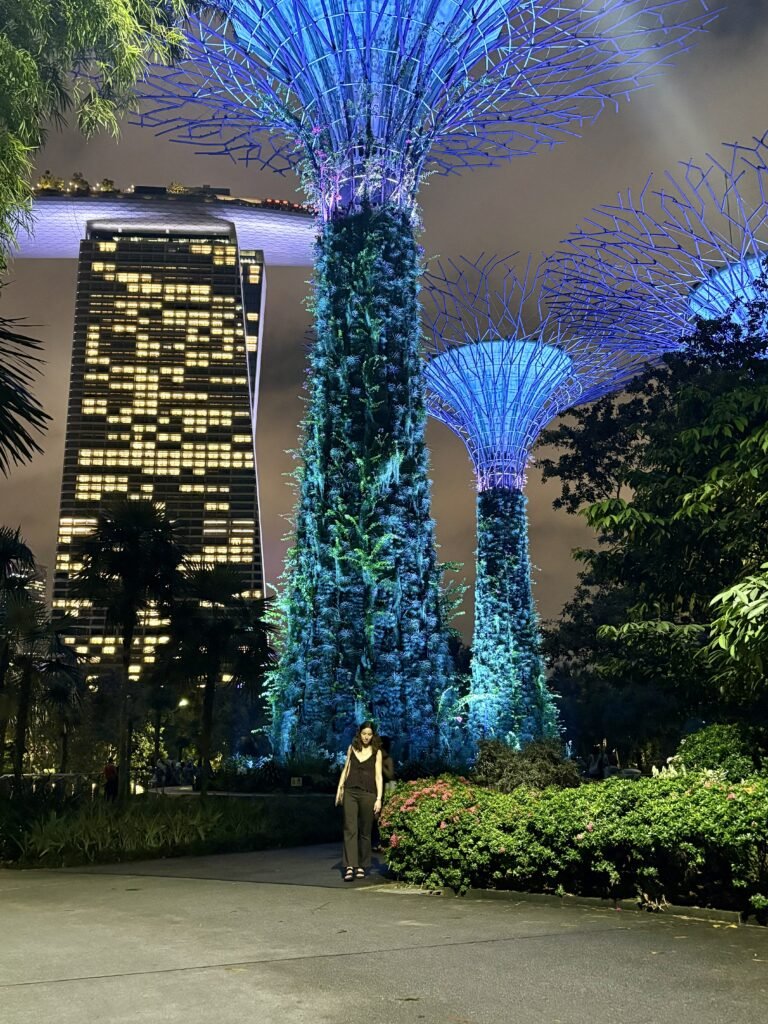
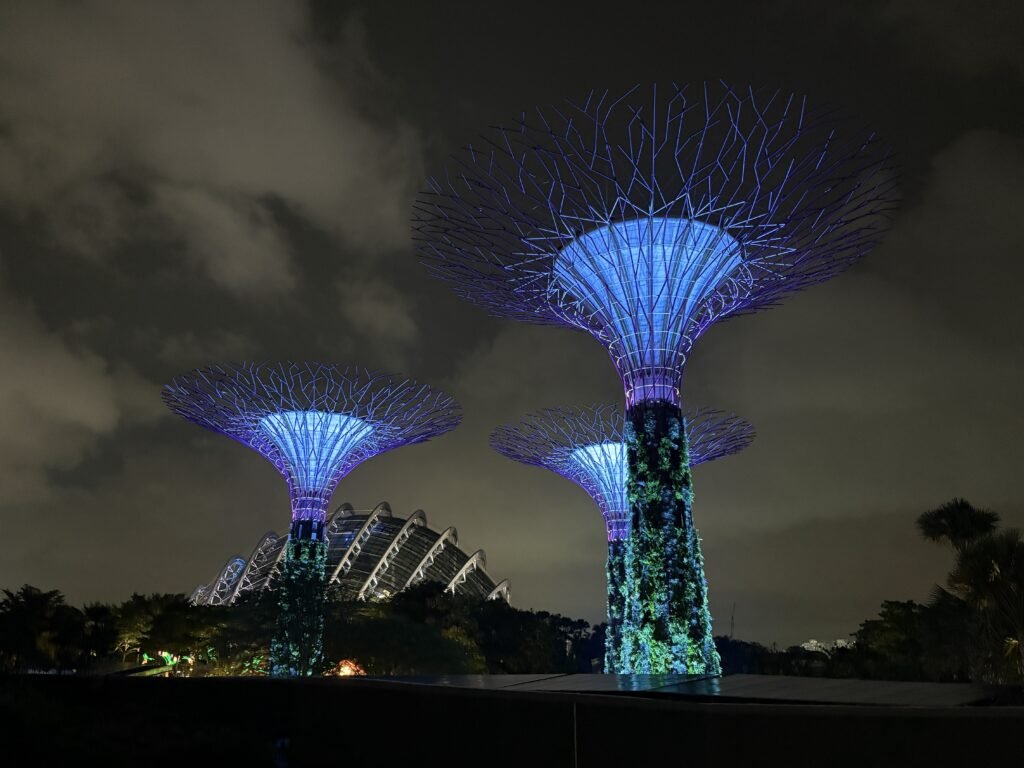
We pass the Silver Garden area, where the 30-meter-high “concrete flowers” rise into the sky.
With Marina Bay Sands in the background, the whole scene looks undeniably impressive.
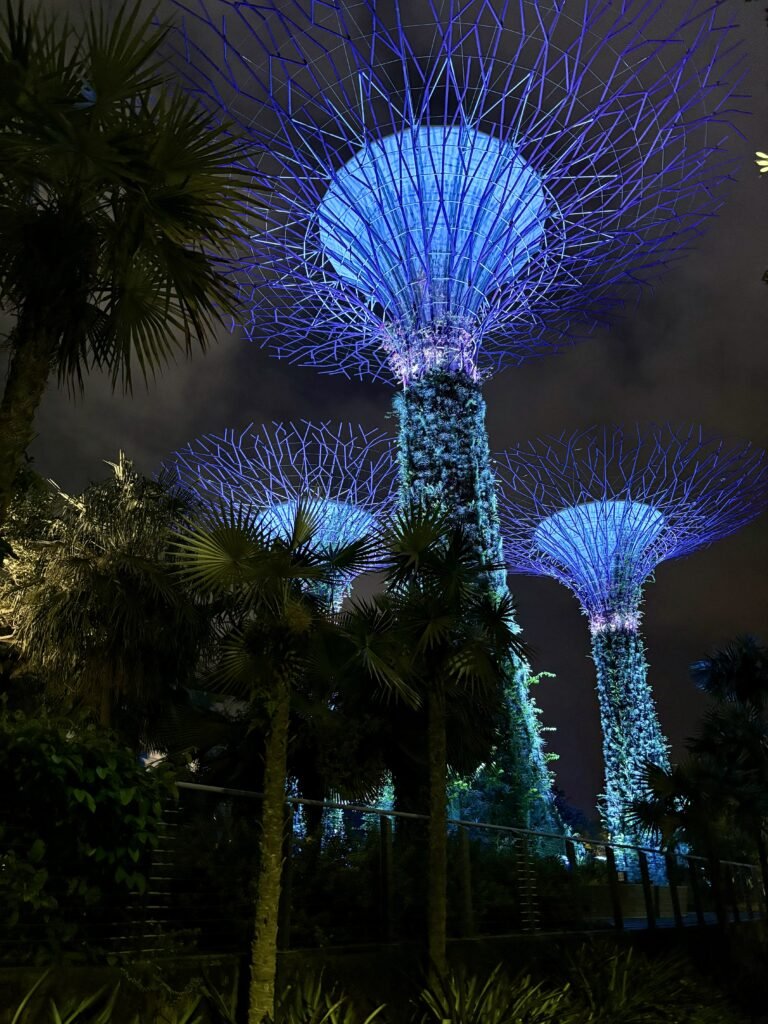
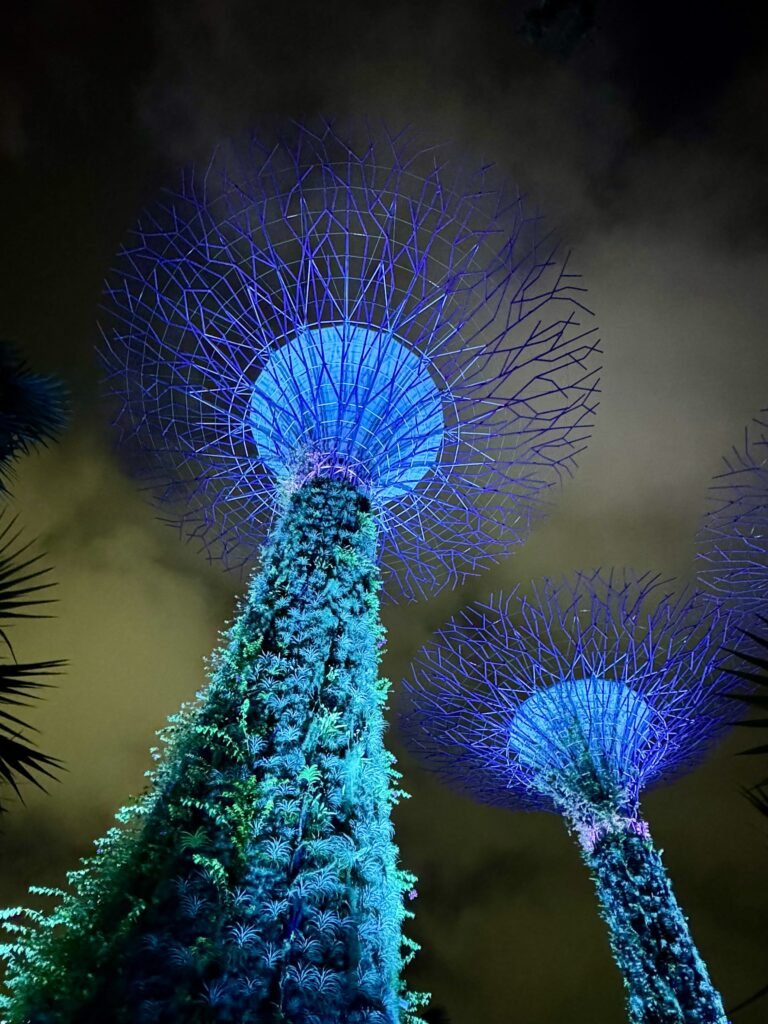
Gardens by the Bay We continue to Supertree Grove, where the evening light show is about to begin. It runs twice daily. To the soundtrack of world-famous movie themes — Pirates of the Caribbean, Jurassic Park, Indiana Jones, and others — the massive artificial trees glow and pulse in changing colours. Lights flicker and shimmer from every angle.
It does look cool — no denying that. But personally, I’m not blown away. I use the 15-minute
show as a perfectly timed excuse to sit down and give my legs a break. Before heading back to the hotel, we grab a moderately decent dinner at an Italian café in our Little India neighborhood. Not life-changing, but sufficient fuel to officially declare: Day One survived.
SINGAPORE: FLOWER DOME & CLOUD FOREST
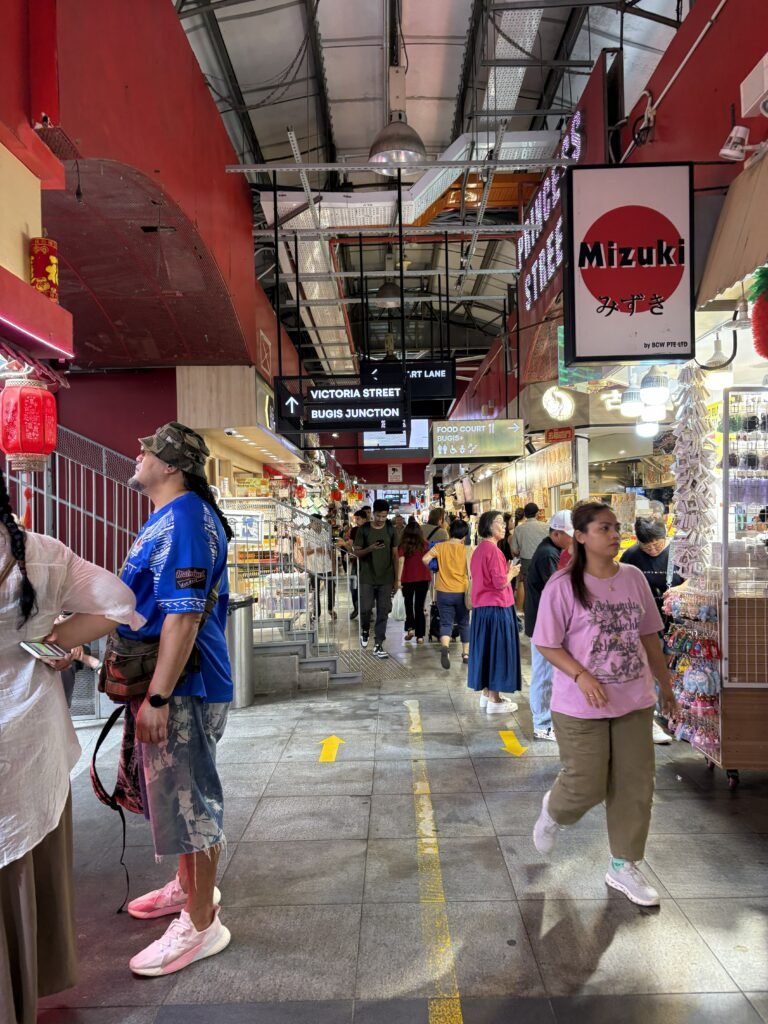
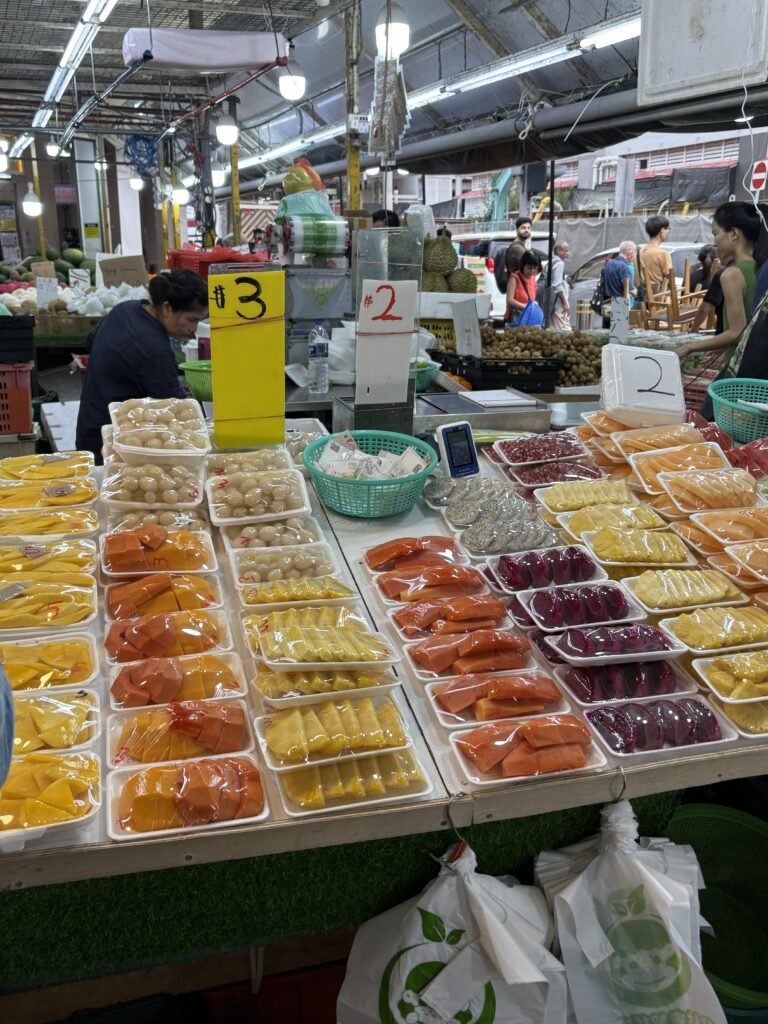
18.09.2025: Hotel breakfast — somewhere in the middle. You won’t starve, but you do find yourself wishing for a few more options. Still, the stomach is full in seemingly safe conditions, and before heading out we responsibly take our preventive 50 ml of strong medicine. Strictly for scientific, digestive purposes, of course. Before visiting the main attraction of the day, we pass through Bugis Street Market — a maze of food stalls and every imaginable China-manufactured miracle object.
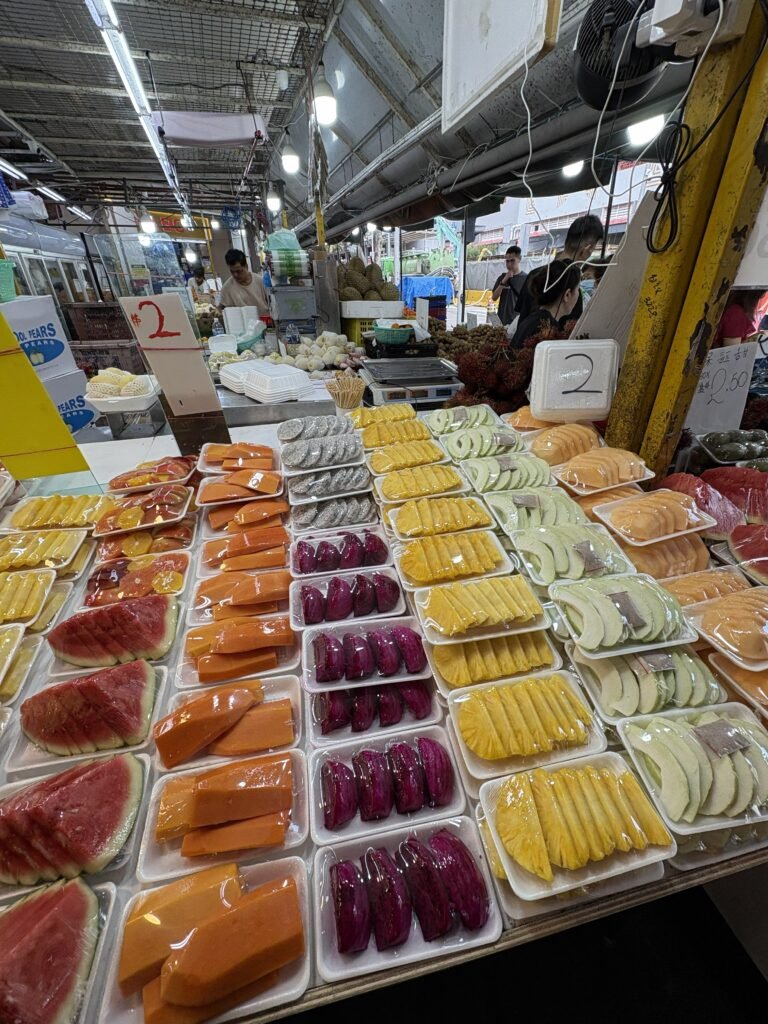
We buy a dragon fruit — an exotic treasure for our northern European standards — to be eaten later in some park like civilized tropical explorers. Walking through the market, we realize it’s the same Chinese-produced stuff you see all over the world. The key difference? Here it’s priced like Chinese-produced stuff. A Singapore magnet? 70 cents. A Singapore tote bag? €1.50. In Europe, the exact same magnet rarely goes for less than €5. But the real reason we came here: currency exchange. Euros into Indonesian rupiah. Officially, we are now multimillionaires — owners of 11.5 million rupiah. We’ll see in a week what that kind of wealth actually buys.
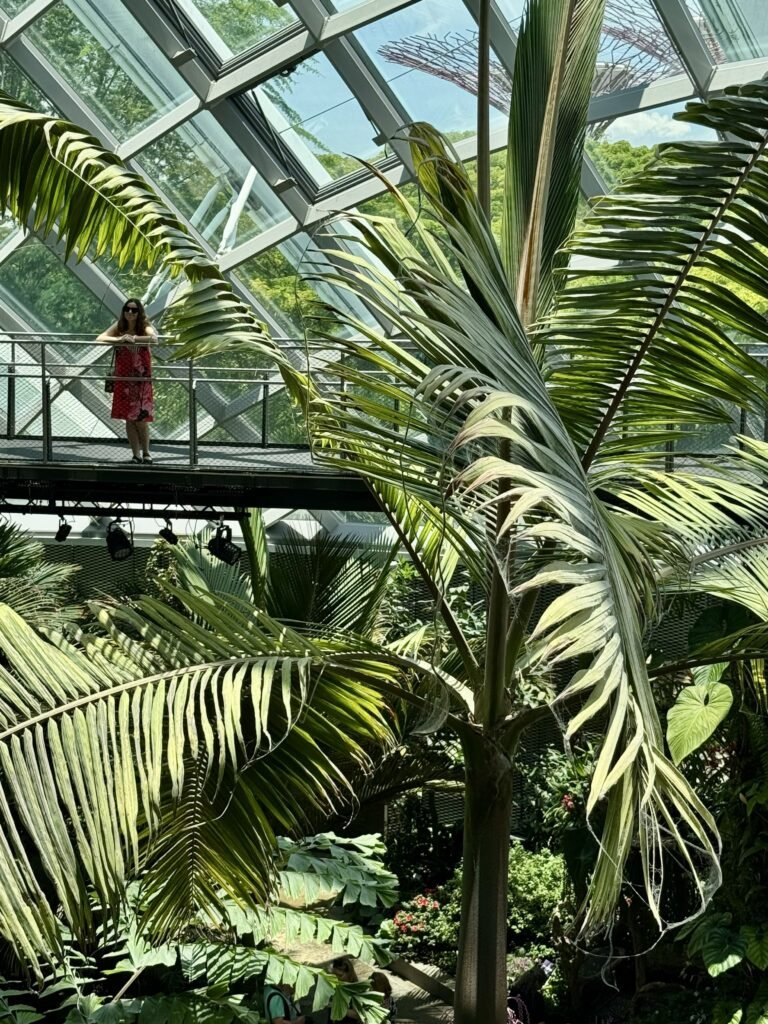
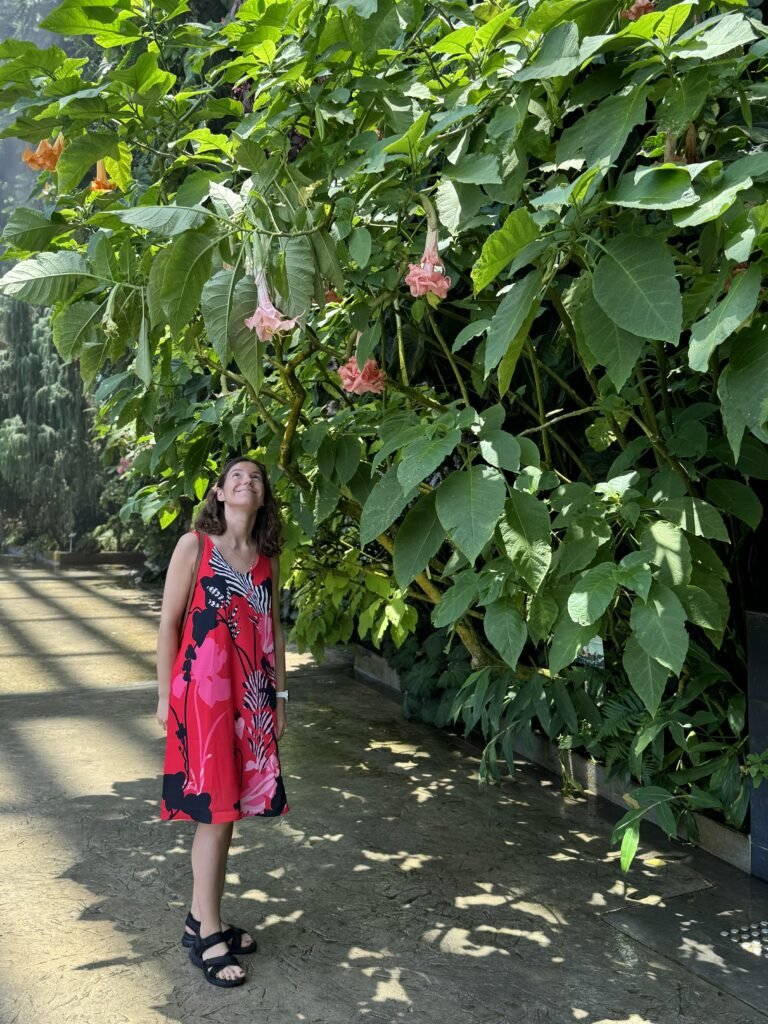
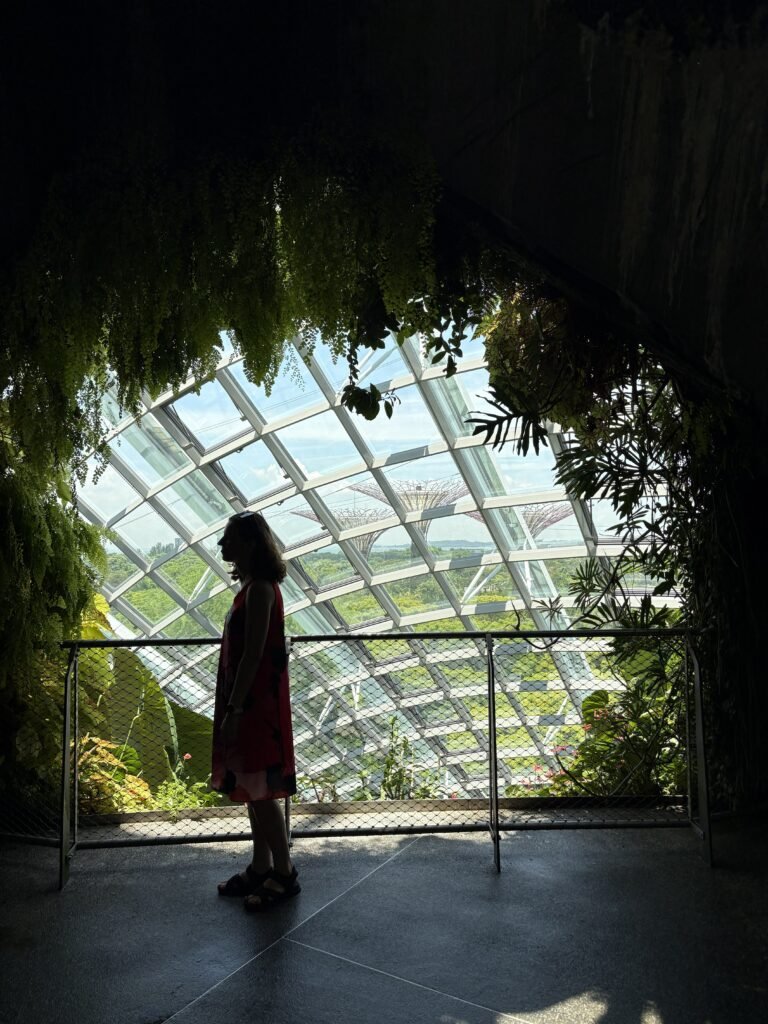
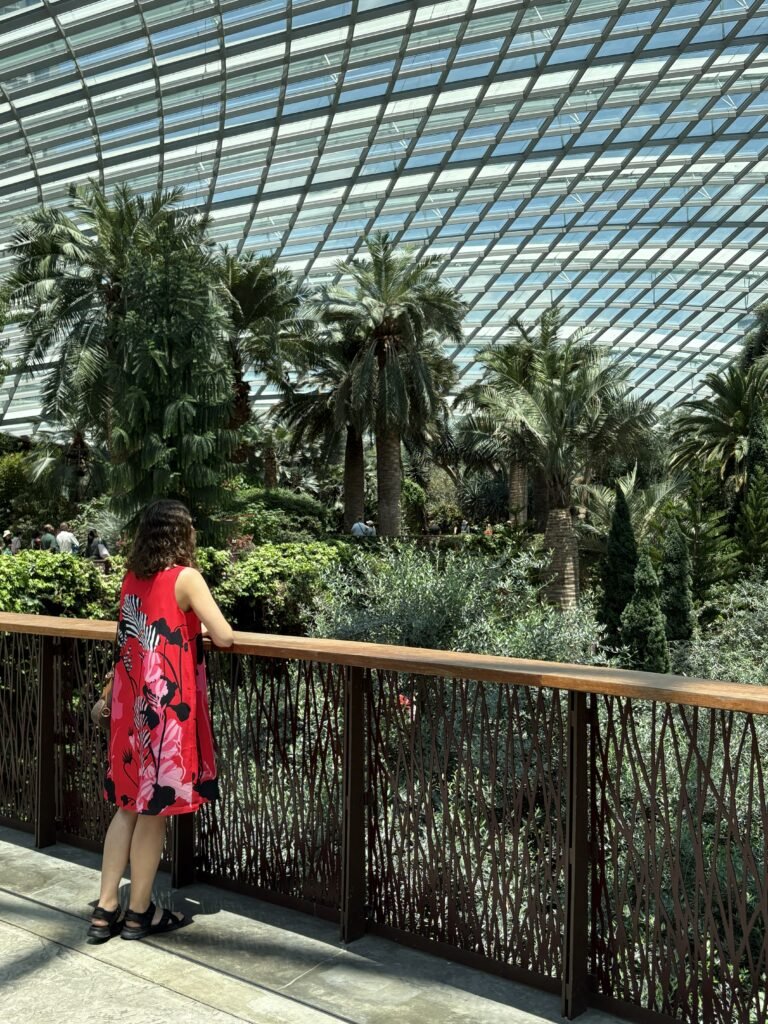
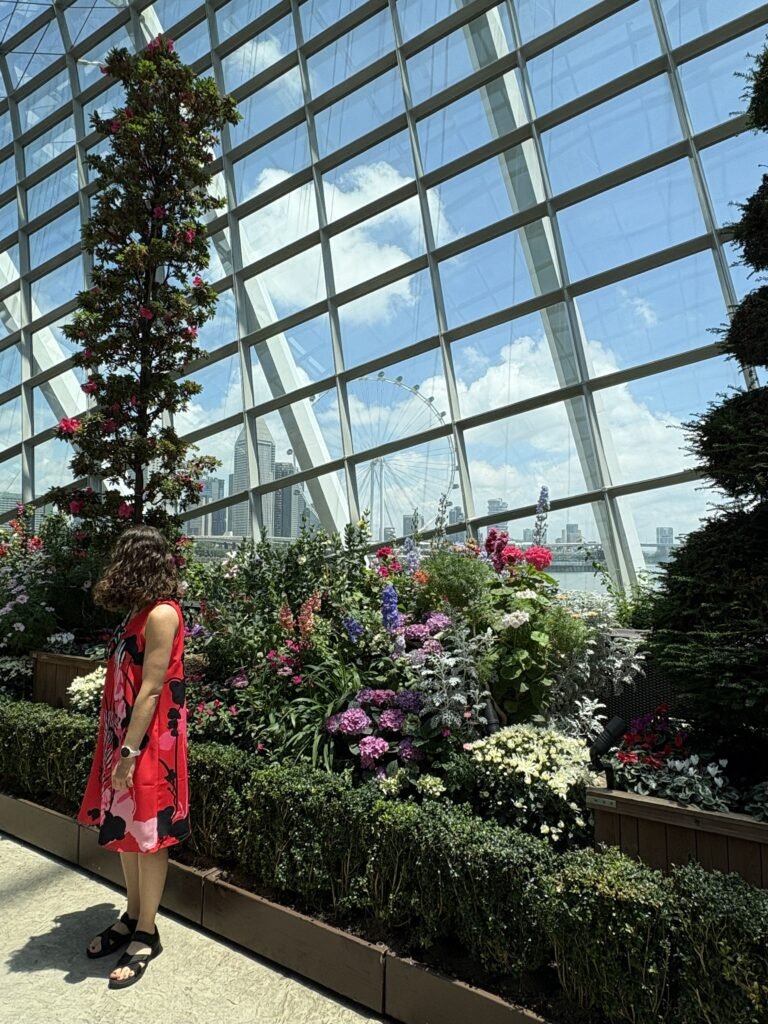
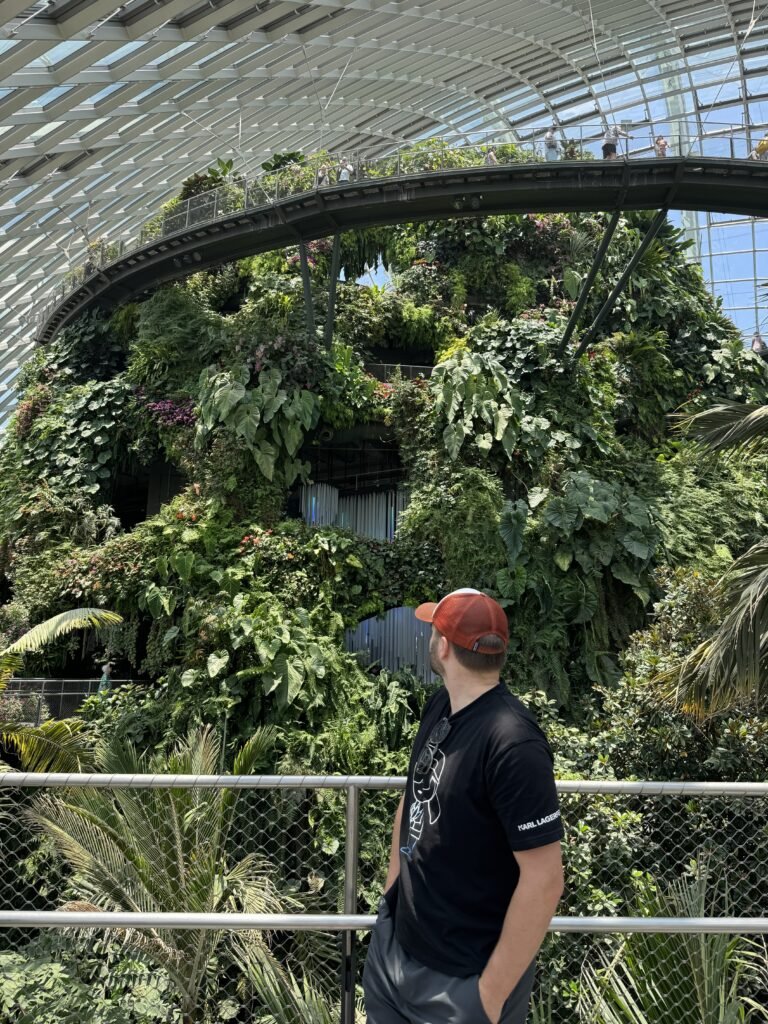
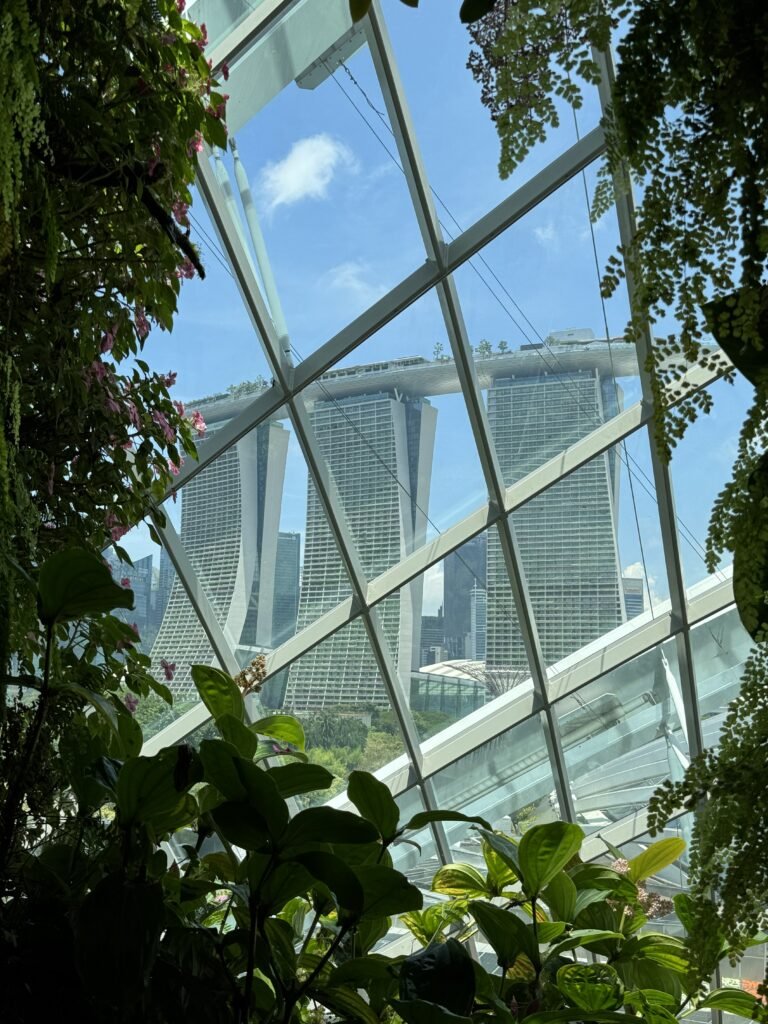
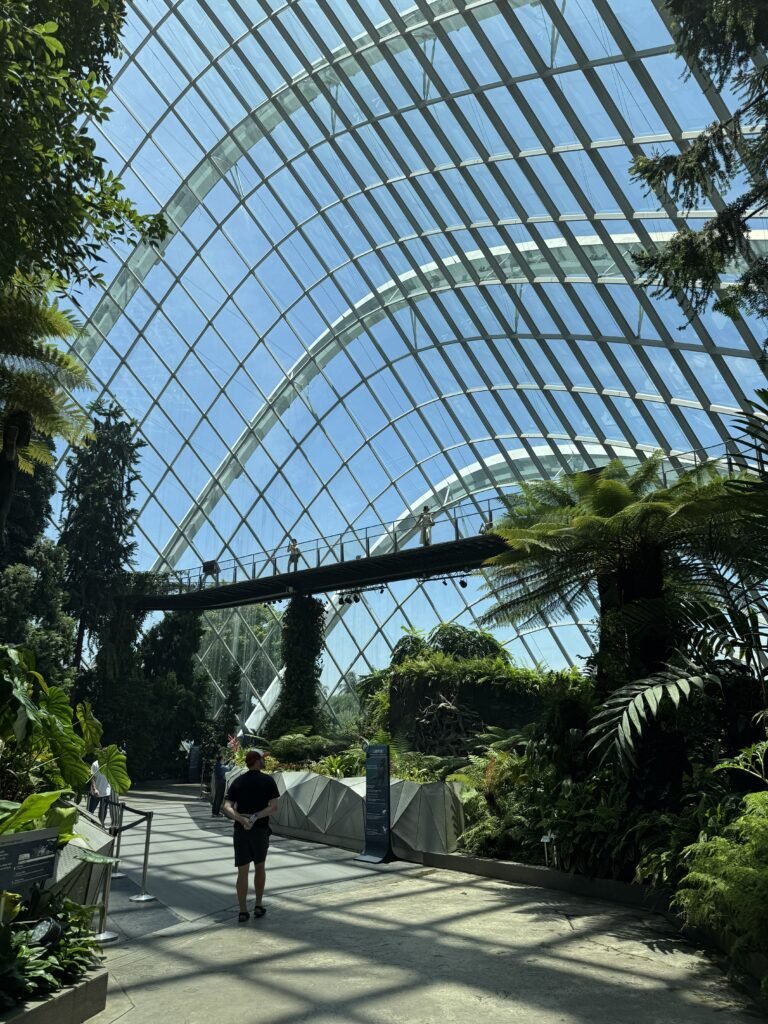
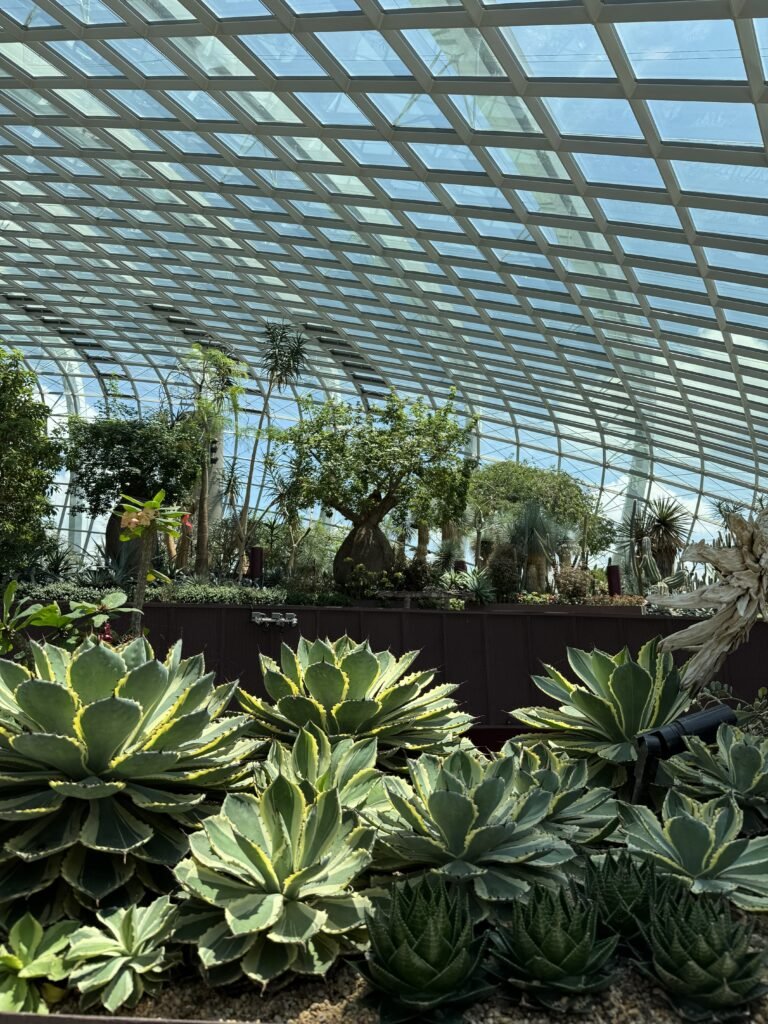
Since I paid for tickets to Singapore’s famous botanical domes months ago, walking in almost feels free. Just show up and enter. In reality, the ticket was €31 per person. Singaporeans have been clever — both the Flower Dome and the Cloud Forest regularly feature large-scale themed installations that change every few months. And not just minor decorations. These are massive, fully integrated builds. If you came back a year or two later, it would likely feel like an entirely different experience. The installations blend so seamlessly into the architecture that it’s hard to imagine they weren’t part of the original design.
The scale is impressive. This is the world’s largest glass greenhouse complex, officially recognized by Guinness World Records. Its volume equals roughly 75 Olympic-sized swimming pools. Right now, the Flower Dome carries a Swiss and Bavarian theme — clearly aimed at flower lovers and
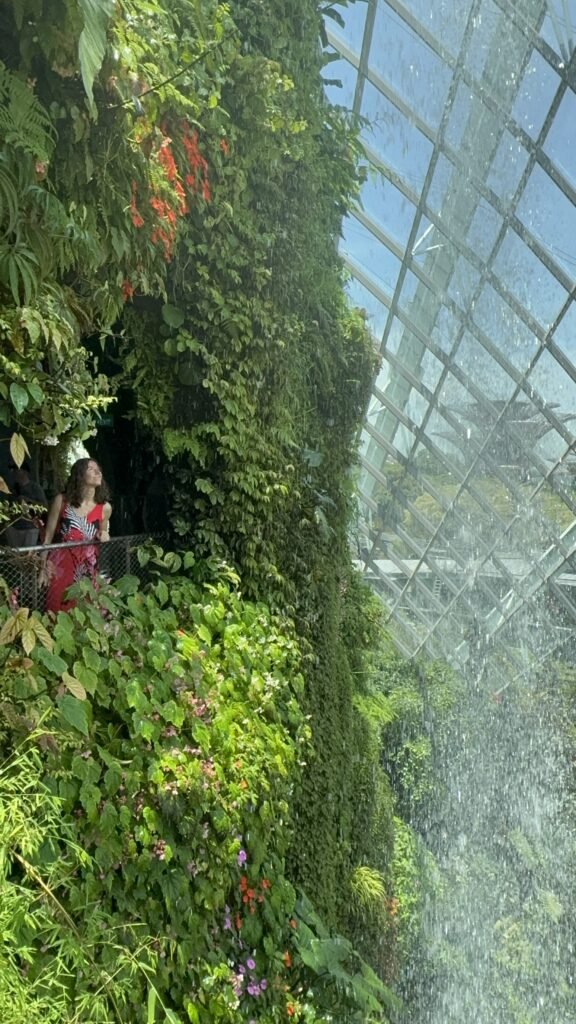
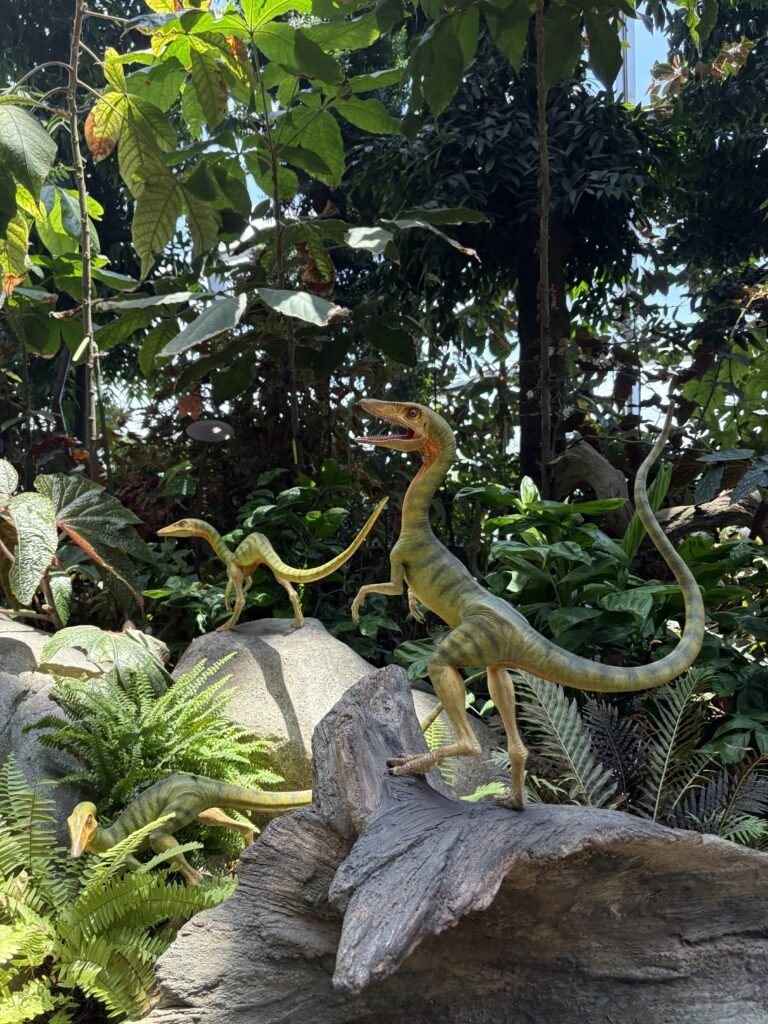
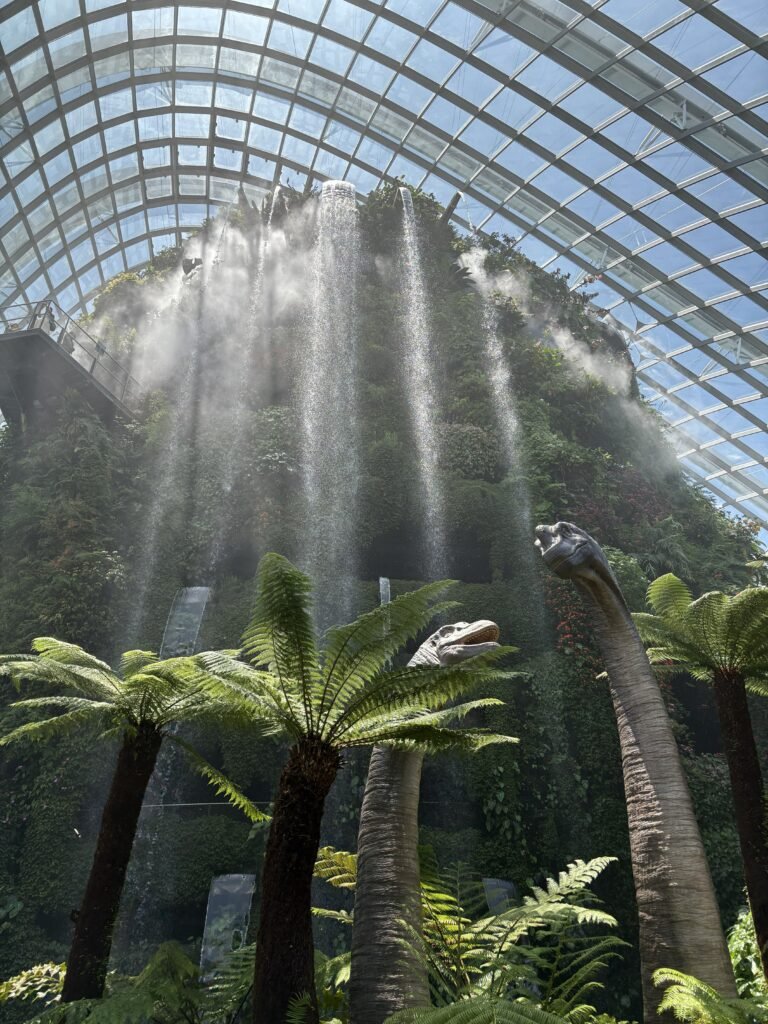
botany enthusiasts, with a more scientific and geographic focus. The Cloud Forest, on the other hand, is about atmosphere and sensory overload. Currently, it features a Jurassic Park theme. If you’ve seen the movies, it’s genuinely fun to watch surprisingly lifelike robotic dinosaurs moving and hissing to the iconic soundtrack. Meanwhile, a 30-meter indoor waterfall crashes down in the middle of the dome, creating a cool mist that contrasts beautifully with the warm tropical air.
That was my biggest surprise — something so obviously artificial somehow manages to feel immersive, real, and genuinely impressive. Even moving at a relatively brisk pace, without a million photo stops, the whole visit still takes us nearly four hours.
SINGAPORE: MERLION
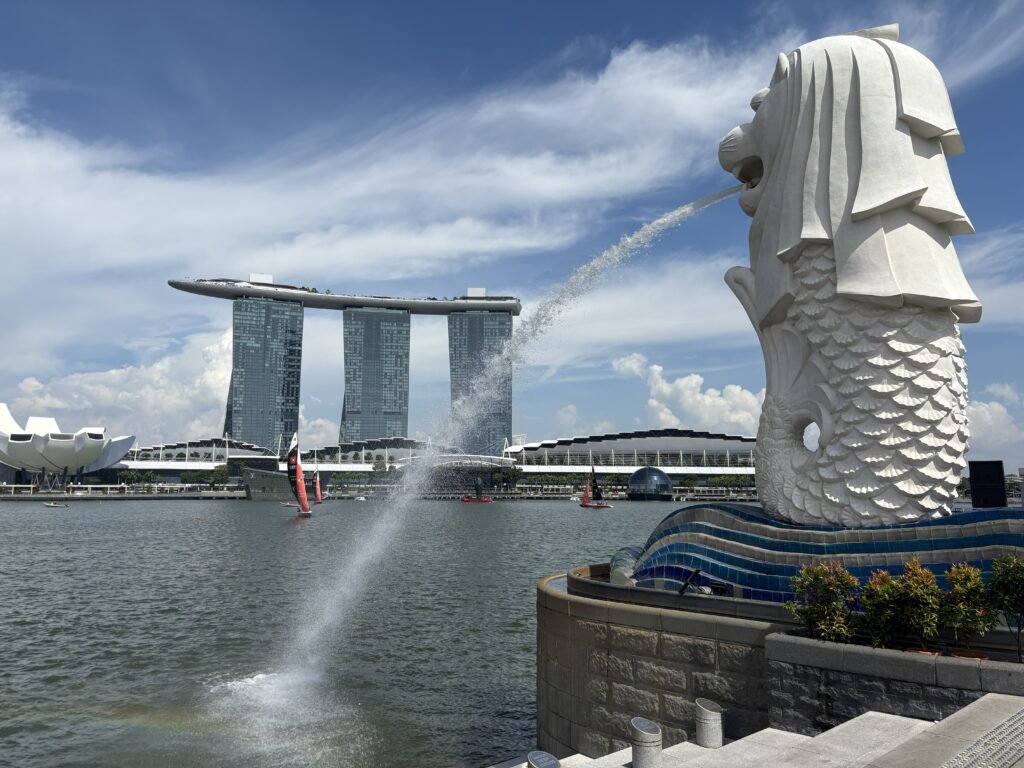
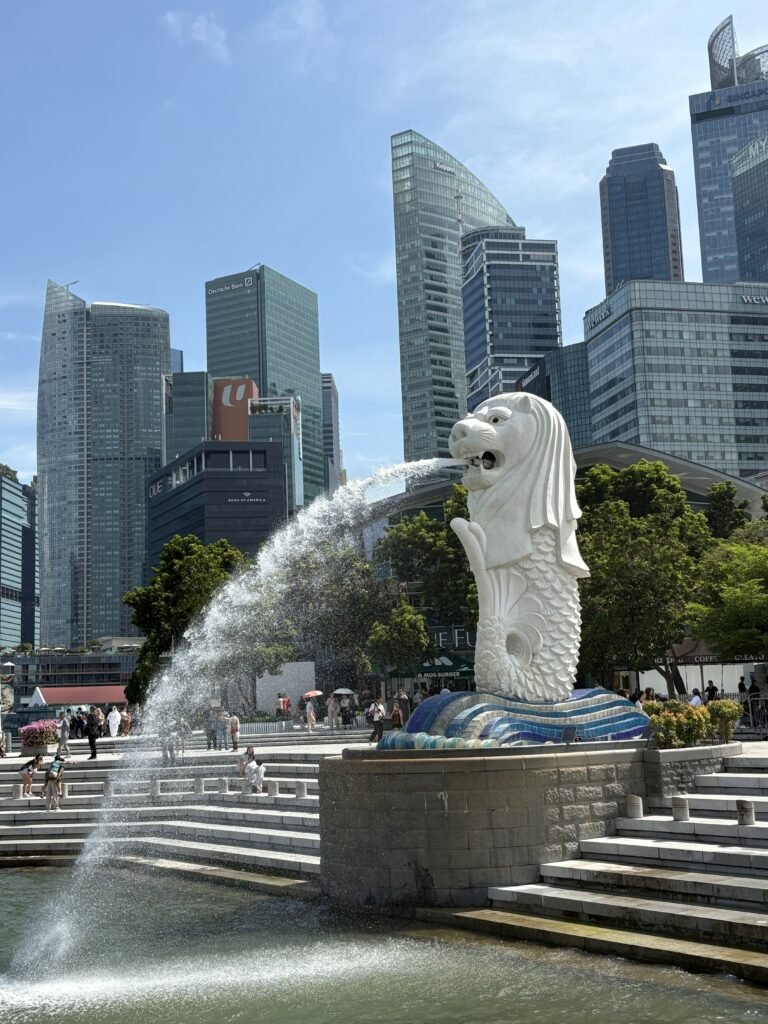
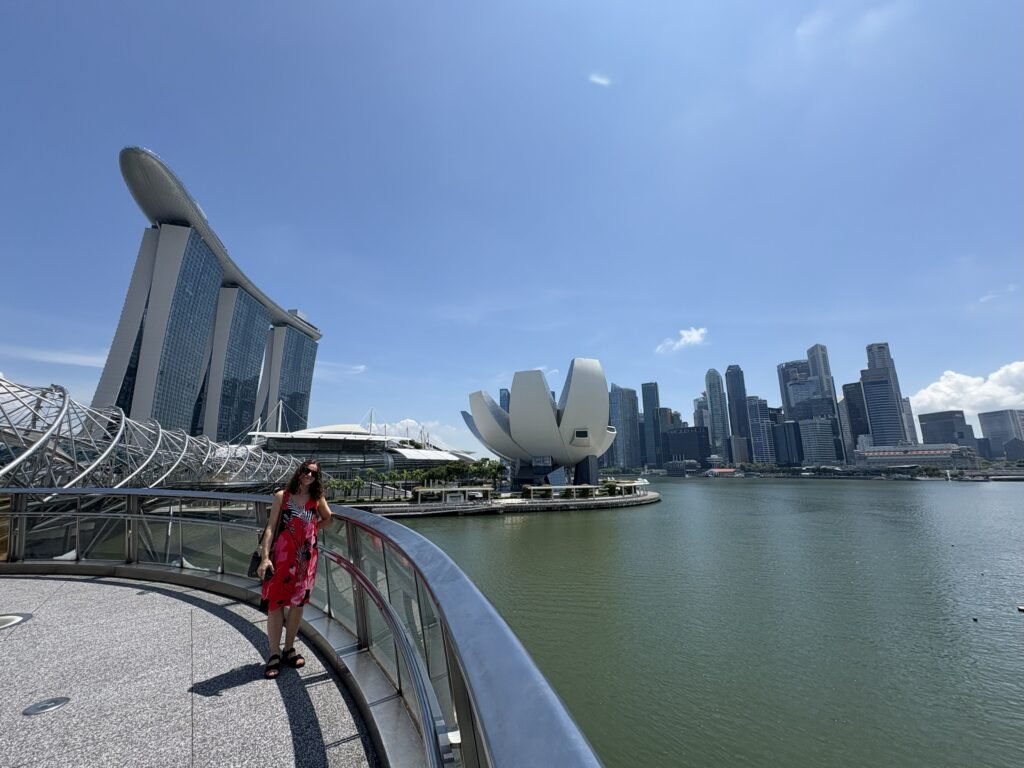
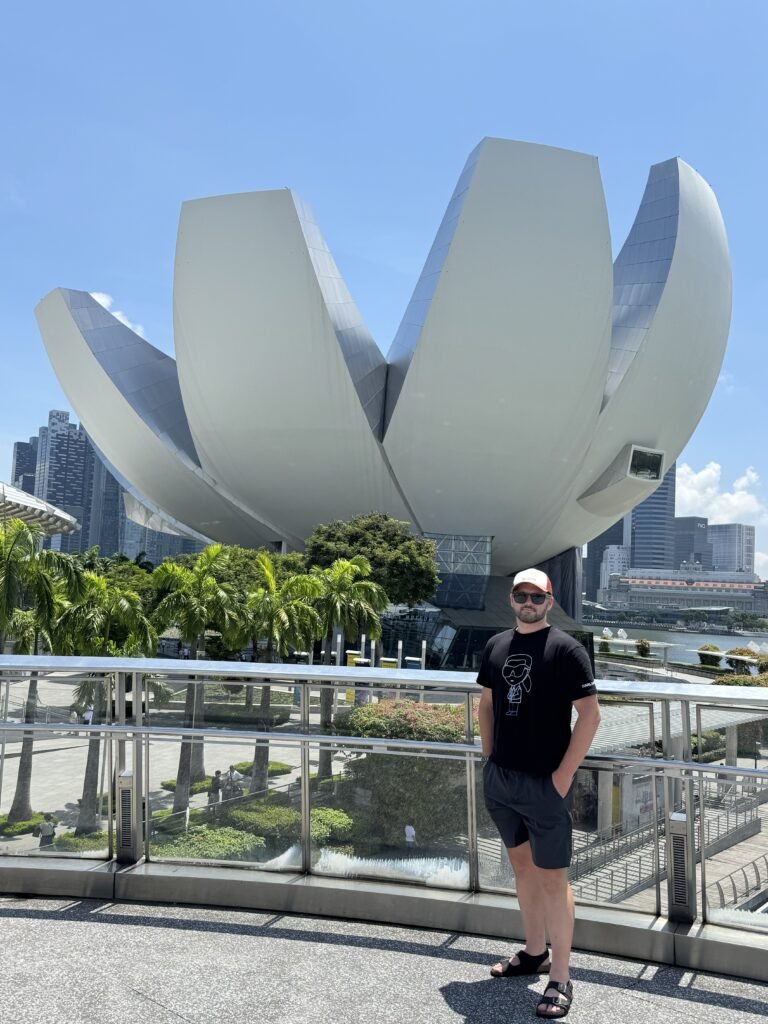
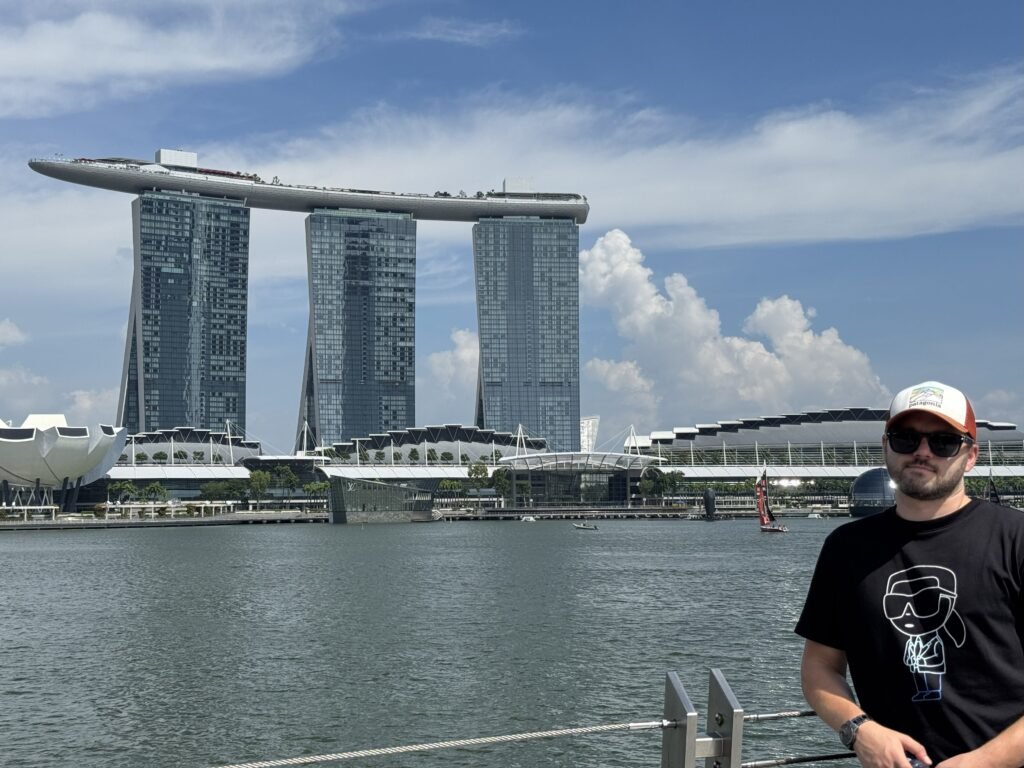
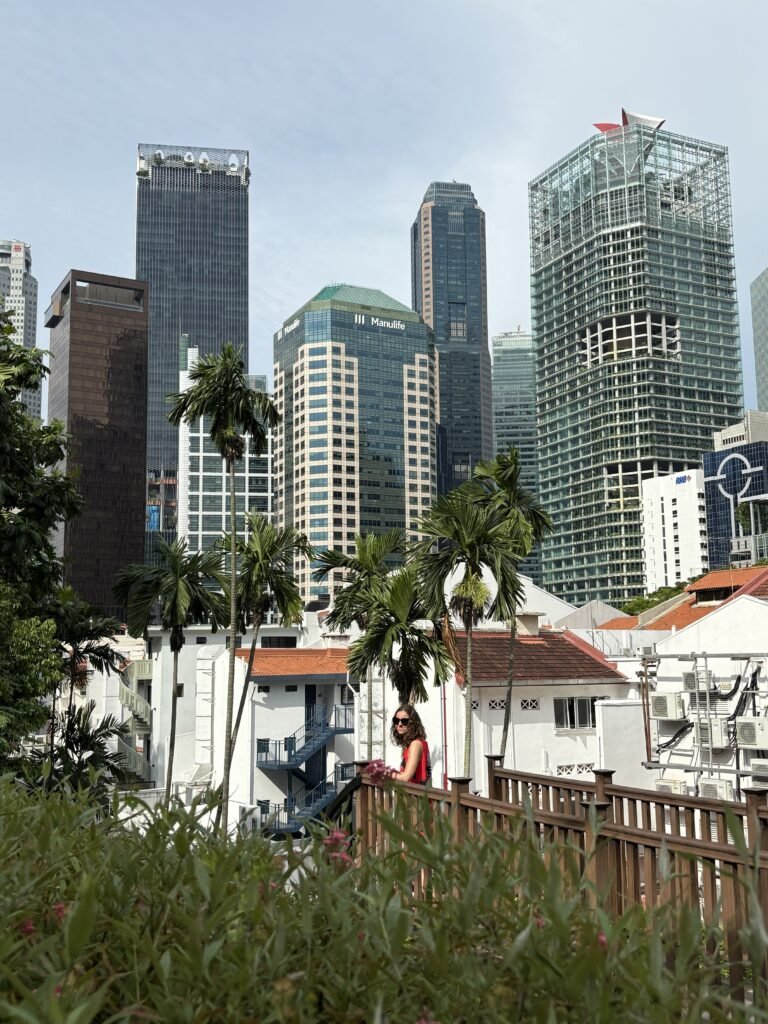
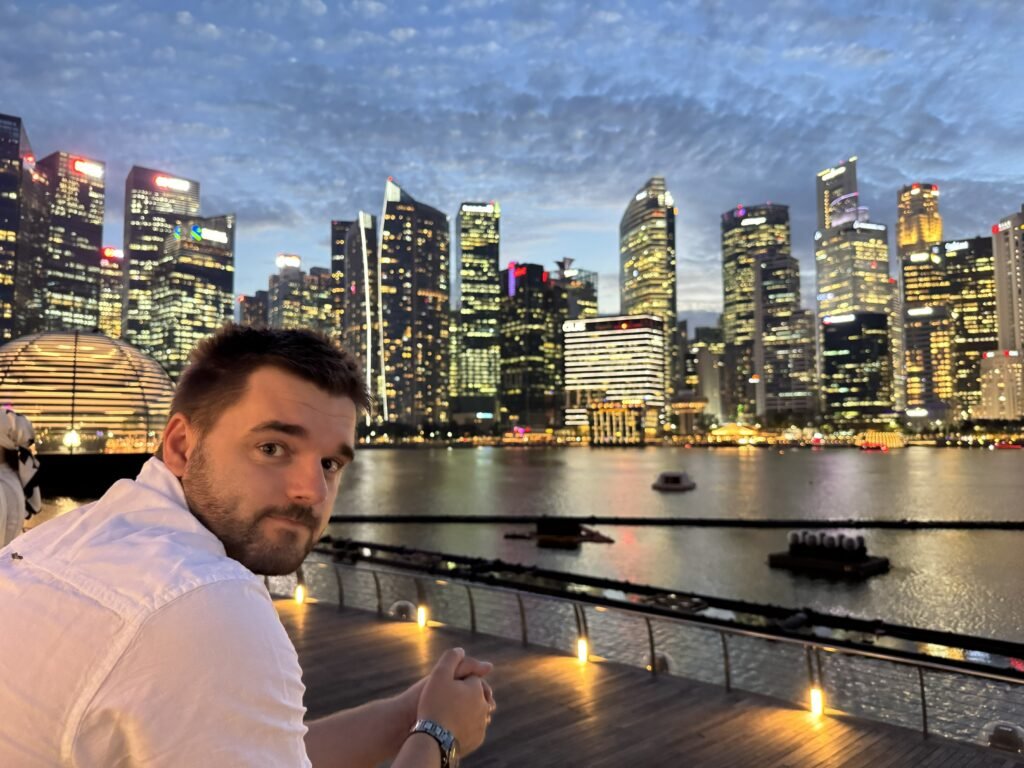
18.09.2025: After such an intense visit, logic suggests rest. Reality suggests stepping back outside into +30°C and 90% humidity. Refreshing? Not exactly. We continue across the Helix Bridge, where the views open up dramatically — Singapore’s business district skyline rising in sharp, polished lines, and of course Marina Bay Sands dominating the horizon. In front of it sits the lotus-shaped ArtScience Museum, looking like it gently floated in from the future.
It’s the kind of skyline that makes you instinctively slow down — even if the humidity insists you
keep moving. We’ll probably still clock our 20,000 steps today. But truth be told, this climate doesn’t exactly encourage enthusiastic strolling. Walking here feels less like a leisure activity and more like a mildly disciplined endurance exercise. But we can take it!
SINGAPORE: CHINATOWN
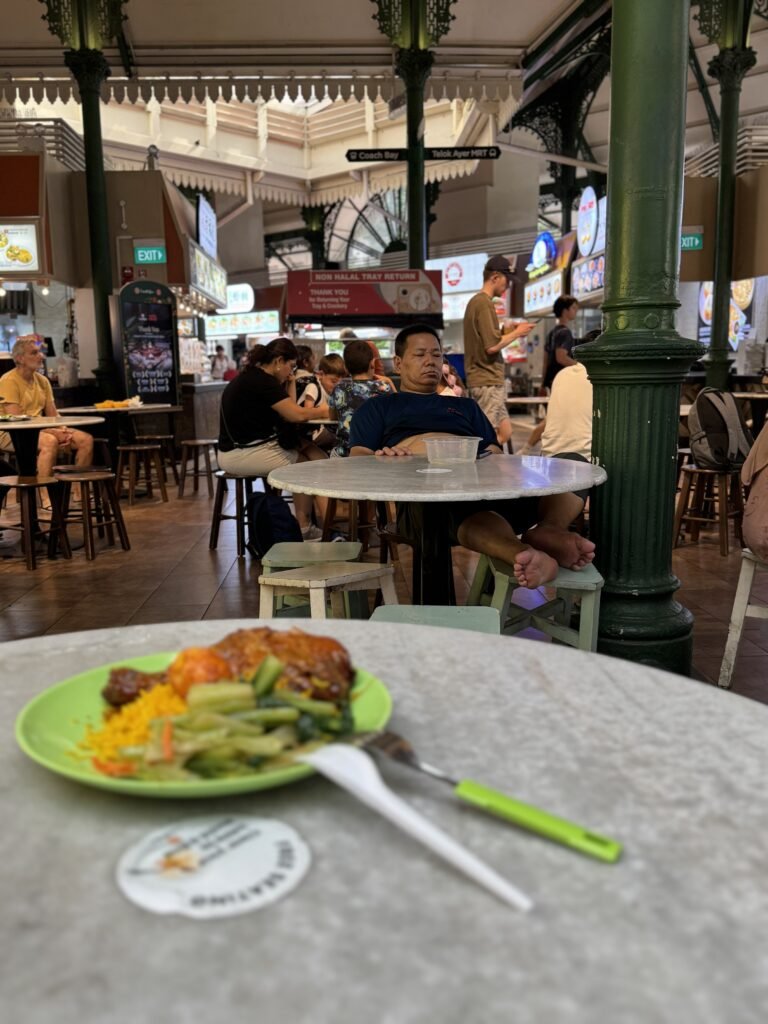
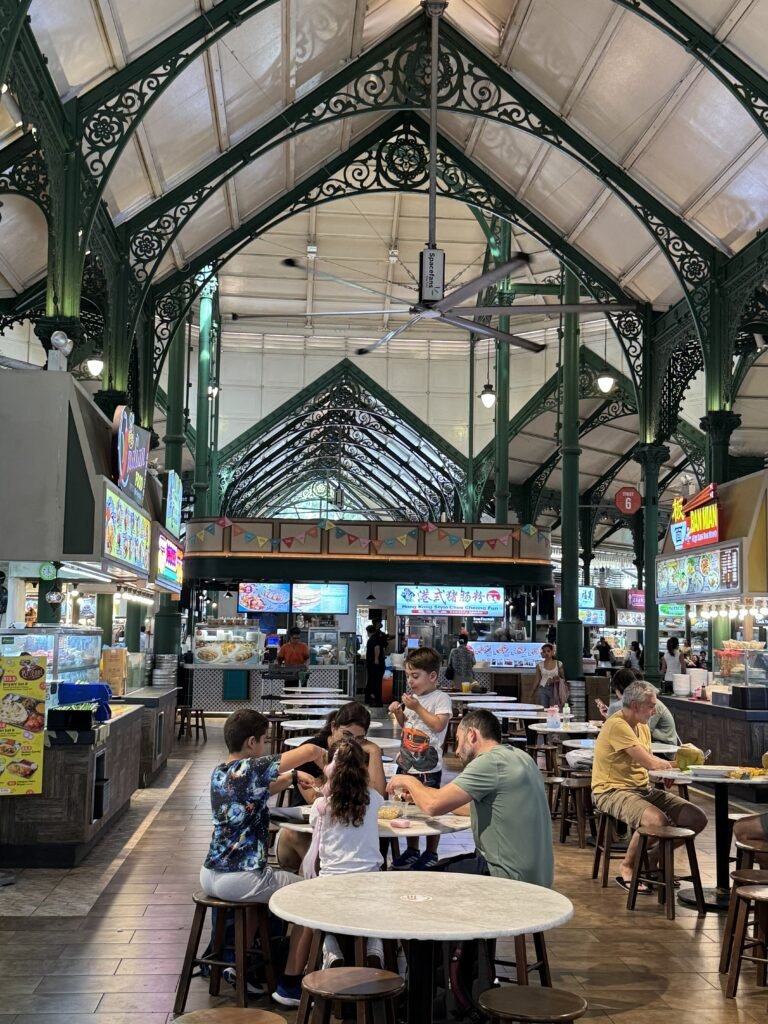
18.09.2025: After circling Marina Bay, the stomach begins filing formal complaints, so it’s time to address the situation. On the way toward Chinatown, we end up inside a large food hall — Lau Pa Sat — where you can eat almost any Asian cuisine at very democratic prices. The concept feels a bit like Riga’s Āgenskalns Market, just in a tropical edition with palm trees and 30-degree heat.
We go for Korean cuisine, and — slightly intimidated by the possibility of nuclear spice levels — choose the safest classic available: rice with chicken. There’s a gentle kick, of course, but well within European survival limits. One portion between the two of us turns out to be completely sufficient.
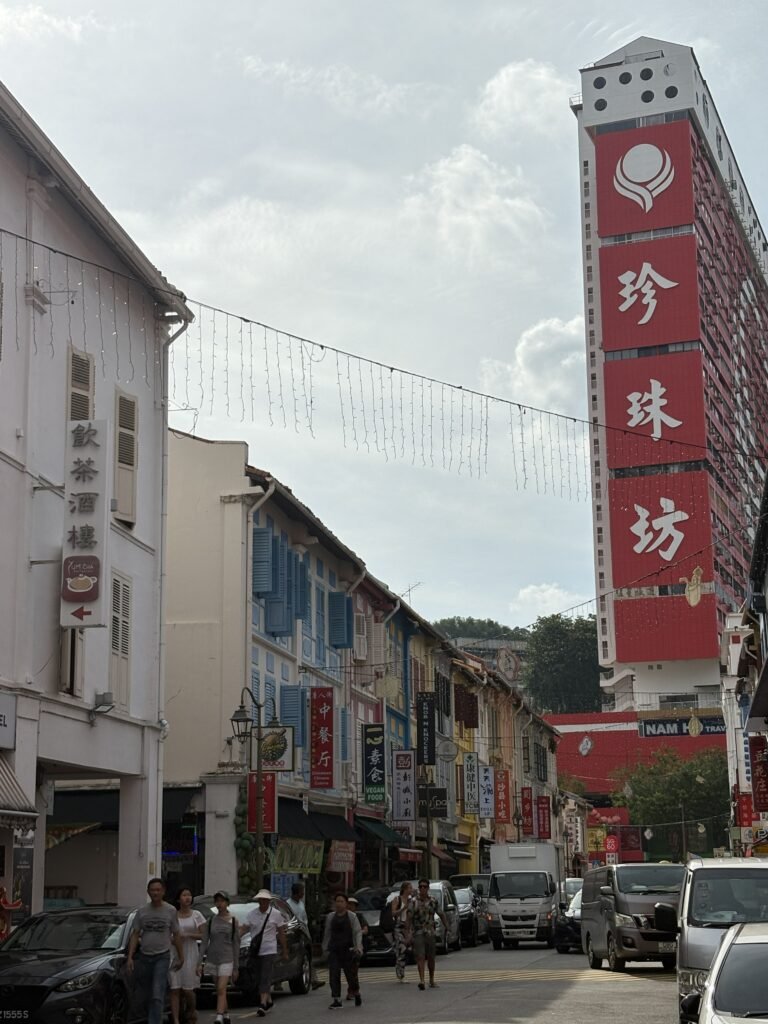
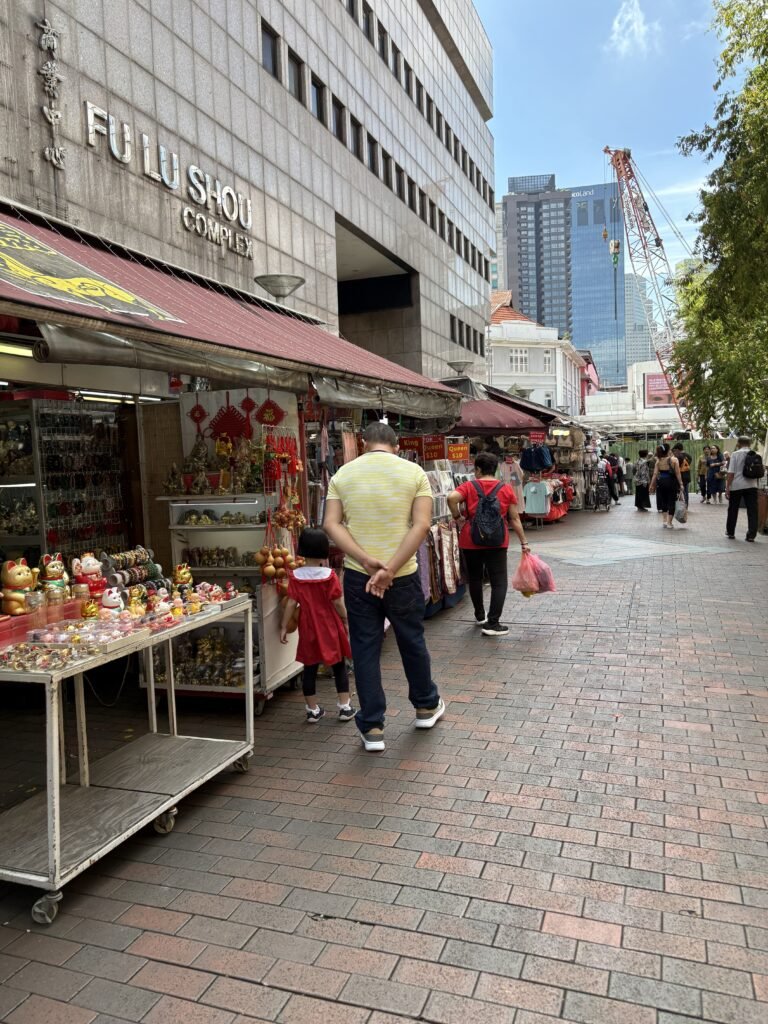
Chinatown, however, feels surprisingly calm this time — almost sleepy, with only a light flow of tourists. The real buzz is concentrated in the street market, where, as tradition demands, you can buy absolutely anything imaginable: bananas, sushi, hair dryers, televisions. Civilization in its purest retail form. We remain spectators rather than consumers. I do attempt to pitch the idea of buying Madara a geisha-style robe, but the proposal is declined without entering negotiations.
Around 5 p.m., exhaustion hits properly. If we want to survive the evening, a strategically correct decision must be made: return to the hotel for a short nap.
Thanks to Singapore’s impressively efficient metro system, within 20 minutes we’re back at our station — just 200 meters from the hotel. How much did we pay for the ride? That remains a mystery. My bank card currently shows a reserved amount of… seven cents. Either public
transport here is astonishingly cheap, or the billing system operates on a level of sophistication we have yet to comprehend.
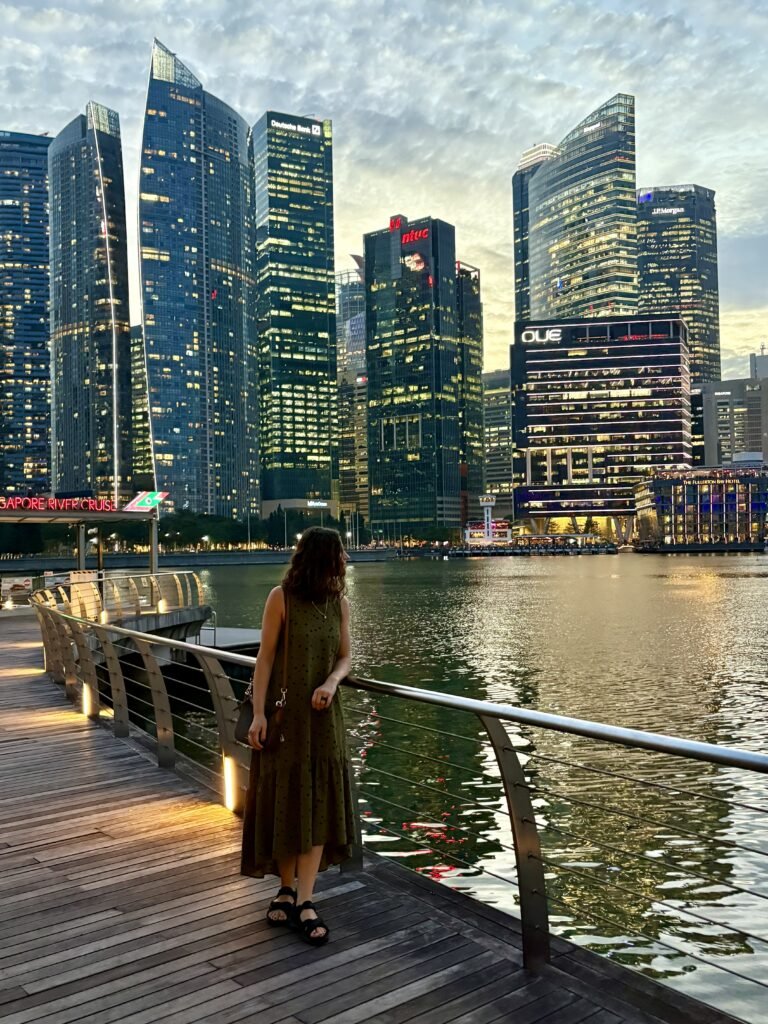
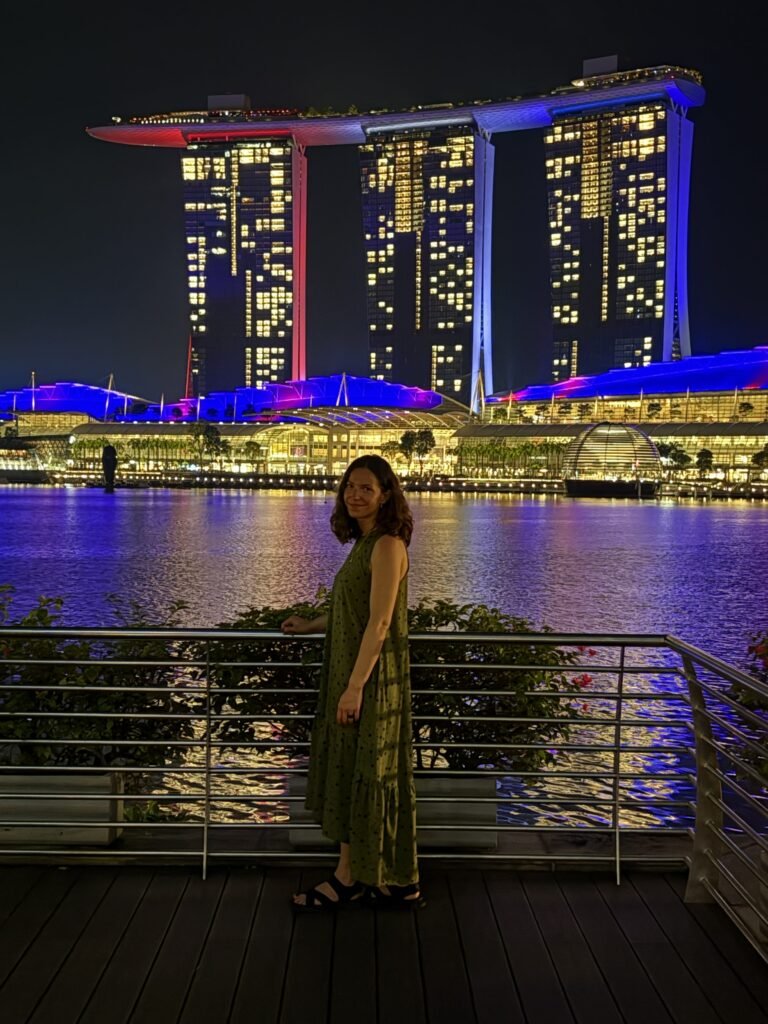
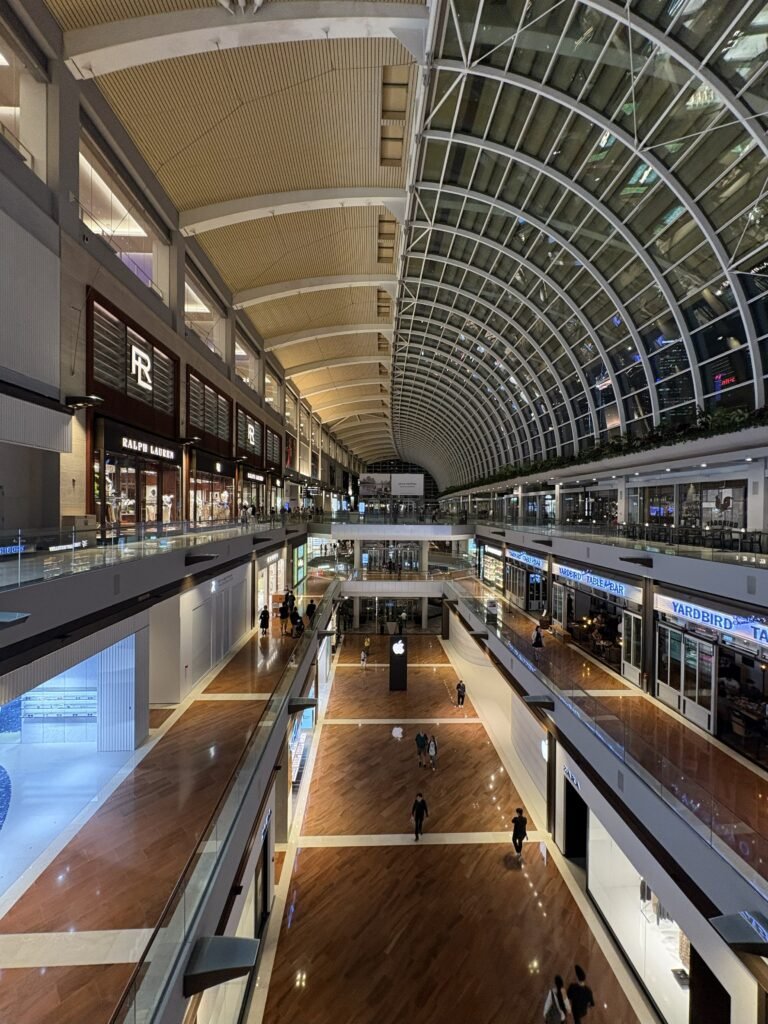
SINGAPORE: MARINA BAY SANDS
18.09.2025: After a short recovery session at the hotel and a slightly more respectable outfit upgrade, we head back to the Marina Bay area. At 8:00 p.m., a light show is scheduled right in front of the iconic Marina Bay Sands. The construction of the three 55-story towers topped with the famous infinity pool cost 6.9 billion USD. For comparison, Latvia’s planned 2026 national
budget is about 17.9 billion euros. The rooftop platform alone stretches 340 meters — longer than the Eiffel Tower is tall.
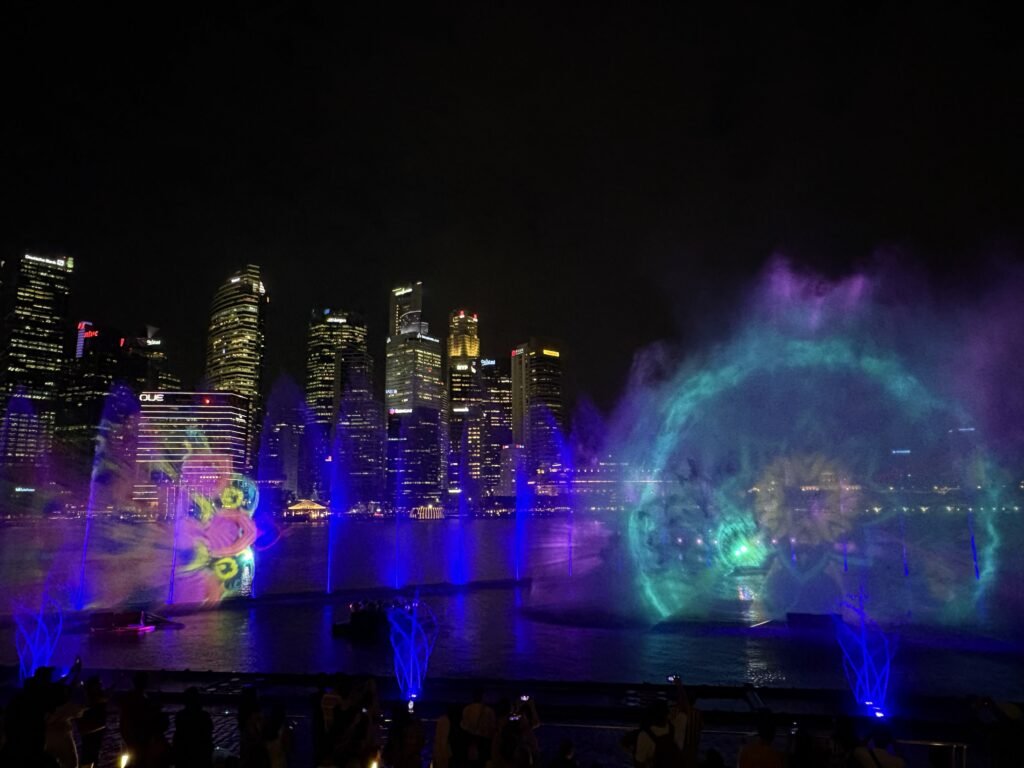
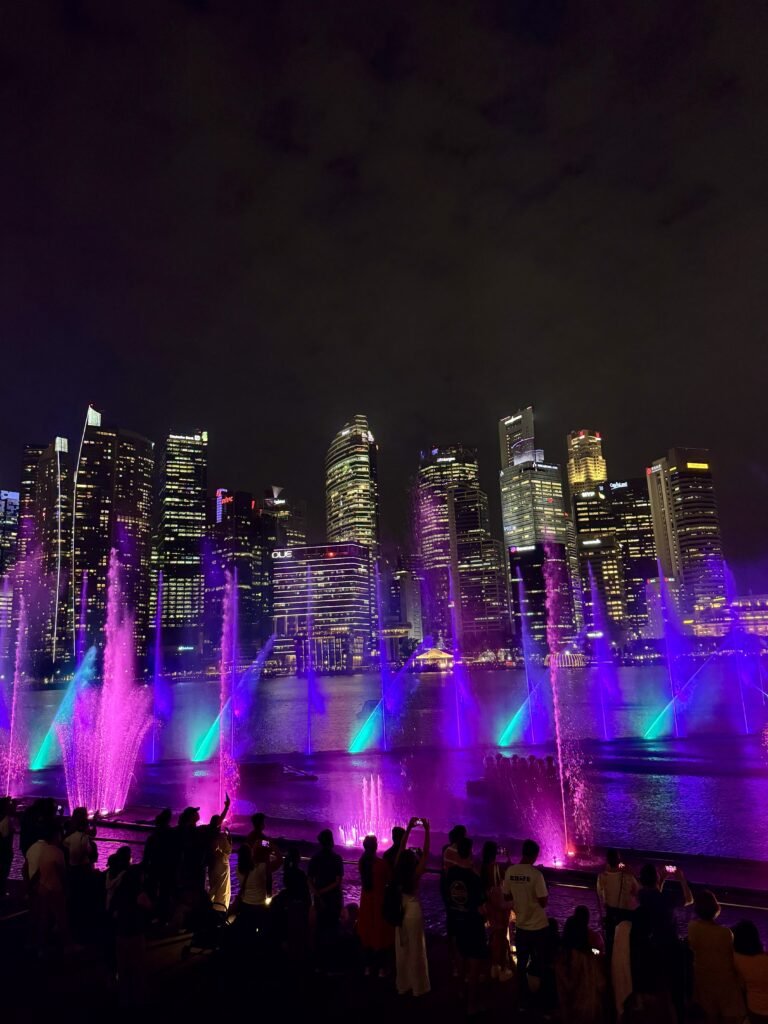
About half an hour before the show, the promenade starts filling up, but it’s not chaotic. You could easily show up five minutes before and still get a decent view without being trampled by selfie sticks. Spectra Light & Water Show At first, I suspect the show might be mildly underwhelming and not entirely worth the 35-minute wait. But then the fountains and laser installations properly kick in — and it becomes seriously impressive. Unlike similar shows we’ve seen (and we do have a benchmark — Dubai at the Burj Khalifa, Las Vegas at the Bellagio), this one uniquely uses a fine water mist as a projection surface. The result is incredibly detailed light imagery floating in midair. Effective. Dramatic. I officially retract my initial skepticism.
I had planned to celebrate yesterday’s birthday properly at a rooftop bar — LeVeL33, just nearby. Unfortunately, it’s closed for two days due to a private event. Now that must be quite the private event — the kind that can afford to shut down one of Singapore’s most iconic rooftop bars for 48 hours straight. In the end, we settle for very solid burgers right there in the bay area. A couple of beers, one more long look at the skyline, and we slowly make our way back toward the hotel. Day two concludes successfully — slightly tired, slightly humid, but very satisfied.
SINGAPORE: WINDSOR NATURE PARK
19.09.2025: Today we trade concrete and steel for green. We hop on a bus toward Windsor Nature Park, where a 7 km trail awaits. I haven’t assigned a strict time slot for this mission — hiking in tropical humidity is not something you can accurately schedule. The park covers about 75 hectares, so predicting how long we’ll wander around is unrealistic.
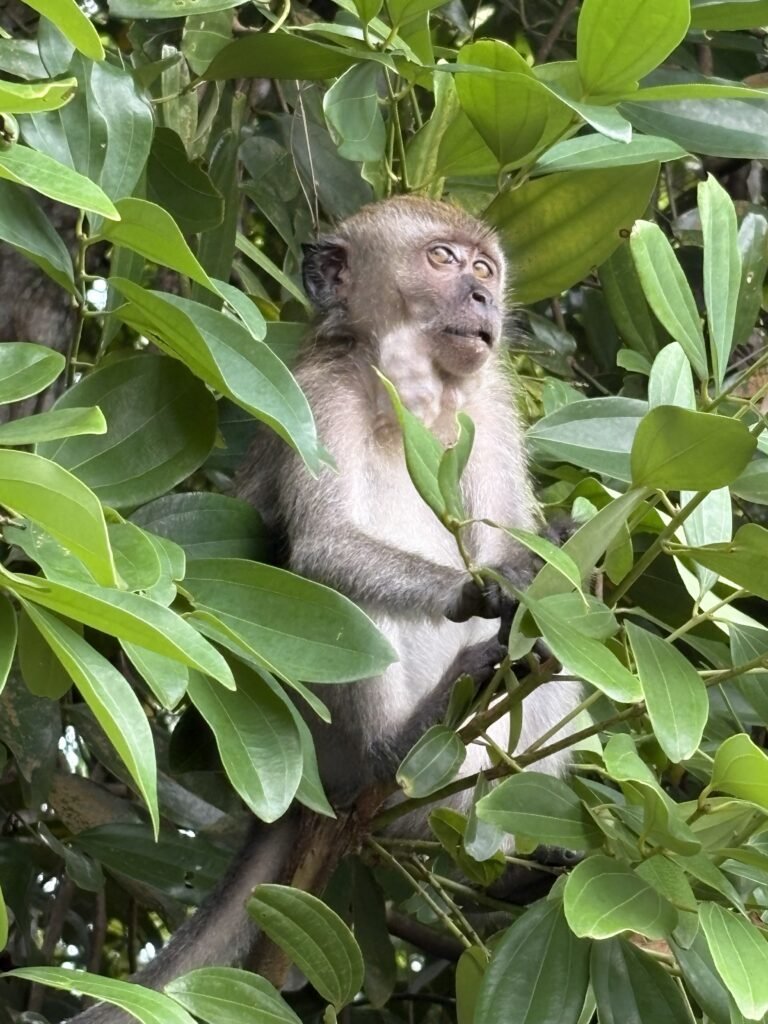
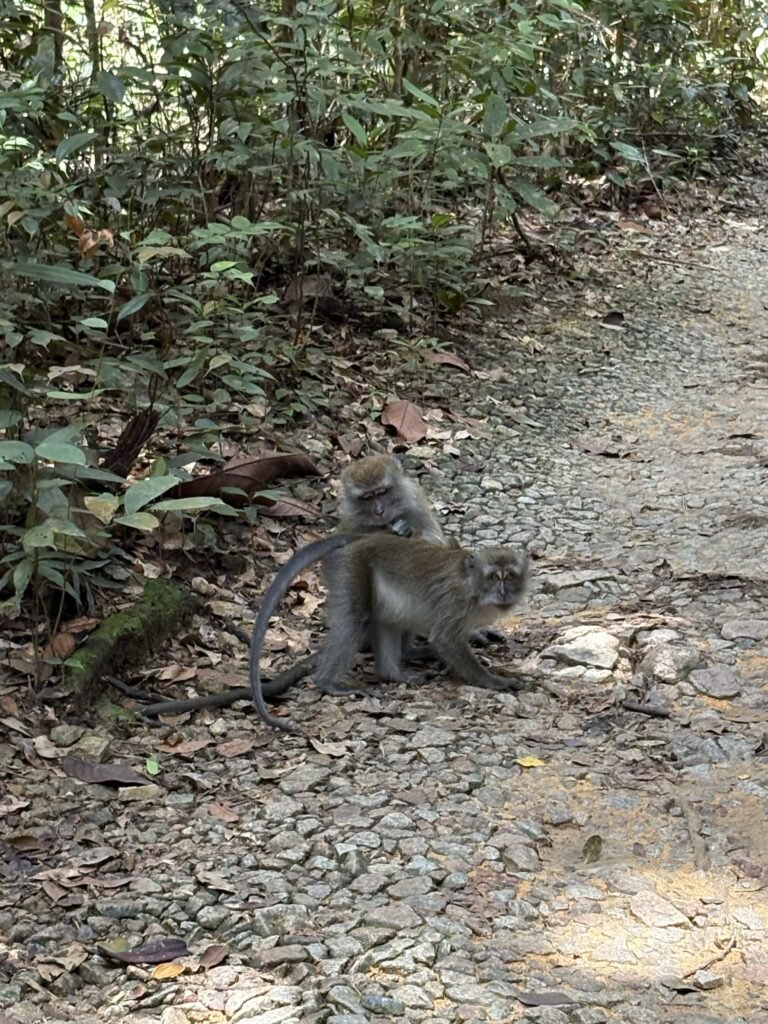
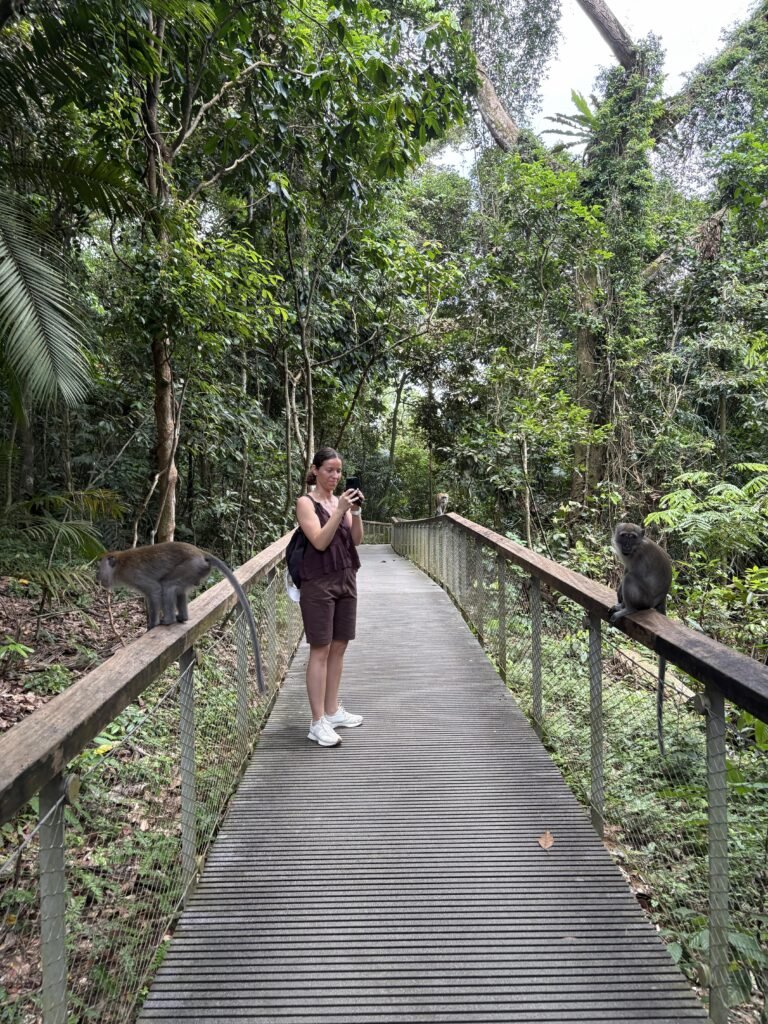
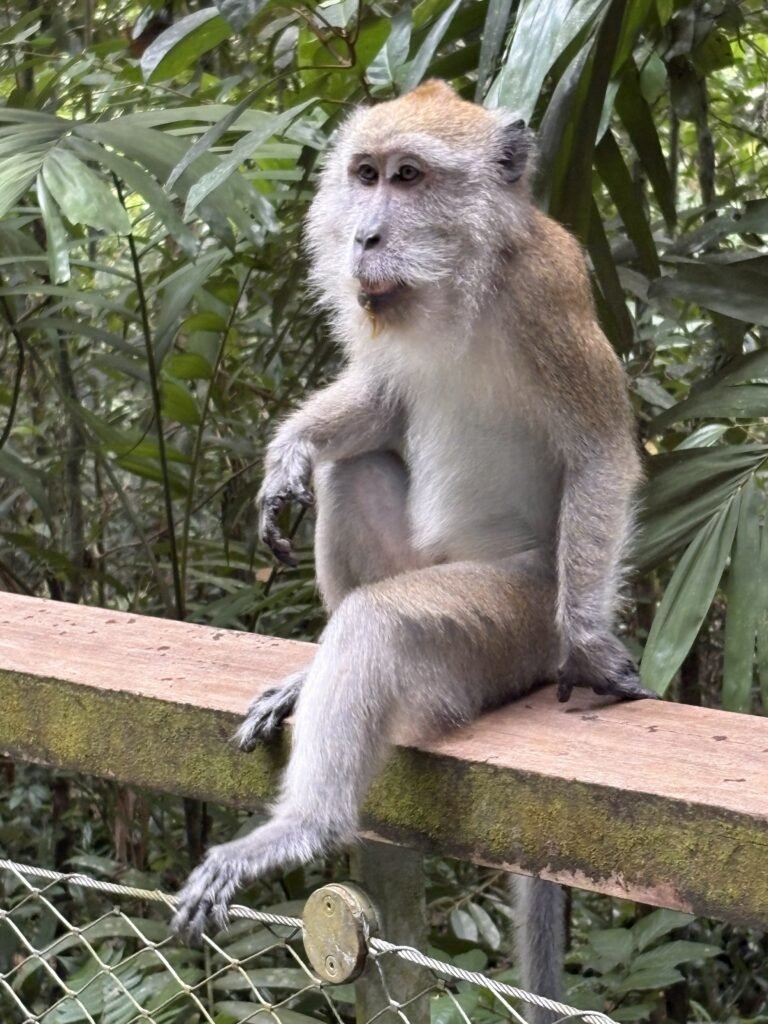
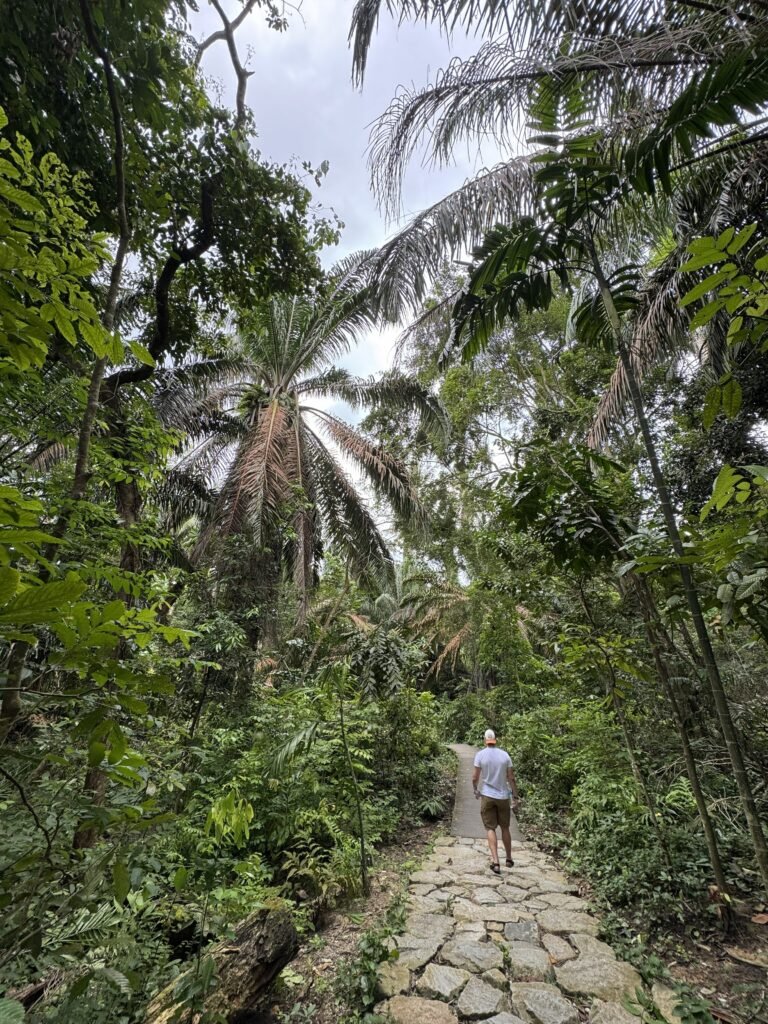
We get off near the entrance, clearly in a wealthier residential area than what we saw on the airport side of town. Beautiful terraced houses and upscale apartment buildings line the streets. Slightly surprising, though — despite Singapore’s high standard of living, even here most cars look fairly modest. Nothing flashy. No supercar parade. Anyway — into the jungle we go. The trail is exceptionally well maintained. Getting lost would require deliberate effort — and probably result in a fine. The humidity is intense, so the pace is calm and unhurried. After about 15 minutes we spot our first macaque, casually sitting on a branch, working through some small fruit with complete indifference toward us. Quick photo session. We move on. There will be more.
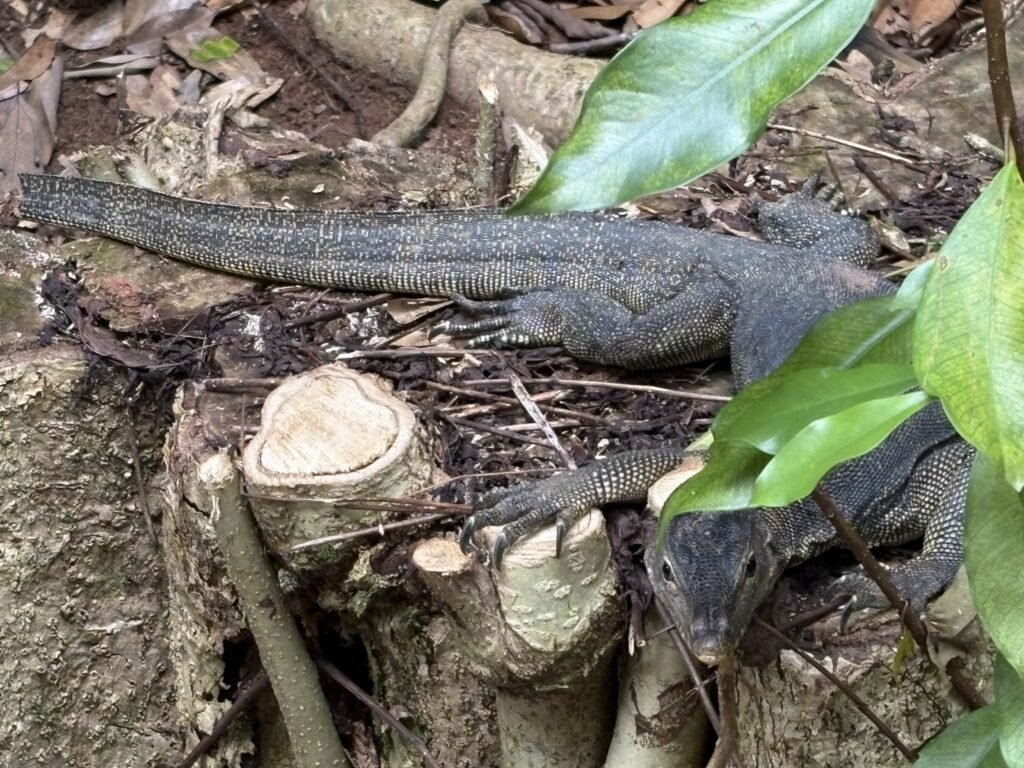
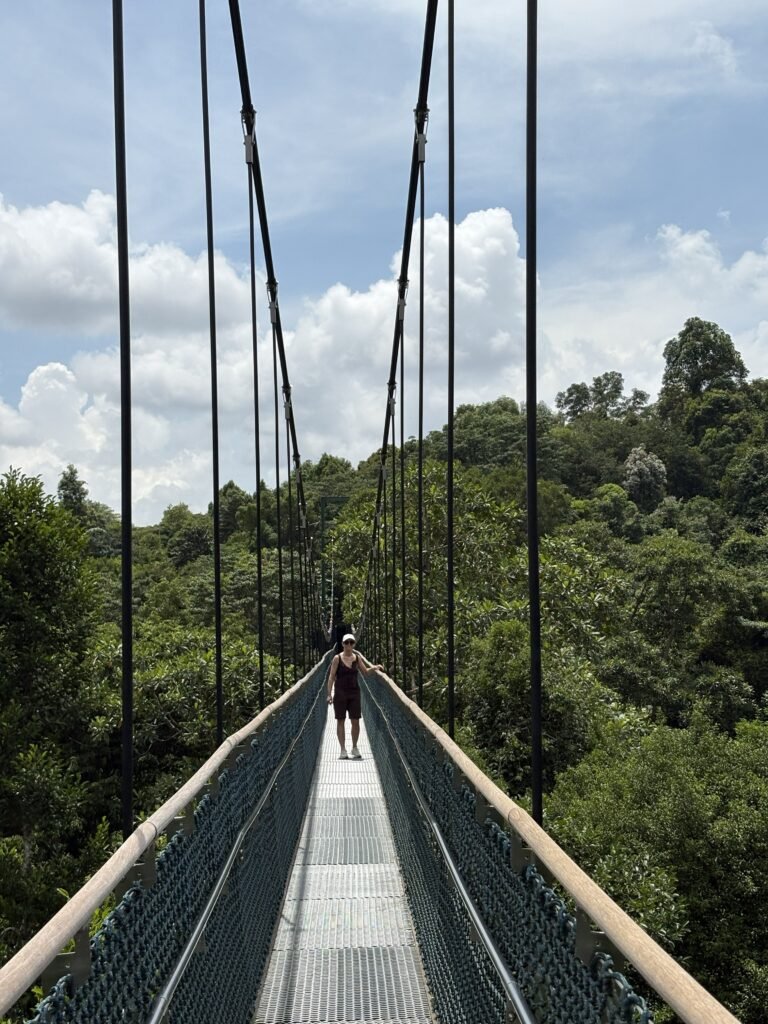
From this moment on, multiple pairs of eyes are watching us. And those are just the ones we notice. There’s an entire silent army observing from the foliage. These macaques are smaller than the ones we saw in Gibraltar, but feel more “natural,” less accustomed to tourists. Visitor numbers here are relatively low, so caution is advised — especially around mothers with babies. At one point I hear something rustling in a pile of leaves. For a second, I’m convinced a white mouse just ran past. Turns out it’s a lizard’s limb. The creature emerges, tongue flicking rapidly, lifting leaf after leaf in search of a snack. It amuses me that in English this animal is called a “monitor lizard.” Quite literally monitoring the jungle at ground level. When we transition from the smaller tourist loop to the longer trail leading to the treetop bridge, the path becomes more natural. No more boardwalk sections — though still perfectly walkable. The jungle at the sides grows denser, impenetrable.
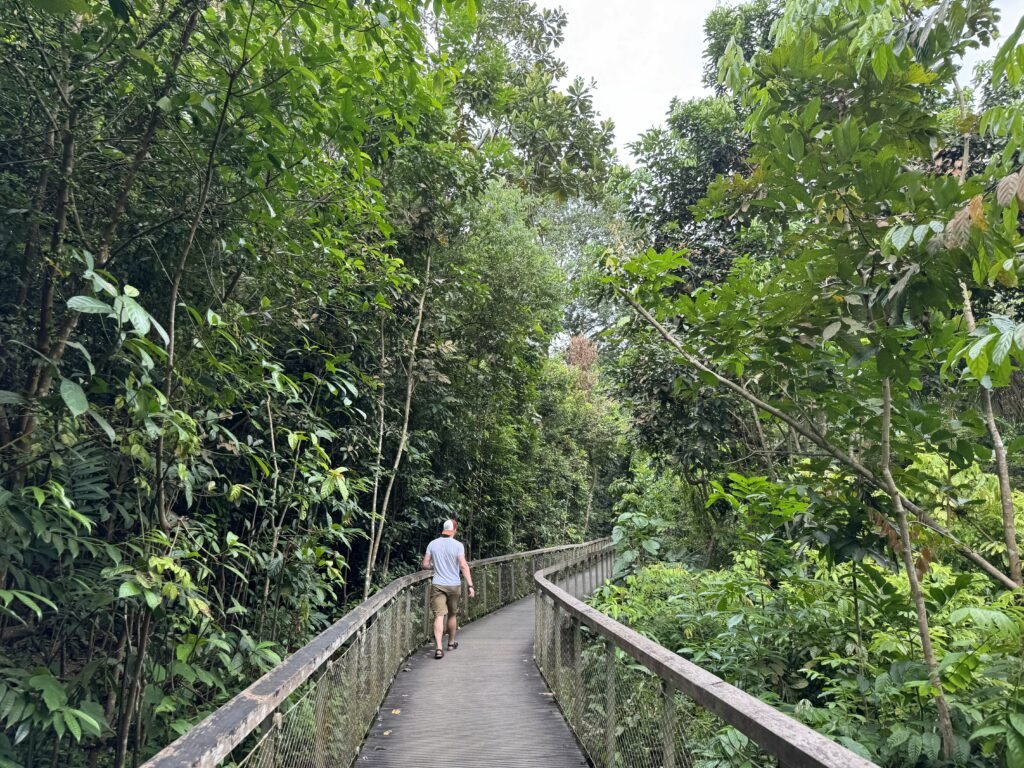
You couldn’t push through it even if you tried. As the number of people decreases, the jungle’s presence becomes louder. Insects buzz, unseen creatures call out, something constantly moves in the undergrowth. You are being watched. The canopy bridge ahead is one-way. After the entry gate, you’re committed to at least another 3 km. If you’re tired, this is your last chance to turn back. We go forward!
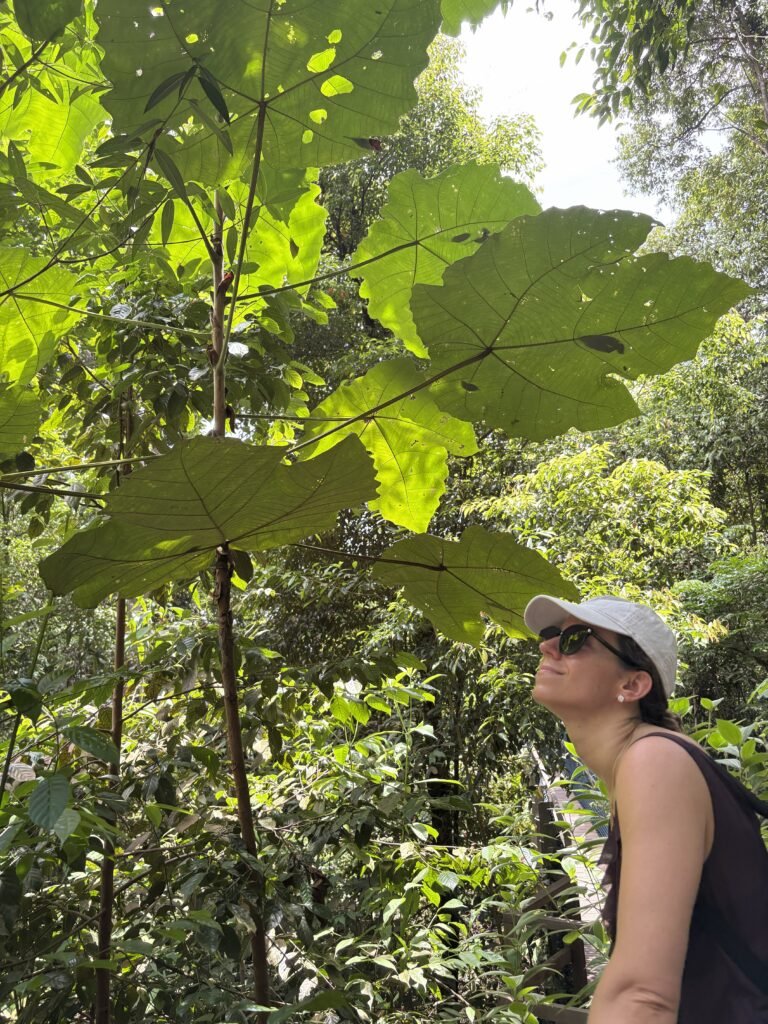
For anyone afraid of heights, this may not be ideal entertainment. The narrow suspended rope bridge sways noticeably with each step. From above, the jungle reveals its true intensity — layers of green upon green. Our northern ferns look modest in comparison. Here, leaves are thick, firm, almost weapon-like. Some palm fronds look sturdy enough to skewer someone. On the way back, we encounter the largest ant of our lives. At least 2.5 cm long. An impressive unit. Meanwhile, Madara tries to film a rooster crowing somewhere in the distance. Naturally, the bird goes silent the second recording starts — and resumes immediately after she stops. Jungle law.
After nearly three hours in the forest, exhaustion hits hard on the bus ride back. Full system shutdown approaching. Time to return to the hotel and recharge.
SINGAPORE: ROCHOR
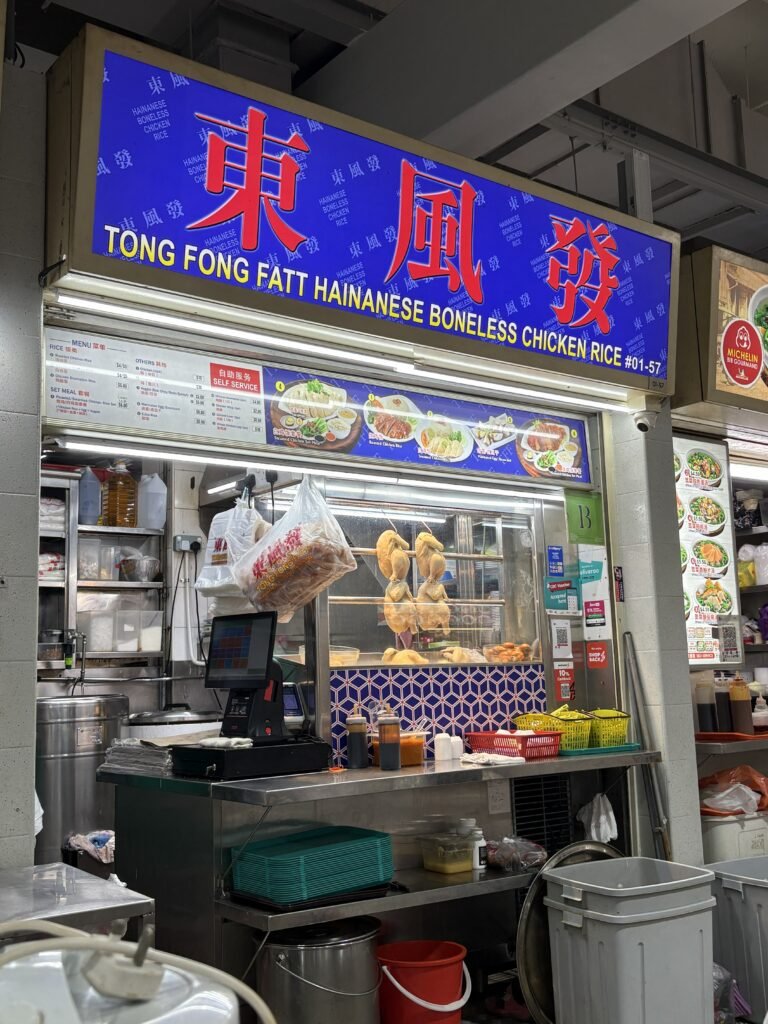
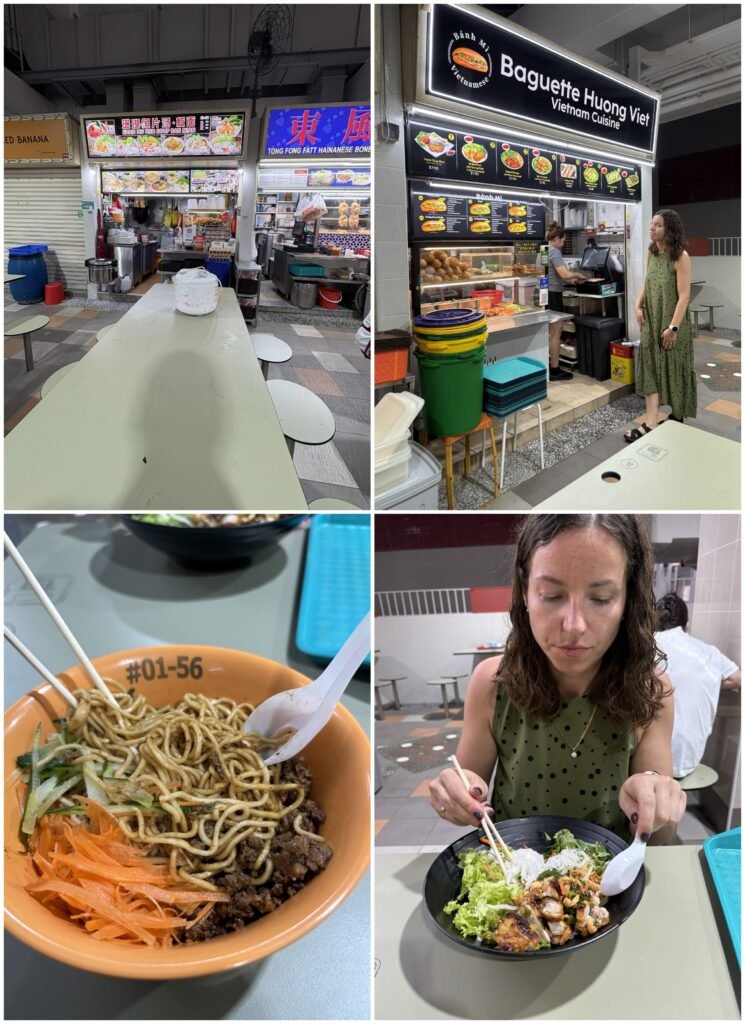
19.09.2025: After a short recharge at the hotel, we head out in search of lunch. Yesterday we noticed a large hawker-style food court near the hotel in the Bugis Street area — and that’s where we return. I go for noodles with meat of… unclear origin. Madara chooses a salad-style
mix topped with fried chicken. Visually? Slightly questionable. Taste-wise? Surprisingly excellent. And the best part — we both eat for a total of 13 Singapore dollars. Hard to argue with that. Now we just wait for the stomach’s official response.
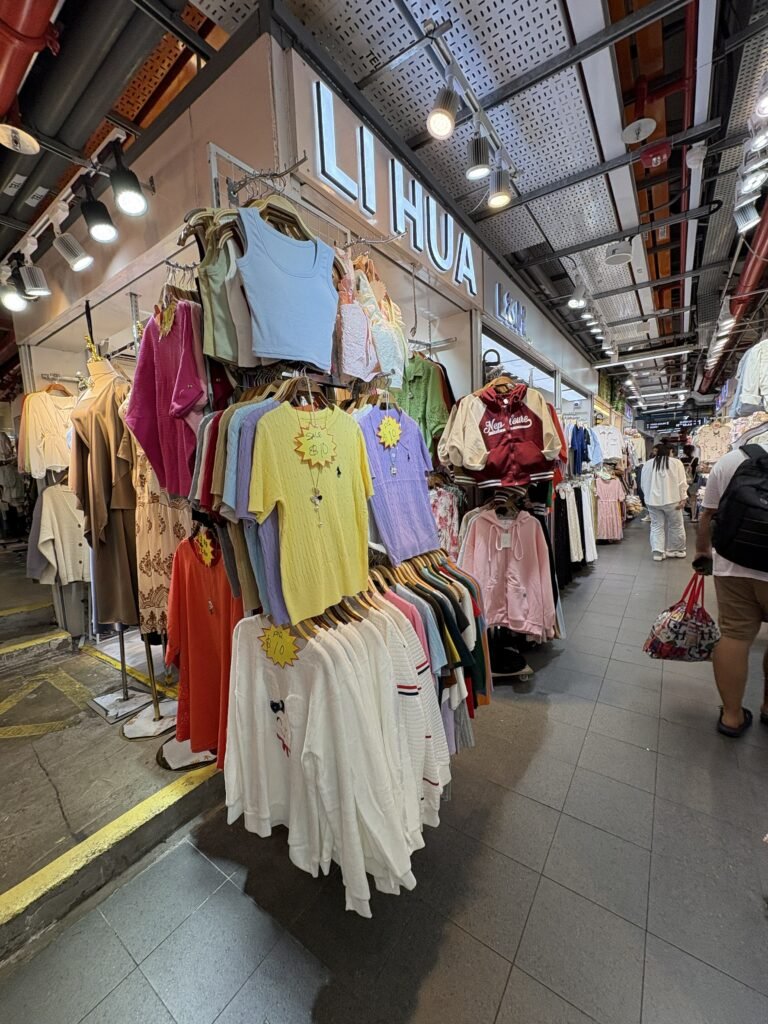
In two rounds, I also treat myself to freshly pressed watermelon juice and mango juice. Absolutely outstanding. Of course, every sip comes with a subtle background anxiety soundtrack — “How will the stomach interpret this?” — but the juices are genuinely fantastic! At the market I finally buy myself a proper souvenir: a wallet dedicated exclusively to my growing collection of foreign banknotes. It features Singapore’s iconic lion engraving and costs just under €3. A solid investment in long-term memorabilia storage.
The original plan was to visit a rooftop bar atop one of the district’s fancy skyscrapers. Unfortunately, the dress code is smart casual — which translates to “not in shorts and sandals.” Rejected by fashion standards, we pivot gracefully. Instead, we head back to our now-familiar Haji Lane in Little India, where we already know which bars feel welcoming.
There, I secure a proper draft Australian beer — redemption at last. Sometimes rooftop glamour loses to street-level comfort. And honestly, cold beer in tropical humidity tastes just as good without a skyline view.
SIN-SZB
20.09.2025: During the night, my tooth — the one that has been quietly demanding attention for a while — decides to make its presence known again. First thing in the morning, I quickly search for dentists in our Kuala Lumpur area and try to secure an appointment within the next couple of days. Going to Indonesia with an unstable tooth is definitely not part of the master plan. Right now it’s not dramatic or even particularly painful — but the uncertainty is unsettling. It could escalate.
What a time to be alive, though. A guy from Latvia, sitting in Singapore, arranging a dental appointment in Kuala Lumpur — in English — for 10:00 a.m. the next day. Which, by the way, is a Sunday. I had previously arranged for a driver to pick us up at Kuala Lumpur airport and take us to the hotel. He messages me at 2:30 a.m. to clarify arrival details. I can’t help but wonder — does his tooth hurt too? Why is he not sleeping at such hour? We head to the airport early to properly admire Singapore’s aviation pride. After three days in the city, I now move through the metro system like a local. No map, no hesitation — straight to the airport. Singapore’s public transport is that efficient and easy to understand.
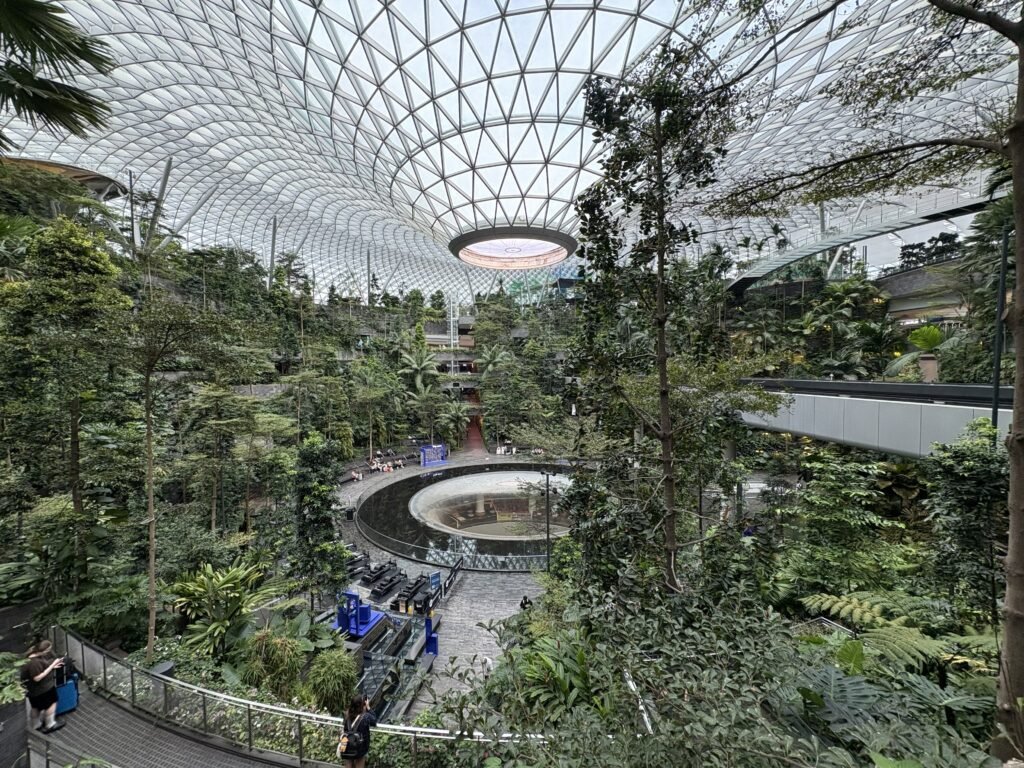
We planned to see the famous indoor Vortex waterfall at Changi Airport — but as it turns out, even waterfalls here have opening hours, and we arrive too early. No worries. Over the course of this trip, we’ll pass through Singapore airport four times. One of those attempts should statistically align with waterfall operating hours. Today’s flight has the strictest baggage weight limit of the entire trip — 10 kg. For a three-week journey, that’s ambitious. Thankfully, we travel with our own portable luggage scale, so near security control we’re busy “doing chemistry,” redistributing items between bags like amateur logistics engineers. All for nothing. In the end, nobody even properly checks the weight.
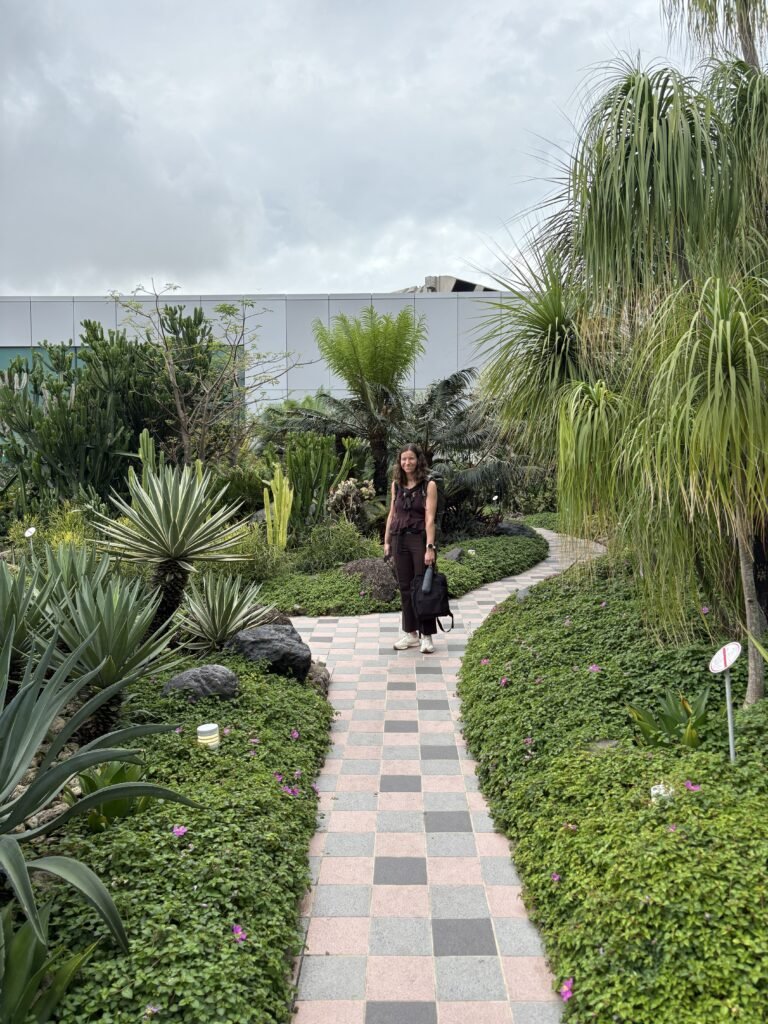
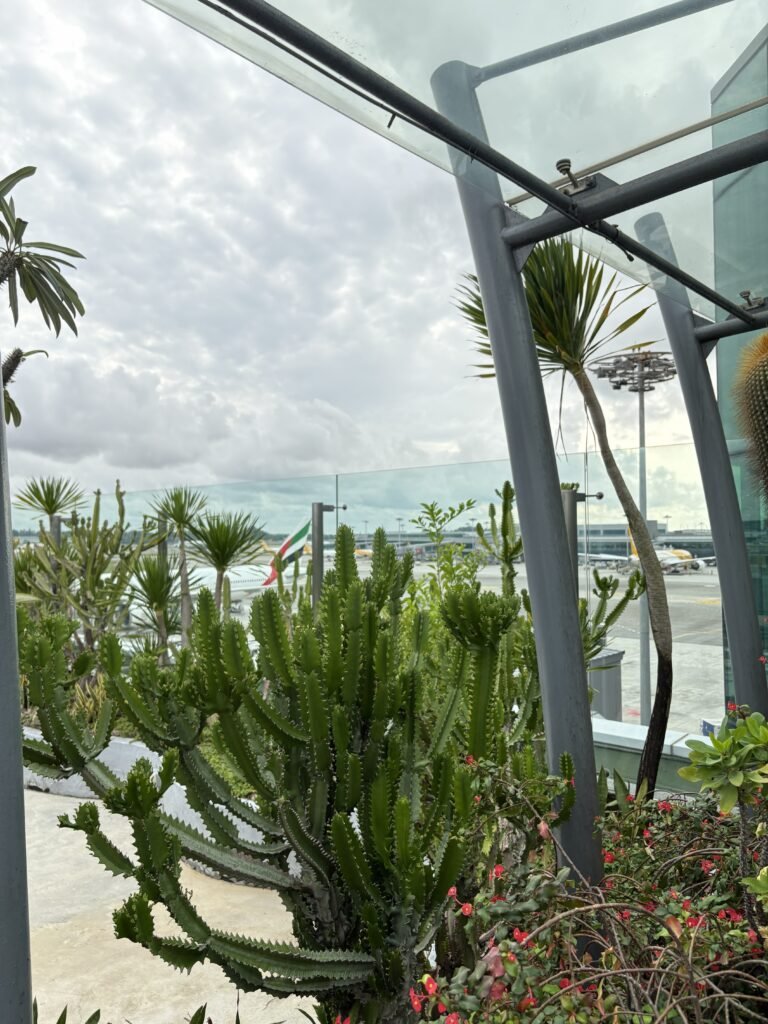
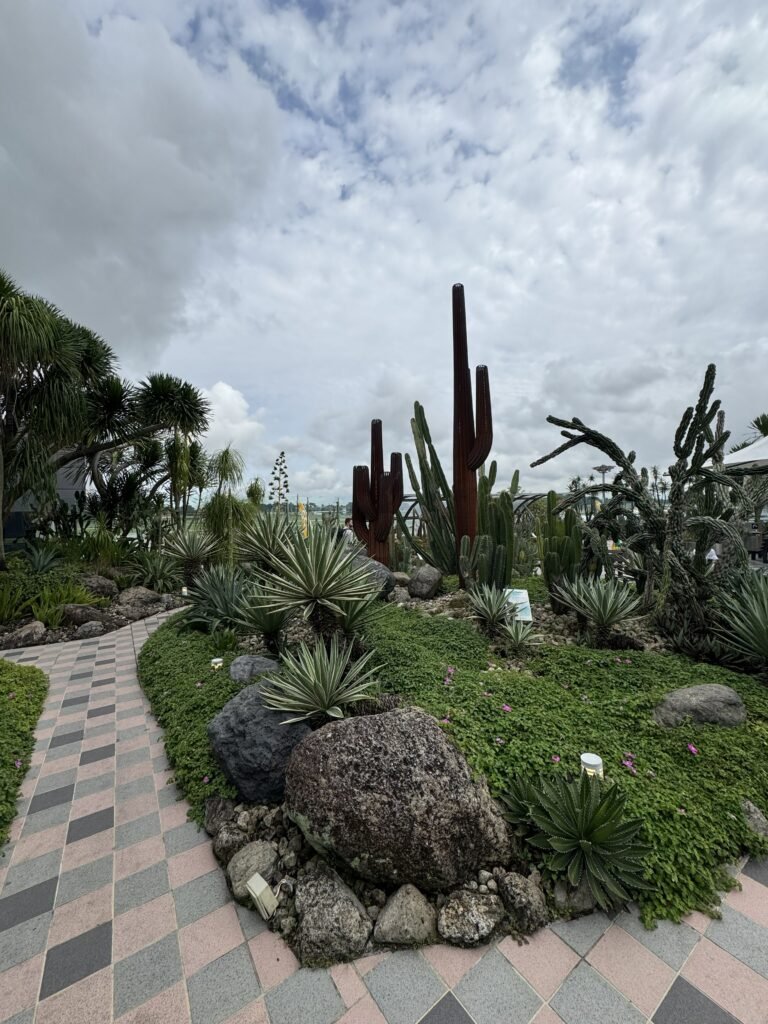
Even without the waterfall, Changi Airport is stunning. So much greenery, so much space. After security in Terminal 1, you can even step outside into a cactus garden — something you don’t typically associate with airports. Granted, it doubles as a smoking area, so in +30°C heat combined with cigarette smoke, it’s not exactly a long-stay destination. We grab one more coffee. Time to move on to the next country on the list — Malaysia. If I’ve counted correctly, this will be country number 36.
KUALA LUMPUR: PETRONAS TWIN TOWERS
20.09.2025: After about 30 minutes in the immigration line, we’re greeted by our driver, Ayu, who takes us to the hotel. Not knowing all the ins and outs of Malaysia beforehand, I had arranged an airport transfer in advance. The price was very reasonable, so there wasn’t much to debate — done! We drop our bags at the hotel and allow ourselves a very brief rest. No time to linger — food first, because tonight’s program is built around one major highlight. Just one sight. But what a landmark!
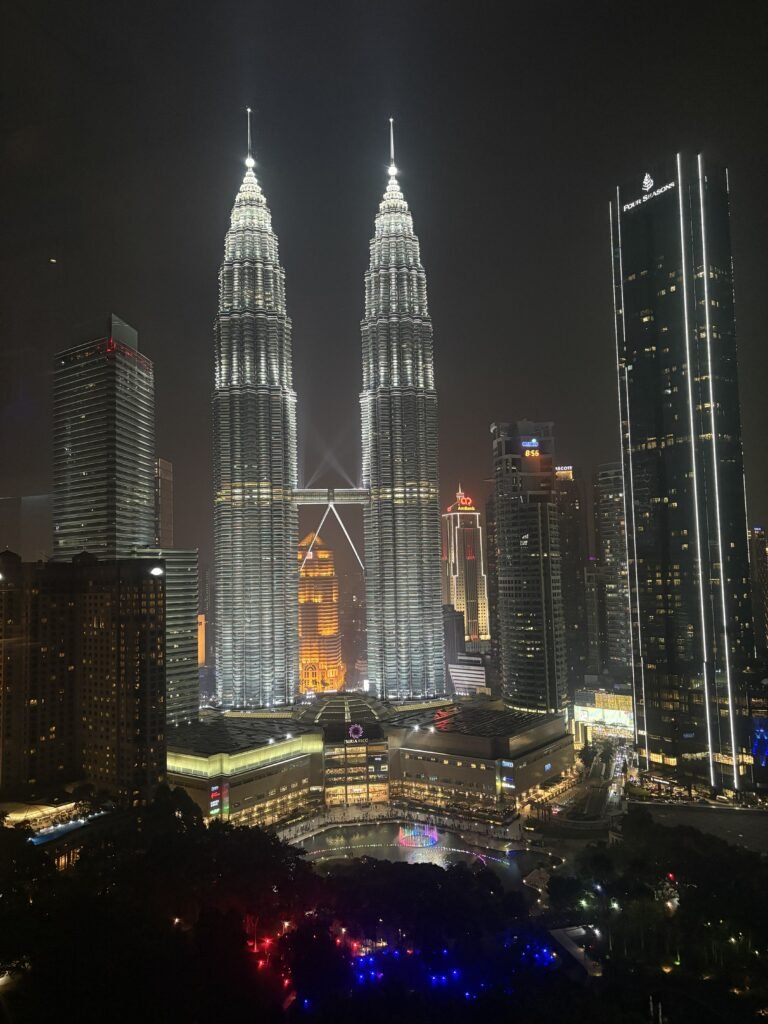
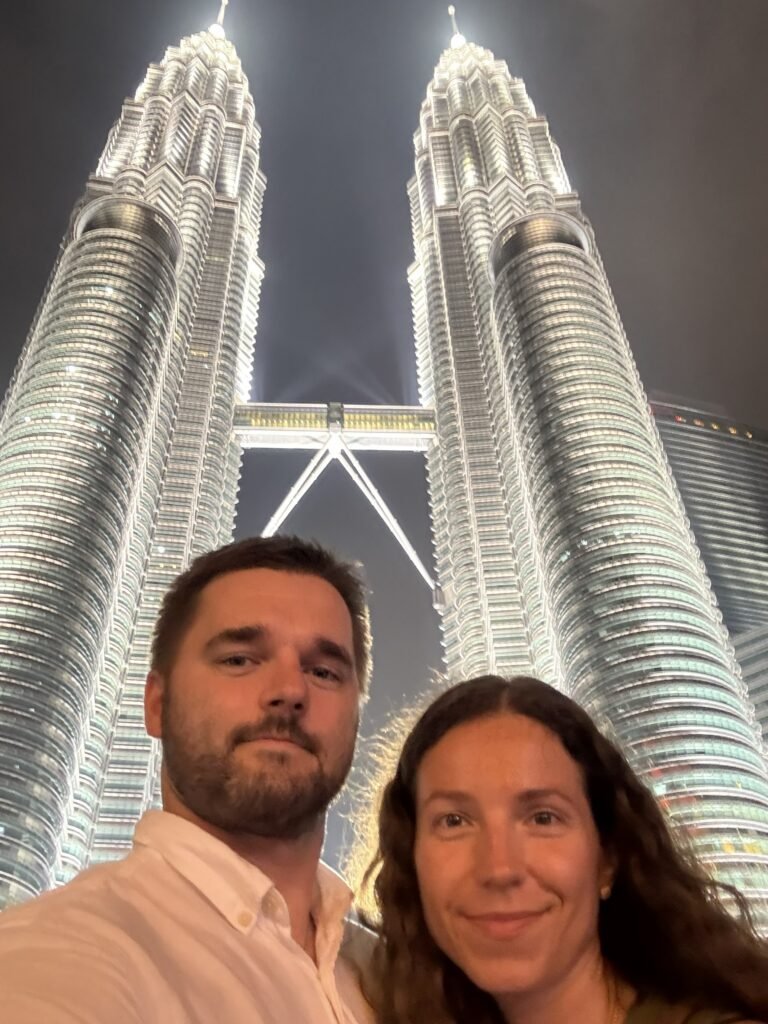
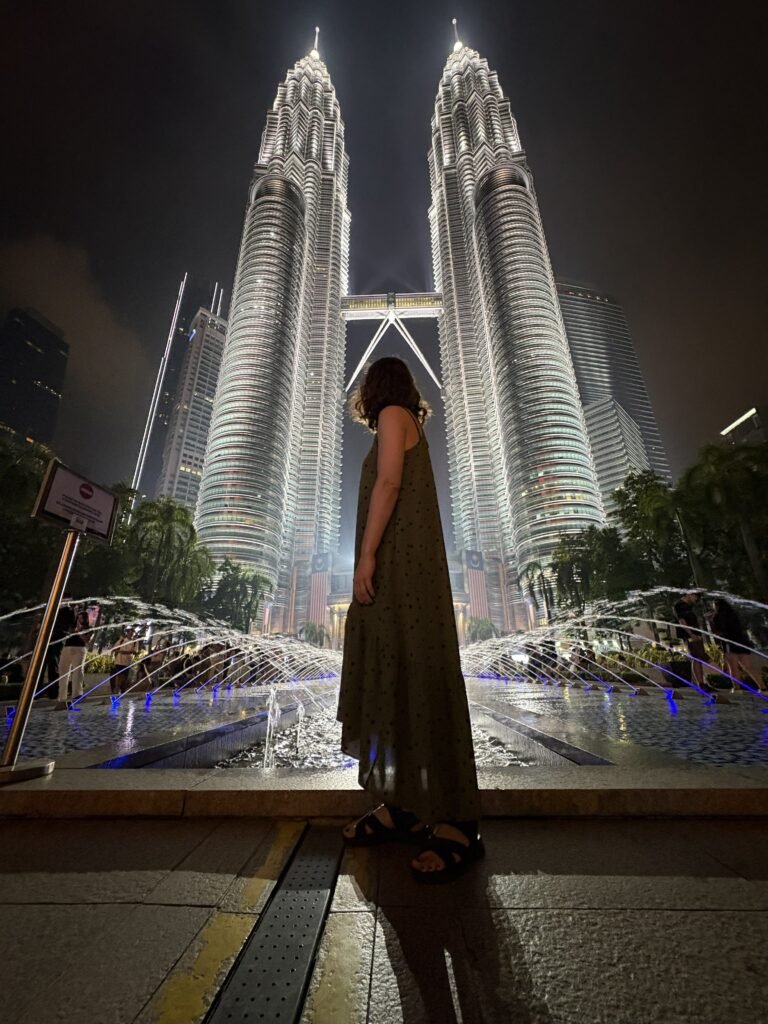
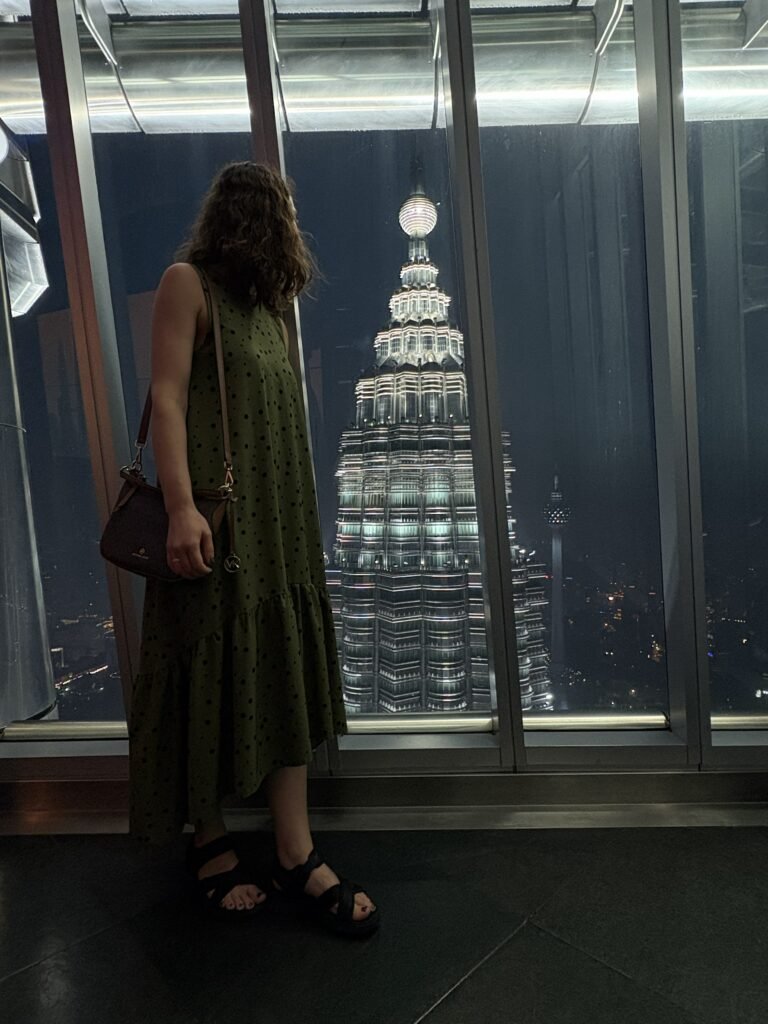
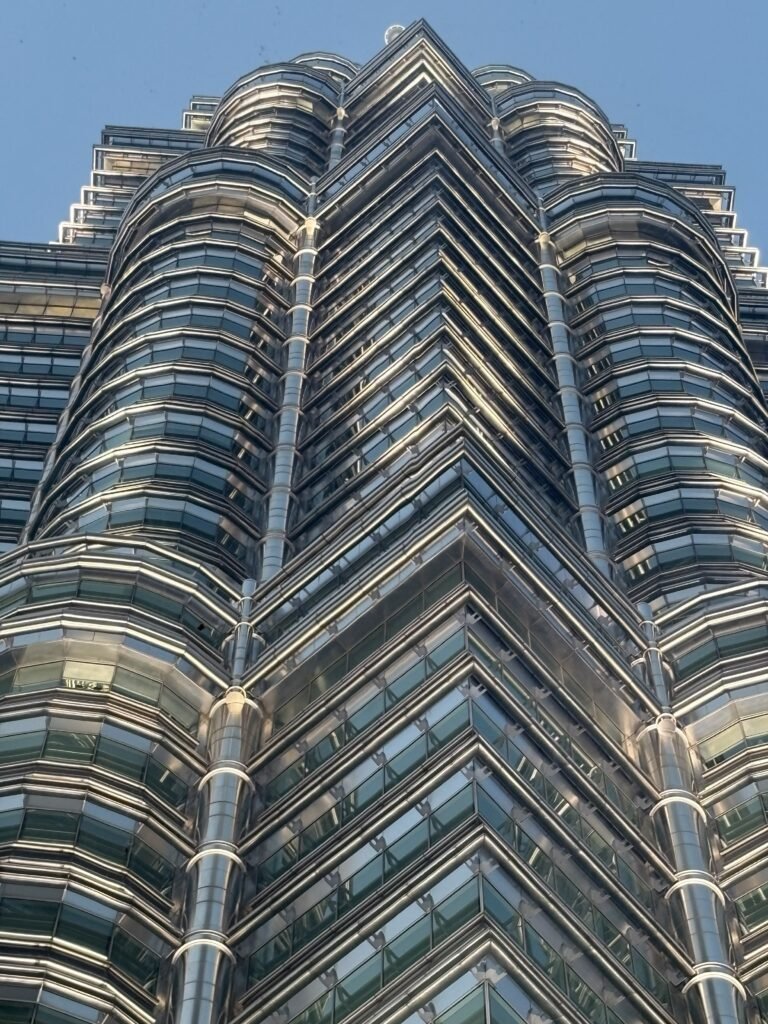
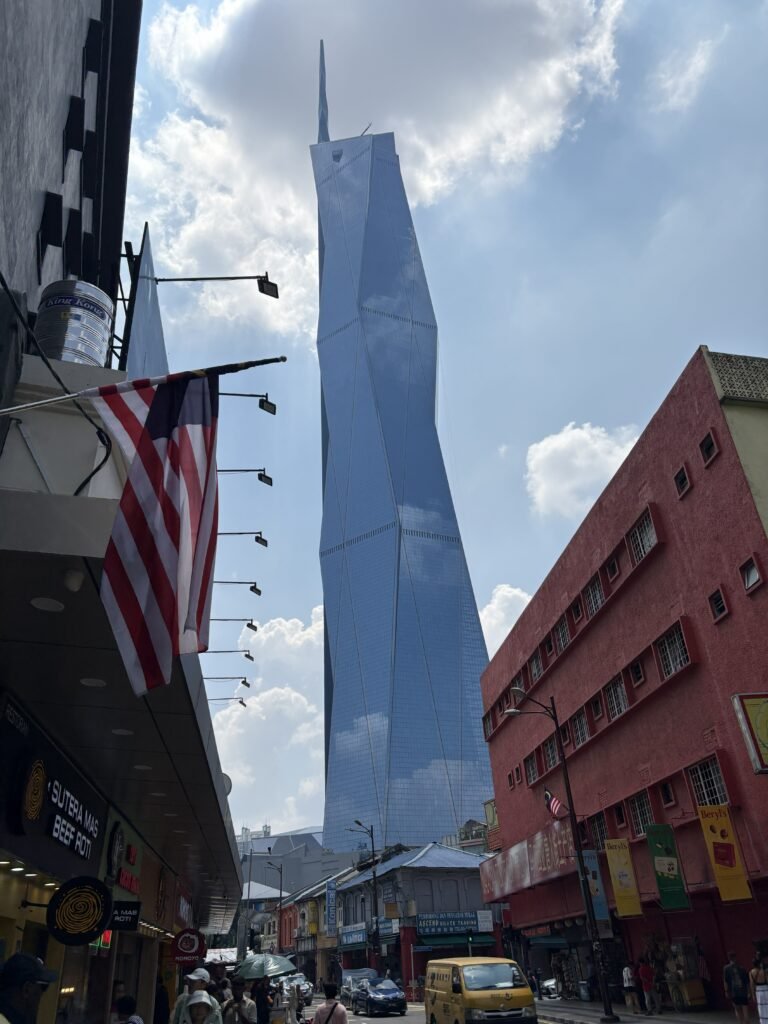
The tallest twin towers in the world! The 452-meter-high Petronas Twin Towers — seen in countless films, instantly recognizable. From our hotel, it’s about a 40-minute walk, which we take at an easy pace. Being close to the equator means rain is always a possibility — and sure enough, it pours heavily on the way. Kuala Lumpur has adapted brilliantly to this: an extensive system of elevated, covered pedestrian walkways connects much of the city center. Thanks to these “air tunnels,” we stay mostly dry. The umbrella we bought for 19 ringgit turns out to be only partially necessary. Ironically, by the time we reach the starting point of the tower tour, we still haven’t properly seen them. Walking through the covered system, you don’t get the full reveal. Fine — we’ll allow the surprise for later.
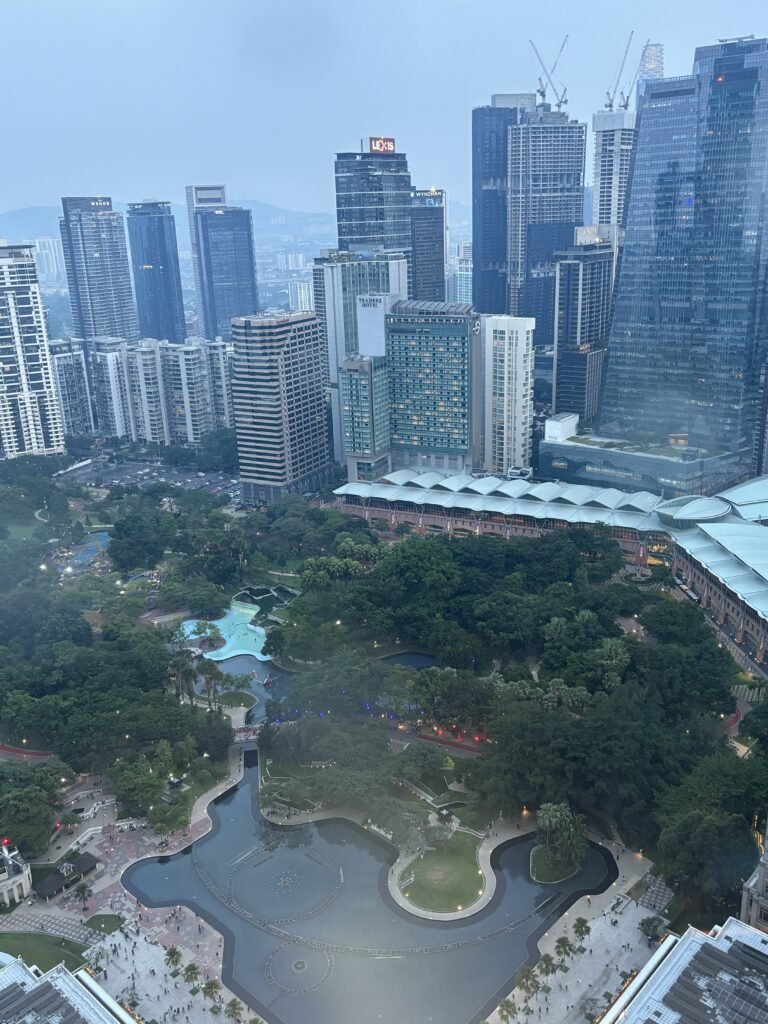
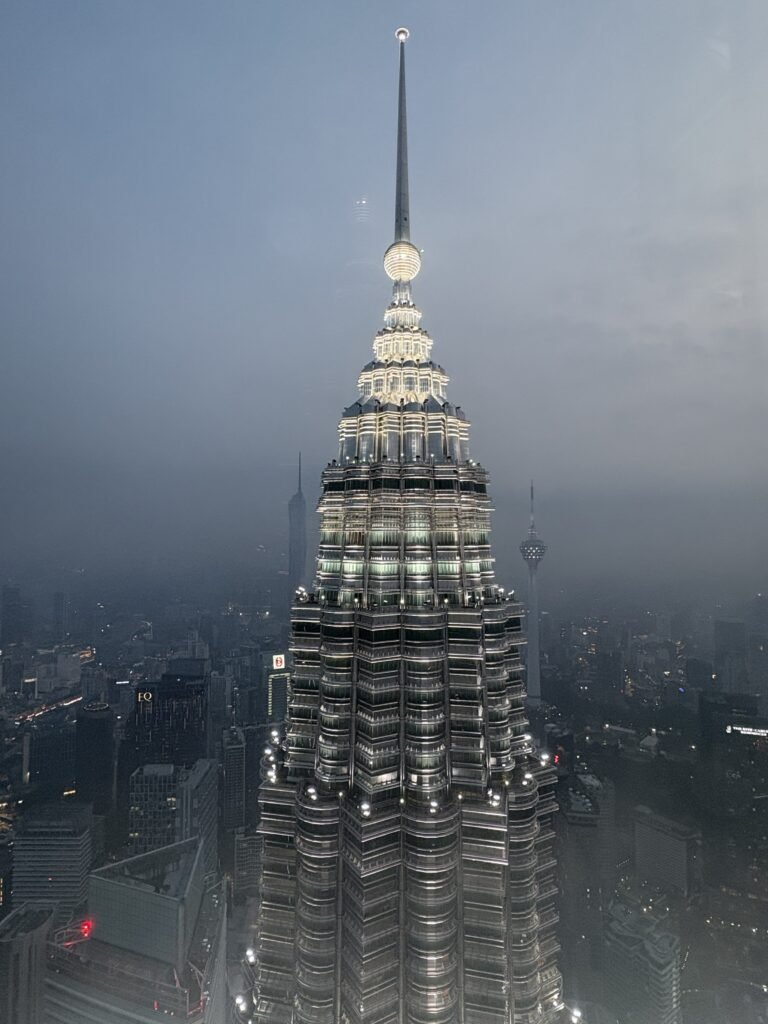
It turns out I’ve accidentally booked a slightly upgraded tour package, which includes access to the famous skybridge between the towers. Because it’s an active office area as well, there’s a strict dress code. No shorts, no flip-flops, no exposed shoulders. A few visitors are denied entry — the rules were clearly stated during ticket purchase. The tour itself is fairly straightforward, but standing on the 42nd-floor skybridge is undeniably impressive. From the middle of the bridge, looking up, you can see both spires stretching skyward. Looking outward, Kuala Lumpur seems endless in every direction. The scale of the city is enormous.
We then move up to the 86th-floor observation deck. In the distance stands the nearly completed Merdeka 118 tower — currently the second-tallest skyscraper in the world at 679 meters. From this platform, we send what has become a bit of a tradition — a “postcard” photo to Grandma back in Talsi, Latvia. The towers house employees of the Petronas oil company — around 12,000 people in total. After the tour, we walk a full circle around KLCC Park, taking in the towers in their full height from below. They are somehow even more powerful from ground level.
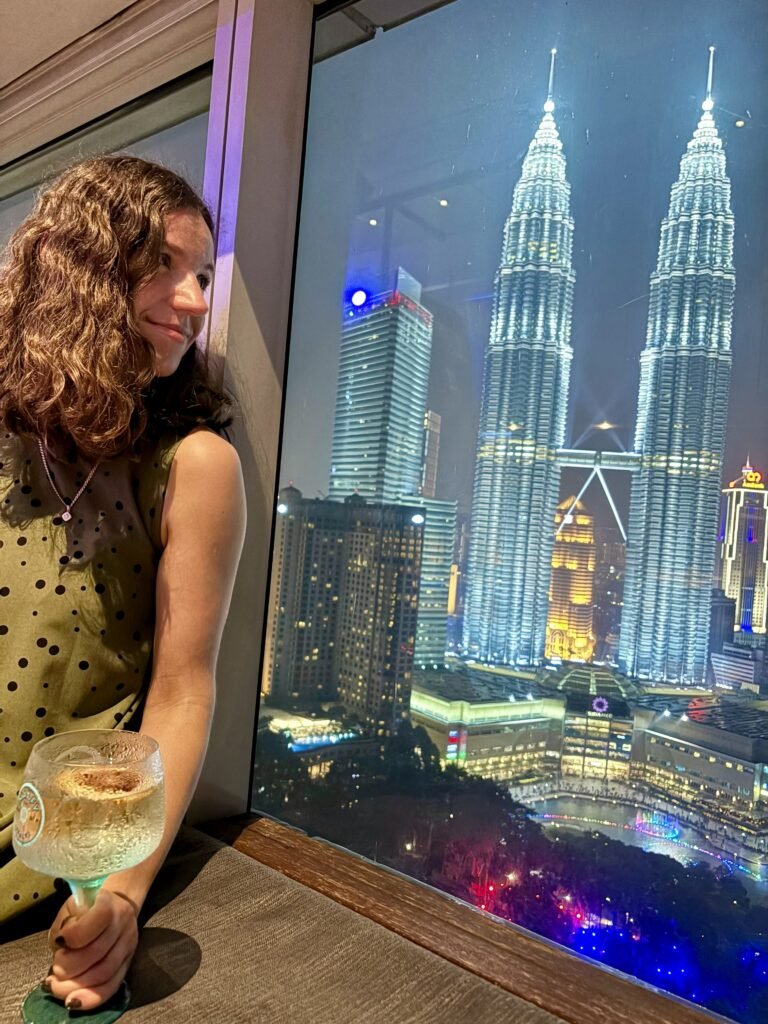
For the evening finale, I’ve set my sights on SkyBar at Traders Hotel.
The view is extraordinary. Honestly, it’s hard to imagine a better vantage point of the twin towers than from here. There’s a stated minimum spend of 100 ringgit (about €20) per person to sit by the window. Considering how overpriced drinks have been in far less impressive places around the world, being cheap here would feel almost criminal. The thought doesn’t even cross my mind.
We share a delicious pizza with one of the best bar views we’ve ever had. Looking back after the trip, I have to admit something unexpected — these towers left one of the strongest impressions of the entire journey. Combined with the city’s atmosphere: multicultural, modern, and most importantly — safe. People are polite and helpful. The 25-minute taxi ride back to the hotel costs just €4.50. Kuala Lumpur is cool. Very cool!
KUALA LUMPUR: CHINATOWN
21.09.2025: This morning feels slightly more stressful than a vacation morning should. At 10:00 a.m., I have a dentist appointment. After a modest breakfast and the most thorough toothbrushing session of my life, we walk 15 minutes to Hello Dental Clinic @ Bukit Bintang.
The clinic is modern, spotless, almost intimidatingly shiny. During diagnostics, they take both a
panoramic X-ray and a full 3D scan of my mouth. After a few additional tests, it turns out the pain
isn’t coming from the tooth that was treated last year — it’s a different one. The verdict: root canal treatment required.
This particular doctor can’t complete the procedure the same day because she doesn’t have the
required microscope equipment. But — and this is where Malaysia truly impresses me — she arranges another specialist for later today. On a Sunday. In a different clinic. Fully equipped and ready to do the procedure immediately. All this while knowing we won’t even be staying long enough in Malaysia for follow-up visits. I honestly can’t imagine messaging three dental clinics back home in Riga on a Saturday afternoon and having two respond quickly with real solutions for the same or next day.
The responsiveness and willingness to help here is remarkable. Truly! Yes, the pleasure costs just under €900. But as I write this in the evening, I feel no tooth pain — and we still have two weeks of travel ahead. Later, thanks to travel insurance, I recover every last cent spent. Maximum successful outcome. Huge thank you, Kuala Lumpur!
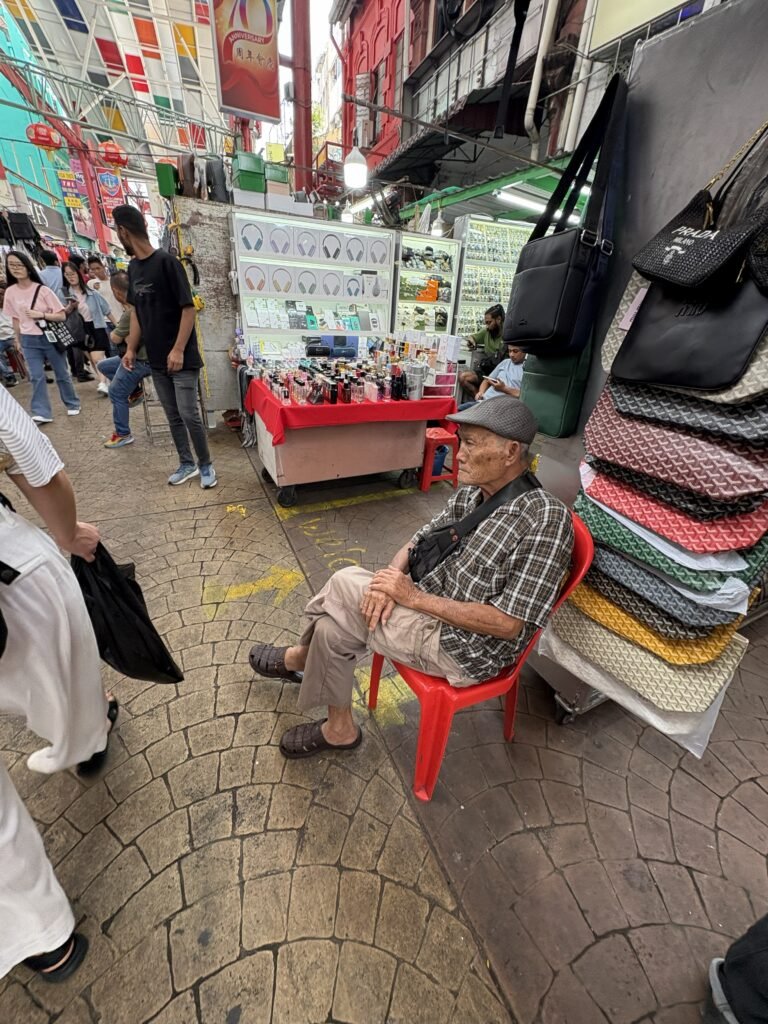
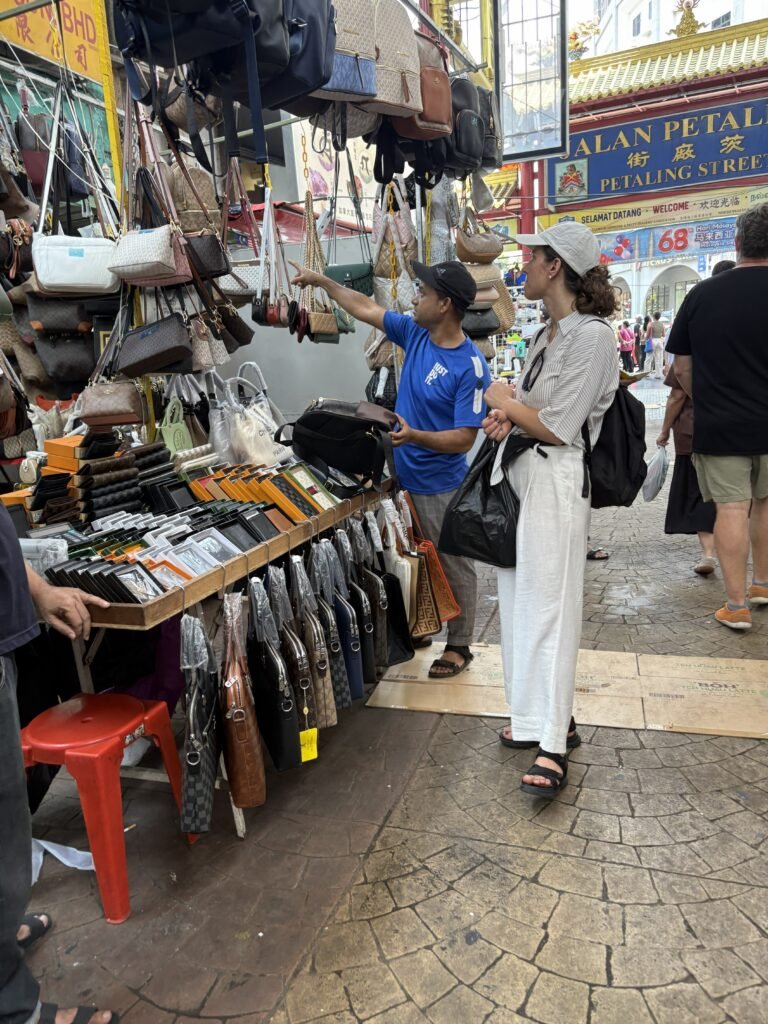
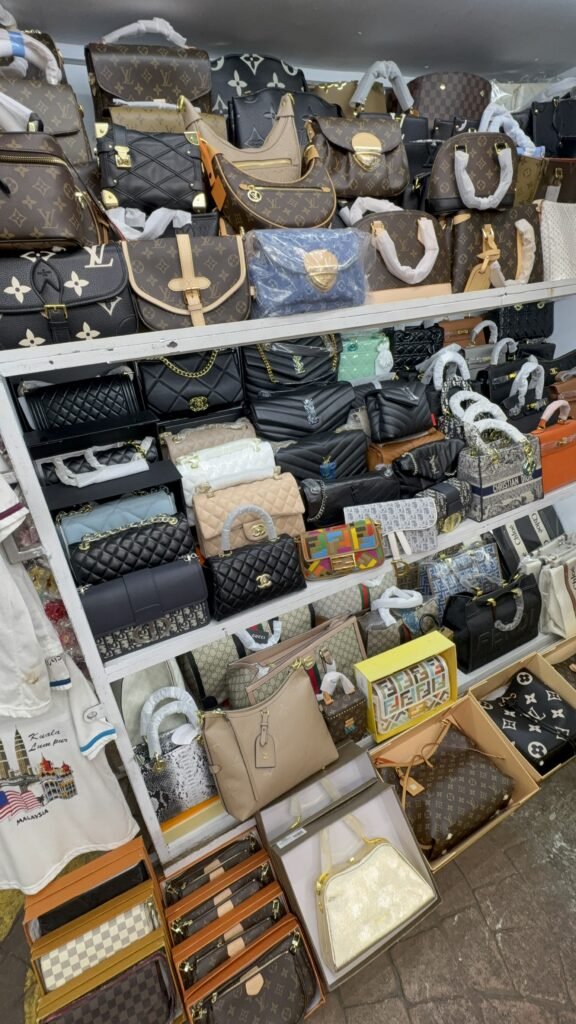
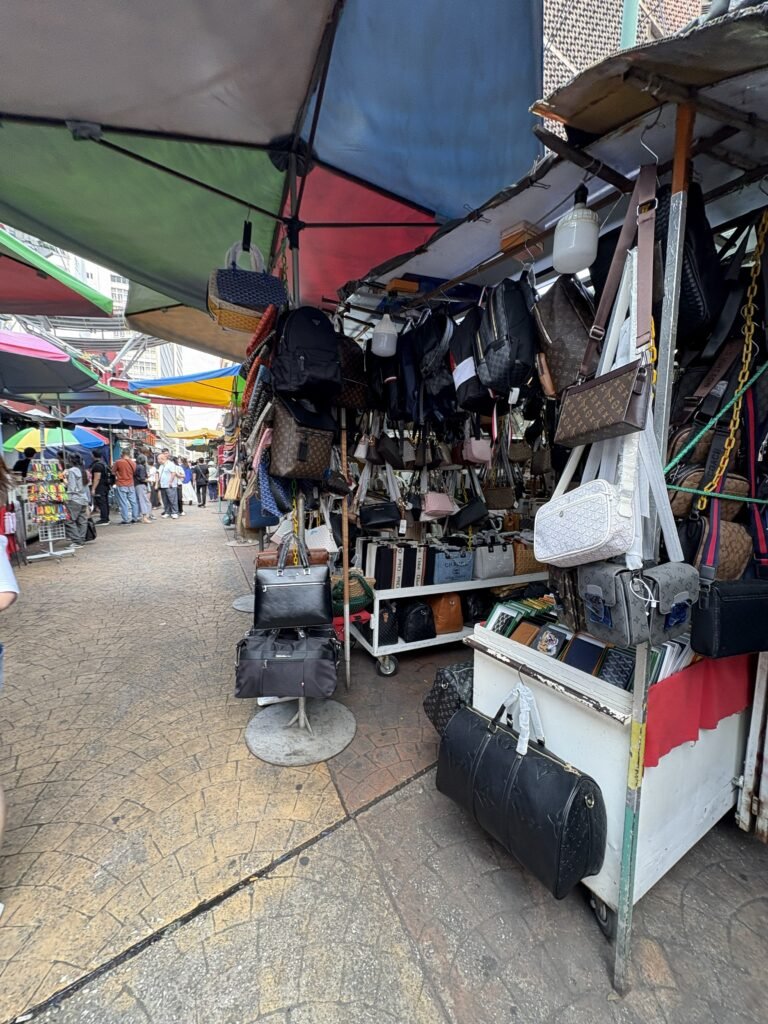
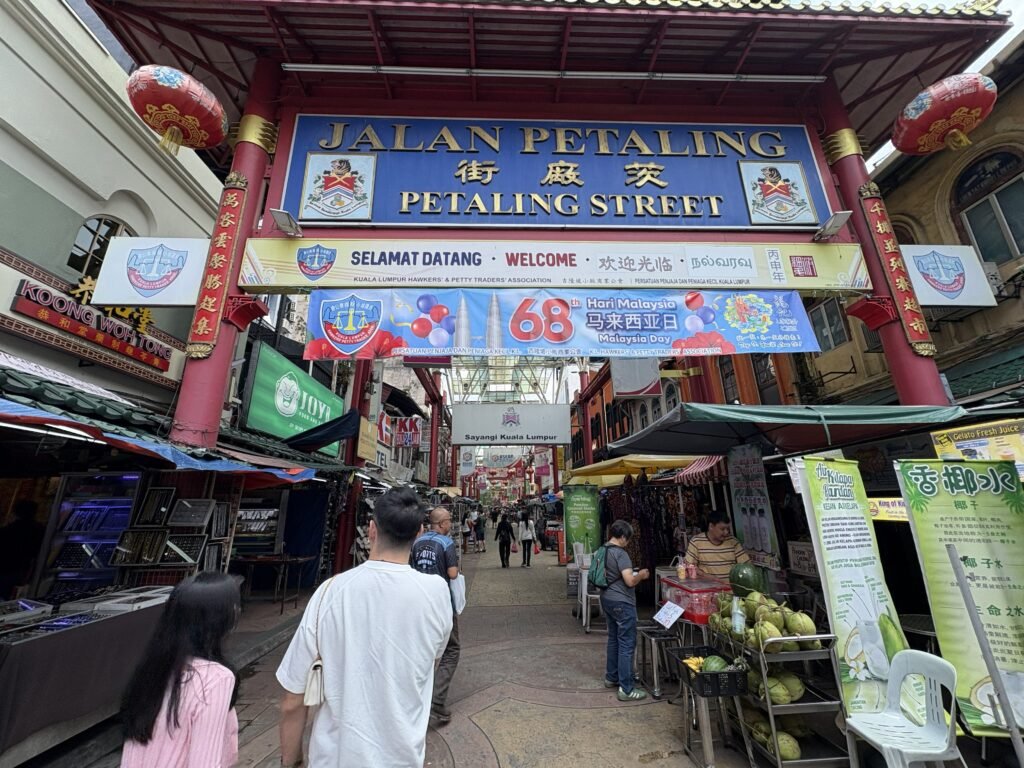
Now, back to slightly more “travel-journal” topics. Before the second dentist visit, we wander into Chinatown — famous for high-quality brand replicas. On Jalan Petaling you’ll find every global brand imaginable — Gucci, Prada, Balenciaga, The North Face, Patagonia — all replicated at an impressively convincing level. Whatever your heart desires. I walk away with a “Mont Blanc” wallet and Patagonia and The North Face T-shirts. Madara doesn’t leave empty-handed either — she secures herself a Coach handbag.
The atmosphere here is fascinating. A constant buzz of bargaining voices. Though I must admit, I
prefer buying from the genuinely local vendors rather than the overly enthusiastic “special price, my friend!” salesmen from middle east who seem to operate on repeat mode. But no time to negotiate further. It’s time to head 30 minutes out to Petaling Jaya, where a Malaysian-style root canal awaits.
KUALA LUMPUR: CENTRAL MARKET
21.09.2025: Four hours in the dentist’s chair later, I’m ready to rejoin civilization. Once again — I can’t praise Malaysia’s medical professionalism enough. The responsiveness, the competence, the effortless communication in English. Because of that, we can continue our trip properly instead of turning it into a dental emergency tour of Southeast Asia.
Meanwhile, as it turns out, while I was undergoing my root canal marathon, Madara was fighting her own internal battle with stomach-related sabotage. And we haven’t even done a proper street food tour yet. Let’s hope this was an isolated “liquid incident.” We order a Bolt — yes, Bolt works perfectly fine here — and for about €4 we’re back in the central districts. Just before stepping out near Central Market, the sky opens. Within roughly 20 seconds of rain exposure — the distance between car door and entrance — we’re practically soaked to our underwear. Tropical rain does not negotiate.
Central Market, or Pasar Seni, is one of Kuala Lumpur’s culturally significant landmarks. Operating since 1888, it houses over 350 shops, mostly focused on local crafts, textiles, and cultural goods — not your usual global chain suspects like H&M or Reserved. The building itself is listed as a Malaysian heritage site (perhaps a local-level UNESCO equivalent).
Wandering through, it feels more like a curated tourist bazaar of colorful fabrics and decorative souvenirs rather than a traditional produce market. There are quite a few people inside, but that’s largely because everyone is sheltering from the city’s daily 30-minute downpour ritual. We complete a lap, but nothing truly captures our attention. The rain slows. Time to move on.
We walk toward Merdeka Square — Independence Square — which should offer a clear view of the historic government building. In theory, the grand façade of Bangunan Sultan Abdul Samad dominates the square.
In reality — it’s almost entirely hidden behind scaffolding. No dramatic architectural reveal today.
Nothing to do but shrug and continue exploring.
KUALA LUMPUR: BUKIT PANANG
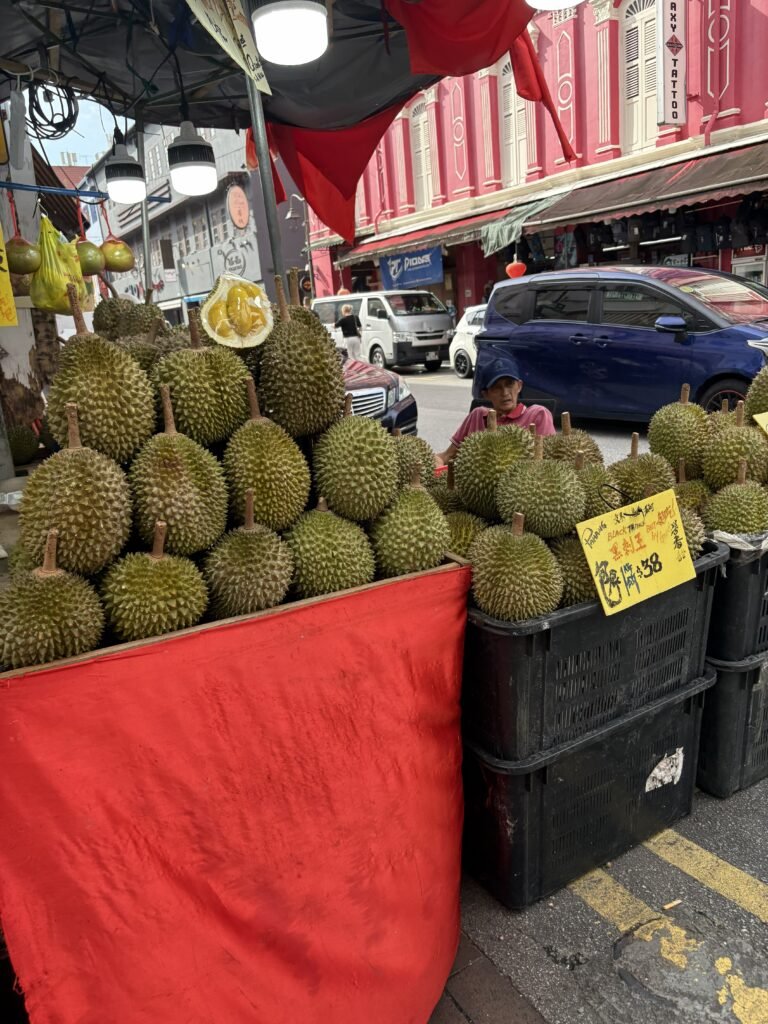
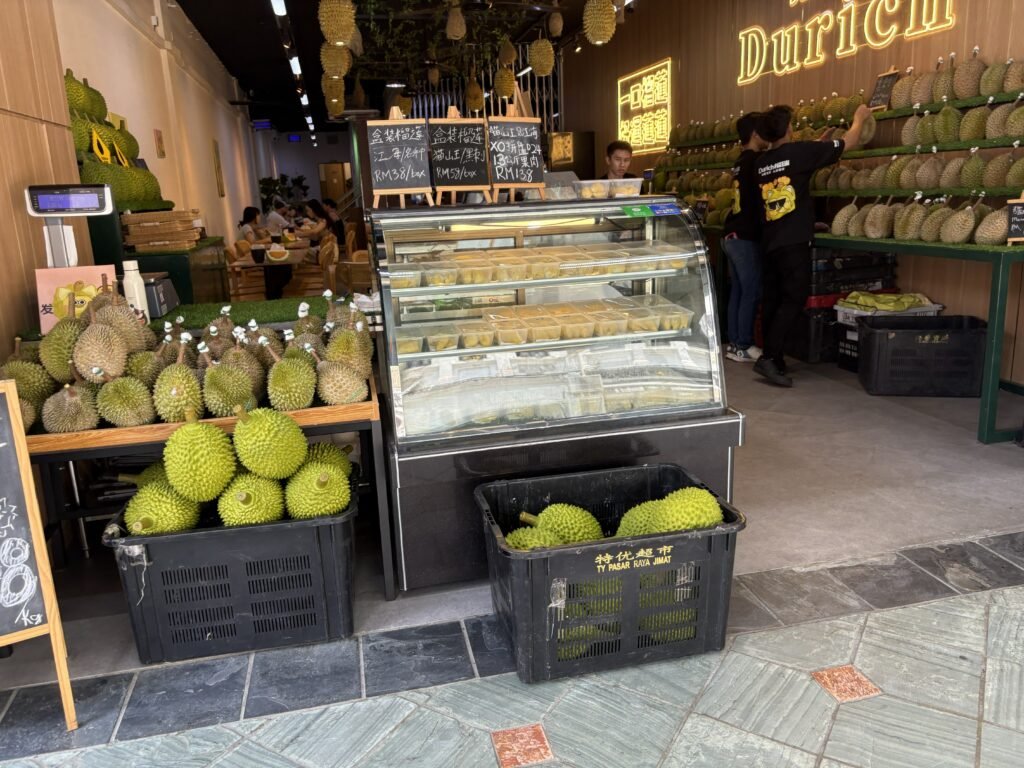
21.09.2025: Tonight we decide to wander through the lively streets of our neighborhood — Bukit Bintang in full evening mode. On the way, we pass through Chinatown again, and Madara “unexpectedly” succumbs to yet another offer from an entirely “official” Coach representative. Resistance levels are dropping. We eventually reach Jalan Alor, Kuala Lumpur’s famous street food strip. At the beginning of the street, slightly removed from the rest of the vendors, stands a durian bar. People wearing plastic gloves are bravely consuming the notorious local delicacy. Even from across the street, the “aroma” makes a confident introduction.
The market is in peak-hour mode. Restaurants are packed, the street buzzing. Vendors calling out, tourists negotiating, cutlery clinking — a proper human anthill.
I try freshly pressed purple dragon fruit juice. Honestly? Pretty underwhelming. Not bad, but I expected more character. Then I notice the ice cubes being scooped from a suspicious plastic box under the table. Combined with the juice’s mild personality, I decide to stop after a few cautious sips. Risk-to-reward ratio not ideal. To be fair, most other juices we’ve tried so far have been outstanding. So good that they almost justify the digestive gamble.
Madara finally gets her long-awaited coconut. A slightly concerning but amusing moment follows: the vendor hands the coconut to a small girl, who removes the straw from her own mouth, inserts it into the coconut, and proudly delivers it to Madara. Fortunately, we receive a fresh straw shortly after.
The coconut water itself? Refreshing, light, subtly sweet. Cold hydration at its best. Our final destination for the evening is Taps Beer Bar — one of the rare spots in Kuala Lumpur serving local Malaysian craft beer. Outside of Heineken and Tiger, finding variety here isn’t easy. The place turns out to be excellent. We arrive during a live performance by a Filipino musician. After about 40 minutes on stage, he comes over to chat. Eventually the conversation reaches the classic question — “Where are you from?” When I answer Latvia, I prepare to deliver my usual explanatory speech — small country in Northern Europe, near the Baltics, etc. But not this time. He tells us he’s actually traveling to Latvia in December. Phone number exchanged. If fate aligns, perhaps we’ll meet again — this time in Riga.
Another unexpected encounter happens while I’m waiting for drinks at the bar. I strike up a conversation with a man sitting next to me. He’s American — from Boston. Once again, the geography question comes up. I’m ready with the standard explanation. But no need. He was in Riga last year for a conference at Rīga Stradiņš University. And being from Boston, of course he also knows our best basketball player Kristaps Porziņģis.
What are the odds?
In an ordinary bar in Kuala Lumpur, meeting a Filipino musician and an American from Boston — and both not only know where Latvia is, but have visited it or are about to.
Sometimes the world feels surprisingly small.
KUALA LUMPUR: BATU CAVES
22.09.2025: Today we attempt to catch up on yesterday’s dental-induced delay. To save time, we take a taxi. Honestly, with rides costing around €4 for 30 minutes, it would almost be irresponsible to waste time on public transport.
Our destination: Batu Caves — arguably Kuala Lumpur’s most famous attraction, or at least battling for second place with the Petronas Twin Towers. If the Twin Towers sparkle with polished steel and perfection, Batu Caves greet you with… trash at your feet. A colony of macaques is enthusiastically auditing the scattered waste. No one seems particularly motivated to restrict their
access. Closed bins or proper lids — like in Singapore — would not be a revolutionary invention. Here, however, coexistence between monkeys, pigeons, and tourists appears fully normalized. And well-fed. We first enter Ramayana Cave (Suyambu Lingam). At the entrance, a man with a payment terminal requests 15 ringgit per person. I vaguely recall something about small entrance fees for side caves, but the setup feels slightly improvised. Perhaps we contributed to his personal development fund.
Inside, the cave is… theatrically decorated in Indian style. The natural rock formations are impressive, but they compete with blue LED lighting and flashing display screens that resemble market-stall advertising panels. It’s hard to admire 400-million-year-old limestone when your peripheral vision is hosting a disco. We don’t stay long. We skip the second paid cave — from the outside, it appears to offer a similar “LED festival” experience. Now to the main event: the Temple Cave, built within limestone formations estimated to be around 400 million years old. A climb of 272 brightly colored steps leads upward. In certain areas, shoes must come off. Women are required to cover their knees; men are treated slightly more leniently. Technically, shorts aren’t allowed — though enforcement mainly targets those wearing extremely short ones. In +30°C humidity, nearly 300 steps feel very real.
The entire ascent is accompanied by macaques attempting opportunistic acquisitions from passing visitors. Food, bags, water bottles — nothing is safe. Vigilance is essential. At the top, inside the vast cavern chamber, a colorful Hindu temple hosts religious rituals and dances. To properly observe, you must enter barefoot. We opt to observe from a respectful distance.
This site is considered one of the most important Hindu shrines outside India. Yet the heavy tourist flow and scattered litter somewhat dilute the spiritual atmosphere. Personally, I find myself more entertained by the monkeys — who seem completely indifferent to both pilgrims and tourists, busy managing their own daily dramas. On the way down, we get a better look at the towering 42.7-meter golden statue of Lord Murugan, standing guard at the base of the steps.
Impressive? Yes. Transformative? Not quite.
Perhaps my expectations were higher. Perhaps I’ve grown spoiled by cleaner, more curated experiences. Either way, we decide to head back to the city. There, the buildings are prettier — and the air smells better.
KUALA LUMPUR: CHOW KIT
22.09.2025: From Batu Caves I order the fastest-arriving Bolt — partly because we’re short on time, partly because the pickup point is right next to a collection of trash bins that have been fermenting beautifully in +30°C heat. A true test of nasal endurance. The car that arrives? A luxury-category Toyota van. Individual seats. Personal screens. The kind of vehicle you could happily cross continents in. And the nearly 30-minute ride costs just under €10. Kuala Lumpur continues to surprise. We head to lunch at Blackbyrd KL, located on the 50th floor of Naza Tower, with a direct view of the twin towers.
Taking the lunch set in this rather elegant setting costs us around €13 in total. For that view? Almost suspiciously good value. We still have some time before our evening street food tour, so we wander through Suria KLCC mall. Between its 500 stores, it feels like every brand that has ever existed is represented here. The “just looking” stroll escalates quickly. I leave with new Nike
AirMax sneakers and a Fossil watch. Madara secures her favorite MK backpack. Productive afternoon. Now it’s time for the real culinary challenge: a street food tour in Chow Kit.
On the way, the city performs its daily 40-minute outdoor shower. We manage to stay relatively dry. Before meeting our guide, we responsibly take our ritual 50 ml “preventive medicine.” Fifteen local dishes await. The first stop: fried noodles with lime and sambal. The lime adds a beautiful freshness. The sambal — allegedly mild — still makes my eyes water. I tactically retreat from the sauce. Next comes roti — layered, flaky flatbread served with three dips: chicken, fish, and green bean curry. Tear, dip, eat. All with fingers. Genuinely delicious. But pacing is crucial. This is a marathon, not a sprint. We wash it down with local milk tea loaded with brown sugar. For me, too sweet — but undeniably interesting. A short walk follows to make room for round two.
In a small café, we’re served cendol — coconut milk with corn, green jelly strands, and palm sugar. This becomes my favorite of the night. Refreshing, lightly sweet, perfect for the heat.
We also sample fruits: salak (snake fruit), crunchy and pear-like, and another hairy fruit I can’t recall the name of — grape-like in flavor. Both excellent. And yes, durian appears again. I try it. Again. Still not convinced. Next stop: keropok lekor — traditional Malaysian fish crackers. Think “fish cookie.” Surprisingly pleasant. Passing by another stall, we grab satay — small chicken skewers with peanut sauce. Fantastic, but the stomach is starting to negotiate surrender terms.
The final major dish is Malaysia’s national pride: nasi lemak.
Served on banana leaf — coconut rice with fried anchovies, boiled egg, and sambal. By now, rice feels like a strategic error. The sambal remains too bold for me, so I focus on the crispy anchovies — a solid choice. Dessert closes the tour: fresh mango juice (predictably outstanding) and fried banana. The fried banana is the surprise hero — warm, soft, lightly crisp outside. Comfort food at its best.
After the tour, we walk back toward the twin towers to help the stomach process events.
It was genuinely a great experience. The guide was talkative, funny, and full of stories.
Excellent choice.
KUL-DPS
23.09.2025: At 1:00 a.m. I receive a message: our flight is delayed by about 1.5 hours. Too late to adjust the driver pickup time, so we stick with the original 7:30 departure. True to stereotype-level precision, our Malaysian driver arrives at 7:25 sharp — already outside, doors open,
engine running.
The drive to the airport takes just over an hour at a steady pace. Meanwhile, in the opposite direction — toward central Kuala Lumpur — traffic is essentially frozen in an endless queue. Remote work clearly hasn’t fully conquered Malaysia.
At the airport, we glide through check-in and security with surprising ease. Minimal questions.
Minimal inspection. Almost suspiciously smooth. Then reality sets in. We’re stuck for three long hours in what appears to be the minimalist edition of an airport terminal. Behind security in Terminal 2, there is… one café. And rows of metal benches. That’s it!
No designer boutiques. No luxury lounges. No distraction therapy through retail. This, we conclude, must be the low-cost carrier zone — AirAsia territory. The glamorous airlines fly from Terminal 1. That’s probably where the nice shops, soft seating, and civilized coffee options live.
Here, however, it’s pure budget aviation aesthetics. Metal chairs. Neutral walls.
BALI: CANNGU
23.09.2025: Shortly before landing in Bali, we spot something enormous rising far above the clouds — almost certainly a volcano. But it’s on another island. That adventure will have to wait for another Indonesia trip. Later, after some quick research, it seems it may have been Mount Rinjani, towering 3,726 meters above sea level.
Tall enough to casually poke through the clouds and remind you who’s in charge. As for the airport — it looks more like a collection of tropical bungalows than a traditional terminal. The central “hall” is essentially an open-air pavilion rather than a sealed building. Makes sense. It’s Bali. Heating costs are not a concern here. From the airport to Canggu, the taxi ride takes about 1.5 hours. The distance doesn’t justify the time — we spend most of it moving at 30–40 km/h through narrow roads packed with relentless traffic. Welcome to Bali logistics. The ride costs just €11.50.
We take the driver’s phone number and later arrange him for a full-day hire tomorrow. €35 for the day. Extremely reasonable — and much easier than negotiating transport stop by stop. After checking in, we walk to the beach, just 5–7 minutes away. Dinner? Five giant tiger prawns for €10. Incredibly good. The prawn tails, with small edible remnants attached, are generously donated to a small dog who diligently patrols the restaurant tables for opportunities. Meanwhile, the Indian Ocean slowly advances. In the 30 minutes we sit there, the tide creeps closer by 15–20 meters. If you’re not paying attention, you could easily end up with a wet backside and an unexpected lesson in ocean dynamics. We relocate to a terrace slightly further inland. The ocean may be patient — but we adapt.
BALI: TANAH LOT TEMPLE
24.09.2025: Our driver Kadek arrives at 10:55 sharp — exactly as agreed. While we finish checking out, he efficiently loads our bags into the car. Smooth start. First stop of the day: Tanah Lot Temple, about a 35-minute drive away. Tanah Lot is one of seven sea temples positioned along Bali’s coast. The temples were strategically placed so that each one could see the next, forming a symbolic spiritual protection chain around the island. Somehow, though, I fail to spot the next one in line.
On the drive, we’re once again reassured that hiring a driver was the correct life decision. Millions
of scooters flood roads that feel barely wide enough for a single car — yet traffic somehow flows
in both directions. The driver seems to focus exclusively on other cars. Scooters? They’ll sort
themselves out. And even if we wanted to rent scooters — where exactly would we store our
luggage?
Tanah Lot sits dramatically on a rock formation at the edge of the Indian Ocean. Massive waves
crash against the cliffs, sending water spraying high into the air. Honestly, I find myself more
captivated by the raw cliffs and pounding waves than by the temple itself. Architecturally
beautiful, yes — but on Bali, even private houses resemble miniature temples with ornate
carvings and tower-like structures.
In one café nearby, we notice three animals about the size of large cats. Later we learn they are
luwak (Asian palm civets). One is grooming itself diligently; the other two are fully powered down
near the cashier. Inside, we enjoy a cup of excellent local coffee. Only afterward do we discover that a giant bat also resides in the café during the day — apparently well-fed with bananas and free to roam at night.
The luwaks here are unusual residents. On Bali, they’re bred for producing the famous kopi luwak
coffee. The civet eats ripe coffee cherries; the fruit pulp is digested while the beans pass through
largely intact. The beans are then collected, washed, dried, and roasted. The fermentation process during digestion alters the bean’s chemistry and flavor profile. And yes — the coffee is genuinely very good. Afterward, we crave fresh juices. I choose mango. Madara originally wants papaya, but they’ve run out, so she settles for orange. Unfortunately, these are not the highlight juices of the trip. The ice cubes look slightly suspicious, too. Lunch will require the traditional 40% preventive companion.
BALI: TAMAN AYUN TEMPLE
24.09.2025: Before we even get back into the car, Kadek has already cooled it down with the air conditioning. Small detail — big appreciation. Getting into a pre-cooled car in tropical heat feels like luxury.
Next stop: Taman Ayun Temple, about a 40-minute drive inland. Immediately, the atmosphere feels different from Tanah Lot. Quieter. Slower. Fewer tourists. And because of that, it actually feels like a sacred place rather than just a scenic backdrop. Shorts aren’t allowed here either — we’re handed traditional sashes to wrap around our waists before entering. Dress code enforced, respectfully. Taman Ayun was built in 1634 and served as the royal temple of the Mengwi dynasty. Its name translates to “Beautiful Garden,” and that description is accurate. The complex is surrounded by a wide water moat, creating the illusion that the temple is floating.
The multi-tiered meru towers rise above the inner courtyards, each level representing layers of spiritual significance in Balinese Hinduism. Unlike the dramatic ocean backdrop of Tanah Lot, this temple feels more balanced and composed — symmetrical gardens, reflective water, layered rooftops. Here, the silence becomes part of the architecture. And for the first time today, I feel less like a spectator — and more like a guest in someone else’s spiritual space.
BALI: TEGALLALANG RICE TERRACES
24.09.2025: By the time we reach the final stop of the day, hunger is no longer subtle. Kadek assures us there are good restaurants nearby. We trust him — and he’s absolutely right. On a terrace overlooking the famous Tegallalang rice fields, we enjoy genuinely excellent lunch. I go for fried noodles with chicken satay; Madara chooses chicken goulash. Both dishes are surprisingly good — and the prices are very reasonable considering we’re likely in one of the most tourist-heavy spots in the region. Total bill with drinks: around €30.
Of that, roughly one-third is accounted for by two 50 ml “preventive” gins. After lunch, we wander along the terrace pathways. It’s undeniably beautiful — layered green steps cascading down the hillside — but there’s a slight artificial feeling. No actual rice seems to be growing at the moment. The setup feels curated for photos. Colourful dresses are available for rent so visitors can pose dramatically against the landscape. It looks stunning. But part of me wanted to see working rice fields — mud, water, farmers, real cultivation.
On the drive back toward the hotel, we spot more authentic plantations through the car window. Real farmers working in the fields, wearing traditional conical straw hats. That’s the scene I had imagined. A few days later, another driver tells us about Jatiluwih Rice Terraces, which are
UNESCO-listed and much more authentic — but located deeper inland. We simply didn’t have the time on this trip. Next time.
For now, it’s back to the hotel. The accumulated fatigue is real. The constant humidity, the heat — it slowly drains energy in ways you don’t immediately notice. Tropical beauty comes with tropical exhaustion.
BALI: BIDADARI VILLA
24.09.2025: At our “honeymoon villa,” we’re welcomed with freshly pressed orange and ginger juice. Cold, sharp, refreshing — exactly what the body needs after a humid day. We settle the payment with Kadek and step into what is technically described as a one-bedroom apartment. On paper.
In reality, it’s a ~200 m² two-story villa with our own private infinity pool overlooking the Ubud jungle valley. The view from the pool is unreal — layers of dense green stretching into the distance. You float at the edge of the water, and beyond it, the jungle just continues endlessly.
The second-floor living room isn’t technically a room. It’s more of a pavilion. No walls — just a roof overhead. Open air. Tropical luxury!
Even the bathroom participates in the nature concept. Sitting on the toilet next to a small pond, you conduct your business under the strict supervision of frogs. Zero privacy from wildlife.
As the evening progresses, we discover that we’re also sharing the upper level with at least two small lizards who have made a home behind a painting. As long as they don’t attempt to relocate into our bed, we agree on peaceful coexistence. Territory divided diplomatically. Impressive accommodation. This is the kind of place where you fall asleep to jungle sounds instead of traffic — and briefly forget what “walls” are supposed to feel like.
BALI: UBUD, MONKEY FOREST
25.09.2025: Breakfast has to be ordered the evening before — and, as seems to be standard practice here, it arrives with minute-level precision. The table is completely covered. Fruit, eggs, toast, juices, coffee. Immediately obvious: the two of us will not defeat this spread.
With full stomachs, we call a taxi and head to one of Ubud’s main attractions — Sacred Monkey Forest Sanctuary. The jungle paths are full of macaques. This is a commercial sanctuary, and staff deliberately feed the monkeys, so calling this completely “wild” nature would be slightly generous. Still, they roam freely across the forest.
On the way there, our Grab driver hits a dead end and we have to reroute. The traffic control method here is wonderfully simple: when something blocks the road, someone places a bamboo pole across it. Everyone respects it. Within minutes, a scooter traffic jam forms. Because of the river layout, roads here run mostly parallel. If one perpendicular crossing is closed, you often have to drive quite far back before you can cross the river elsewhere. Luckily, we’re not in a rush.
Inside the Monkey Forest, just a few meters past the entrance, a macaque family is already settled in. Two are performing an intense flea-removal spa treatment. A third calmly observes the incoming stream of tourists. No urgency. Everyone looks well fed.
There are about 1,200 macaques living in this 12-hectare park. Feeding them is strictly prohibited for visitors — though given the dedicated feeding stations placed around the forest, they don’t seem particularly interested in stealing our belongings anyway. Within the sanctuary grounds stand three Hindu temples dating back to around 1350. The main one, Pura Dalem Agung
Padangtegal, draws the most activity — both human and monkey. The other two, Pura Beji and Pura Prajapati, sit closer to the edges of the park. Each temple serves different deities, though we don’t dive too deeply into the theological details. Animals are always fascinating to watch — especially when they aren’t caged or visibly exploited. Still, it’s brutally humid today. The kind of sticky heat that turns ambition into “let’s not overdo this.” After leaving the forest, we walk along Ubud’s main street, Jl. Monkey Forest, toward the center. Lunch options are endless. I order an outstanding tomato soup. For locals, probably considered extremely mild. For me, it’s flirting with my upper spice comfort boundary. Madara goes for something Caesar-salad-like. Because it contains a generous amount of raw vegetables, she hesitates. If it’s not thermally treated, it was likely washed in tap water — which is not exactly a gift to a European digestive system.
Further down the street, I spot a shop selling T-shirts printed with local cultural motifs — dragons, Buddhas, temple silhouettes. Genuinely beautiful designs. I buy one for myself, and also Enija’s classic travel souvenir: a T-shirt. At least this one is locally produced — not the usual generic import. In central Ubud, we sit down at a small bar for the mandatory preventive gin shot. We also order a mojito with ice. While the bartender carefully prepares our drinks, a large mouse — or perhaps a small rat — conducts business behind him. Hard to tell from the distance.
Today’s final official task: find a barber. Mission accomplished. The salon operation is efficient: two “callers” inviting customers inside, two barbers working, and one guy permanently seated on a sofa scrolling his phone — clearly the money collector. Maximum utilization of human resources.
For about €7.50, I get a haircut, beard trim, and wash. The result is solid. From my international haircut experience, it wasn’t the most luxurious procedure — no hot towels, no aromatic shaving creams, no spa theatrics. Pure business: cut, trim, done. But the beard is shaped, the hair shortened. Mission successful.
BALI: RICE FIELDS
26.09.2025: Today is SPA day! At 10:00 a.m. we have a couples massage booked at the Bidadari Villa SPA complex. But this relaxation must first be earned. To reach it, we descend at least 100 steps down into the Ubud valley. In soft fabric slippers and +30°C humidity, that’s already part of the workout.
The ritual begins with a 10-minute foot soak in a bowl filled with flower petals and slices of lime. Then follow three different massage stages, each involving a new layer of creams and oils.
I missed a good portion of the experience. Because I fell asleep almost immediately. Which, in itself, says everything about how relaxing it was. Afterward, we’re guided into a large bathtub to wash off the layers of oils. The tub is beautifully prepared — covered in flower petals, with two cups of tea waiting on the side. Floating in warm water, surrounded by jungle sounds. Not bad!
After a short rest back at the villa, we set out on foot to find the real rice fields. Yesterday’s Tegallalang terraces were visually impressive but felt a bit staged. Today we want authenticity.
On the way, we pass a café right next to a rice field and stop for dessert and coffee. The view here already feels far more genuine. I order black rice pudding — sweet, rich, perfectly fitting for the setting. Eating it while looking over working rice paddies feels appropriately on theme.
While we sit there, two tourists stand by the road with backpacks, clearly waiting for a taxi. The woman is completely red — sunburned beyond subtlety. We quietly joke that she overdid it in the sun. Note: Two days later, we’ll look exactly the same.
After about 30 minutes of walking, we finally reach genuinely working rice fields. It’s midday, so there aren’t many farmers visible, but we do spot a few traditional “triangle heads” — the conical straw hats moving slowly across the fields. We see every stage of rice production: freshly flooded paddies, newly planted seedlings in soft mud, and sections that even our “professional” eyes would label as almost harvest-ready. Amusingly, harvested rice is laid out to dry directly on plastic sheets by the roadside.
In one small village we pass through, we stop at a few local shops. Prices here are completely different from Ubud or Canggu. A detailed bamboo wind chime costs €2. We buy two. If we manage to get them home intact, they’ll look perfect in the new shed in Grobiņa. (Spoiler: we do.)
After the walk, we take a taxi back toward central Ubud. Interestingly, we notice several times that drivers only switch on the air conditioning once we get into the car. They drive themselves in +30°C heat, but when the sacred tourist enters — cool air activated.
For lunch, I choose octopus. The tentacled creature itself is delicious, but it comes with some mysterious green herbs that are far too spicy for my comfort. Madara sacrifices half of her chicken broth-style soup to rescue me. As our Ubud chapter winds down, we do what travellers inevitably do — shop. I buy a wide-brimmed Patagonia knock-off hat to give my neck a fighting chance against the sun. Madara finds a robe and a dress from what appears to be a genuinely local artisan. Authentic rice fields, tropical heat, jungle SPA, and mild consumerism. A balanced day in Bali.
BALI: CANGGU
27.09.2025: Today we have no strict plans. We want to squeeze every last drop out of our jungle villa, so we’ve arranged the driver for 12:00 p.m., the very last moment before checkout. After breakfast, I manage to fall asleep again on a sunbed by the infinity pool for another half hour.
Yesterday’s rice-field walk is now officially visible on our skin. The sun has left its signature. Apparently it also borrowed some of today’s energy in advance — hence the sleepiness.
Originally, we planned to stop by Kanto Lampo Waterfall on the way to Canggu. Madara had seen plenty of Instagram-perfect photos and videos. But today is the one day I don’t actively monitor the route — and of course, today is the day the driver heads straight toward Canggu skipping this landmark. By the time we realize it, we’re already too far. Turning around would mean sitting in chaotic traffic for half the day. Not worth it. I’m already struggling to tolerate long car rides today.
After nearly two hours, we arrive at our next accommodation: The Wina Villa Canggu — home for the next three nights. After my second official nap of the day, we head out for a slow, aimless walk around the neighborhood. No itinerary. No checklist. Eventually, we drift toward the ocean — Canggu’s main attraction. Canggu used to be a small fishing village. Now it’s a globally recognized hotspot for amateur surfers, digital nomads, smoothie-bowl enthusiasts, and café culture. Restaurants and coffee spots line the streets endlessly. Today we don’t chase experiences.
Today we simply exist. And sometimes, that’s exactly what the schedule needs.
BALI: SURFING IN BERAWA BEACH
28.09.2025: Breakfast is, as usual, generous bordering on ambitious. Madara goes for an omelette, I choose fried noodles. Both outstanding. Both heavy. By 9 a.m., we’ve essentially had
lunch. So — movement is required. We walk toward the beach with no strict plan for the next two days. Just ocean, weather, mood. That’s enough.
Seeing how easily accessible the surf schools are, a thought sneaks in: why wait until tomorrow?
Ten minutes later I’m signed up. My instructor, Jorgi, gives a clear and practical land demonstration right there on the sand — how to lie on the board, how to paddle, how to pop up, and most importantly: what not to do. I’m handed the classic beginner board — large, stable, not exactly Formula 1 material, but forgiving. Time to enter the ocean.
The first challenge isn’t surfing. It’s simply getting through the breaking waves to the lineup. That alone feels like a workout. We reach the starting point. Short breather. Jorgi shouts from the side when to paddle. When to stand. And somehow — on the very first attempt — I pop up and ride the wave all the way to shore. Unreal! Now comes the small detail: getting back out there again.
After four cycles of paddle–ride–paddle–ride, I am a completely depleted lemon. Arms like boiled spaghetti. Back muscles burning from the constant arching position on the board. Twenty minutes in the water feels like an advanced strength session at the gym. I’m genuinely surprised by how physically demanding surfing is. Respect earned.
Afterward, we continue walking along the beach and settle at one of the beachfront loungers. Madara wants to sunbathe. My skin tone has officially revoked that privilege. For two hours, I strategically rotate within every centimeter of available shade under the table canopy. Even so, it’s still a pleasure to watch the massive waves crashing in. The ocean is never boring.
Madara goes in for a swim. She steps knee-deep into the water — and within seconds a wave knocks her flat. The Indian Ocean does not ease you in gently.
We finish the evening at Potato Head Beach Club, where we briefly stopped yesterday.
Interestingly, the waiter remembers us from the day before — even though we barely interacted. Service here is on another level. Balinese hospitality feels genuine and sharp at the same time. They are very aware that tourism is the island’s lifeline. COVID likely made that painfully clear.
Before bed, I apply aloe cream to every reachable square centimeter of skin. We’ll see tomorrow how much damage control is still possible.
BALI: SEMINYAK
29.09.2025: Today we officially have no plans. The originally scheduled surf lesson is cancelled. First, my body is absolutely not ready for another round. Second, my skin has declared independence from sunlight. My arms hurt just lifting a coffee cup. Still worth it!
We head out toward Seminyak for a relaxed walk. But honestly — all these Bali towns start blending together. You could drop me anywhere between Canggu, Seminyak, or Ubud’s busier streets, and I wouldn’t immediately know which one I’m in. From a typical tourist’s perspective, they feel almost interchangeable.
My legs are burning from sun exposure, so I start looking for light summer trousers. I find a very small street vendor — and, without negotiating (rookie move), buy linen pants at what was almost certainly a premium tourist price. Later I discover they’re slightly defective — small hole included. My fault. I grabbed the display pair instead of asking for a fresh one from storage.
They served their purpose for the day. Let’s call it a contribution to Bali’s economic development.
At a slow, wandering pace, we walk from Seminyak Beach back toward Canggu.
Strangely, the beach is almost empty today. Instead of the usual anthill of tourists, maybe 20–30 people are scattered across the entire shoreline. The sand is so hot by mid-morning that Madara can’t walk barefoot. She sprints across it toward the cooler wet sand near the water. We rent loungers — €2.50 for the entire day. I doze off briefly, then head into the ocean wearing a T-shirt to protect my shoulders. The water is warm — almost too warm to be refreshing — but it’s fun to let the waves toss you around.
In the afternoon, during low tide, the waves are actually considered small. The real action is between 9–11 a.m. and 4–6 p.m., when surfers and other ocean enthusiasts dominate the water.
Lying on the loungers, we come to a realization: Beach vacations might not be our thing.
This is the second day of intentionally “doing nothing” — existing between beach and cafés — and restlessness is creeping in. At the same time, the idea of sitting two hours in Bali traffic to reach something 10 kilometers away feels equally unappealing. So we continue existing.
We stumble upon an interesting chocolate shop offering tastings of around 20 varieties — mango, coconut, nuts, even durian. We buy a solid supply for colleagues back home.
The shop assistant casually names the colors of the Latvian flag. Says he knows them from football. I double-check — football? Maybe hockey? Because let’s be honest — our football team is not exactly dominating Europe. But he insists: football. He watches UEFA group matches regularly. Occasionally Latvia appears there. Interesting! Unfortunately, the chocolate mission doesn’t end heroically. During a long warm layover in Abu Dhabi on the way home, everything
melts into abstract art. It hardens again later — technically edible — but visually, not quite the elegant souvenir we had imagined.
DPS-SIN
30.09.2025: Even though the villa itself was beautiful, we slept terribly all three nights. Light, restless sleep. That probably explains yesterday’s mild irritability and zombie-like mood.
Since we need to leave for the airport at 4:30 a.m., at least the poor sleep makes waking up easier. The hotel arranges a driver the day before, and at 4:20 he’s already waiting outside — breakfast boxes in hand. In the middle of the night, Bali’s roads are almost unrecognizable. Empty. For the first time, the car moves for more than 30 consecutive seconds without braking. A rare luxury. By 4:59 we’re at the airport. Before heading through security, we eat the takeaway breakfast: an egg sandwich and a micro-banana. At that hour, that’s more than sufficient. I buy a coffee to go with it, but it’s so hot that I never manage to drink it. Even in +25°C early-morning heat, there simply isn’t enough time for it to cool down.
We pass through exit procedures without stress and board our roughly three-hour flight back to
Singapore. I manage to sleep almost two hours. Ironically, I sleep better in an airplane seat than in our last villa. Landing at Singapore Changi Airport, we make another attempt to visit Jewel and its famous indoor waterfall. This time — success!
It feels almost unreal! A 40-meter-high waterfall inside an airport terminal, surrounded by dense tropical greenery. The tallest indoor waterfall in the world. Every minute, nearly 40 cubic meters of water are recirculated through the system. Around it, arranged like a massive donut, rise ten levels — five above ground and five below — filled with every imaginable luxury brand store. A few mortal-friendly shops and cafés are scattered among them.
Built in 2019, Jewel’s mission was to merge nature, architecture, and retail. Mission accomplished. Spectacularly! This isn’t just an airport extension. It’s a standalone attraction. We have breakfast in the “Jewel” before heading into the city, knowing that once we’re out there, finding convenient food might become unpredictable. Singapore knows how to make even transit feel like an experience.
SINGAPORE: SINGAPORE NATIONAL MUSEUM
30.09.2025: For our last two nights in Singapore, we stay near Chinatown in the Clarke Quay area — just a short walk from the business district and, of course, Marina Bay Sands. We arrive slightly before official check-in time, but they let us in anyway. A blessing — we’re still operating with
a mild sleep deficit. This hotel even offers a pillow menu, where you can choose the firmness that suits you. Promising signs for better nights ahead. Today’s main destination is the National Museum of Singapore, the country’s oldest museum and the main institution dedicated to preserving Singapore’s history and cultural heritage.
At first, I expect a heavy historical reading marathon — walls of text and serious faces. And yes, the early sections are dense. Walking through the museum feels like moving along Singapore’s timeline: from early fishing settlements to the hyper-modern, multicultural metropolis of today.
Singapore’s history is surprisingly dramatic. Reading about the Japanese occupation during World War II genuinely shifts my perspective. For three years, Singapore was under Japanese rule. In school, I somehow formed the simplified impression that Japan mostly fought defensive battles. Reality, as usual, is more complex. “The best defense is offense,” they say.
To truly absorb all the information here would require several days. We skim, absorb what we can, and move on. The later sections become far more interactive and digital. These galleries focus on Singapore’s transformation — and its unapologetic ambition to keep growing. That ambition is visible outside the museum walls as well.
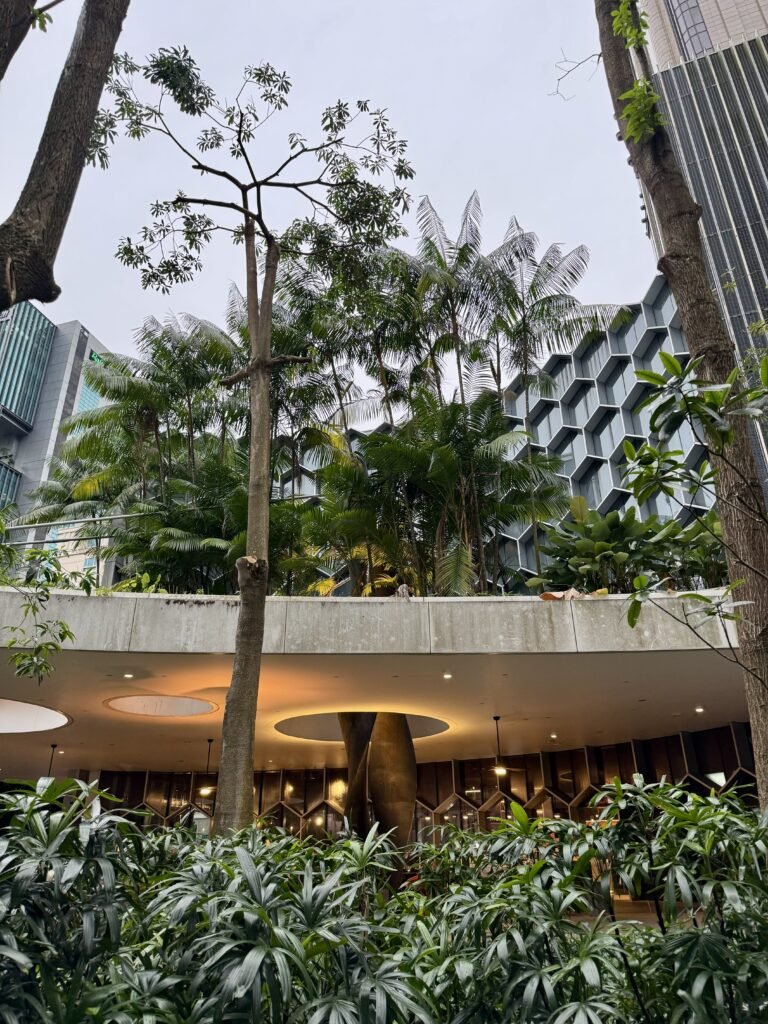
Construction cranes dominate the skyline. Skyscrapers continue to rise. Almost every tower in Singapore’s skyline has a unique architectural identity — and often some form of greenery
integrated into its structure. As a tourist, it’s impressive. As an engineer, it’s fascinating. Living on the 30th or 40th floor, yet having a palm tree on your balcony blocking the sun — that’s next-level urban design. Right outside the museum, we grab food from a small street-style food court. Singapore is expensive in many ways — but good, filling food is not one of them.
For two substantial, tasty meals, we pay around €8 total. In what is considered one of the world’s most expensive cities in 2025.
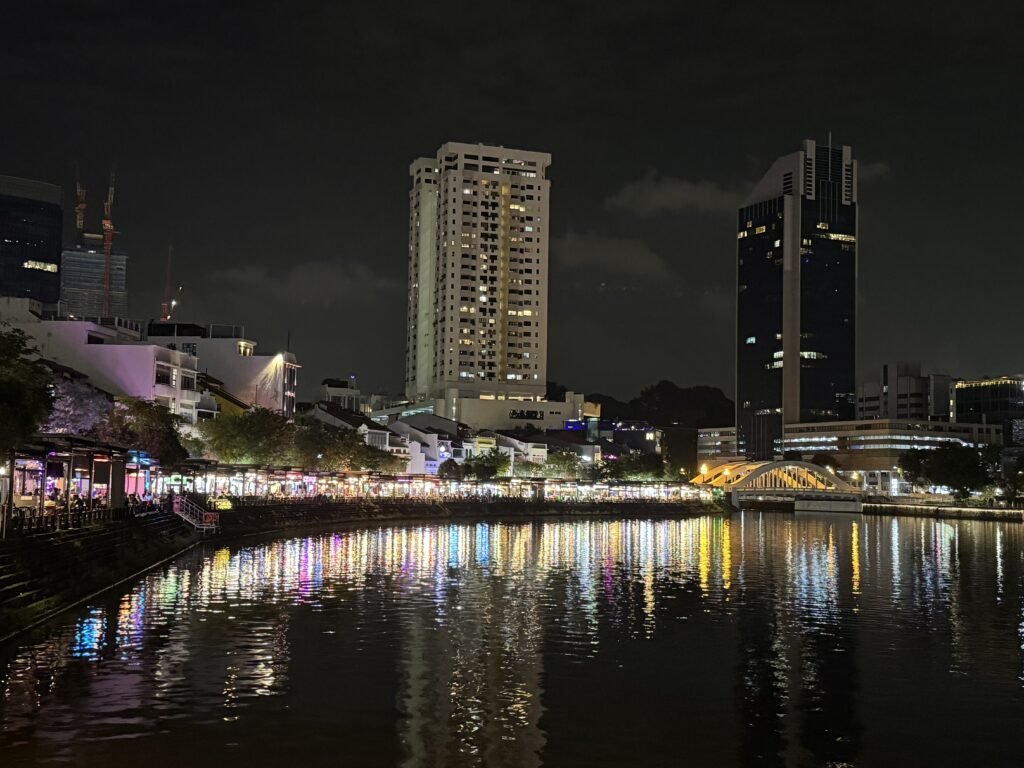
It’s still early, so heading back to the hotel would feel wasteful. We walk toward Clarke Quay, which is buzzing with energy. This weekend is the Singapore F1 Grand Prix, and the area is alive with related events. Live music stages, racing simulators, pop-up installations — the whole district feels like a festival. Singapore doesn’t do things halfway. Even its riverfront nightlife seems engineered for efficiency and spectacle.
SINGAPORE: SINGAPORE BOTANICAL GARDEN
01.10.2025: Our final major sightseeing stop in Singapore is one of the world’s most famous botanical gardens — the Singapore Botanic Gardens. Founded in 1859 and added to the UNESCO World Heritage list ten years ago, the garden covers more than 80 hectares. It’s
enormous. You could easily spend an entire day here and still not see everything.
We spend about three hours walking at a fairly brisk pace and probably cover only a quarter of the grounds — maybe even less. Today’s main focus is the National Orchid Garden, established in 1995 as a center for tropical orchid collection, breeding, and research. Around 1,000 orchid species and 2,000 hybrids grow here. The garden is divided into four “seasons” — slightly ironic in a country where winter is more theoretical than practical. Each zone highlights different colour palettes and blooming styles. There’s also a VIP orchid section, where specially bred orchids are named after visiting presidents and dignitaries. The rest of the botanical garden? That can wait for our next visit to Singapore.
Today’s secondary mission: find elegant shoes for Madara for a fine-dining evening in Abu Dhabi on our way home — though she doesn’t yet know which restaurant awaits her. We attempt this quest along Orchard Road — Singapore’s retail marathon stretch. So many malls, so many shops, that choosing where to enter becomes its own decision-making challenge. While Madara searches, I reward myself with an exceptional pistachio gelato. After about 90 minutes, the mission is accomplished. Shoes secured.
To celebrate, we visit a small Japanese bar nearby serving Japanese draft beers. Extremely good. Extremely expensive. Around €15 per glass. As the bartender jokes: “In Singapore, beer is terribly expensive. That’s probably why I’m poor.” Fair point.
Back at the hotel entrance, we notice something unusual: a vending machine. Normally, you’d expect canned drinks or chocolate bars. Not here! This machine prepares hot meals. We are immediately intrigued. We place an order, and after about 5–7 minutes, a robotic arm slides out our trays. Madara gets teriyaki rice, I choose pasta Bolognese. Visually unimpressive, but surprisingly decent in taste. Efficient. Functional. Very Singapore.
In the evening, we head toward the Downtown area for a second attempt at visiting LeVeL33, the rooftop bar we previously missed. Halfway there, the sky opens up. Singapore may not have the daily 30–40 minute downpours as predictably as Kuala Lumpur, but today we hit the jackpot. Within minutes, our legs are soaked. Fortunately, Madara packed the small umbrellas I confidently declared unnecessary. Lesson learned. Unfortunately, the rooftop mission fails again. Both LeVeL33 and the rooftop venues at Marina Bay Sands are closed for private events related to the upcoming Formula 1 weekend. That will remain on the list for next time. Tonight, we stay grounded.
SIN-AUH
02.10.2025: At least once, I finally make it to the hotel rooftop pool in the morning.
The pool is long enough to actually swim properly — even if it’s only one meter deep. Depth doesn’t slow you down. I do a few relaxed laps while looking out over the Singapore skyline. Not a bad way to say goodbye. Breakfast, checkout, and we arrange to leave our luggage at the hotel for a few more hours.
Our flight isn’t until 21:10, so we still have at least four hours to wander. We never properly explored Chinatown, so that becomes today’s plan. It’s only a 10–15 minute walk away. It’s still relatively early, and some shops haven’t opened yet, but the streets are already lively. After a short walk, I spot an ice cream stand selling Singapore Merlion-shaped cones in unusual flavors. I choose seaweed. Sounds questionable. Surprisingly decent.
We wander into a Chinese kitchenware shop selling tea sets, sushi bowls, chopsticks — everything beautifully arranged. We don’t use chopsticks often at home, but standing there, you almost feel like you should. In the end, we buy a sushi set for my brother. It’s his birthday tomorrow. Just next door stands Sri Mariamman Temple, the oldest Hindu temple in Singapore, built in 1827. Its colorful, intricate statues stand in striking contrast to the surrounding Chinese architecture. What’s remarkable is how naturally the religious coexistence appears. Within a few hundred meters, you move from Chinese temples to vividly decorated Hindu shrines. Harmony here isn’t theoretical — it’s visible.
Before returning to the hotel, we have lunch at Lau Pa Sat again. It’s lunchtime and packed.
One interesting observation: people reserve tables by simply leaving something on them — a tissue pack, a work badge, even a phone — and then go queue for food. And everyone respects it. Even coming from a safe country, I struggle to imagine leaving my phone on a table at Riga Central Market for 15 minutes and expecting it to remain untouched. Singapore operates on a different level. Since we’ve purchased an extra suitcase that needs to be checked in, we decide to take a taxi to the airport. Public transport with multiple bags for an hour doesn’t sound appealing.
We arrive at Singapore Changi Airport slightly too early — luggage drop opens only four hours before departure. So we find luggage storage and head once more to admire the indoor waterfall at Rain Vortex in Jewel. You don’t get tired of looking at it. The greenery, the scale, the surreal engineering. When we first arrived in Singapore, I noticed a Porsche café and told Madara we’d have coffee there on our last day. Today is that day. She orders a “911” cappuccino. I go for a “Carrera” double espresso. One macaron each. The café also sells various Porsche-branded merchandise — my favorite being a wooden 911 toy car with a large spoiler. A final symbolic espresso before departure.
We land around 1 a.m., and by the time we reach the hotel, we’ve already borrowed quite a bit of energy from tomorrow. The moment we hit the bed, we’re gone.
ABU DHABI, UAE: ABU DHABI LOUVRE
03.10.2025: Today’s first stop is one of the entries from our travel book’s Top 500 Places to Visit in the World — Louvre Abu Dhabi. Built in 2017, this massive structure is essentially an overseas sibling of the Paris Louvre. The UAE and France signed an agreement allowing the use of the “Louvre” name — cultural diplomacy with architectural ambition.
Last night, due to darkness and exhaustion, we didn’t properly admire our ride for these two days — a Maserati Grecale. In UAE car rental for more fancy cars are very affordable compared to Europe, so it would be shame to not use that advantage. Thanks to the Etihad stopover program, we’re staying in a five-star hotel where valet parking is standard. You hand over the keys, receive a ticket, and in the morning your car glides back to the entrance as if summoned by invisible strings.
We arrive at the museum in our elegant Italian machine. It’s already well above +30°C in the morning. In the parking lot, a local staff member in a golf cart offers to drive us the 300 meters to the entrance — so the poor tourist doesn’t have to melt on the way. Efficiency meets hospitality.
At the entrance, we hear a lot of Russian. Interestingly, throughout this entire trip, we never visited a country where Russian tourists were absent. Geography may vary — presence does not.
Architecturally, the museum is fascinating.
The complex consists of multiple white cubic buildings, all sheltered under a 180-meter-diameter aluminum lattice dome. Sunlight filters through the geometric structure, creating what the architects call a “rain of light.” The shifting beams produce constantly changing patterns across the white surfaces. At first glance, though, it feels like many visitors are more interested in photographing themselves against Abu Dhabi’s backdrop than actually observing the art. There’s even an option at the entrance to hire a professional photographer to follow you through the museum and document your cultural journey. Judging by the number of people posing dramatically under the dome, the service seems popular. The collection itself is extensive and regionally significant. Impossible to properly absorb in a single day. Even moving at a steady pace, two hours is the minimum to cover it. I use my standard museum strategy: walk at a normal pace, scan the space, and approach whatever genuinely pulls my attention.
Here, that turned out to be the mummies. Probably influenced by the movie The Mummy. In the film, Imhotep tries to reclaim four animal-headed statues stolen from his tomb. It doesn’t end well for the thieves. In this museum, all four statues are still in place. The mummy itself lies nearby. Everyone seems peaceful. No curses activated.
ABU DHABI: EMIRATES PALACE
03.10.2025: After the Louvre, we return to the hotel to freshen up — and then head to one of the Arab world’s signature spectacles. A surprise for Madara. I, however, know exactly where we’re going. Emirates Palace Mandarin Oriental At the entrance, once again, valet staff glide toward us and take the Maserati as if it were the most natural extension of their job description. Doors are opened. Greetings are exchanged. The choreography of luxury unfolds flawlessly. We step into one of the most opulent hotel lobbies in Abu Dhabi. Gold. Marble. Symmetry. Shine.
The central dome rises six or seven stories high — your neck actually gets tired from constantly looking up. Everything glows. Everything reflects. There’s a formal dress code here, and most visitors respect it. The occasional tourist in shorts looks visibly out of place. Honestly, I’m
surprised they’re allowed in. Kuala Lumpur’s Petronas Towers were stricter — shorts meant no entry. Simple. But we proceed. Live piano music accompanies our walk across the vast central hall toward Episodes Café — the place serving the famous 24-karat gold cappuccino.
For lunch, I choose lasagna. Madara orders grilled chicken breast. Mine is outstanding. Hers is very good — not life-changing, but solid. After the main course, we politely ask whether we can move to the central lounge area with softer chairs and lower tables — more suited for coffee and desserts than cutting meat. Within minutes, it’s arranged.
Now comes the real highlight. Crème brûlée. Pistachio ice cream with a delicate biscuit element. And, of course, the gold cappuccino. The coffee arrives crowned with 24-karat gold flakes resting on a chocolate mosque silhouette. Even the pistachio dessert carries touches of edible gold.
If the main courses were “very good,” the desserts are genuinely theatrical — visually and in flavor. Refined. Luxurious. Carefully composed. And yes, plenty of photos were taken. The experience is undeniably special. The bill? €175. Expensive, yes. But if I had to recommend something here — skip the full meal. Come for dessert and coffee and not necessarily the golden cappucino. Regular one works just fine too. That’s where the magic lives. After lunch, we wander through more of the hotel’s grand interiors. Technically, you can’t just walk in from the street to explore — but with a restaurant reservation, you’re welcome.
Outside, a wide staircase with a central fountain leads down toward what is probably the best view of the Etihad Towers. This is also where a famous scene from Fast & Furious 7 was filmed — the sequence involving the Lykan HyperSport jumping between towers. From these steps, we call today’s birthday boy – my brother, Edgars. Luxury backdrop. Gold flakes still digesting. Maserati waiting somewhere in valet custody. Abu Dhabi does not do subtle.
ABU DHABI: WAHAT AL KARAMA
04.10.2025: Our final day of the journey begins at one of Abu Dhabi’s most powerful memorial sites — Wahat Al Karama, the UAE’s memorial to fallen soldiers. The memorial itself is architecturally striking, but for many visitors — and us included — the main draw is the unparalleled view across the water toward the Sheikh Zayed Grand Mosque.
We’ve already visited the mosque on a previous trip, so today we admire it from a distance.
In the center of the memorial plaza lies a circular reflecting pool, about 40 meters in diameter
and only 15 millimeters deep. The shallow water creates a mirror effect so precise that the
massive white mosque appears perfectly suspended upside down on its surface. It’s a photographer’s playground. Perhaps it’s the +40°C heat and relentless sun, but we are the only visitors here — plus one security guard. In the parking lot, a local man even offers umbrellas to visitors so they can walk around without roasting under the sun. A small gesture, but thoughtful.
We then step into the visitor center, where the memorial’s meaning becomes deeper and more personal.
Inside, there’s a large interactive table — essentially a giant touchscreen. Placing physical objects onto the surface triggers digital content, almost like something out of Mission Impossible movies. Put the object down, and interactive windows appear — facts, photos, videos about the memorial and the fallen. The most impressive part: when you rotate or move the object, the on-screen visuals respond fluidly without interrupting playback. The content shifts perspective seamlessly. I hadn’t seen this kind of interactive design executed so elegantly in real life.
We decide we’ll return here in the evening, on the way to the airport. I can already imagine
how the mosque reflection must look at sunset.
ABU DHABI: ETIHAD TOWERS
04.10.2025: After a short swim in the hotel pool, we prepare for the final official event of this journey — anniversary dinner high above Abu Dhabi. Ray’s Grill – located on the 63rd floor of Etihad Towers When I made the 18:30 reservation a few months ago, the idea was perfect timing — arrive in daylight, watch the sunset during dinner, and see the city transform into night. Reality: we arrive about 15–20 minutes too late for the actual sunset. Still, 250 meters above ground, you don’t complain about the view.
When booking, I mentioned that this was the final evening of our wedding anniversary trip — hoping that might improve our chances of a window table. It did more than that. But first — the arrival. We pull up in our Maserati. A suited valet appears, takes the keys, gestures toward the correct tower entrance. Among all these skyscrapers, finding the right lobby isn’t entirely trivial. Somehow, we manage. Inside, the restaurant feels understated and elegant. No gold overload here — just clean lines and floor-to-ceiling glass.
Dinner For me: 300g Argentine tenderloin steak, served with house-made BBQ sauce and a glass of Italian red wine. I add roasted potatoes to balance the digestive equation. For Madara: Grilled sea bass with a glass of Australian white wine. Probably not Persian Gulf bass — at +30°C water temperature it would have grilled itself already. Or at least learned to float belly-up. Before the mains, freshly baked bread arrives. I taste it — excellent — but I restrain myself. Three hundred grams of steak is not a casual task. Despite three weeks in heat and humidity, appetite here never fully returns to European levels. Breakfasts are solid; the rest of the day is often a light negotiation between meals. The food takes its time. Maybe it only feels long after Indonesia’s lightning-fast service, where everything arrived instantly — presumably to prevent the tourist from escaping. Here, there’s no rush.
When the steak arrives, presentation is minimal. Flavor is not. I’d even say that an American steakhouse in Abu Dhabi served me a better Argentine steak than I had in Argentina itself.
Madara, once again: “It’s normal.” I’m starting to suspect her culinary vocabulary contains only three levels: normal, good, and very good.
The Surprise: At the end of dinner, something unexpected happens. Desserts arrive — on the house. On Madara’s cheesecake, written in chocolate: “Happy 5th Wedding Anniversary.”
A genuinely thoughtful touch. We spend almost three hours there — our first proper Michelin-level dining experience. The time disappears effortlessly. Rationally, yes — leaving that amount of money behind for dinner is not “sensible.” But when you combine: the setting, the anniversary, the culmination of a three-week journey, and the fact that this summer’s work allowed us to responsibly afford this indulgence — It felt organic. Appropriate.
Photos and memories stay. Money loses value every year anyway. Before leaving, there’s one final small luxury: a restroom with a panoramic view toward Atlantis The Royal glowing in the distance.
Not many places where you can casually pee at 250 meters above ground with a skyline view.
Then it’s back to the hotel. Suitcases to finish packing. Time to go home.
AUH-CPH
04.10.2025: As planned earlier in the day, on our way to the airport we stop once more at Wahat Al Karama. At night, the reflecting pool mirrors the fully illuminated Sheikh Zayed Grand Mosque.
The scene looks like a painting. Calm water, glowing white domes, deep blue sky. The kind of image that could easily hang on a classroom wall somewhere. A proper final postcard from Abu Dhabi.
Then — the last joyful kilometers with our two-day Italian companion. Driving the Maserati one final time feels slightly ceremonial. The engine note, the smooth acceleration — different class comfort. Pure pleasure. Of course, as always, the biggest challenge at a massive airport is finding the exact rental return parking zone. Eventually we do. And then — small drama.
One of the rims has a noticeable scratch. Properly scraped. I know for a fact it wasn’t me — the only tight parking I did had no curbs anywhere near the wheels. So most likely one of the valet drivers managed it. The car has full insurance, so financially it shouldn’t be catastrophic. Still, it means waiting for the deposit to be released. Slightly annoying that nobody admitted anything. With a simple hotel confirmation, it would’ve been easier. But overall? Fantastic experience with the car. Absolutely worth it.
Our flight is at 2:30 a.m. It seems most long-haul departures from Abu Dhabi happen at night — logical in this extreme heat. The airport feels like something out of a sci-fi movie. In theory, from entrance to boarding gate, you barely need human interaction. If everything works. Tonight, the self-service baggage robot has an attitude. It refuses to print our luggage tag. Judging by how
exhausted the airport employee looks, I’m not the first victim of this glitch today. Ignoring that hiccup, the technology is mind-blowing. I walk up to a machine. Without scanning anything. Without removing my cap. Without presenting a passport. “Hello Jurgis.” It already knows who I am, where I’m flying, and with which airline. My passport is never needed again. Only Madara’s passport gets scanned — and that’s it. You’re cleared! It genuinely feels like stepping into the future.
After a few ceremonial laps around the terminal, it’s time to board. This aircraft feels brand new. Maybe not its very first flight, but everything smells fresh. Clean. The seatback screen is noticeably larger and sleeker than usual. I take advantage and watch The Shawshank redemption.
Brilliant film! Watching it from roughly 2:30 to 5:00 according to my body clock isn’t ideal. Toward the end, keeping my eyes open becomes a personal battle. I win. The following two hours, however, are spent trying to sleep. Moderately successful. The journey home has officially begun.
CPH-RIX –> HOME
05.10.2025: At the very beginning of this trip, there was a bold idea — use our ~6-hour layover in Copenhagen to quickly dash into the city. Technically? Possible. Physically? Not really. Energy levels are depleted. We’re also dressed for +35°C and humidity, not Scandinavian wind. So we stay put. Madara uses the time productively — expanding her perfume collection to a level that probably requires its own checked baggage policy.
I, meanwhile, decide to test one of my new Revolut credit card perks: airport lounge access.
It works. Financially, we win — breakfast is considerably cheaper this way. But of course, the lounge we’re eligible for (the others are in different terminals) is currently under renovation. So instead of plush armchairs and panoramic views, we get a temporary corner setup that doesn’t quite match the marketing photos. Since we don’t yet have much to compare it with, we accept it philosophically. Soon — the final flight. The ninth of this journey. By now on this trip, we’ve spent almost two full days of our lives inside airplanes. Not even counting airport hours. Probably better not to calculate that number. This trip felt different from any before.
Objectively speaking, we didn’t see anything that couldn’t be compared to previous travels:
Skyscrapers? We’ve seen them on multiple continents. Natural wonders? US national parks and Patagonia remain incredibly hard to beat. But this journey wasn’t about “bigger” or “higher.”
It was about people. Culture. Food. Those things cannot be constructed. Cannot be purchased. Cannot be staged. They simply are. The kindness, humility, and genuine willingness to help left the strongest impression. If that human factor hadn’t been there, I genuinely don’t want to imagine how my dental episode in Kuala Lumpur might have unfolded. We went into this trip with relatively low expectations. Hardly anyone in our immediate circle had travelled to these places, so there weren’t many first-hand stories to shape our imagination. And that made the surprise even stronger.
The level of development in these cities. The efficiency. The safety. At no point in any country did we feel like someone was trying to cheat us. No moments of insecurity. No tension. Of course, we didn’t wander down suspicious dark alleys at 3 a.m. But during days and evenings, we walked extensively — through side streets, markets, busy neighborhoods. People smiled. Said hello. Wished us a good day. A Bali taxi driver thanked us — sincerely — for choosing his island among many possible destinations. Asia surprised us. And it did so in the best possible way.